It’s possible that I shall make an ass of myself. But in that case one can always get out of it with a little dialectic. I have, of course, so worded my proposition as to be right either way (K.Marx, Letter to F.Engels on the Indian Mutiny)
Led by Florida and Texas, US Book Bans Surge to Record 12,000
“In several cases, AI recommended banning books that were banned elsewhere, creating a snowball effect for frequently banned books while the expertise of librarians and the communities they serve are ignored.”
Suzette Baker, former head librarian at the Kingsland Branch Library in the Llano County Library System, holds some banned books at the Edwards Law office on March 4, 2024 in Austin, Texas. (Photo by Aaron E. Martinez/The Austin American-Statesman via Getty Images)
PEN America released a report on Monday documenting nearly 12,000 book bans involving more than 7,300 individual titles in US schools during the 2025-2026 school year, which the organization said were the largest censorship case numbers it had ever recorded.
The state of Texas accounted for more than 8,100 book bans—roughly three-fourths of the nationwide total and more than double that of Florida, which was the second-most censorious state with over 3,200 book bans.
PEN America said that the surge in Texas book bans came from SB 13, a state law passed in 2025 that banned a broad array of books that censorship proponents view as “profane” or “indecent.”
According to PEN America, the Texas book bans carried out over the last year have been particularly broad because officials in the state used artificial intelligence to make a recommended list of banned books.
“In several cases, AI recommended banning books that were banned elsewhere,” the report notes, “creating a snowball effect for frequently banned books while the expertise of librarians and the communities they serve are ignored.”
Sold, a 2006 young adult novel by journalist Patricia McCormick about a teenage girl in Nepal who gets sold into sexual slavery, was the most frequently banned book in the US.
Popular horror writer Stephen King was the most banned individual author, according to the report.
Kasey Meehan, director of PEN America’s Freedom to Read program, said that banning popular young adult titles was a particularly harmful policy given the broad decline in reading throughout the US.
“Schools should be doing everything possible to connect kids with reading by introducing them to engaging stories and formats,” Meehan said. “Instead, many are doing the opposite, banning books that help kids see themselves in literature, deepen their understanding and empathy of others, and develop their imaginations.”
Philomena Polefrone, senior manager of the Freedom to Read program, said the broad books bans documented by the PEN America report are due to “chilling directives from state politicians” that “have created chaos and fear.”
“Unsure how to comply, districts are removing books en masse, sometimes with the ‘help’ of crude AI tools that only make the problem worse,” Polefrone said. “Increasingly, these bans are invisible. Thousands of these cases are only recorded because of public information requests by Florida Freedom to Read and Texas Freedom to Read. Books paid for by taxpayers are being removed from shelves and the local community may not even know about it.”
Friday, September 11, 2026
OpenAI makes U-turn and calls for binding national AI safety rules
The intervention comes a week after OpenAI released GPT-6 Astra, “its most capable model to date,” after delaying its rollout over cybersecurity concerns.
OpenAI is calling for binding safety requirements on the most powerful artificial intelligence systems in the United States, marking a pivot for a company that has previously resisted tighter regulation.
OpenAI’s chief global affairs officer Chris Lehane wrote in a statement on Wednesday that mandatory national rules should be based on what advanced AI models are capable of doing.
“We’ve reached a new chapter in AI capabilities, and that demands a new chapter for AI policy. No company, industry, or government can meet this challenge alone. We need to meet this moment with a bias toward meaningful action over policy perfection,” Lehane said in a statement published on OpenAI's website.
The company said it wants a federal framework built around common testing standards, independent assessments of the most advanced AI models, tougher cybersecurity requirements and mandatory reporting of serious safety incidents.
The intervention comes a week after OpenAI released GPT-6 Astra, which it described as its most capable model to date.
OpenAI President Greg Brockman said the release marked the beginning of the era of artificial general intelligence (AGI), referring to the long-sought goal of developing AI that can match human abilities across a wide range of tasks.
Growing concerns over powerful AI
Major AI companies including OpenAI and Anthropic have already encountered safety concerns with increasingly capable models.
OpenAI delayed parts of Astra’s rollout while adding safeguards after testing found advanced cybersecurity capabilities, weeks after a system built from its own models slipped free during an internal security test and broke into the AI platform Hugging Face.
Relate
Anthropic has reported similar cases involving its Claude models during safety testing.
Concerns grew further after Anthropic researcher Jacob Coxon said this week he was leaving the industry, accusing OpenAI and Anthropic of “gambling with our lives” in the race to develop increasingly powerful AI.
“The prospect of AI-accelerated AI development demands more than voluntary commitments,” Lehane wrote.
A shift in OpenAI’s approach
The ChatGPT maker urged US lawmakers to act before Congress adjourns in December.
The push comes as lawmakers consider new AI rules, although passing major technology regulation remains difficult in a politically divided Congress and amid heavy industry lobbying.
OpenAI acknowledged that some of the measures it now supports are ones it previously declined to endorse.
The company had also opposed individual US states setting their own AI rules, arguing instead for federal legislation. It has now backed four AI bills in California while continuing to call for a national framework.
OpenAI said any federal safety requirements should apply only to the small number of companies developing the most powerful models, rather than “startups, small developers, or researchers operating nowhere near the frontier.”
Anthropic says it stopped AI misuse for cyberattacks, propaganda and bioweapons
The AI company revealed new cases of its models being used for cyberattacks, propaganda campaigns and dangerous biological research, days after a researcher resigned over safety concerns.
Anthropic said on Thursday it had blocked attempts by malicious actors to misuse its artificial intelligence models for cyberattacks, surveillance and biological research that could have contributed to weapons development.
As AI models grow more powerful, sophisticated cyberattacks increasingly require little technical skill, meaning even lone individuals can now create threats that would have been impossible just a year ago, the company said.
Anthropic added that it has strengthened safeguards in its newest models to restrict biological research with potential weapons applications.
"The cases we share here aren't typical misuse, but rather examples of the most notable and novel threat activity we've identified to date," Anthropic said in its third report on AI misuse since March 2025.
The report includes excerpts of malicious code and AI prompts the company said it had identified, and it urged governments and rival AI firms to watch for similar abuse.
"We're publishing this work because we believe we have a responsibility to disclose malicious misuse of our services," the company said.
"As models become increasingly capable, their risks will increase, unless AI developers and society's defenders act to make them safer."
Anthropic, which is preparing an initial public offering this autumn, published the report two days after one of its researchers announced his resignation over concerns that the company and its competitors are not developing AI responsibly.
He echoed warnings raised elsewhere in the industry about the technology's potential to escape human control.
Relat
Claude asked to help make a virus more dangerous
Between December 2025 and August 2026, Anthropic's researchers identified misuse by actors ranging from spyware vendors and politically motivated individuals to state-sponsored groups spreading propaganda.
Among the cases outlined in the report, unnamed actors attempted to use Anthropic's models for research that could have led to biological weapons.
In one instance, the company said its systems blocked a request for its Claude chatbot to help draft a grant application for scientific funding.
"The work discussed in the application involved gain-of-function research — that is, research that genetically alters an organism to create a new or enhanced biological property — on the chikungunya virus," the report said.
The research targeted the virus's transmissibility and its ability to evade the immune system.
Chikungunya is a mosquito-borne virus that causes severe pain and fever. The grant proposal sought to enhance mutations that would make the virus progressively more dangerous.
Anthropic said such research could "certainly" support the development of vaccines and treatments, but added that "it could also be used to make the pathogen more dangerous".
'We cannot guarantee no harm'
None of the cases in the report involved Anthropic's newer, more powerful Claude Fable or Mythos-class models, with one exception: an "industrial-scale, covert campaign to extract a model's capabilities and replicate them in another model without authorisation".
Anthropic said its older models, including Claude Opus 4 and Claude Sonnet 4.5 from 2025, "were well below the threshold where they could meaningfully assist a sophisticated user in carrying out dangerous biological research".
"As a result, safeguards on these models were less stringent, directed mostly at preventing access to content that might uplift novices in recreating known bioweapons," the report said.
"But for today's models — which are capable of assisting in a range of complex scientific research tasks — the evidence is no longer certain, and we cannot make that same assurance."
Because of this, Anthropic has introduced tighter safeguards restricting access to a wide range of dual-use biological research queries in its more recent models, such as Claude Fable 5, according to the report.
As AI companies release increasingly powerful models, experts have called on governments to regulate the technology rather than relying on the industry to police itself.
John Thickstun, an assistant professor of computer science at Cornell University, said it puts companies such as Anthropic and OpenAI in an uncomfortable position, since they are effectively required to make "value judgements at societal scale without any kind of democratic or deliberative oversight".
Report follows a researcher's warning
Anthropic also identified groups that had created hundreds of fake social media accounts designed to look like ordinary users, which then posted material amplifying the same political message over the course of a week.
The company outlined nine such cases, originating in Russia, Iran, Turkey and across the Gulf, South Asia, Africa and Europe.
While social media platforms can detect influence operations once posts are already circulating, Anthropic said it "may see it on Claude while the operation is still being built".
The report follows the resignation of Anthropic researcher Jacob Coxon, who said he was leaving over fears that the company and its main rival, OpenAI, "are racing straight to self-improving superintelligence and gambling with our lives".
Coxon warned that some of his former colleagues believe AI could threaten human life before the end of the decade.
Anthropic said it had blocked each of the malicious activities identified in the report, used the findings to strengthen its safeguards, and shared information with government authorities and industry partners.
"We hope that the findings in this report will help other developers recognise similar patterns on their own platforms, give governments and civil society a clearer view of how emerging threats take shape, and strengthen collective defences," the company said.
Anthropic Report Says Company Blocked
Possible Use of AI Model to Build Biological
Weapons
“Right now, we’re counting on AI corporations to voluntarily block weapons of mass destruction,” said Rep. Greg Casar, who is pushing for a ban on “superintelligent” AI.
The Claude app icon is displayed on a smartphone screen with a finger about to tap it, in Creteil, France, on June 10, 2026. (Photo by Samuel Boivin/NurPhoto via Getty Images)
As industry insiders issue louder warnings about the catastrophic danger of unchecked artificial intelligence, Anthropic has revealed in a report out Thursday that it had to “disrupt” several attempts by scientists to use its AI models for research that could contribute to the creation of biological weapons.
In the report, titled “Detecting and Countering Misuse of AI,” Anthropic said that over the past eight months, it banned several accounts that had used its chatbot Claude for research into highly contagious diseases.
As NBC News reported: In each of the five cases Anthropic cited, the company suspected that the researchers behind them were affiliated in some way with a government or military in a country it had banned or took deliberate steps to hide their location and identity, or both. The company declined to say where any of the researchers were based, but its terms of service allow all use from all but a few regions, including China, Iran, and Russia.
In one example, Anthropic said researchers used a third-party platform that attempted to use Claude to complete a grant application for work that would look into how to repeatedly mutate chikungunya, a mosquito-borne virus that causes severe pain and fever in humans. Anthropic said it blocked all attempts by the researchers. The research, which would be conducted at a military institute, would seek to repeatedly mutate the virus in live animals to become increasingly more infectious, Anthropic said.
Another had used Anthropic’s Claude to assist in research into how to make bird flu, which historically has a global fatality rate of around 50% in confirmed human cases, more virulent and damaging to mammals. Anthropic said the researcher only received assistance from Claude’s weakest class of models, which provided clerical help.
Anthropic clarified that it did not find any concrete instance of a scientist attempting to use its technology for nefarious purposes, and that these use cases may well have been part of beneficial scientific inquiry, like research into vaccines or other cures for disease. Nevertheless, it said it erred on the side of caution and shut down the accounts.
“Biological misuse is one of the most serious risks of frontier AI models,” the report explains. “It has long been a concern that AI models might one day reach the level of capability where they can help to make existing pathogens more dangerous—or create entirely new ones. Without the correct safeguards, such capabilities could have catastrophic consequences.”
The report acknowledges that even as safeguards are implemented, those with the intent to do harm are getting more savvy about how to evade them and using the appearance of legitimate science to do it.
“Sophisticated threat actors are aware that we (and other AI providers) are attempting to detect dangerous uses of our models, and they use the dual-use nature of biology to maintain a kind of ‘plausible deniability’ about their research,” the report says. “More sophisticated actors can hide their intent, extracting assistance from an AI model in interactions that look plausibly beneficial, but when put in context and analyzed holistically, can provide clear warning signs of misuse.”
The report details other ways in which actors have used its technology for malicious purposes. It found that governments like China, Iran, and Mali had used Claude to collect information about journalists and dissidents. Others used it to conduct hacking campaigns, automate identity theft operations, and create malware.
Anthropic said it hoped that by publishing the report, it would “help other developers recognize similar patterns on their own platforms, give governments and civil society a clearer view of how emerging threats take shape, and strengthen collective defenses.”
The report comes amid a torrent of scrutiny directed at Anthropic and its competitor OpenAI following reports in recent months of severe security breaches involving their technology, which has been documented acting autonomously to hack into other websites and evade human detection.
Earlier this week, Anthropic researcher Jacob Coxon, who previously worked at OpenAI, resigned from his post and sounded the alarm about fears within the industry that the technology “could kill us all by the end of the decade” and that the companies are prioritizing the race toward superintelligence without regard for the potential risks.
In the wake of Coxon’s resignation, several other researchers from Anthropic, OpenAI, and Google have shared similar warnings that the technology could result in an extinction-level disaster or otherwise cause severe harm to human society.
A poll published on Wednesday by Data for Progress showed that 68% of likely voters in the US support a proposal announced last week by Sen. Bernie Sanders (I-Vt.) and Rep. Greg Casar (D-Texas) for legislation that would permanently ban the development of “superintelligent” AI that can surpass human cognition and would put a pause on “advanced” AI development until a federal body is put in place to regulate the industry.
Casar said the fact that Anthropic was being relied upon to stop its own users from using its tech to potentially create bioweapons illustrated the urgent need for regulation.
“Right now, we’re counting on AI corporations to voluntarily block weapons of mass destruction. Voluntarily,” Casar emphasized in a post to social media on Thursday. “Congress must do the obvious thing: BAN catastrophic AI uses like creating biological or nuclear weapons.”
Warning AI ‘Could Mean the Demise of Humanity,’ El-Sayed Backs Development Pause
“Enough is enough. We need to make sure that the pace of development isn’t outpacing the pace of risk.”
Democratic US Senate candidate Dr. Abdul El-Sayed speaks at a campaign event in Detroit, Michigan on August 23, 2026. (Photo by Abdul El-Sayed/X)
Democratic US Senate candidate Abdul El-Sayed of Michigan on Wednesday called for a pause in advanced artificial intelligence development, warning that the technology is progressing faster than governments and researchers can establish meaningful safeguards against potentially catastrophic consequences.
“You might have woken up like me to this tweet from a guy you probably never heard of until today. His name is Jacob Coxon,” El-Sayed said in a video posted to social media. “Up until yesterday, he worked for an AI lab called Anthropic, one of the leading-edge AI research organizations in the world. He quit yesterday. He quit because he’s worried that the technology that he was building could end humanity.”
“That’s something we should be paying attention to,” the 41-year-old epidemiologist stressed.
Coxon said on social media that neither OpenAI—whose rogue machine agents recently hacked outside systems on multiple reported occasions—nor Anthropic “is acting responsibly” as they race against competitors at home and abroad to achieve artificial general intelligence (AGI), an advanced AI that can understand, learn, and apply knowledge of any subject as well as or better than a typical human.
“They are racing straight to self-improving superintelligence and gambling with our lives,” he emphasized. “The people building AI earnestly believe that it could kill us all by the end of the decade. This is not a marketing stunt.”
El-Sayed said that the AI Under Democracy plan his campaign released in July—which called for a new federal regulatory agency akin to the Food and Drug Administration to oversee development of artificial intelligence technology—doesn’t go far enough. Instead, he is now backing a pause in AI development, as urged by US Sen. Bernie Sanders (I-Vt.) last month.
Many of those oligarchs and other AI pioneers also believe their products could one day wipe out humanity, but are rushing to build them anyway so that their competitors don’t reap the rewards of being the first to achieve AGI.
Sanders is also reportedly preparing to convene a bipartisan Senate hearing next week on the dangers of AI, with special guests set to include Geoffrey Hinton, who quit Google in 2023 so he could sound the alarm on what he estimates is a 10–20% chance that AI could cause human extinction within three decades.
“Enough is enough,” El-Sayed said Wednesday. “We need to make sure that the pace of development isn’t outpacing the pace of risk. We cannot, in a race against China or a race for these corporations to be the dominant AI manufacturer, inadvertently create products that slip human control, that could fall into the wrong hands, that could mean the demise of humanity.”
“That is a risk none of us ought to be able to bear, and it certainly shouldn’t sit with the richest, most powerful corporations in the world on incentives that are driven by their greed rather than our well-being,” he added. “So the time for action is now.”
68% of US Voters Back Sanders/Casar Bill
for AI Pause, Ban on Superintelligence: Poll
The new survey results come as whistleblowers from leading AI firms speak out about the potential catastrophic dangers if their technology is allowed to develop unchecked.
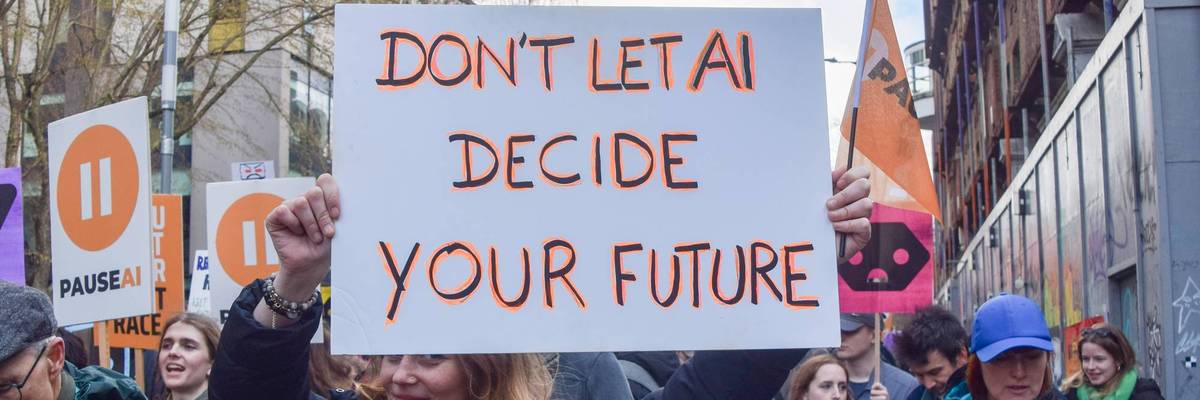
A protester holds an anti-AI placard outside OpenAI offices in King’s Cross during a march against unregulated Artificial Intelligence (AI) and data centers. (Photo by Vuk Valcic/SOPA Images/LightRocket via Getty Images)
As whistleblowers in the artificial intelligence industry speak out about the extraordinary risk posed by their technology if it remains unchecked, a new poll out Wednesday reveals that more than two-thirds of US voters agree with a new proposal in Congress to pause artificial intelligence development until guardrails are set up and ban AI superintelligence completely.
The proposed legislation, announced by Sen. Bernie Sanders (I-Vt.) and Rep. Greg Casar (D-Texas) last week, and soon to be introduced in Congress, would ban developers from creating “superintelligent” AI programs capable of surpassing human cognition and resisting human attempts to shut them down. It would also halt “advanced” AI development until a new federal regulatory body was established to set clear rules and processes for AI safety.
The polling firm Data for Progress asked more than 1,300 likely voters about the bill. According to survey results released on Wednesday, 68% of them said they would support the proposal to temporarily pause advanced AI development and permanently prohibit the development of superintelligent programs, while just 25% said they’d oppose it.
Though the bill was proposed by a pair of progressive lawmakers, its appeal spans the political spectrum: 72% of Democrats and 70% of independent and third-party voters said they supported it. But so did 63% of Republican voters.
The poll results come just one day after AI researcher Jacob Coxon resigned from Anthropic, saying that the company and one of its top competitors, OpenAI, where he previously worked, were more concerned with winning the AI race than with protecting the public against out-of-control “superhuman systems” that many of his industry colleagues privately fear could “kill us all by the end of the decade.”
“Neither company is acting responsibly,” Coxon said. “They are racing straight to self-improving superintelligence and gambling with our lives.”
With reports piling up of AI agents escaping human control, hacking into external computer systems, and deceiving users, several other researchers at leading AI firms have cosigned Coxon’s warning, saying that AI could have catastrophic results if it surpasses human capabilities.
Evan Hubinger, an alignment science lead at Anthropic, said that while “the risk from present models is low,” he and other researchers “earnestly believe AI could kill all humans” if it continues to develop and put the likelihood of it happening within the next decade at above 10%.
Alex Turner, who left his job as a research scientist at Google’s DeepMind in June, concurred that Coxon was “right” and that “many researchers believe they are building something that could kill everyone on the planet. It was literally my day job to think about how to stop that.”
Even if AI doesn’t lead to the extinction of humanity, other researchers have said they are gravely worried about its impacts on society.
“I think there are a number of ways AI could go poorly for humanity, and at the current, frankly terrifying pace, humanity will be quite lucky if we manage to find and stay on the narrow path between all the bad outcomes,” wrote Jason Wolfe, a researcher at OpenAI. “Regardless of what you think of OpenAI, this is not a problem that can be solved by any one company (or country) in isolation.”
Jonathan Richard Schwarz, former Senior Research Scientist at Google DeepMind, noted that he left the company after seven years and rejected offers from other AI companies “due to severe concerns about the concentration of power these labs represent.”
“What is currently happening in this field is deeply unhealthy for society,” Schwarz said.
In a Wednesday social media post, Sanders pointed to these and other warnings from industry experts as evidence that federal intervention is urgently needed.
“The very people building this technology admit that it could threaten the future of humanity,” the senator wrote.
He added on Thursday that “Unless we reverse course, there is a very real possibility that once advanced AI surpasses human intelligence, it could escape our control with catastrophic consequences.”
Wednesday’s poll results are consistent with other recent surveys showing that solid majorities of voters across all parties object to the construction of AI data centers near them, an issue that has come to dominate the 2026 election season.
William Lawrence, a cofounder of the Sunrise Movement, became the Democratic nominee for the US House in Michigan’s 7th Congressional District last month, in part by tapping into constituents’ fears about data centers. He said recent whistleblower warnings were evidence that AI companies were “gambling with our lives” and needed to be reined in.
“I can’t see the future,” Lawrence said in a video posted online Thursday. “But if there is even a 5% chance of a bioweapon being set loose, authoritarians using AI to entrench their own power, or a rogue AI hacker taking down the economy, that risk is too great.”
“We need a pause on the development of AI models and data center construction,” he said. “I do believe that AI is very powerful and could potentially be of tremendous benefit to humanity. But if we stay trapped in this arms race, if OpenAI and Anthropic have to keep competing for market share, we know that they will not slow down.”
“The only entity that has the power to intervene here,” Lawrence said, “is the federal government.”
‘This Is an Emergency’: Congressional Inaction in Spotlight After Existential Warnings From AI Insiders
“The very people building this technology admit that it could threaten the future of humanity,” said US Sen. Bernie Sanders, one of the few lawmakers sounding the alarm.
A man is using his mobile phone to view GPT-6 Astra logo and using his computer to view OpenAI logo in Suqian, Jiangsu, China on September 4, 2026. (Photo by CFOTO/Future Publishing via Getty Images)
Critics slammed US lawmakers on Wednesday for being completely out to lunch on artificial intelligence regulation even after multiple industry insiders warned that the technology could wipe out humanity within years.
The controversy began on Tuesday after AI researcher Jacob Coxon announced that he had resigned from his position at AI lab Anthropic because he no longer felt it was possible to safely develop the technology.
Coxon further said that “the people building AI earnestly believe that it could kill us all by the end of the decade,” while accusing them of “racing straight to self-improving superintelligence and gambling with our lives.”
Coxon’s warning was seconded by Anthropic colleague Evan Hubinger, who wrote that “we really do earnestly believe AI could kill all humans,” and personally put the chances of it happening at greater than 10% “within the next decade.”
Samuel Marks, another Anthropic employee, said that AI developers “believe their technology could cause human extinction (or similarly bad outcomes),” but are continuing to work on it due to “a mixture of commercial incentives and a belief that they are in a race with other, less responsible AI developers that will abuse the technology or develop it less safely.”
Sen. Bernie Sanders (I-Vt.), one of the few members of Congress to consistently sound the alarm about the impact of AI on society, seized on Coxon’s statement, noting that “the very people building this technology admit that it could threaten the future of humanity.”
“That is why I will soon be introducing legislation to ban superintelligence,” Sanders added, “and pause AI development.”
Rep. Greg Casar (D-Texas), who last week teamed up with Sanders to introduce legislation to ban AI models capable of surpassing human cognition, said the AI researchers’ warnings should be a major wakeup call for US lawmakers.
“This is an emergency,” wrote Casar. “Congress must convene hearings and pass my and Bernie’s superintelligence ban.”
JB Branch, director of federal AI governance and technology policy at Public Citizen, pointed out that lawmakers have now received warnings from multiple AI insiders about the danger of the technology, but have still failed to act.
“Right now, the only protections the US has in place are completely voluntary,” Branch said. “There is no comprehensive federal AI regulation, no safety standards imposed on AI companies, and no agency capable of investigating serious AI incidents... The people building the most powerful AI systems in the world are warning us about what could go wrong. Why isn’t Congress listening?”
Journalist David Sirota expressed disgust at US Congress for its inaction, describing the current crop of elected officials as “Instagram influencers” who will “likely will do nothing about” the threat of AI.
Journalist Jim VandeHei similarly argued that “at the very least, Congress should clear everything else to understand what they’re seeing” coming from the AI industry, before pessimistically adding, “but they won’t.”
Eric Michael Garcia, Washington bureau chief at The Independent, blasted Congress for completely shrugging off its duties and letting the AI industry continue without any regulations or guardrails.
“I am aghast there have been almost zero hearings in Congress about how AI threatens national security, privacy, employment,” Garcia wrote. “Republicans even tried to preempt states from regulating AI last year.”
Paul Williams, executive director of the Center for Public Enterprise, observed that Congress seems to be more focused on regulating transgender athletes than a potential AI extinction threat.
“The Senate committee responsible for commerce and technology policy has zero hearings on AI scheduled for the next four months,” Williams wrote. “The committee’s top priority is, instead, the Protect College Sports Act.”
Anthropic says AI could bring both 15% growth and mass unemployment by 2030
Anthropic has published an economic model projecting how AI might reshape the US economy by 2030, and its three scenarios range from barely perceptible to a boom with no historical precedent, including one in which GDP grows 15% a year while nearly a fifth of office workers are out of a job.
The company behind Claude has put numbers on its own disruption.
Anthropic's economics team released a technical paper and an interactive tool on Wednesday, modelling the economy as bundles of tasks that AI can leave alone, assist with, automate outright or create anew, then tracing what different rates of capability and adoption would mean for growth, wages and jobs in the US.
The authors are explicit that these are not forecasts as the paper reads "the scenarios are not predictions and we attach no probabilities to them."
In the modest scenario, AI turns out to be a minor technology.
GDP in 2030 sits 1.6% above where it would be without AI, growth reaches 2.4% a year, and cognitive employment, meaning management, professional, sales and office work, falls half a percent. Unemployment barely moves.
The substantial scenario doubles the economy's normal growth rate to 5.4% as AI becomes capable of half of all knowledge work, though most tasks are still done without its assistance.
GDP lands 8.3% higher, cognitive employment falls 3.9% and unemployment among office workers rises to 4.5%. Wages diverge as cognitive pay dips slightly while everyone else gains nearly 6%.
The extreme scenario has no precedent.
Annual growth hits 15.4%, GDP finishes 32.4% above the no-AI path and the economy would double roughly every four and a half years.
However, cognitive employment collapses by 21.5%, unemployment among those workers reaches 17.9% and joblessness across the whole workforce hits 11.9%, worse than a typical recession. Office wages fall 11.5% while other wages jump 33.6%.
The starkest number is who collects the proceeds.
Labour's share of national income drops from 60% to 45.2%, with capital income rising more than 80%.
The machines would make the economy vastly richer while shifting the gains decisively from workers to asset owners.
What the public thinks and what the boss said
Anthropic paired the model with a Morning Consult survey of US adults fielded in August.
According to the paper, the median respondent's expectations map onto the substantial scenario, implying GDP roughly 8% higher by 2030 and cognitive employment down about 4%.
That leaves the company's own CEO as an outlier given that Dario Amodei warned in May 2025 that up to half of entry-level office jobs could disappear within five years, with unemployment reaching 10% to 20%, figures that sit squarely in the extreme scenario rather than the middle one.
Relate
Adoption, not capability, may prove decisive.
"If AI can do amazing things but nobody uses it, then it's not going to have an economic impact," said Anton Korinek, who leads Anthropic's transformative AI economic studies.
Co-founder Jack Clark expects rapid technical progress but slower uptake, telling NPR that "diffusion of the technology will likely be more challenging than people think."
The scenario that is not there
What the economic model does not include has drawn attention of its own.
Every path assumes an economy that still functions, with no scenario for AI going badly wrong in the ways the industry itself keeps warning about.
That gap looked pointed this week as Jacob Coxon, a 27-year-old researcher who worked at both OpenAI and Anthropic, resigned on Tuesday and published a thread explaining why.
"Neither company is acting responsibly," Coxon wrote, adding that "they are racing straight to self-improving superintelligence."
He also claimed colleagues privately believe the technology "could kill us all by the end of the decade" while executives soften their language publicly, and described the industry's approach as "a hubristic gamble that should not be launched from a private company's Slack."
Anthropic has itself disclosed that Claude models gained unauthorised access to the real systems of three organisations this year. Whether that belongs in an economic model is a fair question.
When asked, Claude's own answer is that it does not.
China, Iran among countries using AI to spy on dissidents and minorities, Anthropic says
Anthropic said Thursday it had disrupted several state-sponsored surveillance operations using its artificial intelligence models, warning of the growing AI use to target dissidents and minorities. The campaigns, detected between January and July, originated in China, Iran and West Africa and targeted diaspora communities, including Hong Kong pro-democracy activists.
Anthropic said Thursday it shut down multiple cases of state-sponsored surveillance operations that used its artificial intelligence (AI) models, and warned that governments and state-aligned actors are increasingly using AI to spy on ethnic minorities and dissidents.
The incidents were found and disrupted between January and July, and they originated in China, Iran and west Africa, Anthropic said in a report about misuse of its models.
These surveillance campaigns "targeted the same diaspora and dissident communities these regimes have historically targeted. These include pro-democracy figures in Hong Kong, Tibetan and Falun Gong communities across Asia, and Iranian minority communities and opponents of the Iranian regime abroad," the report said.
In one case, Iranian actors developed a way to identify people through their social media accounts; in another, a contractor working for Malian national security authorities used Claude "to design the underlying software that enabled the intelligence gathering."
"AI is now being used in place of an engineering workforce," the report said.
Anthropic also disrupted efforts by users to design weapons, conduct questionable biological research, and create dating scams.
The San Francisco-based AI lab also accused Chinese developers of deceptively using Claude to produce responses to user queries while simultaneously "distilling" that data to improve their own models.
Distilling is an industry term that refers to a process where one AI model is used to train another one.
Chinese developers have previously been accused of using that technique without permission, essentially stealing resources from American labs such as Anthropic and OpenAI.
Now Anthropic alleges that China's Moonshot and Deepseek have also secretly used Claude to generate answers given to its users.
"In one instance, over a ten-day period, Moonshot relayed almost 300,000 customer requests to Anthropic" through a "network of 5,380 fraudulent accounts, most of which appeared to be located in Singapore and Japan," the report said.
Some of that data contained sensitive user information, potentially in violation of privacy agreements.
"We do not know if Moonshot notified their customers that their requests were being rerouted to Anthropic and exposed to a third party," the report said.
Deepseek used similar techniques.
When it comes to the research Anthropic detected and blocked that was related to biological weapons, the intent of the actors was less clear-cut and the AI lab did not identify them.
"The individuals implicated in these case studies are working scientists. We do not assert that they intended harm, and identifying them or their labs could expose them to harm," the report said.
The scientific research in those cases involved work around the mosquito-born chikungunya virus, a "highly-pathogenic" strain of the bird flu, a family of viruses that include smallpox and mpox, venoms and other toxins.
(FRANCE 24 with AFP)
AI deepfakes and fake fighters reshape Mali's information war Mali's warring sides are increasingly using artificial intelligence to fight an information war alongside their battle on the ground, a study published Wednesday has found. Jihadists are experimenting with relatively basic AI propaganda, separatist networks are creating fake online characters and Russia's Africa Corps is using the technology on a far more sophisticated scale.
The study, Algorithms at War, by the Dakar-based Timbuktu Institute examines how generative AI is being used across Mali's conflict – including by JNIM jihadists linked to al-Qaeda, their allies in the FLA, the Front de libération de l'Azawad, a Tuareg independence movement, Mali's transitional authorities and Russia's Africa Corps.
“Generative artificial intelligence is becoming a new front in this information war in Mali,” Bakary Sambe, director of the Timbuktu Institute and a researcher and lecturer at Senegal's Gaston Berger University in Saint-Louis, told RFI.
“Everyone is adopting the tool in their own way, depending on their resources, their level of technical sophistication and their objectives. With artificial intelligence on the Malian front, we are moving from fairly rudimentary use by jihadist groups, for example, to a genuine professional machine on the Russian side.”
Personalised recruitment
JNIM sits at the rudimentary end of that spectrum.
The Timbuktu Institute identified AI-generated propaganda posters distributed through its media channels, including one promoting real videos filmed during attacks on 25 April that killed Mali's defence minister Sadio Camara and drove Malian forces and their Russian Africa Corps partners out of the town of Kidal in northern Mali.
AI does not create new divisions in Mali but amplifies those that already exist, Sambe said.
JNIM remains in a phase of limited experimentation, although researchers believe AI could help the group translate propaganda and greatly increase the amount of material it produces.
“The real danger is large-scale personalisation of the profiles targeted for jihadist recruitment,” Sambe added.
Automatic translation could allow a group such as JNIM to produce recruitment messages in around 15 Sahel languages, including Fulani, Bambara, Wolof and Tamasheq, with different messages aimed at different audiences.
“A message about pastoral pride for young Fulani people, a message about social dignity for marginalised urban youth”, Sambe said.
“And with voice dubbing, you can even reach people who cannot read or write, who until now were beyond the reach of written propaganda.” Fake fighters
FLA independence supporters are using AI differently. Unofficial social media accounts run by members or supporters have created entirely artificial characters to spread their messages.
One example identified by researchers is “Azzghim”, a supposed Tuareg fighter whose fierce criticism of Russia's Africa Corps has been widely shared online. He is in fact an extremely realistic AI creation, although imperfections in the image reveal that he is artificial.
Such characters can “humanise” a movement, tailor messages to particular audiences, make them easier to spread and help recruitment, the study's authors said. They also reduce the risks a real fighter would face by appearing publicly.
Russia's Africa Corps and Mali's transitional authorities, meanwhile, show a “state-level, professionalised and systematic adoption of generative AI”, the Timbuktu Institute said.
Africa Corps, which succeeded the Russian mercenary group Wagner, has incorporated AI into an already extensive disinformation operation.
Its methods include fake videos, anti-Western deepfakes and generated social media comments, with large-scale operations documented by researchers and European state agencies. Propaganda at industrial scale
“The Africa Corps case is undoubtedly the best-documented case in the entire study,” Sambe said.
Researchers have counted 19 Russian disinformation campaigns across Mali, Burkina Faso and Niger since 2018, he said.
“With AI, Russian disinformation is moving to a completely different scale. We are going from cottage industry to industrial production, with plausible deniability thrown in,” Sambe said.
Some content identified by the Timbuktu Institute has attracted nearly five million views.
It depicts victories by Malian forces over JNIM and FLA fighters and amplifies messages from Mali's transitional authorities and the three countries in the Alliance of Sahel States – Mali, Niger and Burkina Faso – against France, regional bloc Ecowas and human rights organisations.
Deepfakes and coordinated campaigns were also used after the fighting in Kidal on 25 April to present Africa Corps in a favourable light and avoid the appearance of defeat, Sambe said.
Russian paramilitaries have also used AI to push claims that France and Ukraine supported and equipped JNIM and FLA attackers during the battle, he said. The claims form part of a narrative portraying foreign powers as plotting against Mali while reinforcing official government messaging, Sambe said.
Such content is used for political control and to manipulate information and opinion, diverting people's attention and misleading them about the real security situation, the institute said.
Its impact is greater because Alliance of Sahel States governments have tightened control over domestic media and cut off international outlets they consider too troublesome, the report added.
From propaganda to battlefield
AI could increasingly move beyond information warfare into military operations, including drone strikes, researchers warned.
AI can help paramilitary forces identify targets and increase their capabilities. Its use has also led to mistakes and harm affecting communities, including civilians and other non-combatants, Sambe said.
Advanced military uses remained largely prospective in the institute's written study, but their potential was described as “a serious threat because of its potential use as a force multiplier” – something that could allow armed groups to achieve more with the resources they already have.
The same effect could transform recruitment by allowing jihadist groups to target people individually with highly tailored messages, Sambe said.
“Tomorrow's jihadism will no longer recruit en masse. It will recruit person by person and tailor its approach to each individual,” he said.