Wednesday, July 14, 2021

Man who found 2 megalodon teeth says it's like finding 'fragment of history'
By Mark Puleo, Accuweather.com


The historic megalodon tooth was found after Tropical Storm Elsa passed. Photo by Jacob Danner/Facebook


July 14 -- At a length of 70 feet, armed with razor-sharp 7-inch teeth and with the strongest bite force of any known animal to ever roam or swim the Earth, the megalodon was no joke.

With hurricane-force winds that topped out at 75 mph, armed with lethal wind gusts and one of the fastest forward-moving speeds of any tropical system to ever roam the Atlantic, Hurricane Elsa was no joke either.


But beyond their Hollywood names, what could bring these two fantastical beasts together?

Well, days after Elsa's deadly rampage through the Southeast as a tropical storm, the former hurricane left a parting gift for one beach walker -- a 4-inch-long fossilized megalodon tooth.

"It's something so ancient," Jacob Danner said in a phone call with AccuWeather. "You pick up something that's millions of years old from a creature on the planet, and it takes you back to that childlike fascination of dinosaurs and all the mysteries that are only hinted at when we read about them."

Danner told AccuWeather that he was out on a walk on Fernandino Beach in greater Jacksonville, Fla., when he made the remarkable discovery after Elsa had churned the waters. In the storm's wake, hidden deposits from eras long ago washed ashore the beaches.

Danner is an avid collector and historian, but refers to himself more as a hobbyist than an expert. In his most fruitful venture, he said he once found 33 different shark teeth in a two-hour period. However, prior to this summer, he had never come across a megalodon tooth since moving to the coastal area last January.

But even more incredible than his post-Elsa megalodon find? It was his second such discovery in less than a month.

Just three weeks earlier, Danner had found his first-ever megalodon tooth, a long-awaited uncovering that he said almost made him feel guilty.

"The first one that I found, I think it was like June 17 or 18, I just froze and looked around like I was walking on the sidewalk and came across a $100 bill," he said. "There's part of it that's a surprise and another part of it that feels guilty, not sure how to feel. I looked and was just holding it, turning it in my hands."

But after that first find, he said weeks of poor weather kept him from going on his sunrise walks and searching out more treasures. Dreary overcast conditions, both before and after Elsa, kept him inside until the storm passed.

As soon as he got back out there, however, lightning struck twice.

"This was only the second time in weeks that I had gone out and both times, watching the sunrise on a beach walk, I found the megalodon teeth," he said with a laugh. "It feels like you get a little fragment of the mysteries of the history of our planet."


Danner's incredible post-Elsa megalodon discovery wasn't the first tooth he found from the prehistoric shark. Photo by Jacob Danner/Facebook


In his discoveries, Danner has grown to appreciate the lending hand Mother Nature provides in unearthing those mysteries. He said systems like thunderstorms and nor'easters help churn the waters, bringing new discoveries to shore.

It's like the wind and wave action does a lot of the digging for you, he said.

"Weather certainly informs a lot of the hunting," he said. "So when I watch the tides, I watch the app to check because, for me, the best time to go is always two hours after peak high tide when the tide starts going back out, it's like churning the shore in reverse. So I like to walk a strip back and forth, back and forth, following that and just seeing what the waves turn over."


The history of his fossils dates back millions and millions of years. The long-extinct shark species domineered the world's oceans from the early Miocene Epoch, over 23.03 million years ago, to the end of the Pliocene Epoch, about 2.5 million years ago, according to Brittanica.

The name megalodon itself means "giant tooth," an apt name for one of the largest fish this world has ever seen. Armed with hundreds of serrated teeth and a bite force between 108,514 and 182,201 newtons (humans average a bite force of 1,317 newtons), megalodons are believed to have casually snacked on any and all sea creatures, including whales and other sharks.

Their teeth have survived the last couple million years thanks to a fossilization process known as permineralization. Danner said that he had read that when an all-black tooth is found, it likely indicates a fossil that's at least 11 million years old.

He joked that they look delicately shined as if a jeweler polished them.

"It's showroom ready as is! These things are just incredible, I'm astounded that they could survive all those millions of years," he said.
TO LITTLE TO LATE 
US to begin evacuating Afghans who aided American military

By AAMER MADHANI and DARLENE SUPERVILLE
31 minutes ago

In this Friday, April 30, 2021, file photo former Afghan interpreters hold banners during a protest against the U.S. government and NATO in Kabul, Afghanistan. With American troops withdrawing from Afghanistan, pressure has been mounting for the Biden administration to plan a military evacuation of Afghans who supported U.S. military operations during two decades of war in their country. (AP Photo/Mariam Zuhaib,File)


WASHINGTON (AP) — The Biden administration said Wednesday that it is prepared to begin evacuation flights for Afghan interpreters and translators who aided the U.S. military effort in the nearly 20-year war.

The Operation Allies Refuge flights out of Afghanistan during the last week of July will be available first for special immigrant visa applicants already in the process of applying for U.S. residency, according to the White House.

White House press secretary Jen Psaki declined to detail how many Afghans are expected to be among those evacuated in the first flights or where those evacuated will be taken, citing security concerns.

“The reason that we are taking these steps is because these are courageous individuals,” Psaki said. “We want to make sure we recognize and value the role they’ve played over the last several years.”

President Joe Biden has faced pressure from lawmakers on both sides of the aisle to come up with a plan to help evacuate Afghan military helpers ahead of next month’s U.S. military withdrawal. The White House began briefing lawmakers on the outlines of their plans last month.

The evacuation planning could potentially affect tens of thousands of Afghans. Several thousand Afghans who worked for the U.S. — plus their family members — are already in the application pipeline for special immigrant visas.

RELATED COVERAGE
– Taliban press advances, take key border post with Pakistan
– Taliban surge in north Afghanistan sends thousands fleeing
– Afghan vet: 'What have we ended up with at the end of it?'

The Biden administration has also been working on identifying a third country or U.S. territory that could host Afghans while their visa applications are processed.

Krish O’Mara Vignarajah, president and CEO of Lutheran Immigration and Refugee Service, said that much about the Biden evacuation plan remains unknown, including how the administration will help those in areas outside the capital of Kabul evacuate. The Taliban has made rapid gains in taking over huge swaths of the country, particularly in more rural areas.

“Unfortunately, there are still far too many questions left unanswered, including who exactly and how many people are eligible for evacuation. ... How will those outside the capital access safety?” said Vignarajah, whose group has helped resettle thousands of Afghans in the U.S. “And to what countries will they be evacuated? We have serious concerns about the protection of our allies’ human rights in countries that have been rumored as potential partners in this effort.”

The administration is weighing using State Department-chartered commercial aircraft, not military aircraft, according to an administration official, who spoke on condition of anonymity to discuss internal deliberations. But if the State Department requests military aircraft, the U.S. military would be ready to assist, the official said.

Tracey Jacobson, a three-time chief of mission in Tajikistan, Turkmenistan and Kosovo, is leading the State Department coordination unit that will deliver on the president’s commitment under Operation Allies Refuge. That unit also includes representatives from the defense and homeland security departments.

Russ Travers, deputy homeland security adviser and former head of the National Counterterrorism Center, is coordinating the interagency policy process on Operation Allies Refuge, officials said.

Separately, the White House announced that Elizabeth Sherwood-Randall, the White House homeland security adviser, would lead a U.S. delegation to a security conference in Uzbekistan this week to discuss Afghanistan’s security issues with leaders from the Central 5 — Austria, the Czech Republic, Hungary, Slovakia and Slovenia — and other regional players.

Afghan President Ashraf Ghani and Zalmay Khalilzad, U.S. special envoy on Afghanistan reconciliation, are also expected to take part in the conference.

U.S. officials have said that one possibility under discussion is to relocate the Afghan visa applicants to neighboring countries in Central Asia, where they could be protected from possible retaliation by the Taliban or other groups.

The White House and State Department have declined to comment on the exact numbers to be relocated or where they might go. The U.S. Embassy in Kabul issued 299 special immigrant visas in March, 356 in April and 619 in May, according to the State Department. Biden said last week that the federal government has approved 2,500 special immigrant visas to come to the U.S. since his January inauguration.

Biden announced last week that the U.S. military operation in Afghanistan will end on Aug. 31.

The firming of the date to end the war comes after former President Donald Trump’s administration negotiated a deal with the Taliban to end the U.S. military mission by May 1, 2021. Biden, after taking office, announced that U.S. troops would be out by the 20th anniversary of the Sept. 11, 2001, attacks. The attacks were plotted by al-Qaida leader Osama bin Laden from Afghanistan, where he had been given refuge by the Taliban.

Former President George W. Bush, who launched the war, criticized the Western withdrawal from Afghanistan in an interview with a German broadcaster released Wednesday, saying he fears for Afghan women and girls as the Taliban regains control of much of the country.

“It’s unbelievable how that society changed from the brutality of the Taliban, and all of a sudden — sadly — I’m afraid Afghan women and girls are going to suffer unspeakable harm,” Bush said.

___

Associated Press writers Roberts Burns and Matthew Lee in Washington contributed to this report.
BURN! 
MY FAVORITE ANTI IMPERIALIST FILM
WITH A GREAT SOUNDTRACK BY ENNIO MORRICONE


QUEIMADA, originally QUEMADA(aka BURN), changed its Spanish name to the Portuguese one, because general Franco was threatening UNITED ARTISTS with a new ban of all their films in Spain, like it happened with COLUMBIA after Fred Zinnemann's BEHOLD A PALE HORSE.

The producer Alberto Grimaldi and the director Gillo Pontecorvo changed the nationality of the conquerors, remaining Marlon Brando as the British Sir William Walker.

Initially Grimaldi contacted Paul Newman and Sidney Potier for the roles, but both actors considered the script as "anti-American".

Unlike Newman, Brando was an admirer of the author of LA BATTAGLIA DI ALGERI (BATTLE OF ALGIERS)
and he proposed Cassius Clay for the role of Jose Dolores. Finally Brando's antagonist was Evaristo Marquez and the shooting started in Cartagena de Indias (Colombia), being finished in Morocco after different mishaps and controversies.

But then United Artists considered the movie politically not adequated for US audiences and they made a new editing, cutting several scenes and changing the dialogues.

This mutitlated US cut was the english version. These images are from the uncut italian restored version. Ennio Morricone composed one of his most impressive soundtracks, still maintain its position in the main artery of majestic movie themes. Many of the tracks are literally, a magic carpet ride.


"..The film portrays, quite brilliantly, the nature of a guerrilla uprising. Walker seems all too aware of the danger of a popular uprising, when he cautions the white rulers that "the guerrilla has nothing to lose." And that in killing a hero of the people, the hero "becomes a martyr, and the martyr becomes a myth." " Amazon Review

�An amazing film. . . No one, with the possible exception of Eisenstein, has ever before attempted a political interpretation of history on this epic scale.� � Pauline Kael

'Queimada': Revolution In Perpetual Motion as long as there are empires, there will be wars - "Pontecorvo was an expert on the subject of revolution, possibly even the poet laureate of violent change. An Italian communist, he wore his biases plainly on his sleeve and didn't let them prevent him from reaching greatness, as he did in 1965 in "The Battle of Algiers," a movie so pungent in its realities that the Pentagon showed it to Special Forces people just last year... the movie Queimada is most powerful as argument: It believes in the permanence of revolution, and it closes on a shot of the surly, bitter, seething people of Queimada, and in their anger it sees a forever of violence. This is the way it will go, he seems to be saying, and it doesn't seem that he got that one wrong, unless peace broke out in the past five minutes. It's brilliantly constructed to argue what might be called the classic imperial paradox: To win this war you must make inevitable the next. The corollary is that as long as there are empires, there will be wars. "
Queimada (1969)
Queimada - Trivia The film's original title was Quemada (the Spanish word for "burnt", as the action took place in a Spanish colony. When the Spanish government officially complained and threatened a boycott of the film (objecting to the script's supposedly anti-Spanish bias, Gillo Pontecorvo agreed to alter the setting to a Portuguese island and the release title became Queimada ("burnt" in Portuguese).

Sir William Walker, a real historical figure portrayed in the film by Marlon Brando, was neither British nor knighted. Walker was an American adventurer and his title of "sir" was one he adopted on his own.

'Evaristo Marquez' , who plays rebel leader Jose Dolores in the film, was not an actor. He was a poor villager whom director Pontecorvo discovered while scouting locations and convinced to star opposite Brando. The studio had originally wanted Sydney Poitier.

Marlon Brando once said this film contains "the best acting I've ever done"

Queimada - Amy Taubin
" Burn! was a courageous film for Pontecorvo to make. There are few films as passionate or as uncompromising about the real workings and nature of imperialism as a world order, nor a film which identifies so feelingly with the victims of neo-colonial rule. Not since Eisenstein has a film so explicitly and with such artistry sounded a paen to the glory and moral necessity of revolution. Even had United Artists not attempted to sabotage Burn!, it would be a film deserving wider viewing and critical attention. " Joan Mellen

SEE THE FULL REVIEW
Quemada - Gillo Pontecorvo's Burn! (tamilnation.org)

Opioid Agonist Therapy reduces mortality risk among people with opioid dependence

UNIVERSITY OF BRISTOL

Research News

A new global review has found that receiving Opioid Agonist Therapy (OAT) is associated with lower risk of multiple causes of death among people with opioid dependence.

The review found that people with opioid dependence were less likely to experience overdose-related, suicide, alcohol-related, cancer, and cardiovascular-related mortality while receiving OAT.

Researchers from the National Drug and Alcohol Research Centre (NDARC) at UNSW Sydney, University of Bristol and several other global institutions reviewed the relationship between OAT and mortality across type of drug, setting and participant groups from over 700,000 participants, which is six times the number of any other previous review.

The review found that mortality risk was lower for those receiving either buprenorphine or methadone treatment, the two most common forms of OAT for people with opioid dependence.

Lead author, Thomas Santo Jr, PhD candidate at NDARC, said, "People with opioid dependence who receive OAT are not only at lower risk of overdose than those who do not, but also at lower risk of suicide and several other common causes of death."

"This review provides further justification for expanding access to OAT to help lower the risk of mortality among people with opioid dependence," said Mr Santo.

"Importantly, the benefits of OAT were consistent across region, age, sex, and comorbidity status. The few studies that examined the impact of OAT after release from prison, found that time in OAT lowered risk of mortality."

The review confirmed that there was a greater risk of death in the first month after OAT is stopped. For patients on methadone, there was a greater risk of mortality at the beginning of treatment which was not seen for patients on buprenorphine.

"The first four weeks that follow treatment cessation are associated with particularly high rates of suicide and overdose-related mortality," said Mr. Santo.

"These findings emphasise the importance of retention in treatment for those with opioid dependence who start treatment on OAT. There is also a need for more detailed investigation and intervention development to minimise mortality risk during induction onto OAT."

The review shows that randomised controlled trials (RCTs) of OAT are underpowered (do not have a large enough sample size) to examine mortality risk.

"We looked at trial evidence but so few studies were powered to examine mortality, which is why we need to rely on cohort studies of people in treatment around the world," said Mr Santo.

Professor Matt Hickman, at the NIHR Health Protection Research Unit in Behavioural Science and Evaluation at University of Bristol, said, "The research evidence is clear - OAT reduces mortality risk - but the population benefits of OAT may not be realised if treatment periods in the community are too short and prisoners with opioid use disorders are not released on OAT after leaving prison. Countries - like the UK - with ongoing public health crises in drug related deaths - need to review both access to OAT and the way it is delivered to ensure the greatest number of deaths are averted.

"A clinical decision support system, stratifying clients' risk of dropout in real time, may facilitate the identification of those in need of service enhancements to increase engagement and prevent dropout.

"Work to scale up access and retention could have important population-level benefits."

###

Paper: 'Association of Opioid Agonist Treatment with all-cause mortality and specific causes of death among people with opioid dependence: A systematic review and meta-analysis'. Thomas Santo Jr. et al. Published in JAMA. 2 June 20

Infographic: Wildfires and Climate Change

Visualizing the Connection in Five Sets of Photos and Charts


Every year, millions of acres of land are consumed by fire in the United States. By raising temperatures, melting snow sooner, and drying soils and forests, climate change is fueling the problem. Here’s what we know.


#1: Wildfires are getting worse
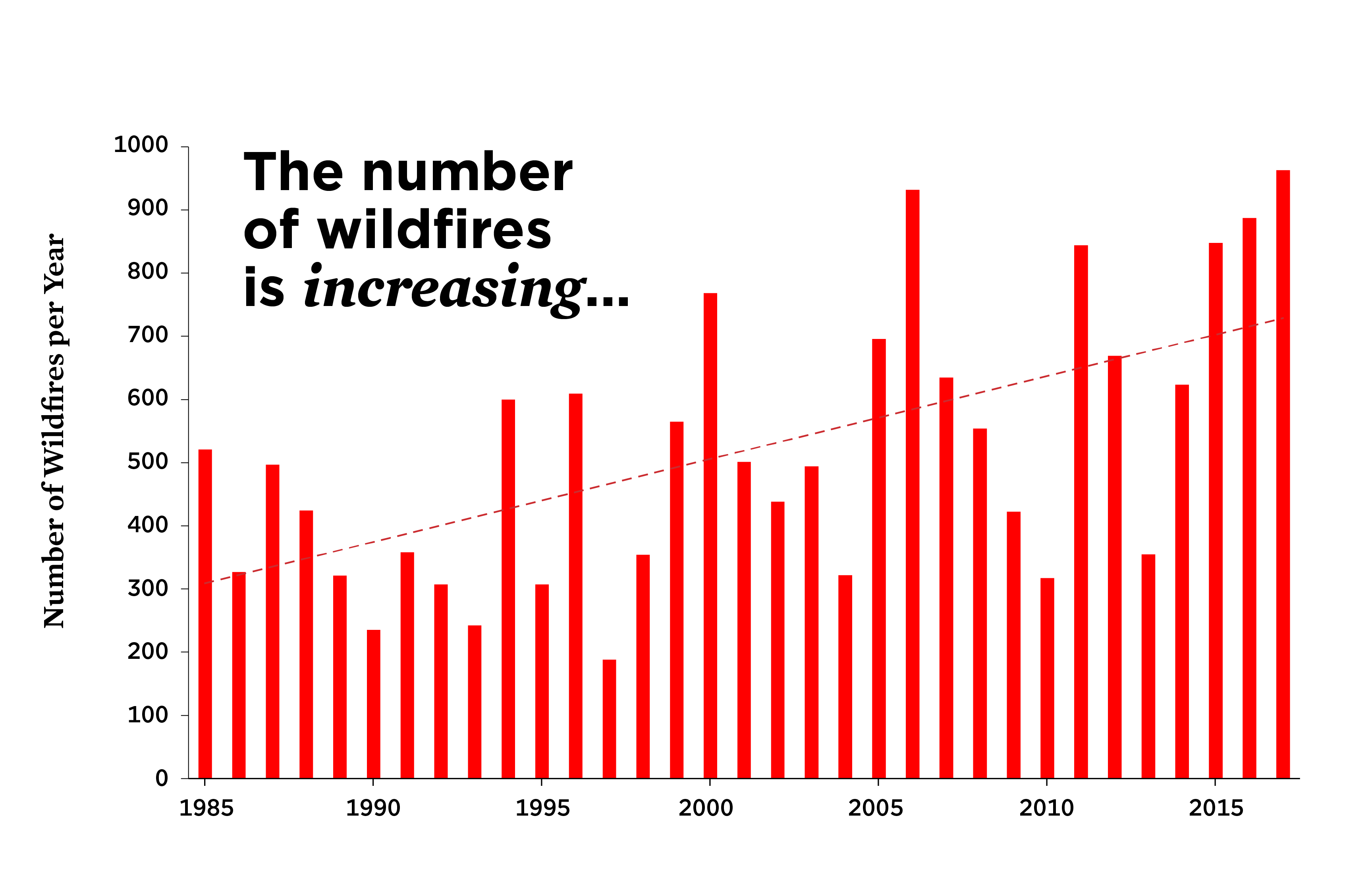
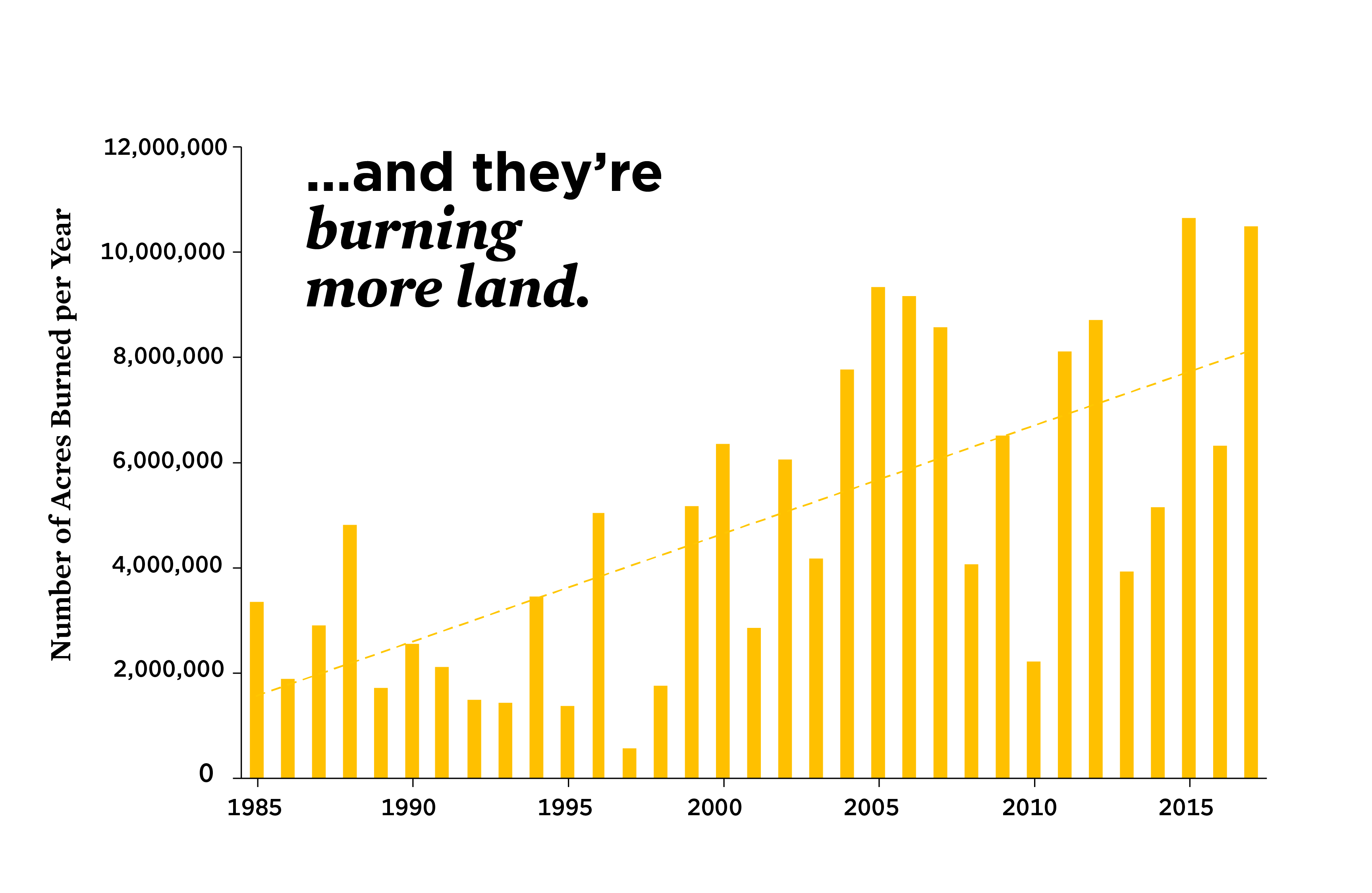
Data from the Monitoring Trends in Burn Severity program. MTBS only includes large fires in the United States (>500 acres for the eastern US, >1000 acres for the west). Prescribed fires removed.


Since 2015, the United States has experienced, on average, roughly 100 more large wildfires every year than the year before. This changes region by region, and year to year, but generally we’re seeing more wildfires, more acres burned, and longer, more intense fire seasons.


#2 Wildfires are causing more harm
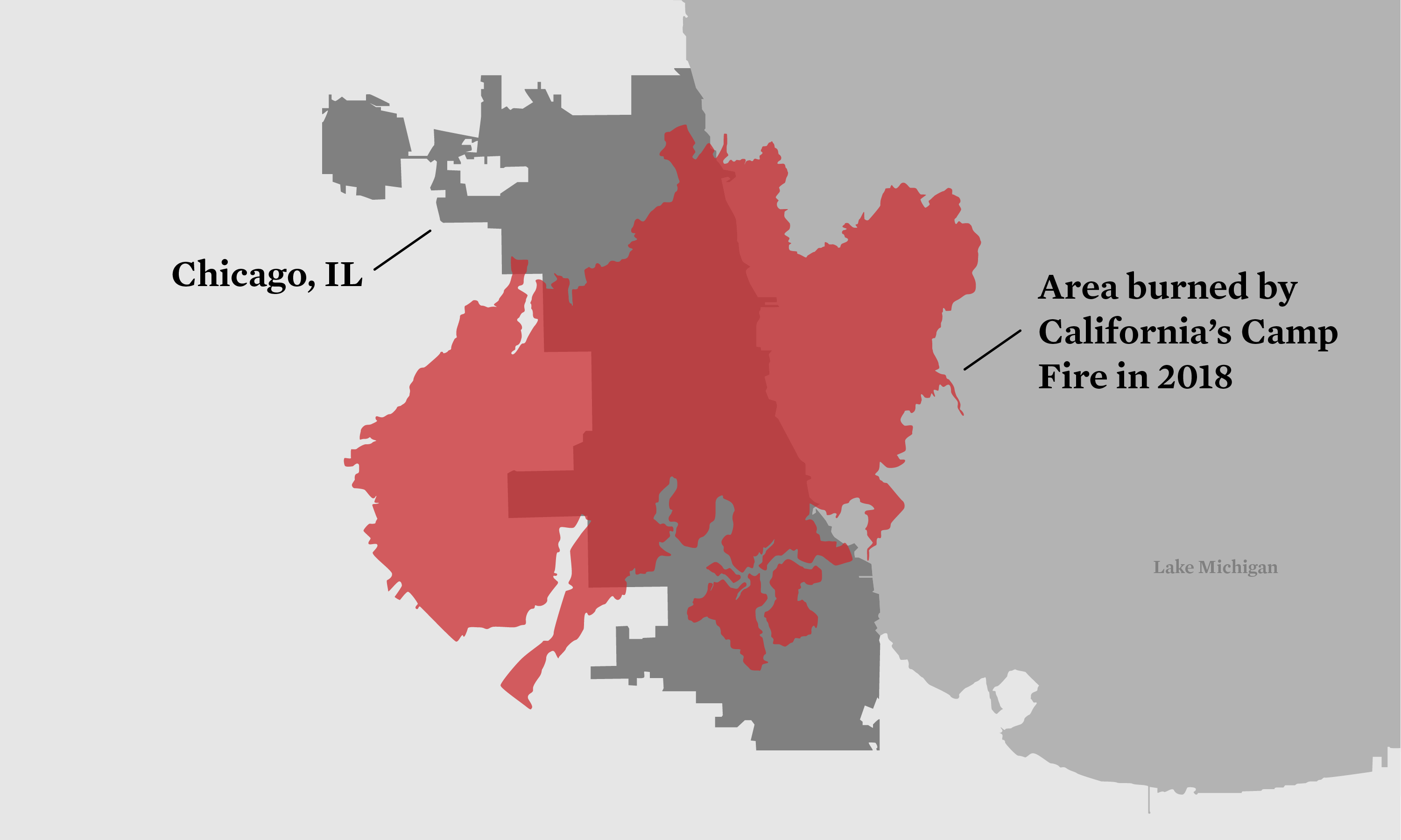
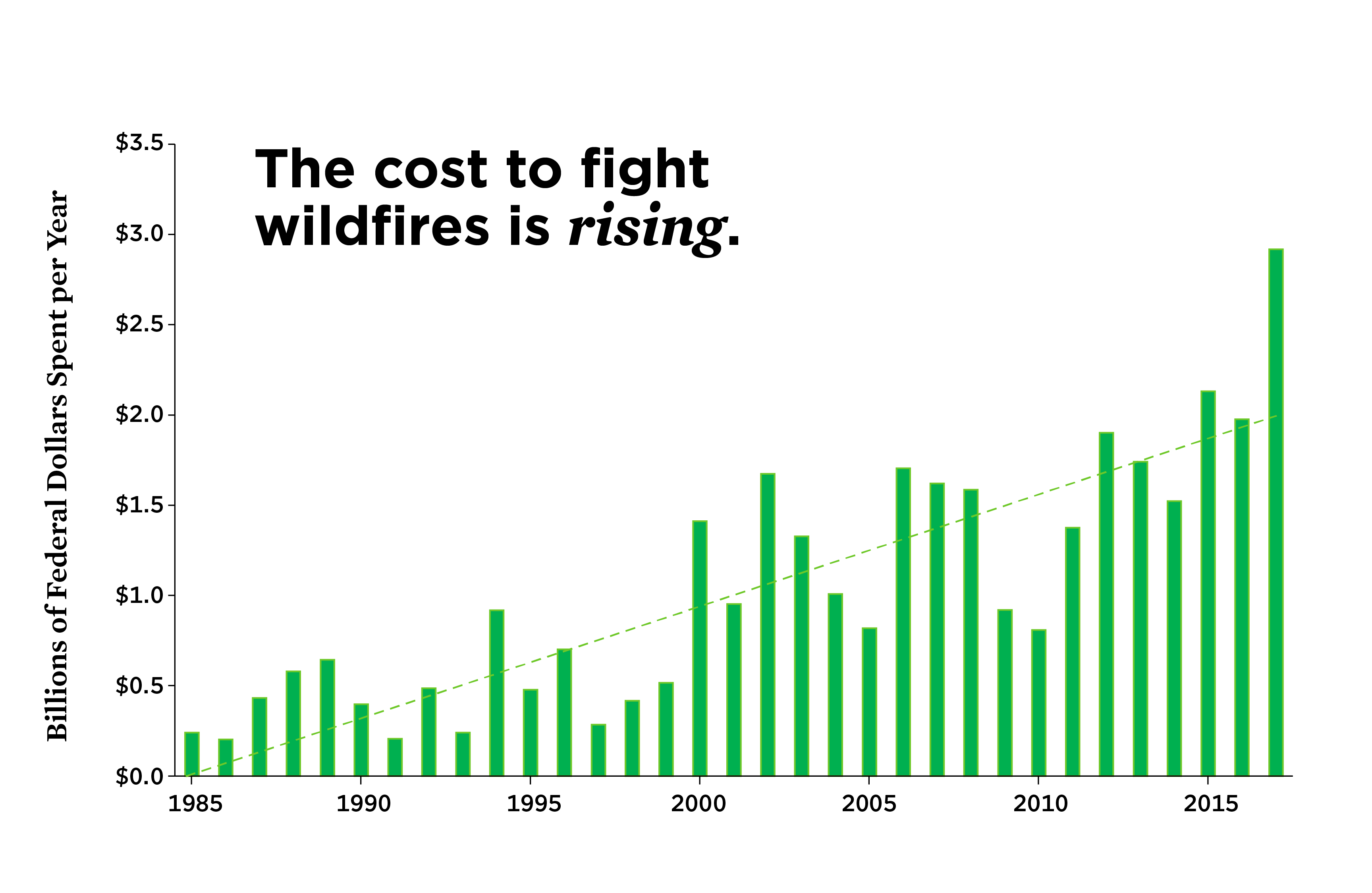
On left, the perimeter of the massive Camp Fire is overlayed on Chicago. Federal suppression costs from the National Interagency Fire Center.


Wildfires are dangerous and destructive. The historically large Camp Fire of 2018 caused at least ninety deaths, destroyed more than 18,000 structures, and covered an area roughly the same size as the Chicago metropolitan area.

They're also expensive. Between 2014 and 2018, the federal government spent an average of 2.4 billion dollars fighting wildfires every year. Even when adjusted for inflation, that’s more than twice what we spent 20 years earlier (1994-1998).

And as the forests burn, they release carbon dioxide and other global warming gases, worsening climate change. As wildfires burn more land, emissions go up.


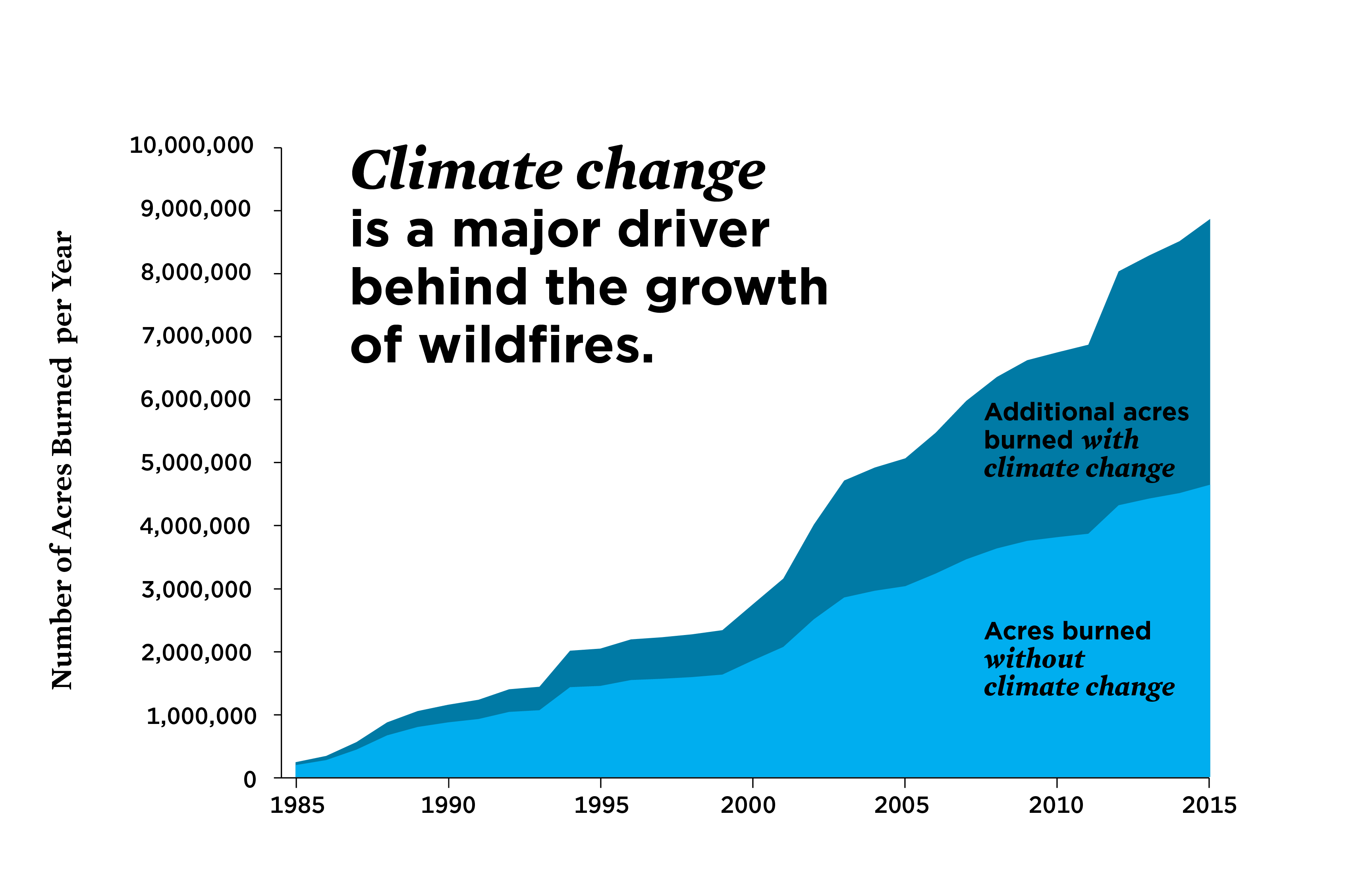
#3: Climate change is a key driver
Attribution data from John T. Abatzoglou and A. Park Williams, Impact of anthropogenic climate change on wildfire across western US forests.


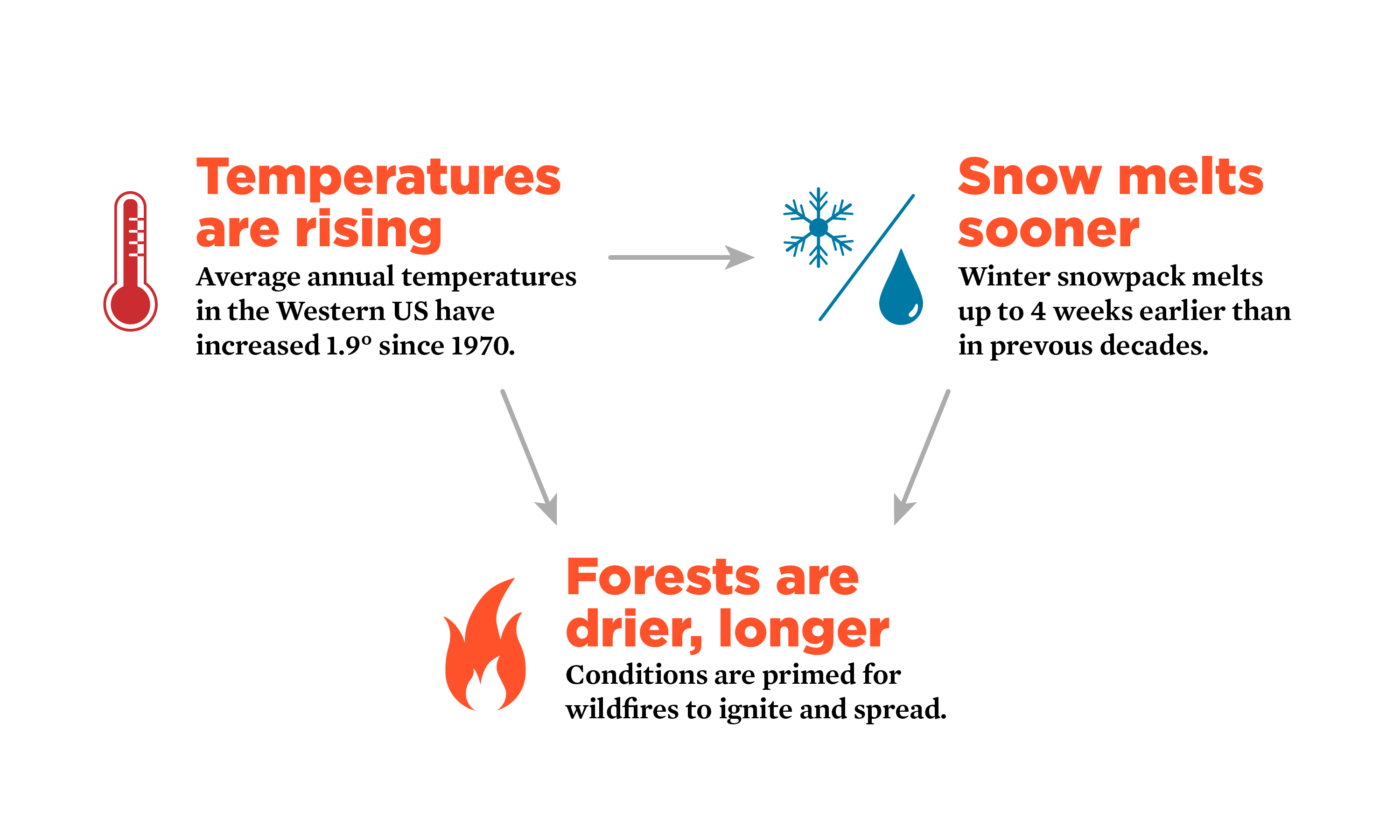
Fire has historically been a natural part of many wild landscapes. But global warming has changed some of the underlying variables that make wildfires more or less likely to occur every year.

Warmer temperatures increase the likelihood that fires will burn more intensely. They also cause snow to melt sooner, and lead to drier soils, forests, and plants, which act as kindling. Increased droughts, unusual rain patterns, and insect outbreaks that lead to large stands of dead trees are also connected with climate change—and they all make wildfires more likely.


#4 Management matters


Other factors also influence wildfire risk—especially management and development decisions in fire-prone areas near forests.

In the western United States, forests historically evolved with frequent, low-intensity fires that removed underbrush, debris, and fallen timber. This allowed for larger trees and made massive fires much less common.

But for the past century, almost all fires have been suppressed, even small ones. This has allowed forests to maintain denser growth and more potential fuel, leading to larger and more intense wildfires.

In addition, development near and into previously wild areas has increased fire risk and made fire-fighting more costly, challenging, and dangerous.

Government agencies have tried to lower forest density through prescribed burning (purposefully lit, low-intensity fires) and thinning (the physical removal of brush, vegetation and dead trees), but have struggled to do so at scale.

On smaller landscapes in the southeast, land managers conduct far more frequent prescribed burns. These fires bring their own risks, including poor air quality, and the chance of growing to be a damaging wildfire. But by mimicking smaller "natural" fires, prescribed burns can benefit forest ecology, and help mitigate at least some of the increased wildfire risk presented by climate change.


#5 Action is possible

In the near term, ecologically-sound forest and fire management could help limit fire risks.

But in the long-term, climate action is the best tool we have. When we reduce global warming emissions, we slow the growth of climate risks, including wildfire. Until then, summers will continue getting hotter, forests will get drier, and more and more people will face the threat of wildfire.


Photo credits: Burning car and home, and burnt neighborhood by Josh Edelson/Getty. Smoke plume by David McNew/Getty. Firefighter carrying drip torch courtesy of the National Park Service. Protesters by Leonhard Foeger/Reuters.


Electrify America to double EV charging network in U.S., Canada


Electrify America announced plans Tuesday to more than double electric charging stations in the United States by 2025. Photo courtesy of Electrify America

July 13 (UPI) -- Electrify America said Tuesday it plans to more than double its U.S. and Canada electrical vehicle charging network by the end of 2025.

The "Boost Plan" expands the number of ultra-fast electric vehicle chargers to more than 10,000 and the number of fast charging stations to 1,800 in the United States and Canada, according to the company's statement.

Electrify America, a subsidiary of Volkswagen Group of America, previously planned to expand individual chargers to 3,500 and charging stations to 800 in the United States by the end of 2021. The new commitment will increase that number to 9,500 individual chargers and 1,700 charging stations by the end of 2025.

Under the expansion, Electrify America will also increase its presence in established U.S. regions and add the states of Hawaii, North Dakota, South Dakota, West Virginia, Wyoming and Vermont, bringing its network to 49 U.S. states and the District of Columbia.

RELATED New device harvests power from sweaty fingertips

Along with its existing U.S. network, Electrify America will also expand its Electrify Canada charging network from current commitment of 32 stations to more than 100 stations and 500 chargers over the next 4 1/2 years.

"We have decided to double our current charging infrastructure in North America over the next four years to help meet the need for the rapid growth expected of electric vehicles by virtually all the auto manufacturers, and to help make EV adoption more accessible and attractive than ever," Electrify America President and CEO Giovanni Palazzo said in the statement. "We are making this commitment to support the plans by major automakers and the U.S. and Canadian governments to help the transformation to an electric mobility transportation system."

Electrify America previously committed to invest $2 billion over 10 years in electric vehicle infrastructure and education in the United States. The funding is part of a $10 billion settlement with the U.S. government over the diesel emission scandal of 2016.

RELATED Hyundai launches high-end Genesis electric vehicle

The Volkswagen subsidiary added in its statement Tuesday that its integrating battery storage solutions to reduce the impact on the power grid and allow deployment of charging stations in areas where it was not previously feasible.

Electrify America noted that it has installed four stations per week on average since its first charging station opened in May 2018.
Fission vs. fusion: What's the difference?

Fission involves splitting atoms; fusion is about combining them.


By Adam Mann - Live Science Contributor 4 days ago
Computer generated artistic impression of fission. (Image credit: Getty Images)

Fission and fusion are both natural atomic processes that release incredible amounts of energy, but in many ways, they are opposites. Fission involves the splitting of a single, generally heavy, atomic nucleus, whereas fusion requires the combining of two or more light atoms.

Atoms include protons and neutrons bound together in a central nucleus. Radioactive elements, like uranium, may contain dozens of these particles in their atomic hearts.

Fission occurs when heavy elements such as uranium spontaneously decay, which causes their nuclei to split. Each of the resulting halves has slightly less mass than the original atomic core, and the missing mass is converted to energy.

Physicists Lise Meitner and Otto Frisch discovered the principles underlying fission after receiving a private letter from nuclear chemist Otto Hahn in December 1938. Hahn's experiments showed that uranium atoms that were bombarded with neutrons would split, and Meitner and Frisch used the new science of quantum mechanics to explain why this happened.

All three scientists soon realized the terrible implications of their discovery, which was happening under the shadow of World War II. A single instance of fission might release a relatively small amount of power, but many fission reactions happening at the same time had the potential to be quite destructive if used to develop something like an atomic bomb.

NUCLEAR FISSION FOR ENERGY AND WEAPONS


When a uranium atom naturally goes through fission, it releases a neutron that will careen around. If this neutron hits other nearby uranium atoms, they will also split, creating a cascading chain reaction. In 1951, engineers built the first power plant harnessing the process of nuclear fission to produce energy, according to the U.S. Department of Energy.

In a nuclear power plant, this process is carefully controlled. Fission releases heat, which boils water and generates steam that spins a turbine.

But in an atomic bomb, the cascading chain reaction spirals out of control, with fission happening at an ever-increasing rate. This releases a tremendous amount of power in a short span, generating the devastating blast of the bomb.


WHY FUSION DOESN'T PRODUCE ENERGY, YET

The International Thermonuclear Experimental Reactor's plasma core is halfway done. This is the tokamak complex, which will house plasma that is 10 times hotter than the sun, once it is complete. (Image credit: ITER)


Fusion, by contrast, has yet to be fully developed as a human power source. In nuclear fusion, two nuclei of a light element, such as hydrogen, must overcome their natural electromagnetic repulsion and merge into a single, heavier nucleus.

The resulting entity is slightly less massive than the original two nuclei, and just like with fission, this missing mass is converted into energy. But generating enough power to smash atoms together until they stick is not easy and generally requires the extreme environment of a star's belly to happen.

Engineers have long dreamed of making sustained fusion reactions here on Earth. Fusion power would produce less nuclear waste than fission and uses relatively common light elements, such as hydrogen — rather than rarer uranium — as a fuel supply, according to the International Atomic Energy Agency.

But creating and sustaining fusion is difficult. An international experiment to test the feasibility of using sustained nuclear fusion to produce energy has built a magnet that's as tall as a four-story building and 280,000 times more powerful than Earth's magnetic field, as part of the International Thermonuclear Experimental Reactor (ITER).

But ITER, a scientific partnership among 35 countries, has suffered numerous delays during its construction and isn't expected to generate more power than it consumes until at least the 2030s.
 
ADDITIONAL RESOURCES

Check out this helpful table that lists the difference between fission and fusion, from Chemistry LibreTexts.
 
Watch this video from the U.S. Department of Energy summarizing how fission and fusion work.
 
Learn more about the ITER experiment on the project's website.


JUMP TO:


Adam Mann is a journalist specializing in astronomy and physics stories. He has a bachelor's degree in astrophysics from UC Berkeley. His work has appeared in the New Yorker, New York Times, National Geographic, Wall Street Journal, Wired, Nature, Science, and many other places. He lives in Oakland, California, where he enjoys riding his bike. Follow him on Twitter @adamspacemann.
Ocasio-Cortez Urges Biden Not to Send US Troops to Haiti

The New York Democrat said the Biden administration should support efforts to bring to justice "any actors that may have been complicit on U.S. soil."


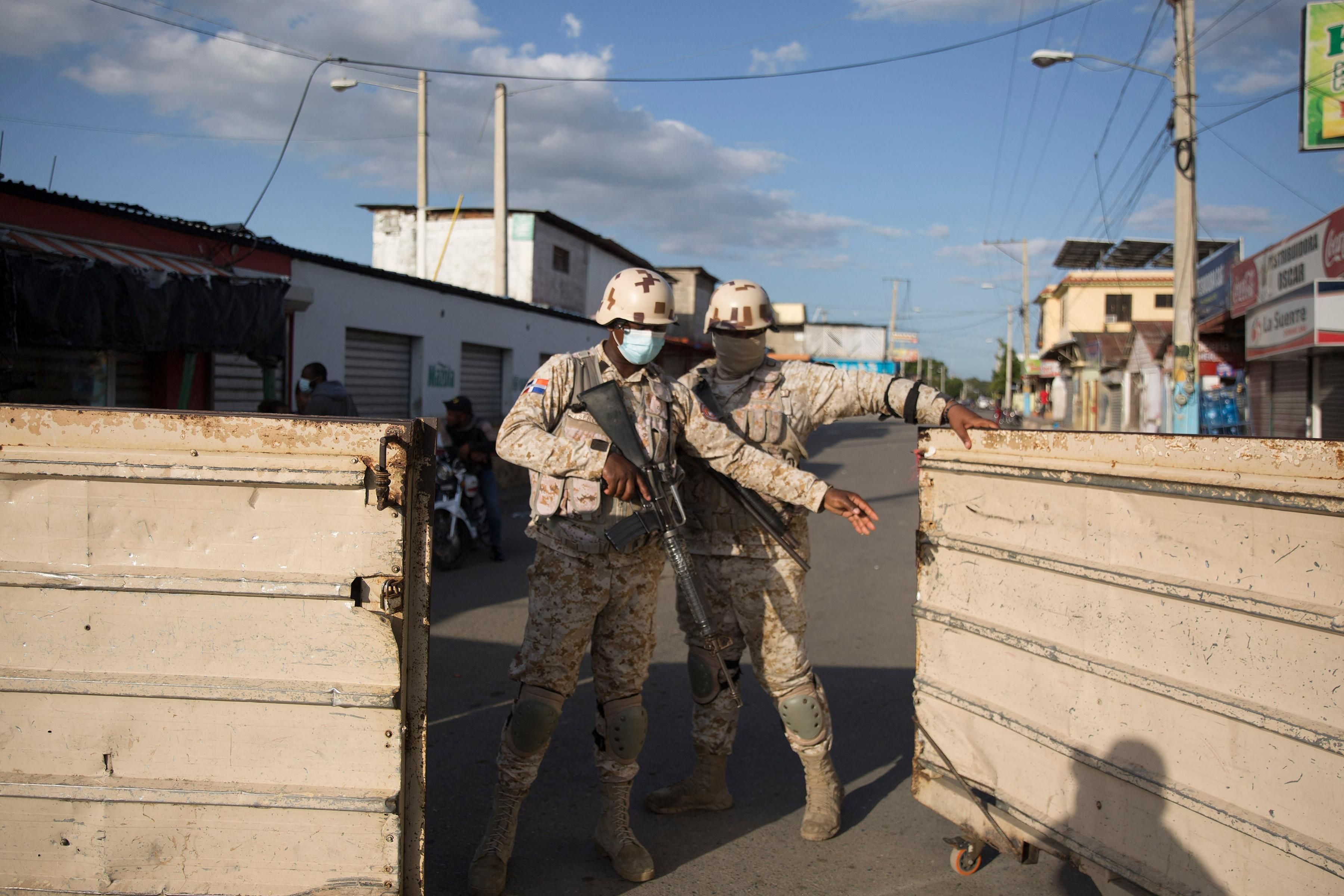
Soldiers guard the Dajabon border crossing between the Dominican Republic and Haiti after the borders were closed due to the assassination of the Haitian president on July 7, 2021. (Photo: Erika Santelices/AFP via Getty Images)


JAKE JOHNSON
July 12, 2021

U.S. Congresswoman Alexandria Ocasio-Cortez said Monday morning that the Biden administration should resist calls to deploy American troops to Haiti in the wake of the assassination of the Caribbean nation's president last week, warning that such a move would risk deepening the country's political crisis.

"I do not believe right now that the introduction of U.S. troops, particularly without any sort of plan, sets any community —whether it's the U.S. or whether it's Haitians—up for success," the New York Democrat said in an appearance on Democracy Now! "Our role should be in supporting a peaceful transition and a peaceful democratic process for selecting a new leader and avoiding any sort of violence."

Ocasio-Cortez went on to say that the Biden administration should support efforts to bring to justice "any actors that may have been complicit [in the assassination] on U.S. soil."

Watch:


The New York congresswoman's remarks came hours after Haitian authorities announced the arrest of a Haitian-born, Florida-based doctor who allegedly helped mastermind the killing of President Jovenel Moïse in his home last week.

Christian Emmanuel Sanon—a 63-year-old man who has been living in Florida periodically for two decades and has more than a dozen businesses registered in the state—is the third Haitian-American who has been arrested in connection with the assassination. In total, more than two dozen people have been detained for taking part in the killing, including 11 former members of the U.S.-backed Colombian military.

According to Haitian authorities, Sanon worked with a Miami-based private security firm to hire the mercenaries who gunned down Moïse in the dead of night. Video footage from the scene shows armed assailants posing as officials from the U.S. Drug Enforcement Agency as they moved in on Moïse's private residence in the early hours of Wednesday morning.

Following the assassination, Acting Prime Minister Claude Joseph asked the Biden administration to send U.S. troops to Haiti with the ostensible goal of protecting the country's key infrastructure, prompting outcry from Haitians and observers familiar with the bloody history of U.S. intervention in the Caribbean nation.

While the Biden administration has yet to grant the troop request, the U.S. did send officials from the FBI and Department of Homeland Security to Haiti over the weekend to—in the words of Pentagon spokesperson John Kirby—"see what we can do to help them in the investigative process."

"I think that's really where our energies are best applied right now in helping them get their arms around investigating this incident and figuring out who's culpable, who's responsible, and how best to hold them accountable going forward," Kirby said in a Fox News appearance on Sunday. "That's where our focus is right now."

Kirby added that Joseph's call for U.S. troops is "going through a review."
Progressives Call on Biden to Lift U.S. Embargo on Cuba as Thousands Protest Critical Shortages

"The truth is that if one wanted to help Cuba, the first thing that should be done is to suspend the blockade of Cuba as the majority of countries in the world are asking," said Mexican President Andres Manuel Lopez Obrador.


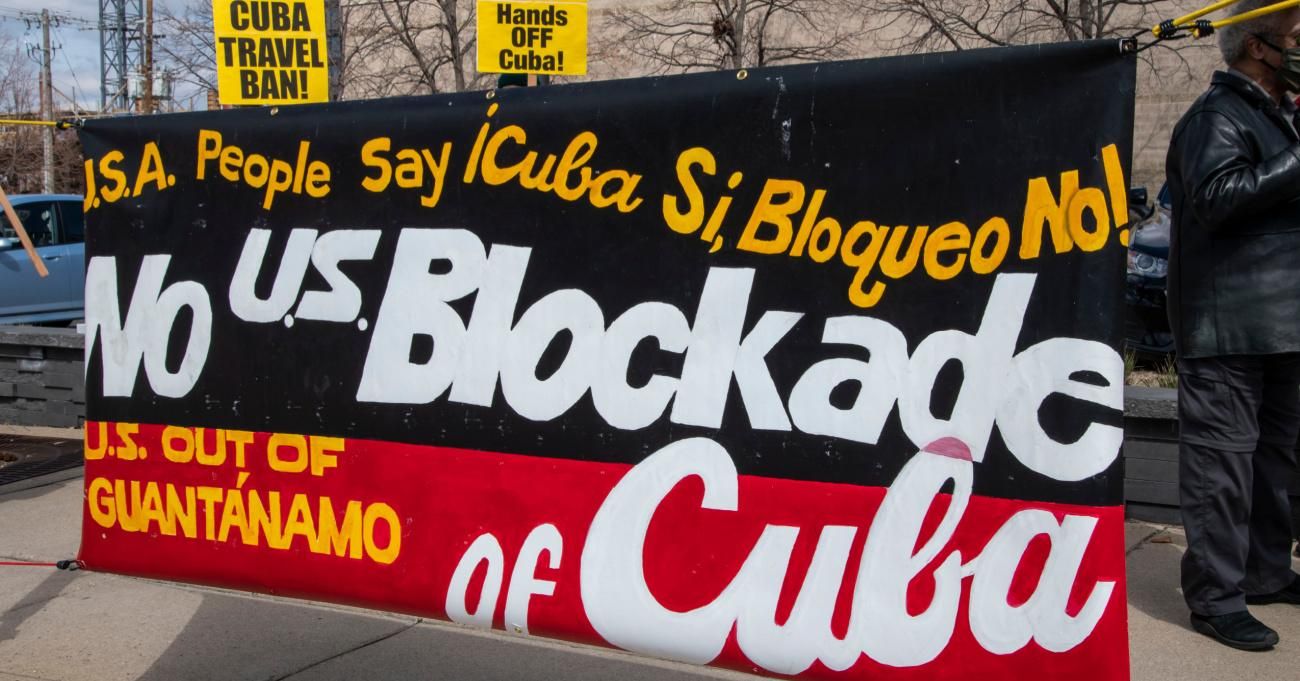
In Minneapolis, Minnesota in March 2021, protesters demand that the Biden administration take immediate action to reverse the economic sanctions imposed by former President Donald Trump on Cuba. (Photo by: Michael Siluk/Education Images/Universal Images Group via Getty Images)


JULIA CONLEY
July 12, 2021

Progressives in the U.S. and around the world on Monday demanded the Biden administration lift the U.S. trade embargo on Cuba and hundreds of sanctions on the country after thousands of Cubans protested the country's economic crisis, which has been worsened by the Covid-19 pandemic.

The protests in Havana and several smaller cities and towns made headlines Sunday, with major international outlets reporting on Cubans taking to the streets to express outrage over food and medicine shortages.


"Biden’s Cuba policies, just like Trump’s, are causing misery and could lead to chaos, violence, mass migration. This must stop!" —Medea Benjamin, CODEPINK

Demonstrators chanted, "Enough!" and "Freedom!" while one person told the Associated Press, "We are fed up with the queues, the shortages."

As The Economist reported earlier this month, food exports from the U.S. to Cuba, which imports about 70% of its food and relies heavily goods exported from the U.S., recently reached their lowest level since 2002.

Last month, The Intercept reported that the decades-long U.S. trade embargo against Cuba as well as sanctions imposed by the Trump administration and kept in place by President Joe Biden has kept Cuba from accessing "critical foreign-made medical supplies to treat its own population" during the pandemic, even as Cuba sent more than 2,000 medical professionals to help fight the global crisis in other countries.

According to The Intercept, large shipments of ventilators, masks, and syringes have been unable to reach Cuba since the pandemic began due to companies' financial ties to the United States.

Days before leaving office, former President Donald Trump designated Cuba as one of four state sponsors of international terrorism, along with North Korea, Iran, and Syria. The Biden administration has not lifted the designation, which "restricts Cuba's access to international financing as its economy emerges from a massive recession, having slid 11 percent in 2020," The Intercept reported.

While much of the international reporting on Cuba's protests over the weekend focused on anti-government sentiment on the island, activists including Medea Benjamin of CODEPINK said the clear solution to Cubans' economic woes lies in U.S. government policy changes.

"Biden’s Cuba policies, just like Trump’s, are causing misery and could lead to chaos, violence, mass migration," said Benjamin. "This must stop!"


The Trump administration barred most travel from the U.S. to Cuba and banned people in the U.S. from sending remittances to their relatives in the island nation, cutting off a major source of income for many—a policy that has yet to be lifted by Biden.

Last month, the U.S. delegation to the United Nations General Assembly was joined only by Israel in voting against a resolution to condemn the six-decade trade embargo imposed by the U.S. on Cuba; 184 countries voted for the resolution, which has passed every year for nearly three decades.

"Biden hasn't shown himself to be any different from Trump," Cuban journalist Laura Prado told CBS News after the U.N. vote. "What's needed is action and deeds."

Biden's State Department released a statement Sunday expressing support for the Cubans who were protesting, framing the issue as promoting the "right to peaceful assembly to express concern about rising Covid cases/deaths and medicine shortages."

"The U.S. has had no problem starving Cuba with a decades-long embargo that the entire world (minus Israel) condemns," said Assal Rad, a senior research fellow at NIAC Action. "If we care about Cubans, lift the embargo."

Others, including Miami's Democratic Socialists of America chapter and Progressive International, echoed the calls made by Rad and Benjamin, with Rep. Jim McGovern (D-Mass.) tweeting about the issue on Monday.


"The truth is that if one wanted to help Cuba, the first thing that should be done is to suspend the blockade of Cuba as the majority of countries in the world are asking," Mexico's leftist president, Andres Manuel Lopez Obrador, said Monday. "That would be a truly humanitarian gesture. No country in the world should be fenced in, blockaded."

David Adler, general coordinator for Progressive International, noted that the corporate U.S. media reported on Sunday's protests as though the embargo has little connection to Cubans' suffering. The blockade has barred U.S. trade with Cuba since 1962 and has cost the island an estimated $130 billion according to Cuban officials and the United Nations.


"So do reporters just not know that there's been a decades-long U.S.-led embargo targeting Cuba," asked Evan Greer, director of digital rights group Fight for the Future, "or they just don't think it's relevant to reporting on protests about food and medicine shortages?"
Our work is licensed under Creative Commons (CC BY-NC-ND 3.0). Feel free to republish and share widely.

Bernie Sanders Adds Voice to Supporters of Cook County Strike

One SEIU Local 73 strike leader said the 18-day action "is about basic dignity and respect for workers who have worked tirelessly throughout the pandemic and before."


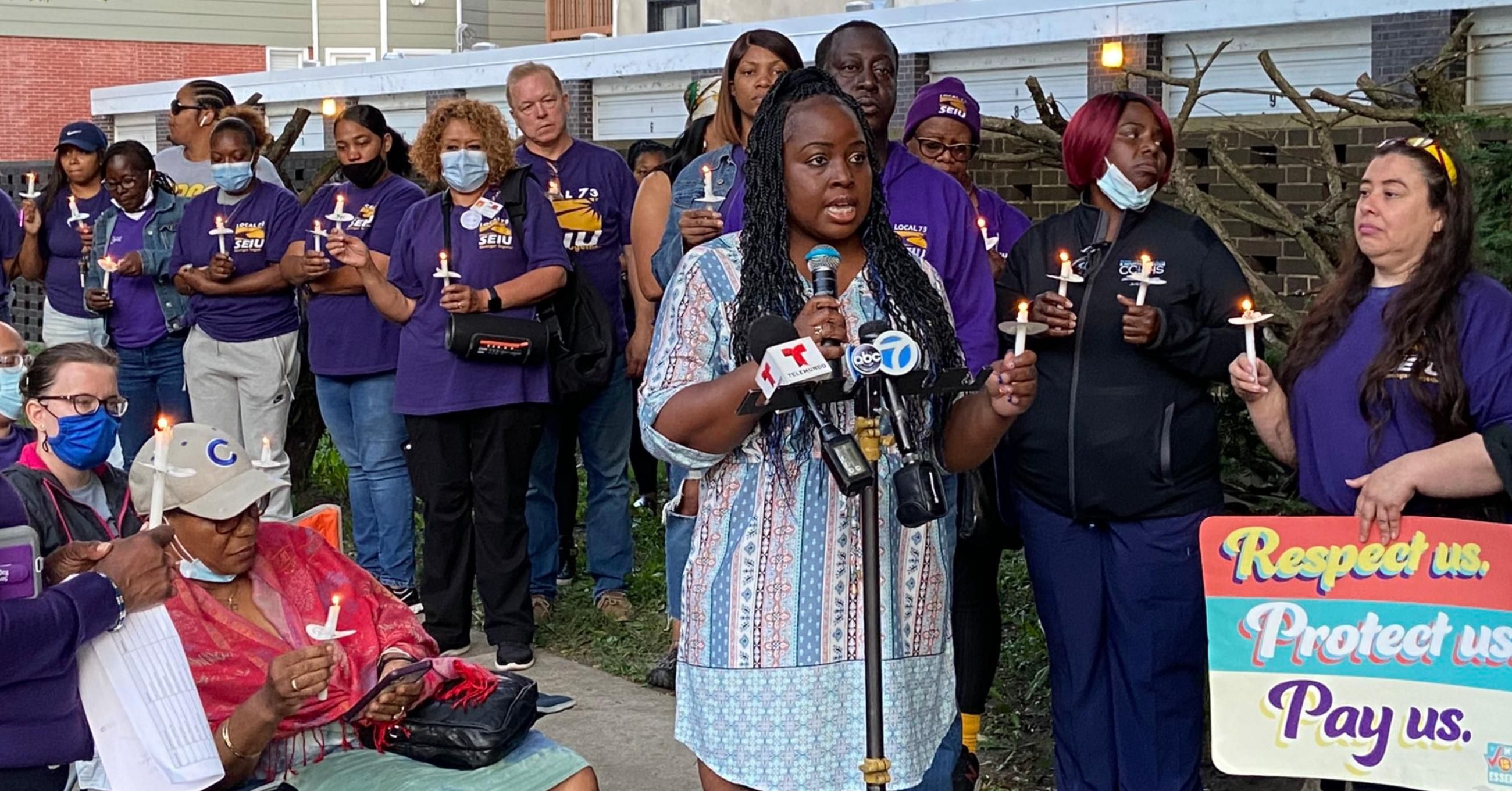
Striking SEIU Local 73 member Shadonna Davis speaks at a vigil for workers who died of Covid-19 in Chicago on July 9, 2021. (Photo: SEIU Local 73)


BRETT WILKINS
July 12, 2021


In a show of solidarity with thousands of Cook County, Illinois employees on strike over stalled contract negotiations, U.S. Sen. Bernie Sanders this weekend admonished county officials for failing to agree to a fair deal for workers who have risked and sacrificed so much—including their lives—during the ongoing coronavirus pandemic.

"I watched those close to me get sick and die. All we are asking for as Cook County workers is what we are due."
—Shadonna Davis,
SEIU Local 73

Over 2,000 members of the Service Employees International Union (SEIU) Local 73 employed by Cook County—which includes the city of Chicago and over 100 of its suburbs—are in their third week of striking over contract negotiations. Strikers continued picketing on Monday, their 18th day of action.

SEIU Local 73, which represents custodians, technicians, and administrative assistants, is demanding better pay and advancement opportunities. Members say that Cook County Board President Toni Preckwinkle—whose failed 2019 mayoral candidacy received seven-figure financial support from the union—does not recognize the sacrifices they've made during the ongoing Covid-19 pandemic.

In a tweet on Saturday, Sanders (I-Vt.) said it was "outrageous" that Cook County received $1 billion from the American Rescue Plan—the $1.9 trillion pandemic relief and economic stimulus package signed into law by President Joe Biden in March—"but still refuses to negotiate a fair deal for workers."


Sanders also supported the 2019 Chicago Teachers Union strike and traveled to the city to stand with the educators during their 11-day work stoppage.

SEIU Local 73 says that in addition to Sanders, U.S. Rep. Marie Newman (D-Ill.) and numerous state, county, and local officials have shown solidarity with the strikers. One of them, Chicago City Alderwoman Maria Hadden, told strikers during a Friday demonstration in Maywood that "you all are the lifeblood of making sure our county works."

"The work that you do is so essential," said Hadden, "and if we've learned anything over the pandemic, it's that we need you!"


Unions, progressive organizations, and faith groups are also among those who have expressed support for the strike. In a letter (pdf) to Preckwinkle, 27 faith leaders wrote:


As the spiritual leaders of Cook County, we are calling on you to settle the contract with the Cook County workers represented by SEIU Local 73. These essential workers have kept our county running during the pandemic. They have put their lives on the line to provide the vital services our people depend on.

Asking for the same raise that the county provided other unions... is only fair and just. These are our neighbors, our family, and our friends. We are asking you to look into your heart and do the right thing. Send your negotiating team back to the bargaining table and settle this contract with the workers.

NBC Chicago reports the county workers' strike, which is the longest in SEIU Local 73's history, began after nine months of failed negotiations over a new contract. The union rejected the county's offer of an 8.5% pay hike over the next four years, explaining that it was a smaller increase than offered to other unions.

SEIU Local 73 leaders decried what they said is a lack of incentives for long-term workers and raises for the county's poorest-paid workers, including custodians and housekeepers. They are also demanding raises to help pay for health insurance premium increases.


A county spokesperson told WBEZ that wage and healthcare offers to SEIU workers are "identical" to those in deals reached with four other unions last month. A statement from Preckwinkle's office said the county "is proud to have a history of strong relationships with the labor unions that represent our workforce."

"The work that you do is so essential, and if we've learned anything over the pandemic, it's that we need you!"
—Chicago Alderwoman
Maria Hadden

However, Ericka White, a union steward and negotiating team member for SEIU Local 73 who works in Cook County's procurement office, told Jacobin that the contract negotiations are "about basic dignity and respect for workers who have worked tirelessly throughout the pandemic and before."

"Cook County government never closed down during the pandemic," said White. "The people using the services of Cook County are the least of us—we couldn't shut down the hospitals, we couldn't shut down the jails, we couldn't shut down the corporate offices. We didn't have that luxury."

"We've always worked hard, and we should not be pushed aside like we're insignificant," she said. "We provide a service for Cook County government, and we're determined to not let that be forgotten. The main thing we're fighting for is our healthcare coverage. The county is proposing increasing our healthcare premiums over the life of our four-year contract by almost 80%."

White continued:


A great many of our coworkers, especially those in the clinics and jails, have contracted the virus. Some not once but twice. We have employees who have passed away due to Covid while doing their jobs. We are a county health system, so we don't turn anybody away. We had whole floors at the hospital that were Covid floors, and our members were the ones working them. For parts of it, they didn't even have PPE [personal protective equipment].

Sylvia Kizer, a 60-year-old county housekeeper of nearly 30 years, is one of the workers who has twice contracted the coronavirus.

"I caught it in December 2020 and then again in March 2021," Kizer told the Austin Weekly News, a community news site covering Chicago's West Side. "I know I caught Covid on the job. I have to ask for personal protection equipment and I work with biohazards. I've worked in areas where we're not informed that the patient has Covid."

"It's a lack of respect, a lack of dignity, a lack of necessity," said Kizer. "They don't see us as grown people and they don't see us as human beings."


Speaking at a Friday candlelit vigil for workers who have died of Covid-19, SEIU Local 73 member Shadonna Davis, who contracted the virus, said, "I watched those close to me get sick and die."

She added: "All we are asking for as Cook County workers is what we are due."
Our work is licensed under Creative Commons (CC BY-NC-ND 3.0). Feel free to republish and share widely.