Thursday, July 15, 2021


Democrats Agree On $3.5T Tag For Go-It-Alone Infrastructure Bill


By IBTimes Staff Reporter
07/13/21 AT 10:09 PM

US Senate Majority Leader Chuck Schumer says former president Donald Trump's false claim that the 2020 election was stolen is spreading like a 'cancer' among Republicans Photo: AFP / SAUL LOEB

KEY POINTS

The deal agrees on a top-line price tag of $3.5T for the infrastructure bill

It is not clear if all Dem senators support the deal

Deal would prohibit raising taxes on individuals earning less than $400k: Report


Senate Democrats have agreed on a top-line price tag of $3.5 trillion for a Democrat-only infrastructure package.

"The budget committee has come to an agreement. The budget resolution with instructions will be $3.5 trillion," Senate Majority Leader Charles Schumer, D-N.Y., said late Tuesday after a meeting with Budget Committee Democrats led by Sen. Bernie Sanders, I-Vt.

The deal greenlights the reconciliation process that will allow Democrats to advance the sweeping social welfare and family aid programs that President Biden has promised, sidestepping a GOP filibuster.


"Every major program that President Biden has asked us for is funded in a robust way," Schumer said. Biden wiill meet with Senate Democrats on Wednesday.

A formal text of the budget resolution is yet to be released, Politico reported. Democrats will need all their 50 votes to pass the budget resolution and the infrastructure bill. It was not immediately clear if the deal had the support of all Dem senators. Centrist Sen. Joe Manchin, D-W.Va., warned earlier Tuesday that he wants a bipartisan infrastructure bill and a Democrat-only bill to be fully paid for.

The Hill quoted an unnamed Democrat aide familiar with the deal as saying the budget resolution will include language that prohibits raising taxes on individuals who make less than $400,000 or small businesses. 
Stand-off With Poland, Hungary Threatens EU Legal Order


By Dave CLARK, Anne-Laure MONDESERT
07/15/21 AT 12:25 PM


The legal warfare between the European Commission and Poland and Hungary over LGBTQ rights, asylum rights and judicial reform raised concerns Thursday that the EU legal order is under threat.

Brussels has launched a series of challenges to its prickly eastern members over what EU officials see as their challenge to European values and the rule of law -- and won some early victories.

But Warsaw and Budapest have fought back just as hard, leaving some to wonder whether a battle is building over the very principle that EU law holds sway over the member states

"There could be a spillover effect, where we could see a whole series of EU countries questioning these principles in a more or less aggressive way," EU Justice Commissioner Didier Reynders said.

"If we allow this to develop, it is obviously a challenge to the union itself."

Reynders' warning came as Hungary's Prime Minister Viktor Orban reacted with fury to the announcement that Brussels had launched a legal challenge to his so-called "anti-paedophilia" law.

"If the European Union wants to interfere in matters and laws covered by the constitutions of other countries, that could shatter the entire EU," Orban's cabinet chief Gergely Gulyas said.

Separately, Poland's prime Minister Mateusz Morawiecki rejected a ruling by the European court of Justice that found that a central part of Poland's judicial reforms was a breach of EU law.

"I cannot allow Poland to be treated in a separate, less favourable way, to be discriminated against," he declared, alleging that the European Commission had exceeded its authority.

"Nowhere in the treaties have the powers to reform a legal system been transferred ... to the level of the European Union," he argued.

A "deeply concerned" European Commission, the Brussels-based guardian of the treaties, vowed to "make use of its powers" and ensure that Poland accept the primacy of European law.

Poland has also been targeted over LGBTQ rights, with Brussels opening a case on Thursday over its so-called "LGBTI ideology free zones" that could also end up in court.

And yet another front in the conflict was opened on Thursday when the commission announced it was taking Hungary to court over its decision to tighten rules for refugees and migrants seeking asylum.

Citing the threat of the Covid-19 pandemic, Hungary has said asylum-seekers must register with an embassy outside the country before arriving, a move Brussels' says is an illegal breach of refugees' rights.

Brussels has launched a series of challenges to its prickly eastern members over what EU officials see as their challenge to European values and the rule of law Photo: AFP / ATTILA KISBENEDEK

Orban's international spokesman Zoltan Kovacs dismissed the argument.

"The European Commission made it clear that it wants Hungary to allow migrants in, so that they can submit their asylum claims here," he tweeted.

"If we comply with the EC's decision, instead of leaving, these migrants will want to stay in Hungary.... We won't let Hungary become a country of immigrants."

Both Hungary and Poland are ruled by right-wing, socially conservative governments whose policies have raised rule-of-law questions

Hungary's "anti-paedophilia" law, which among other things bans the "promotion" of homosexuality and gender reassignment to under-18s, came into force last week despite many warnings from Brussels.

EU commission chief Ursula von der Leyen said last week that the EU executive would force Hungary to repeal or modify the law.

"Europe will never allow parts of our society to be stigmatised: be it because of whom they love, because of their age, their ethnicity, their political opinions, or their religious beliefs," she told MEPs.

Hungary's legislation was billed as a way to protect children, but opponents argue that it conflates paedophilia with homosexuality and stigmatises the LGBTQ community.

In Poland, around 100 towns and villages have adopted the "anti-LGBT" resolution, which some describe as a "charter for family rights".

They cover about a third of Polish territory and are mainly located in the country's east and southeast, traditionally very Catholic.

"The commission considers that Polish authorities failed to fully and appropriately respond to its inquiry regarding the nature and impact of the so-called 'LGBT-ideology free zones'," a statement said.

The Polish law on reforming the judiciary, which came into force in February last year, prevents judges from referring questions of law to the European Court of Justice.

It set up a "disciplinary chamber" to oversee Polish judges, with the power to lift their immunity.

The government argues the reforms tackle corruption and end Communist-era legacies in the judiciary.

But the European Commission says they undermine judicial independence, and Poland could now face financial penalties after the Court of Justice ruled Thursday it had "failed to fulfil its obligations under EU law".

Copyright AFP. All rights reserved.
Haitian Police: President's Killing Planned In Dominican Republic


By AFP News
07/15/21 
The assassination of Haitian president Jovenel Moise by a group of armed mercenaries was planned in the Dominican Republic, according to Haiti's police chief.

A photograph circulating on social media identifies two suspects -- both later arrested -- meeting former Haitian opposition senator Joel John Joseph, who is wanted by police.

According to Haitian national police director Leon Charles, the picture was taken as the trio were planning the assassination of Moise in Haiti's neighbor, the Dominican Republic.

"They met in a hotel in Santo Domingo," Charles told reporters. "Around the table there are the architects of the plot, a technical recruitment team and a finance group."

The investigation into the death of the Haitian president, who was killed by an well armed hit squad in his private residence on July 7, remains shrouded in mystery.

"Some individuals in the photo have already been apprehended, such as Dr. Christian Enmanuel Sanon and James Solages," Charles added.

President Jovenel Moise was killed by an well armed hit squad in his private residence on July 7 Photo: GETTY IMAGES NORTH AMERICA / ALEX WONG

Police accuse Solages -- one of two Haitian-Americans implicated in the killing -- of coordinating with Venezuelan security firm CTU, whose chief can be seen in the photograph and who allegedly visited Haiti several times to plan the attack.

Florida-based financial services company Worldwide Capital Lending Group funded the attack, Charles said, adding that its boss Walter Veintemilla also appears with plotters.

Police say many of the Colombian commandos who raided Moise's Port-au-Prince home arrived in Haiti on June 6, about a month before the attack. Four attackers were already present in the country.

"(Mercenaries) went through the Dominican Republic," said Charles, whose team traced a credit card believed to have been used to buy their plane tickets.

Three Colombian mercenaries have been killed and 18 arrested by Haitian police.

"They are former Colombian special force operatives," the Haitian police chief said. "They are experts, criminals. This was a well-planned attack."

Four members of the slain president's security detail, including the head of security for the presidential palace, have been placed in solitary confinement by the nation's Inspector General as investigations examine internal collusion.
Infographic: The Countries Where Vaccination Is Mandatory

By Niall McCarthy
07/15/21 

During a speech on July 12, French President Emmanuel Macron announced the introduction of compulsory vaccination for healthcare workers in hospitals and a number of other establishments. The new measures have proved controversial and are expected to impact around 700,000 people. The step was taken as part of a new phase of France's plan to curb the pandemic amid the spread of the highly infectious Delta variant.

Thus, France has joined a list of some 15 countries that have decided to impose some of the compulsory vaccination on some level. As our map shows, the obligation is only population-wide in three countries so far - Tajikistan, Turkmenistan and the Vatican City Elsehwere, obligatory vaccinations are in place for healthcare workers or certain professions requiring a high level of human contact in a number of countries including the UK, Italy and Greece.

In Russia, for example, the vaccination of service sector employees is mandatory in some localities, such as Moscow and St. Petersburg, while in the United States, San Francisco recently announced it would require all 35,000 city employees to get the jab

The South African government has sought to deploy around 25,000 troops to curb unrest, amid fears of food and fuel shortages.

South Africa riots: Jacob Zuma's arrest and the connection with Indian community

Jacob Zuma had faced many legal challenges before, during and after his presidency, including allegations of rape, embezzlement of public fund, corruption and fraud among many others.

By hindustantimes.com | Written by Susmita Pakrasi, Hindustan Times, New Delhi
PUBLISHED ON JUL 15, 2021 


South Africa is under unrest and chaos since the arrest of former president Jacob Zuma earlier on July 7. As many as 72 people have died and more than 1,200 people have been arrested, according to news agency AFP. The Indian community living in South Africa is living in apprehensions of dangers to their homes and businesses as cases of riots, arson and violence are being reported.


The South African government has sought to deploy around 25,000 troops to quell the unrest, amid fears of fuel and food shortages. The government has said that 208 incidents of looting and vandalism were recorded on Wednesday, reports AFP.

Let's take a look at the violence in South Africa and its connection with the Indian community

Zuma had faced many legal challenges before, during and after his presidency, including allegations of rape, embezzlement of public fund, corruption and fraud among many others. Of all the corruption issues charged against him, the most significant one is the involvement of the Gupta family.

The Gupta family, with their roots in Uttar Pradesh, moved to South Africa in 1993. Among the prominent members of the family are three brothers --Ajay, Atul, and Rajesh Gupta –and Atul's nephew, Varun. Atul founded Sahara Computers. The Gupta brothers own coal mines, computer manufacturing business, newspapers and a media outlet.

The Interpol issued a red corner notice against the three brothers over a 2016 graft report.

Guptagate corruption

A chartered plane was used to transport guests for the wedding of one of the relatives of the Gupta family. The plane had landed at the Waterkloof Air Base near Pretoria in 2013. What was odd about the incident was that the airbase is allowed for use only by visiting heads of states and diplomatic delegates. The incident stirred an immediate outcry and the South African media dubbed it as 'Guptagate’.

India raises concerns with South Africa

India on Wednesday reached out to South African President Cyril Ramaphosa’s government, which assured it that the attacks were not racially motivated. Foreign minister S Jaishankar spoke to his South African counterpart Naledi Pandor on the phone.

Zulu King asks to stop riots

Zulu King Misuzulu KaZwelithini has called for an immediate end to the violence and looting between Zulus and Indians,” news agency PTI reported.

“Our Indian brothers are our neighbours and we have the second biggest population of Indians in KwaZulu-Natal outside of India and through that, we have had certain people who have come to us to say thank you to the Zulu nation and to the Zulu royal family that you are living with our Indian brothers in peace," he said.
Paralyzed man’s brain waves turned into sentences on computer in medical first

Study marks important step toward restoring more natural communication for people who can’t talk


   
Neurosurgeon Dr Edward Chang’s reflection is seen on a computer monitor displaying brain scans in a 2017 photo provided by the University of California. Photograph: Barbara Ries/AP


Associated Press
Thu 15 Jul 2021

In a medical first, researchers harnessed the brainwaves of a paralyzed man unable to speak and turned what he intended to say into sentences on a computer screen.

It will take years of additional research but the study, reported Wednesday, marks an important step toward one day restoring more natural communication for people who can’t talk because of injury or illness.

“Most of us take for granted how easily we communicate through speech,” said Dr Edward Chang, a neurosurgeon at the University of California, San Francisco, who led the work. “It’s exciting to think we’re at the very beginning of a new chapter, a new field” to ease the devastation of patients who have lost that ability.

Today, people who can’t speak or write because of paralysis have very limited ways of communicating. For example, the man in the experiment, who was not identified to protect his privacy, uses a pointer attached to a baseball cap that lets him move his head to touch words or letters on a screen. Other devices can pick up patients’ eye movements. But it’s a frustratingly slow and limited substitution for speech.

In recent years, experiments with mind-controlled prosthetics have allowed paralyzed people to shake hands or take a drink using a robotic arm – they imagine moving and those brain signals are relayed through a computer to the artificial limb.

Chang’s team built on that work to develop a “speech neuroprosthetic” – a device that decodes the brainwaves that normally control the vocal tract, the tiny muscle movements of the lips, jaw, tongue and larynx that form each consonant and vowel.

The man who volunteered to test the device was in his late 30s. Fifteen years ago he suffered a brain-stem stroke that caused widespread paralysis and robbed him of speech. The researchers implanted electrodes on the surface of the man’s brain, over the area that controls speech.

A computer analyzed the patterns when he attempted to say common words such as “water” or “good”, eventually learning to differentiate between 50 words that could generate more than 1,000 sentences.

Prompted with such questions as “How are you today?” or “Are you thirsty” the device allowed the man to answer “I am very good” or “No I am not thirsty” – not voicing the words but translating them into text, the team reported in the New England Journal of Medicine.

It takes about three to four seconds for the word to appear on the screen after the man tries to say it, said lead author David Moses, an engineer in Chang’s lab. That’s not nearly as fast as speaking, but quicker than tapping out a response.

In an accompanying editorial, Harvard neurologists Leigh Hochberg and Sydney Cash called the work a “pioneering demonstration.

They suggested improvements but said if the technology pans out it could help people with injuries, strokes or illnesses like Lou Gehrig’s disease whose “brains prepare messages for delivery but those messages are trapped”.

Chang’s lab has spent years mapping the brain activity that leads to speech. First, researchers temporarily placed electrodes in the brains of volunteers undergoing surgery for epilepsy, so they could match brain activity to spoken words.

Only then was it time to try the experiment with someone unable to speak. How did they know the device interpreted the volunteer’s words correctly? They started by having him try to say specific sentences such as “Please bring my glasses” rather than answering open-ended questions until the machine translated accurately most of the time.

Next steps include improving the device’s speed, accuracy and vocabulary size, and maybe one day allowing users to communicate with a computer-generated voice rather than text on a screen.
Twitter Reacts To Dogecoin Co-Founder’s Astonishing Anti-Crypto Rant
| Published 2 hours ago By Amara Khatri


After a deafening silence, Dogecoin co-creator Jackson Palmer has boomed against cryptocurrencies, labeling them as a right-wing and a hyper-capitalist technology.

Palmer was presumably asked if he would ever return to cryptocurrency, and the outburst is seen as a response to those questions.
The Twitter Storm

In a series of tweets where Palmer minced no words in sharing what he thought about cryptocurrency, he described it as a hyper-capitalist and inherently right-wing technology, describing it as a means for crypto proponents to amplify their wealth through a combination of means such as diminished regulatory oversight, tax avoidance, and artificial scarcity.

He further stated that the cryptocurrency industry has become like the existing centralized financial system that it set out to replace and criticized the claims of “decentralization” in an industry controlled by cartels and influential figures.
Enabler Of Financial Exploitation

In his outburst, he described the cryptocurrency industry as an enabler of financial exploitation, describing it to be purpose-built for making profiteering more efficient for those right at the top while removing key safety nets for the average investor, leaving them vulnerable.

According to Palmer, Cryptocurrency has taken the worst bits of the capitalist system and has used software to limit interventions such as taxation, regulations and audits, that act as a safety net for average investors.
Crypto Twitter Reacts

Understandably, there were sharp reactions to Palmer’s comments, with several prominent members of the cryptocurrency community sharing their reactions. User CryptoParadyme defended the technology, stating that Code and Coders don’t have politics. According to him, Bitcoin is apolitical and only tracks entries in a trustless manner.

Author of Dear Reader and The Anarchist Handbook, Michael Malice called Palmer’s rant against cryptocurrency an “odd endorsement of cryptocurrency.” Robert Leshner, CEO of Compound Finance, joked that Palmer’s description of the true nature of cryptocurrency actually made it sound pretty bad-ass.

Axia Labs founder, James Waugh, described Palmer’s outburst as ill-informed and said that what he was describing fit the description of the current economic system and not the cryptocurrency industry. However, the co-creator of Dogecoin found some support with The Thinkin Project Founder, Jim Stewartson, who extended his support to him, describing cryptocurrency as an enormous “pump-and-dump” scheme orchestrated by billionaires.
Not The First Outburst

This isn’t the first time that Dogecoin’s co-creator has spoken out against the crypto industry. Back in 2018, when Dogecoin had cracked $2 Billion, Palmer said in an op-ed in Vice that inexperienced buyers were lapping up lower-priced coins hoping that they would become the next Bitcoin. However, according to him, all this was doing was creating market hysteria.

He stated that the “get rich quick” mentality was distracting people from the real reason for cryptocurrency, which was to be used as an alternative that does away with the need to trust in financial institutions in the aftermath of the 2008 financial crisis.

Disclaimer: This article is provided for informational purposes only. It is not offered or intended to be used as legal, tax, investment, financial, or other advice.
Facebook Is Going After the Youngest FTC Chair Lina Khan, One of Big Tech’s Biggest Critic
By Rafia Shaikh
Jul 15, 2021


Facebook has filed a petition to get the newly-appointed Chair of the Federal Trade Commission, Lina Khan, recused from the ongoing antitrust case against the social networking company. This is the second tech company going after Khan as Amazon has also asked for Khan's recusal from antitrust probes because of her past criticism of the company's power.

The 32-year old is the youngest Chair of the agency and has remained outspoken about the unchecked power that the biggest tech companies currently hold. Before chairing the agency, she had become a prominent figure calling for more aggressive policing of companies like Amazon, Google, Facebook, Apple, and others.
"She brings to the job what I would call the boldest vision for the agency in its history," William Kovacic, a former chairman of the agency, had said.

"So in that respect, she is a potentially transformative figure."

It is no surprise that both Facebook and Amazon are going after her in an attempt to avoid government scrutiny and would likely be joined by other major companies, as well.
Facebook's petition against FTC's Lina Khan

"Due process entitles any targeted individual or company to fair consideration of its factual and legal defenses by unbiased Commissioners who, before joining the Commission, have not already made up their minds about the target's legal culpability," Facebook argued in its petition. "When a new Commissioner has already drawn factual and legal conclusions and deemed the target a lawbreaker, due process requires that individual recuse herself from related matters when acting in the capacity of an FTC Commissioner."


Facebook has referred to Khan's work for the Open Markets Institute, an anti-monopoly advocacy organization, her academic work, and even her tweets that supported FTC going after the Big Tech.

Before Facebook, Amazon had filed a 25-page petition arguing that Khan could not be impartial in antitrust matters because of her criticism of the company. As noted by ArsTechnica, Commissioners are expected to be partisan and have often been vocal about their opinions before their ascent to the chair, like Ajit Pai over net neutrality.

Facebook Tumbles as FTC Mulls an Injunction – Is the Company’s Dissolution on the Cards?

When Khan was appointed as chair last month, it was known that she was one of the biggest critics of Big Tech and was one of the reasons she was chosen to lead the agency in a time when it's become crucial to find some clarity over Silicon Valley’s power and control.

With both Amazon and Facebook going after Khan, it is clear that Big Tech is scared of the current administration potentially regulating the industry, something that users, advocacy groups, and lawmakers have been arguing for years now but more intensely since the Cambridge Analytica data disaster.

Major tech companies have long lobbied against bills that could regulate them, break them, or even ban some of their practices. It isn't surprising that Silicon Valley will now try to discredit Khan in another attempt to hold on to that unchecked power it has accumulated over the years. Even if these petitions are unsuccessful, they will still manage to cast doubt on any ongoing and future cases against them and potentially even divide the public's opinion over partisan lines.
EU launches legal action over LGBTQ+ rights in Hungary and Poland


Ruling is part of ongoing fight for rule of law and freedom from discrimination in heart Europe


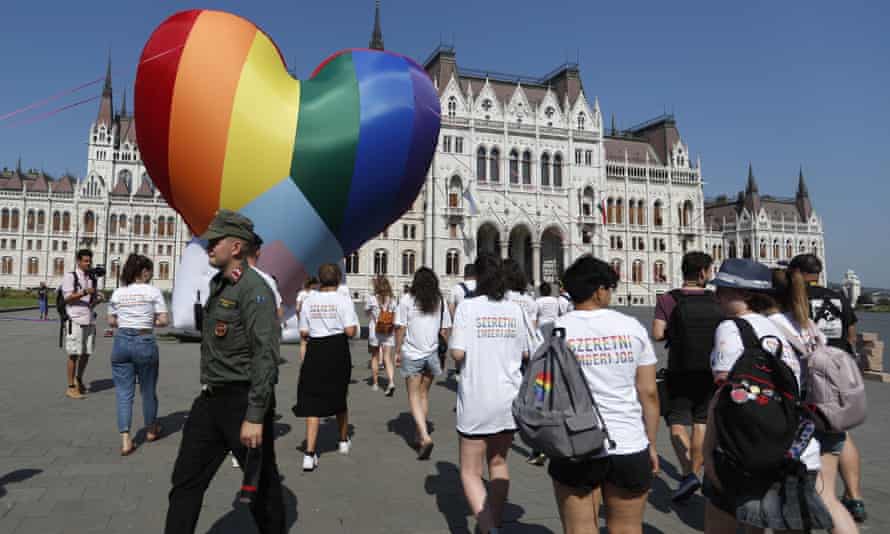
LGBTQ+ activists walk past a rainbow-coloured heart in front of Hungary’s parliament building in Budapest. Photograph: László Balogh/AP

Jennifer Rankin in Brussels
Thu 15 Jul 202

The EU executive has launched legal action against Hungary and Poland to defend LGBTQ+ rights in the latest battle over values with the two nationalist governments in central Europe.

The announcement that Hungary and Poland’s governments could end up in the EU’s highest court is part of an ongoing existential fight for the rule of law and freedom from discrimination in the heart of Europe.

The case against Hungary was triggered by a recently adopted law banishing LGBTQ+ people from books and TV for under-18s, a measure denounced as “shameful” by the European Commission’s president, Ursula von der Leyen. In Poland, the commission considers local authorities have failed to help with its inquiries into resolutions in favour of “LGBT ideology free zones”, passed in more than 100 Polish towns and villages

The commission was under pressure to act after the European parliament denounced the Hungarian law outlawing LGBTQ+ people from being shown in educational content or entertainment that might be seen by under-18s.

The commission said this broke several EU laws, including its audiovisual media services directive, which sets EU rules for TV and streaming services, as well as the freedom to provide services and the free movement of goods, two cornerstones of union law.

The case also takes aim at Hungary’s consumer protection authority, which required a publisher to put a disclaimer on an anthology of fairytales, Wonderland Is For Everyone, because the book was deemed to show “behaviour deviating from traditional gender roles”.

“This law uses the protection of children, to which we are all committed, as an excuse to severely discriminate against people because of their sexual orientation. This law is disgraceful,” von der Leyen told MEPs last week.

Protesters in front of the Georgian embassy in Warsaw, Poland. Photograph: Piotr Molęcki/East News/Rex/Shutterstock

Polish authorities, the commission said, had failed to cooperate with its inquiries into so-called LGBT-ideology free zones, which officials suspect break EU law on non-discrimination.

The two countries have two months to respond to the commission, the first stage in the EU sanctions procedure that can end in the European court of justice (ECJ) and a punishment of daily fines.

The announcements on Thursday came soon after the ECJ ruled that Poland’s system of disciplining judges was incompatible with EU law.

That ruling intensifies the conflict between EU authorities and the Polish government, one day after Poland’s top court rejected an ECJ demand to suspend a newly created body to discipline supreme court judges, a decision described as legal “Polexit” by the EU.

Soon after taking office in 2015, Poland’s ruling Law and Justice party embarked on a rapid overhaul of its legal system that has been widely criticised by independent observers for weakening judicial independence and increasing government control. Those changes include setting up a disciplinary chamber for Poland’s supreme court consisting of new judges.

The ECJ said on Thursday the disciplinary chamber “does not provide all the guarantees of impartiality and independence” and was not protected from “direct or indirect influence” of the government or lawmakers.

Under the disciplinary system, Polish judges can be sanctioned for their judgments in the lower courts, an arrangement that “could be used in order to exert political control” over decisions or “exert pressure on judges with a view to influencing their decisions”, an ECJ statement said.

Polish judges can also be disciplined if they refer cases to the Luxembourg court for a preliminary ruling, a move that strikes at the heart of the EU’s legal order.


EU parliament condemns Hungary’s anti-LGBT law


The ECJ has called for “measures necessary to rectify the situation”. The Luxembourg-based court had already issued a temporary injunction suspending the disciplinary tribunal pending Thursday’s judgment, the decision that prompted Poland’s supreme court to declare it did not have to follow EU law.

The judgment is a win for the commission, which has taken the Polish government to court multiple times over violations of the rule of law. But it may be a bittersweet victory as Polish judges contest the supremacy of EU law, a cornerstone of how the union functions.

The Polish prime minister, Mateusz Morawiecki, said on Thursday it was “an obvious conclusion for any Polish citizen that the constitution is the highest legal act”. Both he and the country’s justice minister, Zbigniew Ziobro, said they considered the EU stance to be politically motivated.

A commission spokesperson said: “The commission is deeply concerned by the decision of the Polish constitutional tribunal yesterday … This decision actually reaffirms our concerns about the state of the rule of law in Poland.”
Electricity demand growing faster than roll-out of renewable energies, says IEA
Electricity demand is expected to grow by 5% this year, much more than the 1% drop it experienced last year as the global economy tumbled into recession thanks to restrictions to stem the coronavirus pandemic (Photo: Mint)


Updated: 15 Jul 2021, 05:19 PM ISTAFP

Demand for electricity is growing faster than the roll-out of renewable energies, leading to a surge in the use of heavily polluting coal and undermining efforts to reach carbon neutrality, the IEA said

Electricity demand is growing faster than the roll-out of renewable energies, leading to a surge in the use of heavily polluting coal and undermining efforts to reach carbon neutrality, the IEA warned on Thursday.

Electricity demand is expected to grow by 5% this year, much more than the 1% drop it experienced last year as the global economy tumbled into recession thanks to restrictions to stem the coronavirus pandemic.

"Renewable electricity generation continues to grow strongly -- but cannot keep up with increasing demand," the International Energy Agency said in a semi-annual report on the electricity market.

Renewable power production expanded by 7% in 2020 and the IEA expects it will grow by 8% this year and by more than 6% next year.


"Despite these rapid increases, renewables are expected to be able to serve only around half of the projected growth in global demand in 2021 and 2022," it said.

That will leave fossil fuel power stations to cover around 45% of extra demand this year.

Coal-fired power stations whose emissions are particularly harmful to the environment and contribute to global warming, are expected to exceed pre-pandemic levels this year. The IEA believes they could hit a record high in 2022.

That will drive a rise in emissions of CO2, a gas that contributes to global warming, which could hit a record level in 2022.

While nations are increasingly committed to reaching net-zero emissions by mid-century in order to limit climate change, the IEA calculates that in order to reach that goal emissions from the power sector need to be falling now.

Use of coal needs to fall by more than 6% a year.

"Stronger policy actions are needed to reach climate goals," the IEA report said as nations are set to hold a major climate summit later this year.

While renewable power is growing at an impressive rate, "it still isn't where it needs to be to put us on a path to reaching net-zero emissions by mid-century," said Keisuke Sadamori, who heads up energy markets and security at the IEA.

"To shift to a sustainable trajectory, we need to massively step up investment in clean energy technologies -- especially renewables and energy efficiency," he was quoted as saying in a statement.

This story has been published from a wire agency feed without modifications to the text. Only the headline has been changed.