‘Surprise’ election result poses new challenges for Colombia’s left
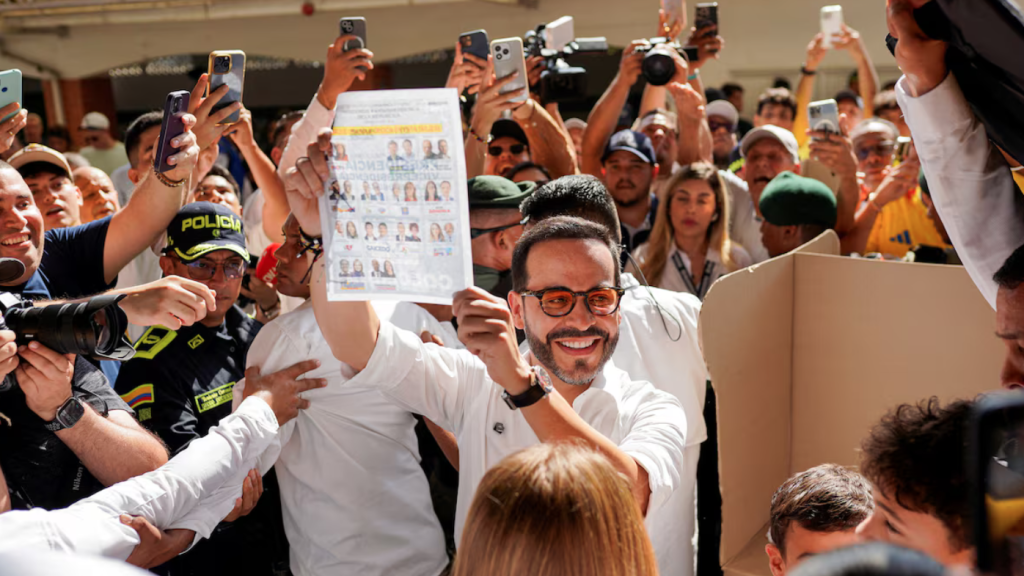
Having supported Ivan Cepeda as the candidate to succeed Colombian President Gustavo Petro, most left-wing and democratic Latin Americans were not surprised by the meteoric rise of a Javier Milei-style far-right candidate in the final weeks of the presidential campaign. Libertarian lawyer Abelardo de la Espriella not only managed to rapidly rise in the polls, but got through to the second round just ahead of Cepeda, a reserved university philosophy lecturer and human rights defender. Cepeda was preselected by Petro’s Pacto Histórico (Historic Pact) to preside over a second term of centre-left progressive government.1
De la Espriella, nicknamed El Tigre (the Tiger), secured 43.72% of the vote against Cepeda’s 40.92% (a difference of 600,000 votes). Paloma Valencia — an aristocrat, a former president’s granddaughter and former right-wing president Álvaro Uribe supporter — secured 6.9% as the Centro Democrático (CD, Democratic Centre) candidate, well below the 15% polls predicted. In the end, El Tigre’s tank steamrolled the CD.
The reality is that neither Colombia nor any of the other 35 Latin American and Caribbean countries are immune to the global neo-fascist far right wave. The country’s history attests to a longstanding right-wing presence in politics, which until May 31 had been occupied by Uribe’s CD (never centre-right to begin with). But de la Espriella’s vote is also reflects the current regional and global climate.
His support came from bourgeois-oligarchic factions (agribusiness, the financial markets, big business and social media platforms), with de la Espriella swiftly overtaking Valencia as their darling. The Colombian Milei was also backed by US President Donald Trump and far-right parties in government across the region.
Moreover, in a country where social media regulation is virtually non-existent, de la Espriella benefitted from a deluge of fake news — largely originating from the US and Spanish state2 — that spread blatant lies about Petro and Cepeda’s supposed links to guerrillas and organised crime. Rounding off de la Espriella’s perfect storm was his hiring of a political marketing firm — the same one that worked on social influencer Pablo Marçal’s almost successful 2024 São Paulo mayoral campaign — and manipulation of Colombia’s, at best, fragile electoral system.
To understand the impact of the fake news, one must remember that Colombia endured six decades of civil war,3 which left 450,000 dead, 121,000 missing and 7.7 million internally displaced, and saw countless bomb attacks against authorities and civilians and the kidnapping and murder of politicians. An agreement was signed in 2016 between the government and the Fuerzas Armadas Revolucionarias de Colombia (FARC, Revolutionary Armed Forces of Colombia) to disarm and reintegrate guerrilla fighters into civilian life.
Petro’s government and the Pacto advocate a policy of “Total Peace,” which seeks dialogue with the remaining guerrilla group, the Ejército de Liberación Nacional (ELN, National Liberation Army), and even criminal armed groups willing to lay down their guns. This policy is vehemently opposed by the CD, agricultural sectors and the urban middle class. De la Espriella skillfully manipulated these sectors, accusing Petro and Cepeda of being bloodthirsty guerrillas and friends of drug traffickers.
A semi-privatised electoral system
Colombia’s electoral system rests on three-prongs. The first is not an electoral court, but rather the National Electoral Council (CNE), which is composed of nine members appointed by parliament, with quotas filled through complex mathematical calculations that give a majority to whoever holds a majority in parliament. The second is the Registrar’s Office, which functions as a large civil and electoral registry office. Only those who are registered can vote.
The third, and most questionable, leg of the tripod is the semi-privatised vote counting system. Counting of the about 120,000 ballot boxes is done manually, with party observers present. However, once ballot box results are processed at the district, department (state) and national level, a tally is carried out by a private Colombian security firm, Thomas Greg & Sons, which does not disclose the source code for the count, meaning there is no way to verify their tally.
It is therefore not surprising that Petro questioned the May 31 results, and has said he will press ahead with his allegations of irregularities. This comes amid reports that de la Espriella co-opted company employees and Electoral Registry staff (as well as members of the police and Armed Forces). According to the president’s social media posts, 800,000 votes for the neo-fascist candidate cannot be verified.
For there part, Cepeda and his campaign team decided on June 1 to endorse the result. According to Pacto leaders this was to allow the election process to continue. The contradiction between Petro and Cepeda’s position could reflect a rift between the two or a deliberate division of labour. Either way, the outlook for the second round remains in limbo.
A young progressive movement with a grassroots base
Despite not achieving Cepeda’s aim of winning the first round, the Pacto and its allies in the Alianza por la Vida (Alliance for Life) obtained the best ever election result for Colombia’s left, surpassing Petro’s 2022 vote.
The strength of this coalition of left-wing and centre-left groups and individuals, along with social movements, can be explained by the momentum and unity forged as a result of the 2019 and 2021 social uprisings. At the time — and in parallel with Chile's anti-neoliberal uprising — the country rebelled against then-president Ivan Duque (CD) for his fiscal austerity policies and mishandling of peace agreements with the FARC and ELN, as well as murder of social leaders and repression of protesters that occurred under his watch.
The movement managed to weather the pandemic, with political figures and organisations identified with the protests coming out stronger. Petro — who leads Colombia Humana (Humane Colombia), a force within the Pacto — won the 2022 presidential elections on the back of that wave.
His government, like all progressive centre-left movements, has been characterised by its strictly constitutional action — it has operated exclusively within the framework of the existing bourgeois-democratic regime. At the same time, it has distinguished itself from similar governments, such as those of Lula da Silva (Brazil), Gabriel Boric (Chile) and Uruguay’s Frente Amplio (Broad Front), by calling popular mobilisation in support of key policies, such as with the 23% minimum wage rise at the end of 2025.
Petro has governed with a parliamentary minority, but has managed to largely circumvented this by channelling significant portions of the national budget to projects submitted by juntas vecinales (neighbourhood associations) and their regional federations.4 Cepeda’s campaign, for its part, decided to capitalise on this tradition of neighbourhood organisation by focusing on a proactive policy-based campaign (rather than attacking opponents), grassroots mobilisation, and the idea of a first-round victory (a debatable choice).
The impression shared by international left party observers is that the campaign did not give enough importance to social media and did not prepare enough for the very high likelihood that the far right would wage an aggressive and widespread campaign of fake news and disinformation, all within the continental context of a renewed Monroe Doctrine5 and Trump’s “Shield of the Americas”.6 The campaign lacked a media command centre dedicated to defending Cepeda and the alliance’s program against de la Espriella’s lies — something that would have been perfectly feasible, with the support of intellectuals and digital activists from across the region.
There were also many complaints within the Pacto, including from leaders, about the absence of lawyers and observers at all 120,000 polling stations.
Pacto Histórico becomes a party
The Pacto decided to register as a political party in December 2024 and obtained legal recognition in mid-2025. This involved unifying the legal entities of the Polo Democrático Alternativo (Alternative Democratic Pole, Cepeda’s former party), the Unión Patriótica (Patriotic Union, which is backed by the Partido Comunista Colombiano/Colombian Communist Party) and Colombia Humana (led by Petro and Senator Gloria Flores).
Also part of the Pacto are a political faction that emerged from the Organización Nacional Indígena de Colombia (ONIC, National Organization of Indigenous Peoples of Colombia) and formerly known as the Movimiento Alternativo Indígena y Social (MAIS, Alternative Indigenous and Social Movement); Unidad Democrática (Democratic Unity, eco-socialist), the Partido del Trabajo de Colombia (Colombian Labour Party, Maoist) and Todos Somos Colombia (We Are All Colombia, affiliated to the Progressive International); and feminism and environmentalist forces — which have broad backing on the local left — as well as the significant Palanquero Black movement (the Colombian name for rural communities made up of former Black slaves and Afrocolombian people).
Colombia’s progressive centre-left movement is a young political force, with just one presidential term under its belt and still in the process of consolidating a unified party for its political project. Given its youth — less experienced than even Mexico’s Morena party, not to mention Partido dos Trabalhadores (Workers Party), Uruguay’s Frente Amplio and Argentina’s Peronist movement — the Pacto has maintained a certain reluctance towards direct confrontation. Cepeda appears to be seeking to overcome this, challenging de la Espriella to a debate the day after the first round.
Its youthfulness is also reflected in an apparent overconfidence in the institutions of the 1993 Constitution, as evidenced by the lack of questioning of the electoral system prior to the results.
The second round
Cepeda’s alliance involved forces beyond the Pacto, including the indigenous movement, represented by vice-presidential candidate Aída Cilcuyé (of the Nasca people); the Green Alliance (a kind of Green Party); En Marcha (On The March, a party formed in 2018 by dissident liberals); former Bogotá mayor Claudia López; independent dissident liberals; and even, according to the reactionary media, CD conservatives unhappy with Valencia. All share a commitment to peace after decades of armed conflict.
A left-wing victory in the second round will be no easy feat, although the more experienced Pacto members and leaders believe Cepeda can win, provided that: (1) problems with vote monitoring are rectified, and communication and legal work on social networks and online platforms is strengthened; (2) as Cepeda said on the night of the first-round vote, even more young people are mobilise to reduce abstention; and (3) if new key endorsements can be secured.
Cepeda will have to secure new votes from supporters of centrist former Medellín mayor Sergio Fajardo, who received 1 million votes in the 2025 primaries; officially negotiate with the Partido Liberal; and develop a strategy to win over CD sectors. Indeed, Valencia’s running mate, Juan Daniel Oviedo, has already declared he will not support or vote for de la Espriella.
The battle is not over. Young people have already begun to take to the streets in Bogotá. An exciting second half is still to come. Rather than making doomsday predictions that the Pacto has lost before the fight even started, the regional and international left would do well to offer assistance, whether through their physical presence in Colombia or online, to help ensure the tide turns in the left’s favour.
- 1
Colombian law prohibits re-election.
- 2
According to research by the Pacto Histórico campaign
- 3
These figures are from the Truth Commission and refer to the armed conflict between the state and the FARC that began in 1964. There have been numerous other civil wars in Colombia’s history including 19 conflicts between liberals and conservatives between 1812–86, and the famous La Violencia (The Violence) between 1948–58, immortalised in the pages of Gabriel García Márquez’s One Hundred Years of Solitude.
- 4
For more information on Colombia's neighbourhood associations movement, see articles by Brazilian historian Tamis Parron in Rosa Magazine www.revistarosa.com.
- 5
As exemplified in the Trump administration's National Security Strategy, which states: "the United States will reassert and enforce the Monroe Doctrine to restore American preeminence in the Western Hemisphere, and to protect our homeland and our access to key geographies throughout the region."
- 6
A military and political coalition of right-wing and far-right governments in Latin America, organised by the Trump administration under the guise of fighting drug cartels

No comments:
Post a Comment