Pope Leo begins to update 'just war' theory
(RNS) — In line with long-standing papal concerns.
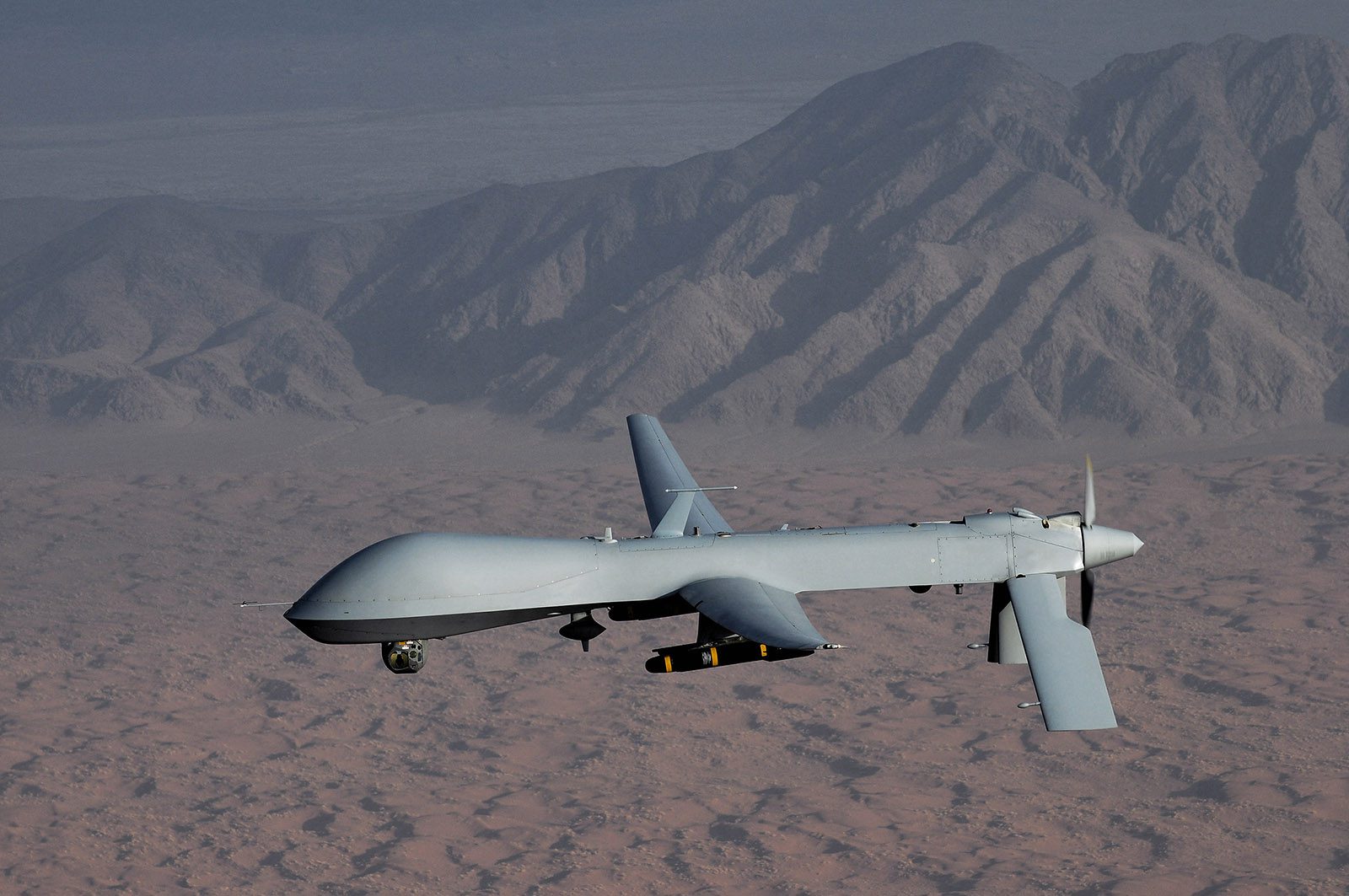
An MQ-1 Predator unmanned aerial vehicle flies a combat mission over southern Afghanistan in 2008. (Photo by Lt. Col. Leslie Pratt/U.S. Air Force/Creative Commons)
Mark Silk
June 2, 2026
RNS
(RNS) — One of the most important aspects of Pope Leo XIV’s encyclical on artificial intelligence is his seeming rejection of “just war” theory.
“Today, more than ever, without prejudice to the right to self-defense in the strictest sense, it is important to reaffirm that the ‘just war’ theory, which has all too often been used to justify any kind of war, is now outdated,” he writes in “Magnifica Humanitas.”
Does that mean he wants to jettison a theory that, going back to St. Augustine, has been a staple of Catholic moral theology?
To be sure, Leo acknowledges a right to self-defense, in line with what the church’s Catechism calls “the ‘just war’ doctrine.” At the same time, he has sometimes sounded as though he believes there’s no such thing as a just war.
“War does not solve problems, but rather it amplifies them and produces deep wounds in the history of people that take generations to heal,” he said after the U.S. bombed the sites of three nuclear-enrichment facilities in Iran last year. “No armed victory can compensate for the pain of mothers, the fear of children, the stolen future.”
And this April he posted: “God does not bless any conflict. Anyone who is a disciple of Christ, the Prince of Peace, is never on the side of those who once wielded the sword and today drop bombs.”

Pope Leo XIV attends the presentation of his first encyclical, “Magnifica Humanitas: On Safeguarding the Human Person in the Time of Artificial Intelligence,” at the Vatican, May 25, 2026. (AP Photo/Alessandra Tarantino)
But it’s not as if such pronouncements are a departure for popes of the past century. In the midst of World War II, Pius XII declared that “the theory of war as an apt and proportionate means of solving international conflicts is now out of date” — thereby supplying the predicate for Leo to “reaffirm” his encyclical’s position. During Pope Francis’ pontificate, he often sounded a pacifist note.
Put simply, modern warfare has led recent popes to raise the bar for when war can be justified. In the 20th century, the issue was its demonstrated capacity to wreak devastation on an unprecedented level. Today, AI presents a new kind of challenge.
Taking up Francis’ concerns about AI generally, in January of 2025 the Vatican’s Dicastery for the Doctrine of the Faith and Dicastery for Culture and Education issued “Antiqua et Nova,” a 30-page doctrinal statement that includes six paragraphs (98-103) on AI and warfare. Calling the “weaponization” of AI “highly problematic,” the statement declares that the “development and deployment of AI in armaments should be subject to the highest levels of ethical scrutiny, governed by a concern for human dignity and the sanctity of life.”
Following “Antiqua et Nova,” “Magnifica Humanitas” supplies some of that scrutiny. AI is relevant to both dimensions of classical just war theory: the right to go to war (jus ad bellum) and right conduct in war (jus in bello). About the first, the encyclical warns that AI can render conflict “more impersonal, lowering the threshold for resorting to violence, transforming defense into threat prediction and thus reducing victims to data.” About the second, it insists that “the decision to use lethal force cannot be delegated to opaque or automated processes, but must remain under effective, self-aware and responsible human control.”
Let us note that Vice President JD Vance himself endorsed the encyclical in general and what it had to say about just war in particular. In his graduation speech at the Air Force Academy this past weekend, he said, “If the warfare of the future is to live up to the moral values of our ancestors, decisions over life and death must be made by humans and not machines.”
Could Vance have been trying to prove his recently minted Catholic bona fides after telling the pope last month “to be careful when he talks about matters of theology”? And was he also using the encyclical to shore up his standing as the administration’s leading war skeptic?
You might very well think that. I couldn’t possibly comment.

No comments:
Post a Comment