Wednesday, September 08, 2021

Texas governor defends abortion law with no rape exceptions
SAYS THEY WILL 'ELIMINATE'  ALL THE RAPISTS
Paul J. Weber And Jamie Stengle
The Associated PressStaff
Tuesday, September 7, 2021 

Texas Gov Greg Abbott shows off his signature after signing Senate Bill 1, also known as the election integrity bill, into law with State Sen. Bryan Hughes, R-Mineola, front center left, and Lieutenant Governor Dan Patrick, front right looking on with others in Tyler, Texas, Tuesday, Sept. 7, 2021. 
(AP Photo/LM Otero)

DALLAS -- Texas Gov. Greg Abbott on Tuesday defended a new state law banning most abortions that also does not provide exceptions for cases of rape or incest, saying it does not force victims to give birth even though it prohibits abortions before some women know they're pregnant.

Abbott, a Republican, added that Texas would strive to "eliminate all rapists from the streets" while taking questions during his first press conference since the law took effect last week.

The comments drew new criticism from opponents of the Texas law that is the biggest curb on abortion in the U.S. since they were legalized a half-century ago, prohibiting abortions once medical professionals can detect cardiac activity, which is usually around six weeks. Though abortion providers in Texas say the law is unconstitutional, they say they are abiding by it.


Related Stories
U.S. Justice Department will 'protect' abortion seekers in Texas

Activists focus on tip site in protesting Texas abortion law

"His comments are confusing to me because they certainly do not seem to reflect the realities of this law," said Amy Jones, the chief executive officer of the Dallas Area Rape Crisis Center.

Recent surveys by the U.S. Department of Justice found that most rapes go unreported to police, including a 2019 survey that found about 1 in 3 victims reporting they were raped or sexually assaulted.

Abbott signed the measure into law in May. Although other GOP-led states have passed similar measures, they have been blocked by courts. Texas' version differs significantly because it solely leaves enforcement to private citizens who can sue abortion providers who violate the law.

Abbott was asked about the new abortion restrictions while signing into law an overhaul of Texas' election rules.

"Texas will work tirelessly to make sure that we eliminate all rapists from the streets of Texas by aggressively going out and arresting them and prosecuting them," Abbott said.

Jones said Abbott's statements were both confusing and disheartening. She said she'd "like to hear more" from Abbott on his statement on eliminating rape.

"Certainly it is in our mission statement to work to end sexual violence, that is why we exist, but we are also very aware that that is an aspirational goal that yes, we do believe that this is a preventable crime, but it if it were that easy, rape would no longer exist," Jones said.

The Justice Department has said it will not tolerate violence against anyone who is trying to obtain an abortion in Texas as federal officials explore options to challenge the law.

'How do you eliminate rape?': Gov. Abbott faces backlash after comments on new abortion law


"Rape is a crime, and Texas will work tirelessly to make sure that we eliminate all rapists in the streets of Texas...," the governor said in part of his statement.

THE RAPIST STILL RAPED HIS VICTIM
SHE IS STILL PREGNANT


A twist in the new unprecedented Texas abortion law: "There's no one to sue" • 

FRANCE 24 English


Gov. Whitmer Calls on Legislature to Repeal 1930s Law Criminalizing Abortion

On Tuesday, Governor Gretchen Whitmer called on the Michigan legislature to pass legislation repealing Michigan’s 1930s law criminalizing abortion. 

The law is currently not in effect because of the 1973 U.S. Supreme Court decision in Roe v. Wade. Repealing the law would ensure a woman’s right to choose. 

In a statement, Whitmer said:

“Recently, Texas passed a new, extreme anti-choice law that puts people’s lives at risk, and threatens healthcare workers. The insidious law essentially bans abortions, even in cases of rape or incest, and allows strangers to sue medical professionals or anyone who helps women get the comprehensive healthcare they need. It is a gross violation of the constitutional right to choose, and the Court’s decision to allow it to stay in place sets the United States on a dangerous path towards overturning Roe v. Wade.

“Unfortunately, there are more cases based on equally extreme state laws awaiting action in the Supreme Court that would completely overturn Roe v. Wade. If the court’s decision in the Texas case is any indication, a majority of justices are willing to throw out the constitutional right to choose that has been in place for 48 years and repeatedly upheld for decades.

“In Michigan today, abortion is safe and legal, but we have an arcane law on the books from the 1930s banning abortion and criminalizing healthcare providers who offer comprehensive care and essential reproductive services. Thankfully, that dangerous, outdated law is superseded by Roe v. Wade, but, if the U.S. Supreme Court overturns Roe, that Michigan law and others like it may go back into effect in dozens of states, disproportionately impacting Black and brown communities.

“I call on the legislature to send Senator Erika Geiss’ bill that repeals our nearly-century-old ban on abortion to my desk. I have always stood with those fighting for their right to choose, and I will not stop now. I will stand in the way of any bills that seek to strip away fundamental rights from women or get in the way of doctors’ ability to do their jobs


OPINION

Texas Just Can’t Stop Punishing Women

New York Times best-selling writer Lauren Hough looks at the passage of SB8 and the exhaustion of raising those coat hangers in protest once again.

I had an abortion in 1996, and I’m not going to explain why I needed one. All I will tell you is that I was in the Air Force, and though the military isn’t allowed to perform abortions, it was still easy enough. I made the appointment for a Saturday, spent the weekend eating junk food and Tylenol, and I was back at work on Monday. I’ll tell you I was damn grateful, even in 1996, that I was stationed in California, not Texas. I’m not going to tell you I wasn’t a slut. I’m not going to tell you I was careful. I’m not telling you because it doesn’t matter.

Every year, every time another draconian law restricting abortion is passed, we perform the same charade. We all know our roles. We tell traumatic stories of rape and incest and those babies we wanted but were formed in the wombs without vital organs. We tell of abusive husbands and boyfriends and fathers. We talk about poverty, and minimum wages, and impossible distances, and lack of sick leave, and forgoing food to afford a medical procedure. Our mothers and grandmothers talk about the old days of back alleys and infection and knife slips.

We march and hold signs. We carry coat hangers. We chant and sing and scream into megaphones. We threaten strikes. We stage sit-ins. We hashtag and tweet and share memes. We write essays.

We do this in a desperate attempt to evoke empathy, express anger, show our numbers, and hope this one time, they’ll hear us.

Those we elect to represent us have their scripts. They say: “No one is for abortion.” It’s a private, no, scratch that, heart-wrenching decision between a woman and her doctor. They use euphemisms like “choice.” They say abortion should be safe, and rare. Don’t forget rare. They say they’re personally against it. No, they’ve never had one, surely never paid for one. What about the life of the mother? What about rape and incest? What about privacy?

The forced-birth enthusiasts have their roles too. They call themselves pro-life. They name these laws “heartbeat” bills, though at six weeks, their heart is not yet fully developed. They say, of course they care about women; they’re just against murdering babies. They call it “murdering babies.” They want women to be more responsible. They claim, falsely, that women regret their abortions. They’re protecting women. They’re protecting innocent lives. No, they didn’t pay for that abortion. They’re sorry they did. That was another time, before they were saved.

In the end, another law is passed. Another clinic closed. Another justice added to the bench.

I’m not telling my story again. I won’t rip myself open and spill my guts hoping I’ll reach someone, hoping they’ll see a human being. They don’t. Because they’re full of sh*t.

I know they’re full of sh*t because if they were really interested in preventing abortion, they’d fund a Planned Parenthood truck on every corner, next to the taco truck. Liquor stores would sell Plan B. They’d fund sex education in schools. Sex education taught by someone other than Coach Kemp, who told us, “Y’all know condoms fail. The only way to make sure you aren’t catching AIDS is marriage.”

If you want to end abortion, you don’t make it easier to get pregnant. If the specter of dead babies haunted them, they wouldn’t push sadistic laws punishing women who miscarry. If they were so horrified by the idea of abortion—truly wanted to save those babies—they’d make sure every baby had enough to eat and a safe place to sleep; every mother and father had a year of paid leave; no family went bankrupt with medical bills from a complicated pregnancy.

They’ve been telling us for years, decades, by their actions that they do not want to end abortion. Why would they? No matter the law passed, the wealthy will still have access to it. But if you can force a woman to give birth, you’ve trapped her in a cycle of poverty. They don’t want to save babies. They want to punish women for having sex. They want to punish women who step out of line. They want to punish women.

For too long, we’ve accepted their terms, and played our roles, trying to beg and bargain—plead the case of the good victim, the good girl, the one with a future, the one who wanted to be a mother. We’ve been trying to reach people who would never reach out to us. All we’ve done is provide them cover to continue their crusade against women.

The truth of the matter is, abortion will always be a reality, no matter which laws they pass. We don’t have to depict it as a heart-wrenching decision a woman regrets down the road. Because we know that’s not true. Abortion isn’t a controversial topic that we should be scared to discuss or even name. It is and has remained popular, even in Texas. One in four women, at least, have had an abortion. It’s 14 times safer than giving birth. It doesn’t even require a doctor. It never has.

The days of coat hangers were never the rule, and all we’ve done by waving them around is perpetuate the lie that abortions are terrifying and potentially life-threatening…despite the fact abortion is as old as pregnancy itself. Its practitioners were usually women with a knowledge of herbs. Today, abortion pills such as Mifepristone are easily accessible online, and just across the border.

Yet now, in Texas, I can be sued for typing that last sentence. Because they don’t want to end abortion. They want to punish women. And they’ve now deputized every Texan to do their dirty work.


Lauren Hough is the essayist and best-selling author of Leaving isn’t the Hardest Thing. She was born in Berlin, Germany, and raised in several countries, and Amarillo, Texas. She’s been an Airforce Airman, a bouncer, barista, bartender, and, for a time, a cable guy.

USA
It's Time to Enshrine in Law Women's Right to Choose
COMMENTARY

By Maria CardonaSeptember 07, 2021

(Joel Martinez/The Monitor via AP)

Texas has passed the most draconian anti-women’s rights law in the country and the Supreme Court has chosen to let it go into effect by deciding not to stop it. In doing so, the court has vindicated the hair-on-fire concerns that many Americans had when ultra-conservatives Amy Comey Barrett, Brett Kavanaugh, and Neal Gorsuch were confirmed as justices.

The furious and passionate dissents by the court’s three liberals -- and even Chief Justice John Roberts’ dissent, though not as fervent -- should be flares burning bright on the political horizon for the 2022 midterm elections.
Recommended

The dissents made compelling arguments that the Texas law is blatantly unconstitutional, that its burden on Texas women is untenable, especially on low-income women, that it shamefully uplifts the “shadow docket” and allows the justices to skirt daylight by avoiding official briefs and arguments of the merits of the law.

But the dissenting justices also put in stark relief what is at stake in the upcoming midterms – the fundamental right of women to decide what happens to their bodies. It is time for Democrats to pull out all the political stops. We need to codify the rights women have under Roe v. Wade by passing the Women’s Health Protection Act. If Republicans refuse to join Democrats to pass it, then we take our argument straight to the American people in the 2022 elections. And I say: Bring. It. On.

Nearly two-thirds of the American people oppose overturning Roe v. Wade. By similar margins, a majority of Americans support keeping abortion legal in all or most cases. President Biden excoriated the extreme law, saying it “unleashes unconstitutional chaos” against women. House Speaker Nancy Pelosi also blasted it and vowed to bring legislation that protected women’s health care rights to a floor vote as soon as the House is back in session.

The Women’s Health Protection Act would establish as the law of the land what the Supreme Court affirmed 50 years ago through Roe. It would guarantee women access to a legal abortion as a fundamental right; it would protect health care providers from frivolous but destructive lawsuits (the kind allowed today under the Texas law); and would remove any unnecessary restrictions that would hinder an individual’s right to decide for themselves what happens to their bodies.

Democrats must start pointing out the obvious hypocrisy of Republican leaders like Gov. Greg Abbott, who on one side of his mouth yelps about the importance of individual freedom and how the government has no right to tell anyone to wear a mask or get a vaccine, but on the other side he signs a cruel and abusive law that will roll back women’s rights in Texas more than a half-century.

We cannot stand for this utter disrespect of Americans’ rights, the stunning disregard of legal precedent, and the outright attempt to usurp a woman’s agency over her body and replace it with the misguided approach to governing of these lawmakers who happen to be overwhelmingly white and male.

This last descriptor is an important one. I can almost guarantee that if men were the ones who could get pregnant, we would have abortion clinics next to ATMs and Starbucks on every corner in this country.

Unless overturned by the courts, the Texas law will have an overwhelmingly and disproportionately detrimental effect on women of color in the state. African American women and Latinas are overly represented in the populations that community health care clinics, including Planned Parenthood clinics, serve. Most are low-income women and many live in rural communities where there is a dearth of any kind of health care services.

Incredibly, this law has no provisions for rape or incest and very narrow exceptions for the life of the mother. So today, if a young girl gets pregnant by an abusive father and she finds out 6½ into her pregnancy, she will be forced to bring to term the child of her rapist father. If, God forbid, the health of that same young girl is put in jeopardy by bringing to term that child, unless her life is at risk or unless the pregnancy “will lead to substantial and irreversible impairment of a major bodily function,” she will have no recourse but to carry the pregnancy to term.

On top of that, any person who is suspected of helping this young child get an abortion, from the health care provider to the Uber driver who took her to the appointment, to the person who made the appointment, can be sued and taken to court.

Liberals were right to fear the installation to the high court of Kavanaugh, Comey Barrett and Gorsuch as the beginning of the end of Roe v. Wade. Sen. Susan Collins was wrong to trust they would in any way respect precedent.

It is now up to all Americans who treasure the Constitution and the personal freedoms it guarantees, and who believe that health care decisions should be made by women, their families, and their doctors, to support Democratic Party efforts to enshrine these sacred personal rights for women into law.

And it is Republicans who should fear political repercussions if they do not support permanently giving these rights to women through legislation, as opposed to holding them hostage to the whims of an ultra-conservative court.


Maria Cardona is a Democratic strategist, a CNN and CNN Espanol political commentator, and former DNC communications director. She also helped pioneer the New Democrat Network’s 2004 multimillion-dollar Hispanic Project for the Democratic Party.
ABORTION IS SATANIC SACRIFICE
‘Abortion is just demonic’: Ex-Planned Parenthood director Abby Johnson responds to ‘evil’ amid Texas abortion law battle

By Billy Hallowell, Op-ed Contributor| Tuesday, September 07, 2021
People gather for a reproductive rights rally at Brooklyn Borough Hall on September 01, 2021, in Downtown Brooklyn in New York City. NOW-NYC and Planned Parenthood of Greater New York Action Fund organized a rally for reproductive rights after a Texas law that has been dubbed the "Heartbeat Bill" went into effect. The law ends access to abortion after six weeks of pregnancy and would allow anyone to sue abortion providers and “aiders and abetters” in civil court. Abortion rights activists have asked the Supreme Court to block the law, but as of Wednesday morning the court has allowed the law to go into effect. In May, Supreme Court justices agreed to review a Mississippi case on the state's ban on abortion procedures after 15 weeks of pregnancy, a direct challenge to Roe v. Wade, the 1973 landmark decision that legalized abortion nationwide. A ruling on that case is expected in 2022. | Michael M. Santiago/Getty Images

Ex-Planned Parenthood clinic director
Abby Johnson called abortion “demonic” in a recent episode of her “Politely Rude” podcast as she unveiled her unequivocal reaction to Texas’ controversial new heartbeat law.

Johnson, who is an outspoken and celebrated pro-life activist, started her show by expressing her elation over the Texas law, which bans most abortions around the six-week gestational period when cardiac activity can be detected.

Hear Johnson’s full and unfettered reaction to the Texas abortion law:
LISTEN TO ABBY JOHNSON’S POLITELY RUDE PODCAST ON EDIFI

“Today, babies with a detectable heartbeat in the womb must be protected,” Johnson said. “And that just thrills me to bits. … I’m just so excited.”

The outspoken pro-life icon was particularly disturbed by “sick” reports that some clinics were performing abortions up until 11:59 p.m. before the new law took effect on Sept. 1.

“How … gross that you’re like, ‘Gotta kill babies up until that last second,’” she said. “That’s how you know that abortion is just demonic. That’s how you know that we’re just dealing with evil here — that there’s like just, ‘Gotta kill them right up until the last second.’”

Johnson credited the heartbeat bill with helping eliminate “85 to 95 percent of abortions in the state of Texas,” and said it's her goal to make abortion harder to attain.

“I want to make it super hard because I want your baby to live,” she said. “I don’t want you to live a lifetime of regret because of a decision that you made in haste … a decision that you made in crisis.”

Johnson said she has met many thousands of women who have come up to her at events to recount their regret over having an abortion.

“Women are living with lifelong regret because of these hasty decisions that they make inside of these abortion facilities each and every day,” she said.

MORE CRAZY CHRISTIANS (STRANGE PROTESTANT CULTISTS)


Tamela Mann emotionally shares that focusing on Jesus is her only goal in life


Danny Gokey says the world need Jesus People


THE BELIEF THAT WHEN A WOMAN HAS 
A MISCARRIAGE IT'S SATAN'S FAULT 
IF ABORTION IS DEMONIC


Afghanistan and the US Corporate Media


Sep 8, 2021 | Opinion


The Taliban’s lightning fast takeover of Afghanistan was amazingly achieved with relatively little killing and bloodshed. Since the rout of the government, an entity essentially installed by the US, the Taliban has been assuring the Afghan people that its governance style will be more moderate than under its previous rule. Many people in Afghanistan are very fearful and particularly skeptical about the idea that the Taliban will change its ways. Many in the US share this skepticism and view the comments by the Taliban about including women in government, an amnesty and honoring human rights as simply public relations spin.

In contrast, very few people in the US political arena or the corporate-controlled US media express any skepticism about the US and its trustworthiness. It appears the possibility that the US is not trustworthy never crosses their minds. However, if it does, they realize that it is likely not to their political or professional advantage to raise this possibility with others.

President Obama benefited from this lack of skepticism when he falsely touted the precision of the US drone program. When Obama claimed that few civilians were killed, the mainstream media generally accepted this claim until there was too much evidence of civilian deaths to be denied.

The hypocritical US political/media elite are now raising concerns about the safety and well being of the Afghan population under the Taliban’s rule. However, it appears that these concerns about Afghan lives were not a major issue for these elites when US Secretary of Defense Donald Rumsfeld rejected a proposed surrender by the Taliban in December 2001, a surrender that would have brought an end to most of the fighting there.

These elite also didn’t show much concern about Afghan lives during the past 20 years when the US forces were bombing and then militarily occupying the country. In addition, the fighting with the Taliban, especially the air campaign, continued throughout these past 20 years and killed a large number of civilians. In fact, according to a excellent recent article by Jim Lobe in Responsible Statecraft, using research by Andrew Tyndall, in 2020 the corporate-controlled media mostly ignored Afghanistan with a total of 5 minutes coverage during the 14,000 minutes of weekday evening news coverage on the three national broadcast networks (ABC, CBS and NBC). In the previous five years prior to 2020, the networks averaged 24 minutes per network per year. Thus there is little evidence of any real concern being shown about the safety and well being of the Afghanistan people before the Taliban recaptured control of Afghanistan.

Moreover, the US has denied the Taliban access to $9.5 billion of Afghan government funds and has worked with the IMF to cut off aid to Afghanistan. These acts clearly demonstrate a hypocritical lack of concern for the welfare of the Afghan people who are facing desperate conditions.

There is also much concern expressed about the treatment of women under the Taliban rule. However, if the US and its corporate media were really concerned about the treatment of women, both entities would certainly challenge Saudi Arabia about its treatment of women. It appears that the issue of women is used selectively and hypocritically to advance US political interests.

There are certainly grounds for being very skeptical about the Taliban and its claims of moderation. However, there are overwhelming grounds for doubting US claims as well. For example, under the Trump administration the US reneged on the Obama administration’s agreement with Iran and other nations on the enrichment of uranium. The Biden administration broke the Trump agreement with the Taliban for the withdrawal of US troops by May 1, 2021. The George W. Bush administration used the false claim of Iraqi weapons of mass destruction as the basis for its illegal attack on Iraq. The Clinton, Bush and Obama administrations all broke the George H.W. Bush promise to the Soviet Union not to expand NATO one inch to the east if the Soviet Union would allow the unification of East and West Germany. This shameful record of the US duplicity stretches all the way back to its very beginning when it broke its treaties with American Indians.

Afghanistan’s future is uncertain, but it depends upon how well the Taliban can deliver on its promises. Given that the Taliban consists of very conservative members as well as members who are relatively progressive, it faces a major challenge in being able to live up to its words. If the US and its allies stop being vindictive losers and allow the international community to help Afghanistan through the current dire situation, Afghanistan will have a chance. In addition, Afghanistan’s relations with its neighbors will play a key role in the success of the Taliban and Afghanistan.


Ron Forthofer is a retired professor of biostatistics and former Green candidate for Congress and for Governor of Colorado.


www.counterpunch.org

 PRACTICAL PHYSICS

Walking with coffee is a little-understood feat of physics

Walking with coffee is a little-understood feat of physics
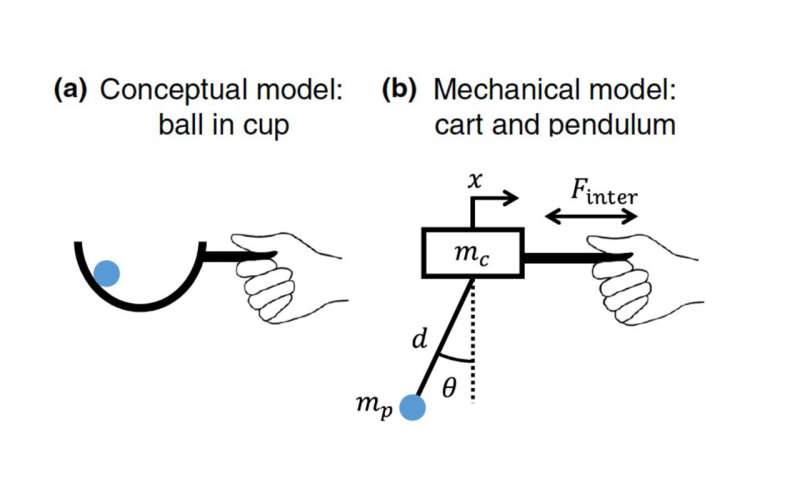
A schematic illustration of the cart-pendulum system to simulate human’s handling of a complex object, such as a cup of hot coffee: (a) a conceptual model of a ball rolling inside a circular cup and (b) a nonlinear mechanical model of a pendulum attached to a moving cart, which is mathematically described by a set of differential equations. Credit: Brent Wallace, Ying-Cheng Lai, Arizona State University

Walking with coffee is something most of us do every day without considering the balancing act it requires. In fact, there's a lot of physics preventing the coffee from spilling over.

The coffee, a thermally agitated fluid contained in a cup, has internal degrees of freedom that interact with the cup which, in turn, interacts with the human carrier.

"While humans possess a natural, or gifted, ability to interact with complex objects, our understanding of those interactions—especially at a quantitative level, is next to zero," said ASU Professor Ying-Cheng Lai, an Arizona State University electrical engineering professor. "We have no conscious ability to analyze the influences of external factors, like noise or climate, on our interactions."

Yet, understanding these external factors is a fundamental issue in applied fields such as soft robotics.

"For example, in design of smart prosthetics, it is becoming increasingly important to build in natural modes of flexibility that mimic the natural motion of human limbs," said Brent Wallace, a former undergraduate student of Lai's and now a doctoral student in ASU's Ira A. Fulton Schools of Engineering. "Such improvements make the prosthetic feel more comfortable and natural to the user."

According to Lai, it is conceivable that, in the not-too-distant future, robots will be deployed in various applications of complex object handing or control which require the kind of coordination and movement control that humans do quite well.

If a robot is designed to walk with a relatively short stride length, then relatively large variations in the frequency of walking are allowed. However, if a longer stride is desired, then the walking frequency should be selected carefully.

A new paper published in Physical Review Applied, "Synchronous Transition in Complex Object Control," originated with Wallace as part of his senior design project in electrical engineering, supervised by Lai. Wallace has received an NSF Graduate Fellowship and now is a doctoral student in ASU's School of Electrical, Computer and Energy Engineering.

The ASU team's research expands on a ground-breaking, virtual experimental study recently conducted by researchers at Northeastern University, using the coffee-cup-holding paradigm and adding a rolling ball, to examine how humans manipulate a complex object. Participants deliberately rotated the cup in a rhythmic manner with the ability to vary force and frequency to ensure the ball stayed contained.

The Northeastern study showed that the participants tend to select either a low-frequency or a high-frequency —rhythmic motion of the cup—to handle a complex object.

A remarkable finding was that when a low-frequency strategy was used, the oscillations exhibit in-phase synchronization, but antiphase synchronization arises when a high-frequency strategy was employed.

"Since both the low- and high-frequencies are effective, it's conceivable that some participants in the virtual experiment switched strategies," said Wallace. "This raises questions.

"How does a transition occur from in-phase synchronization associated with a low-frequency strategy to antiphase synchronization associated with a high-frequency strategy, or vice versa," asked Wallace. "In the parameter space, is the boundary between the in-phase and antiphase synchronization regimes sharp, gradual, or sophisticated?"

The ASU team's research, prompted by Wallace's curiosity, studied the transition between the in-phase and antiphase synchronization using a nonlinear dynamical model of a pendulum attached to a moving cart subject to external periodic forcing.

The researchers found that, in the weakly forcing regime, as the external driving frequency is varied, the transition is abrupt and occurs at the frequency of resonance, which can be fully understood using the linear systems control theory.

Beyond this regime, a transitional region emerges in between the in-phase and antiphase synchronization, where the motions of the cart and the pendulum are not synchronized. It was also found that there is bistability in and near the transitional region on the low-frequency side.

Overall, the results indicate that humans are able to switch abruptly and efficiently from one synchronous attractor to another, a mechanism that can be exploited for designing smart robots to adaptively handle complex objects in a changing environment.

"It is possible that humans are able to use both in-phase and antiphase strategies skillfully and to switch from one strategy to another smoothly, perhaps without even realizing it. The findings from this study can be used to implement these human skills into soft robots with applications in other fields, such as rehabilitation and brain-machine interface," Lai said.

Additionally, tasks as trivial as running wires in a car body on an assembly line—which humans carry out with ease—still elude the most advanced machines.

"A systematic quantitative understanding of how humans interact dynamically with their environment will forever change how we engineer our world, and may revolutionize the design of smart prosthetics and usher in new age of manufacturing and automation," said Wallace. "By mimicking the dynamically-favorable behaviors adopted by humans in handling complex objects, we will be able to automate processes previously thought to be impossible."Transients and synchronization are unified in ecological networks

More information: Brent Wallace et al, Synchronous Transition in Complex Object Control, Physical Review Applied (2021). DOI: 10.1103/PhysRevApplied.16.034012

Provided by Arizona State University 

Exploring quantum gravity and entanglement using pendulums

THE PENDULUM IS USED FOR SCRYING 

ANOTHER FORM OF QUANTUM PHENOMENA

Exploring quantum gravity—for whom the pendulum swings
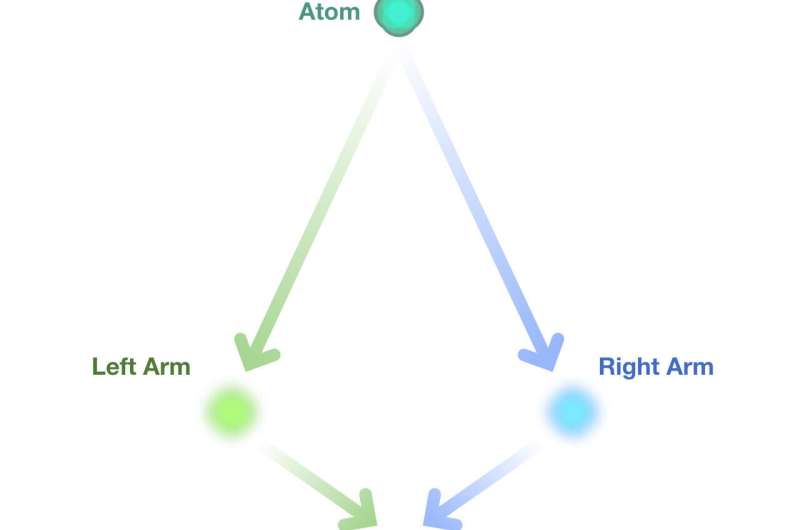
In an atomic interferometer, the atom's wave function is split into left and right arms. The left and right arms are then recombined, producing an interference pattern. Credit: S. Kelley/NIST

When it comes to a marriage with quantum theory, gravity is the lone holdout among the four fundamental forces in nature. The three others—the electromagnetic force, the weak force, which is responsible for radioactive decay, and the strong force, which binds neutrons and protons together within the atomic nucleus—have all merged with quantum theory to successfully describe the universe on the tiniest of scales, where the laws of quantum mechanics must play a leading role.

Although Einstein's theory of general relativity, which describes gravity as a curvature of space-time, explains a multitude of gravitational phenomena, it fails within the tiniest of volumes—the center of a black hole or the universe at its explosive birth, when it was less than an atomic diameter in size. That's where quantum mechanics ought to dominate.

Yet over the past eight decades, expert after expert, including Einstein, have been unable to unite quantum theory with gravity. So, is gravity truly a quantum force?

Researchers at the National Institute of Standards and Technology (NIST) and their colleagues have now proposed an experiment that may help settle the question.

The experiment takes advantage of two of the weirdest properties of quantum theory. One is the , which holds that an undisturbed atomic particle can be described as a wave, with some probability of being in two places at once. For instance, an undisturbed atom traveling through a region with two slits, passes through not one or the other of the slits but both.

And because the atom is described by a wave, the portion that passes through one slit will interfere with the part that passes through the other, producing a well-known pattern of bright and dark fringes. The bright fringes correspond to regions where the hills and valleys of the two waves align so that they add together, creating constructive interference and the dark regions correspond to regions where the hills and valleys of the waves cancel each out, creating .

Exploring quantum gravity—for whom the pendulum swings
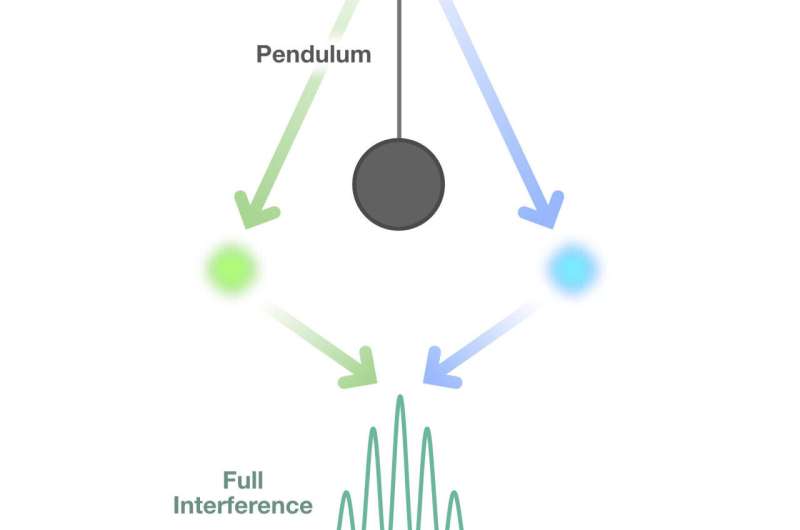
When the experiment begins, the atom's wave function is unaffected by the pendulum. This means the two arms of the single atom interfere fully with each other. Credit: S. Kelley/NIST

The second strange quantum property is known as entanglement, a phenomenon in which two particles can be so strongly correlated that they behave as a single entity. Measuring a property of one of the particles automatically forces the other to have a complementary property, even if the two particles reside galaxies apart.

In a  of gravity, the  between two massive objects would be communicated by a hypothetical subatomic particle, the graviton, in the same way that the electromagnetic interaction between two charged particles is communicated by a photon (the fundamental particle of light). So, if a graviton truly exists, it should be able to connect, or entangle, the properties of two massive bodies, just as a photon can entangle the properties of two charged particles

The proposed experiment by Jake Taylor of NIST's Joint Quantum Institute at the University of Maryland, along with Daniel Carney, now at the Lawrence Berkeley National Laboratory, and Holger Müller of the University of California, Berkeley, provides a clever way to test if two massive bodies can indeed become entangled by gravity. They described their work in an article published online in Physical Review X Quantum on August 18, 2021.

The experiment would use a cold cloud of atoms, trapped inside an atomic interferometer. The interferometer has two arms—a left arm and a right. According to the superposition principle, if each atom in the cloud is in a pure, undisturbed quantum state, it can be described as a wave occupying both arms simultaneously. When the two portions of the wave, one from each arm, recombine, they will produce an interference pattern that reveals any changes to their paths due to forces like gravity.

A small, initially stationary mass suspended as a  is introduced just outside the interferometer. The suspended mass and the atom are gravitationally attracted. If that gravitational tug also produces entanglement, what would that look like?

Exploring quantum gravity—for whom the pendulum swings
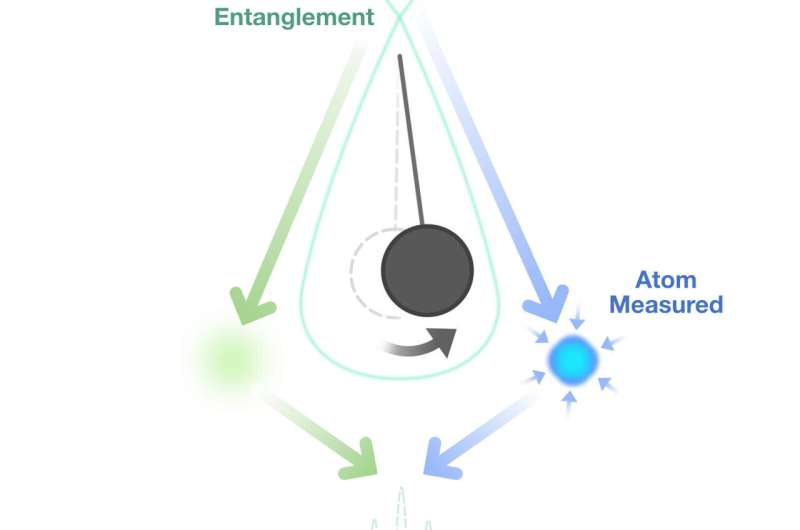
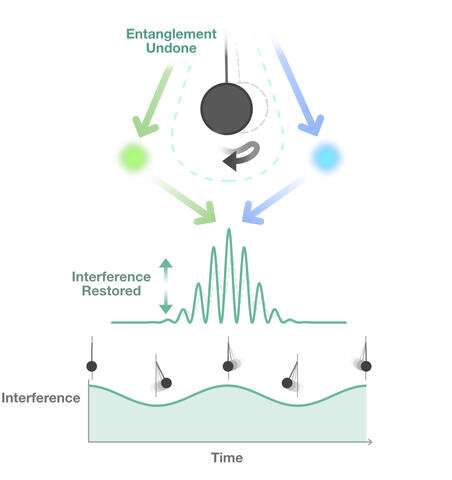
If gravitational attraction indeed causes an entanglement between the pendulum and the atom, the pendulum will partially measure the position of the atom, concentrating it into one arm or the other. Credit: S. Kelley/NIST

The suspended mass will become correlated with a specific location for the atom—either the right arm of the interferometer or the left. As a result, the mass will start swinging to the left or the right. If the atom is located on the left, the pendulum will start swinging to the left; if the atom is located on the right, the pendulum will start swinging to the right. Gravity has entangled the position of the atom in the interferometer with the direction in which the pendulum begins swinging.

The position entanglement means that the pendulum has effectively measured the location of the atom, pinpointing it to a particular site within the interferometer. Because the atom is no longer in a superposition of being in both arms at the same time, the interference pattern vanishes or diminishes.

Half a period later, when the swinging mass returns to its starting point, it loses all "memory" of the gravitational entanglement it had created. That's because regardless of what path the pendulum took—initially swinging to the right, which picks out a location for the atom in the right interferometer arm, or initially swinging to the left, which picks out a location for the atom in the left arm—it returns to the same starting position, much like a child on a swing.

And when it returns to the starting position, it's equally likely that the pendulum will pick out a location for the atom in the left or right arm. At that moment, entanglement between the mass and the atom has been erased and the atomic interference pattern reappears.

Half a period after that, as the pendulum swings to one side or the other, entanglement is re-established and the interference pattern diminishes once again. As the pendulum swings back and forth the pattern repeats—interference, diminished interference, interference. This collapse and revival of interference, the scientists say, would be a "smoking gun" for entanglement.

"It is difficult for any phenomenon other than gravitational entanglement to produce such a cycle," said Carney.

Exploring quantum gravity—for whom the pendulum swings
After each half oscillation period, the pendulum will return to where it started, losing all memory of the gravitational entanglement it had created and restoring full interference. Credit: S. Kelley/NIST

Although the ideal experiment may be a decade or more from being built, a preliminary version could be ready in just a few years. A variety of shortcuts could be exploited to make things easier to observe, Taylor said. The biggest shortcut is to embrace the assumption, similar to Einstein's theory of general relativity, that it doesn't matter when you start the experiment—you should always get the same result.

Taylor noted that non-gravitational sources of quantum entanglement must be considered, which will require careful design and measurements to preclude.

An atom chip interferometer that could detect quantum gravity
More information: Daniel Carney et al, Using an Atom Interferometer to Infer Gravitational Entanglement Generation, PRX Quantum (2021). DOI: 10.1103/PRXQuantum.2.030330
Provided by National Institute of Standards and Technology 


Massive new animal species discovered in half-billion-year-old Burgess Shale

Massive new animal species discovered in half-billion-year-old Burgess Shale
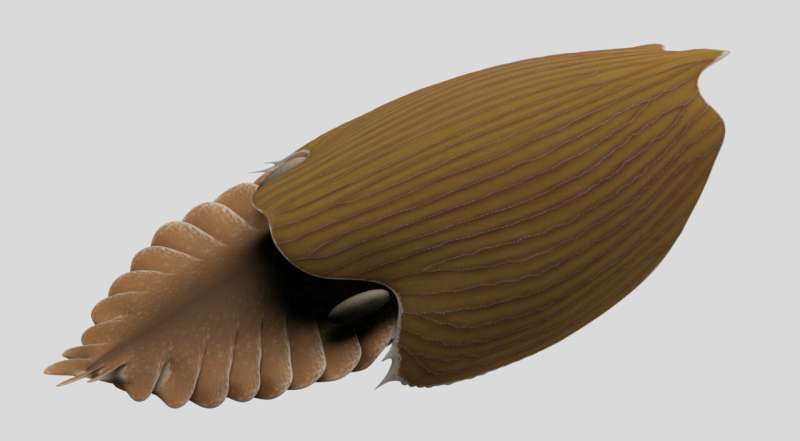
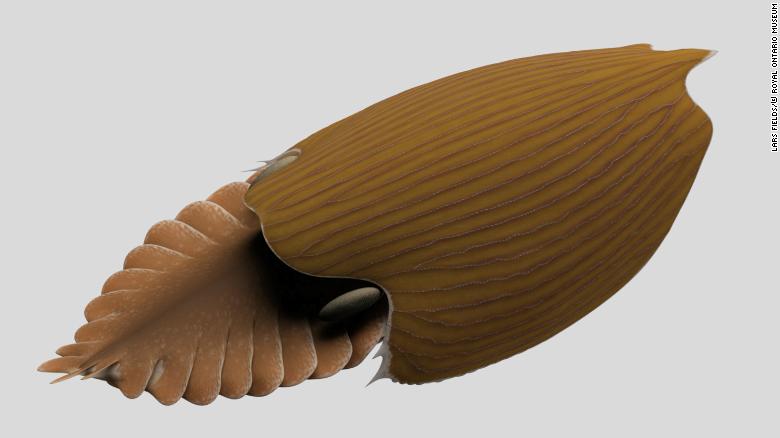
View of Titanokorys gainesi reconstruction. Credit: Lars Fields, © Royal Ontario Museum

Palaeontologists at the Royal Ontario Museum (ROM) have uncovered the remains of a huge new fossil species belonging to an extinct animal group in half-a-billion-year-old Cambrian rocks from Kootenay National Park in the Canadian Rockies. The findings were announced on September 8, 2021, in a study published in Royal Society Open Science.

Named Titanokorys gainesi, this new species is remarkable for its size. With an estimated total length of half a meter, Titanokorys was a giant compared to most  that lived in the seas at that time, most of which barely reached the size of a pinky finger.

"The sheer size of this animal is absolutely mind-boggling, this is one of the biggest animals from the Cambrian period ever found," says Jean-Bernard Caron, ROM's Richard M. Ivey Curator of Invertebrate Palaeontology.

Evolutionarily speaking, Titanokorys belongs to a group of primitive arthropods called radiodonts. The most iconic representative of this group is the streamlined predator Anomalocaris, which may itself have approached a meter in length. Like all radiodonts, Titanokorys had multifaceted eyes, a pineapple slice-shaped, tooth-lined mouth, a pair of spiny claws below its  to capture prey and a body with a series of flaps for swimming. Within this group, some species also possessed large, conspicuous head carapaces, with Titanokorys being one of the largest ever known.

Massive new animal species discovered in half-billion-year-old Burgess Shale
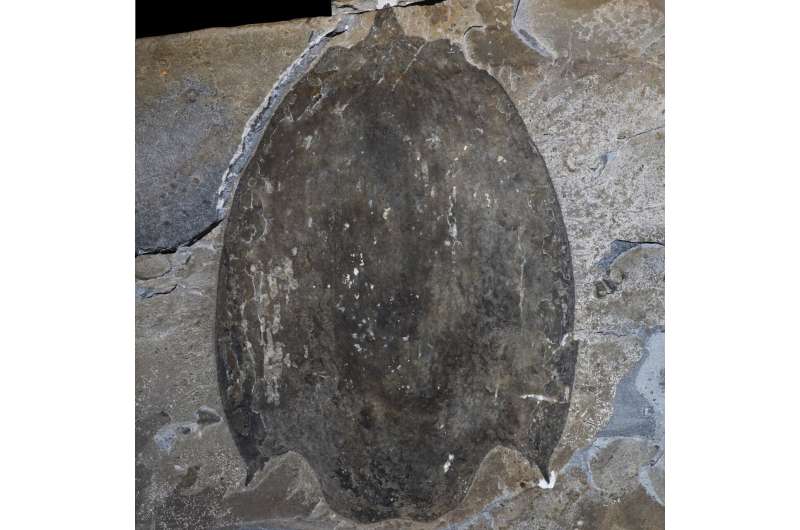
Fossil of Titanokorys gainesi carapace close up. Credit: Jean-Bernard Caron, © Royal Ontario Museum

"Titanokorys is part of a subgroup of radiodonts, called hurdiids, characterized by an incredibly long head covered by a three-part carapace that took on myriad shapes. The head is so long relative to the body that these animals are really little more than swimming heads," added Joe Moysiuk, co-author of the study, and a ROM-based Ph.D. student in Ecology & Evolutionary Biology at the University of Toronto.

Why some radiodonts evolved such a bewildering array of head carapace shapes and sizes is still poorly understood and was likely driven by a variety of factors, but the broad flattened carapace form in Titanokorys suggests this species was adapted to life near the seafloor.

"These enigmatic animals certainly had a big impact on Cambrian seafloor ecosystems. Their limbs at the front looked like multiple stacked rakes and would have been very efficient at bringing anything they captured in their tiny spines towards the mouth. The huge dorsal carapace might have functioned like a plough," added Dr. Caron, who is also an Associate Professor in Ecology & Evolutionary Biology and Earth Sciences at the University of Toronto, and Moysiuk's Ph.D. advisor.

Massive new animal species discovered in half-billion-year-old Burgess Shale
The carapace of Titanokorys gainesi (lower) along with two symmetrical rigid plates (upper) that covered the head from the underside. All together they form a three-part set of armour that protected the head from all sides. The illustration “Titanokorys gainesi, viewed from the front” shows them wrapping around behind the mouth and claws. Credit: Jean-Bernard Caron, © Royal Ontario Museum

All fossils in this study were collected around Marble Canyon in northern Kootenay National Park by successive ROM expeditions. Discovered less than a decade ago, this area has yielded a great variety of Burgess Shale animals dating back to the Cambrian period, including a smaller, more abundant relative of Titanokorys named Cambroraster falcatus in reference to its Millennium Falcon-shaped head carapace. According to the authors, the two species might have competed for similar bottom-dwelling prey.

The Burgess Shale fossil sites are located within Yoho and Kootenay National Parks and are managed by Parks Canada. Parks Canada is proud to work with leading scientific researchers to expand knowledge and understanding of this key period of earth history and to share these sites with the world through award-winning guided hikes. The Burgess Shale was designated a UNESCO World Heritage Site in 1980 due to its outstanding universal value and is now part of the larger Canadian Rocky Mountain Parks World Heritage Site.

Massive new animal species discovered in half-billion-year-old Burgess Shale
Dr. Jean-Bernard Caron, Richard M. Ivey Curator of Invertebrate Palaeontology, Royal Ontario Museum, seated above a fossil of Titanokorys gainesi at the quarry site located in Kootenay National Park. Credit: Joe Moysiuk, © Joseph Moysiuk

The discovery of Titanokorys gainesi was profiled in the CBC's The Nature of Things episode "First Animals." These and other Burgess Shale specimens will be showcased in a new gallery at ROM, the Willner Madge Gallery, Dawn of Life, opening in December 2021.

A voracious Cambrian predator, Cambroraster, is a new species from the Burgess Shale
More information: A giant nektobenthic radiodont from the Burgess Shale and the significance of hurdiid carapace diversity, Royal Society Open Science, royalsocietypublishing.org/doi/10.1098/rsos.210664
Journal information: Royal Society Open Science 
Provided by Royal Ontario Museum


Giant 'swimming head' creature lived in our oceans 500 million years ago


By Ashley Strickland, CNN
Updated Wed September 8, 2021


Photos: Ancient finds
This illustration shows the primitive arthropod Titanokorys gainesi from the front. This creature lived along the ocean floor half a billion years ago

.(CNN)Half a billion years ago, the oceans were filled with life that looked more like aliens than the marine animals we know today. Now, researchers have uncovered the fossil of an unusual creature that was likely a giant compared to tiny ocean life 500 million years ago.
Radiodonts, a group of primitive arthropods, were widespread after the Cambrian explosion event 541 million years ago -- a time when a multitude of organisms suddenly appeared on Earth, based on the fossil record.
The newly discovered fossil belonged to Titanokorys gainesi, a radiodont that reached 1.6 feet (half a meter) in length -- which was huge, compared to other ocean creatures that were about the size of a pinkie finger.
The fossil was found in Cambrian rocks from the Kootenay National Park, located in the Canadian Rockies. A study detailing the fossil published Wednesday in the journal Royal Society Open Science.


New find shows animal life may have existed millions of years before previously thought

"The sheer size of this animal is absolutely mind-boggling, this is one of the biggest animals from the Cambrian period ever found," said study author Jean-Bernard Caron, the Royal Ontario Museum's Richard M. Ivey Curator of Invertebrate Palaeontology, in a statement.
Titanokorys would have been a bewildering animal to encounter. It had multifaceted eyes, a mouth shaped like a pineapple slice that was lined in teeth, and spiny claws located beneath its head to catch prey. The animal's body was equipped with a series of flaps that helped it swim. And Titanokorys had a large head carapace, or a defensive covering, like the shell of a crab or turtle.


This is an artist's illustration reconstructing Titanokorys gainesi as it appeared in life.

"Titanokorys is part of a subgroup of radiodonts, called hurdiids, characterized by an incredibly long head covered by a three-part carapace that took on myriad shapes. The head is so long relative to the body that these animals are really little more than swimming heads," said study coauthor Joe Moysiuk, a Royal Ontario Museum-based doctoral student of ecology and evolutionary biology at the University of Toronto, in a statement.

Researchers are still trying to understand why some radiodonts had such a variety of head carapaces, which came in all shapes and sizes. It's unclear what this head gear was protecting them from, given their size compared to other sea life at the time. In the case of Titanokorys, the broad, flat carapace suggests it had adapted to live near the seafloor.
"These enigmatic animals certainly had a big impact on Cambrian seafloor ecosystems. Their limbs at the front looked like multiple stacked rakes and would have been very efficient at bringing anything they captured in their tiny spines towards the mouth. The huge dorsal carapace might have functioned like a plough," Caron said.


The carapace of T. gainesi (lower), along with two symmetrical rigid plates (upper), covered the head from the underside. They formed a three-part set of armor that protected the head on all sides.

The fossils of Titanokorys were found in Marble Canyon, located in northern Kootenay National Park, which has been the site of many discoveries of Cambrian fossils dating back 508 million years ago. The site is part of the Burgess Shale, a deposit of well-preserved fossils in the Canadian Rockies. The Burgess Shale is a UNESCO World Heritage Site.
One of those discoveries includes the radiodont Cambroraster falcatus, so named because its head carapace is similar in shape to the Millennium Falcon from Star Wars. It's possible that these two species scuffled on the bottom of the sea for prey.
Titanokorys, and other fossils collected from Burgess Shale, will be displayed in a new gallery at the Royal Ontario Museum beginning in December.