Saturday, November 27, 2021

American vaccine disinformation used as ‘Trojan horse’ for far right in New Zealand

Emanuel Stoakes

CHRISTCHURCH, New Zealand — When Josephine Bartley, a councilor in Auckland, New Zealand, heard that a local Covid-19 vaccination clinic had been vandalized in early November, she drove over to survey the damage. After speaking to the owners and helping them connect with local law enforcement, she noticed three men loitering near her parking spot.

© Provided by NBC News

“Some guys were standing around my car just staring at me,” she told NBC News by telephone and email last week.

“One of them called me scum,” she said, and suggested they damage her vehicle. The men then entered a four-wheel drive and left. While the labour party councilor said she did not know if the trio were linked to the vandalism of the health center, which primarily serves the local Pacific community, the experience left her shaken.

“I was confused, I was trying to figure out who was ‘scum’- was it brown people? Was it Labour, was it Council? Was the vaccination? Was it women? But I was concerned for my safety,” Bartley said. The police “advised me not to use my car and lay low for a few days,” she said.

© Fiona Goodall Image: COVID-19 lockdown restrictions are eased in Auckland (Fiona Goodall / Reuters file)

As New Zealand shifts to a policy of “living with the virus,” residents accustomed to living virtually Covid-free for most of the pandemic are being confronted by rising case numbers and widening vaccine mandates. Opposition to vaccination as well as frustration with ongoing pandemic restrictions is fueling a small but vocal protest movement inspired in part by American politics.

In a working paper published in November, a team of researchers in New Zealand said there had been a “sharp increase in the popularity and intensity” of disinformation around Covid-19 since August, when an outbreak driven by the highly transmissible delta variant of the virus that is responsible for the vast majority of New Zealand’s cases began.

The researchers said the disinformation was “being used as a kind of Trojan horse” to coax New Zealanders from vaccine hesitancy to vaccine resistance, and then to the embrace of far-right ideologies like white supremacy and extreme misogyny. Some of the most extreme content, they said, comes from overseas, particularly Australia and the United States.

Bartley said that before the incident at the vaccination clinic there had been a surge in online abuse from New Zealanders directed at her office as well as the clinic.

“I got sent a video with an American anti-vaxxer saying, ‘If you support vaccinations you’re going to hell,’” she said.

NBC News has also seen Telegram messages from Shane Chafin, an American resident of New Zealand disclosing the personal cellphone number of a pharmacist who criticized his anti-vaccine broadcasts, in which he appeared to encourage followers to harass her in retaliation. NBC News has approached Chafin for comment.

Chafin works for “Counterspin Media,” a New Zealand-based news site hosted by GTV, a company founded by former Trump strategist Steve Bannon. In November, a press conference by Prime Minister Jacinda Ardern was suspended after Chafin heckled her about vaccinations.

At anti-lockdown and anti-vaccine protests in cities like Wellington and Christchurch, “Make America Great Again” hats and flags from the QAnon conspiracy theory movement are visible among the crowds. Sam Brett, a student at the University of Canterbury who attended recent protests for his doctoral research, said they felt like a “miniature, New Zealand version of a Trump rally.”

THIS SIGN MAKES NO SENSE
Anti-Lockdown Protesters Gather In Wellington (Hagen Hopkins / Getty Images file)

The protests often feature “powerful, charismatic speakers,” Brett said, who cast the government as “maliciously trying to take away people’s rights.”

They have also co-opted the language and culture of New Zealand’s Indigenous Maori, even as related discourse online promotes anti-Maori racism, said Sanjana Hattotuwa, a research fellow at the University of Auckland and one of the working paper’s authors.

“Maori identity, symbols, history, culture, narratives and specific individuals are being appropriated by white-supremacist accounts and actors, especially on Telegram,” an app that can serve as an alternative social media platform, allowing greater anonymity and less stringent community rules than sites like Twitter.

Those symbols include the Maori flag and the “Ka Mate” haka, a ceremonial dance known globally for its performance before matches by New Zealand’s All Blacks rugby team.

In a statement in November, Ngati Toa, a Maori tribe recognized by the government as having legal rights over the dance, asked protesters to stop using it “immediately.”

“We are absolutely clear that the Covid-19 vaccine is the best protection we have available to us,” Helmut Modlik, the tribe’s chief executive, said in the statement.

In its statement, the tribe singled out Brian Tamaki, an anti-lockdown firebrand who leads a group called the Freedom and Rights Coalition, saying it had been alerted that he planned to teach the haka to protesters for future performances.

Tamaki, who is out on bail after multiple arrests over his appearances at anti-lockdown protests in defiance of court orders and public health controls, did not respond to requests for comment. But Martin Daly, a member of the Pentecostal church Tamaki leads who is also active in the Freedom and Rights Coalition, said he disagreed with the tribe’s directive.

“There’s a lot of Maori iwi [tribal] leaders in our movement, up in the North Island, and they’ve said they’re speaking completely out of line,” he said.

Maori tribes are all the more frustrated because they are less likely to be vaccinated than other New Zealanders and have been disproportionately affected by the delta outbreak.

Hone Harawira, a Maori rights advocate and former lawmaker, said he respected people’s right to protest, but “not when that protest endangers the health and well-being of our whanau,” a Maori-language word for family and community.

Harawira condemned Tamaki’s activity and called on Maori to confront what he perceives as the far-right themes in parts of the protest movement, specifically “their anti-vax games, the Trumpist rhetoric, their hatred and their basic racism as well.”

New Zealand’s national security advisers have warned that individuals radicalized by their exposure to extremist online content during the pandemic could resort to violence, media outlet Newshub reported in November. Security measures for government officials have been stepped up in recent weeks.

Paul Buchanan, an Auckland-based security analyst and former consultant to U.S. intelligence services, said he was concerned by the “importation of U.S.-style populist rhetoric” into New Zealand’s anti-vaccination movement, characterizing it as “tinged with violence and vulgar, dehumanizing disrespect for political and social opponents.”

“When you reduce the quality of discourse down to street-fighting level,” he said, it can raise the risk of violence.

Daly said that fears of extremists among the protest movement were misplaced, arguing it was an expression of broadly felt concerns about the erosion of civil liberties.

“It’s about freedom of movement, to be able to gather, freedom of speech,” he said. “The removal of freedoms is our big issue; we’re not anti-vax, we’re more pro-choice.”

On Nov. 9, as thousands gathered outside Parliament in Wellington to protest lockdowns and vaccine mandates, Ardern said she was aware of the opposition but did not think it was representative of public views.

“Regardless of your position, there’s a place for everyone’s voice to be heard,” she said later. “Please just make it kind.”
Rise of a new coronavirus variant in Africa looks like the disaster scenario experts warned of if rich nations hoarded vaccines for themselves

Sinéad Baker
Fri, November 26, 2021,

A man receiving a coronavirus vaccine on a train in South Africa
.Siphiwe Sibeko/Reuters


A new coronavirus variant was found in southern Africa. Experts worry it could be the worst so far.


Scientists had warned that a dangerous variant could emerge if there wasn't global vaccine access.


They said all countries needed vaccines before rich ones got boosters. Rich nations didn't listen.


As coronavirus vaccines were produced, approved, and rolled out, health experts said the doses needed to make it around the world, not just to the richest countries.

This was needed, they said, to reduce the rates of death and serious illness in poorer nations, and to protect their populations.

They also mentioned another reason: The more the virus spreads, the more likely it is to mutate and result in a strain that could become more dangerous to everyone, including the vaccinated.

A worrying variant found


A new variant, dubbed B.1.1.529, has been mostly identified in Botswana and South Africa, as well as in Hong Kong, where it was imported by a traveler.

A relatively small number of cases has been discovered so far, but the variant has been spreading rapidly, officials said.

Experts are describing B.1.1.529 as worrying, pointing to its high number of mutations, which means it could render existing antibodies, vaccines, and treatments less effective, as Insider's Dr. Catherine Schuster-Bruce reported.

Scientists are trying to figure out whether it's more infectious, more deadly, or both.

Many experts have already said that it's the worst variant they've seen since the pandemic began.

It's not clear exactly where the new variant developed. It could have been in South Africa, in Botswana, in a neighboring country, or somewhere else entirely.

But both those countries have low vaccination rates, and they've documented the struggle in securing doses, including accusing rich nations of hoarding vaccines.

As of Thursday, 23.51% of people in South Africa and 19.58% in Botswana have been fully vaccinated, Our World in Data reported.

A graph showing the vaccine rates of South Africa and Botswana compared to many of the world's wealthiest countries. Our World in Data

This means the nightmare scenario could be arriving in just the way experts have warned about.

Experts warned of this for months

The World Health Organization has repeatedly urged richer countries to share or buy fewer vaccine doses, and to make sure poorer nations have their first doses before distributing booster shots.

Those countries haven't listened.


The WHO experts said this wider vaccine distribution was needed in part to stop new, dangerous variants from emerging. Dr. Soumya Swaminathan, WHO's chief scientist, said in August that she was "afraid" that booster campaigns "will only lead to more variants."

Other experts have warned of the same scenario for months.

Ken Shadlen, a professor of development studies at the London School of Economics and Political Science, told Insider in March that if global vaccine inequality persisted, "it's going to potentially undermine the health benefits of all that we're doing with lockdowns and vaccines."

He said it wasn't inevitable that a vaccine-escaping variant would emerge if the virus kept spreading, but that "it would take a lot of confidence to believe that it's not going to, if it keeps spreading."

Dr. Michael Osterholm, an epidemiologist at the University of Minnesota who advised Joe Biden on COVID-19 during his presidential transition, expressed the same concerns to Insider in March.

He said that efforts to end the pandemic would be difficult if there was a "largely uncontrolled transmission in the low- and middle-income countries," even if the world's richest nations had done widespread vaccinations.

Countries such as the UK and Germany are restricting travel from a number of African nations in a bid to stop the spread of the new variant.
A Hawaiian TikToker called out tourists after a video appeared to show an influencer on a forbidden hiking trail
Lindsay Dodgson
Fri, November 26, 2021

The Haiku Stairs in Oahu, Hawaii, have been closed to the public since 1987.
Marcin Wloch / EyeEm/Getty Images

A Hawaiian TikToker shared a viral video of tourists appearing to climb the Haiku Stairs in Oahu.


The trail, also known as the "Stairway to Heaven," has been closed to the public since 1987.


Camille Leihulu criticized the video and said, "Outsiders get to blatantly ignore laws."


The Hawaiian TikToker Camille Leihulu went viral when she criticized a travel TikToker whose video appears to show her climbing a forbidden hiking trail in Oahu.

Leihulu posted her reaction alongside the original video (known as duetting on TikTok) of a travel vlogger named Sofia McMillan who has 40,000 followers. The original video shows McMillan and her friends at the top of a hiking trail. Leihulu speculated it was the Haiku Stairs, which has been closed to the public since 1987.

The video was captioned "full circle rainbow on stairway to heaven," which the trail is also known as.

McMillan did not immediately respond to Insider's request for comment.

@camilleslagle #duet with @sofmcmillan yes, she acknowledged it’s an old video, but think of the thousands more who’ve done this. DON’T DO IT. #hawaii ♬ original sound - AntiNightcore

In her response TikTok post, which received 1.5 million views, Leihulu said she had never been on the stairs.

"I've never been up these stairs to see this view and I never will because I have respect for Hawaii and my homelands," she wrote in the caption. "Why do outsiders get to blatantly ignore laws and rules and do as they please without facing any repercussions or acknowledging the consequences that Hawaiians have to deal with as a result of their actions?"

@camilleslagle #duet with @sofmcmillan yes, she acknowledged it’s an old video, but think of the thousands more who’ve done this. DON’T DO IT. #hawaii ♬ original sound - AntiNightcore

The 3,922 steps were constructed along Oahu's Ko'olau mountain range in the 1940s to reach the US Navy's top-secret Haiku Radio Station at the summit, which was used to transmit radio signals to submarines. The stairs were open to hikers in the past but closed in 1987 over safety concerns. Anyone using them is considered to be trespassing on government property and could face a fine of up to $1,000, according to the TV-news outlet Hawaii News Now.

Leihulu added: "Hawaiians and Hawaii residents pay thousands in taxes to rescue people who get stuck up there."

In April, the Honolulu Star Advertiser — Hawaii's largest daily newspaper — reported that a 24-year-old man had to be airlifted from an area the summit after injuring his knee.

In September, Honolulu Mayor Rick Blangiardi ordered the stairs be removed following a City Council meeting.

"Due to rampant illegal trespassing, Haiku Stairs is a significant liability and expense for the city, and impacts the quality of life for nearby residents," Esther Kiaʻāina, a city-council member, told Hawaii News Now.

Another council member, Brandon Elefante, told the outlet the city had spent "$1 million in taxpayer dollars to remodel the stairs," as well as "hundreds of thousands of dollars in security costs."

Blangiardi's office did not immediately respond to Insider's request for comment.

Despite warnings, there are dozens of videos posted by TikTokers who have trekked along the Haiku Stairs, which often rack up hundreds of thousands of views.
These carbon-rich ecosystems urgently need protection, study urges

Isabella O'Malley, M.Env.Sc
Thu, November 25, 2021


All ecosystems are worth protecting, but certain ones should be prioritized based on the staggering amounts of carbon they store, a study published in Nature Sustainability has stated.

Mangroves, peatlands, and old-growth forests are ecosystems that capture the highest levels of carbon, but if left protected would still require hundreds of years to capture all of the carbon dioxide emissions released by humans.

These types of ecosystems are particularly special due to their role in managing the global climate because they contain irrecoverable carbon, which is carbon that could not be recovered by 2050 if it was released into the atmosphere today.

“This timeframe exceeds the time we have remaining to avoid the worst impacts of global warming. There are some natural places that we cannot afford to lose due to their irreplaceable carbon reserves,” the scientists reported.


The Inside Passage in British Columbia. Many southern regions of B.C. have some of the highest reservoirs of carbon on the planet. (iStock / Getty Images Plus)

The Inside Passage in British Columbia. Many southern regions of B.C. have some of the highest reservoirs of carbon on the planet. (iStock / Getty Images Plus)

Approximately 23 per cent of the irrecoverable carbon is in state-designated protected areas and 33.6 per cent is managed by Indigenous peoples and local communities. Biomass, such as trees and seagrass, contains 57 per cent of irrecoverable carbon while 43 per cent is found in soils.

Data collected from remote sensors were used to map global carbon reserves. The analysis revealed that the regions with the highest densities of irrecoverable carbon are in the coastlines of British Columbia and Washington state, northern Ontario and Manitoba, western Siberia, western South America, the Congo Basin, Indonesia, Papua New Guinea, and Brunei.

Half of the irrecoverable carbon that is in existence is concentrated in just 3.3 per cent of the Earth’s surface, which is roughly equal to the land area of India and Mexico combined. The researchers have reported that this presents opportunities for initiatives that can target these relatively small areas.

Click here to view the video

The study stated that agriculture, logging, and wildfires have released at least four gigatonnes of irrecoverable carbon. There are approximately 139.1—582.7 gigatonnes of irrecoverable carbon remaining, which is currently facing risks from land use changes and climate change. So far, humans have added 651 gigatonnes to the atmosphere, which has caused global temperatures to warm more than 1°C since the early 1900s.

“While areas of current irrecoverable carbon loss require immediate attention, a view towards future risks — both due to shifting human pressures and a changing climate — is needed to ensure these irrecoverable carbon reserves are maintained over the coming decades,” the study stated.

“Decisions governing irrecoverable carbon in ecosystems today will affect the atmosphere of generations to come.”

Thumbnail credit: Alex Ratson/ Moment/ Getty Images
PFAS
Maine found 'forever chemicals' in deer, but has no idea how widespread the problem is


Pete Warner, Bangor Daily News, Maine
Wed, November 24, 2021,

Nov. 24—The discovery of "forever chemicals" in deer in central Maine and the subsequent guidance to not eat the meat raises serious questions about whether it is safe to consume venison killed in areas of the state where high levels of the chemicals have been detected or are suspected to exist.

The Maine Department of Inland Fisheries and Wildlife on Tuesday issued a "do not eat" advisory for deer meat killed in the Fairfield area, warning hunters who killed deer from that area to throw away the venison.

Five of the eight deer tested by the state were found to have high levels of Per- and Polyfluoroalkyl substances (PFAS), manufactured materials often referred to as "forever chemicals." They are used in numerous industrial and household products, and have been found to present health risks in humans.

Fairfield is one of 34 towns across the state identified in October where the Maine Department of Environmental Protection will test for PFAS contamination in the soil and water. The effort will concentrate on sites where industrial waste, sludge and septic tank sewage were spread as fertilizer.

DIF&W is not drawing any conclusions about deer living near other potential biohazard sites based only on the information gathered in Fairfield. But it will be working with the Department of Environmental Protection to conduct additional testing in locations throughout the state, according to Nate Webb, the DIF&W's wildlife division director.

"This is a rapidly evolving situation and we issued the advisory based on the limited information that we currently have," Webb said. "We expect to have additional information well in advance of next year's fall hunting seasons."

The department chose the Fairfield area as the initial test site based on the DEP's previous discovery of high levels of PFAS in soils there, DIF&W's communications director Mark Latti said. Residents had raised concerns about whether the contaminants had made their way into the deer.

"We believe the deer were likely exposed to PFAS by ingesting forage from impacted fields in Fairfield and it is likely that they have been exposed ever since they began feeding from those areas," Webb said.

DIF&W will use test information provided by the Department of Environmental Protection about PFAS levels in the soil in specific areas to help determine where to conduct future testing of deer.

In addition to the level of PFAS in deer, DIF&W will consider other factors including their proximity to the "hot spots" and migration patterns along with the age and sex of the animals in evaluating the full scope of the contamination, Latti said.

The sampling in Fairfield took place in October, when DIF&W staff and representatives from the U.S. Department of Agriculture's Wildlife Services killed the eight deer that made up the test group. The deer were killed on or near farms that had known contaminants in the soil.

The effort required strict adherence to anti-contamination efforts to preserve the integrity of the samples.

"They had to be handled in a certain way to make sure that they weren't contaminated," Latti said. "Just brushing up against it with your jacket or putting it in the wrong type of container, you could throw off the levels of PFAS in the meat."

Biologists did not document any obvious health issues in the sample of deer.

This is not the first time the state has issued a "do not eat" warning.

"We have an ongoing advisory to not eat the kidneys or liver from moose because of a risk of contamination with cadmium [a heavy metal], and to limit consumption of deer liver for the same reason," Webb said.

He also pointed to ongoing advisories on fish consumption due to potential mercury exposure; one advisory recommends not to consume fish from the Police Athletic League ponds in Fairfield due to PFAS.

New Hampshire is among the states that have made similar recommendations about consuming venison and deer organ meats because of PFAS concerns.

The State Fish and Game Department recommends that hunters not consume deer liver, which studies have shown contain elevated levels of cadmium and PFAS when compared with muscle tissue.

In Michigan, the Department of Health and Human Services recommends that people not eat the organs from any deer, fish or other wild game statewide because chemicals including PFAS can accumulate in those organs.

Michigan has done other studies that found deer living near three PFAS investigation sites, and another adjacent to a lake containing fish with elevated PFAS levels, that determined those animals displayed no evidence or low levels of the chemicals.
Guyana Is Walking A Fine Line With Its Oil Boom


Editor OilPrice.com
Wed, November 24, 2021

Guyana is treading a fine line between its potential for economic growth through new oil developments and the risk of environmental degradation and rising sea levels associated with fossil fuel-driven climate change.

Guyana, the small South American country of just 800,000 people, has become world famous over the last year thanks to the promise of low-cost and high output oil operations in its newly established oilfields. Based on recent discoveries by ExxonMobil, TotalEnergies, and Tullow Oil, Guyana is thought to have 10 billion barrels of crude reserves.

With production starting in 2019, and more and more discoveries being made over the last two years, Guyana’s future in energy looks bright. One of the poorest countries in South America could soon become one of the richest countries in the world per capita if projections about its planned oil production are correct.

However, following the COP26 climate summit earlier this month, much of the world is focused on transitioning away from fossil fuels towards renewable alternatives, not investing in long-term new oil developments. And Guyana is all too familiar with the effects of climate change, experiencing severe floods earlier this year that destroyed crops and homes. Georgetown, the coastal capital of Guyana, is at risk of being submerged within the next decade if sea levels continue to rise. So how will Guyana tread the line between developing its oil riches, and boosting the country’s struggling economy, while ensuring environmental stability?

The challenge faced by Guyana could have a positive effect on the country’s new industry, with a major focus on the development of low-carbon oil production. Both the international and national actors involved in the new exploration and extraction projects are under pressure to meet net-zero international targets. The country could follow the path set out by Saudi Arabia, which is promising to significantly reduce its carbon emissions while increasing its oil production over the coming decades.

Guyana recognizes the challenges it is facing and has asked for assurances from energy firms pumping oil in the region that the country will be protected from the knock-on effects of production. The head of Guyana’s environmental agency has announced that the country will be asking oil operators to guarantee financial assistance in the event of oil spills as well as the removal of disused oil infrastructure.

In talks with a national oil consortium, led by Exxon, Guyana is pushing for an agreement to expand upon the events covered by Exxon’s $5 billion self-insurance policy. If new legislation is adopted, it would ensure that several oil operators in the Stabroek block cover the environmental costs associated with oil spills as well as the decommissioning of oil platforms once a project is complete.

Guyana holds all the cards when it comes to oil production, as the world’s oil majors are moving away from carbon-heavy operations and focusing on new, reliable areas, where they can shape low-carbon production, in Africa and the Caribbean. Just this month, Exxon announced that it’s in discussions with Dutch contractor SBM Offshore NV over the potential for a fourth multibillion-dollar production rig. Although production has already commenced under existing agreement terms, if international oil majors hope to expand operations in the South American country, they will likely have to agree to Guyana’s terms.

In addition to environmental challenges, if Guyana wants its population to support the new oilfield developments, the revenues from the black gold will have to trickle down faster. At present, the Guyanese population is seeing demand for travel and accommodation go up as prices across the country rise with increased demand. However, the average person has not yet seen an increase in their income or other economic benefits in line with the new developments. Sharing the wealth is vital for a country that prior to the recent boom relied largely on fishing and agriculture, industries that are becoming increasingly complicated due to climate change.

Richard Rambarran, Executive Director of the Georgetown Chamber of Commerce and Industry, suggested that Guyana has the potential to become a high-income country over the next 30 years, and a “leader of the global south for sustainable development” if the revenues are invested back into the country.

As one of the world’s poorest countries, it was inevitable that Guyana would respond to the influx in investment offered by some of the world’s biggest oil companies when they made huge crude discoveries. However, Guyana is severely threatened by climate change, with many people in the country relying on the environment for their basic income. Over the next decade, as Guyana’s oil industry takes shape, it must demand low-carbon production from oil operators, as well as assurances that they will pay for any damage caused by the extraction and production of oil. In addition, oil revenues could support sustainable development and boost per capita income if managed well, making Guyana a sustainable example of an emerging oil nation.


By Felicity Bradstock for Oilprice.com
Exxon lobbyist suggests climate change not 'catastrophic, inevitable' risk in undercover recording


Wed, November 24, 2021

A lobbyist for Exxon expressed doubt that climate change carries "catastrophic, inevitable risk" in remarks made earlier this month, which were obtained by the watchdog group Documented.

In the Nov. 9 remarks to the Interstate Oil and Gas Compact Commission, lobbyist Erik Oswald states, "The way I look at it as a scientist is, all's I need to think about is, is there, is there a risk? Yes, there's risk. Is it catastrophic, inevitable risk? Not in my mind. But there's risk."

"And so if we're going to work on this, you know, as a, as a society, if we're going to work on this risk, then my only ask is, let's do it as efficiently as possible," Oswald continues in the recording.

"Find me the cheapest way to put the most CO2 in the ground," he says in reference to carbon-capture technology. "And that's what I'm willing to engage in a conversation on."

In the recording, first reported by The Washington Post, Oswald says the company thinks of such technology "not as the crusaders who are going to be the climate fix" but rather "looking at markets," comparing the business opportunities of a "green premium" to consumers' willingness to buy sugar-free foods.

"The statements lack appropriate context and are not representative of the company's positions on important issues, including climate change and carbon capture," Casey Norton, a spokesman for ExxonMobil, said in a statement to The Hill. "ExxonMobil has long acknowledged that climate change is real and poses serious risks. In addition to our substantial investments in next generation technologies, ExxonMobil also advocates for responsible climate-related policies."

Exxon leaders have said they acknowledge the reality of climate change and fossil fuels' contribution to it, and that they take the threat seriously. In October testimony before the House Oversight Committee, CEO Darren Woods testified that the energy company "does not ask people to lobby anything different than our publicly supported position."

The testimony came months after the release of another recording, in which Exxon lobbyist Keith McCoy told an undercover Greenpeace activist that the company "[fought] against some of the science" and has only expressed support for carbon pricing as a "talking point." The company has disavowed his comments.

- Updated at 5:35 p.m.
Volcanic eruptions proving to be double-edged sword in Canary Islands

Mary Gilbert
Thu, November 25, 2021

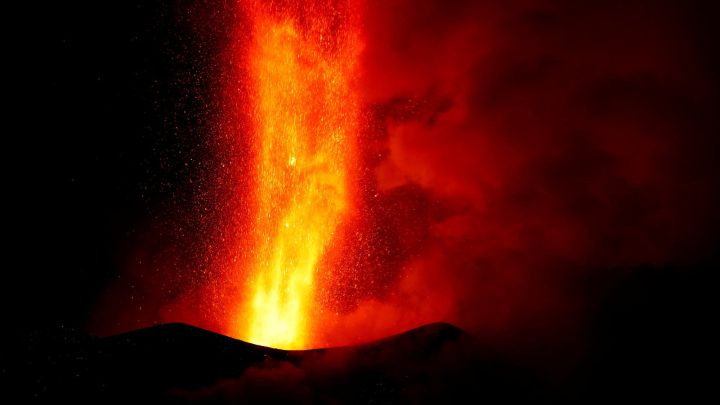
More than two months after eruptions first began, the Cumbre Vieja volcano on La Palma, one of Spain's Canary Islands, continues to create new issues for residents. Since mid-September, residents have had to deal with a slew of hazards including ever-expanding flows of molten lava, homes buried by ash fallout and earthquakes, just to name a few.

Additional risks developed early this week after a third lava flow crashed into the ocean and set off a chemical reaction.

As the hot, molten lava met the relatively cool ocean on Monday, thick clouds of potentially toxic gases were lofted into the atmosphere and forced authorities to order a lockdown for residents of three coastal towns, according to Reuters. Residents of Tazacorte, San Borondon and portions of El Cardon were ordered to remain indoors with doors and windows shut for safety.

Even residents on the opposite side of the island from the most recent lava flow were told to take precautions early this week. In Santa Cruz, the capital city of La Palma, officials recommended that residents wear masks due to high concentrations of particulate matter and sulfur dioxide in the air, Reuters reported.

This was the first time since the Cumbre Vieja volcano began to erupt on Sept. 19 that such a recommendation was made for the capital city, home to 15,000 residents.

Although coastal lockdowns were lifted on Wednesday after the toxic gas began to disperse, masking recommendations remained in place, according to Reuters.

Since the eruption began, more than 7,000 people on the island have been forced to evacuate, according to Diario AS. At least one death has been attributed to the volcano.

Thus far, the eruption has covered about 2,654 acres (1,074 hectares) of land and led to the destruction of more than 2,600 buildings on the western side of the island, according to Copernicus Emergency Management Service, which provides mapping products based on satellite imagery.

In addition to the destruction of buildings, La Palma's banana crop has also suffered significant losses. The island's banana industry has lost an estimated $100 million USD in revenue since September, according to NPR.

Of the lava's 2,654 acres (1,074 hectares) extent, about 106 acres (43 hectares) is actually newly-formed land that was created as a result of lava flowing into the Atlantic Ocean, according to Reuters.

While thousands of buildings have been swallowed by the lava, leaving thousands without a place to live, and some banana crops that are crucial to the island's economy have been destroyed, experts say volcanic activity is actually vital for the survival of the island itself.

"If this didn't happen, the islands would be completely eroded by the sea. We wouldn't have a place to live. So, while it is destructive and traumatic, it is a constructive process. The island is expanding and growing," Carmen Solana told NPR. Solana is a volcanologist at the University of Portsmouth and grew up in the Canary Islands.

Experts say prolonged eruptions are not unusual for the region, which was formed by volcanic activity millions of years ago. Solana says the kind of prolonged eruptions like the one underway on La Palma can typically last between one and three months.

The lengthy eruption continues to disrupt operations at the La Palma Airport, located on the eastern coast of the island. The airport was shut down last weekend after ash buried the runway, leaving some passengers stranded on the island and forcing others to take a ferry to nearby islands.

The airport resumed operations on Thursday after the ash was cleaned, but officials cautioned the continued presence of the ash cloud in the atmosphere could still disrupt operations of individual airlines.

On Friday, a new fissure opened up on the volcano and ash once again covered the airport, shutting down operations.


La Palma volcano, live updates today: eruption, tsunami warning and latest news | Canary Island

AS USA


Cumbre Vieja volcano: latest news

Headlines

New lava flow from fresh fissure has "almost stopped", La Palma local government says

- Canary Islands regional premier promises more homes for those displaced by eruption

- Lockdown lifted in La Palma

All flights to and from La Palma remain suspended on Friday

- Optimism that La Palma airport will be able to operate on Saturday

- Cumbre Vieja rated at alert level 3

- First V-VI intensity earthquake recorded on La Palma

- Cumbre Vieja eruption has been active for over two months, having started on 19 September

Useful information

AS speaks to expert in volcanology about the effects of lava reaching the sea

- The lowdown on the active volcanoes on the Canary Islands

- Where are most volcanoes found on Earth


REST IN POWER
Oregon-born gray wolf dies after 'epic' California trek


FILE - This February 2021 released by California Department of Fish and Wildlife, shows a gray wolf OR93, near Yosemite, Calif. An Oregon-born gray wolf that thrilled biologists as it journeyed far south into California was found dead after apparently being struck by a vehicle, authorities said Wednesday, Nov. 24, 2021. No foul play was suspected in the death of the male wolf known as OR93, the California Department of Fish and Wildlife said in a press release.
 (California Department of Fish and Wildlife via AP, File)More

Wed, November 24, 2021,


SACRAMENTO, Calif. (AP) — An Oregon-born gray wolf that thrilled biologists as it journeyed far south into California was found dead after apparently being struck by a vehicle, authorities said Wednesday.

No foul play was suspected in the death of the male wolf known as OR93, the California Department of Fish and Wildlife said in a news release. Gray wolves are listed as endangered in California, where they were wiped out by the 1920s.

“Before his demise, he was documented traveling the farthest south in California since wolves returned to the state, which is historically wolf habitat. The last documented wolf that far south was captured in San Bernardino County in 1922,” the department said.

A truck driver reported spotting the dead wolf on Nov. 10 near the Kern County town of Lebec, about 75 miles (120 kilometers) northwest of downtown Los Angeles.

The carcass was located along a dirt trail near a frontage road running parallel to Interstate 5, and a warden who responded quickly identified the wolf as OR93 because of a radio tracking collar it wore, the department said.

A necropsy performed at Wildlife Health Laboratory in Rancho Cordova found that the wolf had significant tissue trauma to its left rear leg, a dislocated knee and soft tissue trauma to the abdomen.

OR93 was born to the White River pack in northern Oregon in 2019. He went into California’s Modoc County on Jan. 30, 2021, returned to Oregon briefly, then again entered California on Feb. 4 and headed south.

His last collar transmission was from the central coast’s San Luis Obispo County on April 5. By then he had traveled at least 935 miles (1,505 kilometers) in California, the wildlife department said.

OR93 was among a small number of gray wolves that have begun coming to California from other states.

“I’m devastated to learn of the death of this remarkable wolf, whose epic travels across California inspired the world,” Amaroq Weiss, senior wolf advocate at the Center for Biological Diversity, said in a statement.

“In this annual time of reflection, I thank him for the hope he gave us and for a brief glimpse into what it would be like for wolves to roam wild and free again,” Weiss said.
Flight PS752 tragedy: Passengers on doomed plane used as 'human shield', Iran tampered with electronic devices, new report says
MANY WERE CANADIAN IRANIANS


KIEV, UKRAINE - 2021/01/08: Relatives and colleagues seen during the ceremony at the site of the future monument. In memory of the victims of the flight PS752 on the first anniversary of the plane crash. Boeing 737-800 passenger plane flight PS752 of Ukraine International Airlines (UIA) crashed near the International Airport of Imam Khomeini in Tehran, Iran, shortly after taking off on January 8, 2020. All 176 people on board the airliner died. Among them 11 Ukrainians - two passengers and nine crew members. Passengers of the airliner were citizens of Iran, Canada, Sweden, Afghanistan, Germany, and Great Britain. (Photo by Pavlo Gonchar/SOPA Images/LightRocket via Getty Images)More

Elisabetta Bianchini
Thu, November 25, 2021,

A newly released report from the Association of Families of Flight PS752 Victims claims the Iranian government deliberately did not close the airspace to civilian flights, using passenger flights to "shield against possible American attacks."

At the highest levels of military alertness, the government of Iran used passenger flights as human shield against possible American attacks, by deliberately not closing the airspace to civilian flights.Report by Association of Families of Flight PS752 Victims

On Jan. 8, 2020, 176 people on board the Ukrainian Airlines flight, including 55 Canadians and 30 permanent residents, were killed when the plane was shot down by Iran's Islamic Revolutionary Guard after taking off from the Tehran airport.

KIEV, UKRAINE - 2021/01/08: Portraits of dead passengers and pilots displayed on a large screen during the ceremony at the site of the future monument. In memory of the victims of the flight PS752 on the first anniversary of the plane crash. Boeing 737-800 passenger plane flight PS752 of Ukraine International Airlines (UIA) crashed near the International Airport of Imam Khomeini in Tehran, Iran, shortly after taking off on January 8, 2020. All 176 people on board the airliner died. Among them 11 Ukrainians - two passengers and nine crew members. Passengers of the airliner were citizens of Iran, Canada, Sweden, Afghanistan, Germany, and Great Britain.
 (Photo by Pavlo Gonchar/SOPA Images/LightRocket via Getty Images)
Claims of tampering with electronic devices

The new report claims that electronics were deliberately tampered with, including missing memory cards.

"The bent electronics have raised questions and concerns among several families," the report states. "One likely explanation is that these electronics may have been bulldozed over in an attempt to destroy any potential evidence that victims recorded in the last minutes of their lives."

"Bulldozing the crash site and not delivering many electronic devices of passengers and flight crew clearly demonstrate the government of Iran’s attempts to systematically conceal the downing of flight PS752."

Examination of four devices showed damages that were "inconsistent with damages caused by a sudden and hard impact."

"The fact that these memory/data components are missing is not consistent with damage caused by a sudden and hard impact," the findings from former Toronto police homicide detective, Mark Mendelson, whose consulting firm examined electronic devices, reads.

"Moreover, the fact that screws were removed and covers pried open strongly suggests that concerted efforts were made to extract these components, rendering a review of data impossible."

The report goes on to claim that DNA testing on some victims' bodies did not align with the stated identification by Iranian authorities.

"This neglectfulness on the part of the government of Iran has had serious psychological consequences for families, some of whom did not receive the whole bodies of their loved ones and were given the remains of other victims instead," the report reads.

The report highlights that Iran's Revolutionary Guard Corp operator of the missile system that shot down the plane had "vast experience" with these systems and it is "difficult to imagine that the operator could not distinguish between an alleged cruise missile and PS752."

It also states that it is "highly unlikely" that the missile system operator "could not distinguish the aircraft from a cruise missile, as claimed by Iran."

"It is implausible that the missile system operator simply confused a much larger civilian aircraft, moving in more gradual patterns and at a slower speed, for a cruise missile," the report reads.


'We need urgent actionable support'

The Association of Families of Flight PS752 Victims has been calling for domestic and international investigations, and continues to urge the Canadian government to facilitate a clarification of what happened on Jan. 8, 2020 with the necessary legal and political actions.

“The findings of our report reinforce why we need urgent actionable support and help from governments to facilitate the clarification and truth about what happened that led to the downing of Flight PS752,” a statement from Hamed Esmaeilion, president and spokesperson of the association, reads.

“It’s clear that this tragedy cannot be referred to as just a horrific combination of coincidences. Among logistical findings, the systematic concealment of the root cause of the crash, the destruction of evidence at the crash site, and Iran's vague and misleading reports, all indicate that the downing of Flight PS752 was deliberate.”

In collaboration with the Raoul Wallenberg Centre for Human Rights (RWCHR), a joint submission has been filed with the UN to appoint an impartial fact-finding mission into the downing of Flight PS752.

“As we approach the two-year anniversary of the downing of Flight PS752, Iran continues to conceal evidence and do everything in their power to silence the victims and shield officials from accountability,” a statement from Honourable Irwin Cotler, RWCHR Chair and former Justice Minister of Canada.

“The report’s comprehensive body of evidence provides the necessary grounds to open domestic and international criminal investigations to bring the high-level perpetrators to justice.”