Tuesday, February 15, 2022

The Terrible Fate Facing the Afghan People


 Facebook

Photograph Source: DVIDSHUB – CC BY 2.0

On February 8, 2022, UNICEF (the United Nations Children’s Fund) Afghanistan sent out a bleak set of tweets. One of the tweets, which included a photograph of a child lying in a hospital bed with her mother seated beside her, said: “Having recently recovered from acute watery diarrhea, two years old Soria is back in the hospital, this time suffering from edema and wasting. Her mother has been by her bedside for the past two weeks anxiously waiting for Soria to recover.” The series of tweets by UNICEF Afghanistan show that Soria is not alone in her suffering. “One in three adolescent girls suffers from anemia” in Afghanistan, with the country struggling with “one of the world’s highest rates of stunting in children under five: 41 percent,” according to UNICEF.

The story of Soria is one among millions; in Uruzgan Province, in southern Afghanistan, measles cases are rising due to lack of vaccines. The thread to the tweet about Soria from UNICEF Afghanistan was a further bleak reminder about the severity of the situation in the country and its impact on the lives of the children: “without urgent action, 1 million children could die from severe acute malnutrition.” UNICEF is now distributing “high energy peanut paste” to stave off catastrophe.

The United Nations has, meanwhile, warned that approximately 23 million Afghans—about half the total population of the country—are “facing a record level of acute hunger.” In early September, not even a month after the Taliban came to power in Kabul, the UN Development Program noted that “A 10-13 percent reduction in GDP could, in the worst-case scenario, bring Afghanistan to the precipice of near universal poverty—a 97 percent poverty rate by mid-2022.”

The World Bank has not provided a firm calculation of how much of Afghanistan’s GDP has declined, but other indicators show that the threshold of the “worst-case scenario” has likely already passed.

When the West fled the country at the end of August 2021, a large part of the foreign funding, which Afghanistan’s GDP is dependent on, also vanished with the troops: 43 percent of Afghanistan’s GDP and 75 percent of its public funding, which came from aid agencies, dried up overnight.

Ahmad Raza Khan, the chief collector (customs) in Khyber Pakhtunkhwa in Pakistan, says that exports from his country to Afghanistan have dropped by 25 percent; the State Bank of Pakistan, he says, “introduced a new policy of exports to Afghanistan on December 13” that requires Afghan traders to show that they have U.S. dollars on them to buy goods from Pakistan before entering the country, which is near impossible to show for many of the traders since the Taliban has banned the “use of foreign currency” in the country. It is likely that Afghanistan is not very far away from near universal poverty with the way things stand there presently.

On January 26, 2022, UN Secretary-General António Guterres said that “Afghanistan is hanging by a thread,” while pointing to the 30 percent “contraction” of its GDP.

Sanctions and Dollars

On February 7, 2022, Taliban spokesperson Suhail Shaheen told Sky News that this perilous situation, which is leading to starvation and illness among children in Afghanistan, “is not the result of our [Taliban] activities. It is the result of the sanctions imposed on Afghanistan.”

On this point, Shaheen is correct. In August 2021, the U.S. government froze the $9.5 billion that Afghanistan’s central bank (Da Afghanistan Bank) held in the New York Federal Reserve. Meanwhile, family members of the victims who died in the 9/11 attacks had sued “a list of targets,” including the Taliban, for their losses and a U.S. court later ruled that the plaintiffs be paid “damages” that now amount to $7 billion. Now that the Taliban is in power in Afghanistan, the Biden administration seems to be moving forward “to clear a legal path” to stake a claim on $3.5 billion out of the money deposited in the Federal Reserve for the families of the September 11 victims.

The European Union followed suit, cutting off $1.4 billion in government assistance and development aid to Afghanistan, which was supposed to have been paid between 2021 and 2025. Because of the loss of this funding from Europe, Afghanistan had to shut down “at least 2,000 health facilities serving around 30 million Afghans.” It should be noted here that the total population of Afghanistan is approximately 40 million, which means that most Afghans have lost access to health care due to that decision.

During the entire 20-year period of the U.S. occupation of Afghanistan, the Ministry of Public Health had come to rely on a combination of donor funds and assistance from nongovernmental organizations (NGOs). It was as a result of these funds that Afghanistan saw a decline in infant mortality and maternal mortality rates during the Afghanistan Mortality Survey 2010. Nonetheless, the entire public health care system, particularly outside Kabul, struggled during the U.S. occupation. “Many primary healthcare facilities were non-functional due to insecurity, lack of infrastructure, shortages of staff, severe weather, migrations and poor patient flow,” wrote health care professionals from Afghanistan and Pakistan, based on their analysis of how the conflict in Afghanistan affected the “maternal and child health service delivery.”

Walk Along Shaheed Mazari Road

On February 8, 2022, an Afghan friend who works along Shaheed Mazari Road in Kabul took me for a virtual walk—using the video option on his phone—to this busy part of the city. He wanted to show me that in the capital at least the shops had goods in them, but that the people simply did not have money to make purchases. We had been discussing how the International Labor Organization now estimates that nearly a million people will be pushed out of their jobs by the middle of the year, many of them women who are suffering from the Taliban’s restrictions on women working. Afghanistan, he tells me, is being destroyed by a combination of the lack of employment and the lack of cash in the country due to the sanctions imposed by the West.

We discuss the Taliban personnel in charge of finances, people such as Finance Minister Mullah Hidayatullah Badri and the governor of the Afghanistan central bank Shakir Jalali. Badri (or Gul Agha) is the money man for the Taliban, while Jalali is an expert in Islamic banking. There is no doubt that Badri is a resourceful person, who developed the Taliban’s financial infrastructure and learned about international finance in the illicit markets. “Even the smartest and most knowledgeable person would not be able to do anything if the sanctions remain,” my friend said. He would know. He used to work in Da Afghanistan Bank.

“Why can’t the World Bank’s Afghanistan Reconstruction Trust Fund (ARTF) be used to rush money to the banks?” he asked. This fund, a partnership between the World Bank and other donors, which was created in 2002, has $1.5 billion in funds. If you visit the ARTF website, you will receive a bleak update: “The World Bank has paused disbursements in our operations in Afghanistan.” I tell my friend that I don’t think the World Bank will unfreeze these assets soon. “Well, then we will starve,” he says, as he walks past children sitting on the side of the street.

This article was produced by Globetrotter.

Vijay Prashad’s most recent book (with Noam Chomsky) is The Withdrawal: Iraq, Libya, Afghanistan and the Fragility of US Power (New Press, August 2022).

The Case for Equal Protections for Wolves Throughout Their Range


 Facebook

Gray wolf. Photo: Jeffrey St. Clair.

Last week, the U.S. District Court of Northern California handed down a landmark ruling that struck down the Trump administration’s nationwide de-listing of wolves under the Endangered Species Act. Hailed as a major conservation victory, the ruling grants strong federal protections in the Great Lakes region and along the West Coast, as well as some Interior West states where wolf populations are just beginning to establish themselves. Unfortunately, the court ruling does nothing to curb the extinction agendas of the state governments in Idaho, Wyoming and Montana – the states where the threats to wolves are greatest.

If wolves deserve federal protections across the vast majority of the United States, based on the the best available science, then the need for federal oversight is even more compelling in these three states. The Biden administration now has the opportunity – indeed, the responsibility – to protect wolves under the Endangered Species Act throughout the western states, providing equal protection under the law.

All three states recently changed their laws and regulations to maximize the slaughter of wolves, seeking to turn back the clock and repeat the 19th Century wolf extinction policies cooked up by the livestock industry and a handful of rabidly anti-wolf hunting organizations.

Wyoming is the original bad-actor state, and adopted a state management plan that marks wolves for extinction across 85% of the state. It also subjected the remainder (the lands surrounding Yellowstone and Grand Teton National Parks) to aggressive levels of trophy hunting. Under this plan, it is perfectly legal to kill a wolf at any time of year, by multiple means, without so much as a bag limit or even a hunting license. It was Wyoming that showcased the horrific practice of “coyote whacking,” running down both wolves and coyotes with snowmobiles repeatedly, until they are killed. When a Wyoming legislator introduced a bill to ban this practice, it was swiftly killed in committee, granting a level of legislative approval to a barbaric practice that should land the offender in prison.

Idaho is doing its best to catch up, with the legislature passing a bill taking control of wolf management – over the objections of its own Fish and Game Commission – and authorizing year-round trapping throughout much of the state and allowing trophy hunters to purchase unlimited quantities of wolf tags with a goal of eliminating 90% of the state’s wolf population. The bill authorizes hunters to pursue wolves on ATVs and snowmobiles, allows aerial gunning, and allows baiting and night-vision goggles to be used. Ignoring other pressing needs like education spending, the State of Idaho also authorized $1 million in taxpayer funds specifically to kill wolves.

In Montana, aggressive expansion of hunting and trapping seasons has resulted in a bloodbath at the hands of trophy hunters. Some 24 of the wolves who live in Yellowstone National Park – including the entire Phantom Lake Pack – have been killed over the past year after wandering across the Park boundary into unprotected Montana lands where trophy hunting is authorized. The Indigenous group Protect the Wolves petitioned the states of Montana and Wyoming to block hunting and trapping within a Sacred Resource Protection Zone extending for 31 miles around both Yellowstone and Grand Teton National Parks, but state governments showed depraved indifference for the fate of National Park wolves, beloved by millions of Americans, authorizing hunting to extend right up to Park boundaries. The killings not only disrupt social relationships among Yellowstone wolves, but also interfere with scientific studies and disrupt natural processes.

All three of these anti-wolf state governments are actively “managing” (a generous euphemism for this killing free-for-all) wolves down to their target of 15 packs in each state, a level that fails to maintain a minimum viable population of wolves in the region. It’s a recipe for extinction, which is exactly what the livestock producers and their allies want, and exactly what the Endangered Species Act is intended to prevent. Protecting wolves in eastern Washington and Oregon is also needed to prevent excessive wolf killings in reprisal for livestock losses.

Recently, conservationists petitioned the Biden administration to list wolves as endangered throughout the West. The agency issued a positive 90-day finding, acknowledging that substantial scientific information indicates that listing could be warranted. It’s now time for the U.S. Fish and Wildlife Service to follow through on its legal obligations and extend equal federal protections for wolves throughout the western states, including those states where the wolves are presently targeted most aggressively for elimination.

Erik Molvar is a wildlife biologist and is the Laramie, Wyoming-based Executive Director of Western Watersheds Project, a nonprofit group dedicated to protecting and restoring watersheds and wildlife on western public lands.

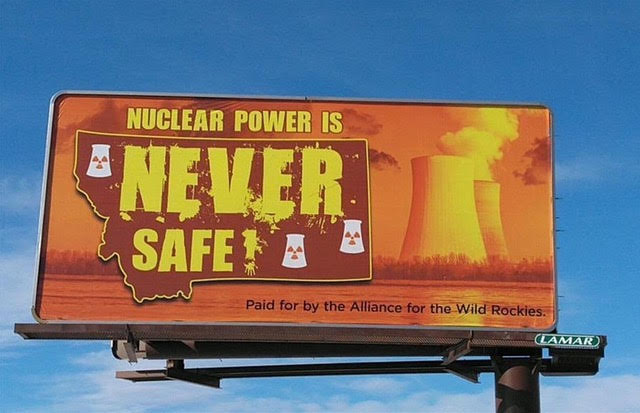
The Alliance needs your help to fight nuclear reactors in Montana


 Facebook


For the last 44 years nuclear power in Montana has been banned unless approved by the voters. The ban was passed by Citizen Initiative, but Republican majorities in the 2021 Montana legislature repealed the ban and Republican Governor Gianforte signed the bill into law. Now, these same Republicans want to build nuclear reactors in Montana to replace the dirty, obsolete coal-fired power plants at Colstrip. There are similar proposals for Wyoming’s shuttered coal plants as well as new reactors at the Idaho National Laboratory.

The Alliance for the Wild Rockies is fighting these proposals and we could really use some help! We have paid to put up two billboards so far and if you’d like to help keep Montana nuke-free it’s quick and easy to donate via our GoFundMe site. Any donation helps, but the more you donate the more we can fight nuclear power.

Many people – and unfortunately a growing number of so-called “green” organizations – see nuclear power as a great non-carbon source of electricity. But the former heads of nuclear regulatory bodies across Europe and the US put out a statement in January voicing their opposition to nuclear energy as a climate solution, writing: “The reality is nuclear is neither clean, safe or smart; but a very complex technology with the potential to cause significant harm. Nuclear isn’t cheap, but extremely costly.” They also added that nuclear power is “unlikely to make a relevant contribution to necessary climate change mitigation needed by the 2030s due to nuclear’s impracticably lengthy development and construction time-lines, and the overwhelming construction of the very great volume of reactors that would be needed to make a difference.”

Gregory Jaczko, former chairman of the US Nuclear Regulatory Commission confirmed that assessment, saying: “Nuclear has shown time and time again that it cannot deliver on promises about deployment and costs. And that’s really the most important factor when it comes to climate.” Jaczko also said we can replace carbon-producing electricity with renewables and he’s right. New renewable sources of electricity as well as ever-improving electricity storage capacity are being built on time and on budget and are generating affordable electricity, unlike nuclear reactors.

2021 report from Wall Street firm Lazard estimated the cost of new nuclear energy at $131 to $204 per megawatt-hour compared to an average cost of $27/MWh for utility-scale solar and $25/MWh for wind. The lower cost for renewable energy more than pays for electricity storage to back up renewable energy.

Mining uranium for nuclear reactor fuel is also dangerous since mining facilities produce tailings that are piled in impoundments close to the mine. These tailings pose serious environmental and health risks from radon emissions, windblown dust, and leaching of contaminants – including heavy metals and arsenic – into the water.

From 1944-1986 the United States extracted 4 million tons of uranium ore from 500 mines on Navajo land that were then abandoned. The rates of lung cancer and other diseases affecting Navajo people living near the mine rose drastically. The Navajo were able to stop uranium mining on their land but these problems still exist with other uranium mines today and should not be ignored in considering the future of nuclear energy.

Due to the fact that uranium is mined in other states and must be shipped into Montana, building nuke plants in Montana to replace the old coal-fired generators will impact people and the environment far from our borders. Moreover, Montana doesn’t need the power since we already export about half of the electricity we generate to other states. This is strictly a high-cost, high-risk scheme to replace 50-year old, uneconomical and environmentally destructive coal plants with uneconomical and dangerous nuclear reactors.
Bottom line is that building nuclear reactors at the headwaters of the greatest rivers in the nation is not just a concern for Montanans but also for all Americans. After all, we outlawed nukes 44 years ago until that ban was overturned last year by an arrogant and ignorant Republican-dominated Legislature and the first Republican governor in 16 years.

The choice is clear: We can and should focus on fighting global warming with conservation, renewable energy generation, and electricity storage – or we can go down an extremely expensive, environmentally-destructive path of nuclear energy that has failed time and time again while leaving behind a legacy of radioactive waste that remains deadly for thousands of years.

The Alliance for the Wild Rockies is working hard to stop the effort to build nuclear reactors in Montana – and we sure would appreciate it if you can find a few bucks to help us out. Thanks!

Mike Garrity is the executive director of the Alliance for the Wild Rockies.


Hathor is Angry: a Glyph


 FEBRUARY 14, 2022

Facebook

Ed Sanders is a poet, musician and writer. He founded Fuck You: a Magazine of the Arts, as well as the Fugs. He edits the Woodstock Journal. His books include: The FamilySharon Tate: a Life and the novel Tales of Beatnik Glory.

On Israel as an Apartheid State: an Interview with Richard Falk


 Facebook

Photograph Source: Chris Yunker – CC BY 2.0

Daniel Falcone: Could you give the context of the framework that brought us to Amnesty International’s findings regarding Israel and Palestine? What has changed regarding the organization to make this happen?

Richard Falk: I have no insight into the inner workings of Amnesty International, but it seems obvious from the length and detailed coverage in their 278-page report that this undertaking was begun years earlier. There were undoubtedly several elements in the background that prompted AI to undertake an inquiry that was bound to be controversial, and from experience to result in an insulting backlash with likely adverse impacts on funding. It has, perhaps, become a bit awkward for AI to dodge the issue of apartheid any longer given the 2001 reports of the two of the most prominent civil society human rights NGOs, Israel’s B’Tselem and Human Rights Watch, which detailed their reasons for concluding that the allegations of apartheid were well grounded in factual evidence and legal analysis.

I would also add that the UN Social and Economic Council for West Asia (ESCWA) academic report co-authored by Virginia Tilley and myself, released in March 2017 had reached similar conclusions, producing acrimonious reactions by Israel and the United States. This pushback reached a climax in a Security Council session, when the American representative, Nikki Haley arrogantly threatened the UN with a punitive response unless this report was repudiated. The recently elected Sec. General, dutifully ordered the report removed from the ESCWA website, which led the director of ESCWA, Rima Khalaf, to resign rather than carry out, a task left to her more compliant successor. So far as I know our report, although removed from the ESCWA website, was never repudiated.

Daniel Falcone: Yair Lapid called the report “false” and “antisemitic.” Do you suppose he believes this to be the case? It seems to be a talking point that is losing its effectiveness. 

Richard Falk: I have now carefully read the AI Report and have concluded that it maintains the highest professional standards of research and analysis throughout. Of course, any legal argument made in the context of a complex fact situation of this sort is subject to logically plausible divergent interpretations. Lawyers earn their livings by learning how to mount arguments defending their respective clients, and I am sure Israel and its supporter abroad have many qualified jurists who can interpret the evidence along lines consistent with Israeli claims of constitutional democracy with human rights equally protected whether the objecting party is a Jew or Palestinian.

Yet for Yair Lapid and others to attack the AI Report as ‘a despicable lie’ that is full of falsehoods, as well as being the work of anti-Semites is nothing other than a shaming tactic designed to redirect the conversation away from the substance of the apartheid allegations to an inquiry into the dubious motivations of AI. This is in an inflammatory and disgracefully irresponsible way of responding in view of AI’s long, distinguished identity as among the most trusted and professional human rights organizations in the world. It is reminiscent of the manner Israel has chosen to respond to all criticisms over the course of the last decade, especially during the period when Netanyahu was prime minister. A similar diatribe was launched against the International Criminal Court a year ago when it formally authorized an investigation of Israeli criminality in response to well-evidenced allegations of a series of distinct crimes by the Palestinian Authority (PA). Incidentally, the PA did not list ‘apartheid’ among its legal grievances.

Daniel Falcone: Lawrence Davidson just wrote a piece called the “Israeli Pogrom,” citing a Zionist group’s attack on Palestinians. Do you see this type of extreme violence as cause for leading up to the report?

Richard Falk: The Davidson essay is devoted to a critique of Israeli settler violence directed at Palestinian civilians living in the West Bank. It shows significantly the double standards manifested by Israeli indulgence of Palestinian abuse by Israeli settlers, while displaying a contrasting vigilance with respect to protecting Jews from Palestinian violence whether in Occupied Palestine or Israel. This certainly manifests racial discrimination carried out with the complicity of the Israeli State. However, it is not evidence of the ideology or even the existence of an apartheid system of control, which either explicitly or implicitly premises governance on racial inequality as between a dominant and subordinate race and adopts specific policies to ensure the persistence of structures of inequality. In Israel’s case it denies complicity and rejects racism as part of its governance plan.

Whether such Israel’s persistent disregard of the obligations of an Occupying Power as set forth in the Fourth Geneva Convention played any role in leading AI to investigate the apartheid allegation remains unknowable as the organization has made no such reference. It is more plausible to suppose that the earlier reports on the apartheid claim played a principal role in leading AI to join the chorus although this is also a matter of conjecture.

Daniel Falcone: According to Haaretz, the US seems ready to dismiss the Amnesty International findings, can you comment on the state of the bipartisan consensus?

Richard Falk: I never for a minute expected the U.S. Government, including Congress, to accept an accusation of apartheid directed at Israel, no matter how impeccable the source and how persuasive the evidence and analysis. For one thing, it would break the special relationship causing a serious disruptive backlash domestically as well as gravely weaken the anti-Iran alliance in the Middle East. We should by not be surprised by the primacy of geopolitics when it collides with the requirement of international law and human rights standards, as well supposedly affirmed national values such as here, anti-racism.

For another, Biden like most of his presidential predecessors unabashedly follows unwaveringly a pro-Israel path in relation to grievances of the Palestinian people, although less crudely than Trump. This predisposition led Biden even to accept several of Trump’s more extreme shows of support for Israeli defiance of the UN consensus, including moving the American Embassy to Jerusalem, the normalization agreements with Arab neighbors, and the annexation of the Golan Heights. In effect, Biden has lowered his voice while maintained continuity most of Trump’s policies. The apparent discontinuities in the form of reviving support for a two-state solution or objection to further settlement expansion are gestures at best, widely known to be policy non-starters having a long record of zero behavioral impact. Above all, because the Oslo-type diplomacy has become superseded by Israeli disinterest in negotiating with the Palestinians, as equals with a shared acceptance of the principal goal being the establishment of an independent sovereign Palestine.

As a result, there is a wide gap in perceptions and attitude between the U.S. Government and the human rights civil society consensus on this crucial question of how to evaluate the apartheid charges. As the AI Report clearly argues, the evidence points to apartheid, and this engages international responsibility to take positive steps to suppress and punish the crime. On this basis AI recommends imposing an international arms embargo on Israel and urges the ICC to investigate the question of Israeli criminality and its legal consequences that is raised by the evidence of Israeli apartheid.

Daniel Falcone: Can you comment on how the Palestinian question is evolving in mainstream US circles? It seems that both individuals and institutions have become more robust to deal with the potential consequences of this political engagement. Can the movement maintain its intensity and enter liberal pragmatic spaces at the same time in your estimation?

Richard Falk: Despite notable developments, Israel continues to hold most of the cards as to the approach taken to the Palestinian question in the U.S. Although the bipartisan consensus and the Zionist civil society infrastructure has somewhat frayed due to the excesses of illiberal Trumpism and because of the increasing normalization of the apartheid critique, Israel still has the upper hand with respect to Congress, White House, and Beltway think tanks.

At the same time, the symbolic victories achieved by the Palestinians over the course of the last two years are significant from a Legitimacy War perspective. Admittedly, to an uncertain extent these developments have been offset by the successes of Trump’s normalization diplomacy (‘The Abraham Accords’), especially as endorsed and extended during the first year of the Biden presidency. It seems premature to reinterpret the symbolic balance between Israel and Palestine as it plays out in the U.S., The picture should become clearer during the next two years.

Because the apartheid line of critique indicts Israel for systemic criminality, which can only be overcome by renouncing the fundamental Zionist claim to secure a fully sovereign Jewish state, it will likely run into a stone wall of resistance in the United States, including in liberal Zionist circles. This resistance may take the form, as it has in NYT/CNNresponse to AI Report, which has been to maintain a stony silence. It is my impression that, not only in the U.S. but throughout the West, liberal opinion with respect to Palestinian grievances is evasive, if not entirely silent. Neither the alternative of implementing the AI recommendations nor the alternative of endorsing the official Israel pushback by way of attacking the reports as full of falsehoods and the work of anti-Semites is acceptable. Under these conditions silence and evasion seem like preferred options.

Yet such a course of action amounts to a validation of critiques of double standards. To weep about excess police force in responding to Hong Kong protest demonstrations or the treatment of the Uyghurs but avert eyes when it comes to the reality of prolonged Palestinian suffering and suppression of basic rights may be a contradiction is morally unacceptable, especially given the history of Western involvement in the political evolution of the Israeli state. At some point, the contradiction may become too blatant to accept even if it currently seems to remain an attractive pragmatic solution in relation to the apartheid critique.

Daniel Falcone: Is there any possibility that mainstream groups labeling the situation as “Apartheid” are making an oversimplification? Aren’t some parts of the region “better” than conditions were in South Africa, and some “worse,” as Chomsky points out. Also, is there a fear that the Palestinian cause is being reduced to a type of US middle class classical rights movements discourse, largely focused on symbolic political rights without constructing a path to wholesale economic policy and transformative justice?

Richard Falk: You raise an important set of overlooked issues. In retrospect, many progressives in South Africa feel that it was a severe mistake to settle for political rights and forego any challenge to white economic and social privilege. And it is also true that when Nelson Mandela was hailed for achieving the breakthrough agreement bringing the apartheid regime to an end, little attention was given to the widespread poverty of the black majority or the gross inequalities in health care, housing, educational opportunity that have hardly changed in the more than 30 years sincepolitical apartheid was dismantled.

At the same time, if Mandela had pressed demands for a more comprehensive approach to societal injustice no agreement at all would have been forthcoming. I am reminded of Hannah Arendt’s comparison between the American Revolution and the French and Russian Revolutions. She argues that the American Revolution was a humanitarian and political success because it didn’t seek to challenge economic and social structures, whereas the French and Russian Revolutions fell a bloody victim to their own laudable ambitions. Arguably the popular movement in Egypt that overthrew an autocratic leader settled for too little, making itself vulnerable to counterrevolutionary reversal, which occurred two years later. I think we are left with an insoluble problem that must be addressed in terms of the particularities of the situation.

Applying these considerations to the Palestinian situation, I would argue that it is preferable to accept limited goals in a manner like what ended apartheid in South Africa. This is ambition enough given the Palestinian circumstances and might make apartheid-ending diplomacy eventually negotiable. As in post-apartheid South Africa, I believe it best to leave the admittedly important economic and social agenda to post-apartheid Israel/Palestine, although realizing that these formidable justice issues remain unresolved.

Daniel Falcone is an activist, journalist, and PhD student in the World History program at St. John’s University in Jamaica, NY as well as a member of the Democratic Socialists of America. He teaches humanities at the United Nations International School and resides in Queens.