Friday, February 25, 2022

Philippine bishops, protesters: no return to Marcos-style rule


By AFP
Published February 25, 2022


Protesters take to the streets of Manila on the anniversary of former dictator Ferdinand Marcos' ouster - Copyright AFP Ted ALJIBE

Protesters took to the streets of the Philippine capital on Friday as church leaders called on the faithful to prevent a return to the abuses of the Ferdinand Marcos era on the anniversary of his ouster and months before a presidential election in which his son is heavily favoured.

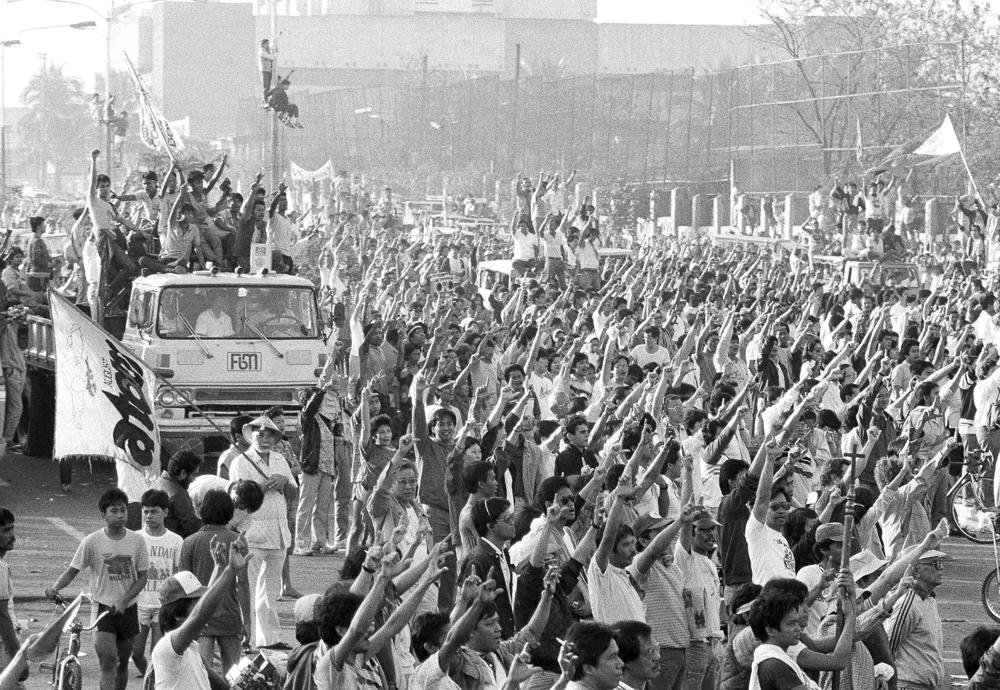
Police in the Catholic-majority country said about 1,100 mostly young protesters gathered on the same Manila highway where millions assembled 36 years ago to end the dictator’s two-decade rule.

“Bring back the loot, not the thief”, they chanted, hoisting a streamer that read: “No to MarcosDuterte2022”. Ferdinand “Bongbong” Marcos Junior is running alongside vice-presidential hopeful Sara Duterte, daughter of President Rodrigo Duterte.

Marcos, 64, has sought to steer public discourse away from the torture, killings and embezzlement of state funds that took place under his father’s rule, instead focusing on the nation’s need to dig itself out from under the coronavirus pandemic.

The capital’s Epifanio de los Santos Avenue was the site of four days of peaceful street protests in 1986 that followed the elder Marcos being accused of stealing the vote from rival Corazon Aquino in a snap presidential election.

Catholic bishops at the time mustered millions of people to protect a small group of military rebels who had holed up at an army base after Marcos uncovered their coup attempt. The protests eventually forced the Marcos family into US exile.

“We don’t want a repeat (of a Marcos presidency), because the Marcoses have been proven corrupt,” Jandeil Roperos, 25, one of Friday’s protesters, told AFP.

– No ‘golden age’ –


On Friday, bishops were again at the fore of the anti-Marcos movement.

In a pastoral letter, the Catholic Bishops Conference of the Philippines said it was the duty of voters to reject “historical revisionism” they say seeks to whitewash the abuses committed under the elder Marcos.

Polls show the predominantly young electorate is set to send the former dictator’s namesake back to the Malacanang presidential palace.

“I think it is obvious from our tone we do not want the dark age of martial law repeated,” the 86-member group’s president, Bishop Pablo David, told reporters when asked if the document alluded to Bongbong.

“People have no business saying that was a golden age because that is a lie.”

While stressing it was not the bishops’ intent to choose for the people, the letter said it was the duty of Catholics “to use their free vote to further the common good”.

“But we are appalled by the blatant and subtle distortion, manipulation, cover-up, repression and abuse of the truth,” it said, including the proliferation of fake news to create an alternative narrative of the country’s history.

The Marcos camp did not reply to AFP’s request for comment.

After he died in Hawaii in 1989, Marcos’ heirs were allowed to return to the Philippines in the 1990s. Bongbong has since been elected governor of his father’s home province, congressman and senator.

50 years apart: Philippine activist fights dictator then son

By JIM GOMEZ and JOEAL CALUPITAN

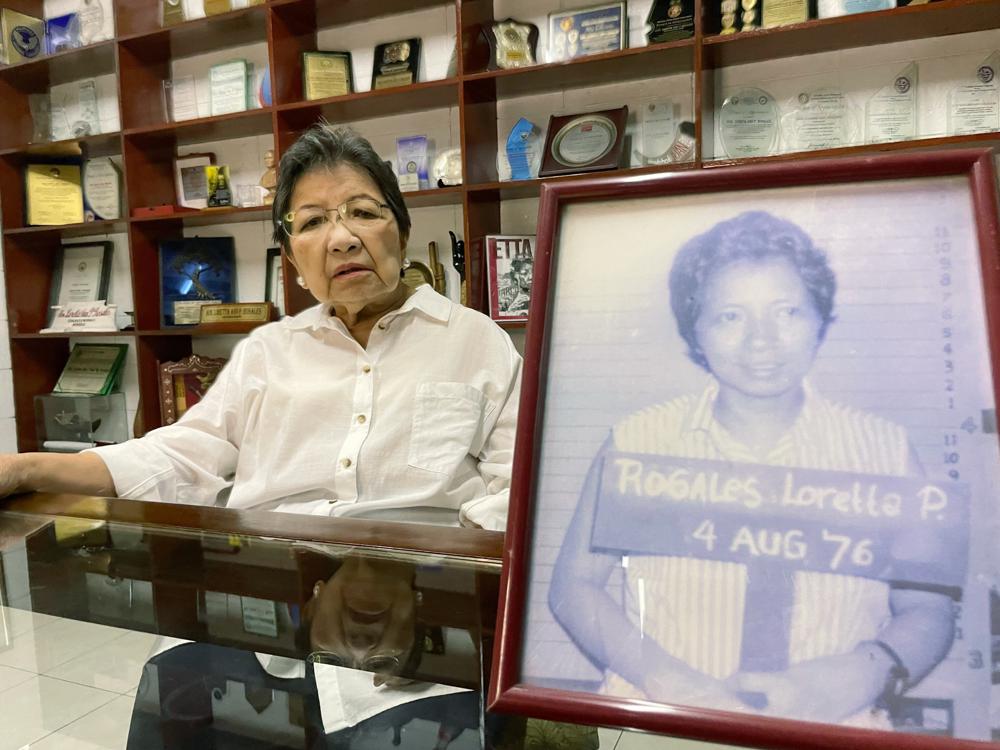
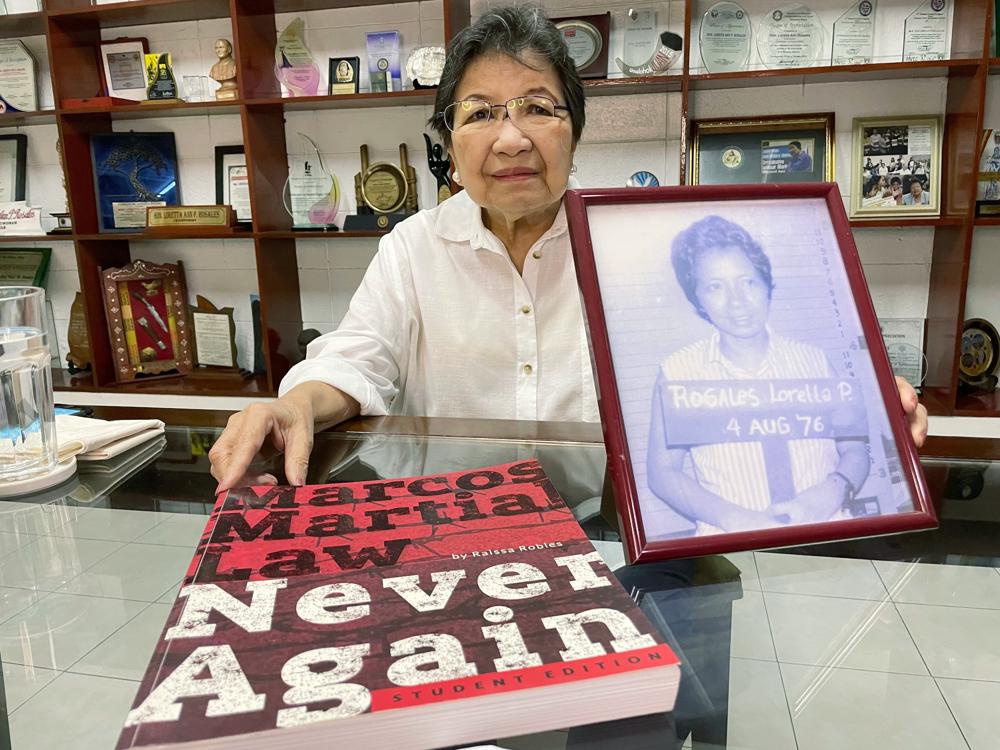
Human rights activist Loretta Rosales sits behind a photo, a grainy military mugshot of her taken after she got arrested in 1976, at her house in Manila, Philippines on Feb. 23, 2022. Memories of the “People Power” revolt by millions of Filipinos who helped overthrow Philippine dictator Ferdinand Marcos 36 years ago are bittersweet for Rosales, who opposed him as an activist and was arrested and tortured by his forces before his downfall. Her battle, however, has gone full circle. The euphoria over that triumph of democracy in Asia has faded through the years and now looks upended with the late dictator’s son and namesake a leading candidate in the May 9 presidential election. 
(AP Photo/Joeal Calupitan)


MANILA, Philippines (AP) — Memories of the “People Power” revolt by millions of Filipinos who helped overthrow Philippine dictator Ferdinand Marcos 36 years ago are bittersweet for Loretta Rosales, who opposed him as an activist and was arrested and tortured by his forces before his downfall.

Her battle has gone full circle.


The euphoria over that triumph of democracy in Asia has faded through the years and now looks upended with the late dictator’s son and namesake a leading candidate in the May 9 presidential election. Ferdinand Marcos Jr.’s rise loomed large as the Southeast Asian nation marked the anniversary Friday of the army-backed uprising that toppled Marcos and became a harbinger of change in authoritarian regimes worldwide.

“It puzzles and dismays me,” said Rosales, who remains a pro-democracy activist at age 82 and is now raising alarms over Marcos Jr. She expressed fears he will take after his father and seek to cover up his crimes and failures.

Rosales was among human rights victims who asked the Commission on Elections to disqualify Marcos Jr. from the presidential race because of a past tax conviction they say showed “moral turpitude” that should bar him from holding public office.

The commission dismissed her petition and five others. All are now on appeal, and an additional one remains pending but will likely also be rejected.

“This is history repeating itself,” Rosales said in an interview. “This is round two.”


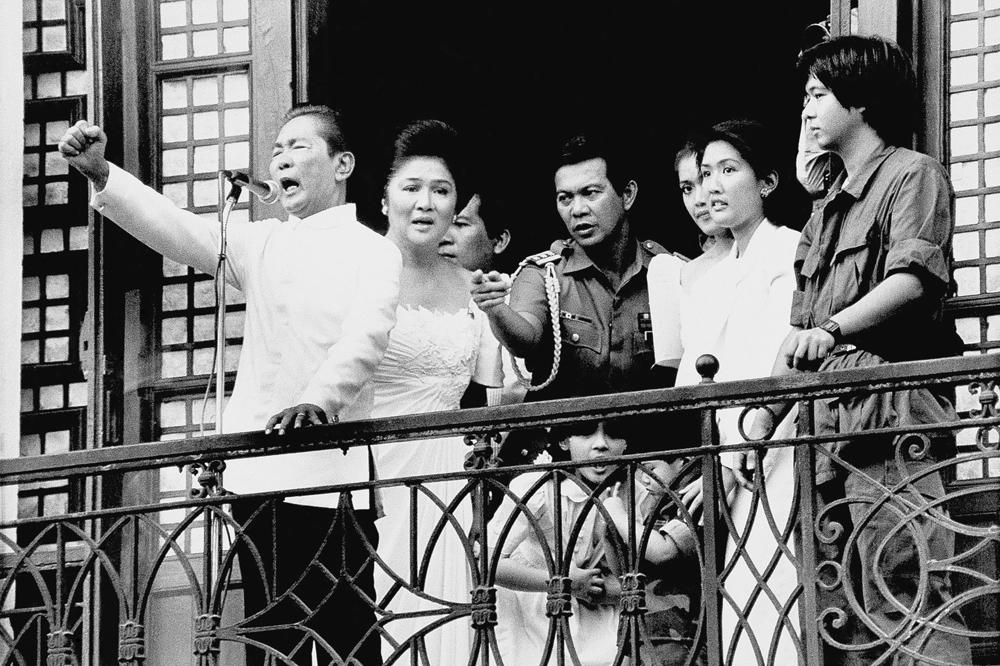
 Ferdinand Marcos, with his wife Imelda at his side and Ferdinand Marcos Jr., far right, gestures strongly from the balcony of Malacanang Palace on Feb. 25, 1986 in Manila, just after taking the oath of office as president of the Philippines. Ferdinand Marcos Jr.'s rise loomed large as the Southeast Asian nation marked the anniversary Friday, Feb. 25, 2022 of the army-backed uprising that toppled Marcos and became a harbinger of change in authoritarian regimes worldwide. (AP Photo/Alberto Marquez, File)


Marcos Jr., 64, who has served as a governor, congressman and senator, leads popularity surveys in the presidential race by a large margin despite his family’s history. He has called the allegations against his father “lies” and his campaign steadfastly focuses on a call for unity while staying away from past controversies.

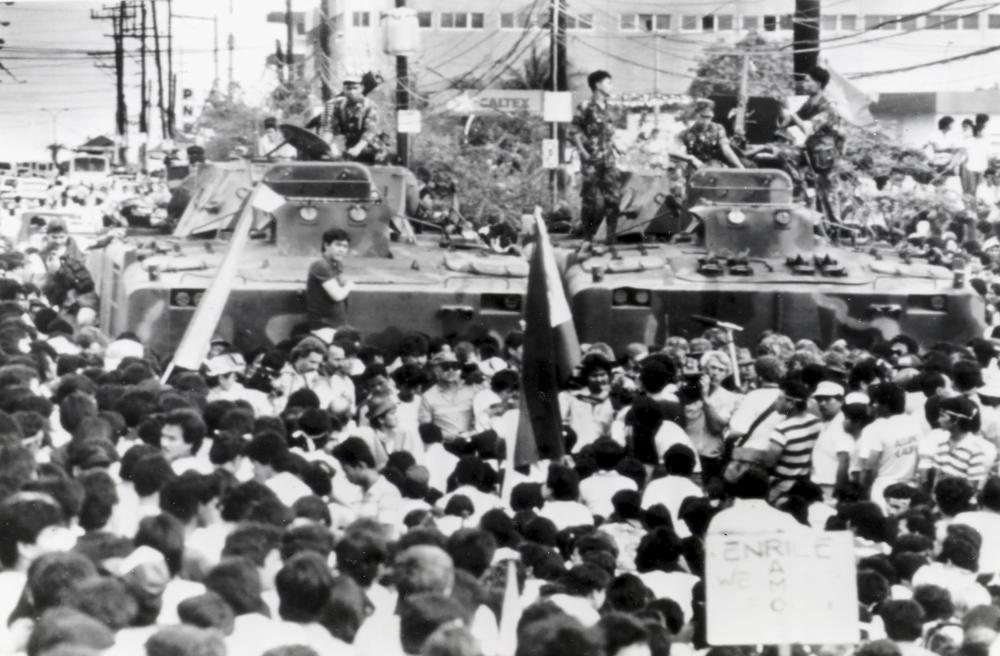
The four-day revolt that forced the elder Marcos from power in 1986 unfolded when then-defense chief Juan Ponce Enrile and his forces withdrew their support from him after their coup plot against the ailing leader was uncovered. Later joined by a top general, Fidel Ramos, they barricaded themselves in two military camps along the main EDSA highway in the capital, where a Roman Catholic leader summoned Filipinos to bring food and support the mutinous troops.

A mammoth crowd turned up and served as a human shield for the defectors. Rosary-clutching nuns, priests and civilians kneeled in front of them and stopped tanks deployed to crush the largely peaceful uprising.

The elder Marcos died in 1989 while in exile in Hawaii without admitting any wrongdoing, including accusations that he, his family and cronies amassed an estimated $5 billion to $10 billion while he was in power. A Hawaii court later found him liable for human rights violations and awarded $2 billion from his estate to compensate more than 9,000 Filipinos led by Rosales who filed a lawsuit against him for torture, extrajudicial killings, incarceration and disappearances.

After the Marcos family returned from exile in the early 1990s, Marcos Jr. decided to run for Congress to protect his family from being hounded politically, he told broadcast journalist Korina Sanchez-Roxas in a recent interview.

In Rosales’s suburban Manila home, a wall is filled with mementos of a life of activism, including as a member of the House of Representatives for nine years and later as head of the Commission on Human Rights until 2015. The only reminder of the worst moments is a grainy military mugshot showing her with a tense smile and carrying a nameplate with the scribbled date 4 Aug 76. That was when she and five other anti-Marcos activists were arrested by military agents while meeting in a restaurant four years after Marcos placed the Philippines under martial law in 1972.


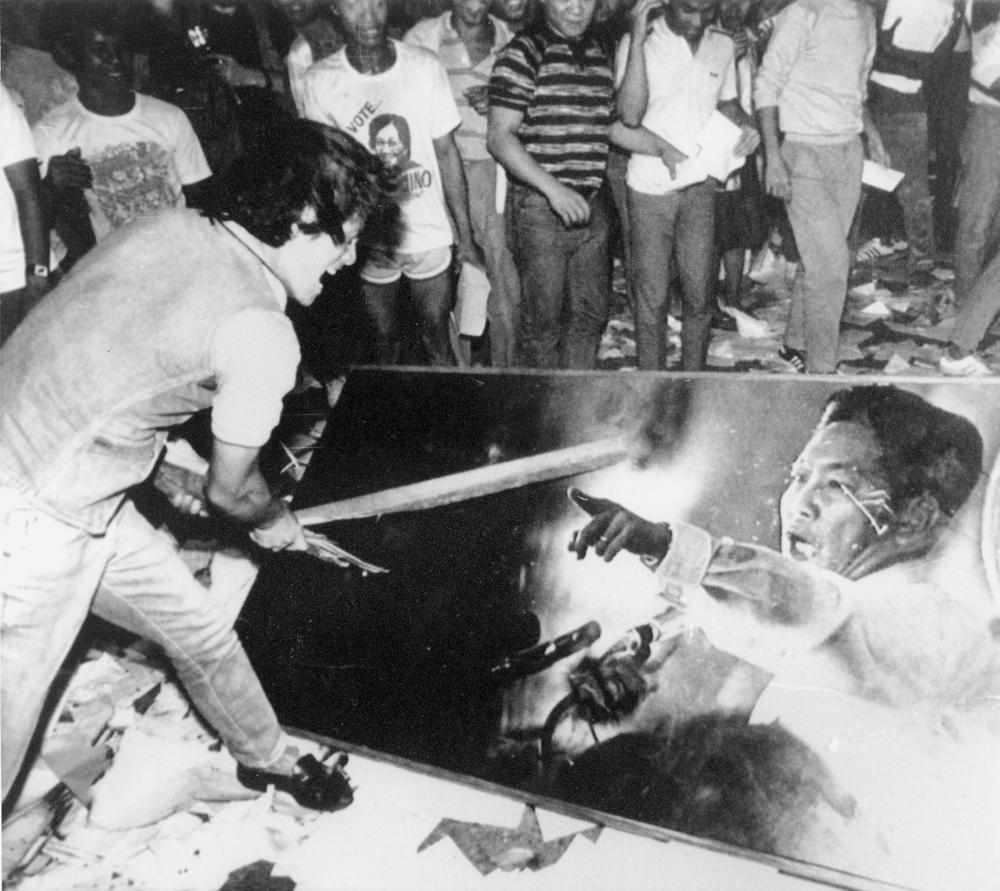
 A Filipino youth slashes an oil painting of Philippine dictator Ferdinand Marcos with a stick as looters stormed the Presidential Palace in Manila, Philippines on Feb. 25, 1986. Ferdinand Marcos Jr.'s rise loomed large as the Southeast Asian nation marked the anniversary Friday, Feb. 25, 2022 of the army-backed uprising that toppled Marcos and became a harbinger of change in authoritarian regimes worldwide. (AP Photo/Mari Vargas, File)

“I was smiling, that was before the torture,” Rosales said.

For about two days in a military hideout, her captors blindfolded her and clipped wires on her fingers and toes and ran streams of electricity that caused her body to convulse wildly, she said. Her mouth was gagged so she could not scream. At other times, she said she was subjected to Russian roulette, in which a captor pointed a revolver to her head and pulled the trigger several times to force her to inform on other activists. “There was sexual molestation,” said Rosales, who was eventually freed.

Nearly four decades after democracy was restored, the Philippines remains mired in poverty, corruption, inequality, long-running communist and Muslim insurgencies and political divisions. Pre-pandemic economic growth mostly benefited the wealthiest families and failed to lift millions from desperation. At the height of the pandemic, unemployment and hunger worsened to record levels.

“Ordinary Filipinos look at these realities and they question whether this is really what they want,” Manila-based academic and analyst Richard Heydarian said, adding that disenchantment over the failures of liberal reformist politics in the post-dictatorship era steadily grew. “This is where Marcos came in and said we are the ultimate alternative.”

Many Filipinos remember relative peace and quiet under martial law in the 1970s and well as lavish infrastructure projects, and Marcos Jr. has promised increased prosperity and peace.

His current strong following did not emerge overnight. As a vice presidential candidate in 2016, he won more than 14 million votes, losing to Leni Robredo by only 263,000 votes.

Robredo, the leading liberal opposition candidate in the presidential race, ranks second in most popularity polls but is far behind Marcos Jr. three months before the vote.

In a measure of how history has shifted, Enrile, now 98, has endorsed Marcos Jr.’s candidacy. Ex-army Col. Gregorio Honasan, a key leader of the coup plot against the elder Marcos, has been adopted by Marcos Jr. in his senatorial slate. Honasan, 73, said he has not decided whom to support among the presidential aspirants but that the choice of the people should be respected.

“If the Filipino people decide to have a collective national amnesia and say, `let’s give another Marcos a chance,’ who are we to question that?” Honasan said in an interview.

Rosales, who backs Robredo, remains hopeful and pointed to large numbers of volunteers who are campaigning for the current vice president on social media and across the country due to exasperation over corrupt and inept politicians.

“This volunteerism is a new kind of resistance,” Rosales said. “It is people power.”

___

Associated Press journalist Kiko Rosario contributed to this report.
TWO YEARS IN THE MAKING
Canada authorises first plant-based COVID-19 vaccine

Medicago's two-dose vaccine can be given to adults ages 18 to 64

By PTI Updated: February 25, 2022 13:13 IST


Canada has become the first country to authorize use of a plant-based COVID-19 vaccine.

Canadian regulators said Thursday Medicago's two-dose vaccine can be given to adults ages 18 to 64, but said there's too little data on the shots in people 65 and older.

The decision was based on a study of 24,000 adults that found the vaccine was 71 per cent effective at preventing COVID-19 although that was before the omicron variant emerged. Side effects were mild, including fever and fatigue.

Medicago uses plants as living factories to grow virus-like particles, which mimic the spike protein that coats the coronavirus. The particles are removed from the plants' leaves and purified. Another ingredient, an immune-boosting chemical called an adjuvant that is made by British partner GlaxoSmithKline, is added to the shots.

While numerous COVID-19 vaccines have been rolled out around the world, global health authorities are looking to additional candidates in hopes of increasing the worldwide supply.

Quebec City-based Medicago is developing plant-based vaccines against multiple other diseases, and the COVID-19 vaccine may help spur more interest in this new method of medical manufacturing.
RIP
Oscar-nominated ‘MASH’ actor Sally Kellerman dies at 84

By ANDREW DALTON

 Sally Kellerman arrives at the premiere of "The Danish Girl" at Regency Village Theatre on Saturday, Nov. 21, 2015, in Los Angeles. Kellerman, the Oscar-nominated actor who played “Hot Lips” Houlihan in director Robert Altman's 1970 army comedy “MASH," died Thursday, Feb. 24, 2022, at age 84. Kellerman died of heart failure at her home in the Woodland Hills section of Los Angeles, her manager and publicist Alan Eichler said. (Photo by Jordan Strauss/Invision/AP, File)

LOS ANGELES (AP) — Sally Kellerman, the Oscar and Emmy nominated actor who played Margaret “Hot Lips” Houlihan in director Robert Altman’s 1970 film “MASH,” died Thursday.

Kellerman died of heart failure at her home in the Woodland Hills section of Los Angeles, her manager and publicist Alan Eichler said. She was 84.

Kellerman had a career of more than 60 years in film and television. She played a college professor who was returning student Rodney Dangerfield’s love interest in the 1986 comedy “Back to School.” And she was a regular in Altman’s films, appearing in 1970′s “Brewster McCloud,” 1992′s “The Player” and 1994′s “Ready to Wear.”

But she would always be best known for playing Major Houlihan, a straitlaced, by-the-book Army nurse who is tormented by rowdy doctors during the Korean War in the army comedy “MASH.”

In the film’s key scene, and its peak moment of misogyny, a tent where Houlihan is showering is pulled open and she is exposed to an audience of cheering men.

“This isn’t a hospital, this is an insane asylum!” she screams at her commanding officer.


She carries on a torrid affair with the equally uptight Major Frank Burns, played by Robert Duvall, demanding that he kiss her “hot lips” in a moment secretly broadcast over the camp’s public address speakers, earning her the nickname.


Kellerman said Altman brought out the best in her.

“It was a very freeing, positive experience,” she told Dick Cavett in a 1970 TV interview. “For the first time in my life I took chances, I didn’t suck in my cheeks, or worry about anything.”

The film was nominated for five Academy Awards, but her best supporting actress was its only acting nod despite a cast that included Duvall, Donald Sutherland and Elliot Gould.

The movie would be turned into a TV series that lasted 11 seasons, with Loretta Swit in Kellerman’s role.

Sally Clare Kellerman was born in 1937 in Long Beach, California, the daughter of a piano teacher and an oil executive, moving to Los Angeles as a child and attending Hollywood High School.

Her initial interest was in jazz singing, and she was signed to a contract with Verve records at age 18. She opted to pursue acting and didn’t put out any music until 1972, when she released the album “Roll With the Feeling.” She would sing on the side, and sometimes in roles, throughout her career, releasing her last album, “Sally,” in 2007.

She took an acting class at Los Angeles City College and appeared in a stage production of “Look Back in Anger” with classmate Jack Nicholson and several other future stars.

She worked mostly in television early in her career, with a lead role in 1962′s “Cheyenne” and guest appearances on “The Twilight Zone, “The Outer Limits,” “The Alfred Hitchcock Hour” and “Bonanza.”

Her appearance in the original “Star Trek” pilot as Dr. Elizabeth Dehner won her cult status among fans.
 
HE'S NO OLIVER STONE
Sean Penn visits Ukraine to make documentary on Russian invasion

US actor and director Sean Penn is in Kyiv making a documentary about Russia's invasion, the Ukrainian president's office said Thursday.


© Provided by WION  Sean Penn 

wionnewsweb@gmail.com (Wion Web Team) - Yesterday 

The double Oscar-winner was photographed attending a government press conference in Kyiv, and could be seen meeting with Volodymyr Zelensky in a video posted to the Ukrainian president's official Instagram account.

"The director came to Kyiv specifically to record all the events taking place in Ukraine and as a documentary filmmaker to tell the world the truth about Russia's invasion of our country," said a post in Ukrainian on the presidential office's Facebook page.

"Today, Sean Penn is among those who support Ukraine while being in Ukraine. Our country is grateful to him for such a display of courage and honesty."

Also read: Ukrainians, please forgive me! Russian actress Irina Starshenbaum on Russia-Ukraine conflict

The post added that "Penn demonstrates the kind of courage that many others, including Western politicians, lack."

Penn, who previously visited Ukraine and met with military staff in November, spoke with journalists and soldiers and "saw how we defend our country," the president's office said.

The 61-year-old star of "Milk" and "Mystic River" is making a documentary for Vice Studios, according to NBC News.

Neither Vice nor Penn's representatives immediately responded to AFP's requests for comment.

His latest visit comes as invading Russian forces pressed deep into Ukraine, with battles raging on the outskirts of Kyiv, and missiles and shells raining down on multiple Ukrainian cities.

Penn has previously attracted controversy as a result of his foray into politics and current affairs, especially after he and Mexican-American actress Kate del Castillo interviewed Mexican drug lord Joaquin "El Chapo" Guzman while he was on the run.

In 2018, Penn was reported to be in Turkey making an as-yet-unreleased documentary about the murder of Saudi journalist Jamal Khashoggi in the kingdom's consulate.
SWIFT, the global finance arm that the West can twist


SWIFT payments network (AFP/Kenan AUGEARD)


Thu, February 24, 2022

An exclusion from SWIFT, a very discreet but important cog in the machinery of international finance, is one of the most disruptive of the possible sanctions that the West could deploy against Russia for its invasion of Ukraine.

Ukrainian President Volodymyr Zelensky called Thursday for such a move after Russian forces invaded his country, as Western powers consider imposing additional sanctions on Moscow.

The White House has pointedly refused in recent weeks to exclude the possibility of barring Russia from the international system that banks use to transfer money, a move that would cripple Russia's ability to trade with most of the world.


European leaders were expected to discuss the measure at their emergency summit later Thursday as one possible option. An EU official briefing journalists suggested the measure would most likely be held in reserve for a future round of sanctions, should the EU need to escalate its punishment.

What is SWIFT?


Founded in 1973, the Society for Worldwide Interbank Financial Telecommunication, or SWIFT, actually doesn't handle any transfers of funds itself.

But its messaging system, developed in the 1970s to replace relying upon Telex machines, provides banks the means to communicate rapidly, securely and inexpensively.

The non-listed, Belgium-based firm is actually a cooperative of banks and proclaims to remain neutral.

What does SWIFT do?


Banks use the SWIFT system to send standardised messages about transfers of sums between themselves, transfers of sums for clients, and buy and sell orders for assets.

More than 11,000 financial institutions in over 200 countries use SWIFT, making it the backbone of the international financial transfer system.

But its preeminent role in finance has also meant that the firm has had to cooperate with authorities to prevent the financing of terrorism.

Who represents SWIFT in Russia?

According to the national association Rosswift, Russia is the second-largest country following the United States in terms of the number of users, with some 300 Russian financial institutions belonging to the system.

More than half of Russia's financial institutions are members of SWIFT, it added.

Russia does have its own domestic financial infrastructure, including the SPFS system for bank transfers and the Mir system for card payments, similar to the Visa and Mastercard systems.

Are there precedents for excluding countries?

In November 2019, SWIFT "suspended" access to its network by certain Iranian banks.

The move followed the imposition of sanctions on Iran by the United States and threats by then Treasury Secretary Steven Mnuchin that SWIFT would be targeted by US sanctions if it didn't comply.

Iran had already been disconnected from the SWIFT network from 2012 to 2016.

Is it a credible threat?

Tactically, "the advantages and disadvantages are debatable," Guntram Wolff, director of the Brussels-based Bruegel think tank, told AFP.

In practical terms, being removed from SWIFT means Russian banks can't use it to make or receive payments with foreign financial institutions for trade transactions.

"Operationally it would be a real headache," said Wolff, especially for European countries which have considerable trade with Russia, which is their single biggest supplier of natural gas.

Western nations threatened to exclude Russia from SWIFT in 2014 following its annexation of Crimea.

But excluding such a major country -- Russia is also a major oil exporter -- could spur Moscow to accelerate the development of an alternative transfer system, with China for example.

bur-bp/rl/kjm


NBA's 2 Ukrainian players release statement denouncing Russian invasion

Jack Baer - Yesterday 

Sacramento Kings center Alex Len and Toronto Raptors wing Sviatoslav Mykhailiuk, the only two Ukrainian players in the NBA, have released a joint statement condemning the Russian invasion of their homeland.

The pair called for unity among the Ukrainian people and prayed for their friends, family and others currently in the country.


The full statement in English:


A great tragedy befell our dear homeland Ukraine. We categorically condemn the war. Ukraine is a peaceful sovereign state inhabited by people who want to decide their own destiny. We pray for our families, friends, relatives and all the people who are in the territory of Ukraine. We hope for an end to this terrible war as soon as possible. Dear fellow Ukrainians, hold on! Our strength is in unity! We are with you! 
Alex Len & Sviatoslav Mykhailiuk

The Russian invasion of Ukraine began early Thursday morning immediately after an effective declaration of war by Russian president Vladimir Putin, with air strikes against cities and military bases across the country and troops and tanks moving across the border from three directions.

Denunciation of the attack against a peaceful country has come in from around the world, as well as from inside Russia. Censuring has come from the realm of sports as well. UEFA has already been reported to be moving its Champions League final out of St. Petersburg following the attack, while four-time Formula 1 champion Sebastian Vetterl is skipping the Russian Grand Prix and calling for the race to be canceled.

Other Ukrainian athletes have spoken out against the attack, most notably the country's famed Klitschko brothers, who have promised to take up arms for their country.
Prosthetics craftsmen hope to 'repair humans' in ailing Venezuela


Thu, February 24, 2022

"I used to repair car tires. Now I repair humans," boasts Jose Bastidas, an amputee who left his auto repair job to make artificial limbs in Venezuela, where the health system has all but collapsed.

"Getting someone to walk is priceless," the 41-year-old told AFP at the Zona Bionica workshop in Caracas.

Bastidas joined the company as a trainee prosthetics manufacturer seven years ago after losing his right leg in a road accident.

"I don't earn much," he said, "but it is thrilling to see people stand up."

There are no statistics on the number of amputees in Venezuela, a country of 30 million people, where three out of four live in extreme poverty, according to a recent study.

The latest data, from 2008, showed that 130,000 people in Venezuela had a physical disability that affects mobility, including amputees.

Zona Bionica says the majority of its clients lost a limb due to a medical problem, such as diabetes, or traffic accidents.

Besides the physical and emotional shock, survivors also have to contend with the cost.

Except for a lucky few beneficiaries of philanthropy, most have to pay all or most of the $1,800 price for the cheapest prosthesis, which needs to be replaced every two years.

The average salary in Venezuela, battered by recession and hyperinflation, is about $50 per month.

- 'We lost a body part, not our lives' -

Heidy Garcia, 30, works in the back office of Zona Bionica, which also runs sponsorship campaigns for amputees in need.

Garcia lost her right leg due to a blood circulation problem four years ago, and proudly displays a personalized turquoise replacement limb under short pants.

"It is very hard at first," said Garcia, referring to phantom pain, cramps and having to get used to attaching the prosthesis, which she managed to acquire through a crowd-funding campaign.

"But you have to keep going and to accept. The mind is very strong."

Garcia said the fact that most of Zona Bionica's workers are amputees brings comfort to new patients.

"I encourage them. They get depressed, they have low morale, but we remind them that we lost a body part, not our lives," Bastidas said.

Cristhian Sequera Quintana, who had both legs amputated after a motorcycle accident in 2015, said that at first, "I did not really want to live."

"I needed help to bathe, to answer the call of nature," the 34-year-old told AFP.

But with the prosthesis, "things changed," said Quintana.

"Now I want to work and live. I want to continue fighting for myself, my son and my family."

pgf/jt/erc/mlr/des/sw


Battle for Brazil's Evangelical vote heats up

Brazil's leftist ex-president Luiz Inacio Lula da Silva, seen here in December 2021, is leading in national polls against Bolsonaro, but lagging behind in Evangelical support (AFP/NELSON ALMEIDA)


Marcelo SILVA DE SOUSA
Thu, February 24, 2022, 

The campaign for Brazil's October presidential elections has not yet officially started, but the candidates are already bending over backwards to woo a powerful constituency: Evangelical Christians.

Evangelicals, who are estimated to make up a third of Brazil's population, were core supporters in President Jair Bolsonaro's victory in 2018, and the far-right leader is doing his best to make sure he keeps hold of the bloc.

But leftist ex-president Luiz Inacio Lula da Silva, who leads in the polls, is courting Evangelicals too, setting up a showdown for the fast-growing demographic in the Latin American giant.

"This is an administration that proudly says it believes in God... that defends Brazilian families," Bolsonaro said last month, summing up his pitch to Evangelical voters.

He had already delivered one key promise in July, following through on his pledge to place a "terribly Evangelical" judge on the Supreme Court by nominating Presbyterian minister Andre Mendonca.

Lula, the popular-but-tarnished ex-president (2003-2010), is not giving up the Evangelicals without a fight, though.

His Workers' Party plans to launch a podcast next month aimed at Evangelical listeners, and this week he met influential pastor Paulo Marcelo Schallenberger to enlist his help in crafting a strategy to win their votes.

Lula is particularly keen to assuage Evangelicals' fears on the question of values, given that many of them see the Brazilian left as too liberal on social issues, a party insider told AFP.

Third-place candidate Sergio Moro, a former graft-busting judge, has also joined the battle: this month he promised Evangelical leaders to follow a list of 14 moral principles, including maintaining Brazil's highly restrictive abortion laws.

"The candidates' actions show how important the Evangelical market is in Brazilian politics," said political scientist Andre Cesar of consulting firm Hold.

"Evangelicals have never had as much space as now," he told AFP.

- Bolsonaro bastion -


Bolsonaro's popularity has been sagging for months, dragged down by a struggling economy and his widely criticized handling of the coronavirus pandemic.

But he continues to enjoy broad support from Evangelical voters -- 44 percent to 32 percent for Lula, according to a poll published last week by PoderData.

That is almost the exact inverse of their poll numbers for the electorate as a whole: 40 percent for Lula and 31 percent for Bolsonaro.

Evangelicals played a decisive role in Bolsonaro's victory four years ago, when he won 70 percent of their votes in the runoff against Lula acolyte Fernando Haddad.


Bolsonaro is not an Evangelical himself -- he is Catholic -- but his wife is fervently Evangelical.

In 2016, he also had himself baptized by an Evangelical pastor in Israel's River Jordan.

The 66-year-old president "shares the same values as Evangelicals on homosexuality, abortion and the importance of the traditional family," said anthropologist Juliano Spyer, author of a book on Brazil's burgeoning Evangelical movement.

"He's not their absolute ideal candidate, but they see him as the best one out there."

- Value call -


Evangelical lawmaker Sostenes Cavalcante says he is confident the faithful will give their vote to Bolsonaro again.

"We haven't had to fight affronts to our values with this administration," he said.

Under Lula and the Workers' Party, he said, Evangelicals "were constantly fighting initiatives on legalizing abortion, gay marriage and sexualizing kids in schools."

However, Evangelicals are an awkward fit with the president's hardline base in demographic terms.

Mostly black, female and poor, they are ill at ease with some of Bolsonaro's stances, including his anti gun control policies.

Like all working-class Brazilians, they have also been hit hard in their wallets as the country has sunk into a malaise of recession and high inflation.

But according to Cavalcante, "even in an economic crisis, Evangelicals will be guided by their values."

msi/jhb/des/oho
AMERICAN EVANGELICAL POWER
'I lost my youth': Women jailed for miscarriages in El Salvador


Elsy, Kenia, Evelyn and Karen (L-R), freed after many years in prison for abortions they say they never had
 (AFP/MARVIN RECINOS)


Carlos Mario MARQUEZ
Thu, February 24, 2022

Kenia was 17 when, she says, she had a miscarriage after a fall and was sent to jail on suspicion of having had an abortion in El Salvador.

Nine years later, she is out after receiving a reprieve, but feels like she was robbed of her youth in a country with among the world's strictest abortion laws.

She was sentenced to 30 years in prison.

"I was deprived of my freedom for such an unjust reason," Kenia said this week at a press conference with three other women who were similarly punished.

"I lost my youth, I lost my family, all my aspirations were taken away from me," she said, in tears.

The four women, who wore face masks throughout the briefing, gave their real first names but withheld their surnames to avoid being further "stigmatized."

After her fall, Kenia recalled, "the last thing I remember seeing was lots of lights... I was in hospital on a stretcher and there were policemen guarding me and taking pictures of me."

One policeman told her he would make sure that she would "rot in prison" and "that is what happened," she said.

Kenia is one of 62 women to have had their "abortion" sentences commuted since 2009, thanks to the efforts of activist groups, said one such campaigner, Sara Garcia.

Ten remain behind bars, however, and two are still awaiting trial.

- 'Because we are women' -


El Salvador has had an outright ban on abortion since 1998, even in cases of rape or if the health of the woman or fetus are in danger.

Terminating a pregnancy can send a woman to jail for up to eight years, but Salvadoran judges often instead find women guilty of "aggravated homicide," which is punishable by up to 50 years in prison.

Many women are prosecuted after seeking medical help for complications in pregnancy, suspected of having attempted an abortion.

The law gives rise to "stigma and prejudice and creates conditions for women to be persecuted, denounced, prosecuted and unjustly imprisoned," said Morena Herrera of the ACDATEE abortion rights group.

Elsy, 38, was recently freed after "ten difficult years in prison" during which she was separated from her son.

Evelyn, 34, spent 13 years behind bars.

"This law is unfair," Evelyn said at the press conference. "We are considered criminals because we are women."

Karen, 28, recounted that she fell ill at home and woke up "in hospital, cuffed to a stretcher."

Even as a newly-free woman, she said she felt judged in El Salvador and regularly received "dirty looks."

"It is important to obtain the freedom of all women unjustly imprisoned, but we must also ensure that there are no more women reported at public hospitals," said Herrera.

cmm/mav/gm/mlr/des/oho