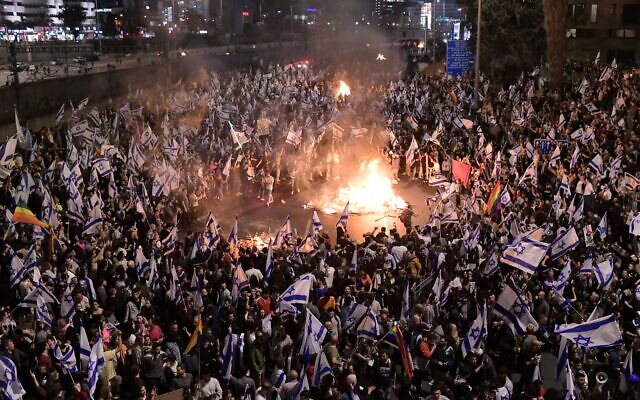
Things fall apart
The firing of Defense Minister Gallant brings to a climax an astonishingly fast and wholly self-inflicted collapse of the Israeli right

The Israeli right is gripped in a deep malaise.
It has its argument about the over-powerful High Court. It believes that argument. It’s been making it for decades. Now, suddenly at the helm of a wholly rightist coalition that no centrist or leftist faction can fell, it believed it had a moment of opportunity.
The government was sworn in at the end of December. By January 4, the great judicial reform was announced by Justice Minister Yariv Levin. The opposition, everyone understood, would rail and rage; old elites watching their displacement would not go quietly into the night. But in the end, the frustration of three decades of judicial overreach, now hardened into a grim determination, would see the coalition through.
That was the plan. Then everything started to go wrong.
It wasn’t the usual things. Former justices did indeed rage on cue. Law scholars signed petitions. But the right-wing coalition was ready with answers. The Israeli court had swollen far beyond anything comparable in the West. On dry but fundamental questions — the power of the court in vetting appointments to itself, the expansion of standing (who can appeal) and justiciability (what issues the court can take up), and on and on — the Israeli court was not, as the right has it, “a judicial dictatorship,” but it was an outlier in the democratic world.
It was wholly reasonable and legitimate to seek to rein it in, and indeed it was once a serious contention of scholars on left and right alike.

For two long months, the right misunderstood the events. The strategy was simple: Pull the Band-Aid off fast, without blinking or wavering. The main problem, Levin and his partner in the reform MK Simcha Rothman believed, would be Benjamin Netanyahu, who has always favored quiet over meaningful, controversial action.
So the decision was made: No debate, engagement or negotiation until the very end of the legislative process would create as few opportunities as possible for a right-wing collapse. Justice Minister Levin refused to give interviews. Calls went out for the opposition to negotiate — but negotiate over what? Levin refused to slow the legislation. The original proposal was extreme even according to its own authors (speaking off-record, of course).
To the half of the country that hadn’t voted for the coalition, the extreme version was the goal, not a tactic on the way to a more moderate version. One doesn’t negotiate the dismantling of democracy on the breakneck schedule of the dismantlers.
In mid-February, one senior figure closely involved in the reform told this writer, “It’s not yet time to compromise.” The early protests, the calls even from supporters of judicial reform to moderate, to explain, to seriously address the growing sense in the streets that this was a full-blown assault on democracy — were rebuffed by right-wing political strategists.
The old elites, they explained, were angry that their cheese was moving.

’I don’t want to defend you’
By the time the political right had grasped the scale of its mistake, it was too late.
It happened at different points for different people, escalating over the past month and reaching a noticeable climax last week, when even impassioned supporters of judicial reform — of this judicial reform — started to rail against the government.
“A self-immolation like this on the right hasn’t been seen around these parts for a long time,” the right-wing columnist Sara Haetzni-Cohen, head of the activist group My Israel, wrote over the weekend.
Calling the reform “one of the most important and significant legal and policy initiatives the right has brought to the table in many years,” she then turned ferociously on the government she’d loyally supported.

“It turns out that the right-wing coalition we elected and for which we prayed doesn’t understand the greatness of the hour,” she charged. “Almost every day we awaken to another idiotic bill or embarrassing public statement produced by this coalition. The list of narrow and self-interested bills, whose purpose is to preserve power or serve narrow interests, grows ever longer. The gifts law [allowing unchecked gifts to public servants], the French law [immunizing the prime minister from prosecution], the law against recordings [prohibiting journalists from publicizing recordings of politicians without consent], the Deri law [to allow convicted politicians to serve as ministers], the Police Investigations Department law [weakening oversight of police in cases of police violence], the law to seize control of the Central Elections Committee, the Western Wall law [that stipulates prison time for women dressed immodestly at the holy site], the hametz law [allowing hospitals to bar food that isn’t kosher for Passover], and more.”
It was a long column, a litany of accusations. “There are laws that are populist to the point of dangerous, like the ‘immunity for IDF soldiers’ bill, which actually could deliver our best sons and daughters to The Hague. It all looks like it’s being done flippantly, with arrogance and hubris, driven by whims and the desire for momentary media headlines. MKs who we elected to bring change and a new message have brought us mainly embarrassment.”
The bottom line: “I’m embarrassed, because for all that I believe in this reform, in this correction, in the power that must return to our representatives — there’s a limit to how much I can explain their idiotic and irresponsible behavior in the Knesset. And you know something, dear coalition? I’m sick of it. I don’t want to defend you when you embarrass me, don’t want to support the irresponsible initiatives you permit yourself to propose, without understanding that every little movement on your part creates waves of protest and disgust on the outside.”
It was a sentiment that seemed to suddenly overtake the right. Some spoke of a “competition of folly” among lawmakers.

Some even noticed that it may not be enough to criticize merely the look of the thing. Of the 141 bills advanced by the coalition (at last count), there were those that would allow police searches of private homes without warrants, appoint 12 additional MKs to the coalition beyond the 120 elected lawmakers to allow the coalition to ignore the parliamentary opposition altogether, and give the ruling party control over the Central Elections Committee.
And all of that is distinct from the actual judicial shakeup, whose most radical and problematic version was still on the Knesset docket until just the past two weeks, and was barely modified even after that.
For a coalition that insisted to anyone who would listen that its reform was about advancing democracy, it seemed to go out of its way to convince any but its most loyal supporters otherwise.
Dr. Bibi and Mr. Netanyahu
No one really knows what’s in Benjamin Netanyahu’s heart. He has a long, illustrious record of serious and successful policymaking and a long paper trail of broadly liberal views and commitments.
But he’s also insisted for three long months that he’s “got both hands on the wheel” of this government, that he’s responsible for it and fully in control of the situation, that he owns everything that’s taking place.
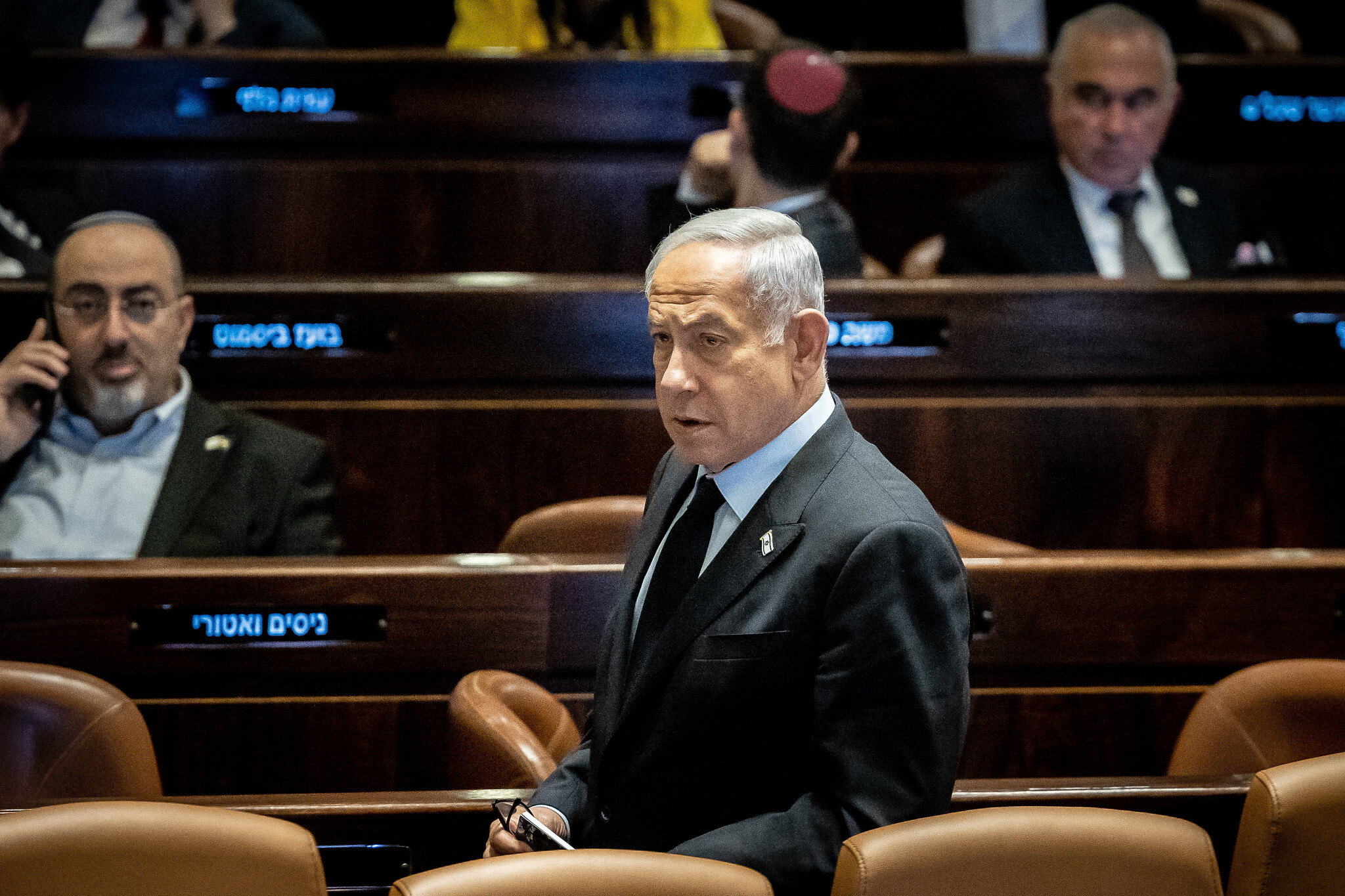
He’s also the main force behind some of the most troubling bills, such as the “gifts law” advancing at breakneck speed through the Knesset Economy Committee this week that would allow almost unchecked and literally anonymous gift-giving to public servants and politicians. The bill is unquestionably a personal one; it would let Netanyahu, already a wealthy man, keep $270,000 given to him by a late cousin. That it is advancing faster than almost any other item on the coalition’s agenda, faster in fact than much of the judicial reform, signals a new kind of Netanyahu.
The Netanyahu, in fact, that many saw in Sunday’s sudden firing of Defense Minister Yoav Gallant, and who systematically gutted Likud’s internal democracy and institutions and now brooks no disagreement in the party ranks.
If Netanyahu is indeed in control, it’s becoming increasingly difficult — and not just for the opposition — to find the old, liberal Netanyahu buried under all the mess.
The right turns
It’s curiously difficult to determine precisely how many Israelis actually support judicial reform. Polls put levels of support at anywhere from 17% — a weekend survey that asked about the specific reform now being pushed by the government — to 90%, a figure drawn from internal polling on the right that seems to have played a part in the government’s strategy planning and presentation of the reform back in January.
The way you ask the question seems to produce radically different answers. And the answers themselves are a moving target, as the idea of remaking the judiciary has left the realm of substantive debate and become a touchstone of political identity.
With those caveats, it’s still possible to hazard a basic outline of Israeli public opinion: A significant majority appears to support some kind of judicial reform, and a significant majority opposes the specific reform being pushed by the government.
In a weekend poll by the Globes business journal, for example, just 17% said they supported the reform as-is, while 25% said they supported “some of its elements,” and 43% opposed the reform entirely.
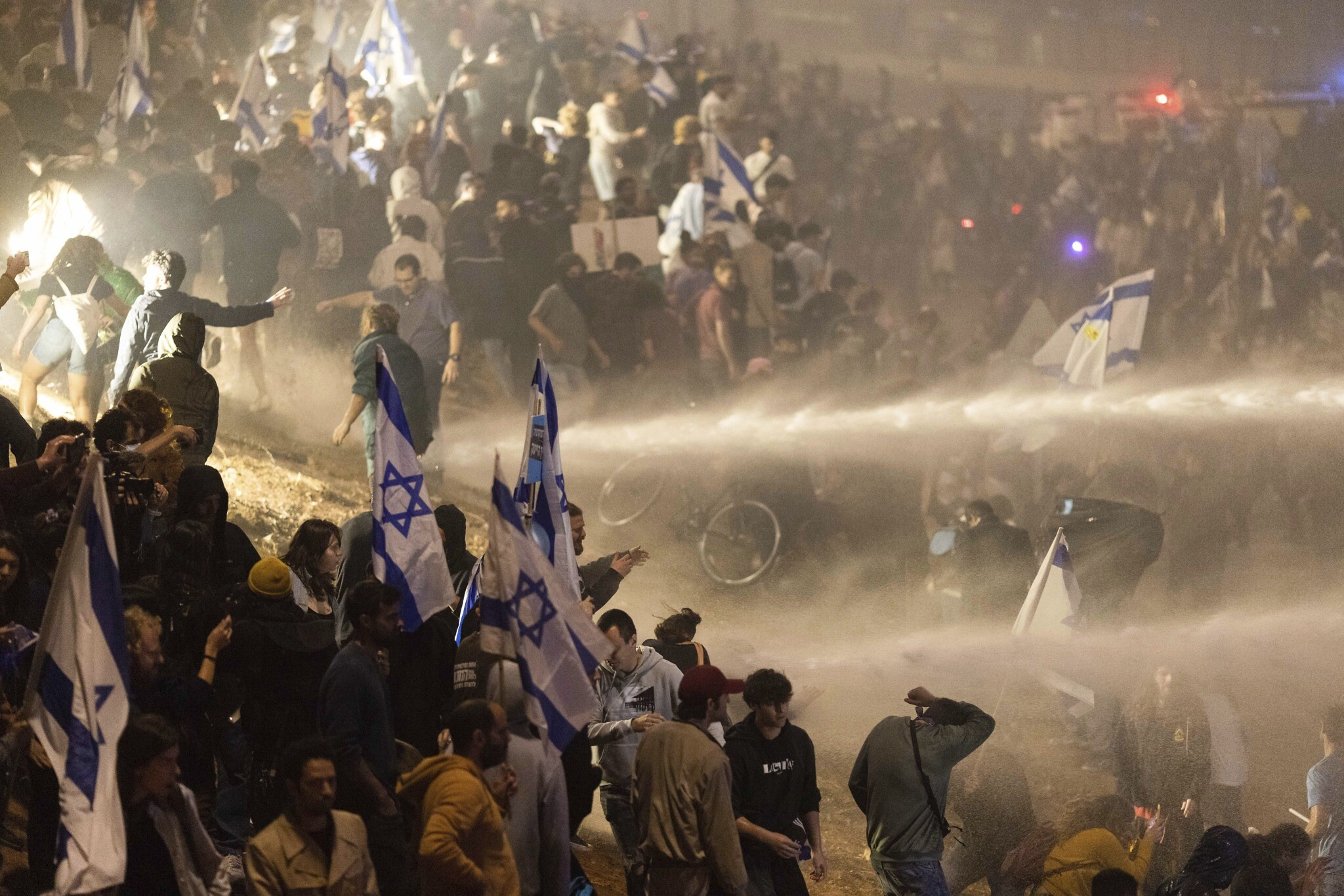
It’s clear, too, that the opposition is far more afraid and mobilized. Asked if they’d personally attended a protest, an astonishing 19% of respondents said yes — one in five Israelis. Just 2% of Israelis said they’d attended every protest. Most of the protesters (15% of all respondents) attended between one and four times. That is, protests that regularly draw 200,000 people represent at least five times as many protesters in the broader population.
Firing Gallant
It was in this heady moment, with an increasingly bitter right-wing activist base that believes that the government, not the opposition, created this moment, and facing a growing protest movement already actively joined by one-fifth of the population, that Netanyahu fired his defense minister on Sunday over his call to pause the reform.
It was the catalyst that revealed just how much larger the protest movement could grow.
Hebrew-language Twitter began to fill up with a new voice: right-wingers, Likud voters, even reform supporters, suddenly grown weary of the government and looking to take a stand.

And it hit the political echelons almost immediately.
“We’ve paid a heavy price,” Likud’s Miki Zohar lamented, for “failing to explain” the reform. Wary of facing Gallant’s fate, Zohar didn’t call for a freeze, but called to support Netanyahu if he should do so.
The view that the government, not Netanyahu’s “left” or “anarchists,” was responsible for the disaster was suddenly obvious to all.
“We must admit honestly — we’ve gone astray!” said Likud’s Amihai Chikli, the minister for Diaspora affairs. “Our mistake isn’t over the burning need for the reform — it’s more necessary now than ever before — but in its implementation.”
Likud’s Economy Minister Nir Barkat sounded a similar sentiment. “I will support the prime minister in a decision to stop and reconsider. The reform is important and we will do it — but not at the cost of civil war.”
Some of the most supportive right-wing journalists reached the same conclusion.

Squandered
Where does the right go from here?
It declared a dramatic change to Israel’s constitutional order as one declares a war. It advanced in a blitzkrieg through a deeply divided country, while signaling at full volume that it intends to do away with basic liberal protections. It started with a radical version of its own reform which some its own advocates now claim was a mere tactic, but which in practice would have gutted the Supreme Court and dismantled most of the political system’s checks and balances.
It didn’t debate, didn’t listen, didn’t try to convince until very late in the game, until it had grown frightened of the blowback. Until it was too late.
And it did all that in a country where polls show broad support for some version of judicial reform.
Never in the history of the country has so much political capital and hard-won electoral success been so swiftly and comprehensively squandered. Every minute that has passed since January 4 has been a neck-and-neck race between the Levin-Rothman-Netanyahu legislative stampede and the right’s hemorrhaging of its political capital.
Everything is still in the air. No one quite knows where the pieces are going to land. But no matter who wins that race, the damage wrought by the past three months of folly and hubris will not be quickly mended.
'I AM UNWILLING TO CUT THE NATION IN TWO'
‘There can be no civil war’:
Full text of Netanyahu’s announcement on overhaul pause
After major protests and strikes following his firing of the defense minister, the PM halts the judicial shakeup to allow for dialogue, while vowing reform will be enacted

Following is the full English translation of Prime Minister Benjamin Netanyahu’s televised address on March 27, 2023, as provided by the Government Press Office, in which he announced he was delaying his government’s planned far-reaching overhaul of the judiciary.
Citizens of Israel,
Three thousand years ago, here in Jerusalem, the judgement of Solomon took place. Two women came before King Solomon. Each one claimed that she was the real mother of the infant. King Solomon commanded that a sword be brought and that the baby be cut in half. One woman was prepared to rend the baby in two while the other woman absolutely refused and insisted that the infant stay alive and whole.
Today as well, both sides in the national controversy claim to love the infant, to love our country. I am aware of the enormous tension that is building between the two sides, between two parts of the nation, and I am attentive to the desire of many citizens to dispel this tension.
However, there is one thing that I cannot accept. There is an extremist minority that is prepared to tear our country to pieces. It is using violence and incitement, it is threatening to harm elected officials, it is stoking civil war, and it is calling for refusal to serve, which is a terrible crime.
The State of Israel cannot exist without the IDF and the IDF cannot exist with refusal to serve. Refusal to serve by one side will lead to refusal to serve by the other. Refusal to serve is the end of our country. Therefore, I demand that the heads of the security services and of the army vigorously oppose the phenomenon of refusal to serve, not contain it, not understand it, not accept it – but put a stop to it.
Those who call for refusal to serve, those who call for anarchy and violence, are knowingly cutting the baby in two. But the overwhelming majority of Israeli citizens on both sides of the divide do not want to rend the infant. They are unwilling to cut the nation in two.
Citizens of Israel,
I am unwilling to cut the nation in two. For three months I have repeatedly called for dialogue and also said that I would leave no stone unturned to find a solution because I remember, we remember, that we are not facing enemies but our brothers.
I say here and now: There can be no civil war. Israeli society is on a dangerous collision course. We are in the midst of a crisis that is endangering the basic unity between us. This crisis requires all of us to act responsibly.
Yesterday I read Benny Gantz’s letter in which he promised in good faith to enter into a dialogue on all issues. I know that there are additional people who support his approach. To them I extend my hand and I do so after having received the consent of most of my colleagues.
When there is a chance to prevent civil war through dialogue, I – as Prime Minister – will take a time-out for dialogue. I will give a genuine chance for genuine dialogue. We insist on the need to enact the necessary changes in the judicial system and we will give a chance to achieving broad consensus. This is an incomparably worthy goal.
Therefore, out of national responsibility, out of a desire to prevent a rift in the nation, I have decided to suspend the second and third readings of the law in the current Knesset session in order to allow time to try and reach that broad consensus, ahead of legislation in the next Knesset session. One way or another, we will enact a reform that will restore the balance between the authorities that has been lost, by preserving – and I add, even by strengthening – individual rights.
From here, I would like to appeal to the supporters of the national camp: We have the Knesset majority to do this alone, with immense support among the people. Many of our supporters came to Jerusalem this evening in order to support the reform, to say: We need change, we need reform.
I would like to say to you: I am proud of you. You are not second-class citizens. I appreciate that you turned out today in the streets of our capital in order to make your democratic voice heard. Nobody will silence your voice, our voice.
I must say something else: You came spontaneously, unorganized and unfinanced, not pushed by the media, with all your heart and soul. You have touched me. I only ask of you one thing: Continue to act responsibly and do not be dragged into any provocation.
Our path is just. Today, the great majority of the public recognizes the urgency of democratic reform of the judicial system. We will not allow anyone to rob the people of its free choice. While we will not give up on the path for which we were elected, we will make the effort to achieve broad agreement.
Citizens of Israel,
We live in the generation of national revival. History has given us an extraordinary opportunity, unprecedented in the annals of nations, to return to our land and build up our homeland and our state.
Soon we will celebrate Passover, the days of remembrance and Independence Day.
We will gather around the holiday table – together.
We will mourn our fallen – together.
We will celebrate our independence – together.
And together we will thank the men and women of the security forces, who do not forget, even for a moment, their duty to defend all of us, all the time.
We all have a common fate and we all have a common mission, which is to ensure the eternity of Israel.
Thank you.