Tuesday, March 28, 2023

Thungela seeks more coal assets as rail woes worsen
Bloomberg News | March 27, 2023 |

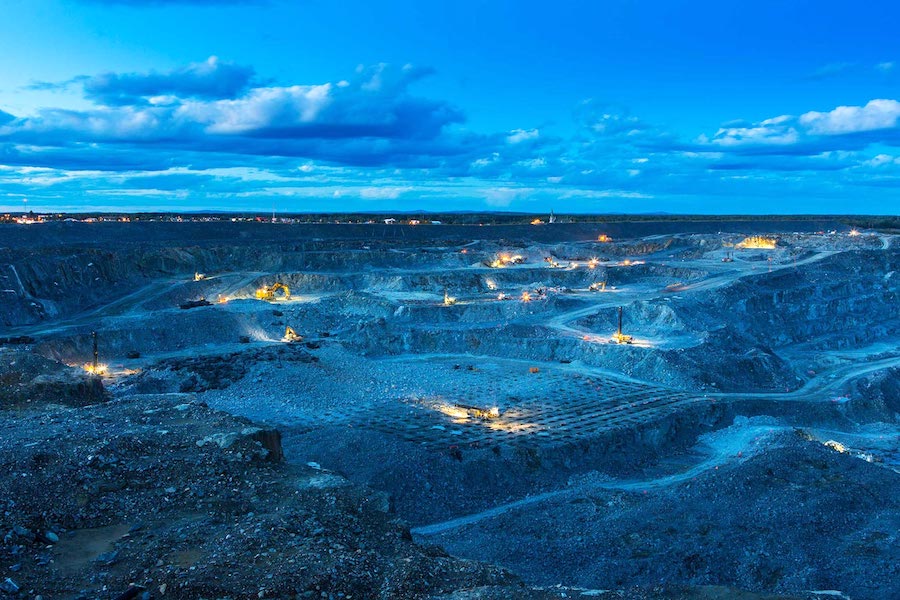
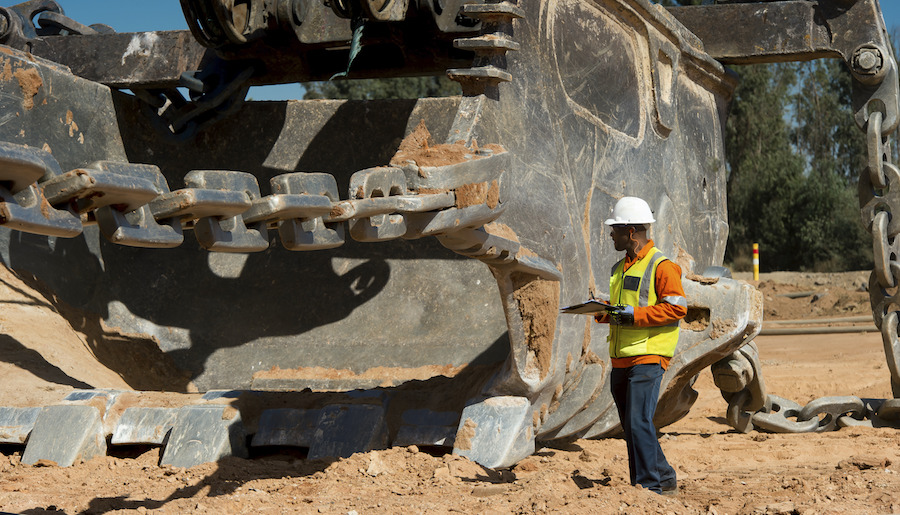
Landau Collieries, South Africa. (Image by Elaine Banister Photography. ©Anglo American 2016.)

Thungela Resources Ltd. is seeking to buy more overseas assets, as rail bottlenecks hobble shipments by South Africa’s largest exporter of thermal coal.


Thungela — spun off from Anglo American Plc two years ago — posted record profit last year as European demand for coal surged following Russia’s invasion of Ukraine. However, the miner’s shares fell as much as 12% in London trading on Monday, after the company said it expects sales to drop for a second year as South Africa’s state-owned rail operator Transnet SOC Ltd. faces increasing problems on its main coal export line


Thungela chief executive officer July Ndlovu said the Johannesburg-based producer will consider purchasing both thermal and metallurgical coal assets amid worsening logistical challenges at home. Under a deal announced last month, Thungela and its co-investors agreed to acquire 85% of the Ensham mine from Idemitsu Australia Ltd. for A$340 million ($226 million).

“We said we wanted to diversify for good reason and therefore will continue to look outside South Africa to future-proof our business,” Ndlovu said in an interview. “If we do get Ensham over the line, it contributes toward that cash generation potential which will allow us to look at all these opportunities.”

The CEO declined to say whether Thungela has found more assets to buy after agreeing to the Ensham deal.

Thungela’s coal shipments fell 10% to about 13 million tons last year, even as higher prices buoyed the miner’s revenue and profit. Those sales are expected to fall further as Transnet grapples with a shortage of locomotive spare parts and vandalism on the line that runs from coal fields in Mpumalanga to Richards Bay Coal Terminal on the east coast.

The miner’s profit more than doubled to about 18 billion rand ($990 million), boosted by record coal prices. Thungela said it will pay a total dividend of 13.8 billion rand, as it sees coal prices remaining strong despite softening this year.

The company said it could ship between 10.5 million to 12.5 million tons this year, which would be the lowest on record, Ndlovu said. Thungela has 3.2 million tons of stockpiled coal at its mines and another 400,000 tons at the port. The uncertainty regarding Transnet’s performance means Thungela couldn’t provide guidance for 2024, it said.

Thungela slumped 11% as of 11:42 a.m. in London. RMB Morgan Stanley said the miner’s guidance this year “is a little disappointing.”

(By Felix Njini)
NOT SO GREEN BC
British Columbia eyes economic boost with three new gold mines

Nelson Bennett - Business in Vancouver | March 27, 2023 

The Cariboo gold project is located in the historic Wells-Barkerville mining camp in British Columbia. (Image courtesy of Osisko Gold Royalties.)

It has been six years since the last new gold mine – Brucejack – went into production in British Columbia.


Now, as many as three could be pouring first gold next year: Premier, Blackwater and Cariboo Gold.

While the Premier and Cariboo Gold mines are brownfield projects with historical mining, the new Artemis Gold Blackwater project south of Prince George is a large greenfield project that will generate a significant number of jobs and economic activity in an area hard hit by sawmill and pulp mill closures.

Combined, the three new mines represent an initial capital investment of C$1.5 billion over the next couple of years, and hundreds of new jobs.

Premier mine – low volume and high grade


The first of the three new gold mines to go into production will be the Premier underground gold mine near Stewart, B.C. Ascot Resources is aiming to pour first gold by the first quarter of 2024. The capital cost of the project is C$300 million, and much of the new works are already built or nearing completion.

The mine is located within Nisga’a treaty lands. An agreement with the Nisga’a provides the First Nation with cash payments, training, employment and business opportunities. Sprott Streaming is helping to finance the mine with a $110 million gold and silver streaming agreement.

The Premier gold mine has been mined since the early 1900s, most recently as an open-pit operation until the late 1990s, so a lot of the infrastructure needed to operate a mine is in place.

“We have a lot of strategic infrastructure advantages that a greenfield site doesn’t have,” said Ascot CEO Derek White. “That’s why we’re able to go much quicker. We’re benefiting from all the historical infrastructure.”

Ascot has designed a hub-and-spoke approach, with one central mill near the historical Premier mine site, and four distinct deposits, all to be mined underground. The furthest deposit is 44 kilometres away by road.

Since a lot of the infrastructure is already in place, most of the capital investment has been in refurbishing the mill and a tailings pond and water treatment system.

“In 2023, the big things for us are putting in a new state-of-the-art water treatment plant,” White said.

Ascot expects the mine to produce 150,000 ounces a year, with average grades of 7.5 grams of gold per tonne. To put that in context, Blackwater’s average annual production would be just under 400,000 ounces per year with gold grades of 0.75 grams per tonne.

“These are high-grade underground deposits,” White said. “So small volume, high grade.”

Ascot will be ramping up to about 200 workers this summer. Once in operation, the mine will employ 230 to 250 miners. While some of the miners may live in camp at the site, others may end up living in Stewart, B.C., White said.

Blackwater Gold – locally owned and low carbon

With an initial capital cost of C$645 million – and up to C$1.4 billion total over a 22-year mine life – Artemis Gold’s Blackwater open-pit gold mine south of Vanderhoof will be largest new mine built in the region in more than a decade. Plus, it is largely locally owned, with 41% of the owners being board members or management, including Vancouver developer Ryan Beedie, who is a director and major shareholder.

“We live here,” said Artemis Gold CEO Steven Dean. “This is our home and our decisions are made here in Vancouver, and not in Toronto or some other head office outside of the province or even outside of the country.”

The Blackwater project was green-lit just last week with the issuance of a Mines Act permit. Early works construction has already started.

“We’re already well into construction,” Dean said.

The Blackwater project will create 500 jobs during an 18-month construction period, with production expected later in the second half of 2024. It will employ 300 miners in the first phase of operation and up to 450 in later phase expansions. The project will expand in phases, with the expansions focused on processing, starting at six million tonnes annually in Phase 1, 12 million tonnes in Phase 2 and 20 million tonnes in Phase 3.

The mine will be in a region of B.C., south of Prince George, that has been hard hit in recent years by sawmill and pulp mill closures, so it will provide a welcome injection of jobs and tax revenue.

“British Columbians will benefit from hundreds of new jobs of this new mine, with both its construction and multiple decades of operation,” said Josie Osborne, minister of energy, mines and low carbon innovation.

“We’re hoping to be able to support employment and re-employment of some of those people in the forestry sector, maybe with a little bit of retraining into our sector,” Dean said. “Whether it be operators, truck drivers, maintenance people in the mill, there are some common skills between the two industries.”

Wheaton Precious Metals is staking the project with a $141 million streaming agreement.

“We think it’s a robust asset that has some potential upside even beyond what they’ve identified so far,” Wheaton CEO Randy Smallwood said. “It looks like a really good asset that will deliver a lot of gold and silver to us. It’s a strong team that’s had great success building other operations and other mines around the world.”

An economic impact study by KPMG estimates the mine will contribute C$13 billion to the B.C. economy over its 22-year life, including C$2.3 billion in provincial revenue.

The Blackwater will have a lean carbon emissions profile. Its processing plant will be fully electric, and therefore zero emission, and the company has an agreement with Caterpillar in which the mine’s haul trucks can switch to fully electric in 2029.

“We have an agreement whereby we will be one of the first to receive these pieces of equipment,” Dean said.

Cariboo Gold – bringing Barkerville back to life

Osisko Development has plans to bring the historic gold mining region of Barkerville back to life. The company had planned to have a new mine in operation last year, but it has been delayed, and the company is now aiming to pour first gold in 2024.

The project has a total capital cost of close to C$600 million – C$137 million for the first phase and $451 million for expansion. In January, Osisko published a new feasibility study that estimates the mine will produce an average 163,695 ounces of gold a year over a 12-year period, with gold grades of 3.72 to 4.43 grams per tonne.

“This feasibility study demonstrates that the Cariboo Gold project will be a large-scale, long-life and profitable gold mine,” said Osisko Development CEO Sean Roosen. “It will also produce significant quantities of gold in its initial years at a capital cost below C$140 million.”

(This article first appeared in Business in Vancouver)
Biden tees up a supply chain rethink with challenge to China’s EVs
Bloomberg News | March 28, 2023 | 


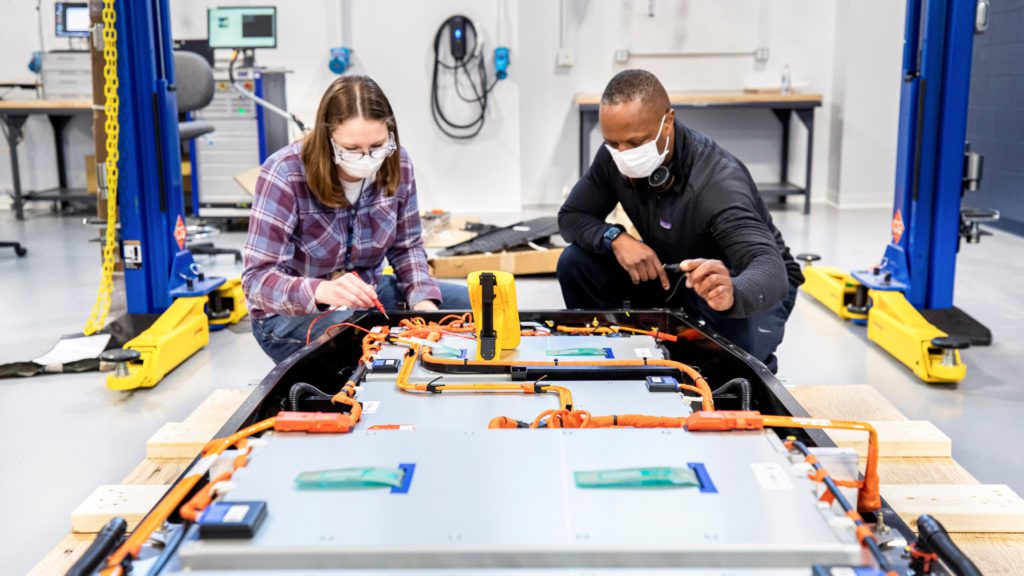
Battery Benchmarking and Test Laboratory in Allen Park, Michigan. (Credit: Ford)

Seven months after President Joe Biden signed the Inflation Reduction Act into law, the magnitude of the challenge it will be for the US to loosen China’s grip on the electric vehicle supply chain — a key objective of the legislation — is coming into sharper relief.


Ford, the top US car producer, confirmed last month that it will tap technology from China’s battery-making behemoth CATL for a $3.5 billion plant it’s building in Michigan. Tesla is expecting the base version of its cheapest car, the Model 3, to lose the entirety of the $7,500 tax credit it’s been eligible for because its cells come from China. And barring big surprises later this week, many other EVs currently qualifying for credits will be eligible for $3,750 incentives, at most, after the Treasury Department finalizes content requirements that have been the subject of heated debate and frantic lobbying.


Days before those rules are released, a Washington think tank whose mission is aligned with the IRA’s goals is releasing a detailed report delving into China’s command of the supply chain, and the corners it says the country cut on the way to dominance. The group — Securing America’s Future Energy, or SAFE — argues that China has been winning out in part because of failures to account for the toll that the extraction and processing of critical minerals including lithium, nickel and cobalt are taking on workers and the environment, often in lower-income countries.

For example, SAFE points to how China pulled far ahead of the US in producing the rare earth used in EV motors, and how Indonesia has built a huge lead over Australia in producing nickel.

The US was the top producer of rare earth elements in the 1990s until Chinese suppliers flooded the market with lower-cost supplies. Those rare earths were cheaper in part because suppliers were allowed to dispose of radioactive waste into the Yellow River that flows through Western China, SAFE says, citing a report by the Institute for the Analysis of Global Security.


As for nickel, some miners in Indonesia are able to produce nickel at lower cost by cheaply dumping their waste into the ocean, SAFE says, citing a German lobby group’s report. While Australia is roughly tied with Indonesia among countries with the largest nickel reserves, it bans these disposal practices. Roughly half of the world’s nickel comes from Indonesia, while Australia supplies only 5%, according to SAFE.

“This uneven playing field, where producers compete on cost alone and visibility into how things are sourced is low, has created a global race to the bottom for critical minerals that not only disadvantages communities, the environment, and responsible producers, but also threatens American national security,” the authors of the report write.

SAFE lays out policy measures that it says would flip this phenomenon on its head. In its report, titled A Global Race to the Top, the group urges the US to band together with the European Union and Japan and agree to only source minerals produced with high standards, arguing that the rest of the world would be forced to follow suit.

There’s an analogous precedent for what SAFE is calling for: The US Agriculture Department visits international sites to ensure imported food products comply with safety regulations. The group calls for Congress to enlist the Bureau of Land Management, the Mine Safety and Health Administration, the Environmental Protection Agency and other relevant federal agencies to similarly visit mines to make sure they’re complying with US standards.

SAFE also recommends that greater transparency of where minerals are coming from — and their human and environmental cost — at the consumer level by adding that information to the window labels that lay out information including pricing and battery range.

“We see responsible mining as being key to diversifying,” Abigail Wulf, the vice president and director of SAFE’s Center for Critical Minerals Strategy, said in an interview. “Right now, it’s incredibly difficult to diversify supply chains, because it’s incredibly difficult to compete on cost. And it’s difficult to compete on cost because where you’re getting these minerals from are ostensibly degrading the environment and exploiting workers in ways you would not be allowed to in the US, Canada, the EU and Australia.”

The IRA, Wulf said, represents a “first critical step” toward the transparency SAFE is calling for. With the global transition to EVs still in its relative infancy, the group argues there’s still an opportunity to shape the future of this market and its impact on economies, geopolitics and the environment.
Botswana partners with gem trader HB Antwerp, seeks to loosen De Beers’ grip

Reuters | March 27, 2023 |

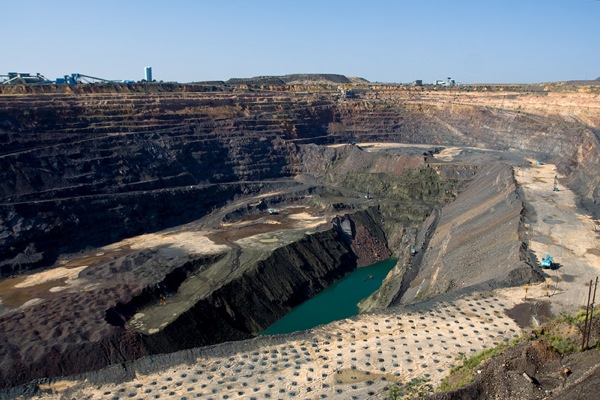
The Jwanend diamond mine in Botswana. (Image courtesy of Debswana)

Botswana will take a 24% stake in Belgian gem processing firm HB Antwerp as it seeks to gain more value from its diamonds, President Mokgweetsi Masisi said Monday, a move which might start to loosen De Beers’ grip on the country’s diamond industry.


Botswana’s state-owned diamond trading company, Okavango Diamond Company (ODC), will also enter into a five-year agreement to supply rough diamonds to HB Antwerp as part of the deal.

“The key commercial terms of the deal have been agreed and the deal will be signed in the coming weeks. Today is the dawn of a new era for the diamond industry in Botswana, as we begin this journey with HB Antwerp,” Masisi said during the official opening of HB Antwerp’s cutting and polishing facility in Gaborone.

Botswana, which jointly owns Africa’s largest diamond producer Debswana with global giant De Beers, a unit of Anglo American Plc, is moving to explore other options outside the 54 year-old De Beers partnership.

The two partners are currently in talks to renew a 2011 sales and marketing agreement which entitles De Beers to 75% of the production from Debswana.

Masisi has threatened to walk away from the talks if Botswana does not get a bigger share of Debswana’s output for marketing outside the De Beers system. The government has not publicly stated what share it seeks, but it is believed to be as high as 50%, double the current allocation.

Founded in 2020, HB Antwerp is currently in partnership with Lucara Diamond Corp, buying stones of 10 carat quality and above from the Toronto-listed miner’s Karowe Mine in central Botswana at prices based on the estimated polished outcome of each diamond, determined through state-of-the-art scanning and planning technology.

HB Antwerp says this model, which it seeks to replicate with ODC, allows Lucara to earn 40% more than it would from selling at rough diamond market prices.

“It’s a strategic partnership, it will add more value to Botswana not just in terms of price or money, but empowering the people of Botswana,” HB Antwerp co-founder Rafael Papismedov told Reuters.

(By Brian Benza; Editing by Nelson Banya and Christina Fincher)
Trapped miners in east Congo tumble out of rubble intact in viral video

Reuters | March 27, 2023 |

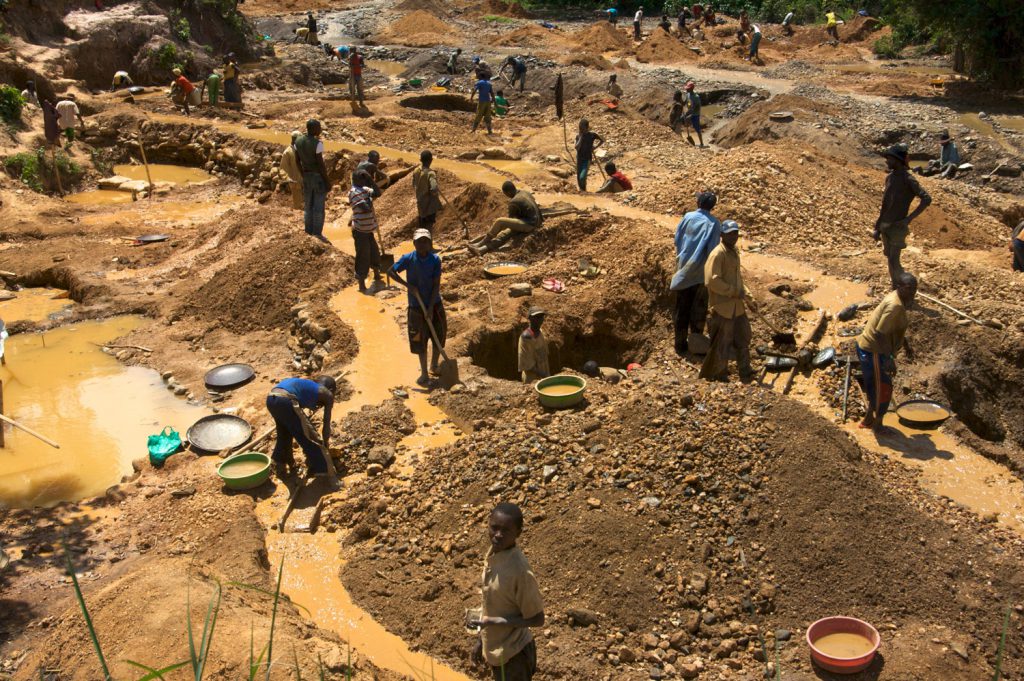
A mine in eastern Congo
 (Photo by Sasha Lezhnev. Courtesy: ENOUGH Project/Flickr CC BY-NC-ND 2.0)

A video showing nine Congolese miners unexpectedly popping out of a collapsed gold mine and tumbling down a steep slope as onlookers cry out in joy has gone viral in Democratic Republic of Congo, a rare happy ending to an all-too-common story.


Mining accidents are rife in the giant Central African country, especially at small, artisanal sites such as the one in South Kivu province that collapsed on Saturday following heavy rain.

The video shows a man precariously perched on the side of a steep slope of rubble, frantically digging with a spade while a group of other men stand in a large circle around him, watching.

All of a sudden, a miner pops out of the rubble and slides down the slope, borne by his own momentum, as the onlookers break out in cheers of surprise and delight.

Disclaimer: The origin of the video has not been verified

The rescuer is then seen redoubling his efforts, forsaking the spade to dig through the rubble with his bare hands. Another miner soon appears, then another, and within two minutes a total of nine men have come out alive and well.

Reuters has verified the video, which was widely shared on social media.

A lack of safety procedures and proper equipment are at the root of frequent tunnel collapses at Congolese mines, in which miners are trapped underground with slim chances of survival.

Two miners died in a similar incident at a nearby informal digging site in early March.

Against that backdrop, hopes were dim as rescue efforts began after Saturday’s incident.

“We quickly mobilized people to clear the rubble that was blocking the entrance. It was on the morning of this Saturday… that they managed to save these nine souls,” local civil society representative Crispin Kayuka told Reuters via telephone.

(By Sonia Rolley; Editing by Sofia Christensen, Estelle Shirbon and Sharon Singleton)
Researchers closer to understanding how orogenic gold belts are formed

Staff Writer | March 28, 2023 |

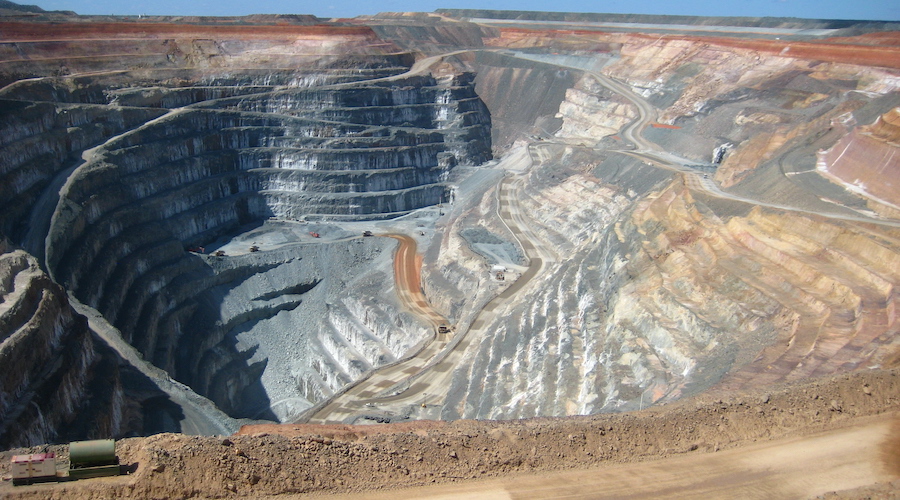
The Sunrise Dam gold mine built on and orogenic gold deposit in Western Australia. 
(Reference image by Calistemon, Wikimedia Commons.)

Chinese researchers have discovered that the lithosphere architecture characterized by crust-mantle decoupling controls the formation of orogenic gold belts.


In a paper published in the journal National Science Review, the scientists explain that orogenic gold deposits account for approximately 30% of the world’s gold resources, but opinions about their mineralization mechanism are mixed.

Such gold deposits were previously thought to have developed extensively in the Precambrian greenstone belt while their gold-bearing fluids were considered to have been generated by the dehydration of crustal rocks during metamorphism. However, there is growing evidence for large amounts of epigenetic orogenic gold deposits on the margins of the Tertiary Craton, where the mineralizing fluids show substantial mantle origin.

To test this hypothesis, the research team chose the Ailaoshan orogenic gold belt on the western margin of the Yangzi Craton, located in the southeastern part of the Tibetan Plateau.

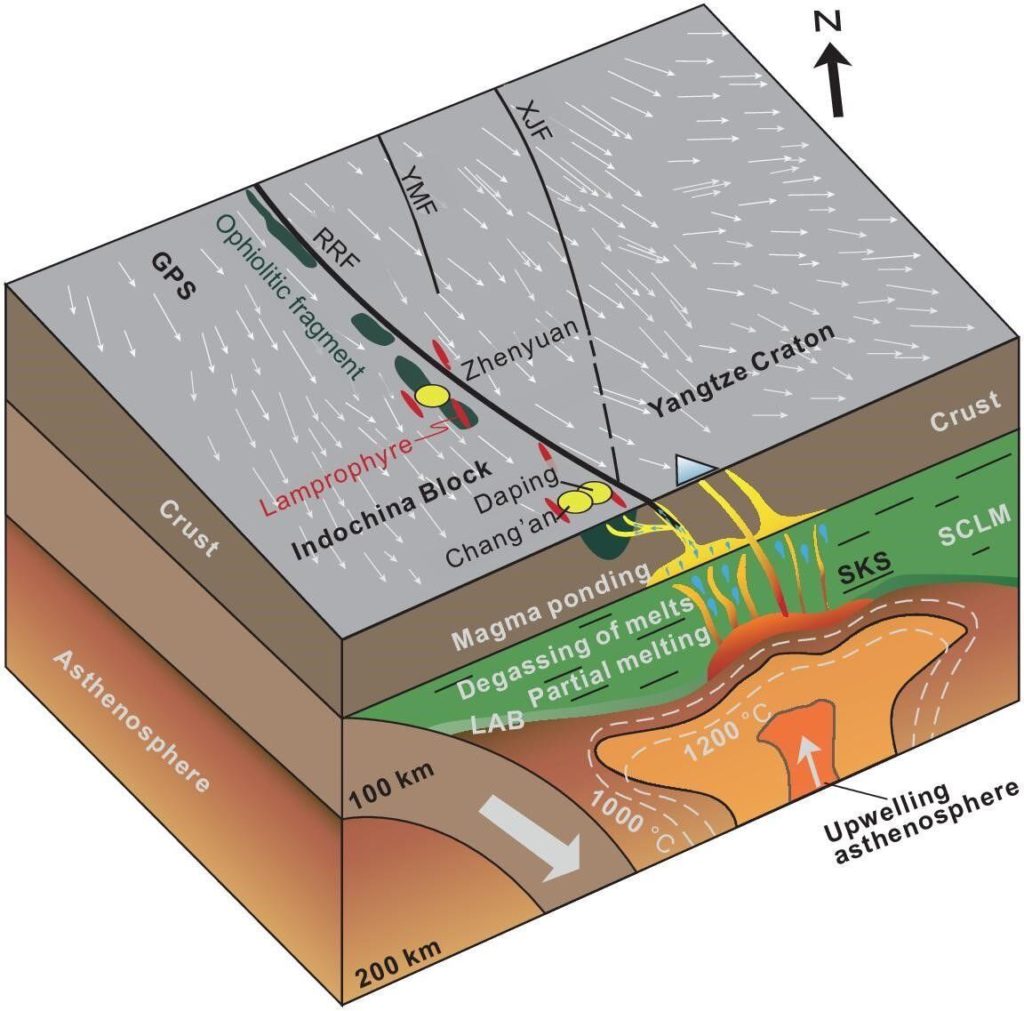
Based on the geological, geophysical, and geochemical data from this gold mining area, the team proposed that lithospheric crust-mantle decoupling on the southeast margin of the Tibetan Plateau controls the formation of orogenic gold deposits and establishes a model for mineralization.

They believe that continental subduction triggered the upwelling of the soft current circle, partial melting of the mantle, and decoupling of the crust-mantle movement.
Control mechanisms of crust-mantle decoupling on orogenic gold systems on the eastern margin of the Qinghai-Tibet Plateau. (Image by University of Science and Technology of China).

“The melt-generated basal magma converges at the crust-mantle decoupling and generates mineralizing fluids, which migrate along supra-crustal fractures to precipitate mineralization in the upper crust,” the team said in a media statement.

In their view, the geodynamic model of crust-mantle decoupling controlling gold mineralization can explain the formation of several large epigenetic orogenic gold provinces.

“The orogenic gold mineralization model proposed in this study can be useful for the integrated geophysical and geochemical investigation of similar gold systems,” the group noted.

The new study is a continuation of the long-term geophysical advanced imaging algorithm development and related research on structural imaging in different regions by Zhang Haijiang’s team at the University of Science and Technology of China.

The group has been working on a series of advanced geophysical imaging algorithms, including the joint imaging algorithms for seismic body wave travel time, surface wave dispersion, and receiver function, and constructed the high-resolution unified velocity model USTClitho1.0 and USTClitho2.0 for the Chinese continental lithosphere.
LITHIUM
Liontown rejects $3.7 billion proposal from Albemarle

Reuters | March 27, 2023 

Kathleen Valley lithium project. Credit: Liontown Resources Ltd.

Australia’s Liontown Resources rebuffed an indicative offer from top lithium producer Albemarle Corp that valued the lithium developer at A$5.50 billion ($3.66 billion) on Tuesday, sending its shares soaring 59%.


Albemarle had offered A$2.50 per share, Liontown said in an exchange filing. The offer represented a 63.9% premium to the ASX-listed company’s last close. Its shares climbed 59% in early trading to A$2.42.

“(The Liontown board) unanimously determined that (the proposal) substantially undervalues Liontown, and therefore is not in the best interests of shareholders,” the company said.

Lithium demand is expected to soar in coming years as supplier scramble to meet surging demand from automakers switching to electric vehicles.

Benchmark lithium prices have jumped more than six-fold over the past two years, before turning down lately due to a drop in electric vehicle sales in top market China.


Liontown said it had received two prior proposals from Albemarle. The first offer of A$2.20 per share was on Oct. 20 last year and the second of A$2.35 was earlier this month.

Albemarle did not immediately respond to a Reuters request for comment.

Liontown controls two major lithium deposits in Western Australia, including its flagship Kathleen Valley project. The project is one of the world’s largest and highest-grade hard rock lithium deposits, according to the company’s website.

First production at the project is expected in the second quarter of 2024.

Liontown has inked supply agreements with Ford Motor Co , Tesla and the battery unit of South Korea’s LG Chem.

Liontown also said RT Lithium Ltd, a subsidiary of Albemarle, had built a stake through on-market purchases. RT Lithium now holds a near 2.2% stake in Liontown.

Charlotte, North Carolina-based Albemarle is the world’s largest lithium producer with major facilities in Chile, China and Australia.

($1 = 1.5033 Australian dollars)

(By Harish Sridharan; Editing by Sriraj Kalluvila, Melanie Burton and Sherry Jacob-Phillips)
Lundin Mining pays $950m for controlling stake in Caserones copper mine in Chile

Lundin Mining grabbed headlines last year when a sinkhole opened up near one of the company’s mines in Chile — 

Cecilia Jamasmie | March 28, 2023 | 

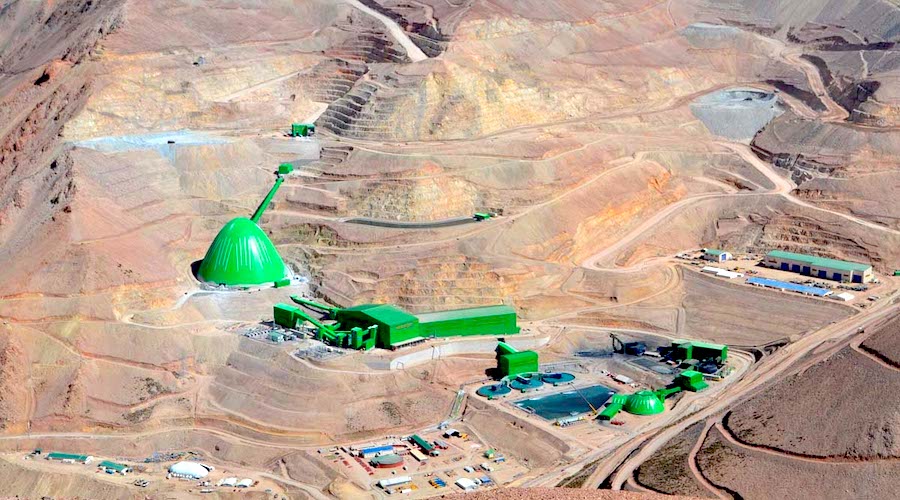
Caserones copper mine is located in Chile’s arid north, close to the border with Argentina. (Image courtesy of Minera Lumina Copper Chile.)

Canada’s Lundin Mining (TSX: LUN)) is buying a majority stake in the Caserones copper-molybdenum mine in Chile for about $950 million, adding to a flow of deals as miners seek to increase their exposure to the metal, crucial for the world’s energy transition.


The miner will acquire a 51% stake in the company that operates Caserones from its owner Japan’s JX Nippon Mining & Metals Corp

Lundin said it will pay $800 million in cash upfront, plus $150 million over six years from the deal’s completion.

The deal also gives the Toronto-based miner the right to purchase an additional interest of up to 19% in the copper-molybdenum mine for $350 million over five years.

“The initial controlling interest increases our exposure to what we believe is a growing top-tier copper mining district. We retain the option to further increase our ownership over the next few years at an attractive price,” Lundin’s chief executive, Peter Rockandel, said in the statement.

JX Nippon Mining & Metals said the decision to sell part of Lumina Copper, its subsidiary and operator of Caserones, was part of an asset portfolio review.

The firm became the majority owner of the Chilean mine in November 2020, when it acquired the stakes from its partners in the operation Mitsui & Co and Mitsui Mining and Smelting.

The operation has suffered a series of ramp-up delays and cost overruns since it began producing in May 2014. Its annual production of roughly 100,000 tonnes still falls short of the 150,000 tonnes a year intended when construction of the mine began.

Completion of the deal is expected by June 2023, Lundin said.

Caserones is located at an altitude of 4,200m to 4,600m above sea level in Chile’s Atacama desert, close to the Argentina border.

Lundin Mining grabbed headlines last year when a sinkhole opened up near one of the company’s mines in Chile — Alcaparrosa.

 'THESE PEOPLE DON’T KNOW WHAT THEY’RE TALKING ABOUT '

Florida bill attacking critical theory in higher education has Jewish profs worried

Opponents say bill could make teaching courses in Jewish studies impossible — and would also outlaw many other academic fields


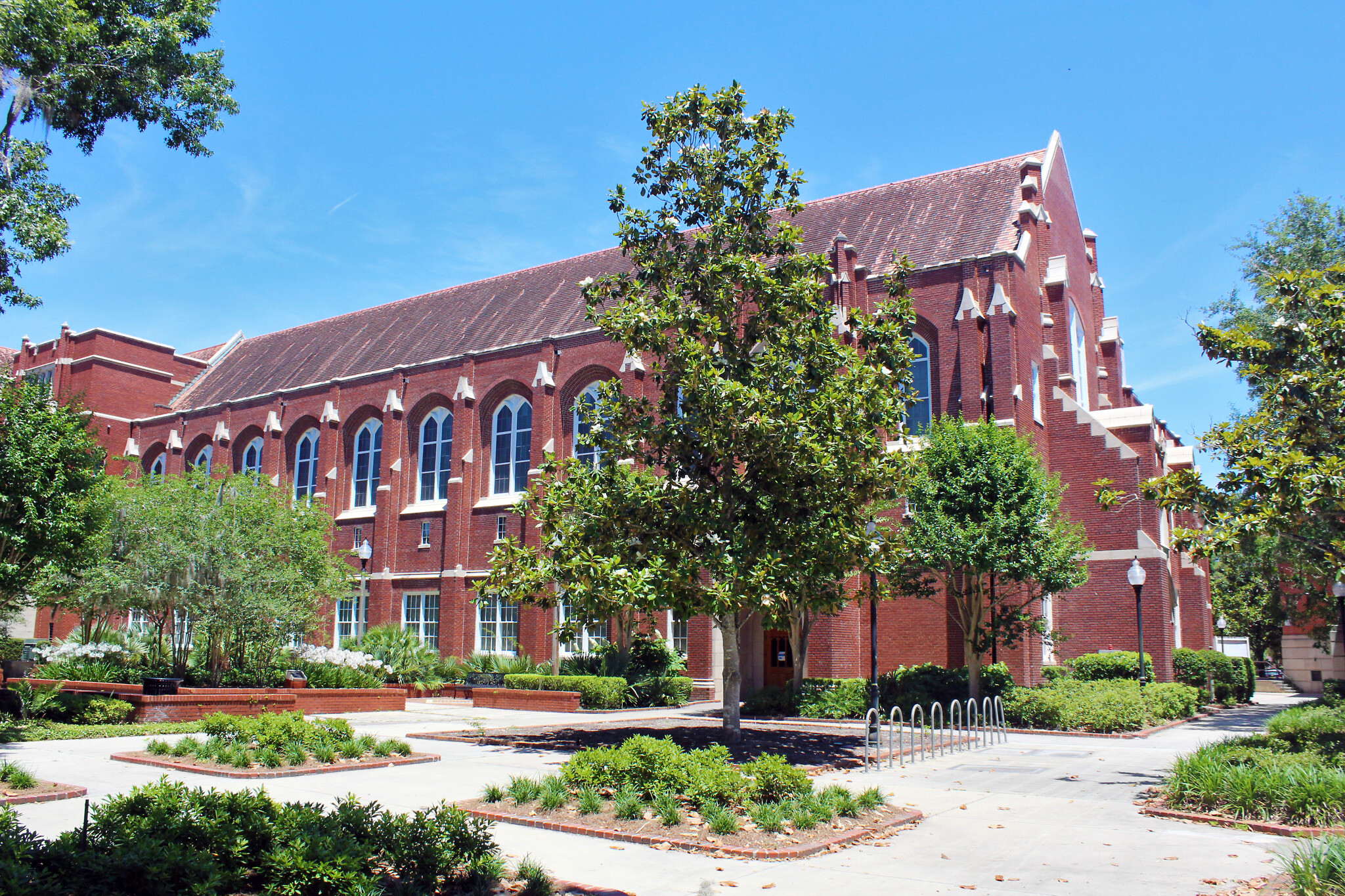
The Smathers Library at the University of Florida, Gainesville, Florida, May 8, 2021
. (Steven Martin via Creative Commons/via JTA)

JTA — The University of Florida has more Jewish students than any other public college in the United States — and earlier this month, one of them reached out to a professor, fearing that it would no longer be possible to study Jewish topics there.

Citing a graphic that had been making the rounds on social media, the student asked if it was true that a new bill working its way through the state legislature would remove all “Jewish Studies courses, majors and minors” in the state. The graphic was shared by several people with large online followings, including comedian D.L. Hughley, who has more than 750,000 followers on Twitter.

“I love my major and I can’t imagine switching to anything else,” the student wrote, according to Norman Goda, director of the university’s Center for Jewish Studies.

Goda wasn’t able to console the student. Like other Jewish academics in Florida who spoke to the Jewish Telegraphic Agency, he doesn’t know whether H.B. 999 would affect Jewish studies on the state’s college campuses. Though the bill’s author — a Republican state representative — says that won’t be the case, the bill’s language is much less clear.

That’s because the bill’s current wording would forbid the state’s public higher education institutions from teaching or offering any major or minor based in “methodology associated with Critical Theory.” That prohibition, say academics and other critics of the bill, would make teaching courses in Jewish studies impossible — and would also outlaw many other fields in higher education.

Exactly what the bill means by “critical theory” is unclear. To academics, the term refers to a tool for analyzing society and culture, created in the 1930s by German Jewish academics, that encourages people to view the world through power structures and to consider why they fall short. To political conservatives, it’s a relative of “critical race theory,” a watchword for those who want to inhibit classroom instruction about racism. An earlier version of H.B. 999 mentioned only critical race theory, not the umbrella theory.

“These people don’t know what they’re talking about,” said a Jewish faculty member at a Florida university, who requested anonymity due to fear of retaliation from the state government, regarding the lawmakers behind H.B. 999. “You’re putting people who don’t know what critical theory is, but have heard the words — and now you’re putting them in charge of universities.”

You’re putting people who don’t know what critical theory is, but have heard the words — and now you’re putting them in charge of universities

A university that completely purged such ideas from its classrooms, the anonymous faculty member said, “would be non-existent.”

The bill in question is the latest example of conservative-led state efforts to snuff out culture-war modes of thought like critical race theory and gender studies, often referred to euphemistically by lawmakers as “divisive concepts” in education. Such efforts have occasionally ensnared efforts to teach Jewish history and the Holocaust.

Attempts to legislate the classroom are particularly potent in Florida, where Republican governor Ron DeSantis, a likely presidential candidate, has frequently stated his desire to ban “woke” concepts from being taught in the state. (DeSantis has stated he will wait to see H.B. 999’s final form before he decides whether to sign it, but in a discussion with college administrators last week he continued to rail against what he called the “ideological agenda” of campus diversity, equity and inclusion programs.)

The state recently rejected the curriculum for a new Advanced Placement African-American Studies course in high schools, forcing the College Board to rework the class. Florida is also home to several active conservative “parents’ rights” groups that have lobbied to remove objectionable books and clubs from public schools.

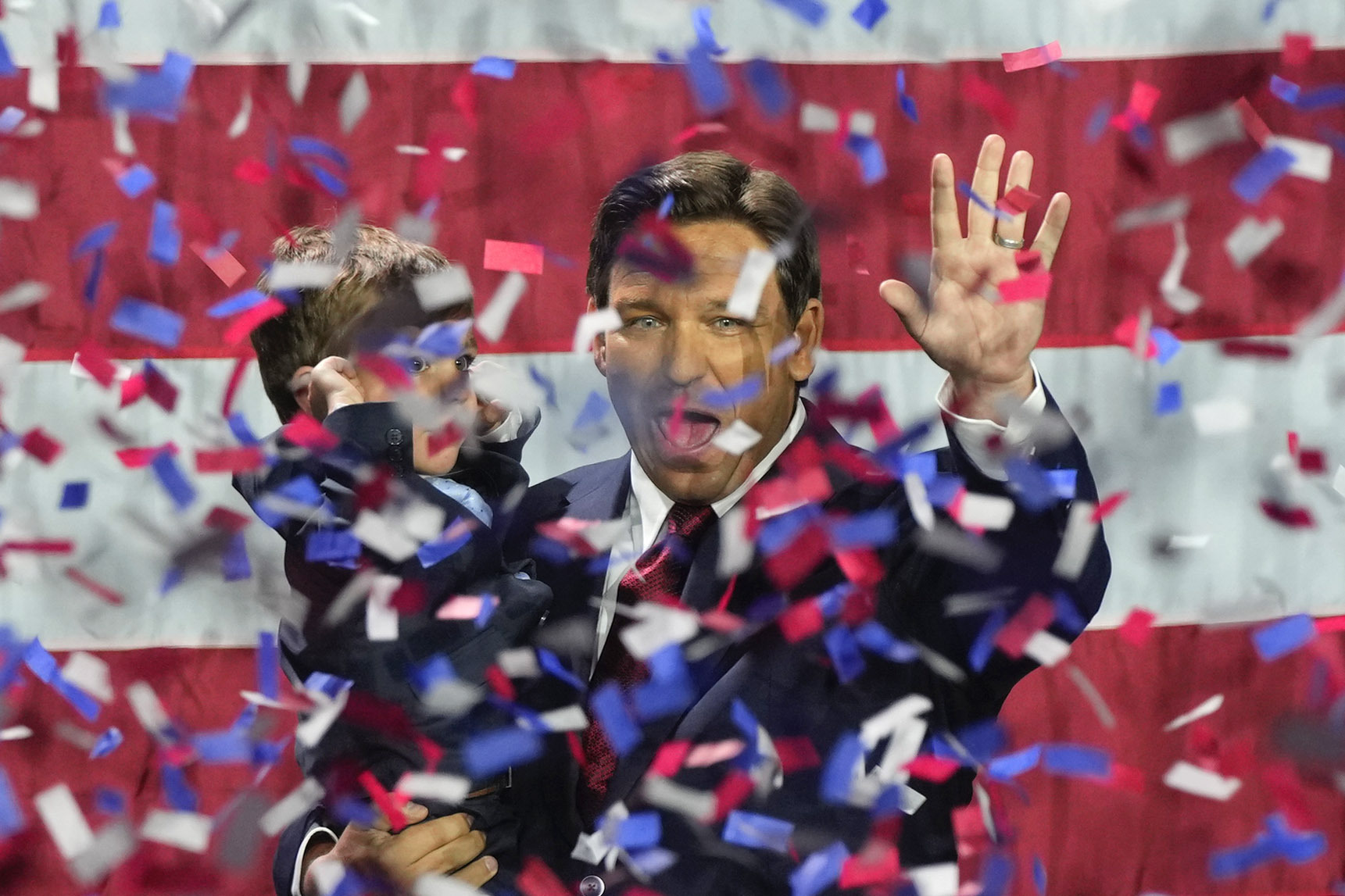
Florida Republican Gov. Ron DeSantis holds his son Mason as he celebrates winning reelection, at an election night party in Tampa, Florida, November 8, 2022. (Rebecca Blackwell/AP)

While most legislation in this realm to date has targeted what’s taught in K-12 public schools, this bill and other efforts in Florida have gone a step further by seeking to regulate the world of state-funded higher education — creating what critics say are new and dangerous threats to academic freedom, with broad and vague wording that leaves efforts to research and teach a variety of disciplines in doubt.

“This bill would cripple the long-standing freedom universities have to design and teach a curriculum based on the development of academic disciplines,” Cary Nelson, an emeritus professor at the University of Illinois and past president of the American Association of University Professors, who has taught multiple courses on Jewish issues, told JTA.

In a recent subcommittee hearing on the bill, Republican state Rep. Alex Andrade, who co-authored the legislation, said, “I believe that state universities should be focused on teaching students how to think, not what to think.” He said the bill’s banning of “radical” ideologies referred to “a system meant to direct and promote certain activism to achieve a specific viewpoint.”

Efforts to limit the material taught to children and college students are underway in several states. But Florida has an especially large population of Jewish students. The University of Florida stands atop Hillel International’s ranking of public colleges with the highest proportion of Jewish students, and the University of Central Florida has the third-largest. Florida State University, Florida International University, Florida Atlantic University and the University of South Florida also rank in the top 60.
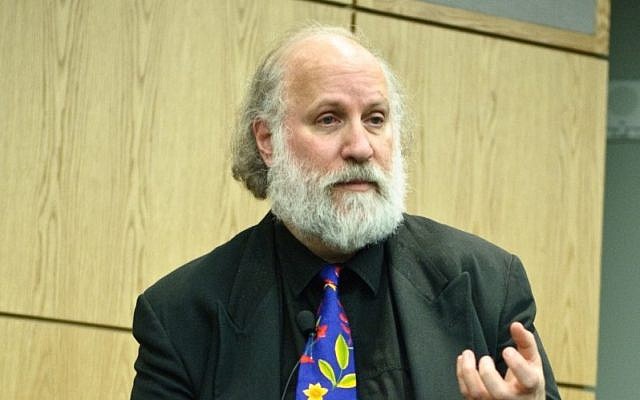
Former president of the American Association of University Professors Cary Nelson, 2010. (Photo credit: CC BY SA Flickr/Don LaVange)

H.B. 999 would affect education at those schools in other ways, too. The bill, which recently advanced to committee, would overhaul the state’s post-tenure review process, so that instead of checking on a faculty member’s research productivity every five years, as is currently the case in the state, tenured professors could face reviews “at any time for cause” including “violation of any applicable law or rule.”

The result, one academic in the state said, would be “open season on faculty,” who could be out of a job if their university’s board — which, in public schools, is beholden to the governor — disagrees with their syllabus.

Andrade rejected the idea that H.B. 999 would undercut Jewish studies in Florida.

“Outsiders are wrong. Ethnic studies are not affected by the bill either by the bill’s intent or the bill’s language,” Andrade wrote in an email to JTA, accusing the bill’s critics of “lying and claiming that Florida’s leaders have tried to ban teaching black history in schools.”

The state’s only Jewish Republican legislator, state Rep. Randy Fine, did not return a JTA request for comment on whether he supports the bill. Fine has promoted similar culture-war legislation in the past, including a bill he co-authored in February that would prohibit all K-12 schools in the state from referring to either students or employees by pronouns that do not correspond to the sex they were assigned at birth.

Outsiders are wrong. Ethnic studies are not affected by the bill either by the bill’s intent or the bill’s language

With a Republican-dominated House and Senate, some form of H.B. 999 seems likely to reach DeSantis’ desk. (A parallel bill in the state Senate does not contain wording on critical theory.) But there is strong opposition from the academic community. Groups including the American Historical Association, the American Association of University Professors and Florida’s statewide faculty union have harshly condemned the bill and urged lawmakers to oppose it.

The American Historical Association’s statement on the bill this month calls it a “blatant and frontal attack on principles of academic freedom and shared governance central to higher education in the United States.” More than 70 academic, historical and activist organizations co-signed the statement.

The executive committee of the Association for Jewish Studies signed a different statement authored by the American Council of Learned Societies, decrying the bill as an “effort to undermine academic freedom in Florida.”

“If it passes, it ends academic freedom in the state’s public colleges and universities, with dire consequences for their teaching, research, and financial well-being,” the statement said of the bill. “Academic freedom means freedom of thought, not the state-mandated production of histories edited to suit one party’s agenda in the current culture wars.”

Asked for comment on the bill, Warren Hoffman, the executive director of the Association for Jewish Studies, pointed to the statement.
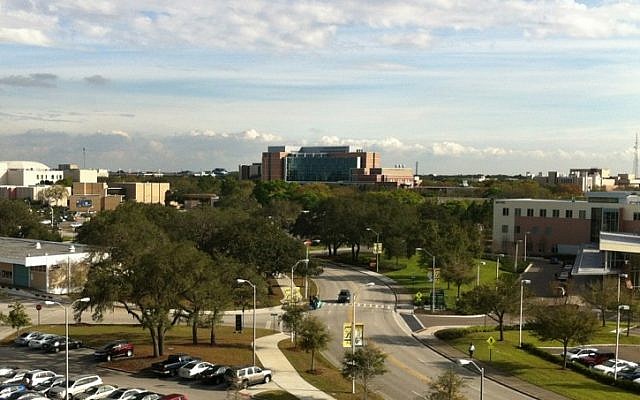
The University of Florida. (Wikimedia Commons, CC BY-SA 3.0, FightingRaven531)

Rachel Harris, director and endowed chair at Florida Atlantic University’s Jewish Studies program, is in her first semester at the university, having just arrived from the University of Illinois. “I’m now wondering if that was a terrible mistake,” she joked. (Harris is spending this term in Israel, researching on a Fulbright fellowship.)

Still, Harris said she was “confident” that legislators would “continue to support educational commitments in the state,” noting that Florida has a Holocaust education mandate for K-12 public schools. Her Boca Raton university is currently building an expanded center for Jewish and Holocaust studies, funded by private donors. H.B. 999 in its current form would prohibit universities from teaching critical theory concepts even when such programs are privately funded.


Despite what he described as a few students at the Jewish Studies center who are concerned about the new bill, Goda said he did not think the legislation would change the experience of Jewish students on his campus.

“Jewish kids these days are really choosing universities based on whether or not Jewish kids feel comfortable there,” he said. “And I would argue that [the University of Florida] is a very welcoming campus for Jewish kids overall. There are strong Jewish institutions associated with the campus.”

Instead, he feels the bill’s real effects would be felt in the state’s ability to recruit faculty and staff while its legislators jeopardize academic freedom, tenure and other lodestars of the humanities. He said, “The real question to me is how and in what way it’s going to be enforced.”
ISRAEL

100 Hebrew teachers for new immigrants file resignation letters in protest at wages

Resignations account for 20% of total number of tutors at state-provided language schools that are already suffering backlog due to lack of teaching staff

Teacher Hanna Rabkin and three new immigrants from Ukraine attend class at Renanim Shuvu school in Nof Hagalil, Israel, March 23, 2022. (Cnaan Liphshiz/JTA)

100 Hebrew teachers at state-run language schools for new immigrants filed resignation letters on Sunday in protest at a lack of progress in negotiations for higher wages that have been going on for months.

The resignations will come into effect on September 1 with the start of the new school year.

Teachers at ulpans, the Hebrew term for specialty Hebrew-language schools, are primarily requesting salaries that are in line with regular school teachers, who have a powerful union and consequently receive substantially higher salaries.

An ongoing major shortage of instructors for ulpans has caused significant delays for thousands of new immigrants in learning the language. Yet the sector is struggling to find new teachers with activists blaming years of poor salaries and work conditions, leading many to leave for better-paying jobs as teachers in other schools.

The country currently only has around 500 ulpan Hebrew teachers and the resignations will have a considerable impact on a system that is already struggling to meet demand.

“I love the new immigrants and the country but I must provide for my family,” one Hebrew teacher, identified only by her first name Yafit, told the Kan public broadcaster.

The past year saw immigration to Israel, or aliyah, rise dramatically to the highest levels in over two decades, almost completely due to Russia’s invasion of Ukraine in February 2022 and its subsequent crackdowns and drafts back at home, which prompted tens of thousands of Ukrainians and Russians to immigrate to Israel.

Israel scrambled to absorb all of these new arrivals, renting hotel rooms and working with schools to prepare for the influx of children who would need language help and social assistance.

One area that was found to be a major weak spot, however, was Hebrew-language instruction for adults. New immigrants faced major delays in beginning these Hebrew courses, with some waiting several months before they could begin learning the language in a classroom setting.

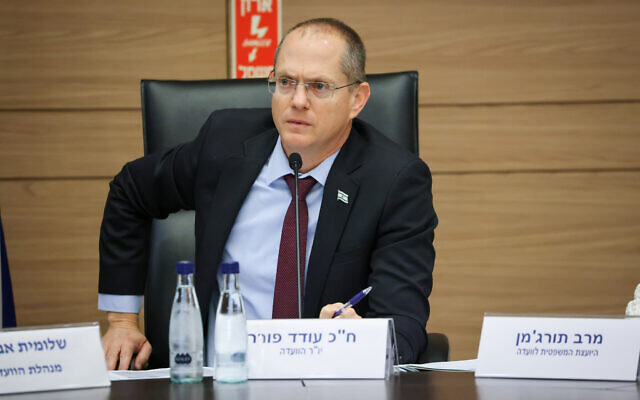
MK Oded Forer, chair of the Knesset’s Immigration, Absorption, and Diaspora Affairs Committee, oversees a hearing on Hebrew teacher shortages on January 18, 2023. (Noam Moskowitz/Knesset)

Yafit claimed that the education and finance ministries are arguing over who should fund NIS 40 million ($12 million) needed to hire more teachers.

She said ulpan teachers’ wages have not been updated for 15 years and new tutors start on minimum wage.

“I am a teacher with the same training and education as all teachers, and anywhere else I could get much more,” Yafit explained.

Opposition Yisrael Beytanu MK Oded Forer, chair of the Knesset’s Immigration, Absorption, and Diaspora Affairs Committee, said in a statement that he has for months been warning the education and finance ministry that their “disregard will lead to the closing of ulpans.”

He noted that recent figures showed Israel is experiencing its largest wave of immigration in 20 years.

“It’s not too late yet,” Forer said. “I call on Bezalel Smotrich and Yoav Kish — stop the crisis in the Hebrew ulpans, equate the teachers’ conditions to the conditions in the entire education system,” he said referring to finance and education ministers respectively.

In January his Knesset committee met to debate the issue and lawmakers heard that new immigrants are sometimes waiting up to six months until they are admitted to an ulpan.

In an effort to relieve the backlog, Immigration and Absorption Minister Ofir Sofer — in one of his first acts — allocated an additional NIS 20 million ($6 million) for vouchers for private Hebrew-language instruction, doubling the ministry’s budget for private lessons.

However, Forer at the time knocked Sofer’s voucher proposal as it puts the onus of responsibility on the new immigrants, rather than on the state. When a new immigrant studies at a state-run ulpan, their tuition is automatically paid to the school by the government. If they study at a private ulpan, however, they pay their own tuition and then request reimbursement from the government.

Yad L’Olim, a group that advocates for immigrants and which is also lobbying for the ulpan teachers, told lawmakers the teachers are demanding to be paid on the same level as other Education Ministry employees, to receive restitution for their years without pay raises, and to be considered full-time employees, instead of as the part-time workers they are designated today.

That was estimated to cost roughly NIS 40 million ($12 million).

In addition to being a source of immediate frustration, the long wait times could have significant negative impacts on immigrants’ ability to settle in Israel in the long-term; knowledge of Hebrew has been shown to be a key factor in successful long-term integration into Israeli society.