Tuesday, March 28, 2023

Drought caused 43,000 ‘excess deaths’ in Somalia last year, half of them young children

New report uncovers tragic scale of climate-led crisis and warns of up to 34,000 more deaths so far this year



Somalia: ‘The worst humanitarian crisis we’ve ever seen’


Tracy McVeigh
Tue 21 Mar 2023 

A new report released by the Somalian government suggests that far more children died in the country last year due to the ongoing drought than previously realised.

The study estimates that there were 43,000 excess deaths in 2022 in Somalia due to the deepening drought compared with similar droughts in 2017 and 2018.

Half of the deaths are likely to have been children under five. Up to 34,000 further deaths have been forecast for the first six months of this year.

Released on Monday by Somalia’s federal health ministry together with Unicef and the World Health Organization, the report was compiled by researchers at the London School of Hygiene and Tropical Medicine and Imperial College London, who looked at retrospective estimates of mortality across Somalia from January to December 2022.

Somalis are dying because of a climate crisis they didn’t cause. More aid isn’t the answer


Accurate statistics are difficult to compile from a population spread across remote areas, and with about three million people displaced from their homes. The highest death rates are thought to be in the regions of south-central Somalia, including Bay, Bakool and Banadir, that are the worst hit by drought.

Somalia’s health minister, Dr Ali Hadji Adam Abubakar, found cause for optimism that famine had so far been averted.

“We continue to be concerned about the level and scale of the public health impact of this deepening and protracted food crisis in Somalia,” he said.

“At the same time, we are optimistic that if we can sustain our ongoing and scaled-up health and nutrition actions, and humanitarian response to save lives and protect the health of our vulnerable, we can push back the risk of famine for ever.”

If this did not happen, he said, “the vulnerable and marginalised will pay the price of this crisis with their lives.”

“We therefore urge all our partners and donors to continue to support the health sector in building a resilient health system that works for everyone and not for the few,” said Abubakar.

For the first time, a prediction model was developed from the study. A forecast from January to June 2023 estimates that 135 people a day might also die due to the crisis, with total deaths projected at being between 18,100 and 34,200 during this period.

The estimates suggest the crisis in Somalia is far from over and is already more severe than the 2017-18 drought.

Wafaa Saeed, Unicef’s representative in Somalia, said he was saddened by the grim picture of the drought’s impact on families, but added: “We know there could have been many more deaths had humanitarian assistance not been scaled up to reach affected communities.

“We must continue to save lives by preventing and treating malnutrition, providing safe and clean water, improving access to lifesaving health services, immunising children against deadly diseases such as measles, and providing critical protection services.”

There have now been six consecutive failed rainy seasons in the climate crisis-induced drought, which coincides with global food price rises, intensified insecurity in some regions, and the aftermath of the pandemic.

The study is the first in a planned series and was funded by the UK’s Foreign, Commonwealth and Development Office.
Opinion: Biden’s veto supports free markets, not ‘woke’ capitalism

Opinion by Witold Henisz
Updated 10:32 AM EDT, Wed March 22, 2023

Wind turbines operate at a wind farm, a key power source for the Coachella Valley, on February 22, 2023 in Palm Springs, California.Mario Tama/Getty Images

CNN —

President Biden just issued the first veto of his presidency over Republican legislation that aims to limit retirement fund managers from incorporating environmental, social and governance factors into their financial analysis.

While ESG investing is criticized by Republicans as “woke” capitalism that is ideologically motivated and harmful to pensioners, it’s actually something both parties and all investors should support.

Biden’s veto supports free markets in the hard work of analyzing the long-term determinants of financial performance, including both traditional financial information like sales growth, cost margins and productivity, as well as information related to environmental factors like carbon emissions, social factors like labor practices and governance factors like transparency in reporting.

The term ESG was first introduced in 2004 to distinguish a group of investors who considered ESG issues not based on their values, ethics or a desire to be socially responsible, but rather because they believed these factors impacted financial performance, particularly in the long term. Put simply, ESG investing just means considering environmental, social and governance factors alongside more traditional financial data in assessments of long-term financial performance.

The logic here is straightforward and anything but political. The value of some assets depends, for instance, on the degree of global warming or our success in transitioning to clean energy. Consider the value of a deep-water oil field or coal mine in which investment today is only profitable if demand for fossil fuels in 2050 is supported by a large fleet of fossil fuel vehicles and coal-burning power plants.

If zero-emission vehicles dominate global markets in 2050 and solar and wind power continue to decline in costs at current rates, any investments in that oil field or coal mine today will not earn a positive return.

Alternately, consider a lithium processing facility or a new battery plant that will only earn a return if battery-powered vehicles make up the majority of the North American fleet in 2050. If fossil fuel vehicles instead remain dominant, investments in that processing facility or battery plant will not pay

In each of these cases, environmental factors and their evolution over time alter the expected value of an investment. Whether you voted Republican or Democrat in the last election, you should prefer that the person, organization or algorithm investing your pension takes these factors into account rather than being prohibited from doing so by Republican-sponsored legislation.

Similar arguments can be made for incorporating the likely cost of air or water pollution regulation, human rights lawsuits, minimum wage legislation and anti-money laundering restrictions into forecasts of companies’ earnings and relative performance. In each case, future revenues, costs and productivity are impacted by environmental, social or governance factors.

ESG investing is not about values, nor is it woke or ideological. It’s about being fiduciarily responsible. It is simply good economics and good finance. Pension managers should be able to take all financially material information into account. Climate risk is, in some cases and under some assumptions, investment risk.

Forbidding pension fund managers from incorporating it into their analysis would be akin to forbidding them from considering the impact of artificial intelligence, the Russian invasion of Ukraine or the growing US-China geopolitical rivalry. Each of these factors could be financially material, and asset managers competing in the free market should be able to analyze them, free of government regulation determining what they can and cannot consider to be material.

It’s true that asset managers’ analyses of ESG issues remain imperfect and the returns on ESG funds, so far, have tended to underperform the market. That’s because the data to assess firms’ ESG impacts is only voluntarily disclosed in the US, and the science and financial models linking that data to financial impacts are still evolving. There is a lot of confusion between ESG investing and counterparts such as socially responsible investing or impact investing, which may pursue other objectives than financial performance. There is also a lot of greenwash or virtue claiming by asset managers seeking to convince the public they offer ESG funds when, in reality, these are more marketing efforts than genuine ESG offerings.

As the focus of ESG data improves over time, the hope is that returns on actual ESG strategies should at least match the market on a risk-adjusted basis net of fees. This is the game that fund managers following all strategies seek to play, and while broad-based index funds show the best performance over the long term, enormous efforts are deployed to find means to beat the market.

Prohibiting investment managers from following ESG strategies when more and more of them are convinced by the underlying logic, following the demand of asset owners and making progress on the data and analytics would be counter-productive. It would preclude investors from having access to some of the biggest and best asset managers. Wharton finance professors have found that ignoring this progress and adhering to Republican legislative proposals to invest only with asset managers not making these efforts would cost taxpayers millions, while separate reports found it would cost investors and pensioners in Indiana and Kansas billions. The process of defining what would be and would not be banned would be a recipe for political chicanery, lobbying and other influence strategies that would further depress returns.

Biden’s veto supports free market efforts to price ESG risks and opportunities. Such efforts benefit pensioners who want their investments to take into account all material factors in their financial analyses — not just those that the Republican party and its billionaire donors support. Pensioners, current and future, both red and blue, should support the hard ongoing work of ESG integration into financial analyses.

 
Witold Henisz
Editor’s Note: Witold Henisz is the vice dean and faculty director of the ESG Initiative at the Wharton School and the Deloitte & Touche Professor of Management. The ESG Initiative has more than two dozen partners supporting its research. Professor Henisz is also an adviser to asset manager Engine No 1, for whom he co-developed the Total Value Framework. He also recently joined the Sustainable & Impact Investing Advisory Council for Glenmede, an asset manager. The views expressed here are his own. Read more opinion on CNN.

Manitoba

Iranians share hopes for Woman Life Freedom movement at Nowruz celebration

It's a bittersweet celebration, vice-president of Iranian Community of Manitoba says

A woman with long hair wearing a black dress looks at the camera and smiles. She stands in front of a traditional Haft-Sin.
Jozi Oliver says this year's Nowruz festival holds a deeper significance for her because of the rise of the Woman Life Freedom movement. (Joanne Roberts/CBC)

Iranians at a Winnipeg celebration of Nowruz, also known as Iranian New Year, say they hope family and friends who are still in Iran find freedom and safety in the coming year.

"[We want] Iranians ... [to] go back in freedom and enjoy these celebrations with their families," said Iranian-Winnipegger Kourosh Doustshenas.

Around 300 people gathered at the Caboto Centre in Winnipeg on Monday to celebrate the annual festival. 

Nowruz, which means 'new day' in Farsi, dates back more than 3,000 years. It celebrates the return of spring and a renewal of life.

"It's the most important day on the Iranian calendar," said Arian Arianpour, president of the Iranian Community of Manitoba.

Although the festival is primarily a new year celebration, a big focus at the Winnipeg event was to support the Woman Life Freedom movement among the ongoing protests against the Islamic Republic. 

"This year is another chance to keep fighting after six months of … fighting against a ruthless regime," said Arianpour.

A white card that reads 'Woman Life Freedom' and features the face of Mahsa Amini rests on a table.
A photo of Mahsa Amini takes centre stage at the traditional Nowruz Haft-Sin, an arrangement of seven symbolic items. (Walther Bernal/CBC)

Woman Life Freedom is a political slogan used as a rallying cry during anti-government protests that started in the country after the death of 22-year-old Mahsa Amini.

Amini died in custody after she was arrested by morality police in September for wearing her hijab incorrectly. Since her death, protests against the Islamic Republic have spread in Canada and across the world. 

Jozi Oliver, who attended the event with family, said this year has a deeper significance to her because of the rise of the movement — and the women who have joined the demonstrations.

"I really hope it will drive some change. We're already seeing change with the women coming out and wanting to support the movement," Oliver said.

"Hopefully I'll be able to visit Iran, a free Iran, soon."

Doustshenas, who is the vice-president of the Iranian Community of Manitoba, said the group didn't know whether to celebrate the new year with so much turmoil happening in their home country.

"It is bittersweet. We are mourning our loved ones," he said.

"Even though it's very hard for us, we want to make sure we safeguard all these traditions and make sure people have a chance to be together."

Doustshenas said the group consulted the community and received overwhelming support for a festive Nowruz celebration that still acknowledged the anti-regime demonstrations and ongoing government crackdown on protestors.

The group decided to have a traditional Iranian music concert, featuring musician Amin Vali. The concert was dedicated to Mahsa Amini, women in Iran and Woman Life Freedom demonstrators.

Two men wearing suits look at the camera with solemn expressions.
Kourosh Doustshenas and Arian Arianpour, from the Iranian Community of Manitoba, stand together. Doustshenas says it's a bittersweet Nowruz celebration. (Joanne Roberts/CBC)

"It's dedicated to all those … who are fighting for freedom," said Doustshenas, and all those in jail because of that fight.

Arianpour said Iranians all over the world have been using celebrations like Nowruz to protest against the Islamic Republic.

"Maybe Nowruz is a chance for all the politicians, all the leaders of the free world, to think of the fact that they have not been supporting the Woman Life Freedom revolution enough," he said.

"[They can] change Iran, change the Middle East, and change the whole world."

Iranians at a Winnipeg celebration of Nowruz, also known as Iranian New Year, say they hope family and friends who are still in Iran find freedom and safety in the coming year.

U.S. pushing Canada to lead international force to Haiti


By Amanda Coletta and Widlore Mérancourt
March 21, 2023

TORONTO — It has been more than five months since Ariel Henry, Haiti’s embattled prime minister, made a plea to the international community: Deploy a “specialized armed force” from abroad to restore order to a country reeling from a constellation of crises.

The request was unusual; Haiti has suffered a long history of destabilizing foreign interventions. But as the Caribbean nation struggles with gang violence, civil and political unrest, and a resurgence of cholera, it quickly drew backing from U.N. Secretary General António Guterres and the United States. The Biden administration soon drafted a U.N. Security Council resolution proposing a “non-U.N. international security assistance mission” to support the beleaguered Haitian police in restoring order.

The catch: The United States does not want to lead it.

That has left Haiti still waiting for an answer. When President Biden meets Prime Minister Justin Trudeau in Ottawa this week on his long-awaited first visit to Canada in office, the leaders will discuss a way forward in Haiti, to which both their countries have close and long-standing ties.

The U.N. is mulling another mission to Haiti. Haitians are skeptical.

The Biden administration, mindful of failed U.S. military interventions in the past, has prevailed upon Canada to take a “leadership role” in an international force. White House national security adviser Jake Sullivan told reporters in January that Canada itself had “expressed interest” in such a role, but U.S. optimism has waned as months have passed without any commitment from Ottawa.

“We believe the security and humanitarian situation in Haiti is worsening and the situation on the ground will not improve without armed assistance from international partners,” a National Security Council spokesperson, speaking on the condition of anonymity according to the agency’s rules, told The Washington Post.

Since the beginning of the year, 531 people have been killed, 300 wounded and 277 kidnapped in gang-related violence in Haiti, U.N. officials reported Tuesday. The pace of the mayhem has been increasing: In the first half of March alone, at least 208 people were killed, 164 wounded and 101 kidnapped, according to officials.

Most of the violence has been in Port-au-Prince, the capital, a spokeswoman for the U.N. High Commissioner for Human Rights said. Most of the victims between March 1 and 15 were killed or injured by snipers who were reportedly shooting randomly at people in their homes or on the streets.

Protesters in the Petionville neighborhood of Port-au-Prince, Haiti, demand the resignation of Prime Minister Ariel Henry in October. (Odelyn Joseph/AP)
YES THAT'S A WOODEN RIFLE HE IS CARRYING

Canadian officials have said any outside intervention must be backed by a political consensus in Haiti. They have noted that previous interventions haven’t led to their desired outcomes. They have also cast doubt on whether the Canadian armed forces have the capacity for the type of mission the United States has proposed.

Officials also bristle at the notion that they have not already assumed a leadership role. They point out that they’ve beefed up their diplomatic presence in Haiti, deployed several missions to assess needs, provided armored vehicles and other support to the police, and imposed sanctions on 17 Haitians, including alleged gang leaders and their alleged backers among the political and business elite.

The United States, meanwhile, has cheered — but not matched — Canada’s sanctions. Brian Nichols, the State Department’s assistant secretary for Western Hemisphere affairs, lauded Canada after Ottawa imposed sanctions on several former Haitian prime ministers and former president Michel Martelly in November. Washington has not yet targeted those officials with sanctions.

Senators’ departure leaves Haiti without an elected government

“For me, the best way to restore some stability for Haiti is to first sanction the elites to tell them that they can no longer finance the gangs,” Trudeau said at a town hall last week in Montreal. “And … we must ensure that the Haitian National Police have the power to do their jobs.”

He said other countries, including the United States, need to do “much more.”

Gilles Rivard, a former Canadian ambassador to Haiti, has advised the Foreign Ministry on U.N.-led peacekeeping missions. He called the reason the United States has not matched Canada’s sanctions a “big question,” given that the close security allies are likely to be sharing intelligence about the individuals in question.

“If we could coordinate on that, it would be very helpful,” he said.

Former Haitian National Police officer Jimmy “Barbecue” Cherizier, leader of the G9 Family and Allies federation of gangs, in Port-au-Prince in January. (Odelyn Joseph/AP)

Dunois Erick Cantave, a member of the Montana Accord, a powerful coalition of civil society groups and political figures, said Haitians initially welcomed the sanctions, but have lost faith that they can bring about change because they are “partial and selective.”

Washington has imposed visa restrictions on more than 40 alleged gang leaders and supporters since October and levied sanctions on four people. A senior State Department official, asked last month if the department planned to add sanctions on more people, said the decision process was lengthy and required the proper “legal authorities” and “corroborating evidence.”

The United States has imposed its sanctions under an executive order that targets “foreign persons involved in the global illicit drug trade.” That wording, analysts said, might explain in part why Washington has not targeted the same people as Ottawa.

“If [the Haitians] have U.S. status, that’s likely the reason that the U.S. hasn’t done it,” said John E. Smith, a former director of the U.S. Treasury Department’s Office of Foreign Assets Control.

Abductions by the busload: Haitians are being held hostage by a surge in kidnappings

Meanwhile, the Royal Canadian Mounted Police said it has “not received any disclosure from third parties on frozen assets for Haiti,” raising questions about Canada’s enforcement capabilities.

Analysts say U.S. allies are hesitant to risk lives in a logistically complicated mission that would require a significant amount of time and resources and have complications. Trudeau leads a minority government dependent on the support of other parties to advance his agenda. He has been on the defensive for weeks over questions about what his government knew about and how it responded to alleged Chinese interference in recent Canadian elections.

“You won’t go there for three months or six months,” Rivard said. “You will go there for at least a couple of years.”

Trudeau, at a meeting with Biden and Mexican President Andrés Manuel López Obrador in January, said he was “very aware that things could get worse in Haiti.”

Since then, the terms of Haiti’s last 10 senators have expired. With the presidency vacant since the 2021 assassination of Jovenel Moïse and in the absence of elections, the national government now has no democratically elected officials. In Port-au-Prince, meanwhile, gang violence has pushed deeper into more neighborhoods.

“Kidnappings are rampant,” Helen La Lime, the special representative of the U.N. secretary general for Haiti, told a meeting of the Organization of American States last week. “The sexual violence that is taking place in Haiti is at levels never seen before — and rarely seen in any society.”

An armored police car in Port-au-Prince this month is pocked with bullet holes from clashes with armed gangs. (Johnson Sabin/EPA-EFE/Shutterstock)


The Haitian police, struggling with high rates of attrition, have been outnumbered and outgunned by the gangs.

The United States, and Florida in particular, is the main source of firearms for Haiti, the U.N. Office on Drugs and Crime reported this month. They are often procured through straw men in states with lax gun laws and then trafficked illegally to the country.

Dominican Republic sending children, pregnant migrants back to Haiti

In Haiti, Henry’s request for a foreign force has been divisive. Some fear such a force would buttress Henry, a deeply unpopular appointee whose critics view his claim to power as illegitimate. He said last week that he would mobilize the army to aid the police in wresting control back from the gangs, another controversial move.

As security conditions deteriorate, some Haitians are taking a dim view of the international response. When Canada deployed two navy ships to patrol Haitian waters last month, Le Nouvelliste, Haiti’s largest newspaper, published a front-page cartoon showing a bandit holding a gun in one hand and a man upside-down in the other — shaking him down, literally. He shrugs off the ships.

They’re a joke, he says in Creole. “They’re not going to get close.”

Georges Michel, a Haitian historian who helped write the nation’s 1987 constitution, said some measures taken by the international community have been well-intentioned but have come too late. As the country’s interlocking crises worsen, he and other Haitians see a foreign security force as the only way that they can breathe.

“When Canada sent a plane and a boat to fight against the insecurity, the population laughed,” he said. “We don’t have problems with the birds or the fish.”

Mérancourt reported from Port-au-Prince. Karen DeYoung, Jeanne Whalen and Yasmeen Abutaleb in Washington contributed to this report.


By Amanda ColettaAmanda Coletta is a reporter based in Toronto who covers Canada for The Washington Post. She previously worked in London, first at the Economist and then the Wall Street Journal. Twitter

Astronomers analyze first results from ESO telescopes on the aftermath of DART's asteroid impact

First results from ESO telescopes on the aftermath of DART's asteroid impact
This series of images, taken with the MUSE instrument on ESO’s Very Large Telescope,
shows the evolution of the cloud of debris that was ejected when NASA’s DART spacecraft 
collided with the asteroid Dimorphos. The first image was taken on 26 September 2022, 
just before the impact, and the last one was taken almost one month later on 25 October. 
Over this period several structures developed: clumps, spirals, and a long tail of dust 
pushed away by the Sun’s radiation. The white arrow in each panel marks the direction of
 the Sun. Dimorphos orbits a larger asteroid called Didymos. The white horizontal bar 
corresponds to 500 kilometers, but the asteroids are only 1 kilometer apart, so they can’t 
be discerned in these images. The background streaks seen here are due to the 
apparent movement of the background stars during the observations while the telescope 
was tracking the asteroid pair. Credit: ESO/Opitom et al.

Using ESO's Very Large Telescope (VLT), two teams of astronomers have observed the aftermath of the collision between NASA's Double Asteroid Redirection Test (DART) spacecraft and the asteroid Dimorphos. The controlled impact was a test of planetary defense, but also gave astronomers a unique opportunity to learn more about the asteroid's composition from the expelled material.

On September 26, 2022, the DART spacecraft collided with the asteroid Dimorphos in a controlled test of our asteroid deflection capabilities. The impact took place 11 million kilometers away from Earth, close enough to be observed in detail with many telescopes. All four 8.2-meter telescopes of ESO's VLT in Chile observed the aftermath of the impact, and the first results of these VLT observations have now been published in two papers.

"Asteroids are some of the most basic relics of what all the planets and moons in our  were created from," says Brian Murphy, a Ph.D. student at the University of Edinburgh in the UK and co-author of one of the studies. "Studying the cloud of material ejected after DART's impact can therefore tell us about how our solar system formed."

"Impacts between asteroids happen naturally, but you never know it in advance," continues Cyrielle Opitom, an astronomer also at the University of Edinburgh and lead author of one of the articles. "DART is a really great opportunity to study a controlled impact, almost as in a laboratory."

Opitom and her team followed the evolution of the cloud of debris for a month with the Multi Unit Spectroscopic Explorer (MUSE) instrument at ESO's VLT. They found that the ejected cloud was bluer than the asteroid itself was before the impact, indicating that the cloud could be made of very fine particles. In the hours and days that followed the impact other structures developed: clumps, spirals and a  pushed away by the sun's radiation. The spirals and tail were redder than the initial cloud, and so could be made of larger particles.

MUSE allowed Opitom's team to break up the light from the cloud into a rainbow-like pattern and look for the chemical fingerprints of different gases. In particular, they searched for oxygen and water coming from ice exposed by the impact. But they found nothing.

"Asteroids are not expected to contain significant amounts of ice, so detecting any trace of water would have been a real surprise," explains Opitom. They also looked for traces of the propellant of the DART spacecraft, but found none. "We knew it was a long shot," she says, "as the amount of gas that would be left in the tanks from the propulsion system would not be huge. Furthermore, some of it would have traveled too far to detect it with MUSE by the time we started observing."

Another team, led by Stefano Bagnulo, an astronomer at the Armagh Observatory and Planetarium in the UK, studied how the DART impact altered the surface of the asteroid.

"When we observe the objects in our solar system, we are looking at the sunlight that is scattered by their surface or by their atmosphere, which becomes partially polarized," explains Bagnulo. This means that  oscillate along a preferred direction rather than randomly. "Tracking how the polarization changes with the orientation of the asteroid relative to us and the sun reveals the structure and composition of its surface."

Bagnulo and his colleagues used the FOcal Reducer/low dispersion Spectrograph 2 (FORS2) instrument at the VLT to monitor the asteroid, and found that the level of polarization suddenly dropped after the impact. At the same time, the overall brightness of the system increased. One possible explanation is that the impact exposed more pristine material from the interior of the asteroid.

"Maybe the material excavated by the impact was intrinsically brighter and less polarizing than the material on the surface, because it was never exposed to solar wind and solar radiation," says Bagnulo.

Another possibility is that the impact destroyed particles on the surface, thus ejecting much smaller ones into the cloud of debris. "We know that under certain circumstances, smaller fragments are more efficient at reflecting light and less efficient at polarizing it," explains Zuri Gray, a Ph.D. student also at the Armagh Observatory and Planetarium.

The studies by the teams led by Bagnulo and Opitom show the potential of the VLT when its different instruments work together. In fact, in addition to MUSE and FORS2, the aftermath of the impact was observed with two other VLT instruments, and analysis of these data is ongoing.

"This research took advantage of a unique opportunity when NASA impacted an asteroid," concludes Opitom, "so it cannot be repeated by any future facility. This makes the data obtained with the VLT around the time of impact extremely precious when it comes to better understanding the nature of asteroids."

The research highlighted in the first part of this article was presented in the paper "Morphology and spectral properties of the DART impact ejecta with VLT/MUSE," which appears in Astronomy & Astrophysics. The second part of this article refers to the paper "Optical spectropolarimetry of binary  Didymos-Dimorphos before and after the DART " in Astrophysical Journal Letters.

More information: C. Opitom et al, Morphology and spectral properties of the DART impact ejecta with VLT/MUSE, Astronomy & Astrophysics (2023). DOI: 10.1051/0004-6361/202345960

Optical spectropolarimetry of binary asteroid Didymos-Dimorphos before and after the DART impact, Astrophysical Journal Letters (2023). DOI: 0.3847/2041-8213/acb261. iopscience.iop.org/article/10. … 847/2041-8213/acb261

Spirals, Tails, And Reflective Dust Were Released In DART Asteroid Collision

Deep observations have revealed insight into the Didymos-Dimorphos system.


DR. ALFREDO CARPINETI
Senior Staff Writer & Space Correspondent

Published  March 21, 2023


Artist's impression of the DART impact on Dimorphos. Image Credit: ESO/M. Kornmesser

Last September, DART hit asteroid Dimorphos, the small companion of asteroid Didymos. The impact was a test of planetary defense, showing that we can truly shift the orbit of a celestial body. But it was also a chance to study what an impact on an asteroid looks like. And astronomers did not waste time in pointing some of the most powerful telescopes at it.

Using the Very Lage Telescope, part of the European Southern Observatory (ESO), astronomers were able to spot features, composition, and peculiarities of the dust released in the impact. And it gave them a great deal of information about what happens when asteroids collide.

“Impacts between asteroids happen naturally, but you never know it in advance,” the lead author of one of two new studies, Cyrielle Opitom, an astronomer at the University of Edinburg, said in a statement. “DART is a really great opportunity to study a controlled impact, almost as in a laboratory.”


This research team followed the evolution of the dust cloud from mere hours after the impact to a month later. At first, the ejected cloud was bluer in color than the asteroid, suggesting that it was made of finer particles, but as time went by and it expanded, the team saw structures develop such as clumps, spirals, and long tails. And as more time went by, they appeared redder and redder, suggesting large particles were the main components of these.

The team also looked for water ice from the asteroid – there was little hope of finding it as they tend to be very dry, but it was important to check. They also looked for any residual fuels from DART, but it impacted the asteroid almost empty.

“We knew it was a long shot,” Opitom explained, “as the amount of gas that would be left in the tanks from the propulsion system would not be huge. Furthermore, some of it would have traveled too far to detect it with MUSE by the time we started observing.”

The other research team looked at the polarization of light from the cloud of debris following the impact. Polarized light is light with a specific orientation (the electromagnetic fields of it oscillate on a specific plane) and the atmosphere and surface of a celestial body can change and polarize the light of the Sun. Or clouds of particles from a collision.


“Tracking how the polarisation changes with the orientation of the asteroid relative to us and the Sun reveals the structure and composition of its surface,” lead author Stefano Bagnulo, an astronomer at the Armagh Observatory and Planetarium in the UK, explained.

Following the impact, the scientists noticed that the level of polarization decreased but the brightness of the system increased, suggesting that the material ejected might have been more pristine and brighter, coming from the subsurface so not previously exposed to solar radiation. Or it could be a question of size.

”We know that under certain circumstances, smaller fragments are more efficient at reflecting light and less efficient at polarising it,” explained Zuri Gray, a PhD student also at the Armagh Observatory and Planetarium.

This is just the beginning of this data analysis. More work is currently being done to analyze what the ESO observatories have seen in this fantastic event.

The paper led by Opitom is published in Astronomy & Astrophysics, and the work led by Bagnulo in The Astrophysical Journal Letters.
 

Research team finds indirect evidence for existence of dark matter surrounding black holes

Research team proves existence of dark matter surrounding black holes
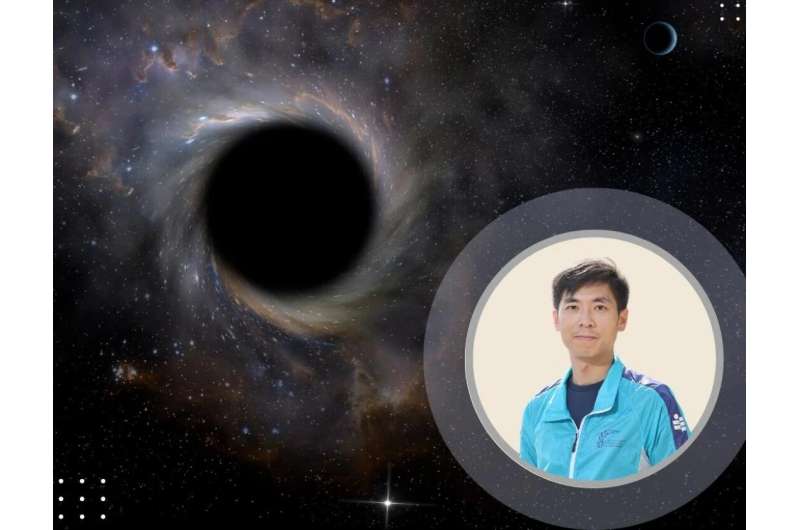
Credit: The Education University of Hong Kong (EdUHK)

Dark matter does not emit or reflect light, nor does it interact with electromagnetic forces, making it exceptionally difficult to detect. Nevertheless, a research team from The Education University of Hong Kong (EdUHK) has proven that there is a substantial amount of dark matter surrounding black holes. The study results are published in the journal The Astrophysical Journal Letters.

The team selected two nearby  (A0620-00 and XTE J1118+480) as research subjects, with both considered as binary systems. That is, each of the black holes has a companion star orbiting it. Based on the orbits of the companion stars, observations indicate that their rates of orbital decay are approximately one millisecond (1ms) per year, which is about 50 times greater than the theoretical estimation of about 0.02ms annually.

To examine whether  exists around black holes, the EdUHK team applied the "dark matter dynamical friction model"—a theory widely held in academia—to the two chosen binary systems, through computer simulations. The team found that the fast orbital decay of the companion stars precisely matches the data observed.

Notably, this is indirect evidence that dark matter around black holes can generate significant dynamical friction, slowing down the orbital speed of the companion stars.

The findings, which verified a theoretical hypothesis formulated in the late 20th century, represent a breakthrough in dark matter research. According to the hypothesis, dark matter close enough to black holes would be swallowed, leaving the remnants to be redistributed. The process ends up forming a "density spike" around the black holes.

Dr. Chan Man-ho, Associate Professor in the Department of Science and Environmental Studies and Principal Investigator, explained that such a high density of dark matter would create dynamical friction to the , in a way similar to drag force.

"This is the first-ever study to apply the 'dynamical friction model' in an effort to validate and prove the existence of dark matter surrounding black holes," he said. "The study provides an important new direction for future dark matter research."

Dr. Chan further mentioned that previous studies, which relied mostly on  and gravitational wave detection to examine the presence of dark matter, depended on the occurrence of rare events, such as a merger of two black holes. According to him, that might require a prolonged waiting time for astronomers.

The novel approach adopted by EdUHK team, however, will no longer be confined by these limitations. He added, "In the Milky Way Galaxy alone, there are at least 18 binary systems akin to our , which can provide rich information to help unravel the mystery of dark matter."

More information: Man Ho Chan et al, Indirect Evidence for Dark Matter Density Spikes around Stellar-mass Black Holes, The Astrophysical Journal Letters (2023). DOI: 10.3847/2041-8213/acaafa


Journal information: Astrophysical Journal Letters


Provided by The Education University of Hong Kong

Did black holes form immediately after the Big Bang?


Gravitational waves from merging black holes go nonlinear

Soon to be ringing: artist’s impression of two black holes that are about to merge. (Courtesy: NASA)

Two independent teams have shown that gravitational waves emanating from the distorted remnants of black-hole mergers should interact with themselves. By including these nonlinear effects in their models, one team, led by Keefe Mitman at Caltech, found it could replicate gravitational wave signals from simulated “ringing” black holes up to 100 times more accurately than previous approaches. The other team came to a similar conclusion and was led by Mark Ho-Yeuk Cheung at Johns Hopkins University


Following the violent and energetic merging of two black holes, the distorted black hole that is created must quickly settle into a state of equilibrium. To reach this steady state, the object releases colossal amounts of energy in the form of gravitational waves (GWs), in a process called black hole ringdown.

In 1973 a team led by Saul Teukolsky was the first to model GWs from ringdown – more than 40 years before the first GWs from merging black holes were detected by the LIGO observatory. Yet at the time, Teukolsky and colleagues only considered small distortions in remnant black holes, something that we now know is not a good description of what happens after a merger.
Large distortions

“Because black-hole mergers are so violent, the distortions of the final black hole are often large,” Mitman explains. “This means that we should expect nonlinear effects [such as] effects from the GW interacting with itself as it propagates through spacetime near the black hole, generating new waves.”

Despite this, astrophysicists have so far held to the idea that nonlinear effects must be too small to show up in observable GW signals. As a result, they have still only considered the linear effects calculated by Teukolsky’s team.

In one new study, Mitman, Teukolsky and colleagues employed a more advanced approach to modelling black hole ringdowns. Following a suggestion from team member Macarena Lagos at Columbia University, the team developed a new way to consider how a model could describe the self-interaction of the GWs emitted after black-hole mergers.

Lagos explains, “We have improved the GW model by including nonlinear interactions of gravity. We considered various numerical simulations of black-hole mergers, containing both linear and nonlinear interactions. We then quantified how well our nonlinear model reproduced the simulations.”
More precise model

Just as they predicted, the researchers’ new approach allowed them to replicate realistic GW signals far more closely than before. “By including this nonlinear term, rather than the more-familiar linear terms that Teukolsky helped discover, we can much more precisely model the GWs created in our numerical simulations,” Mitman continues. “This means that when black holes ringdown to a steady state, that ringing is a nonlinear process.”

By analysing various simulations of black-hole mergers, the team found that nonlinear effects can account for up to 10% of the GW signals – making them far more influential than previous studies had assumed. Altogether, this meant the team could model black-hole ringdowns some 100 times more accurate than purely linear approaches.


Caution needed when testing Einstein’s general relativity using gravitational waves


The team led by Cheung came to similar conclusions and together the results could have important implications for astronomers’ ability to probe the interior structures of black holes from the GW signals they emit during ringdowns. “To extract physical information from GW signals, we need very accurate analytical models that connect properties of the black holes to features in the detected signal,” Lagos explains. “Our results mean that the nonlinear effects are actually important and will be necessary to include in future GW detections.”

With a better understanding that ringdown is nonlinear in nature, the team hopes its discoveries could soon help astronomers to better explain the enigmatic behaviours of black holes.

Perhaps most importantly, they could also enable researchers to test Albert Einstein’s general theory of relativity – which governs black hole dynamics – in the most extreme environments known to astrophysics. With the precision offered by the team’s models, these tests may finally prove stringent enough to push Einstein’s theory to its limits – which could allow new and exciting physics to emerge. However, astrophysicists will have to wait until the next generation of GW observatories come online because the current LIGO–Virgo facilities are not expected to be able to detect nonlinear effects.

The research is described in Physics Review Letters.

21 Mar 2023

Scientists find a common thread linking subatomic color glass condensate and massive black holes

Scientists find a common thread linking subatomic color glass condensate and massive black holes
Black holes with dimensions of billions of kilometers (left, as imaged by the Event Horizon 
Telescope) share features with a dense state of subatomic gluons created in collisions of 
atomic nuclei (right). Credit: Event Horizon Telescope Collaboration (left) and Brookhaven National Laboratory 
(right).

Physicists have discovered a remarkable correspondence between dense states of gluons—the gluelike carriers of the strong nuclear force within atomic nuclei—and enormous black holes in the cosmos.

The dense walls of gluons, known as a color glass condensate (CGC), are generated in collisions of atomic nuclei. This CGC measures a mere 10-19 kilometers across—less than a billionth of a kilometer. Black holes, in contrast, span billions of kilometers across.

The study, published in Physical Review D, shows that both systems are made of densely packed, self-interacting force carrier particles. In CGC, those particles are gluons. In , those particles are gravitons. Both gluons in CGC and gravitons in black holes are organized in the most efficient manner possible for each system's energy and size.

The high degree of order in CGC and black holes is driven by each system packing in the maximal amount of quantum "information" possible about the particles' features. This includes their spatial distributions, velocities, and collective forces. Such limits on "information" content are universal.

This means the research suggests that quantum information science could provide novel organizing principles for understanding these widely different systems. The mathematical correspondence between these systems also means that studying each can improve our understanding of the other. Of particular interest are comparisons of gravitational shockwaves in black hole mergers with  shockwaves in nuclear collisions.

Scientists study the  in nuclear collisions. For example, at the Relativistic Heavy Ion Collider, a Department of Energy user facility, atomic nuclei accelerated close to the speed of light become dense walls of gluons known as color glass condensate (CGC). When the nuclei collide, CGC evolves to form a nearly perfect liquid of quarks and gluons, the fundamental building blocks that make up all visible matter.

Though the strong force operates at subatomic scales, this recent analysis by scientists at Ludwig Maximilian University of Munich, the Max Planck Institute for Physics, and Brookhaven National Laboratory shows that CGC shares features with black holes, enormous conglomerates of gravitons that exert gravitational force across the universe.

Both sets of self-interacting particles appear to organize themselves in a way that satisfies a universal limit on the amount of entropy, or disorder, that can exist in each system. This mathematical correspondence points to similarities between black hole formation, thermalization, and decay and what happens when walls of gluons collide in nuclear collisions at ultrarelativistic speeds—near the speed of light.

The limit on entropy that drives this correspondence is related to maximal information packing—a key feature of quantum information science (QIS). QIS may therefore further inform scientists' understanding of gluons, gravitons, CGC, and black holes. This approach may also advance the design of quantum computers that use cold atoms to simulate and address questions about these complex systems.

More information: Gia Dvali et al, Classicalization and unitarization of wee partons in QCD and gravity: The CGC-black hole correspondence, Physical Review D (2022). DOI: 10.1103/PhysRevD.105.056026


Journal information: Physical Review D 


Provided by US Department of Energy Shining light on the inner details and breakup of deuterons