Japan's SLIM spacecraft and Intuitive Machines' Odysseus sent their last transmissions home before the two-week-long night.
Cheyenne MacDonald
·Weekend Editor
Sat, March 2, 2024
Intuitive Machines
Lunar night has come around again, presenting yet another test for the two landers that recently arrived on the moon’s surface. Both Japan’s SLIM spacecraft and Intuitive Machines’ Odysseus have gone to sleep for the two-week-long stretch of darkness, the two teams confirmed at the end of this week. There’s no guarantee that they’ll be able to resume operations afterward, but they’ll try to reestablish contact when the time comes.
While the solar powered landers weren’t built to withstand the frigid lunar night, SLIM — which has been on the moon since January 19 — has already beaten the odds beforeto pull through last month. It’ll be the first lunar night for Odysseus, which landed on February 22.
The missions, though successful in that the spacecraft survived their respective descents to the surface, stand as further examples of how challenging it is to land on the moon; both landers fell over, leaving them stuck in non-ideal positions.SLIM face-planted, andOdysseus broke a leg and tipped onto its side.
SLIM has been able to capture a few images from the surface, and the team shared another look at the Shioli crater from its perspective on Thursday before it powered down. Odysseus has sent home some pictures too from its wide-angle camera, including one last transmission before lunar night that shows a portion of the lander and the surface of the moon, with a tiny crescent Earth in the distance. But the world has eagerly been awaiting third-person POV pictures from the EagleCam made by students at Embry-Riddle Aeronautical University, which hitched a ride with Odysseus. Unfortunately, that doesn’t seem likely to happen at this point.
The camera wasn’t deployed as originally planned before the moment of touchdown, and while Intuitive Machinessaid this weekthat the team was able to power it up and eject it after Odysseus reached the surface, communications with the camera so far aren’t working. “The Embry‑Riddle team is working on that and wrestling with that to see if there’s anything they can do,” Intuitive Machines CEO Steve Altemus said on Wednesday. The onset of lunar night isn’t going to help those odds.
Lunar update

Odysseus was able to transmit data despite a bumpy lunar landing. - Intuitive Machines
Odysseus, the first US-made vehicle to make a soft landing on the moon in five decades, had a busy week after a hair-raising descent and touchdown near the lunar south pole on February 22.
Despite a bumpy landing that left Odie on its side — a setback captured in striking images — data has been transmitted from all six NASA instruments on board as well as commercial payloads, officials confirmed Wednesday.
Intuitive Machines’ IM-1 lander now faces another test: surviving lunar night, a dangerous situation as the swing into ultra-freezing temperatures during this period could cause damage to Odie’s hardware.
Elsewhere in our solar system, space scientists have spotted three faint and tiny moons orbiting the outermost planets in the Milky Way: Uranus and Neptune.
Curiosities
Explore these mind-expanding stories:
— Archaeologists have unearthed a 2,000-year-old clay head that once belonged to a figurine of a god. The rare find provides new context about life in Roman Britain.
— A dead star that feasted on a planet once in its orbit could foretell the eventual fate of our own solar system.
— Scientists have identified one reason why invasive Jorō spiders are spreading throughout United States.
Like what you’ve read? Oh, but there’s more. Sign up here to receive in your inbox the next edition of Wonder Theory, brought to you by CNN Space and Science writers Ashley Strickland and Katie Hunt. They find wonder in planets beyond our solar system and discoveries from the ancient world.
Elizabeth Howell
Fri, March 1, 2024

Two pictures of a big hill on the moon and rocks in front, in black and white.
As a Japanese moon lander again went dormant, controllers bid farewell.
The sun stopped shining above SLIM, short for "Smart Lander for Investigating Moon," as of 5 p.m. EST (2200 GMT) on Thursday (Feb. 29), officials with the Japan Aerospace Exploration Agency (JAXA) announced on X, formerly Twitter. SLIM landed upside down on the moon on Jan. 19, which means its solar panels are crooked but can still receive a bit of power.
"Although the probability of failure will increase due to repeated severe temperature cycles, SLIM plans to try operation again the next time the sun shines (in late March)," the update from JAXA read, automatically translated from Japanese to English by Google.
Related: Japan's SLIM moon lander photographed on the lunar surface — on its nose (image)
The lander woke up on Feb. 26 during extremely hot temperatures of 212 Fahrenheit (100 Celsius) in its region and has been making contact here and there with Earth in the days since. Most recently, SLIM attempted observations with its multiband spectroscopic camera (MBC) attempted scientific observation, but "it did not work properly," JAXA officials wrote.
"This seems to be due to the effects of overnight," the update continued, referring to the frigid two-week-long lunar night that SLIM experienced before the sun shone near Shioli crater again. "But we will continue to investigate based on the data we have obtained for the next opportunity."
RELATED STORIES:
— 'We proved that you can land wherever you want.' Japan's SLIM moon probe nailed precise lunar landing, JAXA says
— Why Chandrayaan-3 landed near the moon's south pole — and why everyone else wants to get there too
— Not dead yet: Japan prepares for possible recovery of SLIM moon lander
SLIM has only operated for brief bursts of activity, including a short observation schedule after landing upside-down Jan. 19 due to engine trouble. Then it had roughly two days of operations after reviving nearly 10 days later on Jan. 29, and then the itinerant work since Feb. 26.
Despite all, SLIM has met both main and extended mission objectives: Landing precisely on the moon, deploying two tiny rovers and conducting science with its navigation camera and its spectroscopic camera, particularly searching for signs of olivine on the surface.
Japan is only the fifth country to soft-land on the moon, following the Soviet Union, the United States, China and India. The U.S. made its own historic moon landing as well recently; the Intuitive Machines IM-1 Odysseus lander touched down softly on Feb. 22 to achieve the first American landing in 52 years, since Apollo 17. Odysseus went offline Thursday (Feb. 29) and may have completed its mission, operators said
First US Moon lander in 50 years finally gives up on lunar surface
Andrew Griffin
Fri, March 1, 2024

Moon Landing (ASSOCIATED PRESS)
The first US spacecraft to land on the Moon in 50 years has finally given up, and is no longer speaking to its engineers.
The Odysseus lander, made by private company Intuitive Machines, landed on the Moon on 22 February. But that landing went slightly awry, and it broke a leg and fell onto its side.
That left it unable to gather power as expected, and led to difficulties communicating with the Earth. Nonetheless, Odysseus continued to communicate with controllers for longer than expected.
On Thursday, however, the spacecraft went silent. It sent one last photo and switched into its standby mode.
But it might not be the end. The standby mode was triggered in the hope that Odysseus is able to come back online in a few weeks, if it is able to survive the cold of the lunar night.
Intuitive Machines spokesman Josh Marshall said these final steps drained the lander’s batteries and put Odysseus “down for a long nap.”
“Good night, Odie. We hope to hear from you again,” the company said via X, formerly Twitter.
The lander was originally intended to last about a week at the moon.
Houston-based Intuitive Machines became the first private business to land a spacecraft on the moon without crashing when Odysseus touched down Feb. 22. Only five countries had achieved that since the 1960s, including Japan, which made a sideways landing last month.
Odysseus carried six experiments for Nasa, which paid $118 million for the ride. The first company to take part in Nasa’s program for commercial lunar deliveries never made it to the moon; its lander came crashing back to Earth in January.
Nasa views these private landers as scouts that will pave the way for astronauts due to arrive in another few years.
Until Odysseus, the last U.S. moon landing was by Apollo 17's Gene Cernan and Harrison Schmitt in 1972.
Mike Wall
Sat, March 2, 2024

Varda Space Industries' first off-Earth manufacturing capsule captured this fiery view during its reentry to Earth's atmosphere on Feb. 21, 2024.
A pioneering private space capsule captured spectacular footage of its fiery homecoming last month.
Varda Space's first-ever mission, called W-1, wrapped up on Feb. 21 with the successful recovery of the California's startup's off-Earth manufacturing capsule.
That conical, 3-foot-wide (0.9 meters) capsule touched down softly under parachute at the Utah Test and Training Range west of Salt Lake City, carrying space-grown crystals of the antiviral drug Ritonavir.
But much of its journey through Earth's atmosphere was quite harrowing, as shown by the video, which Varda posted to its YouTube channel on Feb. 28. The craft slammed into our planet's thick air at more than 25 times the speed of sound, generating a cataract of colorful, cascading sparks.
Related: See Varda Space's private in-space manufacturing capsule's historic return to Earth in photos
Varda aims to become a major player in the nascent in-space manufacturing industry, which takes advantage of the unique microgravity environment of low Earth orbit to make high-value products like pharmaceuticals.
Such work has been done on the International Space Station already with the help of astronauts. But Varda offers customers an all-in-one autonomous option — a capsule that serves as both a minifactory and a return vehicle, taking pricey humans out of the orbital loop.
W-1 was Varda's first in-space test. The mission launched atop a Falcon 9 rocket in June 2023, one of more than 70 payloads on SpaceX's Transporter-8 rideshare mission. Varda's capsule was integrated into a Rocket Lab Photon spacecraft, which provided power, propulsion and other vital services.

a cone-shaped capsule lies on the desert floor under cloudy skies
About a week after liftoff, Varda announced that crystals of Ritonavir — a drug used to treat HIV and hepatitis C — had grown successfully aboard the capsule as planned.
The company wanted to bring those crystals down shortly thereafter but ran into difficulties securing the required reentry and landing approvals. That permission came last month, paving the way for W-1's historic touchdown.
Varda transported the capsule from Utah to its Los Angeles facilities for inspection and analysis.
"The Ritonavir vials onboard the spacecraft will be shipped to our collaborators Improved Pharma for post-flight characterization," Varda wrote in an update shortly after landing on Feb. 21. "Additionally, data collected throughout the entirety of the capsule's flight — including a portion where we reached hypersonic speeds — will be shared with the Air Force and NASA under a contract Varda has with those agencies."
This is what it looks like to reenter Earth’s atmosphere from a space capsule’s POV
Varda Space Industries stuck a camera on its
W-1 capsule to capture its first reentry mission.
Weekend Editor
Sat, Mar 2, 2024,
Incredible footage released by Varda Space Industries gives us a first-person view of a space capsule’s return trip to Earth, from the moment it separates from its carrier satellite in orbit all the way through its fiery reentry and bumpy arrival at the surface. Varda’s W-1 capsule landed at the Utah Test and Training Range, a military site, on February 21 in a first for a commercial company. It spent roughly eight months leading up to that in low Earth orbit, stuck in regulatory limbo while the company waited for the government approvals it needed to land on US soil, according to Ars Technica.
“Here's a video of our capsule ripping through the atmosphere at mach 25, no renders, raw footage,” the company posted on X alongside clips from reentry. Varda also shared a 28-minute video of W-1’s full journey home from LEO on YouTube.
Varda, which worked with Rocket Lab for the mission, is trying to develop mini-labs that can produce pharmaceuticals in orbit — in this case, the HIV drug ritonavir. Its W-1 capsule was attached to Rocket Lab’s Photon satellite “bus,” which the company said ahead of launch would provide power, communications and altitude control for the capsule. Photon successfully brought the capsule to where it needed to be for last week’s reentry, then itself burned up in Earth’s atmosphere, SpaceNews reported. Now that the capsule has returned, Ars Technica reports that the ritonavir crystals grown in orbit will be analyzed by the Indiana-based pharmaceutical company, Improved Pharma.
SpaceX launch taking crew to ISS delayed again by weather
AFP
Sat, March 2, 2024

A SpaceX Crew Dragon named Endeavour carrying the four is scheduled to blast off atop a Falcon 9 rocket from the Kennedy Space Center in Florida (-)
A planned launch on Saturday of a mission to take three American astronauts and a Russian cosmonaut to the International Space Station was scrubbed due to poor weather.
SpaceX announced that the launch was delayed, and NASA said the agency would now target Sunday at 10:53 pm (0353 GMT Monday) for liftoff.
The SpaceX Crew Dragon named Endeavour is to carry the four atop a Falcon 9 rocket from the Kennedy Space Center in Florida.
Hours before Saturday night's scheduled launch, SpaceX posted on X that "elevated winds" forced the delay.
It was the latest postponement for the launch, which initially was slated for February 22.
Elon Musk's SpaceX has been providing astronaut launch services for NASA since 2020 under NASA's Commercial Crew Program, while a rival program by Boeing has yet to get going.
Matthew Dominick, who leads the "Crew-8" mission, is making his first spaceflight, as is fellow American Jeanette Epps. It will also be the first time for Russian Alexander Grebenkin.
Michael Barratt, a physician, is making his third visit to the ISS. His first two were aboard space shuttles, which were discontinued in 2011.
Space remains a rare area of cooperation between the United States and Russia in the wake of Russia's 2022 invasion of Ukraine.
The US last month imposed fresh sanctions on 500 Russian targets, seeking also to exact a cost for the death of Russian opposition leader Alexei Navalny in a Siberian prison.
The crew will carry out experiments including using stem cells to create organoids (artificially grown masses of cells resembling organs) to study degenerative diseases, taking advantage of the microgravity environment to enable three-dimensional cell growth not possible on Earth.
Joel Montalbano, NASA's International Space Station program manager, told reporters that the US was keeping a close eye on a "small leak" on the Russian side of the research platform, the latest of several recent issues on the Russian side.
A hatch is currently closed to isolate the leak from the rest of the ISS.
ia/bbk/tjj/acb
Reuters
Fri, March 1, 2024

Astronauts arrive before launch to the International Space Station, in Cape Canaveral
(Reuters) - NASA said on Friday it is shutting down a more than $2 billion project to test satellite servicing like fueling in space, citing higher costs and schedule delays.
The space agency said in October that the On-orbit Servicing, Assembly, and Manufacturing 1 (OSAM-1) project continues to face an increase in costs and is expected to exceed its $2.05 billion price tag and the December 2026 launch date.
For its decision to discontinue the project, NASA on Friday cited "continued technical, cost, and schedule challenges, and a broader community evolution away from refueling unprepared spacecraft, which has led to a lack of a committed partner".
Much of the project's cost growth and scheduling delays could be attributed to the "poor" performance of contractor Maxar, NASA said in October.
Maxar was previously contracted by NASA in 2019 to help build its Gateway platform in lunar orbit, a crucial outpost for America's first mission to relay astronauts to the moon.
(Reporting by Harshita Mary Varghese and Zaheer Kachwala in Bengaluru; Editing by Maju Samuel)
A dead Russian spacecraft almost collided with a NASA satellite. The crash could have sent 7,500 bits of debris rocketing around Earth.
Morgan McFall-Johnsen,Ellyn Lapointe
Updated Sat, March 2, 2024

NASA's TIMED satellite narrowly avoided colliding with a dead Russian spacecraft this week.
In the worst-case scenario, the collision could have ejected up to 7,500 bits of debris into orbit.
Satellite collisions are becoming more likely as the amount of space junk in low-Earth orbit grows.
Two satellites nearly collided in space on Wednesday in a harrowing encounter that LeoLabs, a satellite-tracking company, called "too close for comfort."
NASA's Thermosphere Ionosphere Mesosphere Energetics and Dynamics, or TIMED, satellite passed by Russia's inoperative Cosmos 2221 spacecraft with less than 65 feet of clearance. That's shorter than the length of a tennis court.
These satellites are non-maneuverable, meaning neither the US nor Russia have control over where they go.
If they had collided, it could have decimated both satellites, blasting up to 7,500 fragments of space junk into Earth's orbit that would now be zooming around our planet at thousands of miles an hour, faster than bullets.
The fragments wouldn't have posed a danger to life on Earth because any debris that penetrated our atmosphere would have burned up during free fall.
But it would have threatened future spaceflight and astronaut lives since the resulting debris could have made navigating low-Earth orbit far more treacherous.
"There are 'bad neighborhoods' where these massive derelicts are accumulating preferentially," Darren McKnight, LeoLabs' senior technical fellow, told Business Insider in an email.
Avoiding collisions in these congested areas is becoming increasingly difficult as the number of objects in Earth's orbit grows yearly.
Earth's orbit is getting overcrowded

This graph shows the spatial density of non-operational objects in low-Earth orbit. The spikes correspond to altitudes most congested with space junk.LeoLabs
Near collisions between large space objects like this are rare, but it only takes one to completely change the landscape of Earth's orbit and endanger countless other satellites, space telescopes, and even the International Space Station, or ISS.
Two satellite collisions in 2007 and 2009 increased the concentration of large debris in low-Earth orbit by roughly 70%.
And with the advent of mega-constellations of internet satellites, such as SpaceX's Starlink and Amazon's Kuiper, the number of objects in low-Earth orbit is growing more and more each year, increasing the risk of collisions.

Left to right: Low-Earth orbit is the most concentrated area for orbital debris but the total object population of Earth's orbit extends far beyond this inner region.NASA ODPO
In 2007, scientists estimated there were about 10,000 low-Earth objects. By 2021, that number had doubled. And most of it isn't even useful — it's space junk.
Roughly 70% of low-Earth objects are pieces of debris from damaged or defunct rockets, satellites, and nonoperational payloads, according to LeoLabs.
That's just what's cataloged, though.
The European Space Agency estimates that nearly 1 million bits of debris measuring between one and 10 centimeters are circling Earth, with another 130 million bits even smaller than that.
Space junk is so pervasive the ISS sometimes has to navigate around it.
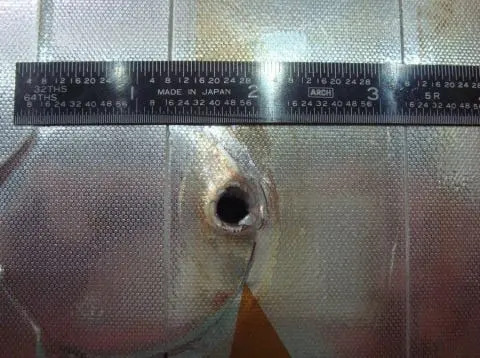
Space debris hit the space shuttle Endeavour's radiator, creating this hole found after one of its missions. The entry hole is about 0.25 inches wide, and the exit hole is twice as large.NASA
In March 2023, the ISS dodged objects twice in one month, once to avoid a collision with a satellite and again to maneuver around debris a few days later.
Even the tiniest pieces of debris can damage the space station and endanger astronauts, though no astronaut has lost their life due to space debris — yet.
The race to clean up space
The consequences of space debris are very real, so much so that the worst-case scenario has a name: Kessler syndrome.
In this scenario, a collision sets off a chain reaction, generating a catastrophic domino effect that produces so much space debris that no spacecraft can safely leave Earth for hundreds or thousands of years.

An artist's illustration of space junk circling in low-Earth orbit.dottedhippo / Getty Images
But preventing collisions today can offset a possible Kessler-syndrome scenario in the future. And some governments and private companies have begun to address the problem.
New space-industry norms and policies in some countries are prompting satellite operators to design their spacecraft to self-destruct when they die by pushing themselves into a free fall that causes them to burn up in the atmosphere.
Last year, the FCC — the US agency that regulates most communications satellites — took its first-ever enforcement action related to space debris when it fined Dish Network $150,000 for failing to properly dispose of a retired satellite.
Some governments seem less concerned. Both India and Russia have tested anti-satellite missiles by destroying their own satellites in orbit, creating new clouds of debris.
As for old, inoperable spacecraft roaming loose in orbit, such as Cosmos 2221, NASA is outsourcing research and development to private companies to collect them.
In September 2023, the space agency awarded $850,000 to TransAstra for their concept of "FlyTrap" space-debris capture bags — basically, giant high-tech trash bags to scoop up a lot of space junk.

TransAstra's capture bags could help solve Earth's space-debris problem.TransAstra
Outside the US, other companies are coming up with their own innovative disposal solutions. The Japanese company Astroscale designed a spacecraft with a magnetic plate that can attach to dead satellites and pull them into free fall.
But these space clean-up technologies are still in testing. The European Space Agency plans to be the first to remove a piece of debris from Earth's orbit with its ClearSpace-1 mission, scheduled to launch in 2026.
Meanwhile, LeoLabs hopes that its precision data on objects in orbit will help satellite operators foresee and avoid near collisions like the one that happened Wednesday.
Read the original article on Business Insider
A new space race has begun – if we don’t act now, it could trigger a war worse than WWII
AC Grayling
Sat, March 2, 2024

The Surprising Adventures of Baron Münchausen – 19th century engraving by Gustave Doré - Culture Club/Getty
For millennia, the Moon has been an object of wondrous speculation: deified as a goddess, hymned in poetry and blamed for madness. Today such speculation has ended and a quite different kind – speculation in the commercial sense – has begun.
We no longer tell tales of the man in the Moon, or of how it’s made from cheese. Now we look at it as land to mine. Lunar deposits of basalt, iron, quartz and silicon – not to mention the strong possibility of chlorine, lithium, beryllium, zirconium, uranium, thorium, and “rare-earth” metals – all whet commercial appetites, since some of these, needed for new technologies on Earth, are in short supply here.
Significantly, the Moon also has ice. Water might sustain human settlement of the lunar surface, and can be separated into its constituent hydrogen and oxygen to make rocket fuel to power further exploration of Mars and the solar system.
This explains the increase in lunar missions in recent years. Plans to put human feet back on the Moon – not visited by astronauts since 1972 – are well advanced; Nasa hopes to achieve it in late 2026. Last week, the Odysseus lander, designed by Houston-based Intuitive Machines and launched aboard a Falcon 9 rocket made by Elon Musk’s SpaceX company, became the first private spacecraft ever to reach the Moon.
For this mission, Intuitive Machines was hired by Nasa (to the tune of $118 million) to deliver research instruments to the lunar surface, including a stereo camera and radio receiver. Other cargo included a set of 125 mini Moon sculptures by the artist Jeff Koons. The lander was wrapped in a metallic jacket manufactured by Columbia Sportswear.
Odysseus is the US’s first Moon landing in more than half a century. But it is a sign, too, of how it is no longer just state enterprise – which drove the space race of the previous century – that is involved. Private companies are investing billions in the Moon’s potential.
Jeff Bezos has spoken of his hope to move “heavy industry and all polluting industry off of Earth and operate it in space”. And the Amazon billionaire – whose Blue Origin company was awarded a $3.4 billion contract by Nasa last year to build a spacecraft to transport astronauts to the Moon – is not wrong. Meanwhile, Musk has spoken of his ambition to establish a human presence on Mars, because “we don’t want to be one of those single planet species, we want to be a multi-planet species”. And he is not entirely wrong either.

Jeff Bezos has spoken of his hope to move 'heavy industry and all polluting industry off of Earth and operate it in space' - Geopix / Alamy Stock Photo
Mining on the Moon is preferable to mining on Earth, already poisoned by industrial activity. And new frontiers bring many benefits to humanity: they are a spur to knowledge and technological innovation, expanding the borders of human imagination and ingenuity.
But history shows that the hunger to conquer and exploit also brings risks. Competition can turn into conflict when billions of dollars are at stake and rivalries to be first or get most are fierce in an unregulated domain. And when it comes to the imminent major leap in humanity’s activity in space, compelled by the search for profit and control of valuable resources, we have scarcely any plans in place. The Moon is a new Wild West, completely open to adventurers with the means to claim it. The fact that the lead is being taken by well-endowed private enterprise, driven by the ambitions of major entrepreneurs like Bezos and Musk, rather than states, brings into view a reprise of the “Great Man” version of history, in which individual ambition is the driving force.
There is just one outdated provision in place for regulating the gold rush that has already begun. This is the United Nations’ Outer Space Treaty, adopted in 1967. At that time the idea of commercial activity on the Moon, of human settlement and mining operations, verged on science fiction. The Treaty did not envisage it, but instead focused on what was a pressing question of the day: the prospect of nuclear weapons being tested there. It stipulates that the Moon should not be used for military purposes, but leaves other activity unmentioned.
Fundamentally the 1967 Treaty was a US-USSR arrangement to limit the spread of Cold War risks. The first satellite put into orbit, the USSR’s Sputnik in 1957, and Yuri Gagarin’s space flight around Earth in April 1961, had galvanised the US into competitive endeavour. They were the prompt for John F. Kennedy’s initiation of the Nasa programme to put men on the Moon by the end of the 1960s. It was a macho technological race, with military implications; these latter underlay the need for some degree of restraint.
The 1967 treaty specifically characterises the Moon as terra nullius, open to anyone who can get there to do what they like other than place weapons on it. But military technology has now advanced into the creation of equally if not more devastating weapons systems, these already deployed in the congested orbital zone around Earth, where constellations of satellites vital to communications, surveillance, military control systems, and much more, are both guarded and threatened by ASATS (anti-satellite weapons) including space- and Earth-based lasers and sophisticated hacking techniques.

'Last week, Odysseus landed on the lunar surface in a jacket by Columbia Sportswear' - Zuma Press / Alamy Stock Photo
The race for profit and power is a path to disaster. The Scramble for Africa in the late 19th century shows how destabilising such lust can be. The European powers partitioned between them an entire continent of 10 million square miles, behaving as if it were empty land although it was inhabited by 110 million people, whom the colonists treated as if they were not there in any political or moral sense. This era of colonial competition was a major causative factor in precipitating the First World War. Within decades of dismembering Africa the major players were killing one another in trenches in France and Flanders. That, in turn, led to the Second World War, which led to the Cold War, all of which accelerated the development of military technologies; to say nothing of the legacies of empire and the revival of historical antipathies around the world. It is a dismaying and troubling picture.
Nor does legal history provide much in the way of comfort. The Antarctic Treaty System, effective since 1961, which protects that continent from military activity and economic exploitation (the only permitted activity being carefully-controlled science) is the most celebrated example of an international agreement successfully, so far, restraining despoliation of a region.
But the Treaty sends loud warning signs. One example suffices. China acceded to the Treaty in 1983. Today, its five research stations in Antarctica have satellite facilities – a boost to its military intelligence powers. In a move further threatening the Treaty, China has made a virtual sovereignty claim to territory by asserting its rights to control a large “Specially Managed Area” around its Kunlun station. China now invests more than any other Antarctic participant and has full land, sea and air capability there. Why this flurry of activity? Perhaps because in 2048 the moratorium on mining in the Antarctic comes to an end, and China wishes to be ready.
Along with Russia, China has repeatedly resisted efforts by the other Antarctic parties to extend protections of wildlife on the continent. If this Treaty, held up as the most progressive ever attained by humanity, is in an increasingly frayed state, what hope is there for the Outer Space Treaty, weak as it is; and therefore what hope for the Moon?
Optimists will say that because there are no people and no wildlife on the Moon, no natural environment to be disturbed or destroyed, there is no need to worry – apart from anxieties about pollution (Nasa’s Apollo astronauts all left their nappies on the Moon). But this misses the point. The point is what competition leads to. Private agencies investing billions of dollars in exploiting the Moon’s resources, and determined to get a significant return from that investment, will not be amenable to interference or disruptive rivalry from others with the same objective. States will not hesitate to support their citizens and corporations who are interfered with by citizens and corporations of other states. If actual fighting breaks out as a result, it will not be restricted to space.
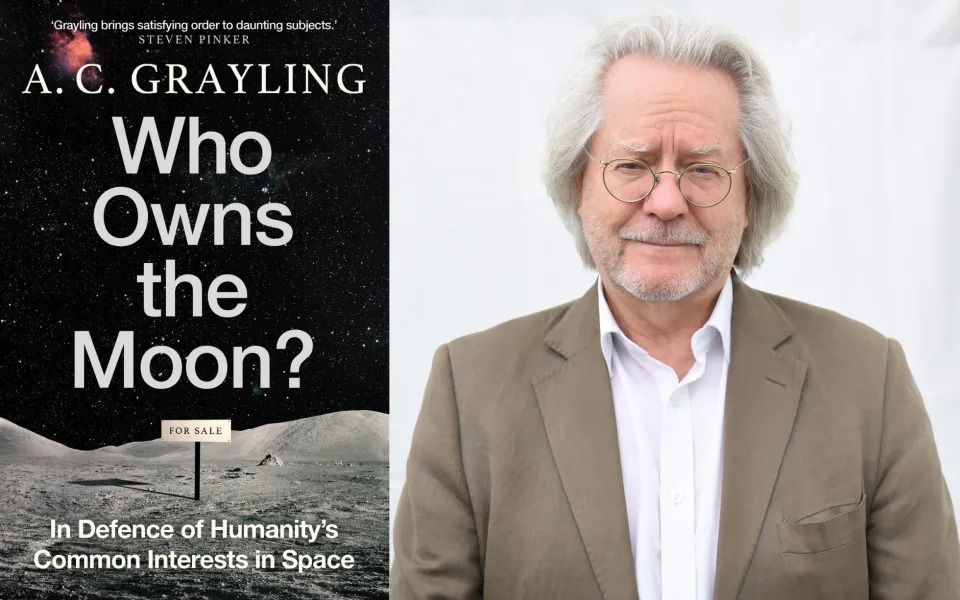
AC Grayling, author of Who Owns the Moon? - Oneworld
It would be wrong to overlook the benefits of the exploration and settlement of space, which could bring an entirely new dimension to human history. Colonies on the Moon and Mars might one day become independent new states, as past colonies on Earth have done. If Earth itself becomes uninhabitable because of climate change or devastating nuclear war, humanity might owe its survival to the great adventure of space travel – Musk argued something similar, when he said, “If there’s a Third World War we want to make sure there’s enough of a seed of human civilisation somewhere else to bring it back and shorten the length of the Dark Age”.
But the truth is, a Scramble for the Moon also prickles with the potential for trouble, and the existing legislation is inadequate to prevent it or manage it if – it is more realistic to say when – it happens.
A new and extremely robust treaty is needed, one that will be better than the Antarctic Treaty in preventing bad-faith actors from circumventing it to steal a march on others, one that will dampen the recklessness which the profit-imperative so often encourages, as every example of the “Scramble” phenomenon shows. Treaties are never watertight; they will be observed only as long as it is in the self-interest of participating parties to abide by them, and history abundantly demonstrates that when self-interest dictates that more profit is to be had from reneging on them, then that is what will happen.
Even so, treaties are our only hope. The lust for money and power has been as destructive in human history as the opposition between religions, so we have to continue efforts to agree ways of limiting the harm they cause. Perhaps in time human nature will mature to the point of making self-restraint and concern for others a more powerful force than self-interest. But we are not there yet.
Now we are on the brink of exporting not just our genius and creativity but our rivalries and jealousies into space – our appetite for riches and control, our too-frequent propensity to fall out with one another and kill each other as a result. Could we not, instead, see this as an opportunity to do things differently? A new frontier to cross into cooperative activity, a new world – a new universe – to be better in? Until we do, we need a new Outer Space Treaty.
It’s time to make clear that if the question is, who owns the Moon?, the answer must be: we all do.
Who Owns the Moon? by AC Grayling (Oneworld, £16.99) is published on Thursday
Elizabeth Howell
Fri, March 1, 2024

A blurry helicopter visible on the surface of mars. an inset image shows a blade on the sand.
The blade was broken — and, still unforged, it's been found on Mars.
Space fans scouring the raw images from NASA's Perseverance rover recently spotted the broken helicopter blade from Ingenuity lying on the sands of Mars. Ingenuity is permanently grounded as a result of the blade-snapping incident, a hard landing that occurred at the end of its Jan. 18 flight.
"Nestled in the vibrant red Martian sand, a lonely blade from NASA's Ingenuity helicopter lies about 15 meters [50 feet] from the aircraft's final resting place," the nonprofit Planetary Society wrote Tuesday (Feb. 27) on X, formerly Twitter.
Related: Ingenuity Mars helicopter snapped rotor blade during hard landing last month (video, photo)
Geovisual design student Simeon Schmauß also processed the Perserverance imagery, captured by the rover's powerful SuperCam instrument, into a composite view that shows both the helicopter and its now distant blade. Schmauß shared the results on X, visible below as well.
Ingenuity's flying days ended after 72 flights — 67 more than the five originally planned for its technology-demonstrating mission. The 4-pound (1.8 kilograms) drone was the first vehicle ever to take flight on Mars after landing with Perseverance in February 2021, and kept going for nearly three years.
Perseverance imagery downloaded from Mars on Sunday (Feb. 25) showed the broken-off Ingenuity blade. But hidden in shadow in some of the raw imagery was the blade itself, barely visible in Martian dunes.

a broken helicopter blade lying on beige sand. the picture includes a circle drawn to show where the blade is
NASA's Perseverance rover captured the broken-off blade of Ingenuity on Mars on Feb. 25, 2024 using its SuperCam imager. This image has been enhanced to make the blade more visible on the sand. (Image credit: NASA/JPL-Caltech/edited by Josh Dinner)
RELATED STORIES:
— NASA's Mars helicopter Ingenuity takes off on historic 1st powered flight on another world
— 'It's sort of been invincible until this moment:' Mars helicopter Ingenuity pilot says 'bland' terrain may have doomed NASA chopper
— Nuclear-powered Dragonfly mission to Saturn moon Titan delayed until 2028, NASA says
The helicopter, operating in Mars' Jezero Crater, demonstrated flight was not only possible but could be done regularly in the Red Planet's thin atmosphere.
After its initial five hops, Ingenuity shifted to a long extended mission in which it was scouting ahead for Perseverance, which is collecting samples for a possible eventual return to Earth (pending funding and technology development for the Mars sample return campaign, whose budget has been under discussion in Congress lately).
What finally downed Ingenuity was a sandy patch of terrain that did not have rocks or other navigation aids to help the helicopter to find its way. As Ingenuity came in for landing, the blade snapped as it hit the ground. But the helicopter, managed by NASA's Jet Propulsion Laboratory (JPL), had already cemented its legacy as a spaceflight pioneer, agency officials said.
"The NASA JPL team didn't just demonstrate the technology," Tiffany Morgan, deputy director of NASA's Mars Exploration Program, said during a Jan. 31 webcast tribute to Ingenuity. "They demonstrated an approach that if we use in the future will really help us to explore other planets and be as awe-inspiring, as amazing, as Ingenuity has been."