Saturday, August 10, 2024

Pakistan presents a unique opportunity for the U.S. in the war on terror

Since the United States pulled their troops out of Afghanistan in 2021 there has been a noticeable lack of intelligence being produced out of that region compared to when there were boots on the ground.


ByRishi Singh
August 10, 2024
Photo by Pixabay on pexels

Since the United States pulled their troops out of Afghanistan in 2021 there has been a noticeable lack of intelligence being produced out of that region compared to when there were boots on the ground. The US now relies on the ‘Over the Horizon’ approach, focusing on drone strikes to target terror groups in Afghanistan, particularly ISIS – Khorasan (ISIS-K) However, while ISIS-K has been in the spotlight lately, there is a growing fear over the resurgence of Al-Qaeda. Naveen Khan paints a sobering picture regarding Al-Qaeda’s future in her recent article called “Core Al-Qaeda Poses a High Threat to the United States.” It highlights that today Al-Qaeda has access to resources and the freedom to operate that they had not had since pre 9/11. She even asserts that Al-Qaeda could have the operational capacity to strike the United States within 12 to 36 months. 

Pakistan offers a unique opportunity for the United States to gain information and intelligence that it no longer has access to. On June 27th Defense Minister Khawaja Asif said that Tehreek-e-Taliban – Pakistan (TTP) hideouts in Afghanistan can be targeted under Operation Azm-e-Istehkam. This announcement comes after months of Pakistan trying to engage in talks with Afghanistan about ramping up counter terrorism efforts in Afghanistan, where Pakistan claims the TTP has used to plot attacks. Since the Taliban took control of Afghanistan the number of terrorism incidents has been increasing, see Figure 1 below. 

Figure 1: According to GRID (GTTAC Research Incidents Database) from 2019 to June 2024

Figure 1 shows the number of terrorism incidents in Pakistan from 2019 through June 2024. The graph shows stable numbers of attacks in Pakistan in 2019 and 2020. However, following the withdrawal of US troops from Afghanistan there is a clear trend of increasing attacks in the region that could easily hit 800 incidents in 2024, around a 300% increase. The attacks have led Pakistan to accuse the Afghan Taliban of providing a safe haven for the TTP to launch and plan their attacks in Pakistan. Defense Minister Khawaja Asif says TTP hideouts in Afghanistan can be targeted under Operation Azm-e-Istehkam. While these operations have not yet started, it is imperative that the US supports Pakistan’s efforts as Al-Qaeda and ISIS-K have been free to operate. The United Nations (UN)  recently released a report regarding the TTP on July 12th, “The Taliban do not conceive of TTP as a terrorist group: the bonds are close, and the debt owed to TTP significant,” The UN Security Council states the TTP has become the largest group that now operates freely in Afghanistan with around 6000-6500 fighters. Pakistan now faces an existential threat without having the proper resources to effectively deal with the threat at hand. 

Pakistan needs to seek tangible support from other countries. However, neighboring superpowers like Russia and China may be unwilling to provide such assistance. They view the new Taliban regime as an opportunity rather than a threat to their national security. China sees the new regime as an opportunity to create new energy and mining projects while exploring investment options. Russia has played with the idea of removing the Taliban from their list of Foreign Terrorist Organizations and opening diplomatic relations with the Taliban government. This leaves the United States as the best option for support, especially when pitching the rising threat of ISIS-K. The increasing numbers of claimed ISIS-K attacks shown in Figure 2 are worrisome and have become more than just a regional threat.

Figure 2: According to GRID (GTTAC Research Incidents Database) from 2019 to June 2024

Figure 2 shows the recent trends associated with Islamic State in Pakistan and Afghanistan. The attacks shown in the figure are incidents that have been claimed by the two groups. It is important to note the increasing trend among ISIS – Khorasan (ISIS-K). ISIS was a group that was believed to have been largely defeated following western counter terrorism efforts in the Middle east and Western Asia. As the trends suggest, there has been a recent resurgence with more attacks being claimed including the deadly attack in Moscow on March 22 that killed 130 people and injured hundreds more. In 2024, a new ISIS faction was created known as Islamic State – Pakistan Province (ISIS-PP) that has already claimed four attacks. The safe haven the Taliban state has created in Afghanistan for terror groups has shown its effect not only regionally but globally as well. 

Following the announcement of Operation Azm-e-Istehkam, the United States should seize the opportunity for more intelligence on top commanders of the different groups. With the over the horizon approach, decapitation has become the default method for their efforts. By obtaining more and timelier information it will benefit the United States’ efforts to limit the growth of ISIS-K and Al-Qaeda groups. The United States must remember the importance of preventative measures before history has a chance to repeat itself. The exchange of intelligence could provide the United States with the ability to better monitor the growing threats in the region as well as strengthen national security ties with Pakistan.

Rishi Singh
Rishi Singh
My name is Rishi Singh, I recently graduated from George Mason University with a degree in Global Affairs and a minor in Intelligence Studies. My studies focused on the Theory and Social Dynamics of Terrorism. I currently work at the Global Terrorism Trends and Analysis Center (gttac.com) with a focus on Pakistan and Southeast Asia. My job works on documenting and analyzing the terrorism trends in the assigned regions.

 PAKISTAN

CRIMINAL CAPITALI$M

KARACHI: Some nine iron and steel importers have been caught in a massive money laundering worth a staggering Rs 9.7 billion, committed in the last three fiscal years. This was revealed in a classified document, which was exclusively available to Business Recorder, Karachi.

According to the details, the Post Clearance Audit (PCA), South has uncovered a huge money laundering case involving around Rs 9.7 billion in the iron and steel sector.

The scandal is linked to nine fraudulent importers who exploited the “manufacturing status” to evade Rs 315 million in duty taxes.

PCA South initiated a sector-based audit focusing on iron and steel imports, following reports of massive misuse.

Solar panel imports: PCA South uncovers another money laundering offence

PCA South issued audit notices to the nine importers, however, all notices were returned by the courier company with remarks that the addresses were untraceable.

Upon verifications by the PCA teams, it was confirmed that said nine importers were physically non-existent.

Scrutiny of the FBR database led to the discovery that these companies had transferred Rs 9.72 billion abroad while evading Rs 315 million in taxes through illegal exemptions availed by way of misuse of manufacturing status.

The modus operandi of these importers indicated a well-orchestrated plot to siphon funds out of the country illegally.

The importers falsely claimed exemptions and reduced rates of duty/taxes that were only allowed for manufacturing enterprises. The importers engaged in commercial sales of same-state iron and steel products while lacking any manufacturing facilities or business premises.

The scrutiny also revealed that said nine importers had very poor financial worth, as per their income tax declarations, which made financing such massive imports highly suspicious.

Even more striking, three of the nine importers did not file income tax returns at all, thus substantiating “Nil” financial worth, while financing imports worth Rs 2.48 billion, showcasing a blatant money laundering scam.

The PCA teams are intensively probing to identify the real masterminds behind these fraudulent operations. To hold the true perpetrators accountable, the investigation is expected to uncover deeper layers of this intricate scam. Investigation will also cover as to how such companies managed to acquire manufacturing status registrations without having any physical existence at all.

PCA teams, led by Director General Chaudhry Zulfiqar Ali and Director PCA South Sheeraz Ahmed, are now probing to identify the true masterminds behind these fraudulent operations.

The investigation aims not only to hold the real perpetrators accountable but also to uncover the deeper layers of this complex scam. A key focus of the inquiry is to determine how these non-existent companies managed to acquire manufacturing status registrations without any physical presence.

Copyright Business Recorder, 2024

Analysis
Three theories around why Ukraine carried out audacious, high-risk incursion into Russia

Kyiv's attack on the Kursk region caught Russia and the world by surprise. What remains are questions about what Ukraine aims to achieve longer term and how Moscow might respond.

Deborah Haynes
Security and Defence Editor @haynesdeborah
Saturday 10 August 2024 


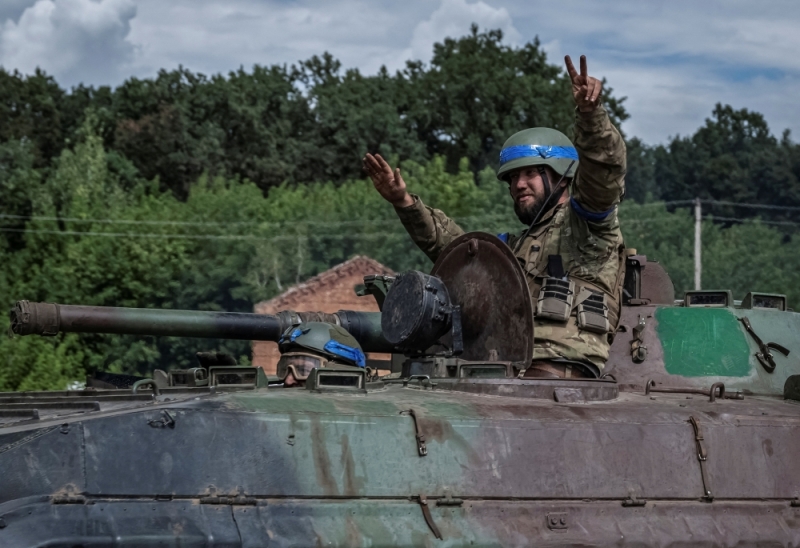
The sight of Ukrainian forces raising their flag over Russian territory is a humiliation for Vladimir Putin, but Ukraine's audacious incursion into Russia is a high-risk gamble.

The shock of seeing Ukrainian soldiers make any kind of gain inside his country - even though it is armed with nuclear weapons and is a global power - will likely prompt the Russian president to order a significant response to deter others from trying.

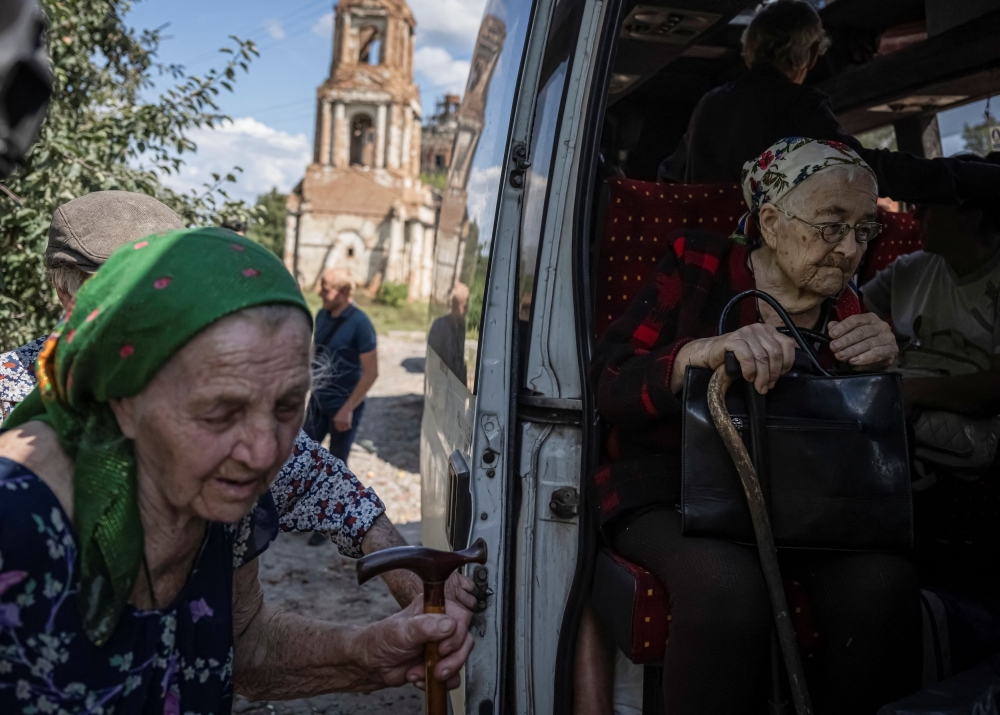
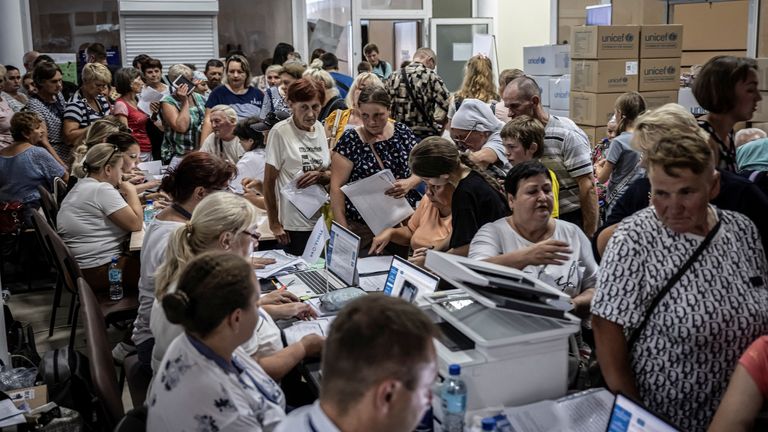
Ukrainian authorities on Friday said they were evacuating some 20,000 people from the Sumy region, which shares a border with the area in southwestern Russia that Ukraine has targeted - an indication that there is a fear Moscow will seek to retaliate.

Kyiv's attack on the Kursk region, which began on Tuesday and likely involved thousands of troops, came almost two and a half years after Russian forces invaded Ukraine in the opposite direction.

The operation appears to have been carefully planned and meticulously executed in top secret, catching Russia and the world by surprise.


What does Ukraine's incursion into Russia mean?

However, there are questions about what Ukraine aims to achieve longer term beyond shocking Moscow and demonstrating that its neighbour's borders are no longer secure.

Analysts say the offensive could be designed to capture and hold territory to be used as a bargaining chip to secure the release of Ukrainian land occupied by Russian forces.

But such a move would require a huge commitment of Ukrainian troops over time to counter Russian efforts to push them back and it is not clear if Kyiv has the manpower.

Another possibility is that Ukraine hopes to draw Russian forces away from frontline positions in eastern and southern Ukraine to shore up their own defences - though this might not be necessary given the number of reserves inside Russia that are still able to be deployed.


Ukrainian residents in the Sumy region arrive at an evacuation centre. Pic: Reuters

A third theory is that Ukraine might be seeking to capture a nuclear plant in Kursk to be used as leverage to force Russian troops to withdraw from a major nuclear power facility in the Zaporizhzhia region of Ukraine, captured in the early days of the war - but again this would be a huge undertaking, requiring significant Ukrainian reinforcements.

Whatever the goal, the mission is not without significant risk.

Two sources voiced concern the assault - while "tactically smart" - could galvanise anti-Ukrainian sentiment among the Russian public and make it easier for Moscow to further mobilise its people to fight back even harder.

There is also the impact on Ukraine's already overstretched forces of extending the frontline into Russia, with troops still required to hold the line against invading Russian soldiers in the northeast, east and south of their own country as well.

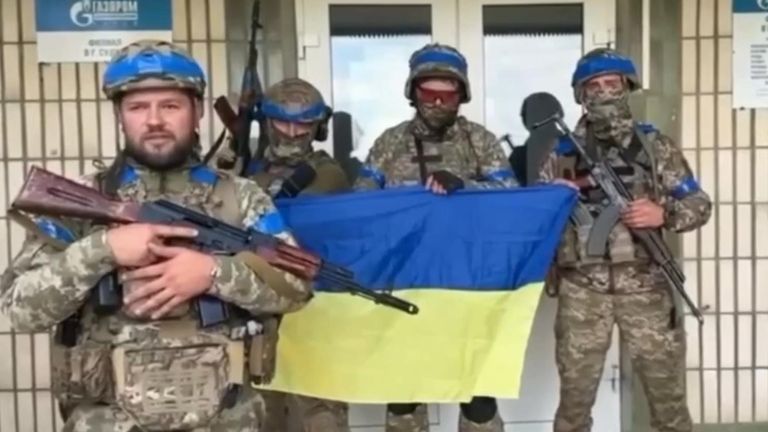
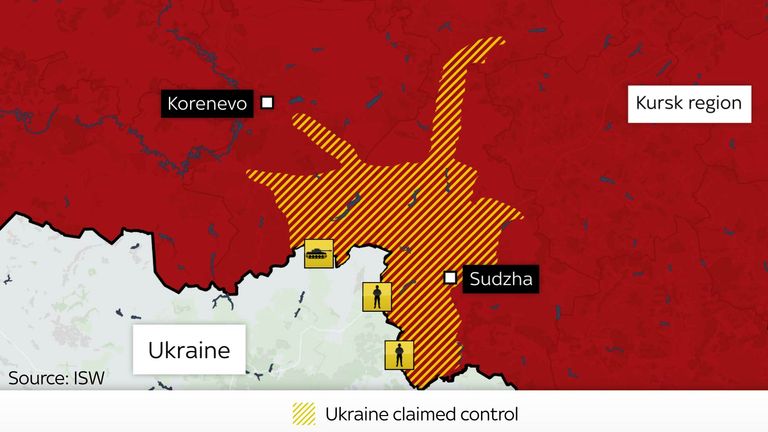
Ukrainian troops claimed they have taken control of the border town of Sudzha

Yet - in what was surely a major morale boost at the very least for Ukraine - the incursion appeared to catch the Kremlin completely off guard in a major security failing.

Mr Putin was forced to send in reinforcements to the Kursk region on Friday in an indication that the situation remains far from under control, despite assurances from his military chief two days earlier that the Ukrainian assault had been stopped.

Ukraine's government has yet to comment directly on the offensive - a tight hold on information has been another element in the planning of the mission.

However, Ukrainian troops in a video shared widely on social media claimed they had taken control of the border town of Sudzha.

Read more:
All calm on Russia's front pages

Prof Michael Clarke analyses Ukraine's attack

A soldier who identified himself as being from the 61st Separate Mechanized Stephova Brigade said the town was "quiet".

Standing before a Ukrainian flag, he also said his troops had seized the local offices of Russia's state-owned energy company Gazprom.

It was not possible to verify the claims but clashes have been reported around the outskirts of the small town of some 6,000 people, which lies just a few miles from the border.

With much uncertainty about what happens next, three things are clear.

The cross-border attack by Ukraine is the biggest of its kind of the war and poses one of the gravest challenges yet to Mr Putin, who has consistently told his people that his "special military operation" in Ukraine is going to plan.

It also demonstrates that militaries can still surprise an opponent in an era when the ubiquitous use of drones and satellites make secret movements on the battlefield much harder to execute without being spotted.


Russia battles thousands of Ukrainian troops as deep as 20km into their territory after incursion

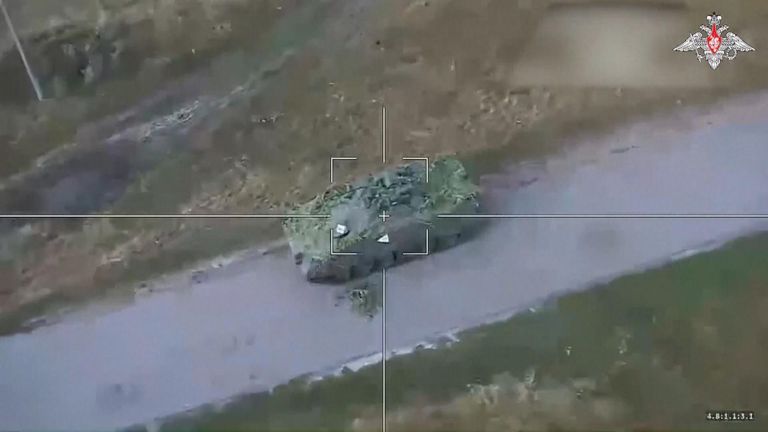
Copyright AP/Russian Defense Ministry Press Service
By Euronews with AP & EBU
Published on 10/08/2024 -

Intense battles raged over the Russian border on Saturday, after thousands of Ukrainian troops launched a large-scale incursion into the country which invaded them in 2022.

Russia fought intense battles against thousands of Ukrainian troops on Saturday, following Ukraine’s largest incursion on Moscow’s territory since the start of the war in 2022.

Ukrainian troops have reportedly pushed as deep as 20km into the Russian territory of Kursk.

Kyiv’s forces had launched an attack over the Russian border on Tuesday, sweeping across Kursk in a surprise attack supported by drones and artillery fire.

Russia’s defence ministry said on Saturday that “the armed forces continue to repel the attempted invasion by the Ukrainian armed forces,” adding that fighting was focused around settlements 10-20km inside Russia.

In a sign of the gravity of the attack, Russia imposed a security regime on three border regions on Saturday. Russia also announced a federal emergency following the assault.

Russia evacuated 76,000 people from the Kursk region following the incursion, according to the Tass news agency.

Ukrainian President Volodymr Zelenskyy acknowledged that the war is moving onto Russian territory during his nightly address on Saturday, highlighting Ukraine’s efforts to push the conflict beyond its borders.


He praised the Ukrainian forces for their efforts, saying that he noted reports from military officials concerning their advancements.

Zelenskyy emphasized Ukraine’s ability to exert pressure on the aggressor, marking a significant shift in the dynamics of the conflict as it extends into Russian territory

76,000 Evacuated as Ukrainian Troops Push into Russia's Kursk Region

World » RUSSIA | August 10, 2024, Saturday // 22:42e
Bulgaria: 76,000 Evacuated as Ukrainian Troops Push into Russia's Kursk Region


Over 76,000 people have been evacuated from areas bordering Ukraine in Russia's Kursk region, according to the local Emergencies Ministry, as reported by Reuters and TASS. This mass evacuation follows the Ukrainian invasion of the region, which began earlier this week.

Russia is currently engaged in intense battles against thousands of Ukrainian soldiers who have advanced up to 20 kilometers into the Kursk region. Reuters describes this as the largest Ukrainian attack on Russian sovereign territory since the war began in 2022.

Russian President Vladimir Putin has called the Ukrainian offensive a major provocation. Although top Russian General Valery Gerasimov announced on Wednesday that the invasion had been halted, Russian forces have not yet succeeded in pushing the Ukrainian military (AFU) back across the border.

Russian military bloggers report that the situation has stabilized after Russia deployed additional forces to counter the surprise offensive. A video verified by Reuters shows a convoy of burnt-out Russian military trucks on a highway in the Kursk region, with around 15 vehicles visible, including one marked with the Z symbol, which Moscow uses for its "special military operation" in Ukraine.

Meanwhile, Belarus is amassing troops along the border with Ukraine in the tactical areas of Gomel and Mazyr. Belarusian President Alexander Lukashenko, commenting on Ukrainian drone incursions into Belarusian airspace, stated, "I don't understand why Ukraine needs this. We have to figure it out. As I said before, we made it clear to them that any provocations will not go unanswered."

The Ukrainian advance has raised concerns in Moscow about how Ukrainian forces managed to penetrate the Kursk region so easily. Ukrainian troops are reportedly advancing towards the Kursk nuclear power plant, which supplies a significant portion of southern Russia's electricity. The plant has six reactors, with two operational, two shut down, and two under construction.

The head of the UN's International Atomic Energy Agency has noted the "significant military activity" in the area and has called for restraint.