Saturday, August 10, 2024

UK: Thousands join anti-racism rallies, far right stays away


Rallies were held in several UK cities, including outside the London office of Nigel Farage's Reform UK party. Britain has been rocked by several days of anti-immigration riots, fueled by misinformation.


Several hundred people rallied outside the London office of the populist Reform UK party
Tayfun Salci/ZUMA Press Wire/IMAGO

Anti-racism protests held across the United Kingdom on Saturday drew thousands of people, aimed at countering a wave of riots in several cities blamed on the far-right.

Several nights of violent disorder erupted nearly two weeks ago due to misinformation online that the suspect in a knife attack that killed three young girls in northwest England was a Muslim asylum seeker.
What happened on Saturday?

Large crowds of anti-racism protesters gathered in London, Glasgow, Belfast, Manchester and numerous other UK towns and cities for the second time in a week. By the late afternoon, however, feared violent confrontations with anti-immigration agitators had failed to materialize.

In London, hundreds massed outside the office of Brexit architect Nigel Farage's Reform UK party before marching to parliament. Farage and other far-right figures have been blamed for helping to fuel the riots through anti-immigrant rhetoric.

In the northeastern English city of Newcastle, shop owners boarded up their stores ahead of a possible far-right protest on Saturday afternoon.

A small group of anti-immigration protests gathered in the city's famed Bigg Market. Police said social media posts boasting of a large crowd were false.

A much larger anti-racism demonstration was held nearby, but both rallies were cleared by police following the granting of a dispersal order. Fourteen arrests were made.
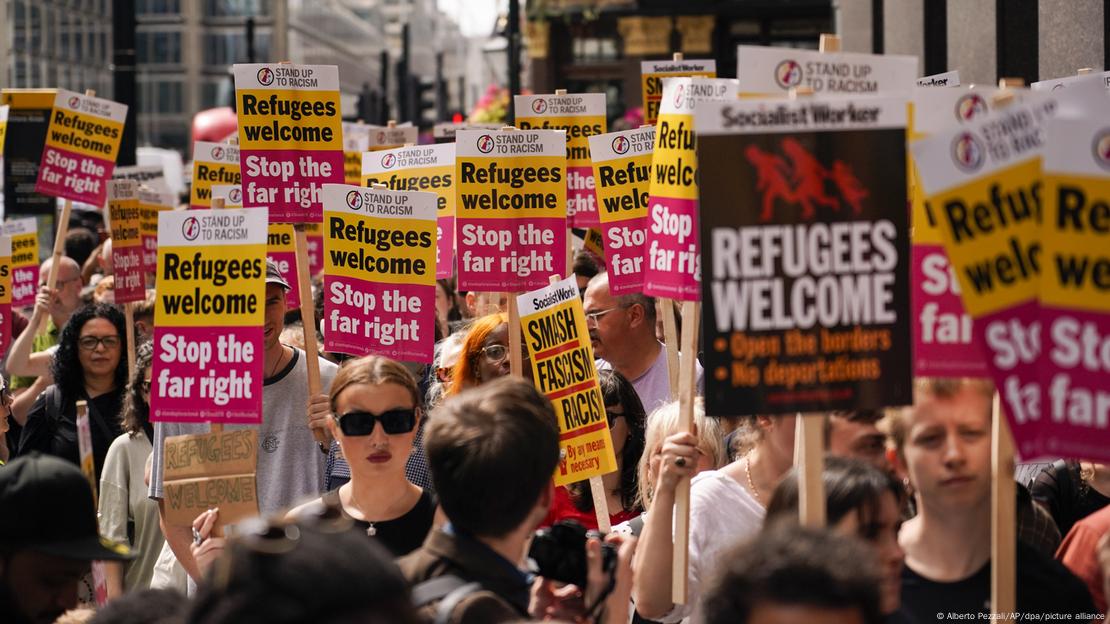
The far-right riots have been met with scores of anti-racism protests in several UK cities
Alberto Pezzali/AP/dpa/picture alliance

Antiracism rallies held in Scotland, Northern Ireland

Hundreds of anti-racism protesters gathered at rallies outside the Scottish Parliament in Edinburgh and in Glasgow's George Square.

In Belfast, Northern Ireland, as many as 15,000 people took part in the United Against Racism rally, with many people holding placards with pro-migrant messages.

A petrol bomb was thrown at a mosque in a town east of Belfast in the early hours of Saturday, but it failed to ignite. Police said they were treating the incident as racially motivated.

No spillover to football matches


The new season of the English Football League — below the high-profile Premier League — kicked off on Saturday, including in cities that have seen disorder.

UK authorities are concerned that some far-right groups have links to England's decades-old football hooligan scene. Police said forces nationwide were collaborating to ensure that "all relevant intelligence" was shared ahead of the matches.

At some grounds, crowds of supporters chanted the name of anti-Muslim agitator Tommy Robinson, who has been accused of helping to fuel the unrest through constant social media posts.

More than 80,000 fans watched Manchester City beat Manchester United on penalties in the FA Community Shield at Wembley Stadium, which passed off without disorder.

Also Saturday, several more people were arrested over their roles in earlier riots. Many others appeared in court, facing possible jail time.
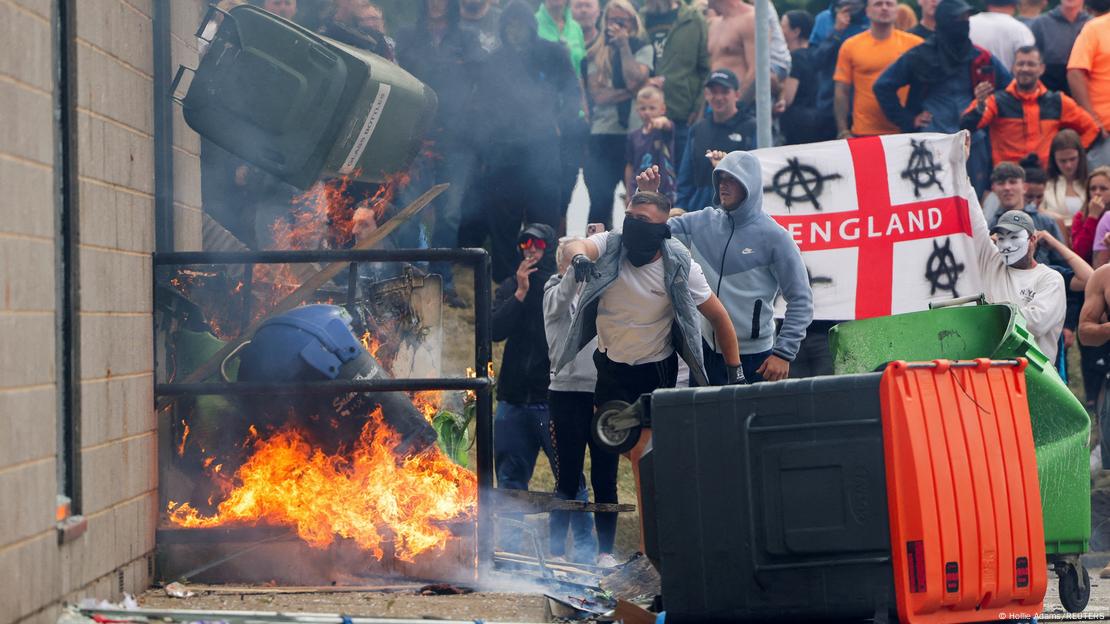
A hotel housing asylum seekers in Rotherham, northern England, was set alight during the riots
Image: Hollie Adams/REUTERS


How the UK riots unfolded

The violence erupted after the murder of three young girls and the wounding of several others in a mass stabbing in the northwestern city of Southport on July 29.

Far-right commentators spread false information that the 17-year-old male suspect held over the knife attack was a Muslim asylum seeker. He was born in Wales.

More than a dozen places across England as well as Belfast were hit by riots over several days. Groups of thugs targeted mosques and hotels linked to immigration, as well as police, vehicles and other sites.

More than 700 people have been arrested and numerous people have been quickly jailed — some for several years — to deter further violence.

mm/rmt (AFP, AP, dpa, Reuters)


Thousands of anti-racism protesters demonstrate outside Reform UK headquarters

Organisers said the turnout of about 5,000 people showed the depth of support for refugees and other minority groups targeted in recent disorder

A Stand up to Racism protest in central London (Jacob Freedland/PA)

Thousands of anti-racism protesters have gathered outside Reform UK’s headquarters with some accusing party leader Nigel Farage of spreading “dangerous rhetoric”.

Demonstrators joined Stand up to Racism’s gathering which met outside the party’s headquarters in Victoria, central London, chanting in support of refugees before marching through Whitehall and towards Trafalgar Square to listen to speeches from activists.

Organisers said the turnout of about 5,000 people showed the depth of support for refugees and other minority groups targeted in recent disorder, amid fears of further violence this weekend.

Samira Ali, who made the closing speech, told the PA news agency: “We feel like we have turned the tide. It’s a testament to our mobilisation that they failed to come out.

“They would not have been stopped if it was not for our mobilisation.”

Another speaker, Gary McFarlan, 63, told the crowd: “A few days ago, the atmosphere was very different. Lots of people were very scared, worried about coming out on to the streets, thinking, ‘Will I get a half-brick in my head? Will I get kicked in the face by a Nazi?’. We turned it around this week.”

Mr McFarlan, a journalist from Haringey, north London, made historical comparisons to emphasise the significance of Saturday’s march.

Referring to the Battle of Cable Street, he said: “We smashed them in 1936. We gave our strength in the East End of London. We smashed them in the 1970s with anti-Nazi leagues.

“We’ve had our battles since then, against the British National Party, the English Defence League – the back of which was broken 12 years ago.”

That’s why we brought the protest to his doorstep today, because we believe he has questions to answer for

Ms Ali said organisers had chosen Reform UK’s headquarters as the starting point for the demonstration because of Mr Farage’s stance on immigration.

She said: “We were protesting outside of Reform UK, against the likes of Nigel Farage and his dangerous rhetoric.Learn 

“The constant rhetoric about ‘stop the boats’, about immigration being a problem, about refugees and Muslims being to blame in society. This is all rhetoric that’s been replicated on the far-right riots. That’s created the toxic atmosphere in which the far right have been able to build.

“That’s why we brought the protest to his doorstep today, because we believe he has questions to answer for.”

Ms Ali dismissed the suggestion that Saturday’s demonstration would mark the end of the counter-protest movement after rioting.

She said: “We want this movement to reach into every area, every workplace, every community. The far right is on the back foot now, but we’re going to keep pushing.”
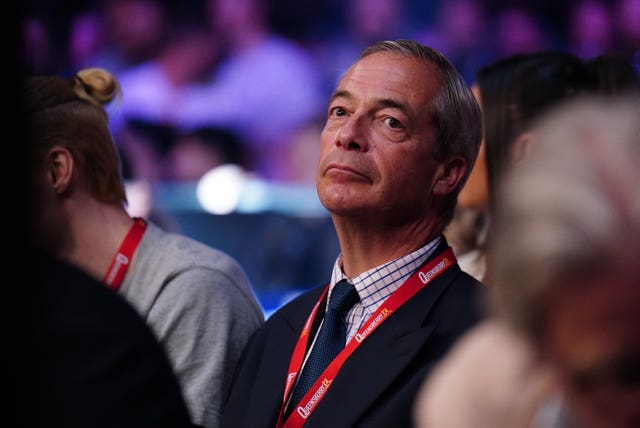
Nigel Farage (Zac Goodwin/PA)

As protesters marched down Whitehall, a GB News reporter said his broadcast had been interrupted after a demonstrator “attacked” one of the crew.

Charlie Peters, who said he had been reporting on the “mostly peaceful” protest since it started, told PA: “As we approached Downing Street one of the protesters recognised us as GB News and people started chanting ‘GB News off our streets’.

“One man got close and started gesticulating towards the camera while we were filming and tried to stop us broadcasting. In doing so, he then attacked one of my colleagues.

“It’s a shame that journalists have to have security arrangements while broadcasting in central London.”


10 Aug: anti-racist organisation from below has turned the tide

Now let's keep up the pressure and confront all forms of racism


3,000 in Glasgow, the biggest of today’s anti-racist demonstrations


SOCIALIST WORKER
Saturday 10 August 2024
This is a developing story and will be updated

The tide has now turned sharply and unmistakably against the recent far right surge of murderous attacks.

It’s mobilisation by massive numbers of people on the streets that achieved this, not the cops and the courts.

Wednesday was the key day when tens of thousands came out even thought there was a real possibility they might be met by baying mobs of fascists determined to torch migrant centres and welfare organisations.

But Saturday’s day of unity, organised by Stand Up To Racism (SUTR), was bigger in many places. It was a sea of anti-racist unity across Britain and saw powerful turnouts in some places where before the response had been small.

There was also a very important demonstration of around 2,000 outside the headquarters of Reform UK in London, underlining Nigel Farage’s role in enabling and encouraging far right violence.

SUTR co-convenor Weyman Bennett told the crowd, “We have to build a movement of millions to throw back the fascists and the far right.”

After the rally, the crowd marched off to parliament. By the time it reached Trafalgar Square, other anti-racist demos in the capital had joined and the anti-racist crowd had swelled to 5,000.

In Hull, some 400 anti-racists defied the racist violence of the previous week and rallied in the town centre.

“It was fantastic, I can’t believe it” reports Eleanor.

“There was no sign of the far right—we filled the square with music and chanting. We chanted, ‘When immigrant rights are under attack, what do we do, unite, push back’.”

SUTR activists organised today’s protest despite being forced to run away from fascists just seven days previously.

Then hundreds of racists and fascists targeted a hotel used to house asylum seekers, throwing concrete blocks and smashing windows.

“We were overwhelmed last week and had to run. They had broken through police lines, and one police officer said to me, ‘You better go or they’ll kill you’,” said Eleanor.

But today was a different story—and was a result of dedicated organising in the face of the far right threat.

“Ahead of today, we had a planning meeting with a few other groups. So everybody was there and united. There was a rep from Hull Trades Council, who spoke about the importance of the trade unions in fighting racism.”

Hull shows it is possible to transform the scenes of racist thuggery into ones of united resistance.

Around 3,000 people joined an anti-racist rally in Glasgow, reports Raymie. It was the first mobilisation in the city since the start of the far right’s offensive in Glasgow.

Two fascists turned up but were chased away by a huge crowd and the police had to rescue them.

Refugee organisations were among the speakers, and there were banners from the Unison, PCS, EIS, Unite and other unions.

The next major event is on 7 September when the far right, backed by Tommy Robinson, have stated they will march.

Over 2,000 anti-racists turned out at the Edinburgh Parliament to show the far right they are not welcome here, reports Alan. “Speeches from, SUTR and EIS, PCS unions, Green Party, Scottish National Party and Labour among other campaigns.

“Speakers talked about defending our community if there are any threats from the far right. They spoke of how racism from the top of society is used to divide the working class.

“It was a jubilant atmosphere with chants of ‘Nazi-scum off our streets’ and ‘Refugees welcome here’.”

There were also 450 in Dundee where a few known Nazis scuttled off.

In Norwich, 500 anti-racists totally outnumbered 15 fascists. Around 300 anti-racists came out in Cambridge and 100 in Southend.

Fascists were planning to turn up to the Cedar Court Hotel in Wakefield near Leeds to attack refugees and migrants living there.

Around 400 anti-racists came out in Hull where the week before fascists had driven off anti-racists

Instead, some 300 anti-racists rallied outside the hotel, and not a single member of the far right was to be seen.

“There were brilliant speakers including Sarah Woolley, bakers’ union general secretary, local NEU reps, local churches and lots of people from Love Music Hate Racism,” Andy reports.

He said it was an “amazing” atmosphere outside the hotel—and a stark contrast to last weekend when a racist mob of 300 gathered.

“We managed to get a big turnout because of the level of anger this time. People were fearful—that’s turned into anger and it motivated them.”

In the town, the Labour Party had visited mosques hoping to convince Muslim activists not to go on the streets. But despite the heavy-handed techniques by the council, the crowd outside Cedar Court was “very diverse,” said Andy.

“We haven’t had this kind of moment in West Yorkshire. It wasn’t really until Wednesday that the mood changed—but there wasn’t a fascist presence planned then. Today we got to test it out.”

Dave reports that in Shrewsbury, Saturday’s result was “SUTR 500, fascists 20. They left after about an hour and a half.”

Leicester saw 350 anti-fascists take on three Nazis, who spent most of their time talking to police. Shockat Adam MP was among the speakers at the anti-racist rally. There were more than 300 anti-racists in Oxford.

Aroundd 500 joined a SUTR unity demo in Portsmouth. Jon reports, “It took over the Guildhall Square. Last Saturday there had been over 200 far right thugs in the square and only 50 on the counter-protest.

“This week the racists managed two people.

“There was a real determination to make sure we have a good turnout for next Saturday when the far right has said it will return. Today was a big step forward for the anti-racist movement in the city.”

Over 400 anti-racists flooded the centre of Hastings to say, “Refugees are welcome here.”

It follows the 600-strong protest against the far right threat on Wednesday and a mobilisation to defend a mosque four days previously.


5,000 anti-racists in Trafalgar Square after the march from the Reform UK headquarters

“This rally bounced off the fantastic success of Wednesday night,” Simon said.

“We had speakers talking about the importance of opposing Islamophobia and defending refugees. They attacked the politicians at the top—the likes of Nigel Farage and Suella Braverman.”

Anti-racists are right to keep arguing for the biggest possible numbers on the streets to combat the far right threat.

Julia Hilton, the Green Party leader of the council, spoke at Saturday’s rally, despite arguing publicly that Wednesday’s protest shouldn’t go ahead.

SUTR activists are busy preparing for an organising meeting on Monday—and have already had to change to a bigger venue.

Over 200 people joined a rally at Chesterfield town hall jointly called by Chesterfield TUC , SUTR and Derbyshire County Unison branch.

James reports, “Powerful speeches came from a range of people including the chair of Chesterfield Muslim Association, the Chesterfield African Caribbean Community Association, Derbyshire Green Party, local Labour councillors and Derbyshire NEU union.

“Barbara from the local refugee support group spoke about how on Wednesday when rumours were circulating of a potential threat, volunteers put together a programme of practical support for people who felt unable to return to the hotel, including overnight accommodation and a meal donated by the local Asian Association.

The crisis of far right violence and fascism in Britain
Read More

“The rally brought together experienced campaigners amd lots of new people enthusiastic to get involved in building SUTR.”

There were huge turnouts in Manchester—up to 3,000—and 1,000 at a solidarity gathering at Finsbury Park mosque in north London. Over 350 gathered in Coventry and around 1,000 in Liverpool.

Over 2,000 anti-racists were on the streets in Newcastle. Rob reports, “The far right managed to turn out around 40-50 miserable-looking bigots. There was a large contingent of Newcastle United football fans, trade unionists and campaigning activists.”

There was a crowd of between 100 and 150 anti-racists at the Harlow, Essex, SUTR Rally—and one fascist.

In Nottingham, reports Martin, “At least 300 attended with speakers from various organisations including the refugee forum, trades council, Muslim action group, PCS union and others.

“There were no fascists in sight except a couple who were trying to get a video.

“Today we came together and showed the power of unity against fascism and racism.”

About 400 joined a rally in Birmingham, where anti-racists are preparing for next Saturday when the far right says it is coming.

There were 150 anti-racists out in Abergavenny in South Wales and 100 in Tenby, West Wales.

Around 300 anti-racists rallied in Hackney, east London. One speaker was from Hackney Migrant Centre, where anti-racists gathered on Wednesday in solidarity.

She said, “Migrants don’t feel safe. But that’s not just because of fascists—that’s because of the policies of the state.”

At least 300 people gathered in York. The open mic rally included a speech from Labour MP Rachael Maskell.

Over 600 rallied in Windrush Square in Brixton, south London, before marching on to the protest outside Reform UK.

The successes this week need to be driven home. The fascists will lick their wounds and hope to come out snarling again. Only the utmost anti-racist vigilance will keep them caged.

That’s because the bitterness in society, the squeeze on ordinary people and the racism of mainstream politics constantly give opportunities for the far right to exploit

This week must be the basis for a mass attack on state racism and Islamophobia, as well as fascist Tommy Robinson and his admirers.

Let’s use the momentum from this week to crush Nigel Farage and Reform UK.

Let’s now unite against the anti-migrant laws that mean refugees drown in the Channel, and campaign to force the Labour government to stop deportations.

Never again should a Labour MP be allowed to condemn the asylum seekers who try to come to Britain, or to demand they are driven out of the hotels where they are housed.

We need to confront the police who harass and sometimes kill black and Asian people.

And crucially, there has to be a wider class approach. The racists feed off the crisis and decomposition of politics and the anger at the rotten system that wrecks so many lives.

The anger against that system can go to the left or the right. We have to direct it leftwards.

The puny methods of the trade union leaders and Labour MPs won’t cut it in the face of a society of mass hardship and poverty, the sense of no future, war, environmental collapse and oppression.A huge anti-racist demonstration swept through Belfast on Saturday. People Before Profit assembly member Gerry Carroll said, “15,000 people flooding the streets of Belfast for the United Against Racism demo today. Belfast overwhelmingly shows we are anti-racist and anti-fascist. Solidarity to our migrant, refugee, asylum seeker, and minority communities.”

Keep up the activityTrade unionists’, MPs’ and campaigners’ unity statement against the far right. Use the statement in your workplace and your local area. Add names and see the full list of supporters here

Campaign launch on Saturday 17 August with Jeremy Corbyn, Daniel Kebede, Bimini and many others. For details go here
Thousands demand halt to Rio Tinto's lithium project in Serbia


Aug 11, 2024

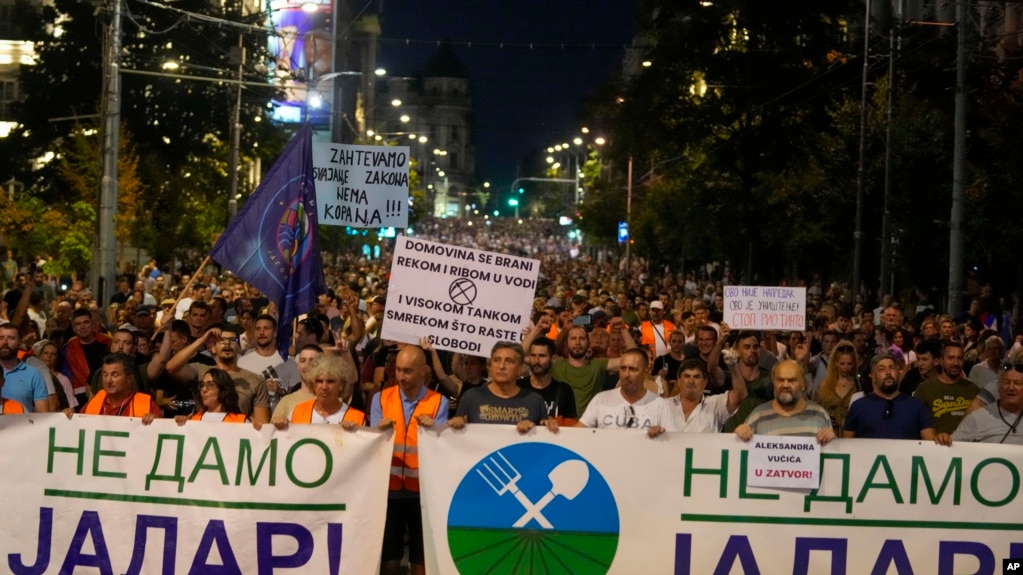
BELGRADE - Tens of thousands of people gathered in central Belgrade on Saturday demanding a halt to Rio Tinto's lithium project in Western Serbia over fears it could pollute nearby land and water.

Protesters packed the streets leading to Terazije square, waving Serbian flags and chanting "You will not dig," and "Rio Tinto leave Serbia!"

Government officials said the protests were politically motivated and designed to bring down President Aleksandar Vucic and his government.


Zlatko Kokanovic, a protest leader and farmer from the Jadar region where the mine is planned, urged protesters to block two major train stations in Belgrade.

Last month, Serbia reinstated Rio's licence to develop what would be Europe's biggest lithium mine, two years after the previous government halted the process due to concerns by environmental groups.

The decision triggered nationwide protests in towns across Serbia. Protesters gave the government a deadline to ban the exploration and exploitation of lithium which expired on Saturday.

"We are not going to give up. The mine cannot be built on agricultural land," said Mica Miliovanovic, a 63-year old worker. "This does not have anything to do with politics."

On Friday, Vucic said authorities had received information from Russia that a coup was being planned in Serbia.

"We have reason to be cautious," vice premier Aleksandar Vulin told Tanjug news agency on Saturday.

If implemented, the $2.4 billion Jadar lithium project could cover 90% of Europe's current lithium needs and make Rio Tinto one of the world's leading lithium producers.

Lithium is a key component in batteries for electric vehicles and mobile devices.

Government officials say the lithium mine would boost Serbia's economy, but environmentalists say the price for it would be too high.

On July 19, Vucic, German Chancellor Olaf Scholz and EU energy commissioner Maros Sefcovic signed a deal that would grant producers from EU member states access to raw materials mined in Serbia, which would include lithium.

The deal is meant to reduce the EU's dependency on imports from America and Asia.

 REUTERS


Thousands protest in Serbia’s Belgrade against lithium mining project

Protesters say they fear project by mining giant Rio Tinto would pollute water sources and endanger public health.

People attend a protest in Belgrade, Serbia, against a lithium mining project in the Balkan country [Zorana Jevtic/Reuters]

Published On 10 Aug 2024

Thousands of people have taken to the streets of the Serbian capital to protest against the rebooting of a controversial lithium mine set to serve as a vital power source in Europe’s green energy transition.

In advance of Saturday’s rally in Belgrade, two leading protest figures said they were briefly detained by security officials who warned that any moves to block roads during the demonstration would be seen as illegal.

“We came here today to raise our voice against something that is beyond politics,” popular actor Svetlana Bojkovic said from the rally, where a large crowd chanted “There will be no mining”, among other slogans.

Serbia has vast lithium deposits near the western city of Loznica, where a mining project being developed by the Anglo-Australian mining giant Rio Tinto has been a perennial political fault line in the Balkan country over its potential environmental impacts.

The deposits were discovered in 2004, but weeks of mass protests forced the government to halt the project in 2022.

But the government recently made a U-turn on the issue following a court decision last month that said the order to revoke the permits awarded to Rio Tinto was “not in line with the constitution and the law”.

People attend the protest in Belgrade against the lithium mine [Darko Vojinovic/AP Photo]

Days later, the Serbian government greenlit the project’s restart and signed a memorandum of understanding with the European Union that is seen as the first step in developing Serbia’s lithium resources.

Lithium is a strategically valuable metal needed for electric vehicle batteries, making it key for helping the car industry shift to greener production.

The project, however, has continued to be unpopular with many in Serbia due to concerns the mine would pollute water sources and endanger public health.

“I am in Belgrade because the survival of life in Serbia is being defended here,” said Slobodan Stanimirovic, a 58-year-old from western Serbia’s Radjevina, near the site of the future mine.

The protest in Belgrade was the latest in a series of demonstrations held across Serbia after the mine’s licences were reinstated.

Activists and demonstrators have called on legislators to pass a law permanently banning the mining of lithium and boron in the country.

Reporting from Belgrade on Saturday, Al Jazeera’s Jelena Glusac said more people joined the protest against the mining project than recent rallies on other issues, including demonstrations last year following two mass shootings.

“It seems like the lithium [mine proposal] managed to gather more people than any other subject,” Glusac said.

Environmental groups said they were prepared to block major traffic arteries across Serbia and engage in civil disobedience if the government refused to act before an August 10 deadline set by activists.

Serbian President Aleksandar Vucic has repeatedly pledged that no mining operations will begin until guarantees about environmental safety protocols are established.

Source: Al Jazeera and news agencies


Thousands protest lithium mining in Serbia

August 10, 2024 
By Associated Press
People hold banners reading, "We Won't Give up Jadar!" and march during a protest against pollution and the exploitation of a lithium mine in the country in Belgrade, Serbia, Aug. 10, 2024.

Tens of thousands gathered Saturday for a rally against lithium mining in Serbia despite officials' warnings of their alleged plot to topple populist President Aleksandar Vucic and his government.

Vucic said earlier he had been tipped by the Russian intelligence services that a "mass unrest and a coup" were being prepared Saturday in Serbia by unspecified Western powers that wish to oust him from power.

The big crowd chanted "There Will Be No Mining" and "Treason, Treason."

Government officials and the state-controlled media have launched a major campaign against the rally, comparing it to the Maidan uprising in Ukraine's capital Kyiv that led to the toppling of the country's then pro-Russian President Viktor Yanukovych in 2013. Organizers of the Belgrade protest have said the protest would be peaceful.

"Our rally today is ecological and has no political ambitions, but the government has accused us of seeking to stage a coup," said popular actor Svetlana Bojkovic.

"We came here today to raise our voice against something that is beyond politics."

The rally in the downtown of the capital comes after weeks of protests in dozens of cities throughout Serbia against a government plan to allow lithium mining in a lush farming valley in the west of the country.

This plan had been scrapped in 2022 after large demonstrations were held that included blocking of the key bridges and roads. But it was revived last month and received a boost in a tentative deal on "critical raw materials" signed by Vucic's government with the European Union.

The Balkan nation is formally seeking EU membership while maintaining very close ties with both Russia and China. The EU memorandum on the mining of lithium and other key materials needed for green transition would bring Serbia closer to the bloc and would reduce Europe's lithium battery and electric car imports from China.

While the government insists the mine is an opportunity for economic development, critics say it would inflict irreparable pollution on the Jadar valley, along with its crucial underground water reserves and farming land.

Locals in the valley are strongly opposed to the mine that would be operated by multinational Rio Tinto mining company. Both the government and the company have pledged to have the highest environmental standards in the mining process, but opponents haven't been convinced.

Tens of thousands have turned out for environment protection rallies held throughout Serbia in the past weeks posing a major challenge to Vucic and his increasingly autocratic rule. Opponents want the government to formally outlaw any lithium and boron mining in the entire country.

The government has set up a medical team to monitor any potential health hazards and a call center that citizens can contact to voice their concerns, an apparent bid to sway some of the opposition.

Serbian Mining and Energy Minister Dubravka Djedovic Handanovic told The Associated Press earlier this week in an interview that Serbia would not only export raw materials but would develop a "value chain" in the country linked to producing batteries and electric vehicles to help develop new technologies.

Residents of the Jadar valley, however, said nothing could persuade them to agree to the mine. They said they were ready to do everything to prevent the mine from opening.
Jordan will not be a battlefield for Iran or Israel, foreign minister warns

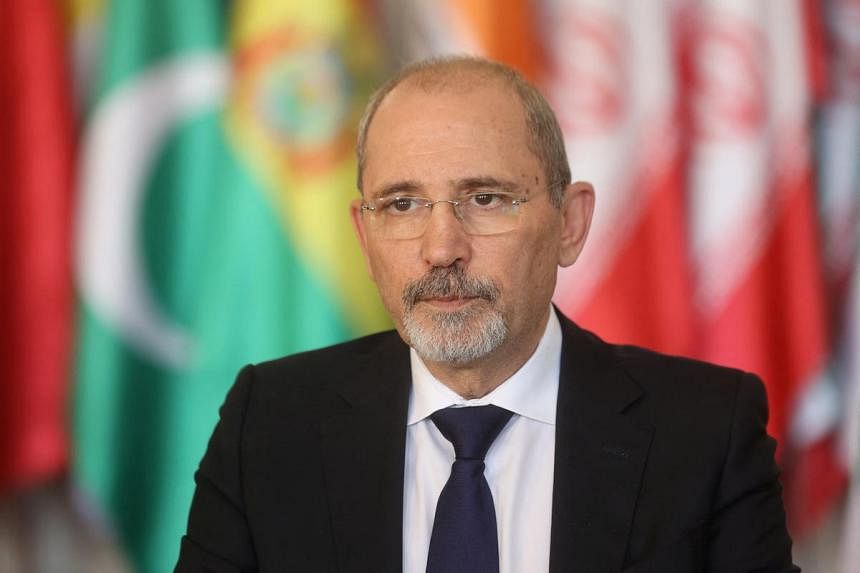
Jordan's Foreign Minister Ayman Safadi looks on as he meets with Iran's acting Foreign Minister Ali Bagheri Kani in Tehran, Iran, August 4, 2024. 
Majid Asgaripour/WANA (West Asia News Agency) via REUTERS/File Photo

Aug 11, 2024,

CAIRO - Jordan's Foreign Minister Ayman Safadi said on Saturday that the kingdom would not be a battlefield for Iran or Israel, as the region braces for a possible new wave of attacks by Tehran and its allies following last week's killing of senior members of militant groups Hamas and Hezbollah.

"We will not be a battlefield for Iran or Israel. We informed the Iranians and the Israelis that we will not allow anyone to violate our airspace and risk the safety of our citizens," the Jordanian foreign minister said in an interview with Saudi-owned Al Arabiya TV.

"We will intercept anything that passes through our airspace or think that it constitutes a threat to us or our citizens."

In April, Jordan, which lies between Iran and Israel, said it intercepted flying objects that entered its airspace as Tehran launched explosive drones and fired missiles at Israel in the first direct retaliatory attack of its kind.

After that attack, which was launched in retaliation for a suspected Israeli strike on Iran's embassy compound in Syria, Jordanian, Iraqi and Turkish officials each said Iran had provided them with some early warning of its action.

Iran has repeatedly vowed to "punish" Israel since the assassination of Ismail Haniyeh, the political leader of Iran-backed Palestinian Islamist group Hamas, in Tehran on July 31. Iran and Hamas blamed Israel for the killing.

Israel has not claimed or denied responsibility for the killing, which has fuelled concerns that the war between Israel and Hamas in the Gaza Strip could spill into a wider Middle East conflict.

Those concerns have also been stoked by the killing of Lebanese armed group Hezbollah's top military commander, Fuad Shukr, in an Israeli strike in Beirut's southern suburbs hours before the assassination of Haniyeh.

 REUTERS
Bangladesh not the first student uprising to help bring about radical change

August 10, 2024 
By Associated Press
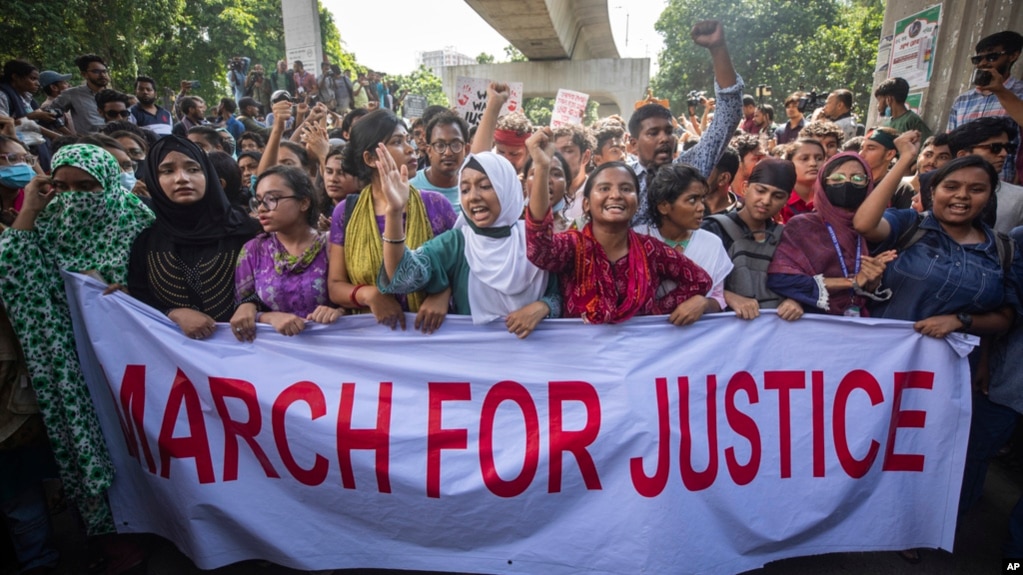
University students shout slogans during a protest to demand justice for the victims killed in the recent countrywide deadly clashes and ask for their campuses to be opened, in Dhaka, Bangladesh, July 31, 2024.

BANGKOK —

In Bangladesh, weeks of protests against a quota system for government jobs turned into a broad uprising that forced the prime minister to flee the country and resign.

The demonstrations began peacefully last month and were primarily led by students frustrated with the system that they said favored those with connections to the ruling party.

But it turned violent on July 15 as student protesters clashed with security officials and pro-government activists. Former Prime Minister Sheikh Hasina fled this week after the unrest during which nearly 300 people died, including both students and police officers.

Students or other young people have frequently played pivotal roles in popular uprisings that have brought down governments or forced them to change policies. Here are some other major cases:

Gota Go Gama protests in Sri Lanka

Like in Bangladesh, widespread protests in Sri Lanka in 2022 were able to bring down a government, and youth played a key role.

Scattered demonstrations turned into months-long protests starting in March 2022 as an economic crisis worsened in the Indian Ocean island nation, leading to a shortage of fuel, cooking gas and other essentials as well as an extended power outage.

In April, protesters primarily led by university students and other young people occupied an esplanade adjoining President Gotabaya Rajapaksa's office in the capital Colombo, demanding he and his government resign.

More people joined daily, setting up a tent camp dubbed "Gota Go Gama," or "Gota Go Village," a play on Gotabaya's nickname "Gota."

The protest site was peaceful, with organizers offering free food, water, toilets and even medical care for people. Camp leaders, many of whom were university students, held daily media briefings and made regular speeches, while the crowd was entertained by bands and plays.

The government reacted by imposing a curfew, declaring a state of emergency, allowing the military to arrest civilians and restricting access to social media, but were unable to stop the protest.

Under pressure, many ministers resigned but President Rajapaksa and his older brother, Prime Minister Mahinda Rajapaksa remained.

In May, Rajapaksa supporters attacked the protest camp, drawing widespread condemnation from across the country and forcing Prime Minister Rajapaksa to resign.

Gotabaya Rajapaksa clung to power until July, when protesters stormed his official residence, forcing him to flee the country. After taking temporary refuge in the Maldives, Rajapaksa later resigned.

His successor, Ranil Wickremesinghe, in one of his first moves as new president ousted protesters from occupied government buildings and shut down their camp, dismantling their tents in the middle of the night.

The situation has since calmed, and Wickremesinghe has been able to address the shortages of food, fuel and medicine and restore power.

Complaints continue, however, about the rise in taxes and electric bills that are part of the new government's efforts to meet International Monetary Fund loan conditions. Former Prime Minister Rajapaksa's son Namal Rajapaksa will be running in the presidential elections this September.

Athens Polytechnic uprising in Greece

In November 1973, students at Athens Polytechnic university rose up against the military junta that ruled Greece with an iron fist for more than six years.

Military officers seized power in a 1967 coup, establishing a dictatorship marked by the arrest, exile and torture of its political opponents.

The regime's brutality and hardline rule gave rise to a growing opposition, particularly among students, culminating in the November uprising.

The protest began peacefully on November 14, with students staging a strike at the Athens Polytechnic university and occupying the campus. By the next day, thousands from around Athens had joined in to support the students and the demonstrations grew, as did calls to end the dictatorship.

On November 17, the military crushed the revolt when a tank smashed through the university's gates in the early hours of the day, killing several students. The number of fatalities is still disputed, but at the time the regime had announced 15 dead.

Days after the uprising, another military officer staged a coup and implemented an even harsher regime. It was short lived however, after a series of events led to a return to democracy in Greece, its birthplace, in 1974.

A prosecutor's report issued after the return to civilian government, estimated fatalities at 34, but mentioned only 18 names. There were more than 1,100 injured.

Today, annual marches in Athens to commemorate the pro-democracy student uprising still attract thousands of people.

Kent State demonstrations in the United States

American students had long been protesting the U.S. involvement in Vietnam when President Richard Nixon authorized attacks on neutral Cambodia in April 1970, expanding the conflict in an attempt to interrupt enemy supply lines.

On May 4, hundreds of students at Ohio's Kent State University gathered to protest the bombing of Cambodia, and authorities called in the Ohio National Guard to disperse the crowd.

After failing to break up the protest with teargas, the National Guard advanced and some opened fire on the crowd, killing four students and wounding nine others.

The confrontation, sometimes referred to as the May 4 massacre, was a defining moment for a nation sharply divided over the protracted conflict, in which more than 58,000 Americans died.

It sparked a strike of 4 million students across the U.S., temporarily closing some 900 colleges and universities. The events also played a pivotal role, historians argue, in turning public opinion against the conflict in Southeast Asia.

Soweto Uprising in South Africa

In the decades-long struggle against white minority rule in South Africa, a pivotal moment came in 1976 in the Soweto area of Johannesburg.

In a series of demonstrations starting June 16, Black students from multiple schools took to the streets to protest against being forced to study in Afrikaans, the Dutch-based language of the white rulers who designed the system of racial oppression known as apartheid.

The protests spread to other areas in South Africa, becoming a flashpoint for anger at a system that denied adequate education, the right to vote and other basic rights to the country's Black majority.

Hundreds are estimated to have died in the government crackdown that followed.

The bloodshed was epitomized by a photograph of a dying student, Hector Pieterson. The image of his limp body being carried by another teenager was seen around the world and galvanized international efforts to end South Africa's racial segregation, though apartheid would linger for nearly two more decades.

South Africa achieved democracy with majority rule elections in 1994 and today June 16 is a national holiday.

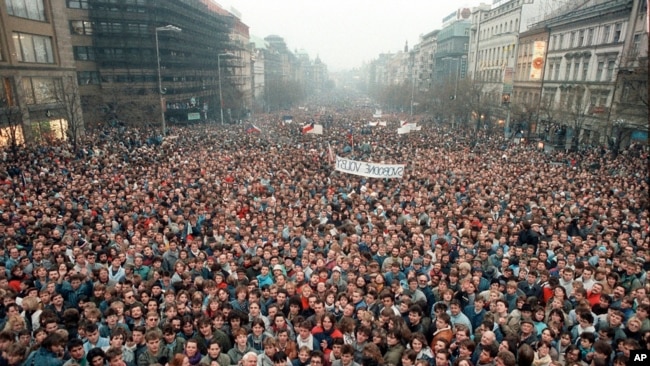
In this Nov. 21, 1989, file photo about 200,000 people gather in Wenceslas Square, Prague, Czechoslovakia. Dubbed the 'Velvet Revolution' for its non-violent nature, the protests led to the resignation of the Communist Party's leadership.

Velvet Revolution in Czechoslovakia

As the Communist governments of Eastern Europe teetered in 1989, widespread demonstrations broke out in Czechoslovakia after riot police suppressed a student protest in Prague on November 17.

On November 20 as the anti-Communist protests grew, the students being joined by scores of others and some 500,000 took to the streets of Prague.

Dubbed the "Velvet Revolution" for its non-violent nature, the protests led to the resignation of the Communist Party's leadership on November 28.

By December 10, Czechoslovakia had a new government and on December 29, Vaclav Havel, a dissident playwright who had spent several years in prison, was elected the country's first democratic president in a half century by a parliament still dominated by communist hard-liners.

In 1992, Czechoslovakia peacefully split into two countries, the Czech Republic and Slovakia.
China's drivers fret as robotaxis pick up pace — and passengers

August 10, 2024 
By Reuters
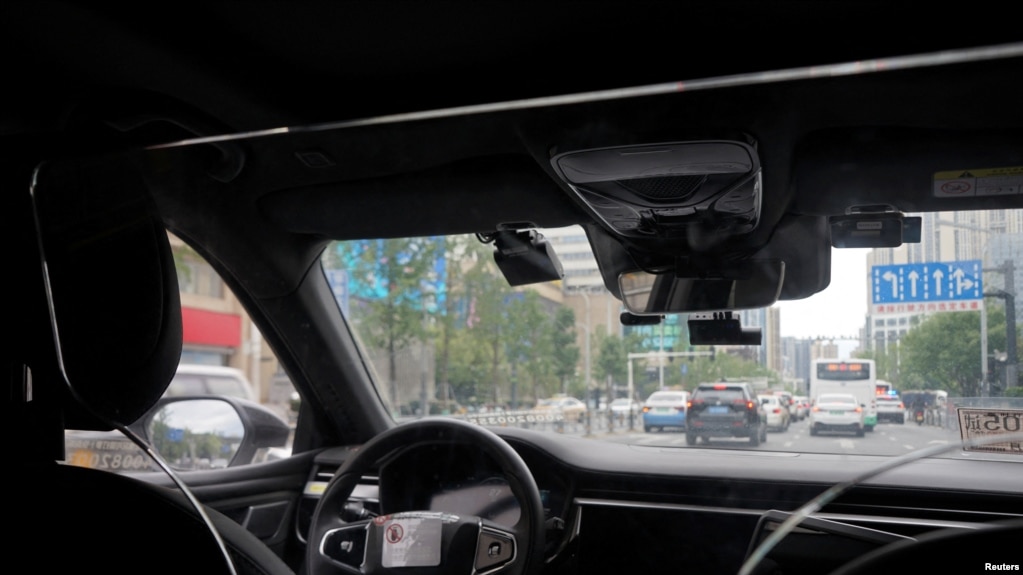
A driverless car by Apollo Go, Baidu's robotaxi service, drives on a road in Wuhan, Hubei province, China, July 19, 2024.

WUHAN, China —

Liu Yi is among China's 7 million ride-hailing drivers. A 36-year-old Wuhan resident, he started driving part-time this year when construction work slowed in the face of a nationwide glut of unsold apartments.

Now he predicts another crisis as he stands next to his car watching neighbors order driverless taxis.

"Everyone will go hungry," he said of Wuhan drivers competing against robotaxis from Apollo Go, a subsidiary of technology giant Baidu 9888.HK.

Baidu and the Ministry of Industry and Information Technology declined comment.

Ride-hailing and taxi drivers are among the first workers globally to face the threat of job loss from artificial intelligence as thousands of robotaxis hit Chinese streets, economists and industry experts said.

Self-driving technology remains experimental but China has moved aggressively to green-light trials compared with the U.S which is quick to launch investigations and suspend approvals after accidents.

At least 19 Chinese cities are running robotaxi and robobus tests, disclosure showed. Seven have approved tests without human-driver monitors by at least five industry leaders: Apollo Go, Pony.ai, WeRide, AutoX and SAIC Motor 600104.SS.

Apollo Go has said it plans to deploy 1,000 in Wuhan by year-end and operate in 100 cities by 2030.

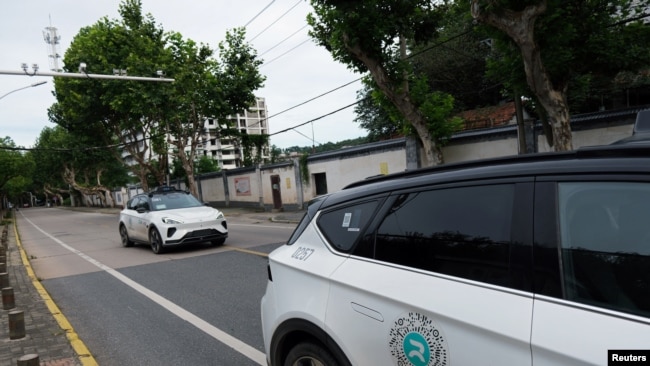
A driverless car by Apollo Go, Baidu's robotaxi service, drives past another Apollo Go robotaxi parked on the side of a road, in Wuhan, Hubei province, China, July 19, 2024.

Pony.ai, backed by Japan's Toyota Motor 7203.T, operates 300 robotaxis and plans 1,000 more by 2026. Its vice president has said robotaxis could take five years to become sustainably profitable, at which point they will expand "exponentially."

WeRide is known for autonomous taxis, vans, buses and street sweepers. AutoX, backed by e-commerce leader Alibaba Group 9988.HK, operates in cities including Beijing and Shanghai. SAIC has been operating robotaxis since the end of 2021.

"We've seen an acceleration in China. There's certainly now a rapid pace of permits being issued," said Boston Consulting Group managing director Augustin Wegscheider. "The U.S. has been a lot more gradual."

Alphabet's GOOGL.O Waymo is the only U.S. firm operating uncrewed robotaxis that collect fares. It has over 1,000 cars in San Francisco, Los Angeles and Phoenix but could grow to "thousands," said a person with knowledge of its operations.

Cruise, backed by General Motors GM.N, restarted testing in April after one of its vehicles hit a pedestrian last year.

Cruise said it operates in three cities with safety its core mission. Waymo did not respond to a request for comment.

"There's a clear contrast between U.S. and China" with robotaxi developers facing far more scrutiny and higher hurdles in the U.S., said former Waymo CEO John Krafcik.

Robotaxis spark safety concerns in China, too, but fleets proliferate as authorities approve testing to support economic goals. Last year, President Xi Jinping called for "new productive forces," setting off regional competition.

Beijing announced testing in limited areas in June and Guangzhou said this month it would open roads citywide to self-driving trials.

Some Chinese firms have sought to test autonomous cars in the U.S. but the White House is set to ban vehicles with China-developed systems, said people briefed on the matter.


SEE ALSO:
US expected to propose barring Chinese software in autonomous vehicles


Boston Consulting's Wegscheider compared China's push to develop autonomous vehicles to its support of electric vehicles.

"Once they commit," he said, "they move pretty fast."

'Stupid radishes'

China has 7 million registered ride-hailing drivers versus 4.4 million two years ago, official data showed. With ride-hailing providing last-resort jobs during economic slowdown, the side effects of robotaxis could prompt the government to tap the brakes, economists said.

In July, discussion of job loss from robotaxis soared to the top of social media searches with hashtags including, "Are driverless cars stealing taxi drivers' livelihoods?"

In Wuhan, Liu and other ride-hailing drivers call Apollo Go vehicles "stupid radishes" - a pun on the brand's name in local dialect - saying they cause traffic jams.

Liu worries, too, about the impending introduction of Tesla's TSLA.O "Full Self-Driving" system - which still requires human drivers - and the automaker's robotaxi ambitions.

"I'm afraid that after the radishes come," he said, "Tesla will come."

Wuhan driver Wang Guoqiang, 63, sees a threat to workers who can least afford disruption.

"Ride-hailing is work for the lowest class," he said, as he watched an Apollo Go vehicle park in front of his taxi. "If you kill off this industry, what is left for them to do?"

Baidu declined to comment on the drivers' concerns and referred Reuters to comments in May by Chen Zhuo, Apollo Go's general manager. Chen said the firm would become "the world's first commercially profitable" autonomous-driving platform.

Apollo Go loses almost $11,000 a car annually in Wuhan, Haitong International Securities estimated. A lower-cost model could enable per-vehicle annual profit of nearly $16,000, the securities firm said. By contrast, a ride-hailing car earns about $15,000 total for the driver and platform.

'Already at the forefront'

Automating jobs could benefit China in the long run given a shrinking population, economists said.

"In the short run, there must be a balance in speed between the creation of new jobs and the destruction of old jobs," said Tang Yao, associate professor of applied economics at Peking University. "We do not necessarily need to push at the fastest speed, as we are already at the forefront."

Eastern Pioneer Driving School 603377.SS has more than halved its instructor number since 2019 to about 900. Instead, it has teachers at a Beijing control center remotely monitoring students in 610 cars equipped with computer instruction tools.

Computers score students on every wheel turn and brake tap, and virtual reality simulators coach them on navigating winding roads. Massive screens provide real-time analysis of driver tasks, such as one student's 82% parallel-parking pass rate.

Students wearing virtual reality (VR) headsets practise on car driving simulators at Eastern Pioneer Driving School in Beijing, China July 23, 2024.

Zhang Yang, the school's intelligent-training director, said the machines have done well.

"The efficiency, pass rate and safety awareness have greatly improved."
Stellantis to lay off 2,450 workers at Michigan plant in US

Move comes as Ram 1500 pickup production ends in Warren Truck Assembly plant

Ovunc Kutlu |10.08.2024 - 


ISTANBUL

Chrysler, Dodge and Ram Trucks' parent, Stellantis, announced Friday it will lay off 2,450 workers at its plant in the US state of Michigan.

Many of the affected workers may shift elsewhere in the company rather than face layoffs, it said in a statement.

Indefinitely laid-off represented seniority employees will receive 52 weeks of supplemental unemployment benefits, paid by the company, and 52 weeks of transition assistance, it said.

"This would be in addition to any state unemployment benefits an employee might be eligible to receive," it said. "They will also receive two years of health care coverage."

The move comes as Ram 1500 pickup production ends at the Warren Truck Assembly plant in Michigan.

Stellantis was formed in 2021 from the merger of the Italian-American conglomerate Fiat Chrysler Automobiles and the French PSA Group. The company's headquarters are in the Netherlands.

While Stellantis designs, manufactures and sells autos in 14 brands, it ranked fourth globally last year in sales among automakers.
Tengku Zafrul: Miti to meet Tesla this month to verify carmaker’s plan in Malaysia, amid rumours of it pausing regional plans


Putrajaya says Tesla has never committed to opening a factory in Malaysia. 
— Bernama pic

By Malay Mail
Saturday, 10 Aug 2024

KUALA LUMPUR, Aug 10 — The Ministry of Investment, Trade, and Industry (Miti) said it is planning to meet American carmaker Tesla Inc’s representatives on August 22 to verify whether it is planning to cancel its plans to develop factories in the region.

Its minister Datuk Seri Tengku Zafrul Abdul Aziz was quoted today saying the meeting will be important as Tesla has yet to make any official statement over the rumour.

“The information or allegations about the factory cancellation, we have only heard from third parties, not from Tesla.

“We will meet with Tesla’s top management from the United States in two weeks,” he was quoted saying by Sinar Harian in Sabak Bernam,

He said his ministry will then issue a statement on the meeting after obtaining Tesla’s agreement, as it involves internal company matters.

Tengku Zafrul also said that any cancellation would not, affect Malaysia as one of the electric vehicle (EV) hubs in the region.

Yesterday, Tengku Zafrul said Tesla has never committed to opening a factory in Malaysia and his ministry had only engaged in discussions with Tesla founder Elon Musk in efforts to attract investment.

Prime Minister Datuk Seri Anwar Ibrahim also had said that Tesla’s decision to defer its planned expansion in the region was not a result of Malaysia’s performance or polices.

Instead, he said it was down to fierce competition to the US EV from Chinese rivals.

Last week, Thai news portal The Nation published a report saying that Tesla was halting plans for factories in the region, including in Malaysia, Thailand, and Indonesia.

This caused confusion here, as Tesla did not previously commit to such a factory, but rather to developing the firm’s supercharger network.
US reverses ban on selling offensive weapons to Saudi Arabia as ties warm


A man stands in the site of the wreckage of a US MQ-9 drone that Houthis claim they shot out of the sky, in a location given as Saada Governorate, Yemen in an undated screengrab obtained on August 4, 2024. — Reuters pic

Saturday, 10 Aug 2024 


WASHINGTON, Aug 10 — The Biden administration has decided to lift a ban on U.S. sales of offensive weapons to Saudi Arabia, the State Department said on Friday, reversing a three-year-old policy to pressure the kingdom to wind down the Yemen war.

The State Department was lifting its suspension on certain transfers of air-to-ground munitions to Saudi Arabia, a senior department official confirmed. "We will consider new transfers on a typical case-by-case basis consistent with the Conventional Arms Transfer Policy," the official said.

Reuters was first to report the decision earlier, citing five sources.

The administration briefed Congress this week on its decision to lift the ban, a congressional aide said. One source said sales could resume as early as next week. The U.S. government was moving ahead on Friday afternoon with notifications about a sale, a person briefed on the matter said.

"The Saudis have met their end of the deal, and we are prepared to meet ours," a senior Biden administration official said.

Under U.S. law, major international weapons deals must be reviewed by members of Congress before they are made final. Democratic and Republican lawmakers have questioned the provision of offensive weapons to Saudi Arabia in recent years, citing issues including the toll on civilians of its campaign in Yemen and a range of human rights concerns.

But that opposition has softened amid turmoil in the Middle East following Hamas' deadly Oct. 7 attack on Israel and because of changes in the conduct of the campaign in Yemen.

Since March 2022 – when the Saudis and Houthis entered into a U.N.-led truce – there have not been any Saudi airstrikes in Yemen and cross-border fire from Yemen into the kingdom has largely stopped, the administration official said.

"We also note the positive steps that the Saudi Ministry of Defense have taken over the past three years to substantially improve their civilian harm mitigation processes, in part thanks to the work of U.S. trainers and advisors," the State Department official said.

Warmer Saudi ties

Yemen's war is seen as one of several proxy battles between Iran and Saudi Arabia. The Houthis ousted a Saudi-backed government from Sanaa in late 2014 and have been at war against a Saudi-led military alliance since 2015, a conflict that has killed hundreds of thousands of people and left 80 per cent of Yemen's population dependent on humanitarian aid.

Biden adopted the tougher stance on weapons sales to Saudi Arabia in 2021, citing the kingdom's campaign against the Iran-aligned Houthis in Yemen, which has inflicted heavy civilian casualties.

Ties between the kingdom and the United States have warmed since then, as Washington has worked more closely with Riyadh in the aftermath of Hamas' Oct. 7 attack to devise a plan for post-war Gaza.

The Biden administration also has been negotiating a defense pact and an agreement for civil nuclear cooperation with Riyadh as part of a broad deal that envisions Saudi Arabia normalizing ties with Israel, although that remains an elusive goal.

The decision comes as the threat level in the region has been heightened since late last month, with Iran and Lebanon's powerful Iran-backed Hezbollah group vowing to retaliate against Israel after Hamas' political chief Ismail Haniyeh was killed in Tehran.

The Houthis have emerged as a strong supporter of the Palestinian Islamist group Hamas in its war against Israel. Earlier this year, they attacked commercial ships that they said are linked to Israel or bound for Israeli ports. 

— Reuters


Pakistan’s remittance inflow stands at $3bn in July, up 48% year-on-year

  • On monthly basis, inflow down 5%
  • Amount from Saudi Arabia remains highest at $761mn
 Published August 9, 2024

Inflow of overseas workers’ remittances clocked in at nearly $3 billion in July, a massive 48% higher on a year-on-year basis when compared with $2.03 billion in the same month of the previous year, showed data released on Friday by the State Bank of Pakistan (SBP).

Remittance inflows in Pakistan clocked in at $2.995 billion in July 2024, 5% lower on a month-on-month basis when compared to $3.158 billion in June 2024.

The amount is the “highest ever for the month of July,” said brokerage house Topline Securities.

Home remittances play a significant role in supporting the country’s external account, stimulating Pakistan’s economic activity as well as supplementing disposable incomes of remittance-dependent households.

Back in June, the World Bank in its report ‘Migration and Development Brief 40’ expected remittances in Pakistan to recover and grow at about 7% to reach $28 billion in (calendar year) 2024 and increase another 4% to about $30 billion in 2025.

However, Pakistan collected $30.3 billion in fiscal year 2023-24 (FY24), 10.7% higher on a year-on-year basis.

Breakdown of remittances

Overseas Pakistanis in Saudi Arabia remitted the largest amount in July 2024 as they sent $761 million during the month. The amount declined by 6% on a monthly basis, but was 56% up than the $487 million sent by the expatriates in the same month of the previous year.

Inflows from the United Arab Emirates (UAE) also declined 7% on a monthly basis, from $654 million in June to $611 million in July. However, on a yearly basis, remittances improved by 94%, as compared to $315 million reported in same month last year.

Remittances from the United Kingdom amounted to $443 million during the month, a decrease of 9% compared to $487 million in June 2024.

Meanwhile, remittances from the European Union improved nearly 6% month-on-month as they amounted to $351 million in July 2024. Overseas Pakistanis in the US sent $300 million in July 2024, a month-on-month decrease of 7%.