Sunday, February 23, 2025

Big tech, banking, energy: who are the biggest spenders on EU lobbying?

Copyright AP Photo

By Paula Soler
Published on 24/02/2025


The world’s largest companies and trade associations from the big tech, banking, energy, and chemicals/agri sectors have significantly increased their EU lobbying budgets in recent years.

The 162 biggest corporations and trade associations collectively spent €343 million on lobbying EU legislators and officials over the past year, according to a new analysis.

Between February 2024 and February 2025, annual lobbying expenditures rose by 13%, and by nearly a third since 2020, according to a report from non-profit groups Corporate Europe Observatory (CEO) and LobbyControl.

However, these estimates remain conservative, as only entities spending over one million euros are required to disclose their lobbying budgets in the EU’s transparency register.

Among the highest-declaring corporates and associations are major big tech players like Meta and Microsoft, with lobbying budgets of €9 million and €7 million respectively, as well as the European Banking Federation, energy firm Shell, FuelsEurope, Bayer, Novartis, BusinessEurope, and the European Federation of Pharmaceutical Industries and Associations (EFPIA).

With the Artificial Intelligence Act having entered into force last year, and the EU Commission planning to introduce the Clean Industrial Deal, an Action Plan on Affordable Energy, a Critical Medicines Act, and a Savings and Investments Union in 2025, all alongside an ongoing drive to slash red tape, the surge in lobbying budgets looks set to continue.

“We've seen a trend of increasing big tech lobbying for years, but the rise in spending by polluting industries such as energy and agri-chemicals over the past five years (44% and 31% respectively) clearly reflects the intense lobbying around the Green Deal,” CEO’s Vicky Cann told Euronews.

“With the Commission set to deliver a corporate-friendly Clean Industrial Deal later this week—alongside a massive deregulation push in the name of 'competitiveness'—it is deeply worrying that this industry lobbying appears to be paying off,” Cann added.


Both LobbyControl and CEO urge EU institutions to rethink lobbying rules and strengthen safeguards against regulatory capture, including the EU Transparency Register, which provides useful information for citizens to track lobbying activity.

“A legally binding lobby register is the only way to impose meaningful sanctions for posting inaccurate data and, in turn, improve the overall quality of the EU lobby register,” the advocacy groups said on Monday, as the platform is due to be reviewed by July 2025.

The analysis also examines the number of meetings between lobbyists and EU officials and the number of badges granting them access to the European Parliament.

The European Chemical Industry Council, BusinessEurope, and Insurance Europe hold the highest number of parliamentary passes, with 323, 295, and 268 respectively – collectively outnumbering MEPs in the parliament.

BusinessEurope also tops the league for the number of declared meetings with EU officials, having logged 467 meetings since 2014, followed by Google (381), Airbus (318), the European Automobile Manufacturers Association (241), and Meta (235).

The findings highlight the need for the EU to expand its existing lobbying restrictions—currently applied to the tobacco industry—to other critical policy areas, such as climate and environmental regulation, the advocacy groups argue.

“As a first step, the Commission should stop granting privileged access to industry lobbyists and ensure that civil society and community voices are heard loud and clear,” the transparency watchdogs emphasized.

Last month, the Commission introduced a major change to lobbying transparency by publishing minutes of meetings between lobbyists and senior officials, extending the disclosure requirement from 400 top officials to around 1,500.

The move got a mixed reaction, but the real impact will depend on how much information is actually disclosed.

‘Now or never moment’: Is it all economic doom and gloom for Europe in 2025?


Copyright Euronews
By Hannah Brown & Angela Barnes
Published on 24/02/2025 s

“If you don't move forward, you fall off the bike,” is the warning from the European Bank for Reconstruction and Development’s chief economist, Beata Javorcik.

Will the second Trump presidential term be the key influence on the global economy of 2025?

According to the European Bank for Reconstruction and Development (EBRD), it’s one of many causes for concern.

“The unwinding of globalisation is going to have negative consequences for the global economy,” Beata Javorcik, chief economist at EBRD, told Angela Barnes in the latest episode of The Big Question.
 
Fragmentation of the global economy

Beata’s two key concerns for 2025 are the impact of ongoing conflict and fragmentation of the global economy. She cited Brexit, the US-China trade war and Russian sanctions as long-term issues continue to pose economic risks.

For Europe to prosper, she explained, the bloc needed to heed the warnings set out in Mario Draghi’s 2024 The Future of European Competitiveness report.

“Europe will not be able to maintain its standards of living if it continues on its current path.

“But paradoxically, the shocks that Europe may experience in 2025 may focus minds and lead to action. It may be a now or never moment for Europe,” Beata added.

While Europe is currently awaiting further news on the proposed US trade tariffs, it’s not the only American move set to cause shock waves across the globe.

“Should the US Federal Reserve have to keep interest rates high for longer, this will translate into higher borrowing costs for emerging markets,” Beata explained.

“Many developing countries and emerging economies already are weighed down by a heavy burden of debt accumulated partially during the pandemic times.

“And high interest rates make the cost of servicing the debt quite high. Yes, inflation has helped to lessen the debt burden, but this burden remains quite substantial. And that's a concern.”

How are sanctions affecting the Russian economy?

Although it’s still unclear how new Russia-US relations will unfold over the next four years, Beata expressed that right now, Russia is starting to suffer the consequences of prolonged sanctions.

While some of the loss of trade from Europe has been filled by exports from China and Turkey, it’s not a direct replacement.

“The technological content of those exports is different and you see in the data that foreign affiliates located in those countries choose not to supply the Russian market.”

She also added that, as multinational companies have continued to exit the Russian market, this has led to cessation of new foreign direct investment (FDI).

“That means lower knowledge flows,” Beata explained.

“These are the effects that are not visible immediately. They work slowly, but they certainly are beginning to take a toll on the Russian economy.”

Where in Europe will we see growth in 2025?

Fortunately, 2025 isn’t all doom and gloom with Beata adding that she’s “very optimistic about services in emerging Europe”.

While the increased implementation of AI is set to affect eastern and western European job markets in completely different manners, Beata sees Eastern Europe thriving in the IT services sector.

“The fact that many of them are in Schengen, in the same time zone, have the same data protection regime as the Western European countries bodes well for greater exports of services.

“As companies are considering their carbon footprint, they are discovering that carbon emissions embodied in services they buy constitute a big chunk of that carbon footprint. So the proximity of Eastern European countries makes them more attractive as suppliers of ICT services.”

The Big Questionis a series from Euronews Business where we sit down with industry leaders and experts to discuss some of the most important topics on today’s agenda.

Watch the video for the full conversation with Beata Javorcik from EBRD.
Situationer: Trump’s aid cuts to hurt pro-democracy projects the most

Pakistani institutions, such as ECP, have benefitted from Washington’s support in the past.


DAWN
 February 24, 2025 


• Pakistani institutions, such as ECP, have benefited from Washington’s support in the past

• Waiver granted for oversight of F-16 programme

THE Trump administration has halted nearly all US government funding for programmes that promote democracy and human rights in many countries, a move that experts warn will have significant repercussions for Pakistan’s democratic institutions.

Pakistan has been one of the largest recipients of US development assistance in South Asia. Under these programmes, Washington provided between $13 million and $15 million to the Election Commission of Pakistan (ECP) to support free and fair elections.

The funds were allocated for the ‘Strengthening Electoral and Legislative Processes’ project, which ran from 2016 to 2023, under the supervision of the United Nations Development Programme (UNDP).

The Trump administration’s broader foreign aid freeze has also impacted humanitarian and development assistance, halting $845m in funding for Pakistani projects and disrupting 11 governance programmes.

In a recent interview with a Fox News affiliate in Detroit, Michigan, former Pakistani president Arif Alvi claimed that the US Agency for International Development (USAID) had given up to $17m to the ECP.

Supporting the Trump administration’s decision to suspend such funding, Dr Alvi asserted that the ECP was responsible for overseeing the 2024 general elections, which he alleged were marred by widespread rigging.

However, according to data from the US government website ForeignAssistance.gov, Pakistan received between $13m and $15m for the seven-year programme, and not specifically for the 2024 elections.

Waivers

However, a number of waivers have been issued as well. Pakistan is receiving two types of waivers under the Trump administration’s new aid policy: emergency humanitarian assistance and security-related funds.

Under a national security waiver, $397 million has been allocated to a US-backed programme monitoring Islamabad’s use of F-16 fighter jets. A congressional aide emphasised that such oversight serves US national security interests, given Pakistan’s nuclear capabilities.

Additionally, the US Bureau of International Security and Nonproliferation has secured 17 exemptions aimed at curbing the spread of weapons of mass destruction.

Pakistan also qualifies for emergency humanitarian aid, including food and medical assistance for flood-affected areas, though the total amount remains undisclosed.

Consequences for Pakistani institutions

The sudden loss of US funding raises concerns about Pakistan’s ability to maintain electoral transparency and civil society engagement. The cut in democracy assistance means that the ECP will have fewer resources for election monitoring and capacity-building programmes.

Civil society organisations that rely on US support for voter education and legal reform will also struggle to continue operations. Media and watchdog groups that play a crucial role in ensuring fair elections may lose funding, limiting their ability to hold institutions accountable.

A senior official at a leading Pakistani think tank, speaking on condition of anonymity, described the situation as “a major setback for democracy advocates in Pakistan. The US was a key partner in ensuring transparency, and this decision leaves a vacuum that authoritarian forces could exploit”.

Global impact

Pakistan is not the only country affected. The National Endowment for Democracy (NED), which funds civil society groups worldwide, reported that it could no longer access its accounts at the Treasury Department.

The shutdown came after staff from Elon Musk’s newly created Department of Government Efficiency (DOGE) took control of financial operations.

Mr Musk has publicly criticised NED, calling it “a scam” and “an evil organisation”, a sentiment echoed by conservative think tanks such as the Centre for Renewing America, which argues that the entity interferes in other countries’ internal affairs.

The cuts are extensive: $486m slashed for global electoral and political process strengthening programmes; $39m removed from fiscal federalism projects in Nepal; and $47 million cut from educational programmes across Asia.

In India, President Trump questioned why the US was funding election-related initiatives in a “wealthy nation”, leading to the cancellation of a $21m grant.

Indian ruling party leader Amit Malviya labelled the now-cancelled funding as “external interference in India’s electoral process”.

Expert warnings

Michael Kugelman, director of the Wilson Centre’s South Asia Institute, emphasised the long-term damage these cuts could inflict: “Pakistan is one of the largest recipients of US development assistance in South Asia. These cuts will not only impact electoral support but will also affect civil society organisations that promote democratic governance.”

Congressman Steve Cohen, a Democrat from Memphis, called the aid reductions “a serious blow to the US government’s role in international development, halting critical humanitarian aid, disaster relief and global health initiatives”.

The International Council of Voluntary Agencies (ICVA), a network of groups in about 160 countries, warned that US cuts had taken a devastating toll on crisis-hit populations. In a recent report, ICVA noted that aid groups across the world have been forced to close operations, lay off staff and halt life-saving work.

While the Trump administration argues that these cuts align with an “America First” policy, critics contend that reducing US engagement in democratic development will embolden authoritarian regimes and weaken global governance.

As debates continue in Washington, affected countries must reassess how to sustain democratic initiatives without US support.

Published in Dawn, February 24th, 2025


AU CONTRAIRE

Should We Celebrate the Demise of USAID and NED?

The opening month of the second Donald Trump Presidency has produced a number of consensus-shattering executive actions that have upended the normal functioning in Washington. One of the most surprising is Trump’s attempt to eliminate the United States Agency for International Development (USAID) and defund the National Endowment for Democracy (NED).

For decades, USAID and NED have presented themselves as wearing a white hat, helping other countries become more democratic and enlightened. However, much of the real work of the agencies was to foment dissent and at times, overthrow governments that do not comply with Washington’s dictates.

USAID and NED fund media outlets that repeat Washington’s propaganda, support political opposition factions that want to align more with the White House, and bolster NGOs that facilitate regime changes.

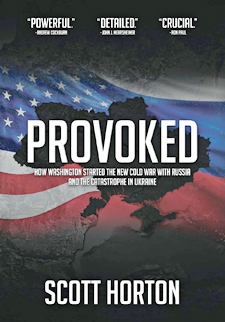
In the following excerpt from Provoked: How Washington Started the New Cold War with Russia and the Catastrophe in Ukraine, Scott Horton discusses some of the many nefarious operations of USAID and NED in Europe. As Washington completed a series of political revolutions, regime change operations, and coups, it changed the balance of power in the region.

In 2014, the US pulled off its second coup in Ukraine in ten years, putting Washington, Kiev, and Moscow on the path to war.

The excerpt below is just a portion of Horton’s comprehensive coverage of USAID and NED’s regime change operations that created a New Cold War with Russia. Donate to the Libertarian Institute’s fund drive, and you can get a signed copy of Provoked.

~ Kyle Anzalone


NED

The color-coded revolutions were essentially U.S. coups d’état dressed up as local “uprisings,” primarily against Russian-leaning states in their near abroad. Backed by the CIA, the United States Agency for International Development (USAID), National Endowment for Democracy (NED), National Democratic Institute (NDI), International Republican Institute (IRI) and friendly, supposedly private non-governmental organizations (NGOs) like Serbian Otpor, the Soros Foundation, Open Society Foundation, International Renaissance Foundation and the Atlantic Council, they have had quite a few successes.

Allen Weinstein, a co-founder of the NED, told the Washington Post’s David Ignatius in 1991, “A lot of what we do today was done covertly twenty-five years ago by the CIA.” Ignatius added, “When [Cold War-era] covert activities surfaced (as they inevitably did), the fallout was devastating. The CIA connection, intended to protect people and organizations from public embarrassment, had precisely the opposite effect.” However, “The biggest difference is that when such activities are done overtly, the flap potential is close to zero. Openness is its own protection.”

Electoral Revolution

Though the U.S. and allied oil companies British Petroleum and Amoco helped overthrow President Abulfaz Elchibey of Azerbaijan in 1993, that was more of a straight-up coup than any pretended “revolution.” But those started with mixed success in Albania and Bulgaria in 1996,  Montenegro and Romania  in 1997, Armenia in 1998Slovakia and Croatia in 1999 and Serbia in 2000.

Slovakia 

The NED’s Rodger Potocki explained that “NDI … and IRI, in the early 90s, working in Bulgaria and Romania, came up with two key ideas on how you build momentum for democratic change: citizen advocacy and monitoring groups.”  In 1997, after the success of their intervention in the Bulgarian elections, the NED targeted Slovak President Vladimír Mečiar. The NED and associated NGOs spent more than $850,000 in direct financial support to Mečiar’s opponent, Paval Demeš, and his OK’98 campaign. Contributors to Demeš’s “electoral revolution” included the United States Information Service, the IRI and NDI, Soros’s Open Society Foundation, the German Marshall Fund, as well as the governments of Britain and the Netherlands.

This money paid for a tour of 13 rock concerts, two films and a television ad buy, encouraging the young to vote. It was a massive success. The NGOs also did extensive exit polling so they could claim their results before the votes could be counted. Though the incumbent’s party received the most votes, the minority parties were able to form a coalition and oust him for a Western-compliant MP named Mikuláš Dzurinda. The NED and associated groups only claimed to be supporting the process, but that was an obvious lie. Their propaganda was entirely designed to push people to vote for the right guy — or at least against the wrong one.

Croatia

In Croatia, Clinton turned on his ally Franjo Tudjman. The NED and its allies created a new group called Citizens Organized to Monitor Elections (known by its Croatian acronym GONG). Again they bought a massive advertising campaign in support of pro-Western parties. The Slovak politician and NGO leader Demeš traveled to Croatia to help show GONG how it was done. Tudjman died just before the election and the pro-Western parties won. Demeš later became a leader at the German Marshall Fund. At least he was honest about what they were doing, saying that “[e]xternal funding for these civic campaigns is critical. Without external support, they wouldn’t happen.”

The Same Old NGO Scam

The NED’s Carl Gershman himself later referred to this revolution as a successful “overthrow” of Yanukovych. Apologists for this intervention like to cry that accusers are “denying the agency” of the Ukrainians who did the coup. But that is ridiculous. Every CIA- or NED-backed coup plot in history has relied on local forces to agitate and then ultimately take over the country. Domestic opponents who accepted U.S. help to replace Shukri al-Quwatli, Mohammad Mosaddeq, Jacobo Árbenz, Ngo Dinh Diem, Sukarno, João Goulart, Cheddi Jagan, Patrice Lumumba, Rafael Trujillo, Gough Whitlam, Salvador Allende, Jean-Bertrand Aristide, Vladimír Mečiar, Franjo Tudjman, Slobodan Milošević, Eduard Shevardnadze, Askar Akayev, Manuel Zelaya, Muammar Gaddafi, Mohamed Morsi, Evo Morales, Viktor Yanukovych, etc. all had “agency,” alright: they were the sock puppets of “the Agency” — the American CIA and their junior partners at USAID, the NED and the rest of the regime change industry.

The question is regarding the motives behind and extent of U.S. government intervention and whether it helped to make a difference in the success of the regime change. As former CIA Director of Operations Ray S. Cline put it, in reference to the successful 1953 Iran coup, what counted was “supplying just the right bit of marginal assistance in the right way at the right time. Such is the nature of effective political action.” The Ukrainians and their factions are the pieces, while major powers America and Russia are the players in this game of chess.

For example, Center UA was a “civil society” group run by Oleh Rybachuk, the former chief of staff of ex-President Yushchenko, who had been central to the CIA-MI6 scheme to work with the Ukrainian SBU against Yanukovych during the Orange Revolution of 2004, and bankrolled by American oligarchs Pierre Omidyar — who donated $335,000 in 2011 alone — and, though he later denied it, George Soros. The Open Society Foundation was happy to take credit where it was due. “The International Renaissance Foundation played an important role supporting civil society during the Euromaidan protests,” they boasted, adding that they had paid for legal aid for “activists, protesters and journalists,” as well as medical care and assistance to Hromadske TV and other pro-Maidan media. The Kyiv Post reported in 2014 that USAID gave Center UA more than $500,000 in 2012 through an NGO called Pact Inc., adding, “Nearly 36 percent came from Omidyar Network, a foundation established by eBay founder Pierre Omidyar and his wife.” And, of course, Soros’s International Renaissance Foundation and NED picked up the rest. With the help of USAID-backed Pact Inc., Rybachuk’s Center UA organized approximately 60 different NGOs and provided grants to at least 80 more. Rybachuk also headed up the Civic Expert Council, advocating for Ukraine to sign the new association agreement with the EU.

As soon as Amb. Pyatt got to Kiev, he approved a $50,000 USAID grant to Hromadske TV. Their editor-in-chief Roman Skrypin worked for the U.S. government’s Radio Liberty and the also-U.S.-funded Ukrainska Pravda. He got another $30,000 from Soros’s International Renaissance Foundation. Skrypin also helped to set up the Channel 5 TV network with money from the IRF in time for the Orange Revolution in 2004. USAID gave Pact Inc. $7 million in 2013. “Euromaidan Press,” official mouthpiece of the Maidan movement, admitted two years later that they got the vast majority of their funding from Soros’s Renaissance Foundation. Their website still reads, “Euromaidan Press is grateful for the longtime support of the International Renaissance Foundation,” and for “the past support of GPD Charitable Trust, British Embassy Kyiv, and National Democratic Institute.”

IRF beneficiary Viktoria Siumar from Hromadske Radio thanked Soros for all his generosity, saying that “without those efforts the revolution might not have succeeded… Partners of the IRF were the main driving force and the foundation of the Maidan movement.”

This is how it works. As the Financial Times reported, “Kiev-based New Citizen, headed by Rybachuk … played a big role in getting the protest up and running weeks ago when Yanukovych backed out of signing far-reaching association and free trade agreements with the EU.” The plan had been in the works for years. As Rybachuk told the Financial Post back in 2012, “We now have 150 NGOs in all the major cities in our ‘clean up Parliament campaign.’ … Facebook had 300,000 members a year ago and now has two million. The Orange Revolution was a miracle. … We want to do that again and we think we will.”

Mustafa Nayyem, co-founder of Hromadske TV, explained in an article for Soros’s Open Societies Foundation that he had kicked the protests off on November 21 with a Facebook post asking people to meet at the Maidan. But as journalist Kit Klarenberg explained, “Nayyem was no ordinary ‘online journalist.’ In October 2012, he was one of six Ukrainians whisked to Washington, D.C., by Meridian International, a State Department-connected organization that identifies and grooms future overseas leaders, to ‘observe and experience’ that year’s Presidential election.” The group met with Senator John McCain among others while they were in town.

Also interestingly, Klarenberg found that “[i]n the hours following Russia’s invasion of Ukraine, NED hurried to remove any and all trace of its funding for organizations in Ukraine from its website.” He noted that while the NED grants database for Ukraine returned no results, “a snapshot of the page captured February 25th [2022] reveals that since 2014, a total of 334 projects in the country have been awarded a staggering $22.4 million,” adding that “by NED President Duane Wilson’s reckoning, Kiev is the organization’s fourth-largest funding recipient worldwide.” Journalist Will Porter found  scrubbed NED records showing they had spent $4.5 million on 70 separate projects in 2013–2014 alone.  Is the NED leadership not proud of the assistance they have given? Evidently they find it preferable to keep their name out of the prehistory of this terrible conflict.

Forbes magazine dug even deeper into Hromadske TV’s funding and found contributions from the U.S., Swiss and German embassies, various Canadian and Swiss government agencies and assorted NGOs, as well as the European Commission’s Ukrainian delegation office. “[D]onations from the European Commission are a particularly interesting reveal,” Forbes noted, “given the anti-Russian government news … coming out of Hromadske.” Rather than a grassroots effort of “the Ukrainian people,” as Nuland claimed, USAID’s annual report from 2013 makes it clear that Ukraine’s entire “civil society” was nothing but American and Western European astroturf. Their NGOs spent at least tens of millions of dollars picking and choosing winners across many different fields.

Soros’s Freedom House even sent out a fundraising appeal based on their intervention in this case. “More support, including yours, is urgently needed to ensure that Ukrainian citizens struggling for their freedom are protected and supported.” No point in their being modest. The group’s David J. Kramer had issued an official statement demanding Yanukovych resign on December 9.

Ukrainian oligarch Igor Kolomoysky, who controlled vast oil, gas and banking interests in the country, had an old grudge against Yanukovych from previous fights over the semi-private oil company Ukrtatnafta. He quickly employed his TV channel 1+1 in service of the protest movement.

Author: Scott Horton

Scott Horton is editorial director of Antiwar.com, director of the Libertarian Institute, and podcasts the Scott Horton Show from ScottHorton.org. He’s the author of the 2024 book Provoked: How Washington Started the New Cold War with Russia and the Catastrophe in Ukraine the 2021 book Enough Already: Time to End the War on Terrorism, the 2017 book, Fool’s Errand: Time to End the War in Afghanistan, and the editor of the 2019 book, The Great Ron Paul: The Scott Horton Show Interviews 2004–2019. He’s conducted more than 5,500 interviews since 2003. Scott’s articles have appeared at Antiwar.com, The American Conservative magazine, the History News Network, The Future of FreedomThe National Interest and the Christian Science Monitor. He also contributed a chapter to the 2019 book, The Impact of War. Scott lives in Austin, Texas with his wife, investigative reporter Larisa Alexandrovna Horton. He is a fan of, but no relation to the lawyer from Harper’s. Scott’s TwitterYouTubePatreon. 


HINDUTVA CENSORSHIP

Indian police seize books by Islamist political party founder in Kashmir


A man visiting a bookshop in Srinagar on Feb 18. Store owners said the Indian police seized books by Islamist political party Jamaat-e-Islami founder Abul Ala Maududi.PHOTO: AFP

UPDATED Feb 19, 2025

SRINAGAR, India – The Indian police in disputed Kashmir have raided dozens of bookshops and seized hundreds of copies of books by an Islamic scholar, sparking angry reactions by Muslim leaders.

The police said searches were based on “credible intelligence regarding the clandestine sale and distribution of literature promoting the ideology of a banned organisation”.

Officers did not name the author, but store owners said they had seized literature by the late Abul Ala Maududi, founder of the Islamist political party Jamaat-e-Islami.


Kashmir has been divided between India and Pakistan since their independence from British rule in 1947, and both claim the Himalayan territory in full.

Rebel groups, demanding Kashmir’s freedom or its merger with Pakistan, have been fighting Indian forces for decades, with tens of thousands killed in the conflict.

Indian Prime Minister Narendra Modi’s Hindu-nationalist government banned the Kashmir branch of Jamaat-e-Islami in 2019 as an “unlawful association”.

New Delhi renewed the ban in 2024 for what it said were “activities against the security, integrity and sovereignty” of the nation.

Plainclothes officers began raids on Jan 15 in the main city of Srinagar, before launching book seizures in other towns across the Muslim-majority region.

“They (police) came and took away all the copies of books authored by Abul Ala Maududi saying these books were banned,” a bookshop owner in Srinagar told AFP, asking not to be named.

“These books were found to be in violation of legal regulations, and strict action is being taken against those found in possession of such material,” the police said in a statement.

The police said the searches were conducted “to prevent the circulation of banned literature linked to Jamaat-e-Islami”.

The raids sparked anger among supporters of the party.

“The seized books promote good moral values and responsible citizenship,” said Mr Shamim Ahmed Thokar.

Mr Umar Farooq, Kashmir’s chief cleric and a prominent leader advocating for the right to self-determination, condemned the police action.

“Cracking down on Islamic literature and seizing them from bookstores is ridiculous,” Mr Farooq said in a statement, pointing out that the literature was available online.

“Policing thought by seizing books is absurd – to say the least – in the time of access to all information on virtual highways,” he added.

Critics and many residents of Kashmir say civil liberties were drastically curtailed after Mr Modi’s government imposed direct rule in 2019 by scrapping Kashmir’s constitutionally enshrined partial autonomy. AFP
RHETORICAL QUESTION

Knowledge is Power—Why Would the Government Want to Dismantle Education?

Dismantling the Department of Education is not just a political talking point; it is an existential threat to millions of students who depend on federal protections 


First-grader Khatona Miller, right, investigates a circled location on a world globe with other classmates on August 22, 2000 at Chicago's Stewart Elementary School.
(Photo: Tim Boyle/Newsmakers)
nd funding.

Rachel Ghosh
Feb 23, 2025
Common Dreams

Education has long been called the great equalizer—a fundamental tool for upward mobility and societal progress. Yet, the Trump administration is advocating for the complete dismantling of the federal Department of Education, or ED,, a move that would profoundly harm millions of students, especially students with disabilities, those living in poverty, and those facing discrimination.

Eliminating the ED would strip away crucial protections, defund essential programs, and exacerbate the inequalities that already plague American education. It’s not just bad policy; it’s a direct attack on the very idea that knowledge should be accessible to all.

For my family, education was never just about personal achievement—it was about survival, progress, and the ability to dream beyond one’s circumstances. My paternal grandparents grew up in a small village in Kolkata, India, in large families with limited means. My grandfather, one of 11 children, grew up in a mud house and did not own a pair of shoes until high school. Yet, thanks to India’s government-funded education system, he and my grandmother attended public schools from kindergarten through their PhDs without paying a dime. Their access to education wasn’t determined by wealth or geography—it was a right.

President Donald Trump himself has said we “have to learn from history.” So why is the administration actively working to undo the progress we’ve made?

That right changed their lives. After immigrating to the United States in 1966, my grandfather eventually became the first Indian-born president of an American university. My late grandmother, too, built a career in academia, inspiring generations of students, including me. They passed down their belief in education’s power to transform lives, a belief my mother upheld when she ensured I attended one of the best public schools available in our Midwestern state. Today, my own career is focused on ensuring that all children have access to the same life-changing opportunities that shaped my family’s story.

That’s why I am deeply alarmed at the administration’s apparent push to destroy the very institution that safeguards equitable access to education in America. The plan to abolish the ED and send all education back to the states would be calamitous. While states and localities already control most aspects of education, the ED plays an essential role in leveling the playing field. It ensures federal funding for students in low-income areas (Title I), enforces protections for students with disabilities (IDEA), and holds states accountable for upholding civil rights in schools.

Without the ED, low-income students will lose critical support. Title I funding currently supports approximately 2 in 3 public schools in the United States. Eliminating this funding would lead to devastating budget cuts, staff layoffs, and program eliminations in schools serving low-income communities. Additionally, students with disabilities will be left behind. The IDEA program currently serves about 7.5 million children aged 3 to 21, accounting for 15% of all public school students. Without ED oversight and funding, these students may not receive the specialized services they need, hindering their educational progress and future opportunities. Civil rights enforcement will also weaken. Historically, federal intervention has been necessary to combat racial segregation, gender discrimination, and unequal educational opportunities. Without ED oversight, there will be no clear mechanism to address discrimination complaints, leaving marginalized students vulnerable.

The elimination of the ED would be particularly harmful to children in government systems. Those in state foster care could lose hard-won protections that ensure they receive a consistent education in their home communities instead of being bounced from school to school and are provided with a course of study appropriate for their age and abilities. They are also far more likely to require specialized educational services—and the federal funding to pay for it. In addition, the ED plays an important role in supporting English for Speakers of Other Languages (ESOL) programs so immigrant students attain proficiency and meet academic standards.

Finally, without the ED, higher education will become less accessible. Millions of college students depend on federal loans and Pell Grants, which are administered by the department. Without them, higher education will become an impossible dream for many. These consequences won’t just affect individual students—they will reverberate across society, deepening inequality and economic disparity for generations to come.

America’s education system is far from perfect. Teachers are underpaid and overworked, standardized testing is flawed, and school funding is wildly uneven. But abandoning federal oversight is not the solution—it’s a retreat into an era when education was a privilege reserved for certain groups and not a right.

Before the ED’s creation in 1979, education was almost entirely a state and local matter, and the disparities were staggering. Many students—particularly in the South, in rural areas, and in low-income communities—had little access to quality education. Black students faced legal segregation and underfunded schools. Girls had fewer opportunities in STEM fields and less access to higher education. Students with disabilities were often denied an education entirely. Federal actions, including the Civil Rights Act of 1964 and the Elementary and Secondary Education Act of 1965, played a critical role in correcting these injustices.

President Donald Trump himself has said we “have to learn from history.” So why is the administration actively working to undo the progress we’ve made? If we allow education to be completely dictated by state governments—many of which are already erasing and rewriting history curricula—will we even be able to learn from our past at all?

Dismantling the Department of Education is not just a political talking point; it is an existential threat to millions of students who depend on federal protections and funding. If we want America to be a land of opportunity, we must fight to preserve and strengthen the institutions that make upward mobility possible. That means investing in teachers, improving curricula, and expanding access to education—not gutting the very foundation of educational equity. If you still aren’t convinced, take a walk past your local school and remember what it felt like to sit in those classrooms. Talk with a child about what topics excite them in school. Ask a grandparent how education changed their life. Then, truly consider what it would mean for these opportunities to be stripped away.

Knowledge is power; why would our own government want to take it away?


Our work is licensed under Creative Commons (CC BY-NC-ND 3.0). Feel free to republish and share widely.


Rachel Ghosh is a senior policy analyst and researcher for Children’s Rights.
Full Bio >
We Can Accelerate the Clean Energy Transition, Even Under Trump

The momentum toward a sustainable future will be unstoppable if clean energy supporters speak up in their own communities.


An ENGIE employee walks past solar panels at the ENGIE Sun Valley Solar project in Hill County, Texas, on March 1, 2023.
(Photo: Mark Felix / AFP via Getty Images)

Matt Traldi
Feb 23, 2025
Common Dreams


Here's a bold prediction for the start of the second Trump administration: The next four years will be the best yet for America's clean energy transition.

That may sound surprising, given the significant steps President Donald Trump has already taken to try to reverse American leadership on climate and clean energy. There's much still unknown about the potential impact of Trump's early executive orders, but one truth remains clear: Far from slowing down, we could be entering a period of unprecedented renewable energy progress.

There's already strong momentum behind the clean energy shift, and whether that momentum continues is less dependent on the federal government than you might think. Trump can't change the reality that, for a huge number of clean energy projects, the permitting authority rests not with federal agencies, but with state and local decision-makers.

Now more than ever, speaking up for clean energy in your community is one of the most impactful steps you can take for the planet, your local economy, and the health and safety of future generations.

This means that the main determinant of how much progress clean energy makes over the next four years isn't the Trump administration. It's your neighbors—and you.

Don't be distracted by all the ink that will be spilled in the coming months about Trump's efforts to slow progress on offshore wind and electric vehicles, or to roll back the Inflation Reduction Act (IRA). For starters, experts agree that a full repeal of the IRA—which made the single largest investment in climate and energy in American history—is unlikely. This landmark law has been an economic boon to red and blue states alike, earning bipartisan support.

The way forward remains open for the vast majority of clean energy projects permitted mostly or entirely at the state and local level. There, local governments, influenced by support across the political spectrum, have become powerful engines of clean energy progress.

Solar and wind are now the cheapest energy options available, even without subsidies. Across the country, these technologies are increasingly boosting local economies, generating revenue for public services, creating well-paying jobs, and delivering health and climate benefits for millions.

Now, our often-overlooked town planning and zoning commissions or county councils hold the key to driving clean energy forward in the coming years. Right now, these spaces are often dominated by small numbers of highly organized opponents—many backed by the same fossil fuel-linked interests that are now shaping Trump's energy policy. Left unchecked, these opponents have become adept at stalling or derailing clean energy progress. As of early 2024, at least 15% of U.S. counties had effectively banned utility-scale wind or solar projects, despite the fact that the vast majority of Americans support these technologies.

Here's the opportunity. With so few people in attendance at local hearings, noisy opponents can significantly influence local decision-makers. That also means every person who makes the choice to speak out in favor of clean energy projects can make a big difference.

Take Mesa County, Colorado, where volunteers with the Western Colorado Alliance came together to overturn a moratorium on solar development in spring 2024. The handful of volunteers who took the time to show up to the pivotal public hearing helped ensure that community support for solar growth was on clear display, outweighing the opposition and convincing local officials to lift the county's ban.

This small group of volunteers helped create jobs, improved health, made their grid more reliable, and had a bigger impact for the climate in one step, together, than through years of individual actions. Even one 500-megawatt solar array that gets built as a result will help avoid the carbon emissions of more than 80,000 people switching to electric vehicles.

With a focus on supporting more of these projects in communities nationwide, clean energy will continue to boom in Trump's second term and beyond, creating a more livable climate and stronger economy for all.

So how do you take action where you live? It's easier than you think—here's a guide to getting started. Visit your city, county, or town's website and see what's on the planning docket. Check your local media for news about clean energy. And when you hear about a proposed project, don't just assume it will happen—or that it will fail. Do your research, share what you learn with neighbors, and reach out to organizations like the one I founded, Greenlight America, for help.

Most importantly, follow the project's approval process and, when it's up for a vote, be there or write in to voice your support to local leaders. They say 90% of success in life is showing up. For clean energy permitting, it's more like 100%.

Now more than ever, speaking up for clean energy in your community is one of the most impactful steps you can take for the planet, your local economy, and the health and safety of future generations.

There will be hundreds of opportunities to make this impact across the country in the next four years. Together, project by project and community by community, we can all fight climate change and pollution and bring clean energy and its economic benefits to all of our communities. The power is in our hands


Our work is licensed under Creative Commons (CC BY-NC-ND 3.0). Feel free to republish and share widely.


Matt Traldi
Matt Traldi is the CEO of Greenlight America, a national nonprofit organization that supports local groups and volunteers working to get clean energy projects built in their communities. He was a co-founder of the national grassroots democracy organization Indivisible.
Full Bio >


Trump’s South Africa Executive Order Reflects the Global History of White Supremacy

The right wing in the United States as well as Great Britain, Canada, and elsewhere, has held a fascination for apartheid and has regretted its abolition.


South African farmer Tewie Wessels addresses a group of white South Africans supporting U.S. President Donald Trump and South African and U.S. tech billionaire Elon Musk gather in front of the U.S. Embassy in Pretoria, on February 15, 2025 during a demonstration.
(Photo: Marco Longari/AFP via Getty Images)
Foreign Policy In Focus

On February 7, U.S. President Donald Trump issued an executive order “to address serious human rights violations occurring in South Africa.” The order charged “blatant discrimination” against “ethnic minority descendants of settler groups,” and mandated “a plan to resettle disfavored minorities in South Africa discriminated against because of their race as refugees.” His actions echo a long history of right-wing support in the United States for racism in Southern Africa, including mobilization of support for white Rhodesia (now Zimbabwe) as well as the apartheid regime in South Africa.

Analysts in South Africa quickly pointed out the many factual errors in Trump’s diatribe. Even Afrikaners, who he alleges are persecuted, are unlikely to accept being refugees since South Africa is their home country. The post-apartheid constitution of 1997, echoing the African National Congress’ Freedom Charter of 1955, clearly states that South Africa belongs to “all who live in it.” But Trump’s misunderstanding is an example of the transnational scope of white racist nostalgia.

An essential component of opposing the MAGA offensive against human rights in the United States has been new understandings of U.S. history, as reflected in the 1619 Project and a host of other publications. Most often, however, this discussion has focused on the United States in isolation. Scholars such as Ana Lucia Araújo, in Humans in Shackles, and Howard French, in Born of Blackness, have pioneered wider global histories. But however influential this trend is among historians, it has not been matched by attention in the media or public debate.

The sympathy that even liberal Robert F. Kennedy expressed for South African white pioneers on a hostile frontier evokes the common ideology of legitimizing settler conquest.

In the global history of white supremacy, the close relationship between the United States and South Africa stands out for centuries of interaction between the two settler colonies, with both ideological and material links from the 17th to the 20th centuries. Significant links between Black resistance movements in the two countries also date back at least to the early 20th century. But until the end of official apartheid in the 1990s, the closest bonds were between white America and white South Africa.

In a short history of the Boer War written by eight-year-old future CIA Director Allen Dulles in 1901, and published by his grandfather, Dulles noted that the Boers landed at the Cape in 1652, “finding no people but a few Indians,” and that “it was not right for the British to come in because the Boers had the first right to the land.” For Dulles, as for other U.S. policymakers until almost the end of the 20th century, it was axiomatic that only whites had rights.

The parallels between these two settler colonies were significant. Robert F. Kennedy, speaking to university students in Cape Town in June 1966, put it like this:
I come here this evening because of my deep interest and affection for a land settled by the Dutch in the mid-17th century, then taken over by the British, and at last independent; a land in which the native inhabitants were at first subdued, but relations with whom remain a problem to this day; a land which defined itself on a hostile frontier; a land which has tamed rich natural resources through the energetic application of modern technology; a land which once the importer of slaves, and now must struggle to wipe out the last traces of that former bondage. I refer, of course, to the United States of America.

The parallels were matched by a long history of interaction. The concept for the African reserves (later Bantustans) in South Africa was modeled on American Indian reservations. As noted by historian John W. Cell, Americans and South Africans debated how to shape “segregation” in urbanizing societies in the mid-20th century. The Carnegie Corporation of New York financed both the classic study of the situation of “poor whites° in South Africa and Gunnar Myrdal´s The American Dilemma: The Negro Problem and American Democracy.

In the early 20th century, mining engineer Herbert Hoover (later U.S. president) was the founder and director of the Chinese Engineering and Mining Corporation, which shipped some 50.000 Chinese laborers to South Africa to work in South African mines. The scheme was abandoned in 1911. Mention of it was recently deleted from Wikipedia, most likely in 2018.

Both countries were united during the Cold War through anti-communism. South African officials studied McCarthyist legislation in the United States and applied it at home through the Suppression of Communism Act. In both countries, “anti-communism” became a way to defy demands for civil rights. Although white racism in South Africa became the focus of international condemnation after the official adoption of apartheid in 1948, the United States and other Western countries systematically opposed sanctions against South Africa for decades until the rise of the international anti-apartheid movement resulted in the congressional override of President Ronald Reagan’s veto to pass the Comprehensive Anti-Apartheid Act of 1986.

That success came after decades of campaigning in the United States and around the world, with heightened international attention coming in response to resistance in South Africa itself. The Treason Trial from 1956 to 1961, in which Nelson Mandela and 135 other leaders of the African National Congress were charged, evoked widespread anti-apartheid actions in the United Kingdom and other countries. The Sharpeville Massacre in 1960 and the Soweto Youth Uprising in 1976 precipitated even larger waves of protest, fueled by new media options. Resistance reached a new peak after the formation of the United Democratic Front in 1983.

Following the release of Nelson Mandela in 1990, and the first non-racial election that brought him into office, there was worldwide celebration at the end of political apartheid. In later years, it became clear that only a minority of Black South Africans had joined the elite at the top of a still sharply unequal society. Disillusionment and discontent over high rates of unemployment and poverty arose among the majority of Black South Africans.

But that is a very different sentiment than the nostalgia for the old apartheid order among white South Africans who left the country as well as many who stayed in South Africa.

The right wing in the United States as well as Great Britain, Canada, and elsewhere, has held a fascination for apartheid and has regretted its abolition. The global anti-apartheid movement unleashed unprecedented demands by citizens to rein in corporate activity that supported apartheid. In the same way that climate activists studied divestment, so too have conservative lobbying groups studied how to block divestment groups. The sympathy that even liberal Robert F. Kennedy expressed for South African white pioneers on a hostile frontier evokes the common ideology of legitimizing settler conquest. Trump’s Executive Order can only be understood in that context.

An Unconstitutional Rampage

Trump and Musk are on an unconstitutional rampage, aiming for virtually every corner of the federal government. These two right-wing billionaires are targeting nurses, scientists, teachers, daycare providers, judges, veterans, air traffic controllers, and nuclear safety inspectors. No one is safe. The food stamps program, Social Security, Medicare, and Medicaid are next.

It’s an unprecedented disaster and a five-alarm fire, but there will be a reckoning. The people did not vote for this. The American people do not want this dystopian hellscape that hides behind claims of “efficiency.” Still, in reality, it is all a giveaway to corporate interests and the libertarian dreams of far-right oligarchs like Musk.

Common Dreams is playing a vital role by reporting day and night on this orgy of corruption and greed, as well as what everyday people can do to organize and fight back. As a people-powered nonprofit news outlet, we cover issues the corporate media never will, but we can only continue with our readers’ support.

© 2023 Foreign Policy In Focus


Zeb Larson
Zeb Larson is a writer and historian of the anti-apartheid movement based in Columbus, Ohio. He got a PhD from The Ohio State University in 2019. He writes on a wide variety of topics, including foreign policy and history.
Full Bio >

William Minter
William Minter is the editor of AfricaFocus Bulletin.


Michigan Governor Accused of 'Wage Theft' for Signing Tipped Minimum Wage Legislation

"Once again, Democrats have thrown working people under the bus, this time in Michigan," said one critic.


A bartender pours a cocktail at the MGM Grand in Detroit on July 28, 2024.
(Photo: Nic Antaya/Getty Images)

Brett Wilkins
Feb 21, 2025
 COMMON DREAMS

Economic justice advocates excoriated Michigan Gov. Gretchen Whitmer on Friday after the Democrat signed legislation that, while speeding up the state's increase to a $15 hour minimum wage, could leave tipped workers earning less than they would under a system imposed last year by the state Supreme Court, according to critics.

Whitmer signed a pair of bills changing the state's minimum wage, tip credit, and paid sick leave law following an eleventh-hour legislative compromise, explaining in a statement that "Michigan workers deserve fair wages and benefits so they can pay the bills and take care of their family, and small businesses need our support to keep creating good jobs."

Abigail Disney, a member of the group Patriotic Millionaires, said in a statement, "Once again, Democrats have thrown working people under the bus, this time in Michigan under the stewardship of Gov. Gretchen Whitmer."


"In its quest to rebrand itself and win back the working-class vote, Democrats needed to present a unified front in this pivotal moment in Michigan—and anything less than that, which this is, should be taken as an abysmal failure," Disney continued.

"This is the unfortunate but predictable outcome of a party that has proven itself over the years to be for sale to the highest bidder. Voters will definitely notice, and Democrats shouldn't expect them to forgive and forget at the polls in 2026 and beyond," she added.

In 2018, advocates drafted ballot initiatives aimed at expanding paid sick leave and raising the state minimum wage, which was then $9.25 an hour. But Republican state lawmakers moved to block the measures by maliciously adopting and then favorably amending them. Last July, Michigan's Supreme Court ruled this "adopt and amend" tactic unconstitutional and ordered the initial sick leave and minimum wage proposals to take affect at midnight on Friday.

By signing one of the bills, S.B. 8, Whitmer leaves in place a system in which tipped workers' minimum wage will be $4.74 instead of $6 under the court-ordered plan. Customer tips are counted upon to close the gap between the tipped and regular minimum wage of $12.48 per hour. Employers must pay the difference if workers don't reach that amount with tips.

While the Michigan Restaurant and Lodging Association welcomed Whitmer's move, John Driscoll, author of Pay the People! Why Fair Pay Is Good for Business and Great for America, said in a statement that "restaurant lobbyists in Michigan may say that they 'won' this battle in preserving the subminimum wage for tipped workers, but in the end, their efforts will only hurt themselves and their state's economy."

"I know from my own experience as the CEO and chair of businesses that pay people stable and fair wages that doing so is best for workers, businesses, and the broader economy," he continued. "When workers have economic security, they are more loyal and productive, which will help businesses and stimulate growth."

"Contrary to what restaurant associations may claim, everybody lost today when Gov. Whitmer signed S.B. 8 into law," Driscoll added. "Tipped workers lost. Businesses lost. And the Democrats lost too when they sacrificed the most vulnerable workers in Michigan to lobbyists."

The advocacy group One Fair Wage accused the governor of "stripping millions of dollars" from Michigan workers' paychecks.

"Michigan's highest court ruled that these wage increases should take effect," One Fair Wage president Saru Jayaraman said in a statement. "Michigan workers have already earned this raise, and taking it away is not a compromise—it is wage theft. We are mobilizing to ensure voters—not politicians—have the final say on whether these protections remain in place."

One Fair Wage said: "If enough valid signatures are collected, S.B. 8 will be blocked from implementation, and the 2024 Michigan Supreme Court decision requiring that all workers receive a raise to $15 an hour with tips on top will go into effect. The referendum will thus ensure that Michigan voters—not politicians—decide whether these wage increases stand."

One Fair Wage must gather 223,099 valid signatures to suspend S.B. 8 and leave the matter up to Michigan voters.

Meanwhile, the federal tipped minimum wage remains stuck at $2.13 an hour, where it's been since 1991. The federal minimum wage has been $7.25 since 2009.


Japan to release emergency rice reserves to fight runaway inflation

U$A HAS OIL RESERVES


By AFP
February 14, 2025

Japan enacted a law in 1995 for the government to stockpile rice 
- Copyright AFP Yuichi YAMAZAKI


Natsuko FUKUE, Tomohiro OSAKI

The Japanese government said Friday it will release a fifth of its emergency rice stockpile after hot weather, poor harvests and panic buying over a “megaquake” warning nearly doubled prices over a year.

Japan has previously tapped into its reserves to cope with disasters, but this marked the first time since the stockpile was built in 1995 that it was doing so because of supply chain problems.

Some supermarket shelves were emptied in August of rice following a week-long holiday, a series of typhoons and warnings of a looming major earthquake that has so far failed to materialise.

The government had initially hoped prices would stabilise late last year once newly harvested rice arrived in stores, but inflation continued unabated, this time because some distributors were hoarding for fear of running out.

Agriculture Minister Taku Eto told reporters on Friday the government will release 210,000 tonnes of rice from its stock of one million tonnes.

“I hope you will take this as our strong determination to improve at all costs the situation where distribution has been delayed and stuck,” he said.

Rice prices had already began to change consumption patterns for some like Tokyo resident Eriko Kato.

“I still do buy rice occasionally, but since it’s so expensive I sometimes give up on buying it once I see the price,” Kato, 41, told AFP.

A five-kilogramme (11-pound) bag was retailing at 3,688 yen ($24) in the last week of January, according to a government survey, up from 2,023 yen last year.


– Cashing in on crisis –


The law for the government to stockpile the grain was enacted in 1995 after a major rice crop failure two years earlier sent shoppers scrambling to buy the staple.

Masayuki Ogawa, assistant professor at Utsunomiya University, told AFP that a series of factors had contributed to the current crisis.

Among them is the tourism boom and shortage triggered by the extreme heat in 2023 — joint record hottest summer.

The crisis was exacerbated by distributors that were believed to be hoarding in hopes of cashing in later, he said.

“It’s suspected that some distributors are trying to make a profit, waiting for the price hike,” he explained.

But he estimates the price increase could stop if these distributors are forced to release their rice after the government’s move.

The reserve release is “a complicated operation,” as government intervention could impact the stability of rice production and producers’ earnings in the long term, he said.

To prevent the distorting effect, the government is required to buy back the same amount of rice it released within a year.

Rice consumption in Japan has more than halved in the past 60 years to about 50.9 kilogrammes (112 pounds) in 2022, but the grain remains deeply ingrained in Japanese culture and its harvesting has shaped the nation’s landscape — even being used in Shinto rituals.

Tokyo resident Kato says she “sometimes just switches to noodles like udon or soba instead” because rice is more expensive.

But “rice is food for our soul,” she said. “It is important.”

20 years on: Recent advances with graphene


By Dr. Tim Sandle
February 14, 2025
DIGITAL JOURNAL


A large sample of glassy carbon. Image by Alchemist-hp (Creative Commons 3.0)

Some 20 years have gone ever since the discovery of graphene as a single atom layer. Numerous papers have been published to demonstrate its high electron mobility, excellent thermal and mechanical as well as optical properties.

Graphene is an ultra- thin material (one atom thick) and is highly conducive at conducting electricity. The material is strong , very flexible and has been used from coating power plants, to making flexible computing screens to filtering out contaminants from water.

In this article, Digital Journal takes a brief look at five recent innovations with graphene that showcase continued developments. These are centred on different manufacturing and characterization techniques, especially in electronics and power modules.

Graphene enhanced concrete

A collaborative consortium, working within with Abu Dhabi government’s initiatives towards reducing carbon footprint and enhancing economies of construction materials, has undertaken work on boosting the properties of concrete in an environmentally friendly way.

When making cement, used to bind traditional concrete and mortar, limestone and other materials are heated to around 1,480 degrees Celsius. This process results in the release of large amounts of carbon dioxide into the atmosphere. By integrating graphene into concrete, engineers and architects can create structures that require less material, while still achieving the same structural performance as traditional concrete.

Graphene-enhanced concrete is 2.5 times stronger and 4 times less water permeable than standard concrete. It uses much less cement to deliver the desired strength. As a result, it is expected to reduce carbon dioxide emissions by 30 percent.

Graphene enhanced tires

The firm Perpetuus Advanced Materials has introduced the first in its range of proprietary nano engineered graphene-enhanced masterbatch compounds, including tires. The initial offerings include other polymer/elastomer masterbatches suitable for industries such as hoses, seals, gaskets, V-belts, and conveyor belts.

By using a plasma treatment process, Perpetuus graphene is integrated into the masterbatch, allowing tire manufacturers to integrate this breakthrough material into their existing production processes. The process eliminates the need for energy-intensive drying steps and the associated disposal of post-production toxic waste.

In terms of performance, road testing showing up to a 40 percent reduction in tire tread wear, together with improved overall handling and braking.

Cooling technologies

Many cooling solutions are contributing to warming the world. Worldwide, air conditioning accounts for 10 percent of current electricity consumption and associated greenhouse gas emissions. To tackle this, one Ontario company is working to redress this by commercializing advanced material manufacturing.

This is in the form of Evercloak’s technology which changes how buildings are cooled by improving indoor air control and comfort without further warming the planet. To develop refrigerant-free dehumidification systems the technology is powered by graphene oxide composite membrane technology. This can improve building cooling efficiency by up to 50 percent.

Graphene renewables

The firm First Graphene Limited has secured patents in Australia and Korea for its Kainos Technology, used to produce graphite, graphene, and hydrogen from petroleum waste streams.

Smartphone cooling

A limitation with smartphones is a tendency to over-heat. A new innovative cooling system is based on graphene film combined with a 3D VC heat spreader and Ultra-High Thermal Conductivity Graphene. Graphene has a very high thermal conductivity. The material’s large thermal conductivity enables passive cooling and a large thermoelectric power factor enables active cooling

The smartphone device that achieves this is the Huawei Mate X6. This continues Huawei’s use of graphene heat dissipation technology, which started with the use of graphene films in the Huawei Mate 20X and continued with later versions, as well as the Huawei MatePad Pro 5G tablet.