Wednesday, April 02, 2025

Op-Ed: April Fool’s Day — The last pre-tariff quarter before Armageddon?


By Paul Wallis
March 31, 2025
DIGITAL JOURNAL


US tariffs are expected to hit hundreds of billions of dollars in total trade between the world's two largest economies - Copyright AFP/File -

It’s no coincidence that 1 April is the start of the tariffs. April Fool’s Day marks the beginning of “anyone’s guess” for global trade. By definition, the first quarter will not be indicative of what’s to come. These may be the last trustworthy trade numbers for years.

Most guesses are extremely negative. Why anyone would want to add 25% tariffs to a shamelessly greedy, overpriced cost of living is more than a bit debatable.

US consumers already couldn’t afford it. The world doesn’t like it. Profitability was good to the point of starting an actual anti-capitalism backlash in the States of all places.

A superficial reading of the “Dirty 15” countries targeted for tariffs indicates that these 15 countries are those with trade surpluses with the US. All this conveniently overlooks the last 30 years of massive outsourcing of US manufacturing, they’re now to blame for US demand for what were US products.

The US makes money out of licensing, goods, patents, and prices maximizing profits. All that has now literally gone out of the window thanks to Slow White and the Sleazy Dwarves.

So US consumers and the entire supply chain are being penalized for decades of incredibly profitable business for US companies. And they’re charging US businesses for it.

Oh dear.

For sheer economic illiteracy, this little effort may never have an equal.

Such howling, gibbering ignorance of the decades-old realities of international trade really deserves its own opera.

“Die Fledermoron” springs to mind.

It’d go well with USAIDA and Smugoletto, wouldn’t it?

Or is it Skankoletto?

The Ride of the Vacuous could be adapted from Wagner. So could Gotterdammerung – The Wonder Years.

The world doesn’t like it.

To be fair, neither do US businesses and whole sectors like it. It’s a 50 gigaton daily hemorrhoid for US businesses. It’s a return to trade policies that have never worked since the Silk Road. Making business more expensive is a massive own goal.

Meanwhile, back in that unfashionable shanty town called the world, the relationships are deteriorating rapidly.

Not content with giving China and the European Union an easy way to pick up infuriated US trading partners:

We have the strange spectacle of the US having no idea how to conduct international business which is already a disaster.

We have the clumsiest, most inept, trashiest US diplomacy in history sabotaging itself every day.

We have a seemingly endless eulogy of bogus numbers, failed deals, and absurd claims of unfairness to the US.

We have domestic administrative chaos in the US and an upcoming budget with not a hint of hard numbers.

We have the interesting perspective that you’re more likely to get accurate projections of US revenue from a Ouija board than the administration.

We have the strange coincidence that a return to 1950s Made in America manufacturing would take decades to achieve, even if it were possible, which it isn’t. How are you going to achieve anything like Chinese production capacity?

We have the hidden absurdity that you can’t replace income tax with revenue from tariffs.

Particularly if you’re not doing business with anyone thanks to your half-ass policies and intolerable conduct.

April Fool’s Day indeed.

__________________________________________________
Disclaimer
The opinions expressed in this Op-Ed are those of the author. They do not purport to reflect the opinions or views of the Digital Journal or its members.
CRIMINAL CAPITALI$M

French prosecutors demand Volkswagen face fresh Dieselgate trial


By AFP
April 1, 2025


Volkswagen in 2015 admitted installing test-cheating emissions devices
 - Copyright AFP/File Ronny HARTMANN

Guillaume DAUDIN

Prosecutors in Paris have called for German carmaker Volkswagen to face justice in France to compensate French consumers over the Dieselgate emissions fraud scandal, according to a court filing seen by AFP on Tuesday.

In one of the biggest scandals to hit the auto industry, Volkswagen admitted in 2015 it had sold 11 million vehicles equipped with devices designed to cheat environmental regulations by lowering cars’ emissions during testing.

On top of numerous lawsuits still pending against the company in the United States and other countries, French prosecutors have now called for it to face charges of aggravated fraud in France too.

The company in response contested the French allegations, saying it was not liable to face trial in the Paris case.

In a court filing in late February and later seen by AFP, prosecutors said nearly a million French customers had to pay for servicing and repairs after the emissions breach was revealed.

They said that a 2021 experts’ report concluded the company used the test-cheating software under a “cost-benefit” strategy “approved by management”.

They cited as an aggravating factor the harm to health from the nitrogen dioxide emissions whose levels were falsely represented by the manufacturer.

Volkswagen told AFP in a statement it “contests the grounds of the accusations of aggravated fraud”.

It “judges that French consumers did not suffer any harm such as to make them liable for compensation”.

It said that vehicles sold in France had already been covered by a court case in Germany that ended in 2018 with it paying out a billion euros (more than $1 billion) in compensation.

“A double conviction on identical allegations is totally prohibited,” it said.

The Paris prosecutors insisted the French charges were “complementary” to the German case with a focus on consumers’ rights.
Tesla sales tumble in Europe in the first quarter


By AFP
April 1, 2025


Tesla has suffered from protests targeting its founder Elon Musk
 - Copyright AFP Sergio Morales

Taimaz SZIRNIKS

Tesla sales kept falling in March in many European markets as it suffered from a double blow of boycotts against the policies of its founder Elon Musk and an ageing model line-up.

Sales of Tesla’s electric cars in France fell 36.8 percent in March from a year ago amid a slight drop in the overall electric car market, according to figures released Tuesday by the Automotive Platform (PFA), which represents the country’s manufacturers and suppliers.

In Sweden, Tesla sales declined 63.9 percent in March and 55.2 percent in the first three months of the year, according to Mobility Sweden.

The Tesla Model Y SUV, the country’s top-selling car in the first quarter of 2024, is now behind two Volvos, the luxury Volkswagen ID.7, and a Subaru.

In Denmark, Tesla sales fell 56 percent in the first quarter, according to Mobility Denmark.

Germany, Britain and Italy will announce their March figures in the coming days.

Already in the first two months of the year, Tesla’s sales in the European Union were almost cut in half, with the company now holding just a 1.1 percent market share.

At the same time, vandalism against charging stations and the brand’s dealerships has increased, while several protests were held on Saturday outside retail locations in North America and Europe to contest Musk’s close cooperation with US President Donald Trump.

Stephanie Valdez Streaty of Cox Automotive said that it was “undeniable that Elon Musk is an influential factor whose actions affect the brand’s image and sales”.

Environmental group Mighty Earth summed up the buyers’ dilemma in a statement Tuesday: while Tesla’s electric cars are positive from an climate point of view, Musk’s actions as head of the government efficiency commission are “sabotaging climate action, kicking environmental cops off the job, and gutting the ability of the U.S. government to stop oil, coal, and meat companies from pouring pollution into the air and water”.

Besides politics, Tesla’s model offerings are ageing and face a slew of new competitors from Europe and above all Asia.


CRIMINAL CAPITALI$M

UK Supreme Court opens car loans hearing as banks risk huge bill


By AFP
April 1, 2025


The UK's highest court on Tuesday opened a hearing to determine whether controversial car loans were unlawful - Copyright AFP/File Patrick T. Fallon


Olivier DEVOS

The UK’s highest court on Tuesday began a hearing to determine whether controversial car loans were unlawful, in a case that could cost banks billions of pounds in compensation.

Banks are appealing a landmark ruling by a Court of Appeal in November that deemed it unlawful for car dealers to receive a commission on loans without sufficiently informing borrowers.

It is estimated that millions of drivers would be eligible for compensation should the Supreme Court side with borrowers in the three-day hearing.

The loans, which were around for 14 years from 2007, incentivised car dealers to set higher interest rates in return for a bigger commission from the banks.

Britain’s financial watchdog has made the commissions illegal.

The Supreme Court will consider two cases against South African lender FirstRand bank and one against British bank Close Brothers.

Outside the Supreme Court on Tuesday, Desmond Gourde, a supervisor at a bus company, told AFP that he was there to support those who want to claim back money.

Gourde managed to receive compensation after he purchased a used Honda Jazz in 2018 for more than £8,000 including interest — without knowledge of a nearly £800 commission for the dealer.

“I had no idea there was a commission. I just applied for the finance, signed the paperwork, but no one told me about the commission,” the 56-year old said.


– Hidden commission –


In preparation for the ruling, British banks have set aside considerable sums, including Lloyds Bank, which has earmarked nearly £1.2 billion ($1.6 billion).

Contacted by AFP, the banks declined to comment at the start of the latest hearing.

Consumer group Which! estimated it could cost banks up to £16 billion, while other analysts expect the sums to be higher, with those at HSBC suggesting it could hit £44 billion.

The highest figures could put it on the same scale as the fallout from payment protection insurance (PPI), one of Britain’s most costly consumer scandals, according to analysts.

Kavon Hussain, a lawyer for one of the claimants, said that “when you went to buy a car the interest rate that you paid was set by the car dealer”.

He explained that car dealers would likely have judged who could afford more or who could afford less to determine the rate.

Amid concerns over the economic fallout, the UK government made an unsuccessful attempt to intervene in the case earlier this year.

Analysts said that the Labour administration may be concerned about the impact on banks’ willingness to provide credit at a time when the economic outlook remains uncertain.

“The bigger the car dealership network, the bigger the commissions,” said Sam Ward, lead investigator at Sentinel Legal, who has worked on several of these car finance cases.

“We found one car dealership network where they got paid £39 million as an advance commission before they’d sold even one car finance policy,” he told AFP.

The Financial Conduct Authority, which banned undisclosed commissions in 2021, plans to wait for the judgement before deciding whether to start a programme for automatic compensation.
‘Give me a break’: Trump tariffs threaten Japan auto sector

By AFP
April 2, 2025


Asahi Tekko president Tetsuya Kimura has called on Donald Trump to 'give me a break' - Copyright AFP Richard A. Brooks

Hiroshi HIYAMA

Business was already tough for auto parts maker Asahi Tekko, but with US car tariffs due to bite this week its president has a simple message for Donald Trump: “Give me a break.”

The 425 workers at the company are some of the 5.6 million Japanese people employed directly or indirectly in the auto sector who are now fearful about their future.

“There is no point in learning about this only two or three months in advance,” company president Tetsuya Kimura said at Asahi Tekko’s factory in Hekinan in central Japan.

“Frankly speaking, I want to say: ‘Give me a break’,” Kimura, a former engineer at Toyota, his current firm’s main customer, told AFP.

At the plant, where the noise of clanging metal fills the air, robotic arms and machine tools busily produce precision brake, engine and transmission components.

The factory is in the Aichi region, Japan’s industrial heartland where Toyota, the world’s biggest automaker by sales, has its global headquarters.

Autos have for decades been one of Japan’s biggest success stories.

Last year vehicles accounted for around 28 percent of the country’s 21.3 trillion yen ($142 billion) of US-bound exports, and roughly eight percent of all Japanese jobs are tied to the sector.


– Ripple effect –


But rising costs, tougher emission rules, a global shift toward electric vehicles and a shrinking and ageing Japanese population have pressured the industry for years.

Honda and Nissan recently abandoned efforts to merge.

The US president last week announced he would impose 25 percent duties on imports of all vehicles into the country from April 3 — hours after he is due to unveil sweeping measures against trading partners for what he says are years of being “ripped off”.

For Japan, this is despite talks in February between Trump and Prime Minister Shigeru Ishiba that saw a joint statement hailing a “new golden age for US-Japan relations”.

Japanese companies are also the biggest investors into the United States. Trump’s policies, Ishiba said last week, are “difficult to understand”.

To compensate for the tariffs, firms such as Toyota, Honda and Nissan will likely hike prices for US consumers, potentially hitting demand for their vehicles — and by extension for parts.

That may come on top of a possible global slowdown, triggered by unpredictable US policies.

The tariff “will hit auto production hard, undermine confidence, and reduce orders”, Moody’s Analytics said in a report about Japan’s business sentiment.

“Given the long and complex supply chains in car manufacturing, the impact will ripple through the economy,” it said.

And Natixis economist Kohei Iwahara told AFP: “Some of the bigger companies could actually transfer their production overseas, and that would have consequences on the smaller auto part companies.”


– Added uncertainty –


The rapid global shift toward electric vehicles has already been forcing some Japanese parts makers to explore opportunities outside of the sector, said Takeshi Sasaki, president of Hokuriku Light Metal Industry.

Hokuriku, based in the Saitama region near Tokyo, makes specialised parts for vehicles under research and development for brands including Honda and Suzuki.

But it is now looking to develop parts for industrial robots in order to ensure its future, he told AFP.

“EVs require fewer parts than internal combustion engine vehicles,” Sasaki said.

“Now we have this tariff. This adds uncertainty on top of the uncertainty that we already had. Forex is a risk. The US economic outlook is at risk.” he said.

Kimura’s firm is also trying to grow a new business that offers tools and know-how to improve efficiency while reducing emissions.

“I am afraid there will be many suppliers that will suffer and go into the red if vehicle production volumes were to fall.

“So I think each of the suppliers will have to work very hard to survive,” Kimura said.

“I never expected (Trump) to go this far.

“Now that this is happening, we just have to move forward and work as we must.”


Carmakers face doubts and jolts over US tariffs

By AFP
April 1, 2025


Will US consumers continue to buy cars after tariffs raise sticker prices? - Copyright AFP/File SAUL LOEB

Taimaz SZIRNIKS

Raise prices or cut into their margins, open or close factories: carmakers must soon make major decisions as the United States imposes stiff tariffs on imported vehicles.

The 25-percent tariffs that the administration of President Donald Trump is imposing as of April 3 will apply to cars and car parts not manufactured in the United States.

But all carmakers will be impacted, as even US automakers import foreign parts and manufacture vehicles for the US market in neighbouring Canada and Mexico.

The Bank of America estimates that the tariffs will apply to 7.3 million vehicles, or eight percent of global sales, and will expose carmakers to added costs and chaos.

– Taking stock –

One, albeit temporary, strategy to cope with the new tariffs is to avoid them by shipping as many vehicles as possible to the United States before they come into force.

“Shipments have expanded quite a bit to absorb the first shock” of the tariffs, said Fitch Ratings Director Cigdem Cerit.

“Everyone did build a little buffer,” she added.

South Korea’s Hyundai was among the automakers that most built up its stock of cars, according to Cox Automotive, an automotive services firm. Meanwhile, Stellantis ate into its ample stocks that had weighed on results in previous quarters.

But the stocks will likely last no more than a few weeks, especially if Americans rush to dealers to snap up any remaining deals.

“After an initial, short surge in buying, we expect vehicle sales to fall, new and used prices to increase, and some models to be eliminated if tariffs persist,” said Jonathan Smoke, chief economist at Cox Automotive.

– Sticker shock –

It is an open question about how much car prices will rise and to what extent sales will fall.

The Bank of America estimates that US vehicle prices would rise by approximately $10,000 if manufacturers fully pass on the cost of tariffs and maintain their profit margins.

“However, we don’t expect consumers would absorb the price increase in full,” said analysts at the bank.

Carmakers “are more likely to sell vehicles at breakeven until they rebalance the production footprint,” it said, estimating that US consumers would see price hikes of around $4,500.

Mid-range imported vehicles are likely to feel the pinch, such as the Chevrolet Silverado pick-up and the Toyota Rav4 SUV.

But even manufacturers like Porsche could have trouble passing on the cost of tariffs on low-end models like its Macan SUV, said Fitch’s Cerit.

Ferrari was the first carmaker to announce a hike in prices — as much as 10 percent — on vehicles sold in the United States, its top market.

A major question is whether consumers continue to buy the same vehicles at a higher price, said Deloitte auto analyst Guillaume Crunelle.

He believes that is unlikely as “people buy in the price bracket that corresponds with their means”.

– Made in the USA –

Donald Trump has stated that the goal of the tariffs is to encourage manufacturing jobs to return to the United States, but it is unclear whether that will be achieved.

Crunelle said companies will ask themselves: “Is it more competitive to manufacture in the United States, with a weaker market, or to pay customs duties?”

US manufacturers are still hoping that tariffs will be reduced on vehicles imported from Canada and Mexico, where they have numerous factories.

“Manufacturers have need for certainty,” said automotive sector analyst Sebastien Amichi at the consulting firm Kearney.

Hyundai and Stellantis have announced the opening or reopening of factories since Trump’s November re-election.

But such moves take time: up to several years to bring a factory online. And suppliers, which are also in a weak position due to the switch to electric vehicles, must also follow manufacturers.

European and Japanese carmakers that play Trump’s game face a double cost according to Deloitte’s Crunelle: in addition to building new factories they have to pay the costs of laying off workforces at home.

Some may refuse to have their arms twisted into manufacturing in the United States.

“I’ll bet that certain manufacturers will prefer to reduce their production costs” at home rather than set up in the United States, Crunelle said.


Ford’s US auto sales dip in first quarter as tariffs loom

By AFP
April 1, 2025


Ford electric drive Michigan factory. — © AFP

Beiyi SEOW

Auto giant Ford reported a slight drop in first quarter US sales Tuesday, while investors await details of President Donald Trump’s upcoming tariffs this week and assess the effects of duties on major carmakers.

The automaker reported a 1.3 percent dip in sales in the world’s biggest economy, to 501,291 vehicles, compared with the same period in 2024.

This was mainly due to the discontinuation of certain vehicle models and rental fleet sales timing, the company said.

But its first quarter figure exceeded a forecast by automotive research firm Edmunds.

Ford maintained in a statement that it saw “strong retail sales in March.”

It pointed to the sales of its best-selling F-Series pickup trucks and the Ranger and Maverick models as boosts to its overall performance.

But economists warn that Trump’s sweeping tariffs on autos and parts, over time, could cause average auto prices to surge by thousands of dollars.

Auto tariffs of 25 percent are set to kick in Thursday. Trump is due to announce additional reciprocal levies midweek to address trade practices his administration deems unfair.

The reciprocal action could further affect US neighbors Canada and Mexico, both key players in North American vehicle manufacturing supply chains.

JPMorgan analysts have estimated that over 80 percent of Ford’s US sales are produced domestically.

The American Automotive Policy Council representing the big three automakers have warned that tariffs should be implemented in a way that avoids lifting costs for consumers and preserves the industry’s competitiveness.
Editorial:
Trump’s ‘liberation’ means war for the world

Tuesday, April 1, 2025


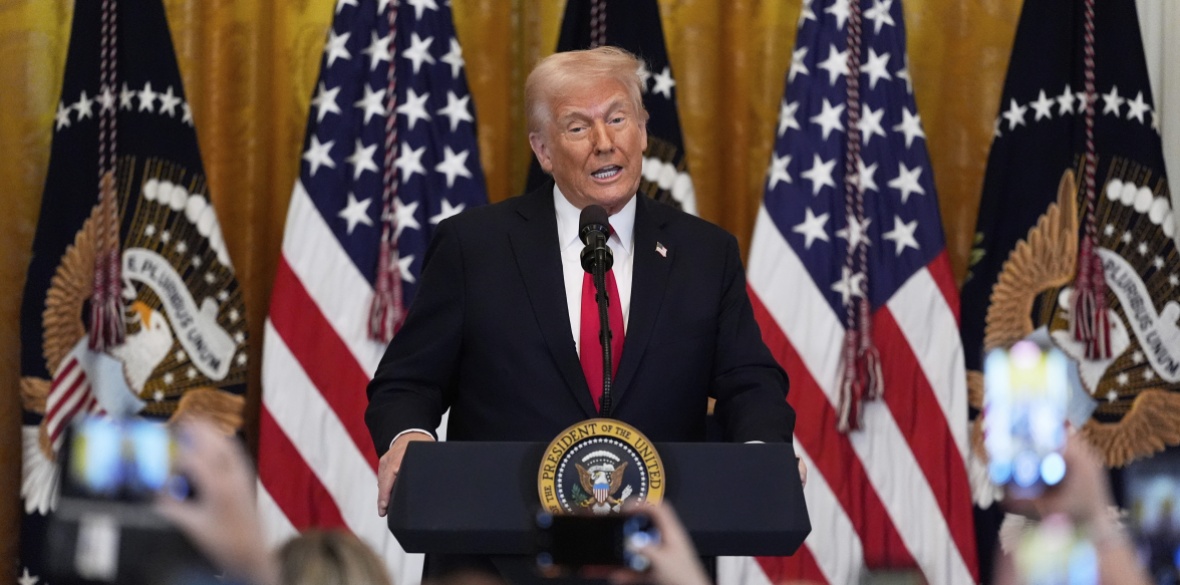
President Donald Trump speaks at a reception celebrating Women's History Month in the East Room of the White House, March 26, 2025, in Washington.

WEDNESDAY is “liberation day” for the United States, according to President Donald Trump as he announces sweeping worldwide tariffs.

It is certainly a landmark day in the decay of capitalist globalisation, the ascendant force in the world economy since the 1970s, dominant since the 1990s and in crisis since the crash of 2008.

That globalisation is now dead. Even the chair of HSBC, one of the world’s biggest banks, Mark Tucker admitted as much last week.

Trump’s swingeing tariffs, imposed willy-nilly on ally and rival alike — indeed, he makes no distinction between the two categories as supine Keir Starmer looks likely to discover — are a declaration of economic warfare.

Some of these tariffs are, it is true, apparently designed simply to enforce whatever foreign policy demands are top of his agenda at any given moment. He is not the first US president to abuse economic power to secure diplomatic advantage.

But there is an underlying strategy to force manufacturers to return operations to the US itself to avoid imposts that would effectively wreck their access to the world’s largest consumer market.

Either way, it is introducing new barriers to the hitherto free(ish) flow of goods and capital, while potentially dividing up the world into spheres of influence.

The latter seems to be the point of Trump’s attempts, so far unfulfilled, to lure Vladimir Putin into a ceasefire preceding an agreed division of Ukraine and its resources.

Capitalist globalisation has already been modified, up to a point, by the emergence of the Brics grouping. This has become, with significant qualifications, a counterpoint to the “Washington Consensus” which imposed the rules of the US-led order on countries far and wide over a quarter-century or so.

HSBC is not particularly stressed by all this, according to boss Tucker. There would be new opportunities for the global trade finance giant within and between new “political groupings and trade blocs,” including the “Brics-plus countries,” he said.

Indeed, tariffs generally strengthen monopoly capital within the most powerful states, and also impel the expansion of territorial control by monopoly capitalist states. Trump’s intent to grab Greenland and the Panama Canal, as well as much of Ukraine’s natural wealth, are all of a piece.

And the new development of blocs is intensifying under Trump’s impetus. In the last few weeks China, Japan and South Korea have been exploring a free trade arrangement, while Canada is seeking to be included in the new European Union militarisation plans.

There is nothing to mourn in the passing of globalisation but much to fear in the new turn to protectionism and growing arms spending.

The passing phase of capitalist development has led to the evisceration of working-class communities and a widening inequality. It has also helped turn the Labour Party into almost its opposite — a party for capitalism’s winners and not for its losers.

This is now a shift comparable with the supersession of the “post-war consensus” by insurgent neoliberalism from the mid-1970s onwards. But like that earlier transition, it leaves the same class in charge.

However, tariff-protected expansionist national-monopoly capital is far more pregnant with the risk of imminent war. You do not need to read Lenin, Hilferding or Bukharin to understand that, only the news online.

The big question is whether the labour movement can mobilise forces equal to the challenge. “Welfare not Warfare” is a start, but class power is the overriding issue.

In previous times of contested transition socialism was the alternative road ultimately not taken. This time our entire future depends on a different choice. It is time the Trumps and Tuckers were alike dethroned by global working-class rule. That would be a real liberation day.


Tariffs: Economic ‘liberation’ or straitjacket?


By AFP
March 31, 2025
Beiyi SEOW

US President Donald Trump has made tariffs a cornerstone of his trade policy, insisting that they will revive American manufacturing while swelling government coffers.

Critics argue that the levies will boost inflation in the near term and weigh on growth, triggering a trade war that could inflict serious damage on the United States and the wider global economy.

Trump has imposed tariffs on major trading partners Canada, Mexico and China since returning to the presidency while slapping fresh duties on steel and aluminum imports, with more to come on what he dubbed “Liberation Day” this Wednesday.

– What are tariffs? –

Tariffs are fees that importing businesses pay for their purchases of foreign goods.

When tariffs are imposed, companies must choose between forking out more for foreign goods — and potentially passing those costs on to consumers — or looking for alternatives.

The levies bring in revenue for governments imposing them and are commonly used to protect local companies and workers from competition abroad.

The charges can make domestic goods more cost-competitive, encouraging buyers to select local producers instead.


– Arguments for –


Trump’s position is that with tariffs on key imports, companies will move more manufacturing to the United States — or buy US-made products — to avoid additional fees.

A commonly-used example is the “chicken tax” of the 1960s, when president Lyndon Johnson pushed back against European tariffs on American poultry with a levy on imported trucks.

Today, a 25 percent US tariff remains on light trucks and this is a key reason that most pick-up trucks sold in the country are built in North America.

The White House says new tariffs could also bring in more than $6 trillion in federal revenue over the next decade — about $600 billion per year — although it has yet to release its full plans.

While US-based companies generally pay the tariffs, White House officials have argued that foreign sellers would absorb the hike by lowering their prices as they seek to do business with the world’s biggest economy.

Supporters of Trump’s trade policy also say that tariffs did not cause widespread inflation during his first White House term.


– Arguments against –


But economists warn that tariff hikes can bring economic pain to affected sectors, and Trump’s stop-start approach to announcing levies has sent financial markets tumbling.

If companies are unable to absorb additional fees and foreign sellers decline to lower their prices, the burden of tariffs could flow to other firms or consumers.

Trump’s 25 percent tariffs on autos and parts could cause the price of a typical car to surge by $5,000 to $10,000, said Wedbush analysts.

Even US automakers producing cars in the country use up to 50 percent of foreign auto parts, they said.

“It would take three years to move 10 percent of the auto supply chain to the US and cost hundreds of billions with much complexity and disruption,” Wedbush added.

Nationwide chief economist Kathy Bostjancic estimates that recent tariffs on Chinese goods, alongside steel and aluminum imports, would raise construction material prices by up to nine percent.

Prices of appliances could also surge up to 15 percent, she said.

Trump’s tariffs attract retaliation too, and countermeasures triggered more than $27 billion in US agricultural export losses from mid-2018 to late-2019.

The Tax Foundation said: “Based on actual revenue collections data, trade war tariffs have directly increased tax collections by $200 to $300 annually per US household, on average.”

These estimates do not account for “lower incomes as tariffs shrink output, nor the loss in consumer choice” as buyers seek tariff-free alternatives, it added.
\


Trump says US tariffs to hit ‘all countries’

By AFP
March 31, 2025


Steel and aluminium exporting nations are bracing for fresh tariffs by the Trump administration - Copyright AFP Julio Cesar AGUILAR

President Donald Trump said Sunday the tariffs he plans to impose in the coming days would include “all countries,” not just those with the largest trade imbalances with the United States.

Trump has promised a “Liberation Day” on April 2, when he is set to unveil reciprocal levies to address trade practices that his government deems unfair.

“You’d start with all countries, so let’s see what happens,” Trump told reporters onboard Air Force One, dashing hopes he might scale back some of the threatened levies or that they would target a select group with persistent trade imbalances.

“I haven’t heard a rumor about 15 countries, 10 or 15,” he said when asked which nations would be affected.

“Essentially all of the countries that we’re talking about. We’ve been talking about all countries, not a cutoff,” he said, without giving details.

Trump’s upcoming tariff salvo had been expected to target the 15 percent of partners that have persistent trade imbalances with the United States, a group Treasury Secretary Scott Bessent called a “Dirty 15.”

But despite widening the target, the president insisted his tariffs would be more “generous” than those levied against the United States.

“The tariffs will be far more generous than those countries were to us, meaning they will be kinder than those countries were to the United States of America over the decades,” he said.

“They ripped us off like no country has ever been ripped off in history and we’re going to be much nicer than they were to us. But it’s substantial money for the country nevertheless,” he said.


Trump has promised a “Liberation Day” on April 2, when he is set to unveil reciprocal levies to address trade practices that his government deems unfair – Copyright GETTY IMAGES NORTH AMERICA/AFP WIN MCNAMEE

Trump has already slapped tariffs on steel and aluminum imports and additional levies on imports from China.

Tariffs on imported autos are also due to take effect on April 3.

Trump’s top trade aide Peter Navarro said the tax on auto imports could raise $100 billion a year.

“And in addition, the other tariffs are going to raise about $600 billion a year, about $6 trillion over a 10-year period,” Navarro told Fox New Sunday.

Trump’s plans to unleash a wide range of reciprocal tariffs risk a global trade war, with other countries already vowing to retaliate and economists warning the sweeping moves risk stoking inflation and triggering a downturn.

Trump has defended the levies as a way to raise government revenue and revitalize US industry.
Meme politics: White House embraces aggressive alt-right online culture


By AFP

April 2, 2025

Maggy DONALDSON

Posting for provocation’s sake has long been the province of internet antagonists and the alt-right, but these days, even the official White House X account is embracing the communications strategy that often celebrates others’ suffering.

Recently, the account posted about the arrest of a weeping, handcuffed alleged felon before her deportation by depicting her likeness in the AI-generated Ghibli style that has flooded the internet, giving the image of her sobbing an animated aesthetic.

Not long prior, the account posted a video of shackled deportees set to the tune of “Closing Time,” the 90’s-era Semisonic hit.

“I think it sums up our immigration policy pretty well: ‘You don’t have to go home but you can’t stay here,'” said Press Secretary Karoline Leavitt, quoting the lyrics with a smile as she defended the message, which Semisonic immediately denounced.

And then there was the Valentine’s Day post: “Roses are Red / Violets are Blue / Come Here Illegally / And We’ll Deport You” read a card featuring the floating heads of President Donald Trump and his border czar, Tom Homan.

For Marcus Maloney, a sociology professor at Coventry University, it is a social media strategy that speaks to “the 4Chanification of American politics.”

An image-based online forum that has become a hub of disinformation, 4Chan was an early home of “shitposting,” a brand of internet communication intended to shock, offend or muddle discourse with absurdity.

And if Trump 1.0 embraced the 2016-era alt-right “shitposters” who bolstered his candidacy, Trump 2.0 is incorporating their methods into official communication channels.

It is a new tactic on an account that not long ago, even in the Republican president’s first term, featured a stream of press releases and relatively innocuous statements.

Responding to online outrage over the Ghibli portrayal of a deportation arrest, White House communications official Kaelan Dorr re-posted the image, vowing that “the arrests will continue. The memes will continue.”

“They’re leaning pretty heavily into meme culture and to chronically online individuals,” said Jacob Neiheisel, a political science professor at the University of Buffalo.

“That’s where a lot of the energy in the MAGA movement is.”

– Offensive ‘outsider’ –

Trump presented himself as the iconoclastic opposite of the more polished Democrats when he won his first term.

By the time he won his second, “the gloves were really off in terms of his communication style — and people really responded to that,” Maloney said, adding that the offensiveness can actually come off as more “authentic.”

“That offensiveness signals a kind of outsider status,” he continued, “even though we’re talking about a guy who’s a billionaire.”

The trolling now adopted by the White House is meant to simultaneously shock and be brushed off as a joke, the genre of “locker room talk” that has been a through-line of Trump’s non-consecutive presidencies.

The former reality TV star has brought that genre’s energy to governing, firing off frenetic statements that often denigrate his opponents and apply crass labels to them.

This style appeals to people already fluent in trolling, particularly younger males, Neiheisel said: “It’s funny for them. It’s entertainment.”

– Demeaning and trivializing –

Another of the White House’s infamous posts likened images and sounds of shackled people boarding a deportation plane to ASMR, the auditory-sensory phenomenon that sees people find relaxation or pleasure in certain sounds.

The flippant language “hurts, ultimately, the gravitas of the presidency — the world’s most powerful office — and it hurts the perception of it not only domestically but internationally,” said Mark Hass, a digital marketing expert and strategic communication professor at Arizona State University.

“It trivializes” important issues like immigration and demeans people, Hass said.

And it can represent an insidious reflection of the Trump administration’s political aims, Maloney said. That callousness can open the door to policies that dehumanize or render vulnerable minority groups, he added.

“It’s a nihilism in respect specifically to how things are communicated,” he said.

“In terms of what they’re actually doing,” he said, it’s “a mainstreaming of far-right dream policies.”
8

Other governments ‘weaponising’ Trump language to attack NGOs: rights groups

GOING BEYOND HUNGARY'S ORBAN


By AFP
April 1, 2025


Trump said America's USAID agency was 'run by radical lunatics' while his advisor Elon Musk said it needed to be put 'through the woodchipper' - Copyright GETTY IMAGES NORTH AMERICA/AFP/File CHIP SOMODEVILLA

Nina LARSON


Language used by President Donald Trump and his government to slash US-funded foreign aid is being adopted by other governments to attack NGOs and independent media, rights groups warn.

Civil society groups in parts of Eastern Europe and beyond — long targeted by discredit-and-defund campaigns because of the light they shone on corruption and lack of transparency — are now also dealing with Trumpian rhetoric, they said.

Trump administration statements “are being weaponised in real-time by autocrats and dictators across Eastern and Southeastern Europe to justify and deepen their crackdown on independent media, NGOs, and human rights defenders,” Dave Elseroad, of the Human Rights House Foundation, told AFP.

From Hungary to Serbia, to Georgia and Bosnia, non-governmental organisations and independent media outlets working to bolster democratic norms are hearing officials borrow White House phrases to justify officials’ stances against them.

The range of expressions available is broad and growing.

It includes Trump’s claim that the US Agency for International Development (USAID) was “run by radical lunatics”, and his billionaire advisor Elon Musk’s calling the agency a “criminal organisation” that needed to be put “through the woodchipper”.

Such terms are “seriously encouraging language used in Budapest or in Belgrade or in Bratislava or Banja Luka,” said Miklos Ligeti, head of legal affairs at Transparency International’s Hungary chapter.

– Verbal ammunition –

In some countries, the verbal ammunition comes on top of a sudden funding gap wrought by the dismantling of USAID, which is hitting the NGO sector hard.

USAID had been providing funding to a vast array of independent organisations in countries like Hungary where such groups have been “financially suffocated domestically,” Ligeti told AFP.

Hungarian Prime Minister Viktor Orban has hailed the crackdown on USAID by his ally Trump as a “cleansing wind”. He says he plans to outlaw NGOs that receive US funds.

Orban — also Russian President Vladimir Putin’s closest ally in the European Union — has vowed to “eliminate the entire shadow army” he says is made up of his political enemies, judges, the media and NGOs.

The UN rights office in Geneva slammed “escalating attempts worldwide to weaken and harm domestic and international human rights systems, including defunding and delegitimising civil society”.

It said that “it is all the more worrying to see these trends also emerging in established democracies”.

In some countries there is a direct line between utterances in Washington and action to undermine civil society.

In Georgia, for example, the ruling Georgian Dream party last month called for the country to adopt its own version of the US Foreign Agents Registration Act (FARA) — which observers warn could be turned against NGOs receiving foreign funding.

And in Serbia, which has been rocked by months of protests over government corruption, authorities referred to statements made by Trump and other top US officials to justify raiding a number of NGOs.

The Serbian government saw the Trump administration’s labelling of USAID as a “criminal organisation” as “a fantastic opportunity to basically punish civil society”, said Rasa Nedeljkov, programme director at the Center for Research, Transparency and Accountability (CRTA).

CRTA’s offices were raided in February by heavily armed police. The operation took 28 hours because prosecutors had CRTA staff manually copy documents related to USAID-funded projects to hand to them, rather than accepting digital versions.

Serbian authorities have explicitly referred to statements by Trump and other US officials to justify raids on a number of NGOs.

Uros Jovanovic, public policy programme manager at another raided NGO in Serbia, Grandjanske, said that “this is just an excuse to crack down on civil society,” adding: “They are trying to intimidate people to stay silent.”

– ‘Intimidation’ –

Pavol Szalai, head of the EU-Balkans desk at Reporters Without Borders (RSF), said leaders in a string of countries were using “the suspension of USAID by Trump to attack media which had received USAID funds”.

He said such groups were being doubly punished: they “lost their funding from one day to the next” while also increasingly being “targeted by intimidation”.

In Republika Srpska, Bosnia’s ethnic Serb statelet, “this is the worst situation ever for civil society organisations (since) the after-war period,” said Bojana Mijic, project manager at Capital.Ba, an independent online daily.

“Independent voices are being lost,” with many organisations closing from evaporated USAID funding and swelling attacks, she said.

The RSF’s Szalai said: “We fear that this public-interest journalism in some countries will not survive the blow.”

He warned that, “as these media retreat.. they will be replaced by propaganda”.
Canada candidates promise less reliance on US a month before vote


By AFP
March 31, 2025


Canadian Prime Minister and Liberal leader Mark Carney has taken a strong lead in polls heading into a second week of the election campaign - Copyright AFP ANDREJ IVANO\


Marion THIBAUT

A month before Canadians vote in an election dominated by threats from US President Donald Trump, leading candidates pledged Monday to build an economy that can thrive independent of its southern neighbor.

Prime Minister Mark Carney, who replaced Justin Trudeau earlier this month, appears to have revitalized his Liberal Party that just months ago looked headed towards a crushing electoral defeat.

Most polls show Carney’s Liberals now leading the Conservatives, whose leader Pierre Poilievre has struggled, experts say, to adjust his message in response to Trump.

The US president has repeatedly spoken about annexing Canada while pushing an array of tariffs that could force America’s northern neighbor and largest trading partner into recession.

Campaigning outside Toronto on Monday, Carney said “Trump is trying to fundamentally restructure the US economy,” which will force Canada to “reimagine” its own.

“We need to build a new Canadian economy, a more resilient economy that can succeed in what will be a drastically different world,” Carney said.

Canada needs to be able to thrive “without any regard to what goes on in the United States,” he added.

Poilievre built momentum over the past year by attacking an increasingly unpopular Trudeau and by promising to address core issues like affordability, notably soaring housing costs.

His campaign has maintained a focus on rising costs but with added emphasis on Trump.

“It is time to turn Canada into an economic fortress that puts our country first for a change,” he said Monday in the eastern province of New Brunswick.

“With Donald Trump threatening our country with tariffs, we need big projects that link our regions, east to west. We need to be able to get our resources across Canada, bypassing America, so we can trade more with each other and sell our resources to the world.”


– ‘Strong against America’ –


Political analysts increasingly believe Canadians will vote on April 28 based on who they think can best stand up to Trump.

Ottawa voter Carol Salemi told AFP over the weekend that the next government will have to engage in “some sort of negotiation” with Washington and “we need a strong leader to do that.”

Danielle Varga, 22, echoed that viewpoint, saying Canada needs “someone that’s strong against America.

“It feels like everyone’s on that same page, which is good,” she added.

Carney has argued his experience has prepared him to lead Canada through economic turmoil.

The 60-year-old is a former investment banker at Goldman Sachs, and later governor of the Bank of Canada during the 2008-2009 financial crisis.

He also led the Bank of England through the Brexit vote and its aftermath.

Trump said he had an “extremely productive” first call with Carney on Friday, adding that the two leaders “agree on many things.”

That was a stark change in tone from a US president who repeatedly mocked Trudeau as the “governor” of a US state.

But Poilievre, 45, maintains Carney is offering a continuation of Trudeau, whom the Conservatives accuse of poor economic management.

“President Trump has said he wants the Liberals back in power. We know why, because they will keep Canada weak and keep our investment flowing out of this country,” he said at a campaign stop on Sunday.


– ‘Looking for a savior’ –


Ottawa University politics professor Genevieve Tellier said the election comes at a “truly exceptional time for Canada.”

The country is “looking for a savior,” she told AFP.

After Trump announced his planned auto tariffs last week, Carney declared the era of deep economic, security and military ties between Canada and the United States “is over.”

Tellier said his “firm tone” and explanation that “relations with the United States would never be the same again” seem to be resonating with voters.

Those remarks have “captured the current mood in Canada,” she said.
Facing US tariffs, Canadians hunt for business in Europe

By AFP
April 1, 2025


Canadian companies were hoping to seize business opportunities in Europe at the Hanover Fair - Copyright AFP SAUL LOEB


Clement KASSER

With his small steel mill facing hefty US tariffs, Canadian businessman Chris Wyatt is hunting for new European customers at the world’s biggest industrial technology fair in Germany.

“There’s uncertainty in the markets so big projects are being shelved or they’re just not moving ahead,” said sales director Wyatt, handing out flyers at his stand, alongside big players in robotics and factory machinery.

This week’s Hanover Fair, which has attracted more than 4,000 exhibitors from around 60 countries, takes place as US President Donald Trump gears up to announce a wave of “reciprocal tariffs”, ratcheting up global trade tensions even further.

And this year’s guest of honour is Canada — a clear signal that Europe stands with Ottawa as it faces not just hefty duties from the United States, its largest trading partner, but also Trump’s threats to annex the country.

“Welcome to Germany, dear Canadian friends,” German Chancellor Olaf Scholz said Sunday ahead of the fair’s opening. “We stand by your side.”

His comments highlighted warming ties between Europe and Canada amid Trump’s sabre-rattling — with some even joking that Canada should join the EU.

For Wyatt the impacts of Trump’s trade war are already being felt.

The president slapped 25-percent tariffs on US steel and aluminium imports on March 12, and even briefly threatened to hike the duty to 50 percent on Canadian imports.

Wyatt’s Ontario company Kubes Steel currently exports 80 percent of its production, specialised steel for a range of industries including the nuclear sector, to the United States.

“Of course, we are concerned,” said Wyatt, whose company employs about 80 people. “People aren’t spending money at this point.”

Still he is hopeful the trade fair will bring new opportunities — he managed to make contacts with prospective new clients, including Spanish transport companies.

– Tariff ‘own goal’ –

In his opening address, Scholz called for stronger ties between the European Union and Canada as the two sides “complement each other” when it comes to making machinery, artificial intelligence, renewable energy and electric vehicles.

Closer ties with G7 economy Canada also stand to benefit Europe and in particular Germany, which will be hit hard by new 25-percent US duties on imports from the auto sector, one of the country’s flagship industries.

The auto duties are bad news for Milko Konzelmann, whose German family-run business producing plastic car parts and valves makes around a quarter of its sales in the world’s biggest economy.

“I will lose money,” he said, adding that he was waiting to see how long Trump would keep pushing tariffs, which he described as an “own goal”.

But if there is no change, the company will focus more on Asia.

Shifting production to the United States to avoid tariffs would “take years” and is a “big decision for a medium-sized company” with just 300 employees, he said.

Despite the hostility towards Trump in Europe, American companies, including Dell, IBM, Microsoft and Nvidia, were out in force in Hanover, with some not shy about speaking in favour of the president’s drive to rebalance US trade with the EU.

Manufacturing powerhouse Germany stands out when it comes to US complaints on trade — Europe’s biggest economy logged a record trade surplus with the United States last year and huge numbers of its goods, from cars to pharmaceuticals, are shipped to America.

“We have to be able to compete and we can’t sit there, playing a game where they (Europe and Asia) sell to us but we can’t sell to them,” Ryan Mosher, from small US company Conrad that makes air compressor parts, told AFP.

Still, he concedes trade tensions will hit his business: “I’m going to lose some money, that’s for sure.”

Texas businesswoman Suzanne Stewart also said the tariffs would impact her company, which makes metal mesh, as it needs to keep importing some materials from Asia.

“In reality not everything is available in the US,” she said.
FacebookTwitterLinkedInEmailShare