Friday, July 18, 2025


Navigator Joins with Amon to Build Two Ammonia-Fueled Gas Carriers
ammonia-fueled vessels
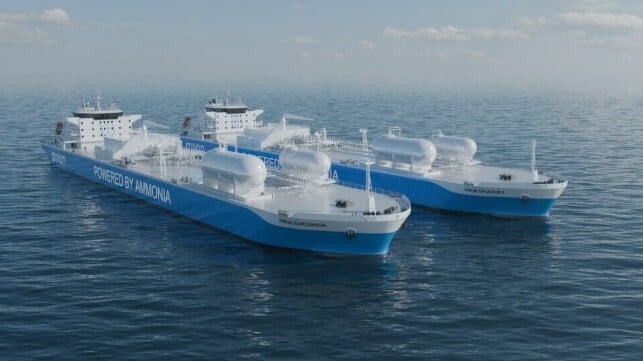
Amon is leading the development of ammonia-fueled vessels for shipping's energy transition (Amon Maritime)

Published Jul 17, 2025 7:23 PM by The Maritime Executive


The ammonia-fueled vessel sector took another major step forward with the news that Navigator Holdings and Amon Maritime have formed a new joint venture and ordered two ammonia-fueled liquefied ammonia carriers. The news came a day after WinGD reported the installation of the first ammonia-fueled marine engine into a newbuild, and the new joint venture builds on Amon Maritime’s mission to lead the green shift in shipping.

Navigator will own 80 percent of the new company to be known as Navigator Amon Shipping, with Amon owning 20 percent. The company will place the vessels under long-term charters to blue-chip industry leaders. It anticipates the vessels will be on five-year charters. Navigator is already the owner/operator of the world’s largest fleet of handysize liquified gas carriers.

The construction order was placed with Nantong CIMC Sinopacific Offshore & Engineering in China. Navigator reports an average price for each vessel of $84 million. Deliveries are scheduled for June and October 2028. Operating on ammonia as their primary fuel, the vessels will transport ammonia and be capable of also transporting liquefied petroleum gas with a capacity of 51,530 cubic meters. The project is receiving a NOK 90 million ($9 million) investment grant from Norway’s Enova.

“Expanding our fleet with two modern ammonia carriers capable of using clean ammonia as a fuel, operating in a long-term time charter, is a strategic enabler in meeting the growing demand for a sustainable fuel source in a net-zero economy,” said Mads Peter Zacho, Chief Executive Officer of Navigator. “These modern vessels will be equipped with newly developed technologies that comply with present and future environmental regulations and will thereby deliver great value to both our customers and our shareholders.”

Amon had highlighted the opportunities in ammonia in June when it received its grants from Enova. It said that ammonia is currently primarily transported on a Medium Gas Carrier (MGC). Because the ship is already designed for transporting ammonia, it said that the relative additional cost to convert to ammonia-fueled propulsion in this segment compared to conventional ships will be less than in most other segments.

As it seeks to expand ammonia into more segments of shipping, Amon Maritime also reported it would launch Amon Bulk after securing a NOK 253 million ($24.6 million) grant from Enova to support the construction of two ammonia-powered bulk carriers. The plan for the bulkers calls for one Capesize (180,000 dwt) vessel designed for long-haul transport of heavy bulk commodities. The second vessel will be a Kamsarmax bulk carrier (80,000 to 85,000 dwt). The smaller vessel, it said, would offer greater port flexibility while maintaining high cargo capacity and energy efficiency. 

Amon Bulk reported it is entering the next phase of shipyard evaluation and the tendering process for these vessels. The aim is to order these vessels for delivery by 2029.

It said the developments in ammonia are another key step toward decarbonizing deep-sea shipping.


First Two-Stroke Ammonia-Fueled Engine Installed as Newbuild Proceeds
ammonia marine engine installed on newbuild
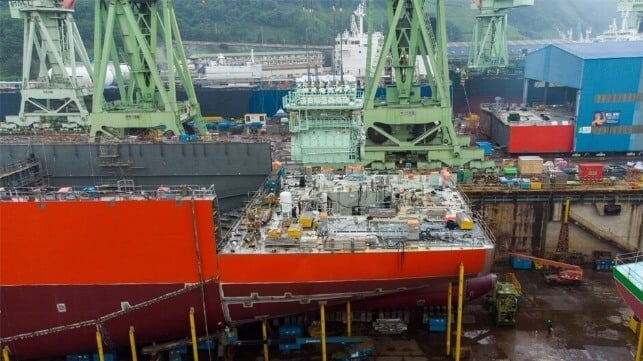
First two-stroke ammonia-fueled marine engine was installed on a newbuild in South Korea (WinGD)

Published Jul 16, 2025 7:25 PM by The Maritime Executive


The race to launch the first commercial ammonia-fueled engines marked a key milestone, reports marine engine designer WinGD. The first two-stroke engines built from the company’s designs were tested and recently successfully installed in the first new ammonia carriers being built in South Korea. WindGD is highlighting that it became the first engine designer to bring an ammonia-fueled two-stroke engine to market, and the vessels are due to enter service in 2026.

The 52-bore engine was built by HD Hyundai Heavy Industries’ Engine and Machinery Business Unit. WindGD reports that the results from its laboratory test engine runs were confirmed at the factory in South Korea, and the engine has now been delivered to HD Hyundai Mipo, which installed it on the newbuild vessel.

WinGD reports the X-DF-A engine features high-pressure ammonia injection supplemented by a low, targeted pilot fuel dose of around five percent at full load. The engine delivers load handling, dynamic response, and fuel efficiency on par with WinGD’s equivalent diesel-fueled X Engines in both ammonia and diesel operating modes. It critically delivers low emissions and an efficient performance similar to diesel engines.
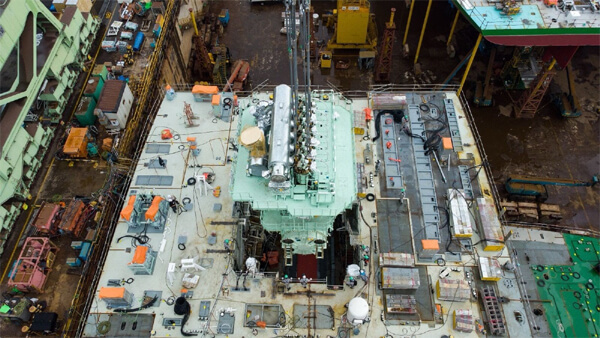
 

The first engine was installed in South Korea on a vessel due to deliver to EXMAR in 2026 (WinGD)


The company achieved other key firsts in the development of its first ammonia-fueled marine engine. Lloyd’s Register, which is part of the project, noted that the engines were the first to achieve class approval in September 2022 for ammonia two-stroke engines. They were selected for the newbuilds in 2023 and are being combined with a fuel supply system developed by Wärtsilä Gas Solutions.

WinGD says that further optimization will continue for the second engine in the 52-bore series, which will be delivered later this year.

The engines are being incorporated into the ammonia gas carriers ordered by EXMAR in 2020. Each vessel will be approximately 623 feet in length. They will have a capacity of 45,000 cbm and will be able to transport either ammonia or LPG.

Construction on the vessels began in December 2024 with the first steel cutting. Work started on the second vessel of the class in May 2025. EXMAR has called the ships “a bold step toward a decarbonized shipping industry, and a cleaner future.”

Each of the major engine designers is working on different sizes of ammonia-fueled engines, and each has reported strong progress in the designs and now qualification testing. WinGD reports it has built an early orderbook of around 30 X-DF-A engines, which will be going into not only gas carriers, but also bulk carriers and containerships.

DNV calculates that there are currently 37 vessels on order that will be capable of operating on ammonia as their marine fuel. The bulk of the deliveries will start in 2026 and 2027. As the infrastructure becomes more developed and the regulations are defined, it is anticipated that ammonia-powered engines will increase in popularity as one of the solutions to meeting the industry’s decarbonization challenge.

 

Seabound Lands a Novel Carbon-Capture Partnership With a Cement Plant

Seabound
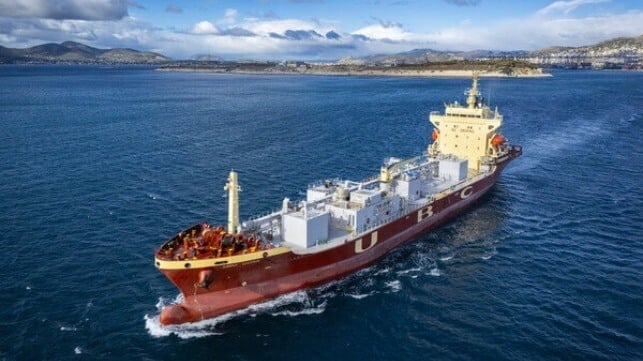
UBC Cork (Seabound / Hartmann)

Published Jul 17, 2025 10:33 PM by The Maritime Executive


Working with German owner Hartmann Group, shipmanager InterMaritime and construction materials giant Heidelberg, the UK-based startup Seabound has launched a unique onboard carbon capture venture that starts with Bunker C and ends up in cement. 

Seabound's carbon capture system captures up to 95% of CO? (variable, depending upon the customer's needs) and 98% of sulfur emissions from ship exhaust. The sulfur-removal capability means that it is compatible with HFO fuel, a cost savings over VLSFO. Its process uses slaked lime - calcium hydroxide, one of the world's most common chemical ingredients - to absorb CO? and convert it into limestone (calcium carbonate). The resulting product is stored on board the ship, then offloaded in port. 

Since limestone is the main feedstock for cement plants, Seabound's technology lines up well with nascent efforts to decarbonize the concrete manufacturing sector. Heidelberg Materials' Brevik plant is one-of-a-kind in this segment: it is the first full-size facility designed to produce carbon-captured cement, the key ingredient in net-zero concrete.

Under the new partnership with Hartmann Group, InterMaritime Group and Heidelberg Materials Northern Europe, Seabound will install its system aboard the cement carrier UBC Cork, which serves the Brevik plant. The captured carbon - in limestone form - will be offloaded when the ship calls at Brevik and will be run through the cement plant. This means that the carbon in UBC Cork's fuel will be captured twice - once on the ship, when it is turned to limestone, and once again when that limestone is turned to cement. Along with the Brevik cement plant's other captured CO2, it will be injected into a subsea reservoir run by the Shell/Equinor/TotalEnergies Northern Lights project, due to start operations later this year. 

"We're proud to partner with industry leaders like Heidelberg Materials and Hartmann to deliver scalable carbon capture solutions," said Alisha Fredriksson, CEO and Co-founder of Seabound. "We're especially excited to be advancing this work in Brevik, a strategic location that's rapidly establishing itself as a global hub for CCS."


Fairbanks Morse Defense Completes Rolls-Royce Naval Propulsors Acquisition

propeller
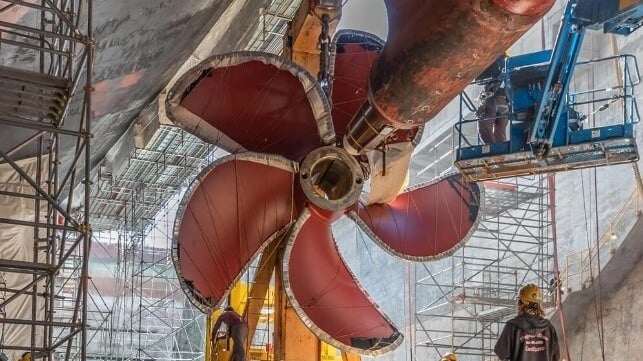
Propeller installation on the USS Nimitz (USN photo)

Published Jul 16, 2025 9:03 PM by The Maritime Executive


Fairbanks Morse Defense (FMD) finalized its acquisition of the Rolls-Royce Naval Propulsors business. It includes facilities in Mississippi and Massachusetts and is seen as a key step in strengthening FMD’s role in supporting U.S. naval shipbuilding.

The deal was announced in September 2024 with Rolls-Royce saying the sale of the naval propulsors and handling businesses was part of the transformation of the company, which started in 2023. It says the transformation is based on a “clear and granular strategy, focusing defense on strategic growth in the areas of combat, transport, and submarines.”

In a separate deal, Rolls-Royce is selling its Naval Handling business also to FMD. It is located in Peterborough, Ontario, Canada, and the sale is expected to close at a later date. Rolls-Royce will retain its Naval Gas Turbines and Generator Sets operations, which provide power-dense solutions for naval propulsion and onboard power needs.

Rolls-Royce highlighted that its Naval Propulsor business includes a range of propellers and waterjets for naval applications, as well as marine handling systems, which enable the deployment and recovery of manned and unmanned craft, and other cargo, from naval vessels. Rolls-Royce says that its propulsion equipment can be found on more than 95 percent of the U.S. Navy Surface Warfare fleet, including on all the U.S. aircraft carriers currently in service. In 2021, the company reached an agreement with Fincantieri Marinette Marine to design and manufacture up to 40 propellers for the Constellation-class (FFG-62) guided missile frigate program.

“This acquisition represents a strategic investment in sustaining the United States’ defense manufacturing capabilities and ensuring we remain prepared to meet mission-critical demands,” said Steve Pykett, CEO of Fairbanks Morse Defense. 

The closing was marked at a ceremony at the newly acquired Pascagoula, Mississippi, foundry. The facility is the only privately owned foundry in the United States capable of casting large Navy-standard propulsor systems, making it a critical component of the maritime defense supply chain. Now operating through a naval-focused defense contractor, the facility is being fully integrated into Fairbanks Morse Defense’s broader portfolio of naval technologies. The strategic shift is designed to boost support for the U.S. Navy through enhanced responsiveness, increased investment, and continued innovation, while also preserving skilled jobs and strengthening Mississippi's industrial economy.

“The Pascagoula foundry, in particular, plays a vital role in supporting the Navy’s maritime dominance, and its continued operation expands our capacity to serve as a trusted partner to the U.S. military,” said Pykett. “Integrating these highly skilled workforces into Fairbanks Morse Defense strengthens our ability to deliver on our mission of supporting warfighter readiness at home and abroad.”

Fairbanks Morse Defense also gains a manufacturing campus in Walpole, Massachusetts, to produce critical propulsor systems for the U.S. Navy, Coast Guard, and allied naval fleets. When the acquisition of the facility in Peterborough, Ontario, is completed, it will support handling systems and undersea technology, including the Mission Bay Handling System used in the Global Combat Ship programs of the U.K., Canada, and Australia.

The addition of the new capabilities continues to build out Fairbanks Morse Defense's diverse portfolio that includes engines, electrical hardware, motors, valves, cranes, davit systems, fans, fittings, and water treatment solutions. The company has also advanced its technology offerings with AI, digital defense, telerobotics, additive manufacturing, smart engineering, uncrewed mission management, extended reality, and remote collaboration tools.


The Undisputed Superpower Of The Seas

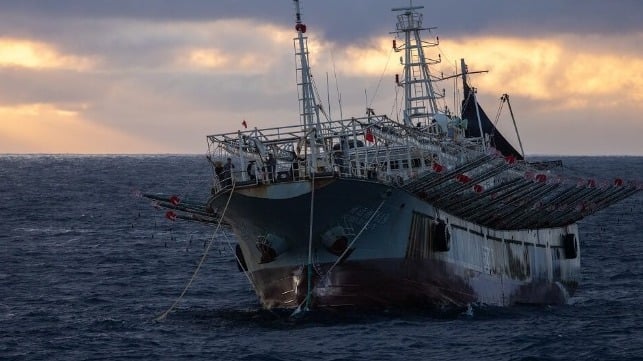
A Chinese squid jigger off the Galapagos Islands (Ben Blankenship / Outlaw Ocean Project)

Published Jul 16, 2025 7:40 PM by Marcella Boehler


Daniel Aritonang graduated from high school in May, 2018, hoping to find a job. Short and lithe, he lived in the coastal village of Batu Lungun, Indonesia, where his father owned an auto shop. Aritonang spent his free time rebuilding engines in the shop, occasionally sneaking away to drag race his blue Yamaha motorcycle on the village’s backroads.

Like thousands of other Indonesians, Aritonang answered an advertisement to work aboard a Chinese fishing ship, traveling the world, combing the high seas. Eighteen months later, he was dead, his body dropped off, beaten and bloated on a dock in Montevideo, Uruguay. The mysterious death was hardly unusual: for the previous 5 years that same port saw one dead body per month dropped off, mostly from Chinese fishing ships, which have, the world over, a reputation as the most brutal.

When Aritonang climbed onto his assigned squid ship, called the Zhen Fa 7, he joined what may be the largest maritime operation the world has ever known. In the past few decades, partly in an effort to project its influence abroad, China has dramatically expanded its distant-water fishing fleet. Chinese firms now own or operate terminals in ninety-five foreign ports. China estimates that it has twenty-seven hundred distant-water fishing ships, though this figure does not include vessels in contested waters; public records and satellite imaging suggest that the fleet may be closer to sixty-five hundred ships. (The U.S. and the E.U., by contrast, have fewer than three hundred distant-water fishing vessels each.) Some ships that appear to be fishing vessels press territorial claims in contested waters, including in the South China Sea and around Taiwan. “This may look like a fishing fleet, but, in certain places, it’s also serving military purposes,” Ian Ralby, who runs I.R. Consilium, a maritime-security firm, said.

But China’s preëminence at sea has come at a cost. The country is largely unresponsive to international laws, and its fleet is the worst perpetrator of illegal fishing in the world, helping drive species to the brink of extinction. Its ships are also rife with labor trafficking, debt bondage, violence, criminal neglect, and death. “The human-rights abuses on these ships are happening on an industrial and global scale,” Steve Trent, the C.E.O. of the Environmental Justice Foundation, said.

The investigation into Aritonang's death is part of Season 2 of the Outlaw Ocean Podcast, which derives from 4 years of reporting, mostly at sea. A team of reporters traversed a half dozen countries and crossed thousands of miles of ocean, while boarding Chinese squid jiggers to talk to workers in this otherwise invisible industry. As the trade war between the US and China has escalated in recent months, the interconnectedness of these two massive economies has become more obvious than ever with tariffs and counter-tariffs spiking prices. But nowhere is China's economic and political power more pronounced than at sea and this, at times, has dire consequences for workers and the environment.  

Before taking the job on the Chinese ship, Aritonang had struggled to find work. The rate of unemployment in his native Indonesia was high: more than 5.5 percent nationally, and more than 16 per cent for youth. Climate change has made matters worse; many of Indonesia’s 17,000 islands are sinking. Aritonang’s home is roughly 100 yards from the Indian Ocean. His village is losing coast from sea level rise at an average of between 10 and 15 yards a year. When Hengki Anhar, a local friend, suggested the two of them go abroad together on a fishing boat, Aritonang agreed. Friends and family were surprised by his decision, because the demands of the job were so high and the pay so low. But a job was a job, and both he and Anhar desperately needed work.

In 2019, Aritonang and Anhar contacted a “manning” agency based in Central Java. In the maritime world, manning agencies recruit and supply workers to fishing ships. They handle everything, including paycheques, work contracts, plane tickets, port fees and visas. They are poorly regulated, frequently abusive and have been connected to human trafficking. Following the agency’s instructions, Aritonang and Anhar went to the city of Tegal. They took medical exams and handed over their passports and bank documents. For the next two months, they waited to hear if they had been hired. Money ran short. Through Facebook messenger, Aritonang wrote to his friend Firmandes Nugraha, asking for help paying for food. Nugraha urged him to return home. “You don’t even know how to swim,” Nugraha reminded him.

Eventually assignments came through, and, in September 2019, Aritonang appeared in a Facebook photo with other Indonesians waiting in Busan, South Korea, to board their fishing vessels. “Just a bunch of not-high-ranking people who want to be successful by having a bright future,” Aritonang said on Facebook. Aritonang and Anhar boarded the Zhen Fa 7, which set sail across the Pacific. The ship’s crew numbered 30 men: 20 from China, and the remaining 10 from Indonesia. The vessel would spend the next months chasing squid in international waters off the coast of South America.

In December, 2020, the Zhen Fa 7 left the vicinity of the Galapagos Islands, sailed around the southern tip of South America, through the Strait of Magellan, and made its way north to an immensely productive high-seas squid fishery known as the Blue Hole, about 360 miles above the Falkland Islands. The bounty was plentiful there, and the captain began working his crew around the clock. A month later, Aritonang fell severely ill. In all likelihood he was suffering from a disease called beriberi, caused by a deficiency of vitamin B1, also known as thiamine. Sometimes called “rice disease,” and often an indication of conditions of captivity, beriberi has historically broken out on ships and in prisons, asylums and migrant camps—anywhere diets have consisted mainly of white rice or wheat flour, both very poor sources of thiamine. On board the Zhen Fa 7 the captain issued each Indonesian two boxes of Supermi instant noodles per week for free. The costs for any additional snacks, coffee, alcohol or cigarettes were deducted from their salaries. The Indonesians were paid US$250 per month, along with a US$20 bonus per ton of squid caught.

The Indonesians on board begged the captain to get Aritonang onshore medical attention, but the captain refused. Later, when asked to explain the captain’s refusal, Anhar, Aritonang’s friend and crewmate, said, “There was still a lot of squid. We were in the middle of an operation.” By February 2021, Aritonang could no longer stand. He moaned in pain, slipping in and out of consciousness. Incensed, the Indonesian crew threatened to strike and the captain finally acquiesced. On March 2, Aritonang was transferred to a nearby fuel tanker called the Marlin, whose crew six days later dropped him off in Montevideo. By then it was too late. For several hours, emergency room doctors struggled to keep him alive, while Jesica Reyes, a local interpreter who had been summoned to speak to Aritonang in Bahasa, Indonesia’s official language, waited anxiously in the hall. Eventually the doctors emerged from the emergency room to tell her that he had died.

In an e-mail, the Zhen Fa 7’s owner, Rongcheng Wangdao Ocean Aquatic Products Co. Ltd. declined to comment on Aritonang’s death but said that it had found no evidence of complaints from the crew about their living or working conditions on the vessel. The company added that it had handed the matter over to the China Overseas Fisheries Association, which regulates the industry. Questions submitted to that agency by the Outlaw Ocean Project went unanswered.

In the months after the investigation was published by hundreds of news outlets, hearings were held in the Canadian parliament, at the EU commission, and in the US Congress to voice outrage at the wider pattern of illegal fishing and worker abuse revealed in China's fishing fleet and in the plants that processed its catch. And in May, 2025, authorities with the US Customs and Border Protection announced that due to forced labor revealed on the Zhen Fa 7,  the agency was banning the import of any seafood tied to this vessel.

Marcella Boehler is global publishing editor at The Outlaw Ocean Project, a non-profit journalism organization based in Washington D.C. that produces investigative stories about human rights, environment and labor concerns on the two thirds of the planet covered by water. Season Two of The Outlaw Ocean Project's podcast series may be found here

The opinions expressed herein are the author's and not necessarily those of The Maritime Executive.


New Tweendecker Loading for Maiden Voyage Catches Fire

cargo ship fire
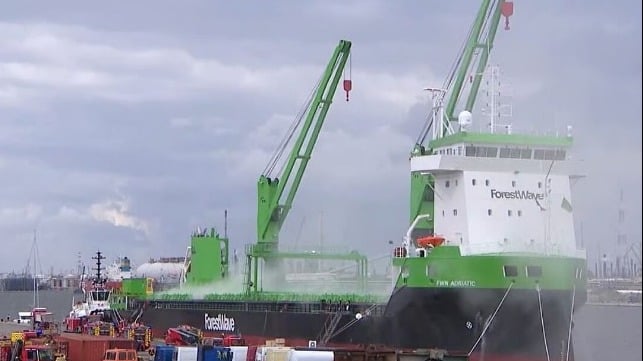
Port cam caught images of the smoking vessel (Port of Antwerp Brugge)

Published Jul 17, 2025 3:28 PM by The Maritime Executive


A new tweendecker preparing for its maiden voyage caught fire while docked in the Port of Antwerp yesterday, July 16. Ships in the port, as well as nearby residents, were being warned to use caution because of the smoke coming from the fire.

The Antwerp Fire Department said it received a call about the fire at 10:30 am local time and it sent crews to aid a fireboat that was fighting the fire aboard the FWN Adriatic (12,500 dwt). The vessel was loaded with cars and plasterboard.

Operator ForestWave, which recently allied with Spliethoff Group, had posted online that the vessel was “loading in North Europe and heading towards beautiful destinations in the Indian Ocean.” It was set to be the maiden voyage of the new ship, which is registered in the Netherlands.

It is the fourth ship of the company’s new Ecobox XL design. Measuring 144 meters (472 feet), shipbuilder Ferus Smit highlights that the design has its focus on loading extra-long items, such as windmill blades, while at the same time still maintaining its good capabilities as a general cargo ship. The new class is 21 meters (69 feet) longer than the earlier ships, extending her box-shaped hold to more than 100 meters in length on the tanktop, and 112 meters above the movable tweendeck level. The new ships are 18 meters wide, enhancing the cargo deadweight further, and maintaining flexibility of loading while keeping a very low resistance on both flat water and in waves.

The fire department reports that it was able to contain some of the smoke by closing hatch covers. It also decided to use CO2 to stop the fire, as it would further reduce the smoke. Although that method was expected to require several hours to completely extinguish the fire.

GLOBALIZATION 

Report: Hyundai to Enter Competition for Morocco Shipyard

Casablanca shipyard
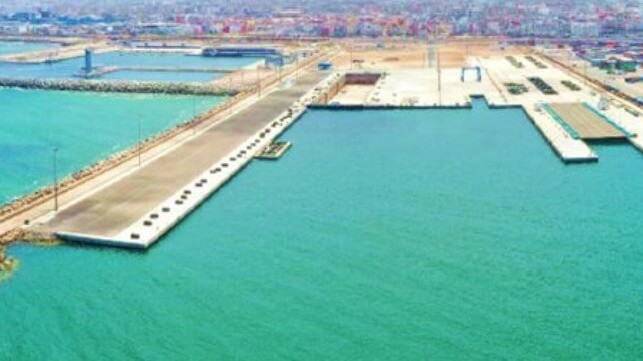
Moroccan government is seeking a company to redevelop a former shipyard site in Casablanca into an operational yard (National Ports Agency)

Published Jul 16, 2025 5:45 PM by The Maritime Executive


Reports from the Korean media indicate the HD Hyundai Heavy Industries, the holding company for the group’s shipbuilding operations, is exploring participating in the upcoming bidding for the rights to operate Casablanca’s new shipyard. It is part of an international strategy by the group, which has already seen it expand into Vietnam and the Philippines, and recent agreements for cooperation in India, the United States, and Peru.

Morocco’s National Port Agency last year announced the competition for the rights to develop and operate a new shipyard at North Africa’s busy port. It cited the strategic location of Casablanca as well as the strong demand, especially in the ship repair sector. It notes the lack of available space in key locations, including the Canary Islands.

The initial goal of the facility was to have a capacity to dry dock 22 vessels per year, as well as having cranes to handle 400 to 470 vessels a year at dockside. The lifting platforms would be able to handle six medium-sized boats up to approximately 5,000 tones. It estimated an investment of as much as $92 million would be required, with the government agency reporting it had budgeted $76 million for the project.

The National Ports Agency decided that the best course of action would be to launch an international competition for companies with at least 10 years of experience operating facilities similar to the one planned in Casablanca. The tender proposal outlines a facility that will encompass 21 hectares. It will include a dry dock with dimensions of 244 x 40 meters (800 x 131 feet), a lifting platform with 9,000 tonnes of capacity, a 200-foot dock, nearly 2,700 feet of fitting out berths, and a strap gantry. The concession is for 30 years and calls for the development, equipping, operating, and maintaining the new shipyard.

Business Korea reports HD Hyundai Industries is considering placing a bid, with reports indicating other expected bidders will include France’s Naval Group and Spain’s Navantia. The shipyard will be the largest in Africa.

In addition, Morocco is reported to be promoting the growth of its domestic fleet tied to the shipyard. It is reported to be seeking 100 new merchant vessels by 2040 to promote foreign trade.

Hyundai has been reported to be positioning itself as a potential contender for Morocco’s planned naval shipbuilder efforts, and now it is looking to also leverage the opportunities in commercial shipping. According to the reports, Hyundai currently has a backlog of nearly three years with over 450 vessels. It has also been looking for ways to become more cost-competitive.

The strategy, according to Business Korea, is to expand the operation globally. This could be the company’s entry into the European market, and initially, they are reported to be looking for concession agreements to lower the total investment costs. HD Hyundai recently signed an agreement with India’s Cochin Shipyard, and the report says they are now exploring shipbuilding in India. It also recently announced a new partnership with the U.S.’s Edison Chouest, and in Peru, it is in a partnership to build new submarines. 

It will not be the first time a South Korean company has sought to build a global shipbuilding company. STX launched a rapid growth effort and by the early 2000s was buying shipyards. It acquired the bankrupt Daedong Shipbuilding Company in 2001 and then took control of Akers, including in Finland, where it launched STX Europe. In France, it invested in Chantiers de l’Atlantique, which became STX France. It was hit hard by the downturn in shipbuilding and the financial crisis later in the decade, and by 2013 was seeking financial protection in the courts. The European yards were sold, and the yard in Korea was eventually relaunched as K Shipbuilding, which itself is rumored to be for sale after a financial turnaround in the past few years.

Boskalis Moves Turkey's Biggest Floating Drydock to NASSCO

Floating drydock
Boskalis / Kuehne+Nagel

Published Jul 17, 2025 10:07 PM by The Maritime Executive


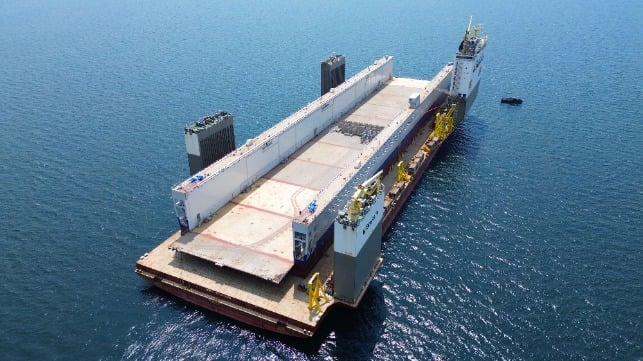
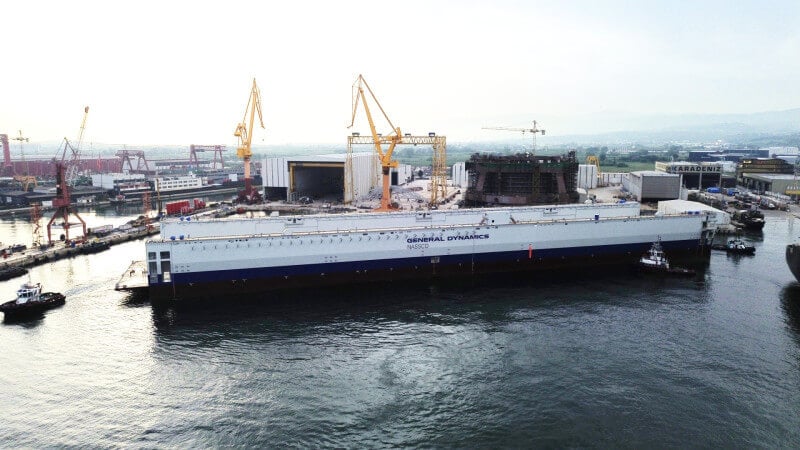
When the Jones Act shipbuilder General Dynamics NASSCO ordered a new floating drydock from a shipbuilder in Turkey, it needed a way to move it across an ocean and around a continent. Luckily, there was an even larger floating drydock available to carry it: Boskalis' BOKA Vanguard, the largest semisubmersible heavy lift ship in the world.

General Dynamics brought in logistics giant Kuehne+Nagel to arrange the oversize shipment, including the technically demanding loadout process. The 17,000-tonne drydock would fit snugly on the Vanguard's 900-foot-long deck, but there would not be an abundance of room to spare. 

“We had checklists. Then we had checklists for the checklists: every smallest detail accounted for, nothing left to chance,” said Aliye Erkan B?y?k, a logistics manager at Kuehne+Nagel's Istanbul office.

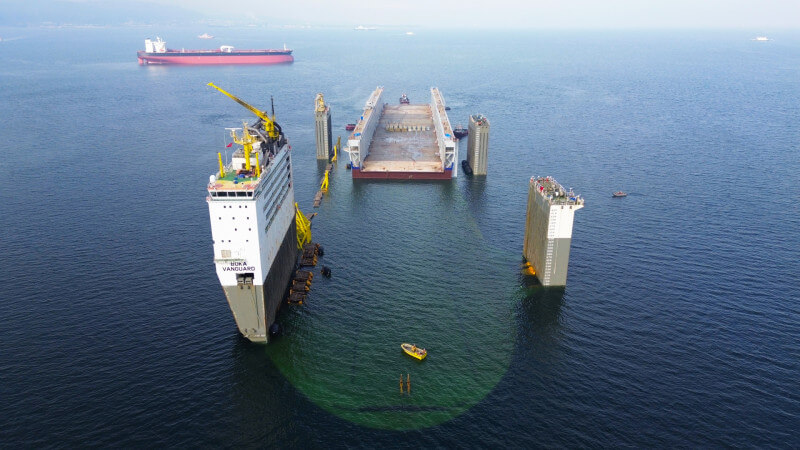
To position the drydock aboard the heavy lift ship, BOKA Vanguard needed to ballast down far enough that her main deck level was lower than the draft of the floating drydock, meaning deep water was a requirement. Once the drydock was clear of the pier at the shipyard, four tugs towed it out into open water to meet up with the heavy lift ship for loading. After positioning, BOKA Vanguard deballasted and the engineering team began carefully lashing the drydock to the deck. 

The cargo, the largest floating drydock ever built in Turkey (Kuehne+Nagel)

BOKA Vanguard semi-submerged for loading (Boskalis / Kuehne+Nagel) 

"The process of securing the drydock was not rushed and took several days: every centimeter, every millimeter had to be double-checked. We also had additional support boats on standby to shuttle crew and engineers between the port, the drydock, and the carrier ship," said Aliye. 

When all was secured, BOKA Vanguard got under way from Turkey and headed for Cape Horn, bound for California. As of Thursday she was just outside of Punta Arenas.

BOKA Vanguard has been used as a simple floating drydock herself. In 2019, the cruise ship Carnival Vista had azipod issues that required out-of-water repairs, but the nearest shipyard (in the Bahamas) did not have an available dock. BOKA Vanguard took Carnival Vista aboard, lifted the cruise ship out of the water and transited to the shipyard, where yard staff made the repairs while the Vista was out of the water.

2013-built BOKA Vanguard is the world's biggest semisub heavy lift ship, by a wide margin. At 115,000 dwt and 900 feet in length, she is large enough to move some of the largest offshore rigs and floating production platforms. When submerged to the maximum depth possible for loading, BOKA Vanguard's keel sits more than 100 feet beneath the surface, making her (for brief periods) the deepest-draft merchant ship ever built.


THE WAR ON WIND

BP Exits US Onshore Wind, Selling 1.3GW Portfolio to LS Power


BP has agreed to sell its entire US onshore wind energy business, BP Wind Energy North America Inc., to LS Power in a transaction expected to close by year-end, pending regulatory approval. The deal includes 10 operating wind farms totaling 1.3GW net capacity, marking another step in BP’s ongoing $20 billion divestment program.

Relevant context

The sale is part of BP’s broader effort to streamline its business and prioritize assets that deliver the greatest value, a strategy it laid out in February as it seeks to simplify operations and generate shareholder returns. The company’s first-quarter 2025 update indicated divestment proceeds of $1.5 billion to date, with a target of $3–4 billion in disposals for the year.

BP Wind Energy’s portfolio spans seven states with interests in 10 wind farms, including full ownership of significant assets like Fowler Ridge and Flat Ridge. All assets are grid-connected with more than 15 off-takers, ensuring steady revenues and making the package attractive to buyers like LS Power.

Following the acquisition, LS Power will integrate these wind assets into its Clearlight Energy portfolio, expanding its renewables footprint to approximately 4.3GW. LS Power already owns a diversified 21GW operating portfolio, including renewable generation, storage, flexible gas assets, renewable fuels, and transmission infrastructure.

This move reinforces a key trend: oil majors scaling back some renewable ambitions amid investor pressure to focus on returns while specialist infrastructure players like LS Power accelerate investments in operating renewable assets that offer predictable cashflows.

Netherlands’ Government Says Offshore Wind Targets Are No Longer Realistic

Netherlands offshore wind
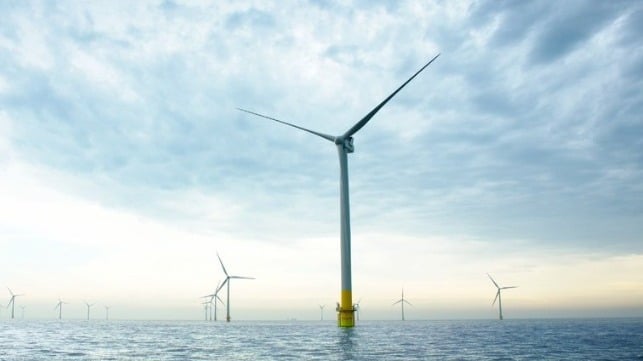
Hollandse Kust Zuid launched in 2023 is the Netherland's largest offshore wind farm

Published Jul 16, 2025 6:32 PM by The Maritime Executive


Addressing the Dutch Parliament, the interim government’s Minister for Climate and Green Growth has said the current goals for offshore wind energy are “no longer realistic.” The Ministry reports it is working on a new plan that will reset the country’s targets, lowering the near-term goal by as much as 40 percent.

The Netherlands is scaling back its ambitions for offshore wind energy power to the dismay of those in the industry and other European partners. However, in May, the country canceled two offshore wind auctions, citing a lack of interest and financial concerns. Today, Parliament was told that there is “slower-than-expected” progress in the transition to green power, according to the broadcaster NOS. It highlighted the supply chain and other challenges in the industry.

There had been speculation a year ago that the Netherlands was falling behind and was likely to miss its targets. It currently has 4.7 GW installed, but the government had set a plan calling for 50 GW to be developed and reached between 2032 and 2040. The longer-term goal was 70 GW by 2050. Currently, about one-sixth of the country’s power is supplied by offshore wind power.

The ministers told parliament that a new plan would be available by September, but they expect it could be as low as 30 GW. They said an additional 10 GW to reach 40 GW might be possible, depending on the speed of development in the industry.

NedZero, the Dutch wind power association, said that it obviously regrets the revised ambitions while noting that more needs to be done to launch electrification. 

However, it also admitted that the new targets, “remain a major challenge and we as a sector will fully commit to it,” said Jan Vos, chairman of NedZero, in a statement. “The crucial thing now is to further develop the demand for sustainable energy. We must stop using oil and gas… Lowering ambitions undermines confidence in the entire supply chain.”

The group is also calling for a stable and predictable government policy, which it said is essential to attract private investment. 

Earlier this year, a group of more than 20 companies had urged the government to introduce financial guarantees or subsidies to reduce investment risks.

The revised policy is being outlined by the interim government, which is currently in a caretaker position. The coalition government collapsed at the beginning of June, putting the current caretakers in position. The plan calls for new elections in October with strong competition from an environmental faction versus a right-wing movement. The results of the election are likely to further impact the Netherlands’ outlook and plans.


TRUMP EPA Seeks to Assert Authority Over Maryland’s Offshore Wind Project Appeals

offshore wind farm
Federal EPA is attempting to assert authority over final steps in approving Maryland's offshore wind farm for construction

Published Jul 16, 2025 1:52 PM by The Maritime Executive


The federal Environmental Protection Agency (EPA) attempted to assert its authority "at the eleventh hour" over the final approvals for Maryland’s first offshore wind project. The deadline was on July 14 for appeals on the final approval for the project, and according to media reports, the EPA sent a letter last week asserting the appeal was under its jurisdiction and not the state’s authority.

In a letter from the region EPA administrator to Maryland’s Department of the Environment posted online by Maryland Matters, the EPA asserts that it has “identified an error” in the state’s final permit decision, which it asserts could “result in invalidation of the permit on appeal and confusion among relevant stakeholders.” The letter contends that the authority to issue to permit was under federal authority delegated to the state, and as such, the appeal is under the EPA’s oversight. 

The EPA was calling for Maryland to reissue the final permit decision for US Wind. Maryland, however, on its website for the process added a footnote saying “A previous version of this webpage also described a separate permit appeals process through the U.S. EPA. The appeals process for this permit is through the State of Maryland only, and the language describing the U.S. EPA appeals process has been removed.” It also reissued the public notice in early June, a month before the EPA’s letter.

The Trump administration has been clear in its opposition to offshore wind energy projects. In March 2025, it was the EPA that withdrew an air quality permit for a proposed New Jersey offshore wind farm that related to prior approval of the construction of that wind farm. While that project was still in development, it created another hurdle in the process.

The Maryland Department of the Environment, Air and Radiation Administration (ARA) reviewed the application made by US Wind for the project, which would ultimately be developed in two phases for a total of up to a total of 114 wind turbines generating between 1.8 and 2 GW of power. After reviewing the comments, ARA determined that the proposed construction and commissioning of the offshore wind project would “not cause violations of any applicable air pollution control regulations.” The Department reported it had made a final determination to issue the permit-to-construct, effective June 6, and it included a window till July 14 to file a petition for judicial review in the circuit court for the county where the activity would occur.

The lease area is located approximately 8.7 nautical miles offshore of Maryland and approximately 9 nautical miles from Delaware. US Wind, a partnership between Italy’s Renexia and American investment firm Apollo Global Management, won its lease for nearly 47,000 acres in August 2014.  The first phase, known as MarWind, was proposed as 300 MW with 22 turbines more than 20 miles from shore, while the second phase, Momentum Wind, was proposed for 800 MW with up to 55 turbines.

Federal approvals for the project were completed in 2024 under the Biden administration. The Department of the Interior issued its Record of Decision after the environmental review in September 2024. The Bureau of Ocean Energy Management issued the final federal approval, the Construction and Operation plan, in December 2024.

Both the state and US Wind told Maryland Matters that they were ensuring that the process was following the letter of the law. The company emphasized that it was “confident that all of our project’s permits were validly issued.”

The project has faced opposition in both Delaware and Maryland, including lawsuits. Despite that, both the state and the company have said they are committed to the project and the benefits it would provide.


Crew of Research Vessel Nautilus Find a Wrecked Japanese WWII Destroyer

Akizuki, sister ship of Teruzuki (public domain file image)

Published Jul 17, 2025 11:36 PM by The Maritime Executive


The privately-held research vessel Nautilus has discovered the wreck of the WWII Japanese Navy destroyer Teruzuki, which was torpedoed and sunk by a PT boat off Guadalcanal.

Teruzuki was a 2,700-tonne destroyer, the second of a class designed and built for the Imperial Japanese Navy in the opening years of the war. She was delivered on August 31, 1942, and survived for two and a half months. 

Teruzuki first saw action during the Battle of the Santa Cruz Islands that October, then joined a Japanese task force to attack U.S. forces at Henderson Field on Guadalcanal. The first attempt at this mission began on November 12; it was thwarted by U.S. forces in a fierce and costly nighttime battle. In the exchange of fire, Teruzuki managed to cripple the destroyer USS Sterett and may have contributed to the sinkings of the destroyers USS Monssen and USS LaffeyTeruzuki was assigned to a second attempt on November 14-15, but did not play a major role during the engagement. Neither attempt at striking Henderson Field succeeded, but both resulted in heavy losses for the U.S. Navy.

On December 11, Teruzuki returned to Guadalcanal as part of a resupply task force with four other destroyers. Their mission was to drop off floating drums of supplies for the Japanese troops pinned down on the island. After the food drums were dropped off and Teruzuki was headed for home, she was attacked by several U.S. Navy PT boats and took two torpedo hits. The damage left her disabled and ablaze, and after three hours, the fire likely set off a depth charge magazine. The resulting explosion blew off her stern and caused her to rapidly sink. Luckily for her crew, the Teruzuki was close enough to Guadalcanal that 156 of her sailors were able to swim to shore. All but nine personnel survived the sinking. 

This month, the crew of Ocean Exploration Trust's Nautilus discovered the final resting place of Teruzuki in Iron Bottom Sound, an infamous stretch of water off Guadalcanal that saw repeated and deadly fighting during the war. The Nautilus crew first picked up the wreck site using an unmanned surface vessel conducting a sonar survey. "We didn't know what it was. It hadn't been identified before," survey expert Dr. Larry Mayer of the University of New Hampshire told Newsweek. They confirmed the find with an ROV inspection, and Hiroshi Ishii, a specialist from Kyoto University, identified the wreck as Teruzuki. The destroyer's stern was missing, and it was found about 200 meters away. 

Many more finds may be coming. Only a dozen of the WWII wrecks in the sound have been identified, but Mayer's team believes that there could be as many as 100 in total - enough to keep the search going for many years to come. 


Israel’s Eilat Port Expected to Close Due to Unpaid Taxes

Eilat Israel
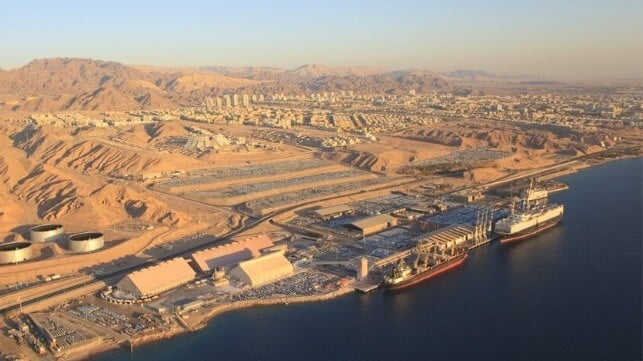
Eilat located on the Red Sea is small, but a strategic port for Israel (Israel Port Co. photo)

Published Jul 17, 2025 2:17 PM by The Maritime Executive


Israel’s only southern seaport, Eilat on the Red Sea, is expected to officially suspend commercial operations this weekend due to the financial collapse of the company holding the port concession. A report in the Globes newspaper says the government is meeting to discuss the situation after the bank accounts of the debt-ridden port operator were seized by the local municipality.

The news report says the port’s operator owes between $178,000 and $208,000 in taxes to the Eilat municipality. In addition, since the start of the war in Gaza and the attacks by the Houthis, the operator has not paid its concession fees to the state. Those are said to be more than $890,000. As a result of the unpaid taxes, Globes learned that the municipality had seized the port operator’s bank accounts.

The Port of Eilat has largely been closed for commercial operations for approximately 20 months since the onset of the fighting in Gaza. It was always a smaller commercial port for Israel, but provided an important link as it is south of the Suez Canal. The port was developed by the government in the 1950s but had difficult periods based on the regional instability, including when Egypt closed nearby waterways.

The current operator won the concession as the only bidder in 2012, receiving a 15-year contract with an option to extend for 10 more years. Eilat reportedly flourished, becoming profitable in recent years. It was handling half of all the auto imports into Israel as well as exports of potash, fertilizers, and minerals. It was also handling oil, while the operator had promoted the potential for container operations as well as live animal imports.

By March 2024, there were reports that the port operator had laid off half of its workers. Income from auto imports, Globes reports, was down 100 percent. As the Houthis gained greater distance with their missiles and drones, attacks have also become more frequent in the area around Eilat. 

Operations will officially stop, according to Globes, on July 20. It reports that tugs and other port vessels will be idled, and all operations will stop in the commercial port. Israel, however, had recently named a new operator for the recreational port, which is a separate operation.

One of the main impacts will be on the Israeli Navy, which is using Eilat as a base of operations. The Navy used Eilat recently to launch and support attacks on the Houthis in Yemen.

“If the situation continues, a decline in the port’s equipment and long-term damage to the continuity of its functioning is expected as a result of the shutdown of cranes, electrical systems, etc.,” warns a letter from the National Emergency Authority obtained by Globes.

The news report says the Israeli government was due to convene a meeting to discuss the situation and possible alternatives to prevent the closure. Globes reports that the Israeli government last month was discussing compensation to the port operator of approximately $4.5 million. However, it says it was being conditioned on payment of the $892,000, the company is in arrears on its concession fees.

The company told Globes it was working on a settlement with the municipality and denied the reports that the operations would be suspended. Israel considers Eilat a strategic asset, further raising the likelihood that the government will intervene to keep the operation going.