Friday, July 18, 2025


Burgundy halts Ekati pit mining, lays off hundreds
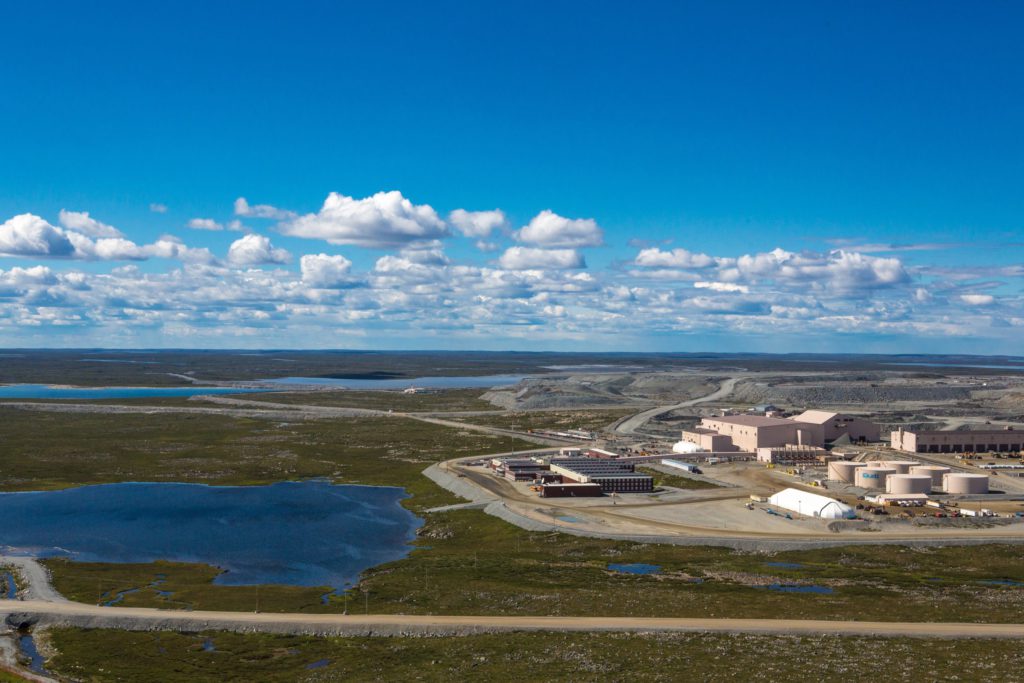
Ekati diamond mine in the Northwest Territories. Credit: (Credit: Arctic Canadian Diamond.)

Burgundy Diamond Mines (ASX: BDM), has halted open pit operations at Point Lake within its Ekati diamond mine in Canada’s Northwest Territories, resulting in the layoff of hundreds of workers and contractors.

The company, which went on a trading halt on Wednesday, cited poor market conditions as the reason for halting operations. Communications manager Ariella Calin said in an emailed statement that the ongoing downturn in the diamond market has rendered the Point Lake pit “sub-economic.” 

“The company has scaled its operating model to support a viable adjusted mine plan without near term surface operations,” Calin said, adding that Point Lake will be maintained to allow for a rapid restart should market conditions improve.

Operations will continue at Ekati’s Misery underground mine, located roughly two kilometres from Point Lake.

Burgundy acquired Ekati in March 2023 through its $136-million purchase of Arctic Canadian Diamond.

Since then, it has grappled with mounting financial pressure amid a downturn in the global diamond market. Earlier this year, Burgundy said it would focus on achieving “financial flexibility” in 2025, including steps to ensure adequate working capital.

The company has also undergone significant leadership changes, including the retirement of chief executive officer Kim Truter in May. He was succeeded by Jeremy King.

Ekati reached a major milestone in 2024, surpassing 100 million carats produced and sold over its 26-year history. Still, the trading halt comes at a critical time for the region’s diamond industry.

The suspension comes as all three active diamond mines in NWT face feventual shutdowns. Rio Tinto’s (ASX, LON, NYSE: RIO) Diavik mine is scheduled to close in 2026, while De Beers’ Gahcho KuĂ© mine is expected to operate until 2030. Ekati’s long-term future remains uncertain.

The mines are located hundreds of kilometres northeast of Yellowknife and are accessible only by air or seasonal winter roads.

A recent report by research firm Impact Economics warns that mine closures could cost the territory 1,500 jobs and prompt more than 1,100 residents to leave.

Burgundy continues in trading halt until the publication of an official update on the matter. A quarterly production update will be released by the end of the month, Burgundy said.


 

US set to impose 93.5% duty on China battery material

Graphite. Stock image.

The US Commerce Department will impose preliminary anti-dumping duties of 93.5% on imports of Chinese graphite, a key battery component, after concluding the materials had been unfairly subsidized.

A trade association representing US graphite producers in December filed petitions with two federal agencies, asking for investigations into whether Chinese companies were violating anti-dumping laws. The new duties will add to existing rates making the effective tariff 160%, according to the American Active Anode Material Producers, the trade group that filed the complaint.

The anti-dumping duty on graphite is set to increase tensions along the global electric-vehicle supply chain that’s already facing Beijing’s export controls of some critical minerals and battery technology. Battery supplier shares slipped, while producers in North America and the Asia-Pacific soared.

“Commerce’s determination proves that China is selling AAM at less than fair value into the domestic market,” Erik Olson, a spokesperson for the anode producers trade group, said in a statement.

Syrah Resources Ltd., an Australian graphite and battery anode company, surged as much as 38%, the most since October 2023. Posco Future M Co., a South Korean battery material firm, jumped 24%.

The tariff would be a blow to battery manufacturers, said Sam Adham, head of battery materials at consultancy CRU Group. A 160% tariff equates to $7 per kilowatt-hour added cost to an average EV battery cell, or one fifth of the battery manufacturing tax credits that originated in the Inflation Reduction Act and survived President Donald Trump’s budget bill, he said.

“That basically wipes out profits for one or two entire quarters for the Korean battery makers,” Adham said.

Tesla Inc. and its key battery supplier, Japan’s Panasonic Inc., were among companies pushing to block the new tariffs, arguing that they rely on Chinese graphite imports because the domestic industry hasn’t developed enough to meet the quality standards and volume that the carmaker requires. Tesla shares fell as much as 0.7% Thursday.

Graphite is a key raw material used to make anodes of the batteries, and nearly 180,000 metric tons of graphite products were imported into the US last year, with about two-thirds of these deliveries coming from China, according to BloombergNEF.

China dominates the processing capacity of graphite, with the International Energy Agency calling the material one of the most exposed to potential supply risks and “requiring urgent efforts for diversification,” according to a report in May.

Graphite is expected to remain the most common anode material for all types of lithium-ion batteries in the medium term, according to the IEA, with silicon only expected to begin eating into its market share from 2030.

The Commerce Department issued the preliminary determination affirming the anti-dumping duties in a document Thursday, and said the final determination should be announced by Dec. 5.

The tariff ruling “provides the policy clarity and market signals needed to accelerate domestic graphite production,” said Jon Jacobs, chief commercial officer at Westwater Resources Inc., which is building a graphite plant in Alabama. Westwater, which has agreements with Jeep-owner Stellantis NV and South Korea’s SK On Co., will have 12,500 metric tons of production capacity when its first phase comes online next year, with plans to expand capacity to 50,000 tons annually by 2028, Jacobs said.

Westwater rose 15% on Thursday. Canadian graphite firms Nouveau Monde Graphite Inc. and Northern Graphite Corp. also surged on the tariff news.

The anti-dumping rate determination “could impact the cost structure for battery suppliers” like Fluence Energy Inc. and Enphase Energy Inc., analysts at Roth Capital Partners said in a note Wednesday. Fluence shares closed lower by 0.4% while Enphase dropped 0.7%.

Additional duties on batteries will add to pressures facing the renewable industry. While energy storage retained key tax incentives in Trump’s budget bill, Treasury Department rules restricting the use of Chinese cells complicates compliance for many developers. Supply chain risks and costs will slow the pace of storage growth on the US grid, according to Wood Mackenzie.

(By Tope Alake, Gabrielle Coppola and Annie Lee)


Alcoa says Trump’s tariffs added $115 million in aluminum costs

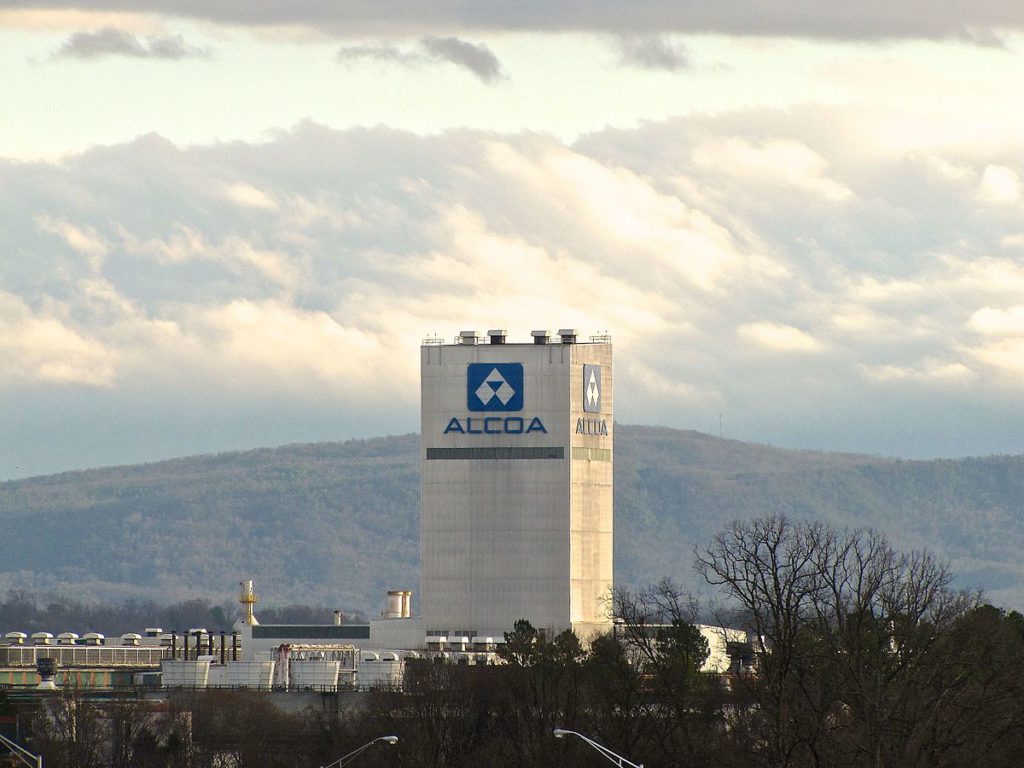
Credit: Wikimedia Commons

Alcoa Corp., the largest US aluminum producer, said tariffs on imports from Canada cost it $115 million in the second quarter, showing how US President Donald Trump’s trade agenda has affected the industry.

The company redirected Canadian produced aluminum to customers outside the US to mitigate additional tariff costs, it said Wednesday while reporting earnings that beat analyst estimates.

Alcoa shares rose as much as 6.4% Thursday in New York, the biggest intraday increase since June 26.

Metal producers are navigating the trade tumult Trump created after raising import tariffs on steel and aluminum, first to 25% in March and then to 50% in June, in an effort to revive domestic production.

Alcoa’s latest toll from tariffs is about six times more than in the first quarter when the Pittsburgh-based firm said the levies, which were then 25%, had cost it an additional $20 million. Mining giant Rio Tinto Group also revealed Wednesday that its Canada-made aluminum generated costs of more than $300 million in the first half due to the tariffs.

Alcoa has had extensive conversations with administrations on both sides of the border, including directly with Trump, Alcoa chief executive officer William Oplinger said on a call following the earnings report.

Oplinger has repeatedly warned US customers will bear the costs of tariffs on aluminum producers.

“While we’re not particularly thrilled with the tariffs,” he said, “our customers are paying significantly higher for aluminum in the United States than anywhere else in the world.”

(By Jacob Lorinc)


Putting More Women on Boards Is Not Enough Without Rethinking Leadership

Boardroom
iStock / IPG Gutenberg UK Ltd

Published Jul 17, 2025 7:18 PM by Irene Rosberg


For the past decade, the maritime industry has made increasing efforts to improve diversity at the top, most visibly through a focus on gender balance in boardrooms. But while headlines around the number of women appointed to shipping boards suggest progress, the reality is more complex. True transformation does not come from merely increasing representation. It comes from challenging and redefining the deeply embedded assumptions about what leadership looks like.

The majority of shipping companies still recruit board members based on traditional markers of leadership such as long tenure at sea, technical expertise or financial control. These criteria often reward legacy thinking and reinforce a narrow leadership profile. That profile is usually male, often uniform, and almost always aligned with past performance rather than future potential.

This is not just a gender issue. It is a governance issue. When boardrooms lack diversity of experience, thought and style, they are less likely to identify new risks, question groupthink or explore unconventional paths to growth. This matters now more than ever, as the industry faces significant transformation. Climate transition, digital disruption, geopolitical volatility and heightened social accountability are not theoretical challenges. They require board-level leadership that is far more adaptive and forward-looking than in the past.

Through my work leading The Blue MBA at Copenhagen Business School, I have seen the impact that broader and more inclusive leadership can make. Our participants come from across the global maritime value chain, bringing different cultural perspectives, disciplines and leadership styles. They are pushed to question what they think they know, to challenge outdated mindsets and to broaden their strategic understanding of the industry.

That same ethos underpins our Blue Board Leadership Programme. It was launched in response to a clear industry need: better prepared board members who understand the full complexity of maritime leadership today. The program does not train people to slot into outdated governance models. It encourages them to rethink the boardroom itself. That includes preparing women not just to join boards, but to shape them from within.

The push for board diversity must move beyond simply placing more women in existing structures. We must instead evolve the structures themselves. That means reshaping how we define credibility, influence and leadership potential. It means understanding that command-and-control leadership, while useful in operational settings, is not always appropriate in strategic boardroom discussions. Collaborative thinking, emotional intelligence, ethical reasoning and openness to ambiguity are increasingly critical boardroom competencies.

We must also look closely at the dynamics that unfold once women are appointed. Too often, women are brought in to fulfil quotas or tick ESG boxes, without being given the same opportunity to shape direction or contribute to meaningful debate. This kind of tokenism undermines both the individual and the board. True inclusion means creating environments where different voices are heard, respected and allowed to influence decisions.

Leadership reform must be part of maritime’s transformation story. Boards need to become spaces where leadership is understood not as a title or CV, but as a mindset and a capability. We must prepare the next generation of board members to think differently, act ethically and lead collaboratively.

Adding more women to maritime boards is essential. But it is not enough. We must also change the conditions in which leadership is exercised. That includes how we select leaders, how we share influence, and which behaviors we choose to value. If we want resilient and relevant maritime organizations, we must stop replicating yesterday’s boardroom in today’s world.

Irene Rosberg is Program Director at The Blue MBA and the Blue Board Leadership Program, Copenhagen Business School.

The opinions expressed herein are the author's and not necessarily those of The Maritime Executive.

MERCHANT MARINE

Op-Ed: Time to Appoint an Alum to Run USMMA

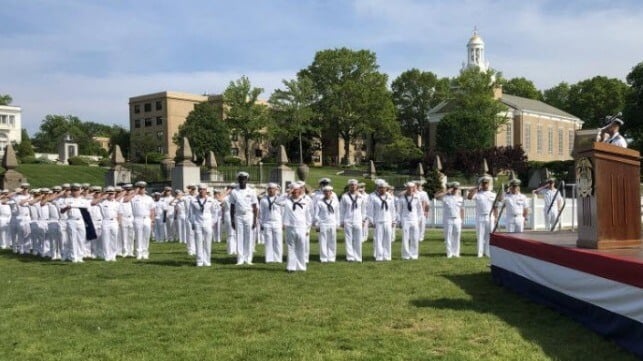
USMMA file image
File image courtesy USMMA

Published Jul 17, 2025 4:12 PM by Kevin Coulson, USMMA Class of '75


There are five United States Federal Academies - the United States Military Academy at West Point, The United States Naval Academy at Annapolis, The United States Coast Guard Academy at New London, The United States Air Force Academy at Colorado Springs, and The United States Merchant Marine Academy at Kings Point (USMMA). Of the five, four typically have one of their own graduates serving as academy superintendent. Only USMMA sends its midshipmen into war zones - on ships laden with beans, bullets and bunker oil for our military - yet it most often has someone other than one of its own grads as superintendent.

142 of our cadets were lost at sea during World War Two. We are the only one of the academies authorized to have a battle standard replete with pennants from the battles in which we participated. We are the only academy whose graduates are licensed to serve as officers and who graduate with reserve officer commissions in the USNR, USMCR, USAR, USAFR or USCGR.

Unfortunately, we are also the one academy whose superintendent is most often not chosen from among its own graduates. This is unfair to the brave men and women who will serve as cadets or as officers aboard our ships in the next war's battle zone.

We, the undersigned, ask that you please take an active part in promoting a Kings Point graduate to be our next USMMA Superintendent. Our midshipmen deserve a leader who has sailed on his/her license, who knows our traditions and understands the future needs of our nation.

Respectfully,

Kings Point Class of 1975, co-signatories, family and friends

Kevin Coulson

Mike Morris

Mark G. Baranello

Larry Kelly

Russ Bauer

Neal McCraw

Steve Ackley

Robert C. Baldwin

Larry Cosgriff

Thomas Heffernan

Joseph Dixon

Nick Weltmann  

Peter DeChadenedes

Warren Heidt

Michael Masciale

John ReShore

Don Fogel

Bill Vallaster

Richard Bense

Mark Brannigan

Jeffrey Hakala

Frederick Leo Ebers

Skip Dubrin

Donald Pastor

Eddie G. Maxwell

Robert Baldwin

Keene Little

Clifford Jagoe

Frank Atcheson

Kenneth Nelson

Chris Nelson

Mike Corney

Robert Herman

Jim Knoepffler

Donal L. Staples Jr.

Stuart Pitts

Charlie Cheatom

Thomas A. Fedoration

Frederick C. Berg III

Thomas A. King

James Brodt

Peter Wishart

Eric Schiller

Steve Meyers

Kathleen Tanton

Mark Brannigan

Francis X. (Biff) Broderick

Alan Pelletier

Gregg Runkel

Kennett Backus

Jim Shettig

Dave Petty

William Leigh

Charles Anthony Nunez

Alexander Barry Williams

Ken and Debbie Halsall

The opinions expressed herein are the author's and not necessarily those of The Maritime Executive.

Report: US Navy May Cut Vice Admiral Posts in Acquisitions Programs

Washington Navy Yard (USN file image)

Published Jul 16, 2025 9:52 PM by The Maritime Executive


Following Defense Secretary Pete Hegseth's order to cut the number of four-star officers across the military by 20 percent, the Navy is considering a plan to eliminate the three-star positions atop its acquisitions bureaucracy, according to Politico. The reported plan would remove the vice admirals in charge of buying and maintaining everything the Navy uses to fight - aircraft, ships, information warfare systems, supplies and facilities - and allow civilian appointees. 

The proposal would affect all five of the Navy's systems commands, including Naval Sea Systems Command (NAVSEA). The department is the buyer and maintainer of America's warships and subs, making it the world's largest shipowner when measured by vessel value. In recent years, NAVSEA has come under scrutiny because of the ballooning costs and timetables of U.S. Navy shipbuilding programs. The command's design requirements and change orders have received a share of the blame for setbacks in building frigates, carriers and submarines - though there are other causes, like the intractable workforce shortage facing shipbuilders and other manufacturing employers. 

Under the revised organizational chart that Politico reported, the navy would eliminate the position of the vice admiral in charge of NAVSEA, along with the equivalent posts at the systems commands for Naval Air, Naval Information Warfare, Naval Facilities Engineering, and Naval Supply. This would have the knock-on effect of cutting the staff posts within the vice admiral's office, reducing head count by a much larger amount. 

A spokesperson for Navy Secretary John Phelan denied that such a plan exists. Separately, a spokesperson for the Navy told Politico that the plan is not yet finalized. 

The decision would align with Defense Secretary Hegseth's proposal to reduce "excess general and flag officer positions" across the military. Hegseth has called for all services to eliminate 20 percent of all four-star positions and at least 10 percent of all other general and flag officers across the military. The objective, Hegseth said in a memo issued in early May, is to cut "unnecessary bureaucratic layers that hinder . . . growth and effectiveness." 

VIDI VEDI ...

Vinci Acquires Wartsila’s Marine Electronics to Strengthen Defense Business

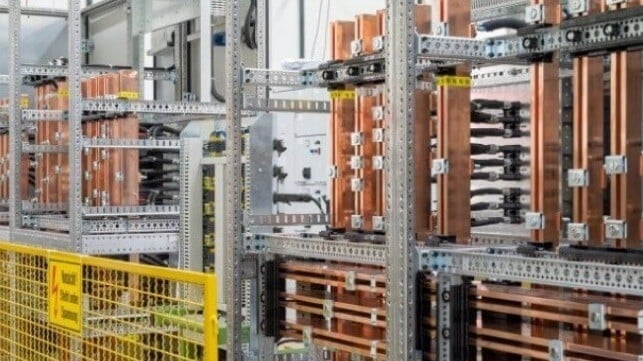
marine electrical systems
The marine electrical systems business will be divested to Vinci who looks to role its role in the defense markets

Published Jul 17, 2025 6:15 PM by The Maritime Executive


Vinici, which provides energy solutions, reports it has reached an agreement with Wartsila to acquire its Marine Electric Systems business unit, which will be used to enhance the company’s position in the defense market and other industrial sectors. The sale is part of Wartsila’s strategy announced in 2024 to divest of non-core businesses to unlock value in the company.

The sale includes Wartsila SAM Electronics, a company based in Hamburg, Germany, which dates back to 1906 and today is focused on technologies for the maritime sector and energy markets. Vinci acquires the German company, which has approximately 350 employees and full-year revenues of approximately €100 million. Included in the transaction are related assets for a project being executed in Brazil.

“This acquisition will enable Vinci Energies to expand its range of services in the industrial sector and to strengthen its position in the German defense market,” said Vinci announcing the agreement.

SAM Electronics provides complete electrical and electronic system packages for vessels, offering turnkey solutions with extensive systems integration competence, and acts as an EPC contractor for complete electrical packages, typically in close partnership with the shipyard. Its services range from design and planning to engineering and cable installation. It offers the capability to integrate with systems from multiple vendors and provides services across most sectors of the shipping industry. 

Vinci emphasizes the opportunities with naval systems. SAM reports it has participated in many national and international projects. It highlights its contribution to the German Navy, demonstrated through its role with the Class 124 and 125 frigates, Class 130 corvettes, and Class 702 combat support ships. It mains offices in Hamburg, Elmenhorst, Wilhelmshaven, and Bremerhaven. Placing it close to many of the leading German shipyards.

“This agreement is yet another proof point of our Portfolio Business divestment strategy coming to life,” said Bernd Bertram, Head of Portfolio Business, Wärtsilä. “VINCI Energies has deep expertise in complex project-based business and therefore is an ideal match for Marine Electrical Systems. I’m confident that VINCI Energies will provide a solid platform for further business success for the benefit of the customers, partners, and the highly skilled professionals of Marine Electrical Systems.”

Wärtsilä notes that the business had been operated independently to facilitate the divestment. The deal is expected to be completed in the last quarter of 2025.

JOB OPENING

Russia Seeks Inspectors to Check Incoming Vessels for Explosives

Ust-Luga, Russia
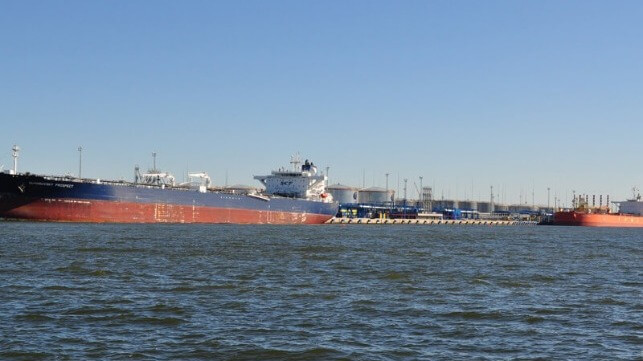
Vessels arriving at Russia's Baltic seaports will be checked for explosives before docking (FSUE Rosmorport)

Published Jul 17, 2025 3:56 PM by The Maritime Executive


Russian port operator FSUE Rosmorport has launched a tender seeking inspectors for vessels arriving at its Baltic seaports. According to the Moscow Times, the inspections will be checking below the waterline and the underside of vessels, looking for unknown objects and possible explosives.

The newspaper highlights that the tender was launched after a series of unexplained incidents in the seaports. The last took place two weeks ago when the LPG carrier Eco Wizard had what the authorities reported as a minor leak of ammonia” while loading. The newspaper reports that the Telegram channel Baza called the incident sabotage and said there had been an explosion. The report said there were two holes found in the hull, and the metal was bent inward, suggesting it came from an external force.

The first vessel reported damaged was in February, also alongside the terminal in Ust-Luga. Official reports sought to downplay the incident, but the local authorities were quick to call it sabotage.

The Moscow Times reports Rosmorport is offering four contracts with a total value of $39.5 million for the underwater inspections. The companies will be using sonar equipment, unmanned vehicles, and other tools, and will be responsible for analyzing the images, looking for possible explosives. They will inspect the propeller and rudder system, thrusters, bow bulb, sea chests, and other underwater areas.

The contracts are split into the different ports, with a total of four available. One covers St. Petersburg, another Ust-Luga and Primorsk, a third for Vysotsk and Vyborg, and finally Kaliningrad.

Companies have till July 24 to enter the auction. Winners will be reported on August 4.


Navigator Joins with Amon to Build Two Ammonia-Fueled Gas Carriers

ammonia-fueled vessels
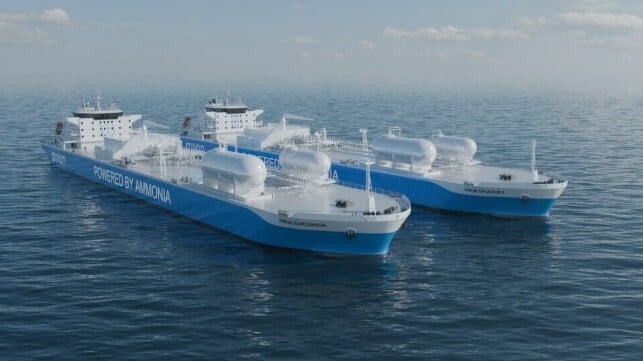
Amon is leading the development of ammonia-fueled vessels for shipping's energy transition (Amon Maritime)

Published Jul 17, 2025 7:23 PM by The Maritime Executive


The ammonia-fueled vessel sector took another major step forward with the news that Navigator Holdings and Amon Maritime have formed a new joint venture and ordered two ammonia-fueled liquefied ammonia carriers. The news came a day after WinGD reported the installation of the first ammonia-fueled marine engine into a newbuild, and the new joint venture builds on Amon Maritime’s mission to lead the green shift in shipping.

Navigator will own 80 percent of the new company to be known as Navigator Amon Shipping, with Amon owning 20 percent. The company will place the vessels under long-term charters to blue-chip industry leaders. It anticipates the vessels will be on five-year charters. Navigator is already the owner/operator of the world’s largest fleet of handysize liquified gas carriers.

The construction order was placed with Nantong CIMC Sinopacific Offshore & Engineering in China. Navigator reports an average price for each vessel of $84 million. Deliveries are scheduled for June and October 2028. Operating on ammonia as their primary fuel, the vessels will transport ammonia and be capable of also transporting liquefied petroleum gas with a capacity of 51,530 cubic meters. The project is receiving a NOK 90 million ($9 million) investment grant from Norway’s Enova.

“Expanding our fleet with two modern ammonia carriers capable of using clean ammonia as a fuel, operating in a long-term time charter, is a strategic enabler in meeting the growing demand for a sustainable fuel source in a net-zero economy,” said Mads Peter Zacho, Chief Executive Officer of Navigator. “These modern vessels will be equipped with newly developed technologies that comply with present and future environmental regulations and will thereby deliver great value to both our customers and our shareholders.”

Amon had highlighted the opportunities in ammonia in June when it received its grants from Enova. It said that ammonia is currently primarily transported on a Medium Gas Carrier (MGC). Because the ship is already designed for transporting ammonia, it said that the relative additional cost to convert to ammonia-fueled propulsion in this segment compared to conventional ships will be less than in most other segments.

As it seeks to expand ammonia into more segments of shipping, Amon Maritime also reported it would launch Amon Bulk after securing a NOK 253 million ($24.6 million) grant from Enova to support the construction of two ammonia-powered bulk carriers. The plan for the bulkers calls for one Capesize (180,000 dwt) vessel designed for long-haul transport of heavy bulk commodities. The second vessel will be a Kamsarmax bulk carrier (80,000 to 85,000 dwt). The smaller vessel, it said, would offer greater port flexibility while maintaining high cargo capacity and energy efficiency. 

Amon Bulk reported it is entering the next phase of shipyard evaluation and the tendering process for these vessels. The aim is to order these vessels for delivery by 2029.

It said the developments in ammonia are another key step toward decarbonizing deep-sea shipping.


First Two-Stroke Ammonia-Fueled Engine Installed as Newbuild Proceeds

ammonia marine engine installed on newbuild
First two-stroke ammonia-fueled marine engine was installed on a newbuild in South Korea (WinGD)

Published Jul 16, 2025 7:25 PM by The Maritime Executive


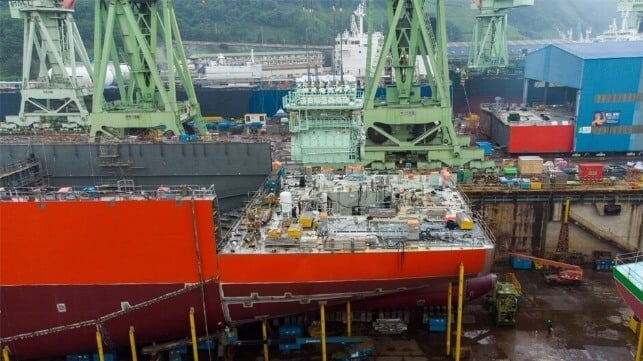
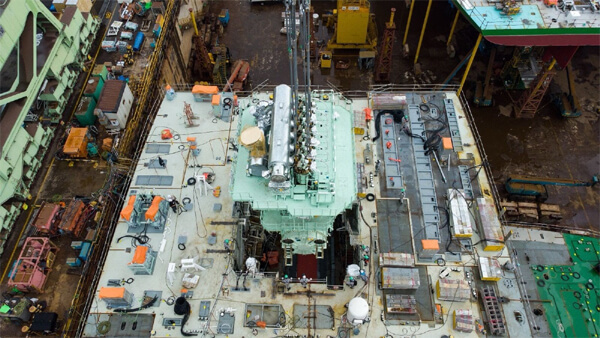
The race to launch the first commercial ammonia-fueled engines marked a key milestone, reports marine engine designer WinGD. The first two-stroke engines built from the company’s designs were tested and recently successfully installed in the first new ammonia carriers being built in South Korea. WindGD is highlighting that it became the first engine designer to bring an ammonia-fueled two-stroke engine to market, and the vessels are due to enter service in 2026.

The 52-bore engine was built by HD Hyundai Heavy Industries’ Engine and Machinery Business Unit. WindGD reports that the results from its laboratory test engine runs were confirmed at the factory in South Korea, and the engine has now been delivered to HD Hyundai Mipo, which installed it on the newbuild vessel.

WinGD reports the X-DF-A engine features high-pressure ammonia injection supplemented by a low, targeted pilot fuel dose of around five percent at full load. The engine delivers load handling, dynamic response, and fuel efficiency on par with WinGD’s equivalent diesel-fueled X Engines in both ammonia and diesel operating modes. It critically delivers low emissions and an efficient performance similar to diesel engines.


The first engine was installed in South Korea on a vessel due to deliver to EXMAR in 2026 (WinGD)


The company achieved other key firsts in the development of its first ammonia-fueled marine engine. Lloyd’s Register, which is part of the project, noted that the engines were the first to achieve class approval in September 2022 for ammonia two-stroke engines. They were selected for the newbuilds in 2023 and are being combined with a fuel supply system developed by Wärtsilä Gas Solutions.

WinGD says that further optimization will continue for the second engine in the 52-bore series, which will be delivered later this year.

The engines are being incorporated into the ammonia gas carriers ordered by EXMAR in 2020. Each vessel will be approximately 623 feet in length. They will have a capacity of 45,000 cbm and will be able to transport either ammonia or LPG.

Construction on the vessels began in December 2024 with the first steel cutting. Work started on the second vessel of the class in May 2025. EXMAR has called the ships “a bold step toward a decarbonized shipping industry, and a cleaner future.”

Each of the major engine designers is working on different sizes of ammonia-fueled engines, and each has reported strong progress in the designs and now qualification testing. WinGD reports it has built an early orderbook of around 30 X-DF-A engines, which will be going into not only gas carriers, but also bulk carriers and containerships.

DNV calculates that there are currently 37 vessels on order that will be capable of operating on ammonia as their marine fuel. The bulk of the deliveries will start in 2026 and 2027. As the infrastructure becomes more developed and the regulations are defined, it is anticipated that ammonia-powered engines will increase in popularity as one of the solutions to meeting the industry’s decarbonization challenge.