Wednesday, July 23, 2025


Sizewell C Nuclear Project Secures £38 Billion Backing

  • The Sizewell C nuclear power station project has been approved with a £38 billion investment, including a 44.9% initial stake from the UK government.

  • Key investors in Sizewell C include Canadian investment fund La Caisse, British Gas owner Centrica, French state companies like EDF, and UK-based Amber Infrastructure and INPP.

  • The project is anticipated to create 10,000 jobs, generate £2 billion in annual savings for the low-carbon electricity system, and benefit approximately 3,500 businesses.

The UK government signed on Tuesday the final investment decision to build the $51-billion Sizewell C nuclear power plant, which will help Britain generate more low-carbon electricity. 

The final investment decision was made possible after new investors joined the government and French energy giant EDF. The UK will have an initial 44.9% stake to become the single biggest equity shareholder in the project. The other shareholders include La Caisse with 20%, UK energy group Centrica with 15%, and Amber Infrastructure with an initial 7.6%. EDF is taking a 12.5% stake in the project, as well as a proposed $6.7 billion (£5 billion) debt guarantee from France’s export credit agency, Bpifrance Assurance Export, to back the company’s commercial bank loans.  

The funding model spreads the around $51 billion (£38 billion) cost of constructing Sizewell C between consumers, taxpayers, and private investors, the government said, adding the model has been decided after the lessons learned from the Hinkley Point C project, which has racked up huge cost overruns. 

“We’re delighted to welcome new investors alongside Government and EDF who, like our suppliers, have strong incentives to keep costs under control and ensure we deliver Sizewell C successfully for consumers and taxpayers,” Julia Pyke and Nigel Cann, Joint Managing Directors of Sizewell C, said today.   

Sizewell C was initially proposed years ago by France’s EDF and China General Nuclear Power Group. However, the UK government bought out the Chinese group’s stake in 2022 amid concerns about China’s influence. 

Sizewell C is the first British-owned nuclear power station to be announced in over three decades. 

The UK government has already committed billions of UK pounds of investment in Sizewell C on the Suffolk Coast in east England, including $19.5 billion (£14.2 billion) announced in June to support the project. 

The UK has been betting big on nuclear power in recent years to boost its energy security and help reach net-zero emissions by 2050.   

Apart from major conventional nuclear power projects, the UK government is supporting Small Modular Reactors (SMR) technology development with competitions to unlock private finance, with a long-term ambition to bring forward one of the first SMR fleets in Europe.

By Tsvetana Paraskova for Oilprice.com


World Nuclear News


Sizewell C gets final go-ahead decision

Tuesday, 22 July 2025
UK Energy Secretary Ed Miliband has signed the final investment decision for the Sizewell C nuclear power plant in Suffolk, England. The government will be the largest shareholder in the GBP38 billion (USD51 billion) project alongside EDF, Centrica, La Caisse and Amber Infrastructure.
Sizewell C gets final go-ahead decision
The planned Sizewell C plant (Image: EDF Energy)

The government confirmed it will take an initial 44.9% stake to become the single biggest equity shareholder in the project. Canadian investment fund La Caisse will have a 20% stake, British multinational energy and services company Centrica 15%, and international infrastructure asset manager Amber Infrastructure will have an initial 7.6% (with an option to acquire a further 2.4% from the government exercisable within 24 months of Revenue Commencement). France's EDF announced earlier this month that it will be taking a 12.5% take in the project.

France's export credit agency, Bpifrance Assurance Export earlier proposed a GBP5 billion debt guarantee to back EDF's commercial bank loans. Alongside this investment, the UK's National Wealth Fund - the government's principal investor and policy bank - is making its first investment in nuclear energy. It will provide the majority of the project's debt finance, working alongside Bpifrance Assurance Export, to help support the building of the power plant. The government said it is providing the National Wealth Fund with additional capital to facilitate this lending to Sizewell C.

A set of procedural steps will now begin which include finalising Sizewell C's economic licence. A final statutory decision by the Secretary of State will follow, after which Revenue Commencement will be declared and the transaction completed. Centrica said it expects Revenue Commencement to take place in the fourth quarter of 2025.

Centrica noted that its investment in the project includes an agreement in principle for an initial 20-year offtake agreement for its share of Sizewell C's electricity production, and for Centrica "to provide Sizewell C with a route to market services for additional volumes".

The final investment decision also unlocks financing for British nuclear energy by adopting the Regulated Asset Base funding model, which will see consumers contributing towards the cost of new nuclear power plants during the construction phase. Under the previous Contracts for Difference system developers finance the construction of a nuclear project and only begin receiving revenue when the power plant starts generating electricity.

The plan is for Sizewell C to feature two EPR reactors producing 3.2 GW of electricity, enough to power the equivalent of around six million homes for at least 60 years. It would be a similar design to the two-unit plant being built at Hinkley Point C in Somerset, with the aim of building it more quickly and at lower cost as a result of the experience gained from what is the first new nuclear construction project in the UK for about three decades.

"Sizewell C will cost consumers around GBP1 per month as an average over the duration of construction," Julia Pyke, Joint Managing Director of Sizewell C, said. "Once operational, the project could lead to savings of GBP2 billion a year across the electricity system.

"Our plan is to deliver Sizewell C at a capital cost of around GBP38 billion [in 2024 prices]. Our estimate is the result of very detailed scrutiny of costs at Hinkley Point C and long negotiations with our suppliers. It has been subject to third-party peer review and has been scrutinised by investors and lenders and has been subject to extensive due diligence as part of the financing process. A capital cost of GBP38 billion represents around 20% saving compared with Hinkley Point C and demonstrates the value of the UK's fleet approach."

Nigel Cann, Joint Managing Director of Sizewell C, added: "Any infrastructure project of this scale will face risks and potentially disruptive events outside of its control, as well as opportunities to reduce costs. Our supply chain is strongly incentivised to keep costs down and our investors will lose potential revenue if there are overruns."

Energy Secretary Ed Miliband said. "This government is making the investment needed to deliver a new golden age of nuclear, so we can end delays and free us from the ravages of the global fossil fuel markets to bring bills down for good."

The final investment decision for Sizewell C was welcomed by the UK's Nuclear Industry Association, with its CEO Tom Greatrex, saying: "Sizewell C will be the greatest and greenest single project in the UK's history, driving investment into our industrial heartlands and providing energy security for the rest of this century. This is money well spent, creating thousands upon thousands of good jobs for communities that need them most, cutting gas imports, and providing a more competitive foundation for our economy.

“The project crucially marks the first time the UK has approved a true replica nuclear power station. That is the best way to build faster and cheaper, and we must apply those lessons to a full programme. This moment has been a decade in the making, and we cannot wait that long for the next project."

Kansai considers Mihama site for new reactor

Tuesday, 22 July 2025
Japanese utility Kansai Electric Power Company plans to conduct surveys of the Mihama nuclear power plant site in Fukui Prefecture to determine if a new reactor could be build there as a replacement for unit 1, which was declared permanently shut down in 2015.
Kansai considers Mihama site for new reactor
The Mihama plant (Image: Nuclear Regulation Authority)

Kansai noted that it announced in November 2010 its intention to begin a voluntary survey at the Mihama site for the construction of a new reactor to replace unit 1 there. However, the survey has been suspended since the accident at the Fukushima Daiichi plant in March 2011.

"However, we will now resume the voluntary on-site survey to evaluate the possibility to construct the successor plant of Mihama Nuclear Power Station, and as a preparation to move forward conducting such a survey, we will provide explanations to the local community," the company said.

Kansai said that the construction of new installations and the expansion and replacement of existing facilities is one of its goals under its Zero Carbon Vision 2050 initiative. "To achieve such goal, we consider it necessary to resume voluntary on-site surveys as part of the evaluation to decide whether the business to construct successor plants is feasible."

It said the survey at the Mihama site is aimed at evaluating whether it is possible to construct a new plant there "by understanding the geomorphic and geological characteristics of the site to ensure that it conforms with the new regulatory requirements". 

It added: "Whether the construction of the successor plant is feasible is required to be judged comprehensively, considering various factors, such as the status of development of advanced light water reactors, regulation policy and business environment conditions to make investment decisions, in addition to the results of this survey. Therefore, decisions to construct the successor plant will not be based solely on the results of this survey."

Kansai said it will hold briefings for the local community on this voluntary on-site survey, "and with their cooperation, plan to conduct geomorphic and geological surveys, etc".

According to a Reuters report, Kansai is considering deploying the SRZ-1200 advanced light water reactor being developed by Mitsubishi Heavy Industries (MHI).

In September 2022, MHI launched the SRZ-1200 design, which is being developed in collaboration with four Japanese utilities. The 1200 MWe reactor is designed to meet the country's enhanced regulatory safety standards.

Design work progresses for Russian molten salt reactor
Tuesday, 22 July 2025
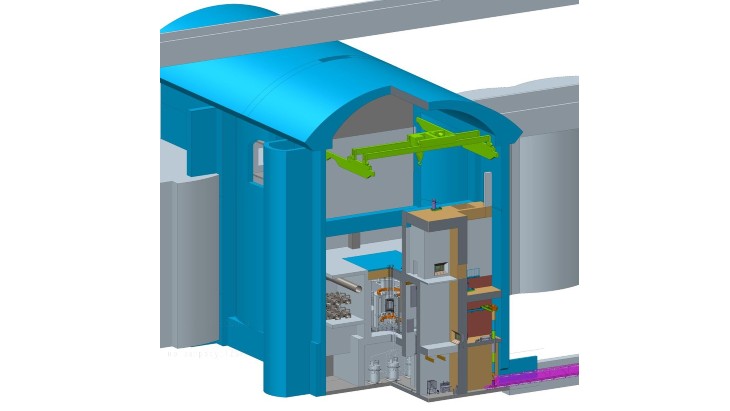
The first stage of design work on a prototype molten salt reactor has been completed, Russian state nuclear corporation Rosatom has said.
Design work progresses for Russian molten salt reactor
(Image: Rosatom)

A preliminary design was unveiled in February 2024. The subsequent phase of design work included the development of materials for the design documentation, under the scientific supervision of the Kurchatov Institute.

Rosatom added: "A brief description of the design of the elements of the nuclear installation and the initial fuel preparation complex was also developed, and the main characteristics of the nuclear fuel and elements of the installation were given. This information will form the basis for the assessment of the impact ... on the environment and a preliminary report on the justification of its safety."

The design stage is due to last until 2027 - the next phase will see the creation of technical designs for the reactor installation and the initial fuel preparation complex.

Dmitry Kolupaev, director general of the Mining and Chemical Combine, said: "Successful implementation of this technology will, among other things, reduce the amount of waste subject to final isolation and the duration of its storage. And in the future, it will create the basis for the development of more powerful molten salt reactors, which will be sufficient for processing the entire volume of the most dangerous components of used nuclear fuel produced by thermal reactors."

Vasily Tinin, director of state policy in the field of radioactive waste, used nuclear fuel and decommissioning of nuclear and radiation hazardous facilities, said: "The implementation of the project will allow us to take the environmental safety of nuclear power to a new level - to take a big step towards waste-free nuclear technologies. The main objective of the technology that we are preparing to develop and which relates to fourth-generation nuclear energy technologies will be the creation of a new system for the disposal (afterburning) of hazardous radioactive substances - minor actinides - which are products of the processing of spent nuclear fuel from VVER and RBMK thermal reactors."

The project plans to use circulating molten salt fuel. And the intention is to continue research and developent work to justify the technological solutions in the design documentation with scaling of the technology expected to continue following the launch of the prototype reactor, which is targeted for 2031. 

It is part of the wider Russian federal project to develop "new materials and technologies for advanced energy systems" and part of the country's goal of closing the fuel cycle. Rosatom says that the period of potential danger from minor actinides can be reduced from 10,000 years to 300 as a result of the process.

While both units 1 and 2 at the Mihama plant have been shutdown, unit 3 of the plant is among the Japanese reactors that have resumed operation, having been restarted in June 2021.

The last nuclear power reactor to be constructed in Japan was unit 3 of Hokkaido Electric Power Company's Tomari plant, which began operation in 2009.

Viewpoint: The vital role of medical isotopes in theranostics
Tuesday, 22 July 2025
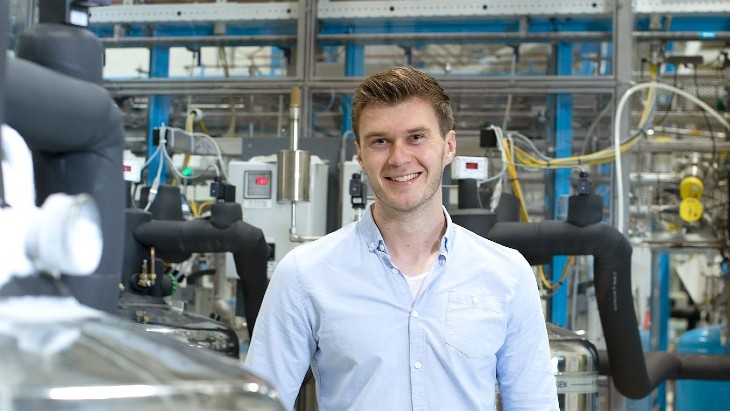
In the rapidly evolving landscape of nuclear medicine, the integration of diagnostics and therapeutics - known as theranostics - represents a groundbreaking shift in how we approach the treatment of life-limiting conditions such as cancer. Wietse Smit, research and development manager, Urenco, looks at the potential, and the challenges, ahead.
Viewpoint: The vital role of medical isotopes in theranostics
(Image: Urenco)

This innovative field leverages the unique properties of medical isotopes to both diagnose and treat cancer, offering a targeted and effective approach to patient care. I have witnessed first-hand the transformative potential of medical isotopes in unlocking the capabilities of theranostics and the potential benefits they offer to patients, their families and the healthcare providers.

At the forefront of this revolution is Urenco, whose pioneering work in developing new production routes for copper isotopes - specifically copper-64 (Cu-64) and copper-67 (Cu-67) - is setting new standards in medical isotope production and delivery.

Theranostics is a combination of "therapy" and "diagnostics", reflecting its dual role in healthcare, particularly that associated with cancer care. This approach utilises radioisotopes to first image the tumour for diagnostic purposes and then treat the tumour therapeutically in a targeted fashion designed to offer the patient the best form of cancer care and treatment.

The process begins with the administration of a diagnostic radiotracer, which travels through the bloodstream and binds to cancer cells. This allows clinicians to visualise the tumour using imaging techniques such as positron emission tomography (PET). This technique is maturing significantly and high-resolution total body PET is revolutionising the way that tumours are found and screened. Once the tumour is accurately located and characterised, a therapeutic radiotracer is administered to deliver targeted radiation to the cancer cells, minimising damage to surrounding healthy tissue and reducing the overall body burden to the already compromised system.

The precision of theranostics lies in its ability to provide tailored, customised treatment to the individual accounting for the type of tumour, the stage of cancer and physiological factors of the patient. By combining diagnostic imaging with targeted therapy, theranostics not only improves the accuracy of cancer treatment but also enhances patient outcomes by reducing side effects and improving quality of life.

Medical isotopes are the cornerstone of theranostics, providing the radioactive properties necessary for both imaging and treatment. At Urenco, our focus has traditionally been on the production of stable isotopes, which serve as precursors for the creation of radioisotopes used in theranostics. At the heart of this offering is the copper 64/67 isotope pair; Cu-64 acts as an imaging agent to detect cancerous cells while predicting treatment efficacy using Cu-67. This dual functionality holds promise for patient treatment but also helps to reduce side effects by sparing healthy tissues. The production of these isotopes involves sophisticated enrichment processes and extensive R&D efforts.

We are exploring new ways to expand our offering of enriched isotopes to meet the growing demand from the medical community. Our work with zinc isotopes, for example, has positioned us at the forefront of developing precursors for theranostic applications, particularly in the emerging field of theranostics.

The impact of theranostics on patient care shows promise. By enabling more precise targeting of cancer cells, theranostics reduces the risk of secondary damage to healthy tissues, a common side-effect of traditional cancer treatments like chemotherapy and external beam radiation. Moreover, theranostics allows for real-time monitoring of treatment efficacy. By using diagnostic imaging to track the distribution and impact of therapeutic agents, clinicians can adjust treatment plans dynamically, ensuring optimal outcomes for patients.

Despite its promise, the field of theranostics faces several challenges. One of the primary hurdles is the limited production capacity for medical isotopes. Currently, the production landscape for Cu isotopes faces challenges due to reliance on nickel-based processes concentrated within limited supply chains. The demand for these isotopes has surged, particularly in the wake of geopolitical events that have disrupted traditional supply chains. At Urenco, we are actively working to expand our production capabilities to meet this demand, but it remains a significant challenge for the industry as a whole.

Another challenge is the need for continued research and development to explore new isotopes and refine existing processes. The field of theranostics is gaining momentum but still requires further understanding and optimisation. There is much to learn about the use of different isotopes in a variety of therapeutic contexts. Collaborative efforts between all parties in the supply chain including industry and academia are crucial to advancing our knowledge and strengthening our resilience and capabilities in this area.

Looking ahead, the future of theranostics is one which has so many benefits to offer. As we continue to refine our techniques and expand our understanding of the underlying science, the potential applications of theranostics will grow and mature offering the much-needed ray of hope for those affected by life-limiting conditions such as cancer. The integration of advanced imaging technologies with novel therapeutic agents holds the promise of advancing healthcare treatments and providing new options for patients.

At Urenco, we are committed to playing a leading role in this transformation. By investing in R&D and expanding our production capabilities, we aim to ensure a reliable supply of the medical isotopes that are critical to the success of theranostics. Our partnerships with academic institutions and other industry leaders will be key to driving innovation and overcoming the challenges that lie ahead.

In conclusion, theranostics have the potential to drive a paradigm shift in life-limiting conditions such as cancer, and offer more targeted, effective, and personalised approach to patient care. The role of medical isotopes in this field is pivotal, providing the foundation for both diagnostic and therapeutic applications.



 AUSTRALIA

South32 Q4 manganese output recovers after cyclone, beats estimates

Image courtesy of South32

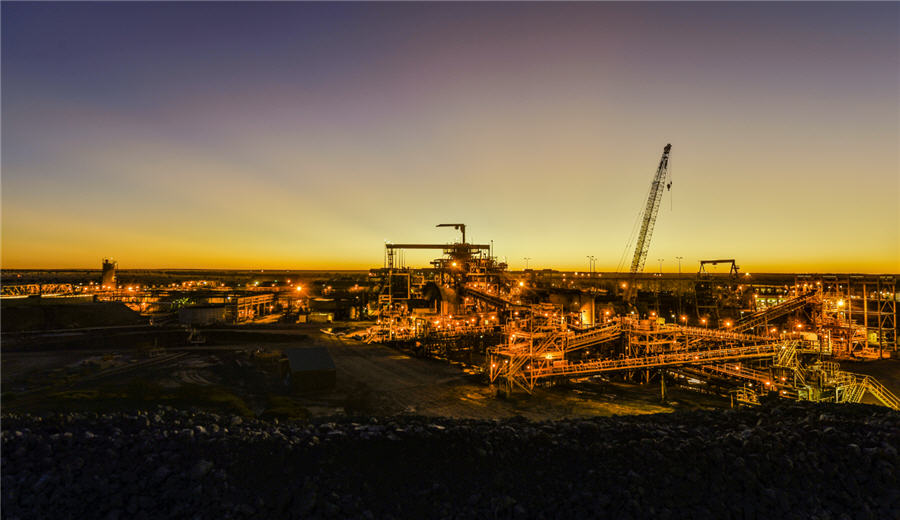
Australian diversified miner South32 reported higher fourth-quarter manganese ore production on Monday, beating analysts’ estimates, as it resumed export shipments from its Australia manganese operations following storm delays.

The company’s Groote Eylandt Mining Co (GEMCO) project in Australia’s Northern Territory faced severe storms in early 2025, making it difficult to get production back on track after a tropical cyclone damaged the site’s vital infrastructure a year ago.

“Australia Manganese successfully resumed export shipments during the quarter, marking a significant recovery from the impacts caused by Tropical Cyclone Megan,” the company said in a statement.

The Perth-based miner said it expects its Australia manganese operation to post a loss of $100 million to $120 million in operating earnings in fiscal 2025, following a restart after disruptions from Tropical Cyclone Megan.

The world’s largest producer of manganese, which is used to improve the quality and strength of steel, clocked an output of 1.1 million wet metric tons (wmt) manganese for the quarter ended June 30, up from 534,000 wmt a year earlier.

The result beat a Visible Alpha consensus estimate of 850,000 wmt, as per Barrenjoey.

The company added it invested $517 million of growth capital expenditure at its Arizona-based Hermosa project in fiscal 2025.

The diversified miner also posted fourth-quarter copper production of 21,900 tons from the Sierra Gorda mine, in which it holds a 45% stake.

South32 in mid-July had flagged an impairment to its Mozal aluminum smelter in Mozambique and said its production was under review because it has not been able to secure affordable power prices after March 2026.

(By Roshan Thomas and Adwitiya Srivastava; Editing by Leslie Adler and Lincoln Feast)


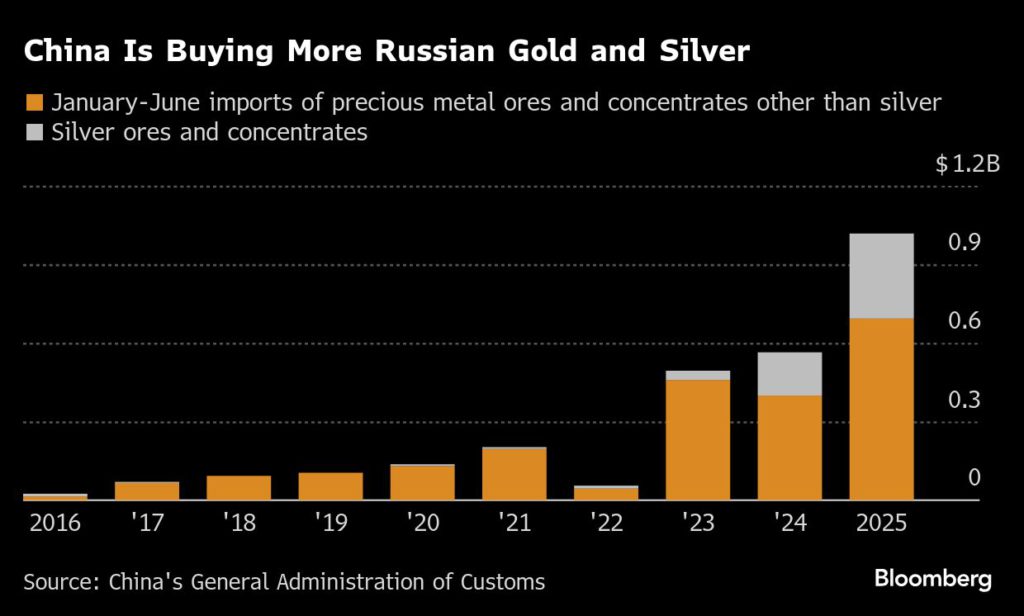
Russian precious metals sales to China hit $1 billion


Stock image.

Russian precious metals exports to China almost doubled in the first half of the year, as record gold prices boost revenue.

Chinese imports of Russian precious metal ores and concentrates, including gold and silver, jumped 80% to $1 billion from the same period a year earlier, according to data from Trade Data Monitor, which sources information from China’s customs office. Bullion prices have climbed about 28% this year, boosted by heightened geopolitical risks and trade tensions, alongside buying by central banks and exchange-traded funds.

Russia, the world’s second-largest gold producer with annual output of more than 300 tons, has been shut out of Western trading hubs like London and New York since its full-scale invasion of Ukraine in 2022. The Bank of Russia, formerly the world’s largest central bank gold buyer, has not resumed large-scale purchases, leaving China as one of the country’s few remaining major markets.


Gold miners in Russia have also been buoyed by growing domestic retail demand, which reached a record high in 2024 as Russians turned to precious metals to safeguard their savings.

Russia’s MMC Norilsk Nickel PJSC, one of the world’s top producers of palladium and platinum, has ramped up exports to China this year. Prices for the two metals jumped 38% and 59%, respectively, this year.

(By Sofia Sorochinskaia and Andy Lin)


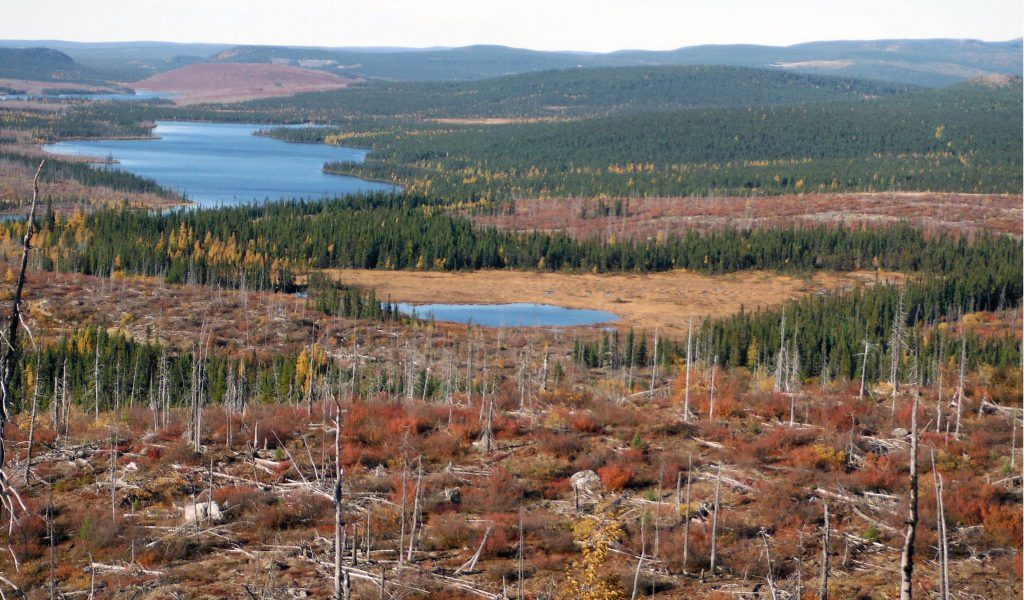
Champion Iron secures $179.1 million from Nippon Steel, Sojitz for Canada project


The Kami open-pit iron ore mine is located to the south of Labrador City and Wabush in the province of Newfoundland and Labrador. Credit: Stantec

Australia’s Champion Iron Ltd said on Tuesday Japan’s Nippon Steel and Sojitz Corp will invest an initial C$245 million ($179.11 million) in its Kami iron ore project in Canada for an aggregate 49% interest.

The investment follows an agreement that the three companies entered into in December 2024 for the project, which Champion Iron acquired in 2021.

Following the initial closing, Champion will hold a 51% interest in the project, while Nippon Steel and Sojitz will have 30% and 19% stakes, respectively.

Nippon Steel, Japan’s largest steelmaker, recently closed its $14.9 billion acquisition of US Steel after an 18-month-long pursuit.

Champion expects the initial closing of the deal to occur in the second half of 2025.

Shares of Champion Iron rose as much as 4.6% to A$5.04 in early trade.

($1 = 1.3679 Canadian dollars)

(By Nichiket Sunil; Editing by Subhranshu Sahu)


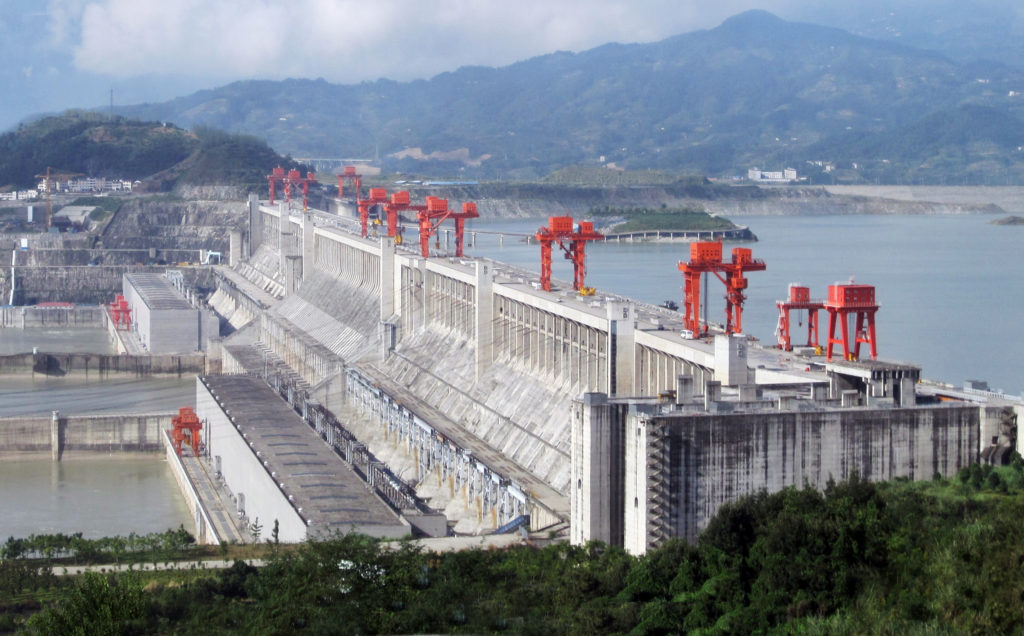
Iron ore price reaches multi‑month highs on China mega‑dam announcement


Three Gorges Dam. Credit: Wikipedia

Iron ore prices surged to their highest levels in nearly five months after China announced construction on a mega‑dam in Tibet.

Market optimism around renewed steel demand, along with ongoing stimulus expectations, bolstered prices. The September iron ore contract on the Dalian Commodity Exchange climbed 2.08 % to ¥809/ton ($112.74), peaking at ¥819, the highest since February 26.

The Singapore Exchange’s August contract rose 2.81 % to $103.60 a tonne, its highest since February 27.

China announced that construction has begun on the world’s largest hydropower dam, a project expected to require three to four times more steel than the country’s 22,000-megawatt Three Gorges Dam, currently the world’s largest capacity hydroelectric power station.

“Iron ore and rebar futures markets are reacting positively to the announcement of the mega-dam project,” Atilla Widnell, managing director at Navigate Commodities in Singapore, told Reuters.

There is little doubt that its construction will significantly benefit local steel markets and could attract construction-grade steel from across China, especially given that it is 3-4X bigger than the Three Gorges Dam, Atilla added.

Steel mill margins also contributed to the run‑up, with mills in China increasing blast furnace activity.

Other steelmaking inputs rallied too: coking coal futures jumped 7.88 %, coke up 5.05 % on Dalian.

(With files from Reuters and Bloomberg)

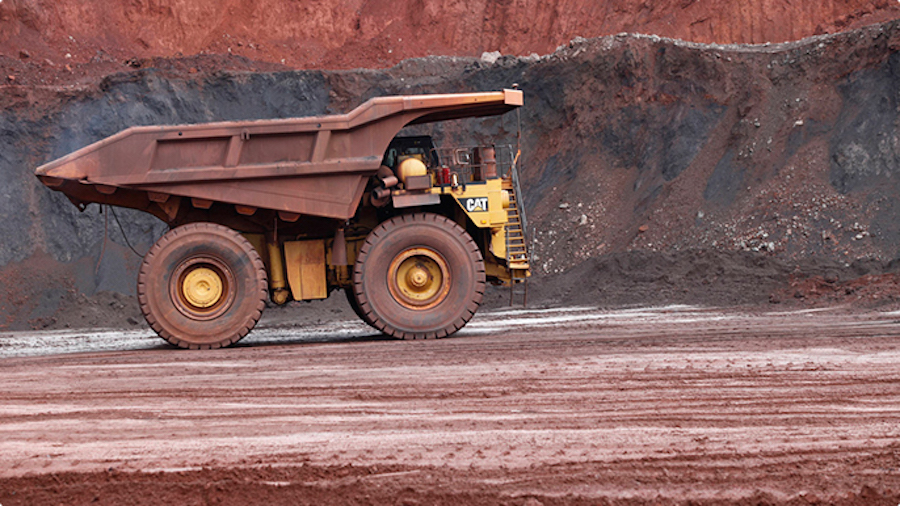
Brazilian miners warned of potential $1 billion in tariff pain


Reference (Image courtesy of Vale)

The Brazilian mining industry is warning of dire economic consequences if the government resorts to reciprocal tariffs in retaliation for US President Donald Trump’s threatened 50% levy starting Aug. 1.

The sector would incur as much as $1 billion in additional costs if Trump follows through on his threat and the Latin American nation adopts such countermeasures, said Raul Jungmann, head of Ibram, a lobby group that represents companies accounting for 85% of Brazil’s mineral production.

Brazilian miners rely on US manufacturers for heavy equipment such as excavators and the mammoth dump trucks that can haul 100-ton loads. Meanwhile, the US accounts for only 3.5% of Brazilian mineral exports, he noted.

“This would represent additional costs of around $1 billion per year” for Brazilian miners, Jungmann told journalists Monday. “Retaliation and reciprocity worry us much more.”

Jungmann’s comments followed a virtual meeting with Vice President Geraldo Alckmin.

Brazilian mining executives are considering engaging US companies in talks to help push the Trump administration to the negotiating table, Jungmann said.

(By Mariana Durao)

OUTLAW SEA BED MINING

Seabed regulators will scrutinize mining firms seeking US licenses

Bloomberg News | July 21, 2025 |


Miners plan to extract cobalt and other battery metals from the seabed
. (Image courtesy of The Metals Co.)


A United Nations-affiliated organization with jurisdiction over the global seabed took a tentative step Monday to respond to US President Donald Trump’s fast-tracking of deep-sea mining for critical minerals in international waters.


The International Seabed Authority’s policymaking body requested the organization’s secretary-general to obtain information from ISA-licensed seabed mining companies at risk of violating their contracts under a UN treaty that prohibits unilateral mining.

That was an oblique reference to seabed miner The Metals Company (TMC), which has applied for US authorization to extract electric-vehicle battery metals in an area of the Pacific Ocean it licenses from the ISA.

Canadian-registered TMC’s US subsidiary applied for a US license in April within days of Trump signing an executive order to expedite the licensing of seabed mining. TMC wants to extract avocado-sized rocks called polymetallic nodules that are rich in metals and cover the Pacific Ocean floor by the billions.

While Friday’s action could potentially affect the future of TMC’s two ISA contracts, one of which is up for renewal in 2026, it wouldn’t necessarily have direct bearing on any US license the company might receive. The US plans to issue the world’s first seabed mining license in international waters under a little-used 1980 federal law.

TMC could not be immediately reached for comment.

Louisa Casson, a Greenpeace deep sea mining campaigner, said the move sends a message to other ISA-licensed seabed mining companies tempted to follow TMC’s strategy. “The international community is taking action to show that rogue actors will face consequences,” she said in Kingston.

Despite the US challenge to the ISA’s 169 member nations (plus the European Union), there was little to no mention of the US president’s action or TMC during the ISA Council’s two-week meeting. “It’s more than an elephant. It’s a blue whale” in the room, French ambassador Olivier Guyonvarch told delegates last Monday.

Observers expect delegates to make more explicit statements about US unilateral mining this week during an assembly of all ISA member states.

The Council, which has 36 member nations, had convened this month to continue decade-long negotiations to draft complex regulations that would allow seabed mining to begin while minimizing harm to deep sea species that inhabit polymetallic nodule ecosystems. Pro-mining nations like China, Russia, Japan and Korea have pressed for the enactment of regulations while 37 other countries are calling for a moratorium on seabed mining until its environmental impacts are better understood


In January, TMC and other ISA-licensed seabed mining companies sent a letter to the Council decrying “the protracted delay” in adopting regulations.

The regulations aren’t likely to be finished for at least another year, if then. As the Council meeting concluded Monday morning, delegates still hadn’t agreed on a number of contentions issues, including a royalty system for deep sea mining and environmental standards.

(By Todd Woody)

Trump’s critical minerals obsession reignites deep-sea mining

Bloomberg News | July 21, 2025 | 


TMC has carried out exploratory mining expeditions to the Clarion-Clipperton Zone (CCZ). (Image: TMC.)


The leader of one of the most aggressive seabed mining startups spent years invoking global warming to spark interest in extracting avocado-sized rocks rich in electric-vehicle battery metals from the bottom of the ocean.


“We want to help the world transition away from fossil fuels with the smallest possible climate change and environmental impact,” Gerard Barron, the Australian chief executive officer of a company then known as DeepGreen, told a 2019 meeting of the United Nations-affiliated International Seabed Authority, which for a decade has been debating regulations to allow the mining of untouched, biodiverse deep-sea ecosystems in global waters.

That’s not Barron’s pitch anymore. Climate was out and critical minerals were in during an appearance earlier this year before a congressional committee in Washington, DC. His firm, renamed as The Metals Company (TMC), would help “ensure the nation’s energy security and industrial competitiveness for generations,” Barron said. “China is close behind.”

Barron’s new tack is working. In April, President Donald Trump issued an executive order expediting US licensing of seabed mining, departing from international law to unleash what the administration called a “gold rush” to “counter China’s growing influence.” The country is set to conduct ISA-sanctioned tests of two seabed mining machines in the Pacific over the next year.

China already dominates the critical minerals supply chain on land, and TMC had successfully tapped into the US president’s pursuit of China-free metals, expressed as a desire for dominion over Canada and Greenland. The global seabed, TMC repeatedly emphasized as it lobbied politicians and the White House, holds the planet’s largest estimated reserves of minerals like cobalt and nickel in the form of black rocks called polymetallic nodules. These cover the Pacific Ocean floor by the billions.

In an instant, Trump cleared the way for a race to the abyss to extract nodules, even though seabed mining technology remains under development and commercially unproven. At the ISA’s annual meeting in Kingston, Jamaica, delegates on Monday decried Trump’s move, with China’s representative denouncing the US for “unilateralist hegemonic acts” and attempting to “replace the global standards with US standards.”


Within days of Trump’s order, Canadian-registered TMC’s US subsidiary filed the world’s first application to mine the seabed in international waters, including an area it licenses from the ISA. An $85 million investment from a leading Korean metals processor soon followed. Nasdaq-listed TMC’s shares, which have periodically languished below a dollar, hit a 52-week high of $8.19 on Thursday.

A Silicon Valley startup called Impossible Metals, meanwhile, has applied for a license to explore and possibly mine nodules in US waters off American Samoa, with an aim to raise $1 billion. Then July 14, a top executive at US defense giant Lockheed Martin told the Financial Times the company is in talks to give seabed miners access to international areas of the Pacific it licenses from the US. A Lockheed Martin spokesperson declined to confirm the report but said, “We appreciate the Trump administration’s focus on ensuring reliable sources of critical minerals, including the ocean.”

On Monday, delegates in Kingston ordered a report on ISA-licensed seabed miners at risk of violating their contracts with the body, a thinly veiled reference to TMC and other companies that might also seek to apply for US licenses to mine in international waters.

The Trump-triggered seabed mining boom faces significant hurdles, though. While TMC has told investors it expects to begin mining within a year of receiving a license, the technology to extract minerals from the seabed at depths of four kilometers (2.5 miles) could be years away from being deployed at scale. Its competitiveness with terrestrial mining is unknown, as is the economic viability of processing and refining seabed minerals amid seesawing metal prices and the growing market share of battery technologies not reliant on nodule metals. The US lacks such metallurgical capacity, and it could take years to bring online in the few countries outside of China with the potential to refine nodule minerals.

“Given the rapid evolution of batteries and other relevant technologies, there is great uncertainty about the future demand for critical minerals,” researchers at RAND wrote in a recent report. “A seabed mining industry, as a whole, faces considerable opposition from nations and organizations concerned about the potential negative environmental impacts.”

The White House did not respond to a request for comment.

The countries that TMC relies on for seabed mining and processing technology are among the ISA’s 169 member nations (plus the European Union) that oppose unilateral mining in international waters. Amid such backlash, a Japanese corporation, Pacific Metals Company, that planned to process TMC’s nodules has now told investors that it would only “launch operations once the international rules are finalized.”

“All those parties have a legal obligation to ensure that deep sea mining only takes place through the ISA,” says Samantha Robb, an Amsterdam-based attorney who specializes in ocean litigation.

At the ISA, delegates convened behind closed doors on Friday to debate how to respond to TMC’s plans. Barron, who once sat with the delegation of a tiny Pacific island nation that sponsors one of TMC’s ISA contracts, has been absent this year but he’s weighing in from afar. “Amid some noisy grandstanding coming out of Jamaica this month, this is a good reminder … the US has every right to pursue seafloor resources in international waters,” he wrote Wednesday on X.

In a statement to Bloomberg Green, TMC says it’s “on firm legal and regulatory footing,” citing the sizable investments it’s recently attracted. The company, however, cautioned investors in a May securities filing that a US mining license wouldn’t be recognized internationally, which could affect “logistics, processing, and market access” for the seabed minerals TMC mines.
‘It’s going to take some time’

More than a thousand miles southwest of Mexico on a September morning in 2022, a yellow, 80-metric-ton machine slowly rumbled across the seabed on tank-like treads, a plume of sediment billowing behind. During a two-month test for TMC, the 38-foot-long prototype vacuumed up 3,000 metric tons of nodules, sending them through a tube to a specialized surface vessel called the Hidden Gem.

TMC hailed the trial as a success. Yet any commercial operations are a ways off, even if the US grants TMC a mining license this year, given technological and legal obstacles that must be overcome.

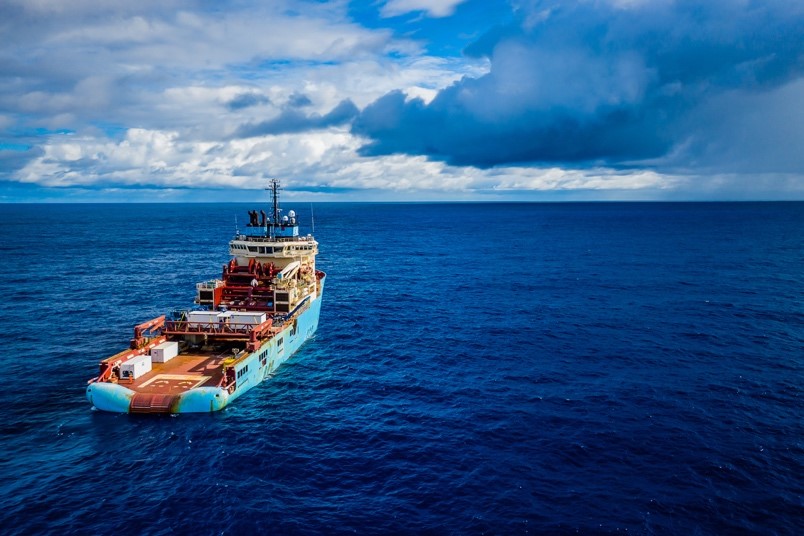
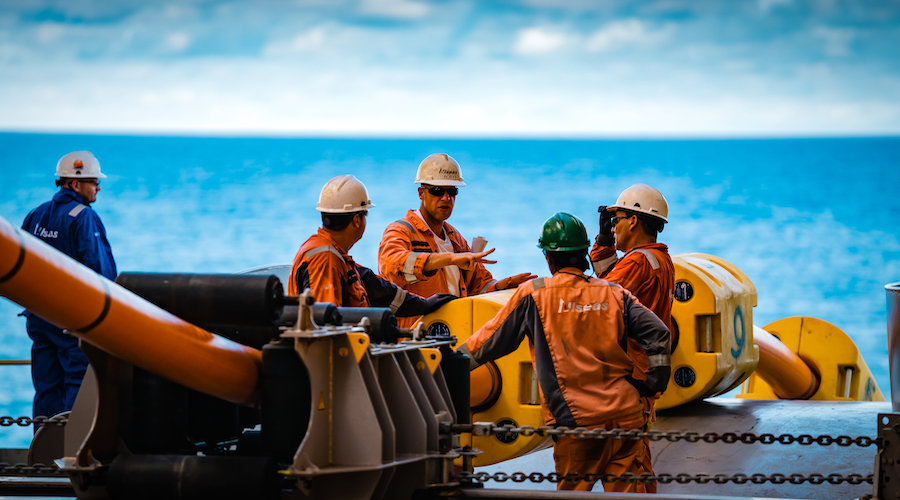
Allseas, a Dutch-owned, Swiss-registered offshore engineering and construction company, developed the technology, the world’s only working prototype of a nodule mining system. The company supplies the apparatus to TMC and is its second-largest shareholder. To meet TMC’s production targets, it must now build a much bigger version capable of harvesting nodules nearly around the clock under crushing pressure far from shore.

A US seabed mining license, however, would require TMC to deploy American-built and owned vessels. How the companies would comply with that mandate is unclear. Allseas said in a statement that it would take about two years to engineer the technical systems to support full-scale mining but it won’t begin that work “until we are confident that all relevant regulatory conditions are met.” Allseas, which itself owns an ISA-licensed seabed mining company, has come under pressure from Dutch politicians and activists not to provide technology for unilateral mining.

TMC says it can’t comment while its US mining license application is under review. But in a May 14 securities filing the company said it’s “evaluating US-based vessel” options. However, the US hasn’t built a specialized seabed mining ship like the Hidden Gem, and only eight US ocean-going bulk cargo carriers — large ships that can hold tens of thousands of pounds of nodules and transport them to shore — are in service. Seven of them are at or near the end of their lifespan, according to a 2024 US Maritime Administration report.

Impossible Metals uses a nodule collector, called Eureka, that’s designed to hover above the ocean floor, its robotic claws selecting individual nodules that its artificial intelligence program determines aren’t inhabited by marine organisms. (Scientists estimate that at least 30% to 40% of deep ocean life in the seabed targeted for mining live on nodules.)

The company has delayed a planned trial of the Eureka in an ISA-licensed area of the Pacific until at least 2027 because the technology needs further refinement. And any mining wouldn’t happen until at least the early 2030s. Impossible Metals’ mining license application is for US waters, not areas controlled by ISA. “That’s far less controversial,” said CEO Oliver Gunasekara. “But obviously it’s going to take some time.”
What it takes to process a nodule

In a small lab in Pasadena, California, scientists at an Impossible Metals spinoff called Viridian Biometals are trying to crack a problem about as challenging as pulling nodules out of the abyss: getting the metals out of the nodules.

Nodule minerals precipitate out of seawater, forming layers around a piece of whale bone, a shark tooth or another small object at the rate of a few millimeters every million years. Unlike terrestrial minerals, where a couple of different metals might be found together in a deposit, nodules contain nickel, cobalt and copper particles scattered throughout every rock, mostly embedded in a matrix of manganese oxide.

“The treatment of materials that contain all four of these elements is not something that is commercially done today,” said Lyle Trytten, a veteran of the metals processing industry and president of Canada-based Trytten Consulting Services.

Viridian scientists are tinkering with rock-breathing microbes that oxidize nodules to extract the most valuable metals. On a June afternoon, senior scientist Kenny Bolster opens up what looks like a freezer to reveal stainless steel bioreactors. As microbes inside oxide the manganese bits, they release nickel, cobalt and copper ions into a solution.

“All this happens at ambient temperature and pressure, which saves an enormous amount of energy and doesn’t produce any toxic waste,” says Viridian CEO Eric Macris.

It’ll take a few years to assess whether the technology is likely to be commercially feasible. “We love what Viridian is doing but we’re just not sure if it will be mature enough when we need it,” says Impossible Metals’ Gunasekara.

If TMC, Impossible Metals and other companies mine the ocean floor under a US license, then federal law requires the minerals to be processed and refined in America. Aside from Viridian’s early efforts, the US has no such capacity.

A single facility in the US capable of processing and refining nodules would cost several billion dollars, and could take up to a decade to reach full production, in part due to the complexities of handling an entirely new feedstock, according to Niels Verbaan, director of metallurgy technical services for Swiss testing and certification company SGS.

The US tax and spending bill enacted on July 4 allocates $5.5 billion to the Department of Defense for investments in critical minerals supply chains. But the US has suffered a precipitous decline in metallurgical expertise since the 1980s when universities began to eliminate related degree programs. “We are decades behind now, and it’s going to be very hard to catch up,” says Corby Anderson, a professor of metallurgical and materials engineering at the Colorado School of Mines. New immigration restrictions will also make it harder to recruit engineering talent from overseas.

China has invested heavily in the industry and is now in a position to retrofit existing facilities to process nodules or build dedicated new plants. The country processes 74% of the world’s cobalt ore, according to a 2024 report from the Wilson Center, a nonpartisan think tank, while 97% of global nickel ore processing capacity lies outside of North America. China also maintains more than 80% of the capacity for refining those metals into advanced EV battery materials.

There’s few existing facilities outside of China capable of handling nodules, even if a US seabed miner receives permission to use them and the owners are willing to revamp operations, according to industry executives. “These processing plants are not just sitting there idle begging for feed, they’re all in use today,” says Trytten.
The ‘blue whale’ in the room

TMC has found one overseas metals processor willing to make the switch. Last year, Pacific Metals Company of Japan fed a 2,000-ton pile of nodules collected by TMC in 2022 into an electric-arc furnace to produce 500 tons of a material. In February, it was smelted into a nickel-cobalt-copper alloy.

Japan finds over 200 million tonnes of battery metals in seabed

“These process plants are very expensive to build, they’re very complicated, they’re very risky,” says Jeffrey Donald, TMC’s head of onshore development. “So by using an existing asset, existing operators, you’re really taking that capital off the front end and you’re really de-risking the technology and operations aspect.

In April, Pacific Metals announced it would transition from processing nickel ore to smelting nodules. But it doesn’t expect full production to begin until 2029 at the earliest.

TMC has also struck a deal with metals giant Korea Zinc, which is assessing the feasibility of refining nodules into battery materials, a process TMC has so far tested only in the lab.

Whether nations would be enabling deep-sea mining through commercial relationships with US-licensed seabed mining companies was the subject of whispered conversations among ISA delegates this month as they continued drafting mining regulations. Trump’s move to mine in international waters and TMC’s defiance of the ISA was, as French ambassador Olivier Guyonvarch alluded, “the blue whale” in the room. Observers expect the ISA delegates to make public statements by the end of the annual meeting this week.

The UN Convention on the Law of the Sea prohibits unilateral mining by any country or corporation. It also requires the ISA to administer the global seabed for the benefit of humanity, with any royalties from mining divided among member states. The US never ratified the treaty, though it had generally adhered to its provisions and still participates in ISA proceedings as an observer.

Pressure is growing on member states to not supply technology to seabed mining companies the US licenses, process their nodules or buy metals from them, as the treaty mandates ISA countries treat unilateral mining as illegitimate. Thirty-seven ISA countries support a moratorium on seabed mining until its environmental impacts are better understood.

“The risks of bypassing the ISA’s oversight are not only legal, they are also economic,” ISA Secretary-General Leticia Carvalho said in a statement to Bloomberg Green. “Product lines derived from ventures that violate international law will carry reputational and legal concerns that increase the risk of the investment and can undermine its return.”

Pacific Metals appears to have gotten the message. In a recent investor briefing, the company, which did not respond to requests for comment, emphasized that when it comes to nodule processing, it considers “international credibility to be a material issue.”

(By Todd Woody)

Tuesday, July 22, 2025

POSTMODERN MERCANTILISM

Copper-laden ships race to reach US ahead of Trump’s 50% tariffs


Stock image.

At least four ships carrying copper are trying to reach US ports before August to get ahead of planned import tariffs on the metal.

The shipments represent the final scramble by merchants to cash in on a lucrative arbitrage trade that has upended the global copper market since US President Donald Trump first floated the idea of copper tariffs. The urgency to secure imports increased in the past two weeks after Trump announced the levy would be 50% starting Aug. 1.

Bulk carrier Kiating left Australia’s Townsville port last Wednesday carrying 8,000 metric tons of refined cargo and is destined to reach Hawaii by July 30, according to shipping data provider Kpler. The firm can’t identify who owns the cargo, but it said two other recent US-bound shipments from the port contained copper from Glencore Plc’s Mount Isa Mines.

Port data show that the Kiating was originally scheduled to land in New Orleans, but changed its destination to Hawaii after Trump’s announcement — cutting its likely voyage time by almost 20 days. Even so, the cargo owner will be in a race against time to register the metal with the local customs office once the vessel arrives.

“It’s hard to say how efficient clearance will be in Hawaii, given that it’s such an atypical destination for this cargo,” said Ben Ayre, lead dry-bulk shipping analyst at Kpler.

In Latin America, three vessels brimming with Chilean copper are also rushing to get to US ports. Cargo ship Louise Auerbach is near Colombia’s Buenaventura port and en route for a July 28 arrival at Tampa, Florida, according to data compiled by Bloomberg and people with knowledge of the voyage. The BBC Norway is in Panama and the BBC Campana is anchored off northern Chile’s coast, according to the latest shipping data.

The vessels are among the last batch of copper cargoes whose owners are betting they can clear US customs just before the tariff bites. For reference, the difference between arriving ahead of the levy and having to pay it would be more than $70 million on a typical bulk carrier cargo of 15,000 tons. The voyage from northern Chile to southern US takes 10 to 15 days.

To boost the chances of landing before the tariffs, shippers can attempt to clear customs for the entire cargo at their first US port of call. They can also pay for preferential spots in the lineups, turning what can be days of waiting into just hours.

With copper prices surging in the US, traders including Glencore, Mercuria Energy Group, Trafigura Group, Hartree Partners LP and IXM SA have shipped huge volumes to US ports since Trump ordered the Commerce Secretary in February to consider tariffs as part of an probe into the impact of foreign copper on the US.

The tariff trade allowed those firms to capture profits that industry veterans say are the biggest they’ve ever seen. A 50% copper tariff is double what many analysts and traders expected, and prices in New York surged even more after Trump’s July 8 tariff announcement, creating even bigger potential profits for traders who can get vessels to America in time.

With copper trading at about $9,900 a ton on the London Metal Exchange, a 50% levy would mean US buyers need to pay a further $4,950 to customs authorities to import copper into the country. Nominally, traders stand to make nearly as much in profit if they can import the metal before the tariffs land in less than two weeks.

Traders are still awaiting key details about the tariffs, particularly whether there will be a grace period for cargoes that are already on the water — as there have been when similar levies were imposed on aluminum and steel.

(By Yvonne Yue Li, Julian Luk, James Attwood and Archie Hunter)


Aclara seeks state funding for US-Brazil plans


ALL CAPITALI$M IS $TATE CAPITALI$M


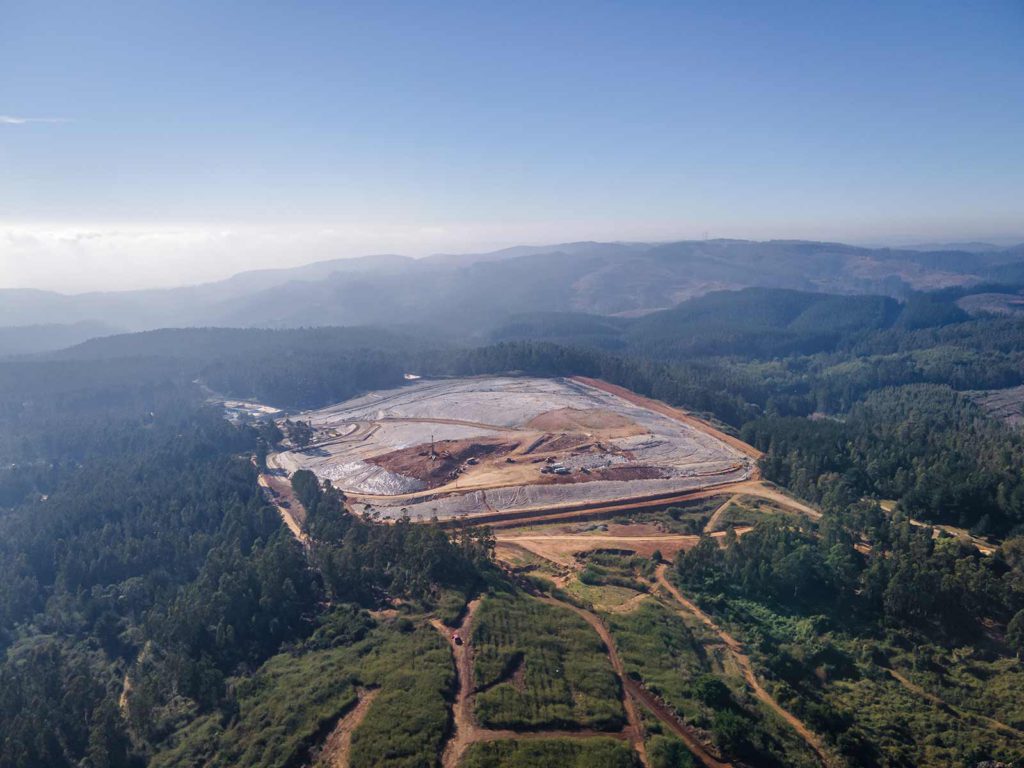
Landfill in Penco project. Credit: Aclara

Aclara Resources Inc. is in talks with US government agencies for possible financing toward its $1.5 billion plan to mine rare earths in Latin America and develop processing facilities in the US.

The company is looking to leverage efforts by Western governments to reduce reliance on China, which currently makes about 90% of the world’s rare earth permanent magnets.

Aclara has filed funding submissions with US agencies and is preparing to present its case in Washington, chief executive officer Ramon Barua said in an interview. The firm sees an opportunity after the Pentagon’s recent arrangement to take a stake in the only US producer, MP Materials Corp.

“Those conversations right now are private, but a project like ours definitely catches the attention of the administration,” he said. “So we’re trying to explore together with them if there’s an opportunity to join forces.”

Aclara is 57% owned by the Hochschild Group and trades in Toronto, where it as a market value of about $245 million. The firm, which doesn’t generate revenue, has two development-stage projects — one in Chile and one in Brazil.

Barua declined to say which agencies Aclara is dealing with or what form financing could take. He did make note of grants and loans offered by the Department of Defense as well as the Energy Department and the US International Development Finance Corporation, as well as the Pentagon’s $400 million equity investment in MP Materials earlier this month to fund a major new magnets plant.

That deal implies prices that are double those in China, and the new US facility would need the kind of elements that Aclara plans to mine in Brazil and Chile.

“We have something that is perfectly complementary to their MP Materials deal,” he said.

Aclara wants to begin tapping ionic clay deposits in Chile and Brazil by 2028, supplying elements used in applications such as electric vehicles and wind turbines. “If we want to meet that goal, we need to have significant funding between now and the end of the year.”

Besides the extraction projects in Chile and Brazil, Aclara is considering locations for a processing plant in the US, with Louisiana, Texas, South Carolina and Virginia all candidates. It also has an accord with German magnet maker Vacuumschmelze GmbH, which is set to build a facility in South Carolina.

To be sure, it’s not the first time rare earths have captured global attention. In the early 2010s, companies including Molycorp Inc. rode a wave of investor interest, until the market crashed as more supply came on and consumers switched to cheaper alternatives.

The industry still faces plenty of hurdles beyond pulling elements out of the ground such as competing with China in processing and creating a price benchmark outside China’s opaque market.

But a recent uptick in geopolitical tensions — after China imposed restrictions on exports and the US announced the MP Materials deal — is changing the tone of conversations with prospectives investors, Barua said. Previously talks focused on prices. Now, investors are more concerned about how soon projects can get started, he said.

“For projects like ours that require funding and offtake agreements, recognizing that the price of these elements is significantly higher than what the Chinese suggest, is very important,” he said.

(By James Attwood and Mariana Durao)


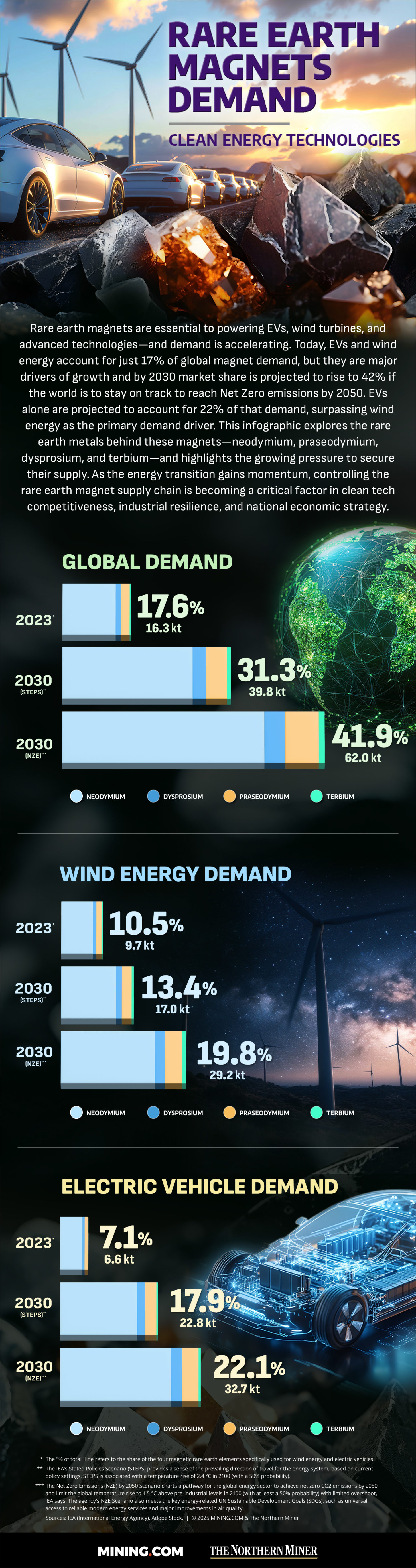
Infographic: Rare earth magnets demand for clean energy tech

Rare earth magnets are vital for electric vehicles (EVs), wind turbines, and advanced technologies—and demand is rising fast.

Currently, EVs and wind account for just 17% of global magnet use. But by 2030, that share could jump to 42% to stay on track for Net Zero by 2050.

EVs alone are expected to drive 22% of this demand, overtaking wind. This infographic by MINING.COM and The Northern Miner highlights the key rare earth metals for magnets—neodymium, praseodymium, dysprosium, and terbium—and the growing need to secure their supply.

Watch: In this 18-minute presentation at the CentralMinEX conference in Newfoundland, The Northern Miner Group President Anthony Vaccaro examines how the world is fracturing into competing spheres of control.

(By Anthony Vaccaro; Files from: Ali Ravaghi; Creative: James Alafriz)