Sunday, September 07, 2025

PETITION

Say NO to US Assault on Cuba’s Medical Missions
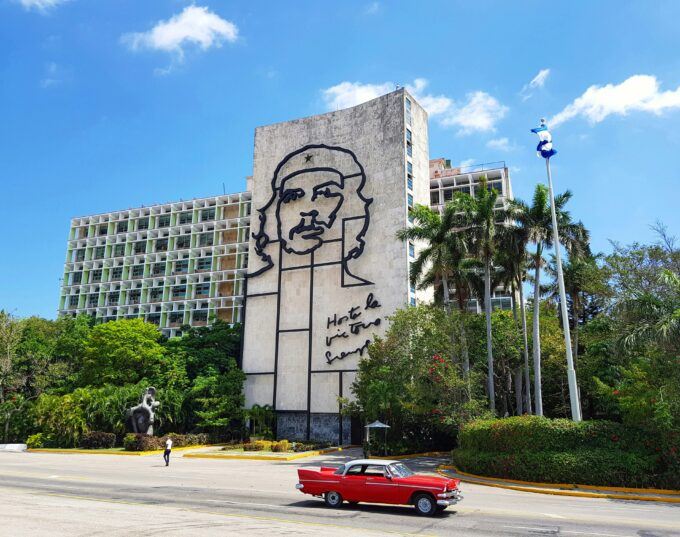


 September 5, 2025

Image by Soonha Jo.

The UN General Assembly’s August 25 session on global health and foreign policy heard from Cuban Ambassador Yuri Gala López. Cuba’s top UN official mentioned that, “we have helped to prepare tens of thousands of doctors from various countries of the Global South.” He denounced U.S. inclusion of Cuba on its list of State Sponsors of Terrorism and then turned to “the slanderous U.S. campaign directed at our medical services.”

“Selfishness must be banished from international relations, and unilateral coercive measures that negatively impact the enjoyment of the right to health must be eliminated,” he insisted. But his generalities leave unsaid the anti-human, cruel, and cynical nature of a new mode of U.S. attack on Cuba. Now the U.S. indicts Cuba for taking healthcare to the world, for practicing international solidarity.

We urge readers to sign a petition demanding that the current U.S. assault on Cuba’s medical missions stop. The Bay Area Cuba Solidarity Network and the US-Cuba Normalization Conference Coalition collaborated in presenting the petition.

It calls upon the U.S. government to end “the U.S. slander campaign against Cuba’s medical brigades” and remove “visa restrictions on countries that contract with the brigades for much-needed healthcare services.” The petition with its signatures will be delivered to elected officials of the U.S. government and to delegations of the various countries belonging to the UN General Assembly.

What follows here is advocacy in the form of basic information about Cuba’s international medical solidarity and about U.S. anti-Cuban hostility that would bring down even the most beneficent of human undertakings. The report concludes with a link allowing readers to sign the petition.

From the time of Cuban national hero José Martí (1853-1895), Cuba’s Revolution has attended to the aspirations of oppressed peoples everywhere. With the victory of the Revolution in 1959, allowance for decent healthcare emerged as a foremost goal, and not solely for Cubans.

Speaking in October 1962, Fidel Castro declared that, “With a view to the future, … the definitive solution is the mass training of doctors. And the Revolution has strength today … to begin a training plan for doctors in the quantities that are necessary. And not only many, but above all good ones; and not only good as doctors. but good as men and as women, as patriots and as revolutionaries!”

By 2022, Cuba had sent 605,698 healthcare workers of all sorts to 165 countries.

The U.S. government announced on February 17 that, “current or former Cuban government officials, and other individuals, including foreign government officials … [and] the immediate family of such persons” will no longer be receiving visas for travel to the United States. The policy “targets forced labor linked to the Cuban labor export program [involving] Cuba’s overseas medical missions.” It applies to officials of the various countries who make arrangements for the visiting Cuban doctors and other healthcare workers.

Secretary of State Marco Rubio on June 3 announced visa restrictions imposed on unnamed officials in Honduras, Nicaragua, Guatemala, and El Salvador who are somehow linked to the Cuban doctors. On August 13, the State Department identified officials of Brazil, Grenada, and several African countries would not be receiving visas.

U.S. officials justify the new policy as the U.S. response to the Cuban government’s exploitation of Cuban healthcare workers, which is cast as “human trafficking.” The U.S. itself, of course, has its own record replete with actions taken at home and abroad leading to oppression of already marginalized and needy populations.

The Cuban doctors and nurses working abroad receive a stipend from host governments that cover living expenses. Families in Cuba have access to their regular pay, plus a bonus for overseas service.

The fabricated charge of forced labor becomes a U.S. tool for solidifying its economic blockade of Cuba. The medical missions are vulnerable to sanctions because they produce income for Cuba’s government, the object of U.S. wrath. The yield in 2018, for example, was $6.4 billion.

Cuba uses funds derived from the medical missions to help pay for Cuba’s own healthcare system. The U.S. attack on the medical missions is not new; between 2006 and 2017, the U.S. government offered inducements for the Cuban doctors to abandon their posts and move to the United States. Fewer than 2% did so.

Notable examples of countries paying for medical services under Cuban auspices include: Brazil, where some 8500 Cuban healthcare workers served during the Delma Rousseff presidency; Italy, host to 370 Cubans serving now in Calabria; Mexico, having welcomed 3100 additional Cuban physicians in 2024; France, concerned about medical care for its colony Martinique; Saudi Arabia, workplace for 600 Cuban doctors from 2014 on; and Qatar, employer of 52 doctors and 292 nurses from Cuba during the Covid era.

Not only do medical missions provide income for Cuba’s government, but they also cost. Scholar Helen Yaffee indicates that 27 of the 62 countries hosting Cuban doctors in 2017 paid nothing for care received from Cuban providers.

Cuba’s medical internationalism is of heroic proportions. Cuban healthcare workers were confronting the deadly Ebola epidemic in West Africa in 2014-2016. At least 42 countries called upon them to treat Covid-19 patients. After a terrible earthquake, they were saving lives in Pakistan’s mountains in winter 2005. They cared for the afflicted in Haiti after the giant 2010 earthquake there.

Around the globe, Cuba’s brigades of emergency health workers have been present relieving suffering associated with epidemics, floods hurricanes, and earthquakes; 13,467 of them have served in 56 countries since 2005.

Reviewing the scandalous U.S. treatment of Cuba’s medical missions, Hernando Calvo Ospina, a Colombian journalist living in France, noted recently that, “Where the United States and Europe sends troops, Cuba sends doctors,” also that, “To date, no government, private entity, or international organization has managed to structure a global medical program that provides an effective, large-scale response to people in need the way Cuba does.”

This report turns to readers: if the information offered here leads you to a negative view of the U.S. assault on Cuba’s medical internationalism, you might now weigh in and say NO. You can do exactly that by adding your name to the petition noted above. Click here to register your NO vote:

SIGN PETITION

W.T. Whitney Jr. is a retired pediatrician and political journalist living in Maine.

Fewer Immigrants Means Fewer Workers, Less Growth


 September 5, 2025

One of the releases from the Bureau of Labor Statistics (BLS) that gets relatively little attention is its annual projections for growth in employment by industry and occupation over the next decade. BLS’s latest numbers are worth at least a few minutes of thought.

BLS projects that the economy will add 5.2 million jobs between 2024 and 2034, an average of 520,000 a year or 43,000 a month. That compares to job growth of 19.2 million in the decade from 2014 to 2024.

The slower job growth should not be a surprise. Immigrants accounted for 6.6 million of the job growth in the decade from 2014 to 2024. As a matter of policy, the government is now sharply limiting immigration going forward and deporting many of the people who are already here. The growth of foreign-born workers in the labor force will clearly be far less going forward than it was in the last decade.

The baby boom cohorts are also retiring in large numbers. In 2024 the baby boomers were between the ages of 60 and 78. By the year 2034, the youngest baby boomers will be turning 70. Very few boomers will still be in the workforce at that point.

While women’s labor force participation can still rise some to match rates in other wealthy countries, the participation rate for prime-age women (ages 25 to 54) has been nearly stagnant for a quarter century. Policies like improved childcare, more flexible work schedules, and increased opportunities to work from home can increase participation, but we seem to be headed in the opposite direction at the moment.

The BLS projections imply employment will grow at the rate of 0.3 percent annually over the next decade. GDP growth is roughly equal to the sum of employment growth and productivity growth. The Congressional Budget Office (CBO) projected that productivity growth would average 1.6 percent over the decade, which would imply average GDP growth of 1.9 percent.

However, productivity growth averaged just 0.3 percent in the first half of 2025. It would be wrong to extrapolate from such a short and unusual period, but it does point to a risk of things going badly. Of course, if AI and other technologies pan out as the optimists hope, we could do much better than the CBO projections.

It is also worth noting the distribution of the projected job gains. BLS projects that just under 2 million of the new jobs, or a bit less than 40 percent, will be in the categories of healthcare and social assistance. Professional, science and technical services are projected to account for 16 percent of the job gains and restaurants and hotels for 11 percent. Manufacturing is projected to lose a small number of jobs over the decade, while employment in the mining sector is projected to fall by 1.6 percent.

BLS’s track record with these projections has not been great. In 2014 it projected job growth of 9.8 million over the next decade. As noted earlier, the actual number ended up being 19.2 million, which was boosted by the large inflow of immigrants, especially in the years following the pandemic.

The errors have gone both ways. In 2004, BLS projected the economy would add 18.9 million jobs. It ended up adding just 7.2 million jobs over the decade. They obviously did not anticipate the collapse of the housing bubble and resulting financial crisis and recession.

Given these misses, we probably should not put too much confidence in the employment projections for the next decade. However, they are reasonable extrapolations of recent trends and known demographic features, like the aging of the population.

This first appeared on Dean Baker’s Beat the Press blog.

Dean Baker is the senior economist at the Center for Economic and Policy Research in Washington, DC. 


Witch Hunts


September 5, 2025


On 18 August 2025, Max Blumenthal, one of the main voices of The Greystone podcast, interviewed Prof. Glenn Diesen, a political scientist at the University of South-Eastern Norway, and a recognized expert on present day Russia. Prof. Diesen’s position is that the war in Ukraine is the result of mistaken policy decisions made by Western leaders resulting in NATO’s incursion into Eastern Europe. For what it is worth, this is the position I have held from the beginning of the war (see my blog “Russia Reacts to NATO and History,” 20 January 2022). Here are some of the statements Diesen made during the interview (I have edited them for clarity):

+ “The Russians invaded after they tried [by diplomacy] for years to stop NATO’s incursion into Ukraine. And they see this as an existential threat…. It doesn’t matter if the EU leaders or people in Washington don’t agree….They [the Russians] have demanded as the foundation of any peace Ukrainian neutrality, which means no more NATO expansion. They’re not going to move away from this.”

+ “And if this had been February of 2022, that [Ukrainian neutrality] would have been enough. But as we know, at the peace negotiations back in Istanbul three and a half years ago, the British and Americans sabotaged it…. And now there’s been territorial changes [in Russia’s favor] throughout the resulting war. So now the Russians are saying they want the neutrality of Ukraine plus territorial concessions. The demand for territorial concessions is also due to lack of trust…This is what happens when a great power says there is a threat to its national security.”

+ “The only reason why we have the meeting in Alaska [August 15, 2025] is because Russia is winning. The Russians have been making huge progress. You wouldn’t always know it from watching the media, because again, there’s a lot of narrative control. So from the Russian perspective, a ceasefire is not peace. And this is why Putin convinced Trump that a ceasefire doesn’t do it. The idea that Trump can now just pressure Russia  to do anything, it’s ludicrous…. So now the alternative isn’t between this horrible deal and something good. It’s between this horrible deal and something even worse. The former advisor of Zelensky made the point. Either we give up four territories or we give up eight territories. So, you know, let’s go for the four. There’s no other good deal here.”

+ “This idea that it was just Russian imperialism, there’s no evidence for it. The Russians actually were willing to compromise [for security guarantees]…. Three months before the war I was saying, give the Russians security guarantees, otherwise, war will be unavoidable.” 

“Narrative Control”

It’s at this part of the interview that Blumenthal announced that “I’m being told by many people in the chat that this stream on YouTube, at least, will not play in the EU. I’m having people from Germany, the UK, and Norway tell me that.” That was an obvious attempt at “narrative control.”

“Narrative control” is a form of censorship usually thought to be operating only in dictatorships—a necessary pillar of a political regime that seeks to practice a form of mind control over a population’s thinking. However, it has also been applied successfully in the democratic West. And, it is important to note that, over time, leaders are no less subject to “narrative control” then are their national populations. Signs of the success of “narrative control” are seen in repeated foreign policy failures, such as NATO policy decisions that led to the Russian/Ukraine war. Another major and ongoing area is Israel, Zionism and a definition of antisemitism that has tied us to the Zionist state. In this case we now live with the genocidal consequences of over a century of “narrative control” on the subject of Zionism and Israel. There are plenty of other cases of “narrative control.” For instance, how we see Cuba, Venezuela, Yemen, among others. 

The vital question here is not whether any of these states are democratic, communist, or otherwise autocratic. The question asked by most Western policy makers is, does a regime follow the line dictated by the West’s dominant polity maker—the United States. Such policies are the product of over a century of “narrative control” that acts like a “Procrustean bed” on our view of the world. What is more, an effort is made to defame any challenging outspoken individual who can command an audience.

Consequences of Deviation

At this point of the program Max Blumenthal asks Prof. Diesen what are “the motivations of those who have attacked you?…Is it  purely ideological, are they really just zealots or is there not a material basis for their opposition to you?” Diesen replies in terms of “narrative control.” Thus, “as long as people accept the stereotype, then the facts don’t really matter that much anymore.” This includes the leaders in the West, like NATO Secretary General Mark Rutte who said, “either we send weapons [to Ukraine] or we have to learn to speak Russian.”

Diesen described most of the attacks on him as “ad hominem.” “Their arguments are indefensible, but it seems to make no difference. My argument was that we should not boycott diplomacy. This was interpreted as a pro Russian and anti-Ukrainian stance….We never discuss the security concerns of our opponents. It’s just they are all really bad men. This is a really bad environment to debate anything.” And Diesen becomes one of the really bad men. Thus, “derogatory letters are written to my university. Negative articles are written about me all the time. Pictures of my house have been posted on the Internet. When I am invited to give talks people try to have them canceled. It’s a very ugly environment here {in Norway]. And only a few days ago, There was this strange campaign in the media in which they said that they had evidence that I was part of a Russian influence operation. And the reason why, well, they got an invitation list to a conference I attended in Kaliningrad in April of last year. And they said, oh, look, he’s on the list of foreign people who have been invited…. And they presented this as if it would be a list of agents of Russia. But it was a conference devoted to Immanuel Kant. It was his 300th birthday. I mean, it is so stupid. And now all the media just referred to me as being exposed as part of an influence operation. And when all of this is exposed as being a big hoax, nothing is done to correct it. They don’t mention that they’ve gotten something wrong. They don’t discuss the consequences of getting it wrong. They are still encouraging the university to fire me. Now I am apparently a traitor. It is very authoritarian and ugly.”

A significant part of Prof. Diesen’s experience is the “complete lack of argument from the other side.” What we have is a tactic that substitutes personal vilification for rational argument. For instance, there is no debate as such here in the United States about the supplying offensive weapons to a state that’s committing genocide. And vilification, to say nothing of the risk to one’s job or university enrollment, is what one suffers for supporting the Palestinians. This is the case on an increasing number of major American college campuses, where open debate is supposed to be protected free speech. So Prof. Diesen is not alone experiencing this sort of harassing response.

Conclusion

What is happening to Prof. Diesan can, and does, get much worse. Besides the harassment on college campuses described above, the Israelis have killed at least 200 journalists and press photographers and imprisoned 90 more. The role of Russia as an influencer is nothing compared to Israelis and Zionists. 

The ability to tolerate a large variety of voices is the sign of a healthy community. Perhaps the only exception to this is the purposeful inciting of a riot or other violence. It is the sign of our times that the President of the United States, Donald Trump, is guilty of such speech and lacks the moral compass to recognize the nature of his actions. An ardent Zionist (like Joe Biden before him), Trump now blackmails the nation’s universities to reign in, rather than expand the range of allowable speech. 

The Ukraine war and the Zionist war have come together to threaten important rights in many Western societies. Now throw in (most strongly in the U.S.) the attack on science, modern medicine, social welfare, racial equality and climate change, then mix in the rise of religious fundamentalism in the U.S., religious extremism in Israel, and fascism in both the U.S and Europe. What do you get? Western Civilization as we have known it, at least since 1945, is in decline.

Lawrence Davidson is a retired professor of history at West Chester University in West Chester, PA.