Friday, January 09, 2026

INDONESIA

From Captive Coal To Credible Nickel: Reframing State–Corporate Responsibilities – Analysis

January 9, 2026

By Adrian Law and Kam-yee Law

Indonesia’s nickel boom powers EV supply chains but also reveals how permissive policy, lenient permitting and coercive enforcement combine with corporate strategies. A state–corporate crime lens shows why accountability must shift to governance design, clean energy inputs and enforceable community rights.

Framing the Issue

Indonesia’s nickel programme is often reported through incidents and controversies. A criminological perspective helps us see the structure behind those events. State–corporate crime refers to serious harms produced by the interaction of public authorities and private enterprises. It invites readers to look at how rules are written, how permits are granted and how force is used, and to ask whose goals are served.

This lens, associated with the work of Michalowski and Kramer, encourages analysis of enabling conditions rather than isolated wrongdoers. It is therefore suited to a sector where rapid downstreaming, industrial parks and export competitiveness have become organising principles for policy and investment.

Disaggregating the State

The state that shapes nickel production is layered. At the national level, resource nationalism bans ore exports and concentrates smelting inside industrial parks. In those parks, captive power is allowed for projects labelled as of national strategic importance. Where grid access and renewable integration are weak, coal becomes the practical default. At the administrative level, environmental impact assessment system (the Indonesian one is AMDAL) often functions as a facilitative gate rather than a decisive check, especially on small islands and conservation landscapes. Licences can be issued, suspended and reactivated with limited attention to cumulative impacts. At the local level, policing and security practices deter protest and narrow civic space. Documentation around Halmahera’s Indonesia Weda Bay Industrial Park (IWIP) records weak Free, Prior and Informed Consent (FPIC), intimidation and criminalisation of organisers. The three layers do not act in isolation. Together they create a structure in which corporate targets can be met at low energy cost, while harms fall on coastal and indigenous communities.

Energy and Emissions

Captive coal remains the backbone of the nickel complex. Independent tracking shows about 15.2 gigawatts of captive coal already operating by late 2024. Proposals in the pipeline could lift the total to roughly 26.2 gigawatts by 2026. Most additions serve metals parks, with nickel dominant. A complementary dataset estimates total industrial captive power at around 22.9 gigawatts in 2024, of which about 81 percent is coal. Within that figure, nickel uses about 13.94 gigawatts and aluminium about 1.0 gigawatt. These numbers explain why energy inputs, not only output volumes, drive risk.

Scenario analysis by IEEFA for four major companies—Antam, Harita, MBMA and Vale—projects a rise from roughly 15.0 million tonnes of CO2 in 2023 to about 38.5 million tonnes in 2028 if current carbon intensity persists. If others matched Vale’s practice of hydro and biodiesel inputs, the 2028 total could fall to about 22.3 million tonnes, a reduction of around 43 percent.

Traceability is improving, although uneven. The University of Maryland’s Center for Global Sustainability maps smelter ownership, energy sources and siting hotspots across Sulawesi and Maluku. The data point to slow movement away from captive coal. Turning datasets into governance requires procurement gates that reward verifiable low‑carbon power rather than declarations.

Communities and Remedy

Where the three layers of the state align with corporate imperatives, harms concentrate at project perimeters. Residents report loss of access to clean water, sedimentation and coastal decline, respiratory illness and disrupted livelihoods for fishers and smallholders. Field reporting from Sulawesi’s Kabaena island describes waters turning reddish brown from runoff, falling catches and health complaints. Governance therefore needs enforceable FPIC, recognition of customary rights and independent grievance mechanisms with protection for defenders, otherwise remedy drifts toward corporate philanthropy and administrative routines that do not address structural harm.


Complicity, Defined Carefully

A useful caution is to avoid framing complicity so widely that responsibility blurs into collective blame. The analysis is sharper when roles and mechanisms are specified. One practical approach is to distinguish state‑initiated harms, state‑facilitated harms and corporate‑initiated harms. Another is to identify enabling devices such as captive‑power exemptions, permit reactivations or policing contracts, and to calibrate remedies in proportion to those roles. Such specificity keeps the architecture of harm in view without moral overreach.

Upstream Supply‑Chain Mechanisms

Resilience depends on credible institutions, as the Philippines’ ghost flood‑control scandals remind us. For critical minerals, leverage sits upstream. Automakers, battery firms and financiers can write procurement gates that condition offtake or lending on non‑coal smelting, independent emissions baselines, enforceable FPIC and verifiable community‑benefit agreements. Border instruments such as the EU Carbon Border Adjustment Mechanism can reinforce domestic governance by taxing carbon‑intensive nickel.

Policy Pathways

Energy inputs can change. Industrial parks can adopt verifiable renewable mixes through hybrid systems, embedded metering and third‑party audits. Offtake contracts and concessional finance can be aligned to reward low‑carbon power. Indonesia’s 2025 decarbonisation roadmap for nickel sets a target of cutting sectoral emissions by 81 percent by 2045. That ambition will depend on closing captive‑coal exemptions and strengthening grid access.

Permitting can be rewritten to centre irreversible thresholds. Mining on designated small islands should be barred. Cumulative‑impact modelling should be mandatory for industrial clusters. FPIC needs legal force, not only guidance. Grievance bodies should be independent and include protections for whistleblowers. A firewall between public order and corporate schedules would clarify the boundaries of police engagement and improve trust. (Greenpeace SE Asia licence analysis; Auriga/Earth Insight evidence)
Conclusion

Case material from Halmahera, Kabaena and Raja Ampat is essential because it reveals how rules, permits and policing combine with corporate strategies. A state–corporate crime lens recentres analysis on that intersection and on the design points that can prevent harm before it occurs. Similar oversight cultures and enabling architectures are visible elsewhere. Japan has wrestled with soft corporate governance and nuclear restart anxieties. The Philippines has faced ghost infrastructure scandals. Laos has pushed hydropower while under debt stress. The framework therefore travels beyond Indonesia. Nickel can be credibly green when governance subtracts harm at the source.

About the authors:

Adrian Law is an early career criminologist, trained at the University of London. He is currently teaching at the University of Wollongong College Hong Kong and at Hong Kong Chu Hai College.

Kam-yee Law is an Associate Professor in the Department of Social Sciences & Policy Studies at The Education University of Hong Kong. His work focuses on the political sociology of East and Southeast Asia. He also writes critiques on media and culture issues.


Is The Supreme Court Ready To Grant The President ‘Sole Power’ Over The US Economy? – Analysis


January 9, 2026
Hudson Institute
By Paul Sracic

Executive Summary

The Supreme Court’s forthcoming decision in Learning Resources, Inc. v. Trump (consolidated with Trump v. V.O.S. Selections, Inc.) marks an important test of the United States’ separation-of-powers framework. Although the central dispute is statutory and focused on whether the International Emergency Economic Powers Act (IEEPA) empowers the president to impose sweeping tariffs during a declared national emergency, the core issue is fundamentally constitutional. The court has to navigate a direct clash between two constitutional values: the Hamiltonian imperative for executive agility in responding to complex, multi-vector hybrid, or irregular threats, and the Madisonian commitment to decentralized power and legislative oversight in the regulation of commerce.

By agreeing to hear this case, the court has also placed itself at the center of a conflict between three distinct eras of jurisprudence regarding presidential powers over foreign affairs. The oral argument, held on November 5, 2025, revealed a bench somewhat divided not just on the meaning of the word regulate, but on the fundamental architecture of the US system of divided powers in an era where national security threats are no longer purely military.

The specific context of this case involves a two-pronged executive action: the so-called trafficking tariffs, aimed at curbing the lethal inflow of fentanyl, and the reciprocal tariffs, aimed at reversing chronic trade deficits with hostile nations. The administration’s argument is based on the underlying premise that both the drug epidemic and the hollowing out of the American industrial base are forms of foreign aggression that Congress is apparently either too slow or too unwilling to address. The challengers respond that invoking these crises to rewrite the tax code amounts to a legislative usurpation, effectively nullifying Article I, Section 8’s explicit grant of taxing power to Congress

The decision will ultimately turn on how the court triangulates the relationship between the “sole organ” doctrine of United States v. Curtiss-Wright Export Corp. (1936), the rigid structural analysis of Youngstown Sheet & Tube Co. v. Sawyer (1952), and the modern synthesis of Zivotofsky v. Kerry(2015). As evidenced by the pointed inquiries from the justices, the resolution of this triangulation will determine whether the modern presidency transforms into an office of economic sovereignty—merging the power of the sword with the power of the purse—or remains tethered to the legislative checks envisioned by James Madison.


1. The Context: Hybrid Warfare and the Redefinition of “Threat”

To understand the constitutional questions raised in Learning Resources, it’s important to first look past the dry statutory language of IEEPA and confront the facts-on-the-ground reality driving the executive branch’s action. The administration operates on the assumption that the United States is currently under attack by hybrid warfare, a strategy employed by adversaries like China that blends kinetic potential with economic degradation and social destabilization.

The “unusual and extraordinary threat,” required by IEEPA and declared by the president, is twofold:The Biological Threat (Fentanyl). With overdose deaths exceeding 70,000 annually, the administration characterizes the influx of synthetic opioids and their precursors not as a law enforcement issue, but more recently as a chemical weapon attack. The argument is that traditional interdiction has failed, and the only remaining leverage is to impose crushing tariffs on nations that fail to police either their chemical industries or, in the case of Canada and Mexico, the use of their borders to allow these drugs to be transported into the US.

The Structural/Economic Threat (Trade Deficits). Simultaneously, the administration argues that chronic trade deficits, some with hostile powers, act as a slow-motion siege. By subsidizing their own industries to undercut American manufacturing, adversaries are eroding the US defense industrial base. The logic is that a nation that cannot make its own steel, semiconductor chips, or pharmaceuticals cannot fight a war. Therefore, the reciprocal tariffs are not merely economic policy; they are essential measures of national self-preservation.

This dual framing creates the central constitutional tension. If the fentanyl crisis is a foreign attack on the population, and the trade deficit is a foreign attack on the economy, does the president’s inherent power to repel national security threats override Congress’s specific authority to regulate trade? This framing almost dares the Supreme Court to prioritize abstract separation-of-powers principles over the concrete reality of saving lives and industries.


2. Curtiss-Wright and the Pursuit of Efficiency

The Trump administration’s legal defense rests on a foundation laid in 1936, in the wake of the bloody Chaco War between Bolivia and Paraguay. Seeking to contain the violence, Congress passed a joint resolution authorizing President Franklin D. Roosevelt to ban arms sales to the belligerents. When the Curtiss-Wright Export Corporation was indicted for violating the subsequent embargo, the company challenged the resolution as an unconstitutional delegation of legislative power. The District Court agreed with the company, but the Supreme Court reversed, holding that the president possesses inherent plenary powers in foreign affairs, independent of Congress, thereby upholding the embargo and affirming broad executive authority in international relations.

Justice Sutherland’s opinion in United States v. Curtiss-Wright Export Corp.provided the executive branch with its most potent constitutional weapon. Sutherland famously described the president as the “sole organ of the federal government in the field of international relations.” The court reasoned that unlike domestic powers, which are carved out by specific constitutional grants, the power to conduct foreign relations is an inherent attribute of national sovereignty. Citing the president’s unique capacity for “secrecy and dispatch,” Sutherland argued that “the President requires a degree of discretion and freedom from statutory restriction in foreign affairs that would not be admissible were domestic affairs alone involved.”

The Hamiltonian Logic of 2025

Curtiss-Wright established the constitutional value of efficiency. It suggests that because the world is dangerous and fluid, the government must be able to speak with one voice and act with speed. In Learning Resources, the administration applies this logic to the modern economy, adding to Sutherand’s “secrecy and dispatch” the argument for negotiating leverage. In 1936, the foreign threat was a specific military conflict involving machine guns. In 2025, the threat is a complex web of supply chains, currency manipulation, and chemical precursors.

If the president is the sole organ of foreign relations, and foreign relations are now conducted through the regulation of global markets, the Hamiltonian logic of Curtiss-Wright dictates that the president must possess the capacity to levy tariffs without waiting for the slow machinery of Congress. The administration posits that IEEPA is merely the statutory vehicle for recognizing this inherent power. By authorizing the president to regulate commerce during an emergency, Congress was acknowledging the reality that Sutherland described: only the president has the intelligence, the unity, and the speed to manage a global crisis.

This highlights the seductive power of the efficiency argument. In a world of crisis, the deliberative process feels like a liability. The administration argues that the “deliberation” the challengers call for is actually a form of policy paralysis that results in American deaths and American bankruptcy.

3. The Steel Seizure Case

The sweeping sole organ theory faced a challenge 16 years later in Youngstown Sheet & Tube Co. v. Sawyer. Amid the Korean War and facing a threatened steelworkers strike that could cripple the war effort, President Harry Truman issued an executive order seizing the nation’s steel mills. He justified the action by citing his inherent powers as commander-in-chief and the aggregate of his powers under the Constitution. It is noteworthy that, unlike in Curtiss-Wright, Congress did not grant the president comparably broad discretion in Youngstown. Indeed, when debating the Taft–Hartley Act, Congress had considered—but ultimately rejected—authorizing the executive to take actions like President Truman’s seizure of the steel mills.

Truman’s argument in 1952, however, mirrors the administration’s argument in 2025. In his executive order seizing the mills, he asserted that “steel [was] an indispensable component” of the “weapons and materials” essential to the war effort, just as the current administration argues that a solvent industrial base is essential to national security. Truman argued that a strike was an emergency, just as the current administration argues that the trade deficit and trafficking in fentanyl are emergencies.

The Supreme Court rejected Truman’s claim, ordering the mills returned to their owners. Although Justice Hugo Black authored the majority opinion, Justice Robert Jackson’s concurrence became the definitive operating manual for the separation of powers. Jackson rejected the “loose and irresponsible use of adjectives” like “inherent,” instead proposing a tripartite framework that measures presidential power against congressional will.

Justice Jackson defined three categories or zones under which to evaluate presidential actions:Maximum Authority. When the president acts pursuant to an express or implied authorization of Congress, his authority is at its maximum.
The Zone of Twilight. When the president acts in absence of either a congressional grant or denial of authority, there exists a “zone of twilight” where, according to Justice Jackson, the “actual test of power is likely to depend on the imperatives of events and contemporary imponderables, rather than on abstract theories of law.”
Lowest Ebb. When the president takes measures incompatible with the expressed or implied will of Congress, his power is at its lowest ebb.

Youngstown affirmed that “emergency” is not a magic word that suspends the separation of powers. Even during a (albeit undeclared) war, the president could not seize private property (a legislative function) simply because it was “efficient” to do so.

Representing the challengers before the Supreme Court in Learning Resources, Attorney Neal Katyal anchored his argument in this Youngstownframework. He argued that the reciprocal tariffs and trafficking tariffs are not just regulating threats; they are taxing the entire American economy—consumer goods, electronics, raw materials—under the pretext of security.

Katyal’s argument echoed Justice Jackson’s admonition that “men have discovered no technique for long preserving free government except that the Executive be under the law, and that the law be made by parliamentary deliberations.” If the president can declare a trade deficit an emergency that justifies bypassing Congress, then he has effectively dissolved Article I, Section 8.


4. Zivotofsky and the Search for Exclusivity

The clash between Curtiss-Wright’s emphasis on executive efficiency and Youngstown’s insistence on separated powers remained largely abstract until the court confronted it directly in Zivotofsky. The case involved a collision between a congressional statute and executive diplomacy regarding the status of Jerusalem.

In Zivotofsky, the Supreme Court ruled for the president, striking down the congressional statute. The reasoning, however, was a careful synthesis of the previous eras. The court accepted the executive branch’s argument, but not on the broad Curtiss-Wright grounds of inherent authority. Instead, it applied the Youngstown framework. Even though the president was in Zone 3 (acting against the will of Congress), he prevailed because the court found he possessed an exclusive power granted by the text of the Constitution—specifically, the Reception Clause, which implies the power to recognize foreign nations.

Crucially, while giving the president a victory, Zivotofsky reinforced the walls around the executive. The court explicitly noted that this exclusivity was rare. In areas where the Constitution does not grant exclusive power—such as the regulation of passports, immigration, and commerce—the court affirmed that Congress retains its authority. In Justice Kennedy’s words, “Curtiss-Wright [does] not hold that the President is free from Congress’s lawmaking power in the field of international relations,” and that the president “is not free from the ordinary controls and checks of Congress merely because foreign affairs are at issue.”

Three members of the current court—Chief Justice John Roberts and Justices Samuel Alito and Clarence Thomas—participated in the Zivotofskycase. Importantly, all three would have cabined the dicta on presidential powers in foreign affairs from Curtiss-Wright even more than the majority opinion. Chief Justice Roberts, in a dissent joined by Justice Alito, argued that the court’s precedents [had] never accepted [Curtiss-Wright’s] sweeping understanding of executive power.”

Zivotofsky, therefore, creates a massive hurdle for the administration inLearning Resources, and it is a bit surprising that the challengers did not mention it during the oral argument before the Supreme Court. Unlike the Reception Clause at issue in Zivotofsky, which belongs to the president, the power to regulate foreign commerce belongs explicitly to Congress. There is no “exclusive” executive power to tax imports, regardless of the lethality of the goods being imported or the size of the trade deficit.

This exposes the administration’s core weakness: it seeks Curtiss-Wrightdeference without meeting Zivotofsky’s demand for clear textual grounding. They are relying on a statute (IEEPA) to do work that the Constitution reserves for amendments.


5. The Major Questions of Categorization

Zivotofsky makes clear that Youngstown, and not Curtiss-Wright, governs questions of executive authority. Therefore, the threshold legal question becomes where the IEEPA tariffs fall within Justice Jackson’s Youngstownframework. Solicitor General D. John Sauer, representing the Trump administration, told Justice Thomas, “We are in the area of Youngstown Zone [or category] 1.” In Sauer’s view, Congress expressly empowered the president when it enacted IEEPA in 1977, granting the president authority to “regulate” foreign commerce during national emergencies. Because this statutory delegation is clear, the president is exercising power with the “maximum” constitutional and statutory support.

The challengers argue the opposite—that this is a Youngstown Zone 3 case. They maintain that the authority to “regulate” foreign commerce is different from the authority to “tax” through tariffs. Since IEEPA never mentions duties or tariffs, and because Article I, Section 8 squarely assigns the power to “lay and collect Taxes, Duties, and Imposts” to Congress, the president is asserting a legislative power that has not been delegated. In their view, Congress authorized the blocking of transactions and seizure of assets in emergencies, not the unilateral imposition of duties to combat issues like drug trafficking or budget deficits.


6. Strategic Implications: The Imperial Presidency vs. the Shackled Giant

The oral arguments revealed that the Supreme Court is likely to use what has become known as the Major Questions doctrine to resolve this categorization dispute. Under this approach, the court holds that in cases of “vast economic and political significance,” it will not assume that Congress delegated power unless it did so clearly. If the court concludes that Congress granted the president effectively blanket tariff authority—and further holds that IEEPA’s definition of a national emergency constitutes an intelligible principle sufficient to defeat a non-delegation challenge—then the case falls within Youngstown’s Zone 1, and the administration will prevail. If, however, the tariffs are deemed outside the scope of Congress’s authorization, the analysis shifts to Youngstown’s Zone 3, and the tariffs must be struck down as unlawful. After Zivotofsky, simply arguing that the actions—tariffs in this case—are “foreign facing” does not remove Congress from the equation.

Scenario A: The Victory of Efficiency

If the court upholds the tariffs, the Hamiltonian vision will have clearly won. It would symbolize a return to Curtiss-Wright’s sole organ understanding of presidential authority, where the complexity and speed of the modern global economy and the lethality of modern asymmetric threats like fentanyl have rendered the slow deliberation of Congress impractical and dangerous.

Future presidents would be able to use IEEPA not just for targeted sanctions, but for broad protectionism, industrial planning, and revenue generation, all under the guise of “national emergency.” As was alluded to during the oral argument in Learning Resources, if a trade deficit justifies a 10 percent tariff on all goods, climate change might justify a carbon tax imposed by executive order. The check on this power would henceforth be political, not legal.

Scenario B: The Victory of Deliberation

Conversely, if the court strikes down the tariffs, it will be a strong reaffirmation of both the Zivotofsky and Youngstown principle, with the “inefficiency” of the legislative process understood to be a feature, not a bug, of the American republic. A ruling for the challengers would clarify that Zivotofsky’s “exclusive” powers are narrow and that the president cannot invent new economic powers, even to fight a drug war or a trade war.

The decision would also force a return to deliberative democracy. To fight the fentanyl crisis or the trade deficit via economics, the president would be required to build a political consensus in Congress, explaining to the people’s representatives why higher prices are necessary for national security. This path would undoubtedly make the US slower to react. A sudden shift in precursor manufacturing routes or a currency devaluation might go unanswered for months while the House Ways and Means Committee holds hearings. Yet this slowness preserves the foundational logic of the republic: the power to tax and the power to war must be kept separate, lest the executive use the pretext of foreign danger to dominate the domestic population. It forces the executive to persuade, rather than dictate.

Conclusion

In Learning Resources, the Supreme Court faces a choice between two uncomfortable prospects. On one hand, a potentially disabled America, unable to pivot quickly in an era of ruthless hybrid warfare, bound by the procedures of the eighteenth century while its adversaries operate at the speed of the twenty-first. On the other hand, an unbound executive, effectively holding the power to tax by decree, transforms the sole organ of diplomacy into the sole master of the economy.

The oral arguments of November 5 suggest a court wary of the latter. While the justices recognize the horror of the fentanyl epidemic and the strategic peril of trade deficits, the skepticism from both the conservative and liberal wings suggests a reluctance to abandon the structural safeguards of Youngstown. The court appears poised to rule that, while the president must protect the nation, this doesn’t absolve him from legislative checks. The “imperative of events” may be strong, but the imperative of the Constitution—deliberation, separation, and checks—remains the supreme law of the land.


About the author: Paul Sracic is an adjunct fellow at Hudson Institute. His work focuses on trade policy, working-class voters, and United States–Asia relations. Dr. Sracic was for many years the chair of the Department of Politics and International Relations at Youngstown State University in Ohio and currently serves as senior advisor to the 316 Group in Columbus, Ohio.


Source: This article was published at the Hudson Institute


Hudson Institute

Hudson Institute is a nonpartisan policy research organization dedicated to innovative research and analysis that promotes global security, prosperity, and freedom.
LIBERTARIAN ANTI-IMPERIALISM

Why The Monroe Doctrine Cannot Be Reestablished – OpEd


The Monroe Doctrine: A satirical political cartoon reflecting America's imperial ambitions
 following quick and total victory in the Spanish American War of 1898. Credit: Cornell University: Persuasive Cartography: The PJ Mode Collection, Wikimedia Commons.

January 9, 2026
MISES
By Patrick Frise

The Monroe Doctrine occupies an unusual place in American political discourse. It is often invoked as though it announced a permanent rule of hemispheric governance, capable of being revived or enforced by later administrations. In contemporary usage, it is frequently treated as a declaration of American authority over the Western hemisphere or as a justification for intervention against foreign powers and regional governments. This understanding does not reflect the document as written, the circumstances that produced it, or the limits its authors assumed.

The Monroe Doctrine was not a standing policy. It was a situational proclamation issued in response to a narrow set of geopolitical concerns in the early nineteenth century. Once those conditions passed, the doctrine lost its operative meaning. What remains today is not a living policy, but a historical text repeatedly repurposed to justify authority it never conferred.

The doctrine originated in President James Monroe’s annual message to Congress in December 1823. At the time, the political landscape of the Americas was rapidly changing. Mexico won independence from Spain in 1821. The Central American provinces, including what would become Guatemala, Honduras, El Salvador, Nicaragua, and Costa Rica, declared independence that same year. South America had been in revolt for more than a decade. These movements were largely complete by the early 1820s, though their political stability remained uncertain. In Europe, the Napoleonic Wars had recently ended, and conservative monarchies organized under the Holy Alliance asserted a right to suppress liberal revolutions and restore traditional regimes. France intervened militarily in Spain in 1823, raising concerns that European powers might assist Spain in reclaiming its former colonies. Russia, meanwhile, was advancing territorial claims along the Pacific coast of North America.

It was in response to these developments that Monroe articulated what later came to be called the Monroe Doctrine. The relevant passages of the message are explicit about their scope. Monroe stated that the American continents, “by the free and independent condition which they have assumed and maintain,” were not to be considered subjects for future colonization by European powers. The conditional clause is central. The prohibition on colonization was tied directly to the existing independence of American states, not to any claim of American authority over them. Monroe further emphasized that the United States would not interfere in the internal affairs of Europe or in existing European colonies. “In the wars of the European powers, in matters relating to themselves,” he stated, “we have never taken any part, nor does it comport with our policy so to do.” American action, he explained, would be defensive and limited to circumstances in which American rights were invaded or seriously menaced.

Nothing in the proclamation asserted a right to intervene in the internal affairs of other American states, to exercise supervisory authority, or to control regional politics. The doctrine functioned as a diplomatic warning directed outward, not as a charter of authority directed inward. It was inseparable from the conditions that produced it. The United States in 1823 lacked the military capacity to enforce hemispheric dominance. British naval power, driven by Britain’s interest in open trade rather than restored empires, was the principal deterrent to European recolonization.

This understanding of restraint was not unique to Monroe. In the aftermath of the 1837 Caroline affair during the Upper Canada rebellion, Secretary of State Daniel Webster articulated what later became known as the Caroline doctrine. In correspondence with British officials, Webster rejected broad claims of preventive self-defense and insisted that any use of force must be justified by a necessity that was instant, overwhelming, and left no choice of means or moment for deliberation. The episode, which arose from tensions along the Maine and Canadian border, reflected the same underlying principle found in the Monroe Doctrine—force was permissible only as a last resort, tied to concrete threats, and limited by proportionality.

Even in its own century, the Monroe Doctrine did not operate as an enforceable rule of international conduct. European powers continued to intervene in the Americas after 1823, most notably through France’s installation of Emperor Maximilian in Mexico during the 1860s. More significantly, the doctrine’s reciprocal foundation eroded as the United States abandoned its own commitment to non-intervention. By the late nineteenth century, American foreign policy had shifted decisively away from restraint. The Spanish-American War (1898) and subsequent American control over Cuba and Puerto Rico marked a clear departure from the posture Monroe described.

This shift was formalized with the Roosevelt Corollary in 1904, when President Theodore Roosevelt asserted that conditions of political disorder in the Western hemisphere could justify American intervention to forestall European involvement. This reasoning inverted the Monroe Doctrine’s logic. Where Monroe warned against external interference, Roosevelt asserted a discretionary right of internal interference. The corollary was not derived from the text of the Monroe Doctrine, it replaced it.

The subsequent Lodge Corollary of 1912 further illustrates how far American policy had moved from Monroe’s original premises. Proposed by Senator Henry Cabot Lodge and adopted by the Senate, the resolution asserted that the United States would oppose the acquisition of territory in the Western hemisphere by non-American powers, including through private or corporate control. Although narrower than later interpretations, the Lodge Corollary marked a departure from Monroe’s concern with formal European colonization tied to post-Napoleonic restoration. It reflected a growing emphasis on exclusion rather than reciprocity. Even so, it did not purport to authorize regime change, military dominance, or political supervision of American states.

Once the United States engaged in repeated interventions throughout Central America and the Caribbean, and later committed itself permanently to European security through two world wars and enduring alliances, the reciprocal premise of the Monroe Doctrine ceased to exist. A policy grounded in mutual non-intervention cannot survive when one party abandons that principle. At that point, the doctrine no longer functioned as written; it persisted only as rhetoric.

Recent invocations of the Monroe Doctrine illustrate how far this rhetorical detachment has progressed. In a December 6, 2025 speech at the Reagan National Defense Forum, Secretary of War Pete Hegseth said:


This is the Trump corollary to the Monroe Doctrine, recently codified so clearly in the National Security Strategy. After years of neglect, the United States will restore U.S. military dominance in the Western Hemisphere. We will use it to protect our homeland and access to key terrain throughout the region.

On January 3, 2026, Secretary Hegseth stated:

Venezuela has a long history of being a rich and prosperous country. It’s been stolen away from its people by horrific leadership. We can do both help them and help the United States in the western hemisphere by reestablishing the Monroe Doctrine. Peace through strength with our allies.

These statements treat the Monroe Doctrine as a basis for military dominance, territorial access, and political intervention. Yet nothing in the 1823 proclamation authorizes such actions. The doctrine does not confer a right to strike nations, change regimes, or manage regional politics. It addressed a specific fear that European monarchies might reimpose colonial rule on newly-independent American states in the early nineteenth century. That fear no longer defines the international system. The political geography of the Americas has been settled for generations. European colonial ambitions in the hemisphere collapsed long ago. The United States itself has repeatedly violated the reciprocal restraint on which the doctrine depended.

To speak of “reestablishing” the Monroe Doctrine under these conditions is to misunderstand the nature of the document. A presidential message tied to a specific historical moment cannot be revived as a standing policy any more than any other nineteenth-century speech can be treated as binding authority today. The doctrine was not a statute, a treaty, or a constitutional provision. It was a contextual warning issued in response to temporary conditions. Once those conditions disappeared, the doctrine’s operative meaning disappeared with them.

From an Austrian perspective, this process is neither surprising nor unique. Ludwig von Mises argued that state intervention rarely remains limited to its original scope, but instead generates pressures for further intervention as earlier measures fail to resolve the problems they create. In Interventionism: An Economic Analysis, Mises described this dynamic as a process in which political authorities continually expand their reach by reinterpreting prior actions as justifications for new ones, rather than as limits on power. The evolution of the Monroe Doctrine follows this pattern. A historically contingent warning, once untethered from its original context, becomes a flexible instrument of policy rather than a constraint on it.


About the author: Patrick Frise works at a Minnesota-based law firm. He holds a BA in Social Science from the University of North Dakota and has experience in military service, law, public policy, and research. His interests include legal history, foreign policy, and political economy.

Source: This article was published by the Mises Institute

The Mises Institute, founded in 1982, teaches the scholarship of Austrian economics, freedom, and peace. The liberal intellectual tradition of Ludwig von Mises (1881-1973) and Murray N. Rothbard (1926-1995) guides us. Accordingly, the Mises Institute seeks a profound and radical shift in the intellectual climate: away from statism and toward a private property order. The Mises Institute encourages critical historical research, and stands against political correctness.


Both Sides In Sudan’s Civil War Turn To Genocidal Tactics, Investigators Say

January 9, 2026 
By Africa Defense Forum

Shortly after the Sudanese Armed Forces (SAF) drove the rival Rapid Support Forces (RSF) out of Wad Madani earlier this year, bodies began appearing in regional agricultural canals.

Some were naked, others dressed in civilian clothes. Some had their hands bound. Many had been shot in the head. Witnesses told investigators that SAF fighters had moved through the area declaring individuals to be collaborators as they went.

On the other side of the country, in the RSF-dominated Darfur region, starvation and thirst kill displaced non-Arab civilians daily in one of the world’s worst humanitarian crises.

Deep into its second year, Sudan’s civil war grinds on with each side declaring that the conflict will end only with the total victory of one side or the other. As a result, each side has turned to genocidal tactics to achieve that goal, according to international investigators.

Mona Rishmawi, co-author of a report about Sudan to the United Nations Human Rights Council, described the situation in a September 2025 statement:

“You kill, [you provide] no food, no water, you don’t allow food production. You don’t allow access to food, to markets … and you don’t allow access to humanitarian aid. What you do want is to kill the population … So, the effect of this is really the crime against humanity … of extermination.”

Although the report stopped short of declaring genocide, council Chairman Mohamed Chande Othman said both the SAF and RSF had committed atrocities. The list includes, among other things, forced marriage of young girls, sexual violations of men and boys, and witnesses’ descriptions of RSF detention sites as slaughterhouses.

The unbridled death and destruction sweeping Sudan echo events in pre-independence South Sudan and Darfur. During the first six months of the current conflict in 2023, the RSF and its allies systematically set out to remove ethnic Masalit people from el-Geneina, the capital of West Darfur, according to Human Rights Watch.

The RSF conquest of el-Fasher, the capital of North Darfur, at the end of October 2025 was one of the most recent examples of genocidal tactics. After the SAF’s retreat, RSF fighters killed an estimated 7,000 civilians still in the city. More civilians, many of them women and children, were killed or attacked as they fled.

The bodies floating in agricultural canals in al-Jazira State suggest that the SAF also uses genocidal tactics, analysts say.

Satellite images taken in May 2025 revealed dozens of bodies as canal waters receded in the dry season. Many of those were in Bika, just a few meters from the bridge where SAF leader Gen. Abdel Fattah al-Burhan declared victory after his troops drove the RSF out of Wad Madani.

Forensic analyses showed that the bodies were of non-Arab people from the Darfur region or from South Sudan, according to a CNN report.

“Anyone who appeared to be Nuba, from western Sudan or from the south was immediately shot,” an SAF officer who spoke on the condition of anonymity told the network.

Video taken from Telegram and included in the CNN report shows SAF soldiers standing among the bodies of at least 50 apparently unarmed young men, all of them in civilian clothing and many barefoot. Many appear to have fresh pools of blood beneath them and gunshot wounds to the head. A pair of crutches lay across one of the bodies.

As the SAF consolidated its control of al-Jazira State, it turned its attention to the Kanabi people, non-Arabs descended from Darfuris and South Sudanese who live in communities across the state. Between October 2024 and May 2025, the SAF and allied militias attacked 39 Kanabi communities in al-Jazira and another 18 in Sennar State.

Witnesses told CNN that SAF-allied fighters burned houses and shot at civilians in Kanabi communities and told Kanabi residents that they wanted all non-Arabs to leave.

Suliman Baldo, director of the Sudan Transparency and Policy Tracker, told CNN that such language becomes a kind of permission to target the Kanabi and other non-Arab groups.

“They consider southerners, or people with African features, as second-class citizens — and therefore disposable,” Baldo told CNN.

As the SAF and RSF remain dedicated to nothing short of total victory, their reliance on genocidal tactics will leave both with legitimacy issues after the conflict ends, according to Alberto Fernandez, vice president of the Middle East Media Research Institute.

“While both still dream of ultimate victory,” Fernandez wrote recently, “both groups seem to have backed themselves into a corner.”

Africa Defense Forum

The Africa Defense Forum (ADF) magazine is a security affairs journal that focuses on all issues affecting peace, stability, and good governance in Africa. ADF is published by the U.S. Africa Command.
Israel, Somaliland, And Turkey: Recognition Battleground In The Horn Of Africa – Analysis


Map of Somaliland. Credit: Wikipedia Commons

January 9, 2026 
By Scott N. Romaniuk

Many regions illustrate the fault lines of contemporary geopolitics, and the Horn of Africa is among the most revealing. Long treated as peripheral to Middle Eastern power struggles, the region has become a critical junction where maritime security, ideological competition, and post-colonial sovereignty converge.

Recent discussions on Israel’s diplomatic recalibration in Africa have brought Somaliland’s status back into focus. What was long a dormant issue has become an active geopolitical fault line, generating divisions between Israel and numerous countries and drawing condemnation within the United Nations Security Council (UNSC).

Within this context, Israel’s decision on December 26 to recognize the breakaway Republic of Somaliland marks more than a mere diplomatic gesture. It represents a strategic recalibration with consequences that extend far beyond northern Somalia, placing Israel on a potential collision course with Türkiye and challenging long-standing assumptions about borders, legitimacy, and influence.

At its core, the Somaliland question appears straightforward but conceals complexity. Somaliland has functioned as a de facto state since 1991, maintaining its own institutions, security apparatus, elections, and currency. Yet it remains unrecognized internationally, largely due to a global preference for preserving Somalia’s territorial integrity. Israel’s willingness to challenge that consensus has transformed a frozen dispute into an active geopolitical contest.

Recognition as Strategy, Not Symbolism


Diplomatic recognition is often treated as a legal or moral act, but in practice it functions as a strategic tool. Israel’s engagement with Somaliland is less an endorsement of self-determination than a calculated move shaped by geography, security, and diplomatic isolation.

The Horn of Africa sits astride one of the world’s most sensitive maritime corridors. The Bab al-Mandeb Strait links the Red Sea to the Indian Ocean and serves as a gateway between Europe and Asia. In recent years, instability in Yemen and attacks on commercial shipping have turned this passage into a zone of heightened risk. Any actor capable of influencing this corridor—directly or indirectly—acquires leverage disproportionate to its size.

From Israel’s perspective, Somaliland offers proximity without entanglement. Unlike Somalia’s federal government, Somaliland is relatively stable, internally coherent, and not deeply embedded in broader Islamist or regional rivalries. Engagement there provides Israel with strategic depth near the Red Sea while avoiding the political complications of dealing with Mogadishu’s fragmented authority.

This approach fits a historical pattern in Israeli foreign policy. Israel has long sought relationships along the periphery of hostile or unstable regions, prioritizing access, intelligence, and security partnerships over formal alliances. Somaliland aligns with this tradition.

Türkiye’s Stakes in Somalia

If Israel’s interest in Somaliland is strategic, Türkiye’s opposition is existential in geopolitical terms. Since re-engaging with Somalia in 2011, Ankara has invested heavily in the country, positioning itself as Mogadishu’s most committed external partner. Prime Minister Recep Tayyip ErdoÄŸan’s visit that year at the height of Somalia’s famine underscored Türkiye’s humanitarian and political commitment during a period of acute crisis.

Turkish involvement spans infrastructure development, humanitarian aid, diplomatic backing, and military training. Somalia is not merely a recipient of Turkish assistance; it is a cornerstone of Türkiye’s broader ambition to project influence across Africa and the Red Sea basin.

For Ankara, Somalia represents a rare convergence of moral narrative and material interest. Turkish leaders frame their engagement as solidarity with a Muslim nation emerging from decades of conflict while simultaneously securing access to ports, trade routes, and military footholds. This dual framing allows Türkiye to build influence without provoking the backlash associated with overt great-power interventions.

Israel’s engagement with Somaliland threatens to disrupt this model. Recognition of a breakaway region undermines the authority of the Somali federal government—Türkiye’s primary partner—and weakens Ankara’s claim to be the principal external guarantor of Somali unity and sovereignty.

From Türkiye’s perspective, the issue is not merely Somaliland’s status, but the precedent Israel sets by challenging Somalia’s territorial integrity without regional consent.

DIMENSIONISRAELTÜRKIYEIMPLICATIONS / NOTES
Strategic Objective Gain proximity to the Red Sea, access to ports, and leverage in the Horn of Africa without entanglement Preserve Somalia’s territorial integrity, maintain influence in the Red Sea, counter regional rivals Highlights the clash between flexible partnerships and an emphasis on territorial sovereignty

Engagement Method Potential recognition, functional partnerships with Somaliland, limited entanglement Investment in infrastructure, humanitarian aid, military training, political backing for Mogadishu Different tools of influence: Israel relies on signaling, Türkiye on embedded presence

Risk Tolerance Willing to challenge norms of territorial integrity for strategic gain Low tolerance for challenges to Somali sovereignty Israel’s approach creates precedent risk; Türkiye’s approach may provoke overreach in defense of its model

Regional Vision Flexible, functional partnerships; acceptance of fragmentation Centralized sovereignty; preservation of existing borders Reflects competing visions of regional order
Geopolitical Lens Diversifying partnerships amid diplomatic isolation; strategic depth along the Red Sea The Red Sea and Horn of Africa as extensions of influence; countering UAE and Egyptian rivals Both view the region through broader strategic priorities

Potential Flashpoints Diplomatic pushback from Somalia, Türkiye, and African institutions Israeli engagement with Somaliland; potential involvement of external actors Risk of escalation, miscalculation, and externalization of conflict

Outcome for Somaliland Opportunity for investment, recognition, and strategic visibility Potential constraint due to loyalty to Somalia and Turkish-backed frameworks External attention brings benefits but also the risk of instrumentalization
Source: Author

Competing Visions of Order

The tension between Israel and Türkiye over Somaliland reflects a deeper clash between two visions of regional order. Türkiye emphasizes centralized sovereignty, strong state partners, and influence exercised through development and security assistance. Israel favors functional partnerships with actors capable of delivering stability and access, regardless of formal recognition.

Neither approach is inherently illegitimate, but they produce different outcomes. Türkiye’s model preserves borders as a bulwark against fragmentation. Israel’s model accepts fragmentation as a reality to be managed. Somaliland thus becomes a test case for which vision more accurately reflects political realities in the Horn of Africa.

This divergence is sharpened by distinct strategic lenses. For Türkiye, Somalia anchors its presence along the Red Sea and counters rivals such as the UAE and Egypt. For Israel, Somaliland offers an opportunity to diversify partnerships when traditional diplomatic support has become more conditional.

Sovereignty, Precedent, and the African Dilemma

One reason Somaliland has remained unrecognized is fear of precedent. African states, shaped by colonial borders that often ignored ethnic and historical realities, resist secessionist claims to avoid opening a Pandora’s box. Recognition by a major power risks weakening this informal but powerful norm.

Israel’s willingness to challenge this restraint places it at odds with Somalia, Türkiye, and much of the African diplomatic establishment. Yet it also exposes limits in the existing framework. Somaliland has outperformed many recognized states in governance and security while remaining excluded from international institutions. The gap between effectiveness and legitimacy is increasingly difficult to justify.

Israel’s move does not resolve this contradiction but forces it into the open. Treating Somaliland as a viable partner implicitly questions whether recognition should be tied to inherited borders or to demonstrated capacity—a question that resonates beyond the Horn of Africa.

Diplomatic Realignment and the Gaza Factor

Timing matters. Israel’s engagement with Somaliland cannot be separated from its broader international position. Facing scrutiny and strained relations in Europe and the Global South, Israel seeks partnerships in regions less constrained by domestic politics.

Somali President Hassan Sheikh Mohamud has linked Israel’s recognition of Somaliland to plans to relocate Palestinians from Gaza, complicating the optics. Somaliland has denied any agreement to accommodate Gaza refugees or host Israeli military bases. While Somaliland is not merely a diplomatic substitute, Israel’s engagement signals a willingness to challenge consensus rather than accommodate it.

Türkiye, already a vocal critic of Israel, views the issue as a symbolic confrontation. A technical recognition dispute has thus become a broader expression of regional rivalry.

Risks of Escalation

Despite its strategic logic, Israel’s engagement carries risks. It may provoke diplomatic or economic retaliation, complicate relations with African institutions, and entangle Israel in complex local dynamics.

Türkiye’s response also carries risks. By portraying Somaliland’s recognition as unlawful and existentially threatening, Ankara may amplify the dispute and invite further external involvement. What begins as a bilateral disagreement could escalate into a wider geopolitical flashpoint.

The dispute also illustrates a broader trend: the Horn of Africa is no longer a passive recipient of influence, but an arena where global and regional powers actively compete. Ports, trade routes, and recognition have become instruments in a wider struggle over access and alignment.

For Somaliland, external attention offers both opportunity and risk. Engagement may bring investment and visibility but also threatens to instrumentalize Somaliland’s aspirations in conflicts not of its making. Somalia faces the challenge of asserting sovereignty in a context of growing external contestation.

Recognition as a Signal

Israel’s engagement with Somaliland, and Türkiye’s opposition, reflect more than the legal status of one territory. They reveal a shifting international environment where norms are negotiable and strategic advantage often trumps convention.

Recognition becomes a signal of broader intent. Türkiye’s reaction underscores how threatening such signals can be to states invested in the existing order.

Whether Somaliland gains wider recognition remains uncertain. What is clear is that the debate itself has reshaped the Horn of Africa’s political landscape—a potentially enduring consequence in a region marked by long memories and shifting alliances.

A version of this article was published at Geopolitical Monitor.com


Scott N. Romaniuk

Dr. Scott N. Romaniuk is a Senior Research Fellow, Centre for Contemporary Asia Studies, Corvinus Institute for Advanced Studies (CIAS), Corvinus University of Budapest, Hungary.

Scientists named 190 new plants and fungi species in 2025 – including gruesome spider-killing fungus

Copyright Gabriel Iturralde. Supplied by RGB Kew.


By Liam Gilliver
Published on 08/01/2026 - EURONEWS


Scientists warn that human activities are “eroding nature to the point of extinction” after releasing a list of new species named in 2025.


Almost 200 newplants and fungi were named new to science last year, with conservationists warning that many are already “threatened with extinction”.

Today (8 January), the Royal Botanic Gardens, Kew (RBG) in London, along with its international partners, has revealed its top 10 species that were described in 2025. The list aims to highlight just how much of the natural world still remains unnamed.

“Describing new plant and fungal species is essential at a time when the impacts of biodiversity loss and climate change accelerate before our eyes,” says Dr Martin Cheek, senior research leader in RGB Kew’s Africa team.“It is difficult to protect what we do not know, understand and have a scientific name for.”

Dr Cheek adds that wherever his team looked, human activities are “eroding nature to the point of extinction”. He argues that failing to invest in taxonomy (aka classifying species), we risk dismantling the very systems that “sustain our life on Earth”.


So, here are 10 of the top plants and fungi described by scientists in 2025.


The bloodstained orchid

Close-up shot of the Telipogon cruentilabrum (aka the bloodstained orchid). Gabriel Iturralde. Supplied by RGB Kew.

Telipogon cruentilabrum is a new species of orchid found in the high Andean forests of Cotopaxi in Ecuador. Named after the bloodstained lip of the flower, the species grows on tree daisies, typically around 1.5 to 3 metres above the ground.

Its yellow and red-veined flowers mimic female flies to attract sexually aroused males for pollination. However, more than half of this species’ habitat has already been cleared, and tree felling continues due to mining and agriculture.

RBG says there are only around 250 known species of Telipohon in the world, with this particular species being one of four new plants described in 2025.

“They are notoriously difficult to cultivate, and species can only be identified when in flower,” the organisation adds.


‘Grusome’ spider-killing fungus

Purpureocillium atlanticum, a spider-killing fungus. Joao Paulo Machado De Araujo. Supplied by RGB Kew.

The newest member of the fungal kingdom may send a shiver down your spine. Purpureocillium atlanticum, found in the Atlantic rainforest of Brazil, belongs to a group of entomopathogenic fungi that parasites other organisms.

Otherwise known as zombie fungus, this creepy species infects trapdoor spiders buried in the forest floor inside their burrows, covering the spider almost completely with a soft mycelium.

From the corpse, a fruiting body emerges, passes through the trapdoor hole and is held above the ground to release its spores and continue the cycle.


The fire demon flower

Aphelandra calciferi, aka the fire demon flower. Rodolfo Vasquez. Supplied by RGB Kew.

Instantly recognisable by its bright orange-red and yellow flowers, this three-metre-tall forest shrub was named after Calcifer, the fire demon from the 2004 film Howl’s Moving Castle.

Scientists think the Aphelandra calciferi has great potential as a conservatory ornamental plant thanks to its striking appearance.

It is one of two new species from Peru published in a paper by the Peruvian-UK author team of Villanueva-Espinoza and John Wood, an honorary research fellow on Kew’s Americas team.

Christmas palm


Known locally as Amuring, this stunning red-fruited palm tree grows up to 15 metres tall. Now scientifically recognised as Adonidia zibabaoa, it grows on karst limestone ridges in a small area of typhoon-prone Samar Island, one of the Visayas of the Philippines. The species name derives from an old name for Samar.

Related

“Nature needs action, not just discussion,” says founder of IDEA international campaign

RBG says its designation as a new-to-science species was “challenging” as it was not immediately obvious what genus the tree belonged to. However, DNA analyses confirmed its placement in the genus Adonidia.

There are only two other species known in the genus, including the Christmas palm, one of the most widely cultivated tropical ornamentals in the world.


‘Living stone’

Lithops gracilidelineata, a succulent that looks just like a rock
Sebastian Hatt. Supplied by RBG Kew.

Scientifically named Lithops gracilidelineata subsp. Mopane, this species belongs to a group of plants famed for their stone-like camouflage.

While they may look like no more than a mere pebble at first glance, lithops are actually succulents with a single pair of leaves and a daisy-like flower.

The 38 known species are confined to arid regions in Namibia and South Africa, though some have also been found in Botswana. However, the new ‘mopane lithops’ differs from all others as it grows in a higher rainfall area with ‘mopane’ woodland. It also has a smooth, whitish grey leaf surface rather than cream or brownish pink.

Lithops are popular in cultivation, often as houseplants, but illegal over-collection from the wild to supply this market is driving the species towards extinction. Several species have already been categorised as Endangered or Vulnerable to Extinction by the IUCN.


A critically endangered snowdrop

Galanthus subalpinus, the tiny snowdrop that has already been declared as Critically Endangered. Ian McEnery. Supplied by RBG Kew.

This beautiful flower may look similar to the snowdrops you see scattered around the UK. However, it did not appear to match any known species as first observed by snowdrop enthusiast Ian McEnery.

Scientists have since traced its origin to the sub-alpine grasslands of Mount Korab in northern Macedonia and Kosovo. Now officially named Galanthus subalpinus, the tiny snowdrop has already been declared as Critically Endangered due to threats from collecting for the horticultural trade.

Overgrazing and fires are additional factors putting this species at risk.


Caterpillar orchid

A close-up shot of Dendrobium eruciforme, the caterpillar orchid. Andre Schuiteman. Supplied by RBG Kew.

The caterpillar orchid (Dendrobium eruciforme) gets its nickname because the tiny, creeping plants resemble a colony of caterpillars sitting on a tree trunk.

This is the smallest of six new species published by Indonesian scientists last year.

Five of the discoveries arise from Kew’s work with local partners to identify the most important areas to conserve in Indonesian New Guinea.

Fungus from grass roots

A high proportion of the fungi scientists have yet to describe are expected to be those not easily detected by the human eye. Magnaporthiopsis stipae, which was isolated from the roots of a grass last year, is a perfect example.

This is just one of 24 new species, 11 new genera and one new family published as new to science in a study of an order of fungi, which are mainly endophytes and the agents of plant diseases.

Banana/Guava-tasting tree fruit

Eugenia venteri. Fanie Venter. Supplied by RBG Kew.

Picking fruit from this 18-metre-tall tree from Papua New Guinea is relatively easy. They are produced on stems that run down from the trunk and along the ground for up to seven metres, producing white flowers.

Scientists say the fruit tastes like a hybrid of a banana and guava, with a eucalyptus aftertaste. The species, named Eugenia venteri, is thought to have evolved to have its flowers pollinated and seeds dispersed by giant ground rats found in the area.
Detaroid legume tree

Saving the biggest until last, this endangered tree can be found in the Cameroon rainforest – with a trunk diameter of 66 centimetres. Scientists have roughly calculated that the Plagiosiphon intermedium has a mass of 5,000 kg.

It is a detarioid legume (a member of the bean family) that is the first species to be added to the Plagiosiphon genus, previously with just five species, in nearly 80 years.

Detarioid legume trees grow in groups and depend on fungi that form symbiotic relationships with tree roots. The new species is known from only two locations, both in Ngovayang, one of Cameroon’s top hotspots for unique plant species, but it is currently unprotected.

Making peatlands a green economy in Ireland's Midlands


Copyright Euronews
By Selene Very

Emissions from dried peat are a major issue in the Irish Midlands. The Peatlands for Prosperity project is pioneering paludiculture, transforming carbon-producing land into a sustainable source of economic opportunity.

The Irish Midlands is a region defined by contradictions. Geographically, it is the heart of the island; a diverse landscape of lakes, rivers and vast peatlands. Demographically, it is one of the country’s youngest and fastest-growing regions, with nearly 50% of its population under 35. Yet, economically, it faces a profound crisis. For generations, the local economy relied on harvesting peat for fuel—a practice that produces a significant amount of CO2 emissions.

Now, a pioneering European project, Peatlands for Prosperity, is trying to help the region transition from its carbon-heavy past to a sustainable future. The challenge is not merely environmental; it is a battle to secure an economic lifeline for a rural population that cannot afford to be left behind.

Peatlands cover over a fifth of Ireland’s landmass. For centuries, these lands were drained to facilitate turf cutting and conventional farming. Douglas McMillan, General Manager of Green Restoration Ireland, explains the invisible cost of this legacy: “Peat is all carbon. A healthy peatland is 98% water, so to do anything, you have to drain it and bring the moisture down to 80-85%. But of course, when you drain it, you expose that peat to oxygen, and you get very high emissions to the air. You can release up to 30 tonnes of CO2 per hectare per year.”

“Dry peat is the problem, making it wet fixes all of the problems.”
Douglas McMillan
General Manager, Green Restoration Ireland

The solution proposed by the project is "paludiculture", which is farming on wet soils. By raising the water table to within 10-40 cm of the surface, oxidation stops and the land reverts from a carbon source to a carbon sink.

The Peatlands for Prosperity initiative is not a theoretical exercise; it is being stress-tested on two distinct sites in County Offaly, each serving a specific function.

The first is the Paludiculture Showroom at Donie Regan’s farm in Shinrone. Serving as the project's R&D centre, this site focuses on small-scale, high-value crop trials. Here, researchers are testing the viability of berries, specifically blueberries, cranberries, and chokeberries, alongside medicinal plants like bog myrtle and industrial crops like sphagnum moss.

The second site is Adrian Egan’s Landscape Farm in Ballinahown. It is a practical laboratory designed to prove commercial scalability. Because Peatlands for Prosperity primarily serves as a vital resource for local farmers making the ecological transition. Adrian hosts a monthly workshop to share test outcomes and provide attendees with the means to establish their new businesses. Or, as he says, “Peatlands for Prosperity is basically just teaching people that there are numerous ways of producing products from peatlands, also providing for biodiversity while producing something that you can use in the economy.”

View Gallery
5 Photos


One of the participants, Peadar O’Laughlin, has already found a way to exploit what he has just learned: “From today's session, I've been considering maybe some bulrushes, a crop that could be used by thatchers. I will certainly read the literature that we got today and consider other plants as well,” he says.

The €300,000 project budget was jointly financed by the EU and the Irish government through the EU Just Transition Fund Programme, an instrument under the European Cohesion Policy that has so far supported over 170 projects across the wider Midlands region.

Managed by the Eastern and Midland Regional Assembly (EMRA), this funding is not a top-down directive from Brussels, but a "bottom-up" strategy involving local authorities in Laois, Longford, Offaly, and Westmeath. As Clare Bannon, Acting Director of EMRA, notes, “There are multiple projects that are going in tandem with this. We're trying to plant seeds so that the sustainability of these communities going forward is there and that they have a future here in the Midlands.”

“We're planting seeds so that these communities have a future here in the Midlands.”
Clare Bannon
Acting Director, EMRA

Now the challenge is making a just transition possible, turning climate issues into opportunities for growth and prosperity.

 FASCIST INTERNATIONAL 

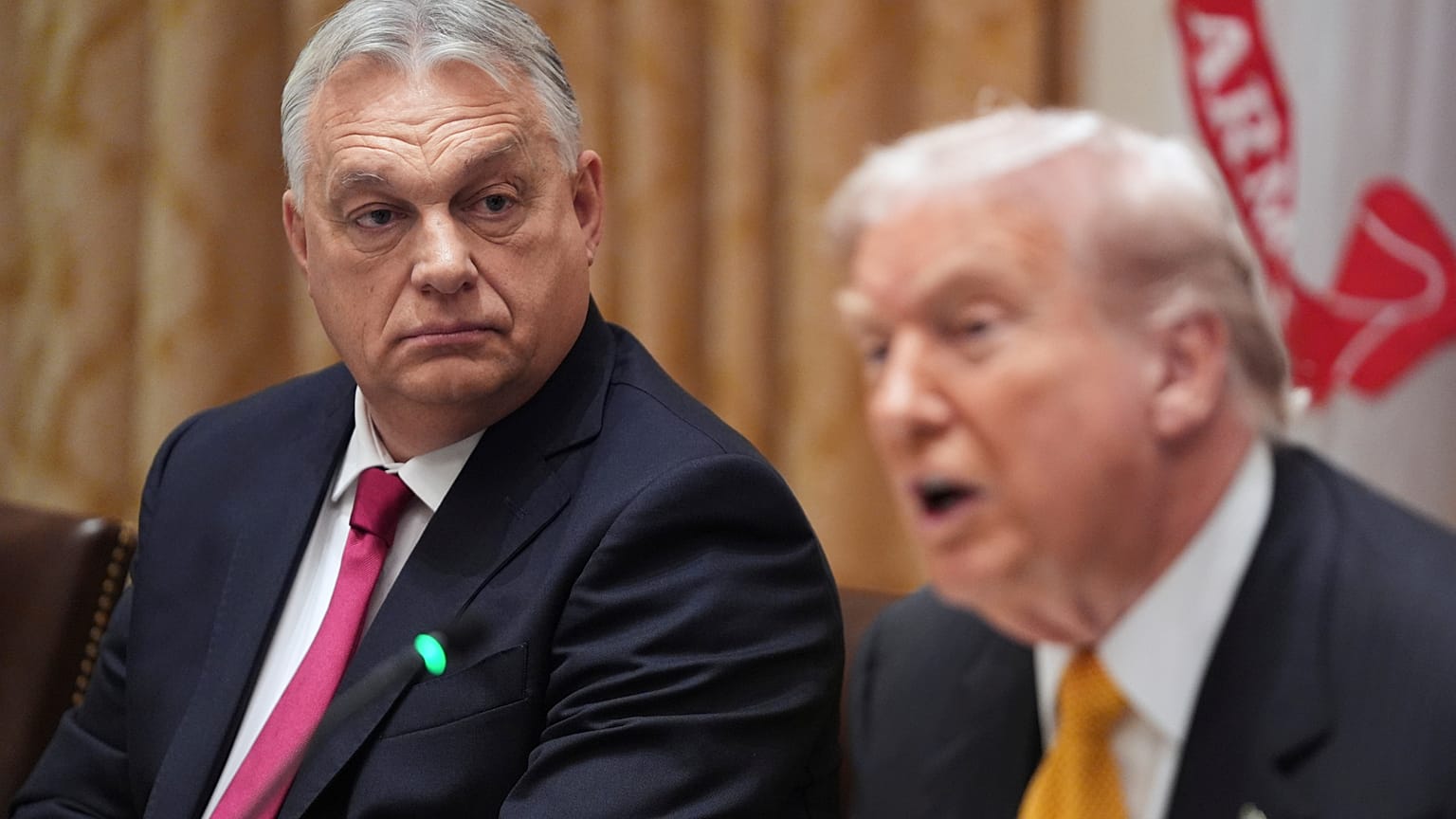
Donald Trump intends to visit Hungary's Orbán during key election campaign

Hungary's Prime Minister Viktor Orban listens as President Donald Trump speaks with reporters during a meeting in the Cabinet Room of the White House, Friday, Nov. 7, 2025, in
Copyright AP Photo

By Sandor Zsiros
Published on 


The US president sent a letter to the Hungarian PM, confirming his willingness to visit Hungary and wishing Orbán "best of luck" with the key election in April.

US President Donald Trump teased a visit to Hungary at the invitation of Hungarian Prime Minister Viktor Orbán as the country readies for a crucial election in April.

According to a letter published by Orbán, Trump praised what he called the "golden era of American-Hungarian relations" and highlighted his interest in deepening cooperation in the areas of defense, energy, and our shared fight against illegal migration.

"Your leadership serves as an example to others around the world. You have consistently stood for the principles that make Hungary strong — faith, family, and national sovereignty — and America respects that courage" Trump wrote.

Trump hosted Orbán in Washington in last November for talks, where Hungary secured an exemption for one year from US secondary tariffs hitting Russian oil exports. Orbán invited Trump to Hungary at the time.

"I am honoured by your invitation to visit Hungary. My team will be in touch soon to coordinate scheduling," Trump wrote in his letter.

The visit looks set to coincide with Hungary's election campaign ahead of a high-stakes election in April.

According to opinion polls, Orbán's challenger, the Tisza party led by Péter Magyar, is ahead of the ruling coalition Fidesz-KDNP. In his message, Trump also referred to the election campaign.

"I wish you the best luck in the upcoming election campaign.”

The Trump administration said in a controversial national security document last year that it would foster relations with parties and governments resisting the “current trajectory” of the EU from within.

In November, Trump praised Orbán as a "great leader" and praised his efforts to curb illegal migration.