Sunday, February 15, 2026

Is Heathcliff Jewish? Emily Brontë’s Revolutionary Novel of Repression and Reversals

 February 13, 2026

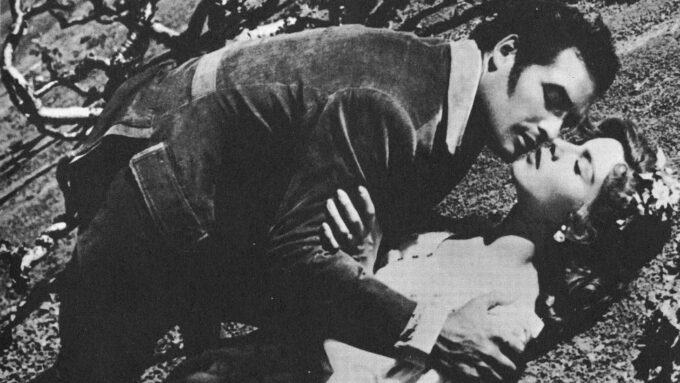
Jorge Mistral as Heathcliff and Irasema Dilián as Cathy in Luis Bunuel’s Wuthering Heights (Abismos de pasión).

“The tyrant grinds down his slaves and they don’t turn against him: they crush those beneath them.”

– Heathcliff in Wuthering Heights.

Emily Bronte’s 1847 novel, Wuthering Heights, published first under the alias, Ellis Bell, has appeared on movie screens at least nine times, most recently in a 2026 version directed by Emerald Lilly Fennell and starring Margot Robbie and Jacob Elordi, an Australian of Basque descent who boasts a dark complexion that makes him suitable to play dark-skinned Heathcliff. Previously, the role belonged largely to men with white skin— Laurence Olivier, Timothy Dalton and Ralph Fiennes. All miscast. But the Spanish actor Jorge Mistral took the part in a Spanish-language adaptation by Luis Buñuel from 1954. Before Buñuel directed his Wuthering Heights, there were two Indian versions, both in Hindi, with the main characters indigenized.

Filmmakers have not tired of the tangled plot or grown impatient with the two star-crossed Shakespearean lovers, Heathcliff and Catherine, who cries out not long before she dies, “My love for Heathcliff resembles the eternal rocks.” She adds, “I am Heathcliff! He’s always, always in my mind: not as a pleasure…but as my own being.”

The latest cinematic version has brought out the culture vultures, including Rosemary Counter, who writes in Vanity Fair that Emily “may have been autistic, antisocial, agoraphobic, and/or anorexic. She may have been a lesbian, or in an incestuous relationship with her brother.” Forget it! Counter adds, “In any case, the author of Wuthering Heights—arguably the horniest Gothic novel ever written—was probably a virgin with a vivid imagination.” Pleeasse!

Sister Charlotte, who knew Emily better than anyone else, noted that she had a “spark of honorable ambition,” and that, like her siblings, the “mode” of her writing was “not what is called ‘feminine.” Charlotte added that books written by women and published under their real names were likely “to be looked on with prejudice.” The sisters took aliases and thereby aimed to undermine and survive the onslaughts of the patriarchy. Emily died in 1848, a year after Wuthering Heights was published; she never knew the fame that would accrue to her novel or herself as an author.

Over the past century—a silent film version screened in 1920— movie audiences have watched over and over again, ad infinitum, albeit with variations, a narrative about two lost souls who love one another too much for their own good, and who rain down disaster on one another and on those around them. No Jane Austen-like happy ending for Catherine and Heathcliff, or for the two main families who inhabit the novel, the Earnshaws and the Lintons. After Heathcliff dies, Hareton Earnshaw marries Cathy Linton; finally, generational conflicts are put to rest and the two houses come together as one.

Yes, there are more characters than one might want or like, but Emily aimed to convey a sense of family history and family feuds and offer a sense of redemption.

To ask, “Is Heathcliff Jewish?” might provoke cultural disturbances akin to the kinds of friction that the protagonist himself generates at Wuthering Heights after he’s snatched from the streets of Liverpool and flung into the untamed Yorkshire moors where he’s exploited, abused, beaten and treated as an inferior.

The tables are soon turned.

The short answer to the question, “Is Heathcliff Jewish?” is an emphatic “No,” though that hasn’t stopped Emily Brontë scholars from suggesting that he is in fact Jewish, or at least that he has “Jewish roots.” That’s what Professor Sharon Lynne Joffe argues in a recent issue of Brontë Studies, the Journal of the Brontë Society, which was founded in 1893 and still going strong. Joffe writes that Brontë “incorporated nineteenth-century stereotypes of Jews into her character,” and that she “would have been familiar with these stereotypes through her reading of Blackwood’s Magazine.

Not so fast, professor. Joffe takes a leap of faith–not a logical step–and adds that “Heathcliff’s physical characteristics, his initial inability to speak English, his lineage, and his eventual success support my contention that Brontë used Jewish stereotypes to create Heathcliff.” Nothing in the novel itself supports the notion that he’s Jewish, though like Jewish characters in fiction and Old Testament figures like Jonah, he’s the Outsider. Of course, Jews aren’t the only literary outsiders.

Nor does it help Professor Joffe’s case to summon Blackwoods to support her claims. My own reading of that magazine and others from the Victorian era, including Punch and Cornhill (I was conducting research for my book about British literature and the British Empire) taught me that editors, publishers and writers used racial stereotypes to describe anyone and nearly everyone on the planet, including the “wild” Irish. The word “wog, and the letters WOG, which stood for “Worthy Oriental Gentleman,” were used to describe the French, the Italians, the Indians from India and anyone with brown or black skin who didn’t speak proper English. Racism and anti-Semitism lurked at the heart of an empire where the sun supposedly never set.

In the page of the novel, Heathcliff is called all kinds of names:  “gipsy” (Roma in today’s lingo), “Afreet” (a dangerous figure in Islamic cultures) and a “Lascar” (a East Indian sailor who worked on English ships). But he’s never called a Jew, Jewish or Semitic. In chapter four, readers learn that Mr. Earnshaw, the master of Wuthering Heights, encounters “in the streets of Liverpool…a dirty, ragged black-haired child” who speaks “gibberish that nobody could understand.” Gender and ethnicity unknown. The child is initially referred to as an “it,” and neither masculine nor feminine. Earnshaw sees “it starving, and homeless and as good as dumb,” and refers to “it” as a “poor, fatherless child.” Adopted and brought to Wuthering Heights in Yorkshire, which is as much a character with a personality as any of the humans.

Once it’s apparent that “it” is “a sullen boy,” he’s called “Heathcliff.” The name fits. After all, the orphaned child from Liverpool, becomes a creature of the wild and rugged moors. An archetype of man in “the open air,” to borrow a phrase Herman Melville uses to describe Captain Ahab, he’s unlike the gentlemen who appear in the stuff drawing rooms of Jane Austen’s novels. If Heathcliff takes on the identity of an anti-hero, Wuthering Heights, like Moby-Dick, becomes an anti-novel; a revolutionary work that deconstructs and reconstructs the very form of the novel itself as a genre. Multiple narrators and a non-linear narrative break the paradigm.

Emily’s older sister, Charlotte Brontë —the author of Jane Eyre— noted that Heathcliff was “a man’s shape animated by demon life – a Ghoul,” and that her sister’s book was “half statue, half rock…hewn in a wild workshop with simple tools and of homely materials.” She described Heathcliff as a “little black-haired swarthy thing, as dark as if it came from the Devil.” That sounds racist to me. In Charlotte’s eyes, Wuthering Heights wasn’t a proper novel, though she allows that it evolved into something powerful that was “savage, swart, sinister.” That’s not like Pride and Prejudice or Sense and Sensibility.

For Charlotte, the question about the novel that was meant be answered wasn’t so much Heathcliff’s ethnicity, but rather the ethics of the novel itself that’s haunted by a “horror of great darkness.” The phrase echoes Melville talking about the “blackness” in Nathaniel Hawthorne’s stories. (If Melville had written an English novel, it would have been Wuthering Heights.) At the end of Charlotte’s preface to Emily’s tour de force, she writes, “Whether it is right or advisable to create beings like Heathcliff, I do not know; I scarcely think it is.” She could have asked the same question about Mary Shelley’s monster in the Gothic novel, Frankenstein.

Charlotte added insightfully, “This I know: the writer who possesses the creative gift owns something of which he is not always master…something that works for itself.” Like Moby-DickWuthering Heights has a mind of its own.

Bronte’s novel has usually been called a love story and a tale of revenge. Indeed, Heathcliff is determined to punish those who treat him badly, as well as everyone who is in his eyes guilty by association with his foes, including his wife, Isabella, whom he drives mad with psychological warfare. But the novel is also an epic about reversals, repression and resistance. Published a year before the revolutions of 1848, which shook the capitals of Europe, Wuthering Heights reflects the zeitgeist of the Age of Revolution, which began in 1776, with the outbreak of the American Revolution and that exploded again with the French Revolution of 1789 and that culminated in 1848. Wuthering Heights begins in the 1770s and ends at the start of the 19th century. Revolutionary in form as well as in content, it breaks all kinds of literary boundaries. No wonder it has survived for nearly two hundred years. Not the new movie. Toss it in the bin to be rewound.

Heathcliff would have found himself at home in the company of French revolutionaries such as Robespierre and Danton and Napoleon, too. He would also have enjoyed the company of the English romantic poets, Shelley, Keats and Coleridge. At a critical point in the narrative, he observes, “The tyrant grinds down his slaves and they don’t turn against him: they crush those beneath them.” Brontë uses the word “grind” repeatedly. It paints a picture.

In Wuthering Heights, repression doesn’t automatically lead to resistance. It can lead, as in the case of Heathcliff to tyranny. The Brazilian author, Paolo Freire, makes an observation similar to Heathcliff’s in his classic Pedagogy of the Oppressed, published in 1968, another year of revolution. For Freire, pedagogy is the essential element that turns the oppressed into rebels. A pedagogy for the oppressed is precisely what Heathcliff is denied, even as he becomes an educated, wealthy gentleman–albeit still a tyrant. Charlotte claimed that Emily observed the world around her and that her “imagination found material whence it wrought creations like Heathcliff, like Earnshaw, like Catherine,” adding, “having formed these beings she did not know what she had done.”

But she might have. Heathcliff’s remark about slaves and tyrants, grinding down and crushing, suggests that she understood his sentiments, perhaps shared them and meant to express them through her own unequivocal voice of anger and defiance.


Jonah Raskin is the author of Beat Blues, San Francisco, 1955.

“Tales of Ordinary Madness”: Warren Haynes, Charles Bukowski, and the Darkness of the American Dream


 February 13, 2026

Warren Haynes performing at South Farms in Morris, Connecticut. Still from video posted to YouTube.

Warren Haynes had just moved to the East Village of New York in the summer of 1988. “Born on the edge of a lonely town,” as he described his Asheville, North Carolina upbringing in a song, Haynes would first follow the call of music to Nashville. After touring with The Dickey Betts Band, but before joining the Allman Brothers, and before launching the hard rock jam band, Gov’t Mule, Haynes found himself in his new home on the eleventh floor of an apartment building in what both jingoistic boosters and tough critics have called the heart of the American Empire. With the possible exception of LA, there is no city more associated with the “American dream” than New York. “If you can make it here, you can make it anywhere,” the anthem boasts, but those who don’t make it are often the target of exploitation, abuse, harassment, and hatred. They don’t navigate the bright lights of the dream, but instead live in the shadow side of its nightmare.

“I was looking out from the balcony of my apartment, and I was watching people demonstrate, coming up Houston Street,” Haynes remembered when I interviewed him, “It was a protest after all the homeless people got kicked out of Tompkins Square Park, and they had nowhere else to go.”

The August 6th rally heightened the anger of city officials, who sent Police Captain Gerald McNamara and reinforcements of eighty police officers to the park. The clear attempt at intimidation failed, as the relatively small group of protestors, roughly two hundred homeless and their advocates, street musicians, and youth activists, refused to leave. In response to the demonstrator’s defiance, the police called in the calvary, eventually swelling to the force of four hundred armed officers. Still relentless, the crowd remained stationary; chanting, shouting, and waving placards with messages like, “Gentrification is Class Warfare.”

Radical theorists have often written about how, from the slave patrols to the ICE assault against Latino neighborhoods, law enforcement does not act in the interest of public safety, but instead to guard the economic and racial boundaries of society, ensuring that undesirables stay out while those on the inside remain untouchable. The Tompkins Square Park riot is a perfect illustration. It wasn’t the protestors who rioted, but by the admission of New York’s own police commissioner in a subsequent report, the cops themselves. 38 people sustained injuries so severe that they required hospitalization, over 100 filed police brutality complaints, and even journalists faced the wrath of a maniacal, outlaw police force. Jeff Dean Kuippers, a reporter for Downtown magazine, was there with his Black girlfriend. After a police officer called her a “n****er bitch,” he clubbed Kuippers over the head. The poet Allen Ginsburg witnessed the riot, and later said, “The police panicked” and “started beating people who did nothing wrong.”

“I was relatively new to the New York scene,” Haynes said during our conversation, “It was a heavy moment. Where were all these people going to go?”

As he was “looking out from the balcony,” Haynes wrote the heavy song, “Fire in the Kitchen.” Its thunderous blast of rock music opens Haynes’s debut solo record, Tales of Ordinary Madness. With a voice that shouts in the keys of southern soul, rides down the gravely roads of the blues, and amplifies prophetic rage, Haynes sings of a scene that is Biblical in its depiction of the rich versus poor, but all too modern in its iteration: “Bedlam spreading like a rumor / Can’t take people and push them out on the street.” His voice screams in anger over the sight of a “child with a gun…stranded no place left to turn.”

“Fire in the Kitchen” greets the listener like an inferno, telegraphing Haynes’s musical and lyrical commitment. With Steve Holly, of Wings fame, on drums, the opening songs acts as a bridge between the blues-inflected jams of The Allman Brothers and the harder rock of Gov’t Mule. The musical interlude in the middle deconstructs twice only to come roaring back each time. With fitting ferocity, the music punches behind the protest lyrics of Haynes, who had set out to chronicle the condition of American life that he describes as “The realization that no matter what you achieve, there’s always going to be this wall that’s impossible to penetrate. That wall is built and run by corporate greed.”

Tales of Ordinary Madness was originally released in 1993, and is now available in a stunning new remix that, along with the increasingly relevant sociopolitical lyrics, make it sound and feel as if it is brand new. When I asked Haynes about the decision to remix and rerelease his debut record, he said, “Records that were being made in the late ‘80s and early ‘90s were slicker. There was more reverb, more processing and production. It sounded good in accordance with everything that was going on in that time period, but a couple of years later, people started making records more old school with less gloss. I always wanted to hear what it would sound like mixed that way. We got Tim Scott to remix it, and now it sounds much more like I always envisioned it sounding.”

The new version has a rawness that complements Haynes’s blues-inspired guitar playing and Memphis-soul style vocal performances. It also has greater instrumental clarity. The basslines and the keyboards, whether from Chuck Leavell, a Rolling Stones and Allman Brothers Band alum, or Parliament-Funkadelic’s Bernie Worell, snap out of the speaker, helping to create a rich musical universe to support Haynes’s dynamic guitar solos and powerful singing.

The updated sonic quality better aligns with the songs themselves, as Haynes is providing a musical tour of a tattered America, the underside of an empire in decay. It is an America far removed the “gloss” of suburban mansions, high priced car dealerships, and supermarket fashion magazines.

In the middle of the record, there is a funky and jazzy groove that opens the song, “Invisible.” Singing over a steady beat and bassline that sounds straight out of a Family Stone or James Brown records, Haynes introduces the subject of the song: “See these cans / These worn out shoes / This old shopping cart / Full of rusty blues / It’s plain as day / So why do I feel invisible?”

“‘Invisible’ was inspired by an encounter I had on the street in the city not too long after moving there,” Haynes told me, “A guy who appeared to be homeless and was asking for handouts looked at me and said or just implied with his facial expression, ‘Don’t act like you don’t see me.’” The song is from the vantage point of that man, one in a million who pedestrians, like the wealthiest institutions in the most powerful country in the world ignore as a matter of routine, acting as if they are out-of-the-way stationary objects, rather than human beings. The funk and jazz characteristics of “Invisible” allow it to act as a soundtrack of the motion, pace, and rhythm of the multicultural city corner; a motion, pace, and rhythm that the homeless fall into, even as they endure profound alienation.

In the second verse, Haynes turns the man against himself, singing the lines, “If you can’t spare a dime / Brother, can you spare a smile / Instead of looking right through me / Like I was invisible.”

Musically, the song foreshadowed the eclectic, unpredictable, and intense exploration that Haynes would lead as founder and leader of Gov’t Mule. “Invisible” charges through its jazz and funk influences, incorporating elements of blues and rock, as Haynes plays a wild, yet controlled slide guitar. There are moments when he finds new mid-song chord progressions, lending even more dynamism to the composition, and others when he is playing with abandon and fury.

The album closing, “Broken Promised Land,” originated with its title. Haynes said that after the titular phrase entered his mind, the rest of the song came “pouring out.” An emotional, slow burning ballad, Haynes’s voice has the primal passion of Wilson Pickett as he sings of “A boy on the corner selling rock to get you high” and how the poverty, sights of people sleeping on the street, and police violence from “town to burning town” form something far removed from the patriotic promises of July 4th parades and rose-red-white-and-blue colored presidential and senatorial speeches. “This sure don’t taste like freedom / In broken promised land…” Haynes sings before beginning a lengthy guitar solo to end the song. As his blues-soaked notes coagulate with tears, a backup singer cries out; her soulful singing registering the sounds of desperation.

Haynes’s extraordinary musical navigation of America rides on the engine of unpredictable and raucous rock and roll energy. His ability to play guitar solos with escalating rage capture a country where flag-waving promises operate as a cruel taunt to the dying poor. The songs fall into two categories: Those, like “Invisible,” “Fire in the Kitchen,” and “Broken Promised Land,” that place the listener behind the eyes of the Americans who live among the debris of shattered hopes and expectations, and those that adopt the voice of the powerful; the “movers and shakers” who build their empires on the blood, sweat, and tears of the dispossessed; those whose palaces cast a cold shadow over the squatters in Tompkins Square Park, the teenagers selling crack rocks, and the single parents pushing shopping carts through the street.

The aptly named “Movers and Shakers” is a seven-minute piece of rock-soul that takes as its immediate subject the “legendary assholes,” to use Haynes’s phrase, within the record business, but the subject enlarges to encompass a system of severe stratification. It could apply to nearly any major industry: Silicon Valley, oil and gas, or health insurance. A CEO sits in a garish office overlooking life on the street far below. “It used to be your world / I guess you got your tired of that…” Haynes sings. The chorus sketches a different world for the wealthy magnate: “Movers and shakers / Big dealmakers / Acres of corruption in this little big town…”

The song offers the hope of justice: “The Titanic was unsinkable,” Haynes shouts in the style of a blues preacher, “Nobody’s too big to fall.”

Any sense of hope is long gone in “Sister Justice,” an angry rock song sung from the perspective of a power elite who dictates to his audience of common workers and middle class strivers, “Instead of masquerading as someone who cares / I’ll be there when they push you down those golden stairs…Do your dirty work / But don’t come crying to me.” In “Sister Justice,” Haynes’s voice takes on menacing tones, especially as it becomes clear that the confessor is not lamenting, but celebrating the conditions that he describes: “Tears in your coffee, dirt in your dreams / The rich get richer while the poor man screams / Got the boys in battle / Face down in the mud / On foreign soil trading oil for blood.”

In “Power and the Glory,” Haynes enlists three legendary keyboard players – Chuck Leavell on organ, Bernie Worell on clavinet, and Johnny Neel of The Allman Brothers Band on Wurlitzer – and saxophonist Randall Bramblett, who had played with, among others, Bonnie Raitt and Robbie Robertson. The low bass line, eclectic keyboard extravaganza, and doubling of sax and guitar create a rich, dramatic musical universe ideal for the story of the song. Beginning with a “party in the valley,” the “gracious host” asks, in what Haynes describes as the key line of the song, “How many judges are in your pocket, cause that’s what separates the men from the boys?” It all ends with someone being “crude” and someone else being “crushed.” The act of sexual harassment doesn’t worry the wealthy perpetrator who orders his “boys” to “clean it up” before “riding into the sunset in his trusty limousine.”

“It’s about how people behave with unnecessary levels of wealth and power,” Haynes told me. It moves with an irresistible groove, and yet Haynes’s voice returns to dark, malevolent form when he sings in the voice of the cruel character, “Place no others before me / They might get chewed up, used up / That’s the way it goes / Up here in the power and the glory…”

There is a mid-album break in the chronicle of the nightside of America for lust and romance with “I’ll Be the One,” a sweeping six minute ballad that features a beautiful vocal over poetic lyrics, and the newly added, “Tear Me Down,” a funk-rock number that Haynes would later repurpose for Gov’t Mule. The rest of the album’s songs of rage and despair fall into the classification of the album’s title, Tales of Ordinary Madness, a phrase that Haynes borrowed from a short story collection of the late Charles Bukowski.

“I had just read his book, and it’s pretty dark,” Haynes said during our discussion, “Of course, song lyrics and literary writing are completely different, but there was a strong overlap there, especially in the exploration of the human psyche and the aforementioned ‘wall’ of corporate greed.”

Charles Bukowki began as an underground writer within the Los Angeles literary scene and alternative press, writing poems, short stories, and novels that chronicled the fleeting highs and fatal lows of residents of Skid Row, all night bar flies, drug addicts and alcoholics, habitual gamblers, petty criminals, and characters cast into permanent exile on the bloody edges of American experience. The brutality of his work invited accusations of misogyny and misanthropy, and some of it, particularly the later novels that descended into self-parody, fit the bill, but his artistic triumphs, whether in narrative or verse, build a world that is uniquely his own, casting light on those that TV ads and mayoral speeches prefer to keep in the dark, all in a voice that, like Haynes’s lyrics of social conscience, manages to combine compassion with anger.

Bukowski’s Tales of Ordinary Madness opens with “A .45 to Pay the Rent,” a glimpse into the life of a family living in destitution. After allowing his daughter to fill his shopping cart with too many items in the grocery story, a young father returns home to a dingy apartment only to get into an argument with his girlfriend, the young girl’s mother, about their emptied-out finances. Their argument is obscene, crackling with the threat of violence. Then, the man grabs his gun, declaring that “This is the only justice in America. This is the only thing anybody understands.” She begs him not to “go out,” but he insists that he has no choice. The story ends with the mother reading her daughter a bedtime story, while the father scouts liquor stores and gay bars to rob.

“A Dollar and 20 Cents” places the reader beside a “bum at 60,” a man who had a “hell of a childhood and hell of a manhood,” but lost everything in recent years. He wanders the beach early in the morning, gazing out at water that looks “dirty and deathly.” After enduring disrespect from teenagers, he counts the money to his name – the same amount in the story’s title – and goes home to a flophouse. The landlady brings him a cup of “piss-yellow” chicken soup “without the meat.” He waits until she leaves, and dumps it outside in an attempt to spare her feelings. He lays down, listens to the ocean, takes a “large sigh,” and dies.

There is a countercultural kinship between Haynes and Bukowski, and their respective “Tales.” They both use artistic powers, whether it is Bukowski’s economy of language or Haynes’s vocal strength and guitar virtuosity, to give humanity to those who America’s competitive, consumer-based society has often deemed less than human. Their “tales of ordinary madness” emphasize that much the of experiences and travails that surround us are truly insane, but because much of politics, the press, and pop culture have reacted to them with dismissal or self-serving propaganda, they’ve become ordinary. The “fire in the kitchen” that burns while the police assault street musicians to empty out a public park, like the lonely death of a hungry, 60 year old man in a wealthy nation, should outrage everyone, but under the cover of official and unofficial lies, these episodes are just life in the big city.

Art can combat complacency. Haynes and Bukowski enlisted their efforts into that mission, but they also had crucial networks of support. City Lights Books, the publishing arm of the countercultural bookstore in San Francisco, where the Beat poets and Jerry Garcia hung out between the stacks, published Bukowski’s “Tales,” while Megaforce Records put out Haynes’s debut. Megaforce is the label that first offered a contract to Metallica, and many other thrash bands. Haynes recalls the “passion” of everyone involved with the company, and that he was happy to join a company that sponsored bands like King’s X and Living Colour. Companies like Megaforce and City Lights were not in the mainstream, but they had the ability to break through to the heart of commercial culture. Charles Bukowski became something of a literary folk hero, with the adaptation of his work in two American films and three foreign films. Haynes’s Tales of Ordinary Madness would receive favorable reviews from the Chicago Tribune and Rolling Stone, and his next project, forming the band of Gov’t Mule, would lead to over thirty years of success in the jam and blues-rock music worlds.

The infrastructure necessary to support artists of the counterculture is now in later stages of decay. Although Megaforce and City Lights are still operational, many small publishers, labels, and alternative newspapers have shuttered. The internet promised a proliferation of diverse voices, but instead it helped to concentrate more power in the hands of fewer moguls. Even major newspapers, like the Washington Post, cannot withstand the onslaught of high tech raiders. In 2010, there were dozens of independent publishers in Chicago. Now, there is one.

Fittingly enough, one of the most intense and impactful musical moments on Haynes’s record deals with the death of independent media and genuine artistry. “Blue Radio,” an eight minute epic, opens with a reggae rhythm and ends with an explosive guitar solo. In between, Haynes sings of the greed, degradation of culture, and cost cutting that suffocated the spirit of rock and roll, and cheapened the beauty of America’s greatest cultural export. “Where did you go, blue radio?” Haynes cries out before eventually concluding, “There’s too much green in between me and you…”

“Those golden dreams, why did they have to go?” Haynes sings. It is a question that, listening to the new remix Tales of Ordinary Madness, 23 years after the record’s initial release, haunts all of the songs. On the shortest song of the record, the blazing rock number, “Kiss Tomorrow Goodbye,” Haynes shouts out in anger over how xenophobia and short term, shallow thinking are killing the future. Years later, the late philosopher, Mark Fisher, would write about how we live in a world haunted by lost futures – the lost futures of broken promises, the lost futures of the dreams of social justice and progress that did not come true.

With extreme income inequality, homelessness rising as rents increase to exorbitant levels, and ICE, the goon squad of the Trump junta, abducting, assaulting, and even killing innocent people, Haynes’s artistic advancement of protest against the madness of the American experience has grown only more relevant and more powerful.

David Masciotra is the author of six books, including Exurbia Now: The Battleground of American Democracy and I Am Somebody: Why Jesse Jackson Matters. He has written for the Progressive, New Republic, Liberties, and many other publications about politics, literature, and music. His Substack is Absurdia Now.