Sunday, February 15, 2026

Held Captive in Their Own Country During World War II, Japanese Americans Used Nature to Cope With Their Unjustified Imprisonment


 February 13, 2026

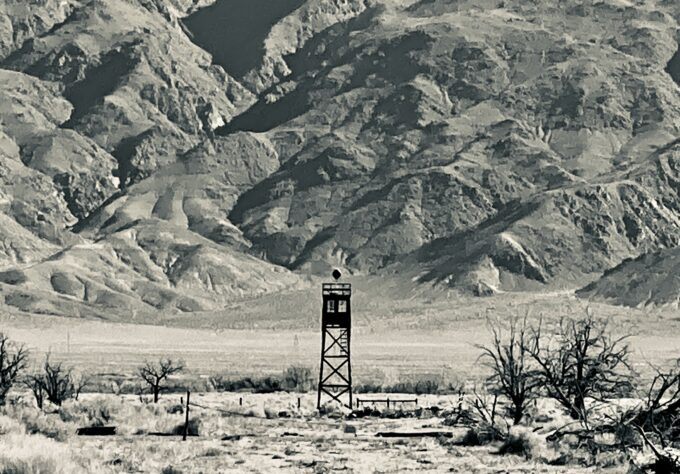
Guard tower, Manzanar concentration camp. Photo: Jeffrey St. Clair.

With a stroke of a presidential pen, the lives of Izumi Taniguchi, Minoru Tajii, Homei Iseyama and Peggy Yorita irreparably changed on Feb. 19, 1942. On that day, President Franklin D. Roosevelt issued Executive Order 9066, which set in motion their wartime incarceration along with other people of Japanese ancestry who were forcibly removed from their homes in parts of California, Oregon, Washington and Arizona.

To cope with their fear, anger and loss in the turbulent times, they would have to dig deep into their emotional reservoirs of resolve and ingenuity.

Without bringing charges against them or providing any evidence of disloyalty, the U.S. government detained legal Japanese immigrants and their American-born descendants in desolate inland locations during and after World War II, simply because of their ethnicity. Nearly 127,000 people of Japanese ancestry were incarcerated between 1942 and 1947, according to Duncan Ryȗken Williams, director of The Irei Project, which is compiling a comprehensive list of those detained. My grandparents, parents and their families were among them.

As I describe in my book “When Can We Go Back to America? Voices of Japanese American Incarceration during World War II,” they boarded livestock trucks and World War I-era trains guarded by armed U.S. soldiers for destinations that were not disclosed to them. They could only take what they could carry and what they had within themselves.

84 years ago, an executive order mandated sending Japanese Americans to “relocation centers” as a security threat during World War II. Thousands were imprisoned at the Manzanar Relocation Center in the California desert. Recently, some of their descendants returned to play baseball and softball, sports that had given prisoners hope and a sense of normalcy. The reenactment paid tribute to the resilience of the detainees, explains USC history professor Susan H. Kamei.

When the Japanese Americans arrived at temporary detention facilities, euphemistically called “assembly centers,” hastily constructed on fairgrounds, racetracks and other government property, they were shocked to be body-searched, fingerprinted and interrogated. Thousands discovered their living quarters were animal pens or horse stalls. The ones considered lucky were assigned to poorly built barracks. The barracks had only cots, bare light bulbs hanging from the ceilings, and pot belly stoves in the corners; the interiors lacked any partitions.

People stand and sit near beds in an open space with clothes hanging from hooks on the wooden wall.
Japanese Americans incarcerated at assembly centers were quartered in rough barracks.
Clem Albers, War Relocation Authority, Department of the Interior via National Archives and Records Administration

Immediately they scavenged wood from vegetable crates and construction debris they found nearby to create privacy within the barracks units and to make furniture and other household furnishings. Displaced from their livelihoods, education and social structure, with nothing to do, they also quickly organized a wide range of activities, including sports, as well as arts and crafts of all kinds. Their resourcefulness born out of necessity converged with the Japanese aesthetic to make functional items beautiful as they sought to make their temporary quarters more livable.

When the prisoners were transferred to long-term detention facilities run by the War Relocation Authority later in 1942, they brought with them what Delphine Hirasuna, an author and descendant of people who had been incarcerated during the war, calls the “art of gaman.” “Gaman” is a Japanese word meaning the dignity and grace to bear the seemingly unbearable. With this philosophy, they created objects of both utility and beauty.

Delphine Hirasuna speaks in 2014 about how Japanese Americans endured their incarceration with grace and even creativity.

Finding beauty in branches, rocks and shells

At the Gila River and Poston camps located on tribal land in the Mojave Desert, incarcerees found that desert wood could be carved, filed and polished to make partitions, household objects and works of art.

Armed soldiers guarded the barbed-wire perimeters from lookout towers, but as the war wore on, the incarcerees were allowed to venture beyond the camp fences. Izumi Taniguchi, then 16 years old from Contra Costa County, California, recalled getting permission to walk outside the Gila River camp boundaries to while away the time.

He remembered, that some people used the ironwood for sculpting. Minoru Tajii, then 18 years old from El Centro, California, held at the Poston camp, described ironwood as “an oil-rich wood, so when you polish it up it comes out very nice, so we go out and find that and bring it back.”

The Poston “sculptoring department” advertised in the camp newsletter “Poston Chronicle” on Jan. 20, 1943, that “anyone with ironwood wishing to learn how to make figures and notions may bring their materials to the department, 44-13-D, and work under the guidance of sculptoring teachers.”
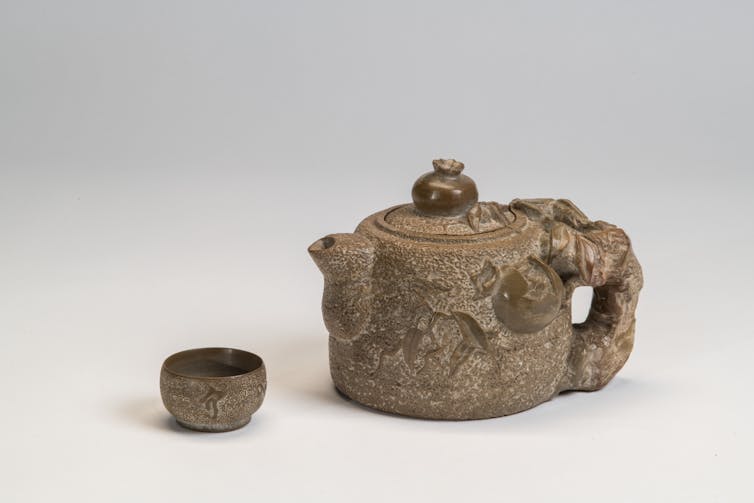
A teapot and cup made out of slate by Homei Iseyama, decorated with depictions of pomegranates and leaves evoking his connection with nature as a landscape gardener and bonsai master.
Gift of the artist’s family via Smithsonian American Art Museum

Homei Iseyama, from Oakland, California, became known for the exquisite teapots, teacups, candy dishes and calligraphy inkwells he carved out of slate stones he found around the Topaz, Utah, camp. Born in 1890, he attended Waseda University in Tokyo before immigrating to the United States in 1914 with dreams of attending art school.

At the Tule Lake camp, located on an ancient lake bed, the incarcerees discovered thick veins of shells that provided material for making art and jewelry. Fusako “Peggy” Nishimura Yorita got very involved in making shell jewelry. As digging for shells became a popular and competitive pastime for the Tule Lake incarcerees, Yorita enlisted her two teenagers and friends to help dig waist-deep holes at sunrise and sift the sand with homemade wire sieves.

Peggy Nishimura Yorita composed the flowers and leaves in this corsage pin from shells she found at the Tule Lake concentration camp.
Courtesy of the Bain Family Collection via Densho Digital Repository

A 33-year-old single mother, Yorita sold her shell jewelry to make a little money. She also enjoyed the creative endeavor. She recalled: “I was just making new things all the time. And to me, it … was … a wonderful outlet.”

As the incarcerees were allowed to leave the camps, they were given $25 and a one-way bus or train ticket to wherever they were going to rebuild their lives. Many took with them their handcrafted objects, reminders of how they overcame the physical and mental harshness of their detention years.

The author’s grandfather, Ayatoshi Kurose, made this small tansu chest out of crate wood for her teenage mother in the Heart Mountain, Wyo., camp. Courtesy Susan H. KameiCC BY-NC-ND

When my mother entrusted to me the fragile small tansu chest that her father made for her in camp out of crate wood, she told me that her father had felt sorry for her that she didn’t have anyplace to store her belongings. To improve the appearance of the wood, my grandfather placed a hotplate on the pieces to deepen the grain. My mother appreciated the care he took to carve traditional Japanese scenes onto the panels with a pen knife. She said the chest represented to her the depth of her father’s love.

Eight decades after Roosevelt issued Executive Order 9066, researchers are delving into the traumatic intergenerational impact that the incarceration has had on the camp survivors and their descendants. Memorials such as The Irei Project seek to restore dignity to those who suffered unconstitutional injustices. On Feb. 19, known annually as the Day of Remembrance, Americans can honor them by appreciating their “art of gaman,” testaments to their resilient spirit as they found and created beauty in their wartime environments.The Conversation

This article is republished from The Conversation under a Creative Commons license. Read the original article.

Susan H. Kamei is Adjunct Professor of History and Affiliated Faculty, USC Shinso Ito Center for Japanese Religions and Cultures at USC Dornsife College of Letters, Arts and Sciences.

LA REVUE GAUCHE - Left Comment: Search results for INTERNMENT

The Winter Olympics in Trouble?


 February 13, 2026

Image by Phįŗ”m Nhįŗ­t.

One Hundred Percent (100%) of Olympians believe excessive levels of climate change are real and a serious threat to ecosystems that support life. That is an intentional lie, but it may very well be true. Nobody experiences the upheaval of climate change like Olympians. “I couldn’t watch it happen and not say anything about it.” (Bea Kim, snowboarder Olympian from California, Can the Winter Olympics be Saved? Talking Climate, Feb. 11, 2026)

Bea is a member of POW (Protect Our Winters Now) founded by Jeremy Jones, a U.S. snowboarder. A POW letter signed by over 200 ski professionals addressed the International Ski and Snowboard Federation’s failure to support climate polices. POW wants to see climate action, cuts in greenhouse gas emissions such as CO2, or the snow will be gone.. Their sport is at risk. Their professions hang in the balance of climate change policy maneuvering on the world stage; will nation/states adhere to Paris ’15 commitments to cut emissions by cutting fossil fuels? So far, that balance is hanging by a very thin thread, pointedly downward.

Bea spoke at the UN during the International Day of Sport: “Through my travels as a professional snowboarder, I’ve gone around the world, and I’ve seen one common theme throughout… The world is changing. The glaciers are melting that we’re actually riding on. Our winters are starting later. The weather patterns are becoming erratic. Each year we wonder if there will even be enough snow to compete and do what we love,” Ibid.

Olympians are knowledgeable about the impact of climate change. Prior to the Milan Cortina Winter Olympics, Norwegian skier Nikolai Shirmer delivered a “Ski Fossil Free” petition to the IOC (International Olympic Committee) calling for an investigation into the propriety of fossil fuel sponsorships in winter sports. “The show goes on while the things you depend on to do your job – winter—is disappearing in front of your very eyes.” The petition has 21,000 signatures seeking answers as to why the sport accepts sponsorship from the likes of British Petroleum and others committing to massive, and increasing, amounts of greenwashing to trick (brainwash) the public that fossil fuels are just great. But Olympians are not buying into the ruse.

“In the 70 years since Cortina first held the Winter Games in 1956, February temperatures in the northern Italian town have warmed 6.4°F” (Mllano Cortina 2026: Warming Winter Olympics, Climate Central, Jan. 31, 2026). That’s fossil fuel CO2 hard at work.

“All of the other cities to host the Winter Olympics since 1950 have warmed since then — threatening the reliability, safety, and fairness of outdoor winter sports competitions,” ibid.

A recent study found that of the 93 ideal locations for winter Olympics, nearly one-half will no longer be good host sites within the next couple decades because of climate change. This assumes climate change does not speed up much beyond current circumstances. But since the turn of the century, climate change has been like a rocket ship taking off, gaining speed as it barrels ahead, accelerating, not decelerating. For example, according to NOAA National Centers for Environmental Information, global surface temperature since 2000 has increased by 222%, from 0.4°C above the 20th century average to 1.29°C above by 2024.

According to the 2024 Annual Climate Report by NOAA, the heating of land and ocean combined has increased three times the 1850-1975 rate, per decade, since 1975. That long-term trend of 125 years has been crushed over the past few decades.

The feedstock for global warming has also increased at an insanely rapid rate. Annual global emissions, mostly from burning fossil fuels, accounting for 90% of CO2, have increased from 25 billion tons in 2000 to 38 billion tons in 2025. That’s tons of emissions moving upwards by more than a 50% increase, remarkable!

Meanwhile, the annual growth rate of CO2 has rocketed upwards from 1.62 ppm in the atmosphere in 2000 to 3.6 ppm in 2025 or 225%, mirroring the insanity of the Roaring 2020s

Accordingly, climate change is on a rip-snorting tear never witnessed before in human history with off-the-charts data points that spell continuation of big trouble for winter Olympic events, unless fossil fuels are stopped and excessive CO2 withdrawn from the atmosphere on a scale that humbles the Marshall Plan, in part, humbled because CO2 atmospheric removal technology has proven to be anemic, at best. Moreover, is the world up to consideration of such an undertaking under the influence of United States focus on full blast expanding fossil fuels while killing green technology and decimating climate research as increasing numbers of copycat right-leaning countries and weak-kneed corporations tag along on America’s deep dive down into the rabbit hole.

Olympians have more direct contact with climate change than anybody as practice/training spots throughout the world become more difficult to find. Indeed, this is a more challenging matter than creating one Olympic village every four years. Based upon anecdotal evidence and testimonials, across the board, the athletes are perplexed by the failure of world governments to take on, to challenge, to at least mitigate, climate change’s imposing threat to ecosystems that support life, and, of course, skiing.

Robert Hunziker lives in Los Angeles and can be reached at rlhunziker@gmail.com.