Thursday, February 26, 2026

Mr. Ip and the Wall Street Journal Discover Wealth Inequality


It was in 2013 that Thomas Piketty rediscovered the problem of wealth inequality with his celebrated book Capital in the Twenty-first Century. Published by Harvard University Press and selling several million copies, the book turned prevailing mainstream economic thinking on its head. Academic economists and capitalist apologists had long assured us that capitalism persistently created wealth and distributed it fairly to all the factors of production, with deviations from this fair distribution attributable to unusual or exceptional intervention in the process.

But Piketty’s look at all the available, relevant data showed just the opposite: capitalism– absent any external or exceptional circumstances– invariably generated growing inequality. Using sources dating to the eighteenth century, Piketty showed that, with the exception of the destruction of capital or the rare active measures to redistribute it, wealth inequality was bound to grow. Piketty offered no deep explanation of why this is a feature of capitalism, but he did offer the usual social democratic panacea– tax the rich!

Coming only four years after the steepest economic downturn since the Great Depression, Piketty’s opus was well received by a wide audience. As a consequence, one might think that the idea of overthrowing the system responsible for more than two centuries of growing inequality would accordingly enter the popular conversation.

But it was not to be. Though a new gilded age of conspicuous consumption, new manifestations of privilege, and raging demand for luxury emerged, no serious threat to the capitalist system sprung forth. Anger was contained effectively in the US by a rotten, corrupt two-party system. Fear and a deeply ingrained hostility to socialism gripped older generations. And younger people– facing a desperate future– were open to an alternative to capitalism, but saw no clear road for it.

Now, thirteen years later, the Wall Street Journal’s top economic commentator, Greg Ip, has again rediscovered inequality. He writes about today’s economy:

Its rewards are going disproportionately toward capital instead of labor. Profits have soared since the pandemic, and the market value attached to those profits even more. The result: Capital, which includes businesses, shareholders and superstar employees, is triumphant, while the average worker ekes out marginal gains.

The divergence between capital and labor helps explain the disconnect between a buoyant economy and pessimistic households. It will also play an outsize role in where the economy goes from here.

The brute financial force of all that wealth means market fluctuations, like last week’s, matter more for consumer spending. Meanwhile, artificial intelligence could funnel even more of economic output toward capital instead of labor. Last week may be a taste. Amid reports that layoffs are climbing and job openings plunging, especially for professionals exposed to AI, the Dow Jones Industrial Average closed above 50000 for the first time…

The shift to capital from labor has actually been under way for more than 40 years. Labor received 58% of the total proceeds of economic output, as measured by gross domestic income (conceptually similar to GDP), in 1980. By the third quarter of last year that had plummeted to 51.4%. Profits’ share, meanwhile, rose from 7% to 11.7%.

Ip’s charts show that S&P 500 profit margins have doubled over the last 15 years, with corporate profits rising 43% since the end of 2019.

Where Ip tells us that this is an alarming trend over the last 40 years, Piketty tells us that growth in inequality is the long-term trajectory of the capitalist economy. Both are right.

What is disconcerting is that the victims of this trend, the vast mass of working people, have no voice, no representation, no program to address this inevitable — if we are to believe Piketty — consequence of a capitalist system.

What is even more disconcerting is that voices on the left that purport to advocate for working people offer such unimaginative, weak alternatives.

Now Ip only raises the specter of growing inequality to alert ruling circles of the danger that the masses will sharpen their pitchforks and rebel against the privileges of capital. Piketty proposes redistributing wealth through mechanisms — like taxation — that the system controls with its most loyal agents. The idea that bourgeois political parties will substantially tax the bourgeoisie is truly fantastic.

Unions — one of the few remaining mass organizations supporting workers — offer a poor record of staunching the flow of wealth to capital, even in industries where unions are well represented and strong. And union leaders seldom have any vision beyond that offered by center-left parties.

Sadly, too many of the left’s public intellectuals are mired in side shows: cooperatives as an answer to international monopolies, romanticizing the capitalist order existing before Thatcher and Reagan, or cheering on an abstract “global south” bringing capitalism to its knees.

Others paint a dire picture of wealth being cannibalized by a cabal of rentiers, scorning the Marxist theory of bourgeois and exploited proletariat. This novelty finds currency in the fashionable, but deeply incoherent idea of “technofeudalism.”

Missing from these distractive theories is any understanding of capitalism’s fundamental logic: the contradiction between workers and capital. Oddly enough, a capitalist apologist, a conservative writer, Greg Ip, understands this contradiction all too well in his observations about growing inequality, as does Piketty in his writings.

For many of those offering their thoughts to working people, the working class is inconsequential or decimated by deindustrialization in their relatively small part of the world (typically, English speaking or Eurocentric). As a result, they spin arcane theories of inequality or oppressions. They overlook the reality that there are over a billion and a half workers in Asia alone, most of whom are working under conditions of capitalist exploitation as described by Karl Marx and Frederick Engels. They have forgotten that while industry has shifted globally, while there is a constant change in the global division of labor, the material wealth is still created by working people.

The mobility of production and the division of labor are permanent features of capitalism that have only accelerated in recent decades. New technologies and industries have sprung up, where older technologies and industries migrated to areas of cheaper labor. A country like the United States is hollowing out, with a diminishing manufacturing sector, but a high-value, high-income technology sector at one level and a precarious, lower-income service sector at another level. Workers at all levels in all countries where capital employs labor are exploited by capital.

The lengths to which so many supposed leftists go to ignore or deny the fundamental relationship between workers and capitalists– the ultimate cause of growing inequalities– is startling. The dawn of the industrial age gave new meaning to the word “exploitation.” Marx and Engels refined that meaning, giving it a rigorous role at the center of their analysis. And it remains essential to our understanding of the world today.

Workers are exploited.

Reformers seek to blunt exploitation’s sting.

Revolutionaries act to eliminate it.

Greg Godels writes on current events, political economy, and the Communist movement from a Marxist-Leninist perspective. Read other articles by Greg, or visit Greg's website.

Regime Change at the Fed: From Big Bank Bailouts to Local Productivity


On January 30, when former Federal Reserve board member Kevin Warsh was nominated by President Trump as the central bank’s next chair, markets sold off and gold and silver plunged. Investors were positioned for a “dove,” someone inclined to cut rates aggressively and keep money loose; and Warsh has a long-standing reputation as a “hawk.”

So wrote Michael Nicoletos in an article titled Everyone Is Focusing on the Wrong Thing. But Nicoletos and some other commentators are seeing something else on the horizon – a rebalancing of the banking system through an overhaul of the Federal Reserve itself. In recent months, noted Nicoletos,  Warsh has argued that the central bank’s bloated balance sheet” has made borrowing “too easy” for Wall Street, while leaving “credit on Main Street too tight.” That contrast — abundant liquidity for the largest financial institutions, scarcity for the communities that actually generate economic activity — is a structural flaw that has unbalanced the American economy.

Nicoletos explained:

For the better part of fifteen years, the dominant approach to economic management went something like this: the Fed buys massive amounts of Treasuries and mortgage-backed securities (Quantitative Easing), flooding the financial system with reserves. This pushes asset prices higher: stocks, bonds, and real estate. The people who own those assets feel wealthier. Through this “wealth effect,” they spend more. And since roughly 70% of U.S. GDP is consumption, the economy grows.

As a result:

The top 10% of Americans, who own the vast majority of financial assets, did exceptionally well. The other 90%, the average worker, the small business owner, the person trying to buy their first home, were largely left behind.

Nicoletos called the Warsh nomination a regime-change story, a shift in how policymakers think about growth, inflation, and the Fed’s role in markets. Warsh has spent years at the Hoover Institution arguing that the Fed’s balance sheet is bloated and that Quantitative Easing distorted markets. He has described QE-driven growth as a temporary “sugar high,” and he has called for “regime change” at the Fed. Rather than controlling inflation through QE and higher interest rates, he argues, it should be focused on increasing supply through local productivity.

Nicoletos observes that Treasury Secretary Scott Bessent, too, has been arguing that the economy needs to shift away from Wall Street-driven liquidity to Main Street-driven credit. Bessent says the era of the Fed being the primary engine of financial markets should end. Stephen Miran, a Governor at the Federal Reserve, has also been speaking publicly for lower rates, a smaller Fed footprint, and faster growth.

The new approach, says Nicoletos, represents a fundamental shift in policy. “Instead of relying on the Fed’s balance sheet to inject liquidity from the top down, the idea is to use the banking system to channel credit from the bottom up.”

Echoes from the Treasury

In remarks before the Federal Community Bank Conference on Oct. 9, 2025, Treasury Sec. Bessent said, “Since 2010, we’ve lost 3,600 community banks. That’s not sustainable.” He emphasized the collapse of new bank formation since 2008, the regulatory tilt toward megabanks, the need to restore local lending ecosystems, and a goal of “Parallel Prosperity” — Wall Street and Main Street rising together. He affirmed, “No longer will regulation serve to entrench big banks and empower Washington bureaucrats to the detriment of community banks and the clients they serve.”

How would this rebalancing be carried out? In a letter in The Wall Street Journal by Bessent and Sen. Bill Hagerty titled “How to Make Main Street Banks Great Again,” the co-authors observed:

The biggest banks benefit from a perceived government guarantee that smaller institutions lack.

This perceived guarantee has contributed to the steady disappearance of community banks. The U.S. has lost 3,600 of them since 2010, a 45% decline. Community banks’ share of bank assets has fallen to 15% from 23%. Their share of outstanding loans has dropped to 20% from 27%. …

Despite holding only 15% of industry assets and deposits, community banks account for 40% of small-business loans and 70% of agricultural loans.

Empowering them to succeed is essential to driving economic growth in America’s heartland.

… Dodd-Frank was supposed to end “too big to fail” but instead created “too small to succeed.” It’s time for regulators and Congress to reckon with the damage that the act has inflicted on community banks and the families that depend on them. To expand opportunity for all Americans, the banks that serve Main Street must have the same chance to succeed as the banks that serve Wall Street.

The proposed solution of Bessent and Hagerty is legislation involving “targeted expansion of deposit insurance” to include non-interest-bearing deposits over the current limit:

This would put community banks on a more even playing field with their larger competitors, and provide small businesses more certainty to maintain their payroll and other operating accounts with community banks in times of stress. By bolstering depositor confidence and reducing the risk of runs, the policy would prevent costly failures before they happen.

How About Some “Mini-Feds” for the States?

FDIC insurance coverage for business payroll is no doubt a good idea, but to really level the playing field, community banks need more. They lack the access to liquidity and the “implicit guarantee” of the biggest banks, which remain “too big to fail.” A more comprehensive approach would be for states to establish their own “mini-Feds” as backstops for local bank liquidity and capitalization. For a model of how this can be done and how well it works, we have a 106-year-old example in North Dakota.

The state-owned Bank of North Dakota (BND) has actually been called a mini-Fed for the state’s local banks. North Dakota has maintained a stable, locally-rooted banking ecosystem while the rest of the country consolidated, and it has more community banks per capita than any other state. The BND provides correspondent banking services to virtually every financial institution in North Dakota. It provides secured and unsecured federal fund lines, check-clearing, cash management, and automated clearing house services for local banks. It participates in their loans and guarantees them. The banks are thus willing to take on more risk, and they have been able to keep loans on their books rather than selling them to investors to meet capital requirements.  As a result, North Dakota banks were able to avoid the 2008-09 subprime and securitization debacles and the 2023 wave of bank bankruptcies.

By partnering with the BND, local banks can also take on local projects that might be too large for their own resources, projects that might otherwise go to out-of-state banks or remain unfunded. Due to this amicable partnership, the North Dakota Bankers’ Association endorses the BND as a partner rather than a competitor of the state’s private banks.

Unlike the Federal Reserve, which is not authorized to support state and local governments except in very limited circumstances, North Dakota’s “mini-Fed” can help directly with state government funding. Having a cheap and ready credit line with the state’s own bank reduces the need for wasteful rainy-day funds invested at minimal interest in out-of-state banks. The BND has also demonstrated the power of a state-owned bank to leverage state funds into new credit for disaster relief and other local needs.

The BND has had an average return on equity of close to 20% in this century. Truth in Accounting’s annual Financial State of the States report rated North Dakota #1 in fiscal health for 2025, with a budget surplus per taxpayer of $63,300. In 2024, North Dakota was rated by Forbes Magazine the best state in which to start a business. The BND model is a win-win for local banks, the state government, ND taxpayers, and the state’s local communities.

Introducing Don Morgan, Public Banking’s New Champion 

In the last 15 years, over 50 bills have been filed in states across the country for public banks like the Bank of North Dakota. But so far, none of those bills has passed. Why not? Opposition by big out-of-state banks was anticipated; but community bankers have also expressed concern, worried that the state bank will compete and take their business.

Don Morgan, who has been BND president for the past two years, has now put those concerns to rest. The BND has long kept a low profile, but Morgan represents a new generation, willing to take the show on the road. He says he loves talking about the Bank of North Dakota. In two recent in-person presentations — at Harvard Law School and before New Mexico legislators and bankers in Santa Fe — he has detailed the bank’s history, structure and successes. He stresses that the BND is forbidden by law to compete with North Dakota’s private banks. Instead, it partners with them.

Morgan is an engaging speaker who is easy to understand, and his presentations have put legislators and community bankers at ease with the concepts. The recorded podcasts (linked above) are well worth a listen.

The Collateral Obstacle

Other hurdles for public bank advocates are chartering requirements that the BND did not face in 1919. These include FDIC deposit insurance and deposit collateralization of 100% or more – requirements that actually make no sense for a public bank whose deposits come from the local government that owns it.

Consider California, which has state tax revenues exceeding $62 billion (down from $92 billion a year ago). These funds must be deposited somewhere. Under current law, any bank holding California public deposits must pledge 110% collateral in the form of Treasuries or agency securities to back them. The rule was designed to protect public money, but it has contributed to the same structural asymmetry noted by Warsh and Bessent.

Large Wall Street banks can meet collateral requirements easily. They “insure” their capital with interconnected derivatives backed by collateral that has been “rehypothecated” (pledged or re-used several times over). The Financial Stability Board in Basel has declared that practice to be risky, “[a]s demonstrated by the 2007-09 global financial crisis.” The five largest Wall Street depository banks hold $223 trillion in derivatives — a risk highlighted by the Bank for International Settlements as “huge, missing and growing.”

But the mega-banks are classified as “SIFIs” – Systemically Important Financial Institutions; and under the Dodd Frank Act of 2010, a SIFI that goes bankrupt will be recapitalized through “bail-ins,” meaning the banks are to “bail in” or confiscate capital from their creditors, including their “secured” and “collateralized” depositors. Under the Bankruptcy Act of 2005 and Uniform Commercial Code Secs. 8 and 9, derivative and repo claims have seniority over all others and could easily wipe out all of the capital of a SIFI, including the “collateralized” deposits of state and local governments. The details are complicated, but the threat is real and imminent. See David Rodgers Webb’s The Great Taking, and Chris Martenson’s series drilling down into the obscure legalese of the enabling legislation, concluding here.

Main Street banks do not have access to those pools of collateral or to the Fed’s implicit bailout guarantee. As a result, local government deposits tend to flow to the largest banks, while local banks are shut out of the liquidity they need. Main Street credit remains tight, the state’s own money leaves the state economy, and public bank advocates have trouble designing business plans that are cost-effective.

This is a technical constraint that can be fixed with sufficient political will. North Dakota solved it by backing the BND with the full faith and credit of the state. This makes sense, since the state owns the bank and has ultimate control over the use of its own deposits. The BND does not have or need FDIC insurance, which would cover only $250,000 of its billions in state deposits; and there is no fear of runs, because the state is required by law to keep its deposits in the bank, and in any case it would not run on itself.

Not just the Bank of North Dakota but North Dakota’s local banks are very safe, aided by the BND with liquidity, capitalization, regulation, loan guarantees, and other banker’s bank services. No local North Dakota banks have been in trouble during this century, but if they were to suffer a bank run, the BND would be there to help.

The National Infrastructure Bank: A Complementary Solution

Another form of public bank that can rebuild productive capacity is a national infrastructure bank of the sort that powers China’s massive development. Infrastructure – in transportation, energy, water systems, broadband and public facilities – is a foundational driver of productivity. A National Infrastructure Bank (NIB) bill, HR 5356, is currently pending in Congress that would create a $5 trillion infrastructure bank capitalized with existing Treasury bonds. The mechanism is explained here. It would finance infrastructure at low cost without raising taxes.

The NIB bill now has 55 sponsors in the House, but they are all from the Democratic side of the aisle. Perhaps the Warsh/Bessent push for increased productivity will inspire some Republicans to join.

The Path Forward

If productivity is the cure for inflation, then the United States needs a financial system built to support productive investment. That requires community banks, but the current structure works against them. The Bank of North Dakota shows that a public bank can strengthen local lenders, expand credit, and anchor a resilient state economy. A National Infrastructure Bank can do the same at the federal level.

Public banks — local and national — are not alternatives to the private sector. They are the missing infrastructure that makes the private sector work.

Ellen Brown is an attorney, co-chair of the Public Banking Institute, and author of thirteen books including Web of DebtThe Public Bank Solution, and Banking on the People: Democratizing Money in the Digital Age. She also co-hosts a radio program on PRN.FM called “It’s Our Money.” Her 400+ blog articles are posted at EllenBrown.comRead other articles by Ellen.


The Rise and Fail of the Griftocrats


Oprah, Deepak Chopra, Huckabee, Trump and his ICE marks


I have been writing for decades that Oprah Winfrey was a more effective force insofar as retailing capitalist propaganda than the Joseph Goebbels’ progeny of Fox News/NewsMax outrage peddlers and the corporate-funded nomenklatura/apparatchik clowns of the rightwing think tank shit-circuses.

Oprah’s grift emanates from the same capitalist ideological snake oil of self-bootstraps transcendence; withal, if an individual visualizes the capitalist order’s conception of success with the proper measure of rigorous intensity and unquestioning belief in the magical nature of the system then the universe will align with your entitled destiny. If not the failure is all on you — but not, in any manner due to the (rigged against you) system.

It was in the Oprah cosmology of con artistry that Jeffrey Epstein confidant and enabler Deepak Chopra retailed his New Age spiel that engaging in a ghost dance with constellations of quantum entanglement would deliver the true believer to material success and perpetual psychical bliss.

No photo description available.

In essence, the mode of belief is and remains the “power of positive thinking” salesman’s credo of Ronald Reagan (“Its morning again in America”) and Donald Trump (“Make America great again”) political hucksters that trace their worldview back to the “good news” testifiers of Christian evangelists’ so-called prosperity gospel.

In a capitalist culture in which anything and everything, from ghostly quanta to human flesh is fodder for exploitation and passes as normal – i.e., The Epstein Island Of Everyday American Life – then the contents of The Epstein File and the personages named would only come as a shock to the noxiously naive.

UFO enthusiasts posit, we have entered into the “Age Of Disclosure.” One would have to have been abducted by aliens – or be alienated into deep, protective insularity — to have experienced ontological shock at the news that the capitalist overclass was a private club reserved for High Dollar degenerates. In that case, welcome to childhood’s end.

The noxious naivety of the self-grifted true believer

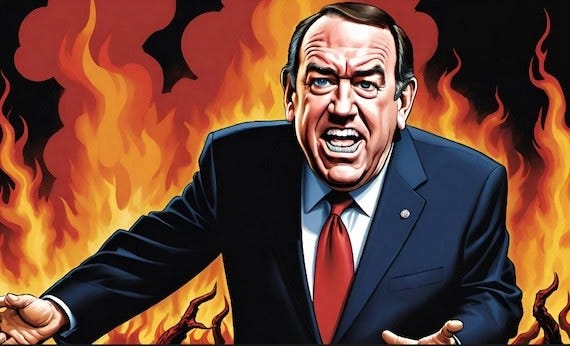
US ambassador to Israel Mike Huckabee waxing Christian evangelical lunacy, “Israel is a land that God gave, through Abraham, to a people that he chose. It was a people, a place and a purpose.”

Pressed in a recent interview by aging, prep school crashout, Christian Nationalist Tucker (a demon tried to eat my face) Carlson on whether Israel has the right to annex the whole of the Levant, Huckabee responded: “It would be fine if they took it all.”

May be an illustration

Yet, from the realm of historical and archaeological records — there is not a shred of evidence confirming the Old Testament yarn relating a Jewish, out-of-Egyptian bondage and the slog through the Sinai Desert to The Promised Land. Instead we are presented with an origin myth created by Bronze Age barbarians, a band of malcontent, underclass, breakaway Canaanites.

Revealing Christian Zionists such as Huckabee’s claim of divinely blessed Israeli exceptionalism all the more loony muffin: The state of Israel was established by European atheists.

While there is nary a remnant of a chariot of Pharaoh’s army to be found at the bottom of the Red Sea nor a single artifact of a wandering tribe of Jewish refugees in the Sinai, the DNA of Palestinians confirms, they are the Jews of the Torah. In contrast, my own Ashkenazi/Dutch Sephardic DNA reveals a genetic admixture that tilts in a far greater direction towards Europe (southern Italy, Spain, France and Germany) than in the direction of the Levant.


Moses Views the Promised Land, 1670 engraving by Gerard Jollain

Yet I am privy to the Zionism-contrived The Law Of Return to The Promised Land while Palestinian victims of the Nakba are barred from their (scientifically and historically verified) ancestral homeland.

In essence, as personified by Ambassador Mike (The Crackbrained Revelator) Huckabee, MAGA foreign policy is the product of a collective hallucination of Bronze Age barbarians.

Regarding the self-undermining felicity to Israel of the so-called opposition party

Have the Democratic Party elites internalized the reason for losing to the careening towards senility, shambling tub of toxic goo Donald Trump?

Nada, judging by Democrats’ response to Trump’s militaristic belligerence towards Iran.

Evidence suggests, a determining factor to Kamala Harris’ defeat was her cruelly boneheaded response to Gaza protesters at her rallies, and her general indifference to Israel’s proclivity for war criminality.

Harris to anti-genocide demonstrators, “You know what, if you want Donald Trump to win, then say that. Otherwise, I’m speaking.”

May be an image of the Oval Office and text
The protesters chanted in response: “Kamala, Kamala, you can’t hide. We won’t vote for genocide.”

To state the obvious, Candidate Harris did not take them – and the millions of others there in spirit – at their word.

Then there is this: When interviewed on the daytime kibitz show, The View, when asked how her policies would depart from then President Biden’s, she answered, “not a thing comes to mind.”

History is a rhyming pattern: Nothing appears to be coming to Chuck Schumer’s and Hakeem Jeffries’ minds when it comes to Trump’s ethnic cleansing, build-Dubai-over-the genocide-rendered-corpses plan for Gaza or his risking a catastrophic war with Iran due to the goading/rumored blackmailing by war criminal Benjamin Netanyahu.

undefined
Soldat und Tod, 1917, Hans Larwin

Trump is the Second Law Of Thermodynamics disguised in human form, on scene to bring down the US empire. Concurrently, It appears the rotten-to-its-core Democratic Party needs to be composted and have an actual opposition party be seeded and rise from its corrupt, reeking remains.

The Rise and Fail of the MAGA Reich

May be an image of text that says 'IN POLICE ICE POLICE Iael -'

ICE incels costumed into Brownshirt thugs are kvetching that they are being reamed by the MAGA Reich. For example, insofar as receiving a promised $50k signing bonus, the bait-and-switch con was: If they quit before fulfilling their full five year deportment of thuggery, they are obliged to repay their signing bonus — plus interest. Also, the promised health benefits were a sleight-of-hand trick. Many are yet to have received even a single paycheck for their fascist service.

It appears you hyper-authoritarian soreheads have revealed your stupid, vicious nature to the world at large and your only payback will come in the form of karma. You reveled in Trump’s cruelty; you were amused when he grifted “losers.” (He was notorious for not paying contractors.) Well now, you have been grabbed by the pussy, exploited, and then dispatched to the Epstein Island of your own private Hell.

Proceed to the nearest mirror, take an extended perusal: It couldn’t have happened to a more deserving fascist jerkopath.


The Cardsharps, c. 1594, by Caravaggio

Phil Rockstroh is a poet, lyricist, and essayist. His poems, short fiction, poetry and essays have been published in numerous print publications and anthologies; his political essays have been widely posted on the progressive/left side of the internet.  Read other articles by Phil, or visit Phil's website.
JD Vance confronted with harsh polls on Fox News: 'Turn it around'


Nicole Charky-Chami
February 25, 2026 
RAW STORY


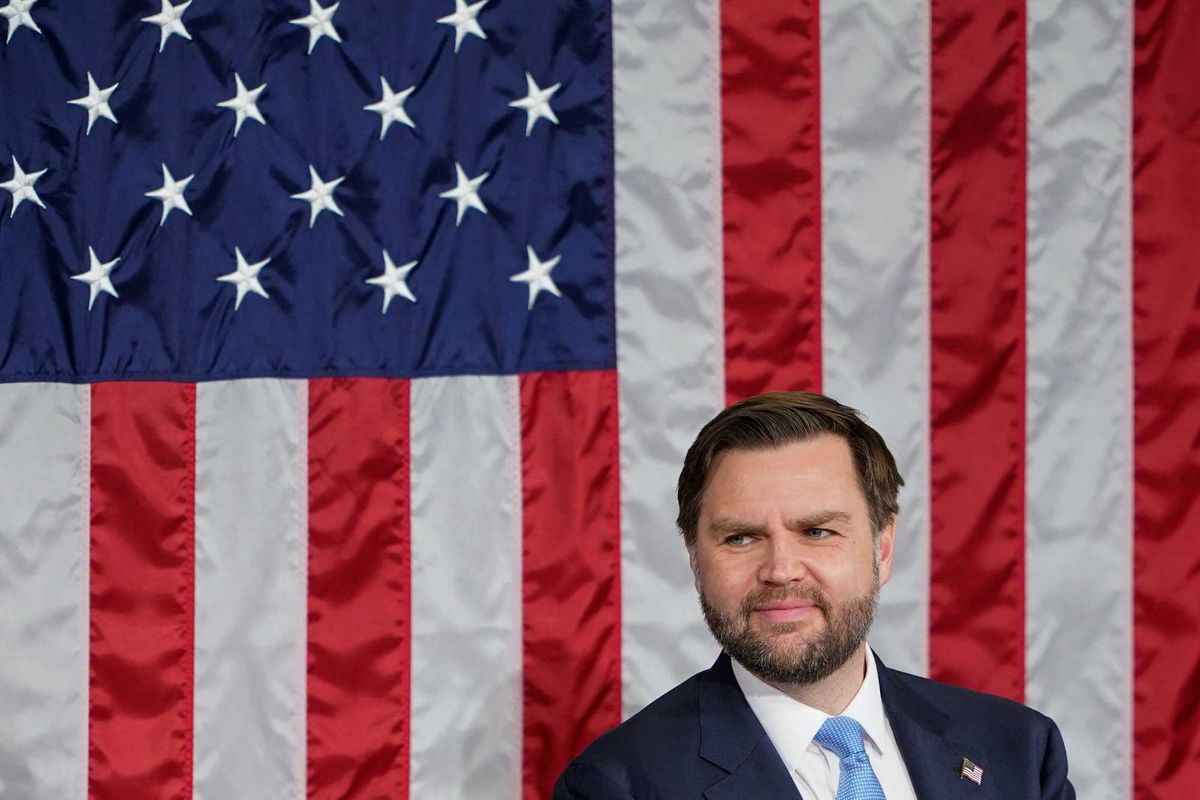
Vice President JD Vance attends President Donald Trump's State of the Union address in the House Chamber of the U.S. Capitol in Washington, D.C. on Feb. 24, 2026. REUTERS/NATHAN HOWARD

Vice President JD Vance had to face a reality check from an unlikely source Wednesday — Fox News.

Vance was talking to anchor Bill Hemmer following President Donald Trump's rambling and record-breaking State of the Union speech, when Hemmer asked him several pointed questions about dismal polling results showing Americans' dissatisfaction with the economy, The Daily Beast reported.

Hemmer pointed to how the topic was an “issue that might clip” Republicans just months away from midterms. He referred to a Fox News poll conducted from Jan. 23–26 that revealed just 40 percent approve of Trump’s handling of the economy, while 59 percent disapprove, according to The Beast.

The Fox News anchor didn't mince words with the vice president.

“You’ve got nine months to turn it around,” Hemmer told Vance. He compared the daunting task to "pushing a car uphill."

"You know Democrats are juiced — they're ready to vote tomorrow," Hemmer said.

Vance admitted that the Trump administration was confronting a challenge.

"In some ways, we are pushing a car uphill,” Vance said, just before he changed the subject and blamed former President Joe Biden. He also tried to argue that Americans would get a "massive tax refund."