Thursday, March 12, 2026

Why the Democrats Are Not Radical Enough

Until left Democrats are willing and able to support meaningful job guarantees, they have little chance of reaching the working people they have lost over the past 40 years of wholesale job destruction.
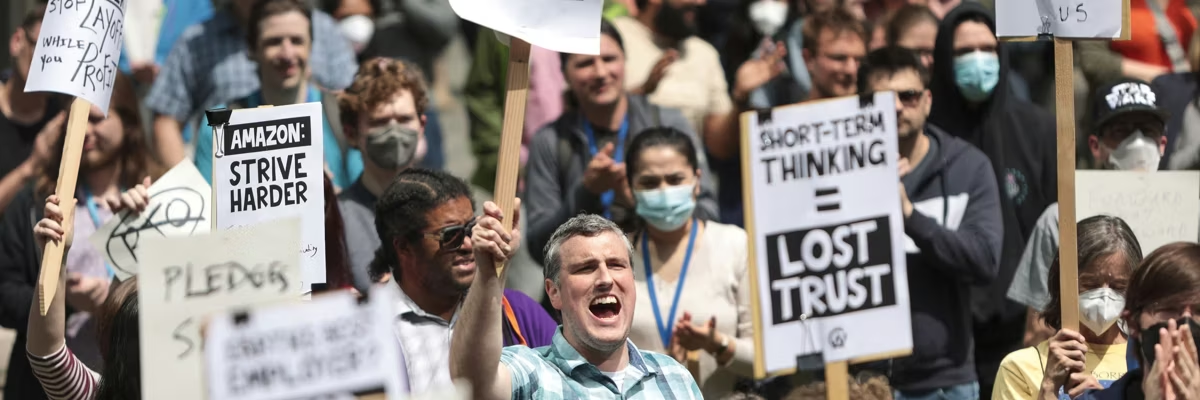

Amazon employees and supporters gather during a walk-out protest against recent layoffs, a return-to-office mandate, and the company’s environmental impact, outside Amazon headquarters in Seattle, Washington, on May 31, 2023.

(Photo by Jason Redmond / AFP via Getty Images)

Les Leopold
Mar 11, 2026
Common Dreams

Centrist Democrats argue that the party should not “go so far left in a primary that they can’t win against MAGA in the general.” As the Center for Working Class Politics observes, these “Third Way” Democrats stress “affordability” and “abundance” without taking on the billionaire class. Progressive Democrats, including groups like the Democratic Socialists of America and Working Families Party, are seen as just too radical to attract working-class voters.

I disagree. I think the problem is that Democrats, even progressive Democrats, are not radical enough.

We have only to look at former President Franklin D.. Roosevelt’s 1941 “Four Freedoms” State of the Union address to be reminded of what our politics could be and should be. The “Four Freedoms” (of speech and religion, from want and fear) are properly the best remembered parts of the address. But just before these “four essential human freedoms,” Roosevelt listed “the simple, basic things that must never be lost sight of in the turmoil and complexity of our modern world.” They are:Equality of opportunity for youth and for others.

Jobs for those who can work.
Security for those who need it.
The ending of special privilege for the few.
The preservation of civil liberties for all.
The enjoyment of the fruits of scientific progress in a wider and constantly rising standard of living.

What did he want? He thought we “should bring more citizens under the coverage of old-age pensions and unemployment insurance,” which (thankfully!) has been done, although the support should be increased.

He believed we should “widen the opportunities for adequate medical care,” which has been done in part, with much more to do.

And he called for the nation to “plan a better system by which persons deserving or needing gainful employment may obtain it,” which we have pretty much stopped talking about altogether, except to mouth empty phrases about economic growth and job creation.

And this is where, in particular, progressive Democrats are not radical enough, at least not for the thousands of workers I have talked to, worked with, and taught. The economic plans offered by the Democratic Party, even those from left Democrats, fail to offer “a better system by which persons deserving or needing gainful employment may obtain it.” And until they do, Democrats will continue to lose traction with working people, who live with job fear each and every day.

Why Are Democrats Not Talking About Guaranteeing a Job at a Living Wage for Everyone Who Wants to Work?


The government guarantees everyone with money to spare a safe place to put it to earn a fair market rate of return. It is called a US Treasury bond. Why doesn’t the government also guarantee everyone with labor to spare—everyone who wants to work but can’t find a job—with a place to work at a fair market rate?

There are no voices, except for Sen. Bernie Sanders (I-Vt.), who proclaim loudly and clearly that all working people should be guaranteed a job at a living wage. Why not? Members of the moneyed class are able to protect themselves from financial risk by easily diversifying their investments. But the working class’ most critical investment—their job—is always at risk.

The jobs of working people are increasingly precarious as corporations lay off workers whenever they please, whether for good reasons, bad reasons, or no reasons at all. Today we see millions of layoffs taking place to finance mergers (watch out Hollywood!), leveraged buyouts, and stock buybacks to enrich the richest of the rich. And who knows what AI holds in store?

The millions of workers in rural America who have suffered one mass layoff after another need the power that comes from employment security—jobs that don’t just depend on the profit-maximization strategies of corporate America.

A government-backed guarantee of a job at a living wage would end the wholesale immiseration of families and communities hit by mass layoffs. It would end the kind of job blackmail that makes it difficult for workers to form unions to seek higher wages and better working conditions. This is what counterbalancing corporate power really looks like!

How would it work? Corporations would remain free to reduce their workforces. But every laid-off worker who wants to keep working would be able immediately to find equally remunerative work nearby in the public sector if private sector jobs are not available.

Also, just as employers are able to lay off anyone for business reasons, workers would be free to quit any job they no longer want and easily find another. This kind of “employment assurance” is the worker equivalent of the portfolio diversification and hedging that the wealthy use to protect and enhance their wealth. (And as we all know, when this financial system crashes, the federal government always protects the assets of the wealthy, but not the jobs of working people.)

Is there sufficient public sector work to support such a program? Of course there is, especially if the country commits to rebuilding its physical and human infrastructure. Surely every municipality and state agency needs more workers right now to meet their current goals, let alone new ones to enhance the public’s interests. There’s no shortage of public goods that need to be produced.

Could we afford it? Yes, it would be costly. But the money would be well spent to build better communities. Just ask any group of workers what their communities need, and they will quickly rattle off how to improve them.

And if we all share the costs in proportion to our wealth, we can certainly afford it. Warren Buffett’s tax rate should not be lower than his secretary’s! A small tax on the trade of stocks, bonds, and derivatives might even cover it.

Working-Class Empowerment

Funding and practicality are not the only things holding progressive Democrats back. I worry that power of capital has, if just unconsciously, narrowed their vision. Too many Democrats of all stripes seem to believe that corporate control over employment is an unalterable fact of economic life. Therefore, they don’t go for the jugular—employment guarantees.

The millions of workers in rural America who have suffered one mass layoff after another need the power that comes from employment security—jobs that don’t just depend on the profit-maximization strategies of corporate America.

Until left Democrats are willing and able to support meaningful job guarantees, they have little chance of reaching the working people they have lost over the past 40 years of wholesale job destruction. Massaging the messages is no match for saying loudly and clearly that if you want to work, there is an acceptable job waiting for you.

Many left Democrats believe that we need to shift from a profit-first to a people-first economy. All to the good. But that has little meaning unless working people are assured of a decent paying job if they are looking for work. And also, able to leave a bad job without suffering economic annihilation!

It’s time for the left to become economic radicals again!

(Many thanks to labor historian Mike Merrill for his assistance on this piece.)


Our work is licensed under Creative Commons (CC BY-NC-ND 3.0). Feel free to republish and share widely.


Les Leopold

Les Leopold is the executive director of the Labor Institute and author of the new book, “Wall Street’s War on Workers: How Mass Layoffs and Greed Are Destroying the Working Class and What to Do About It." (2024). Read more of his work on his substack here.
Full Bio >


Chuck Schumer: Man of Peace


For many years, Senator Charles Schumer demanded tougher and tougher sanctions on the people of Iran, as he shamelessly documents on his own website. He insisted on a Cuba-like blockade, punishing and deterring any company or nation from providing life support to Iran. He predicted, ludicrously but proudly, that such punishing sanctions might lead to an overthrow of the Iranian government.

Like all Congressional supporters and opponents of the Obama-era nuclear deal, Schumer pretended that Iran was pursuing nuclear weapons, but never pretended his only goal was to prevent that fictional behaviour:

“The actual Iranian people are secular and pro-American. And they are not poor. They are rising into the middle class… If we can squeeze them economically, you might get them to take to the streets again and at the very minimum put pressure on their government to back off their nuclear escapade and at the very best overthrow the government.”

For Schumer, the long-enjoyed imaginary nightmare of a nuclear Iran was always a justification for lawless U.S. actions because it was a threat to Israel, while meanwhile always pretending (with one exception obtained via great persistence) that Israel had no nuclear weapons and was a threat to no one.

During the debate over a nuclear deal with Iran, the two common positions in Congress were (1) we need this deal because Iran is trying to build nuclear weapons, and (2) we need no deal and ideally a war because Iran is trying to build nuclear weapons. Schumer opposed Obama’s deal.

When Trump 1.0 wanted to tear up the deal, Schumer claimed to oppose that, even while relentlessly demanding more sanctions in apparent violation of the deal. Even when admitting that Iran was not violating the deal, Schumer never stopped denouncing Iran as the enemy of the United States, engaged in behaviour that he claimed required ever more sanctions in (unstated) violation of the deal by the United States.

Nine months ago, Schumer posted a video solemnly accusing Trump 2.0 of being too “chicken” to take on Iran. When Israel has attacked Iran (or done anything else whatsoever) Schumer’s focus has been on praising Israel.

As of February 24 and 25 of this year, we could read reports on how Schumer and other leading Democrats were working to avoid a vote on a war powers resolution until the war could be begun.

And once the war was begun, Schumer and gang didn’t denounce mass murder, but mumbled about procedures, as if a Congressional vote could have legalised a blatant violation of the UN Charter, or as if proper planning could turn slaughter and destruction into respectable acts. Schumer published a statement mixing opposition to Trump’s war with tougher-on-Iran-than-thou rhetoric and insistence on knowing the supposed goals of the war — were they tough enough?

This was followed by a new statement claiming to support a war powers resolution and to oppose the war because of a handful of U.S. deaths, without a word for the many Iranians killed or the rule of law — and another statement about how unpopular the war should make Trump, and yet another about how senators should vote yes on war powers — but not a word in public or, as far as we know, in private about Democratic Senator John Fetterman who was already publicly saying that he would vote no.

After the failed vote, Schumer focused on Republicans and gas prices, with still never a word for those killed or the likely long-lasting consequences of all this large-scale violence, never a word on the need to block efforts to give Trump an Iran War Slush Fund of $50 billion, never a word on the need to block Congress from giving the Pentagon $1 trillion a year or upping it to $1.5 trillion, never a word on the need to close U.S. bases in Gulf region dictatorships, never a word on the need to cosponsor and pass the Block the Bombs Act to finally halt the illegal shipment of weapons to Israel — shipments still passionately and proudly supported by Schumer despite the genocide he loves having been joined by the new war on Iran that he claims to oppose.

I’ve talked with a number of people about this latest war who oppose it — people I don’t think have ever before opposed any of the hundreds of endless U.S. bloodbaths of recent history. While I find this vaguely encouraging, I’m struck by their usual next comment: “Well, at least the Democrats are trying their hardest.”

David Swanson is an author, activist, journalist, and radio host. He is director of WorldBeyondWar.org and campaign coordinator for RootsAction.org. Swanson's books include War Is A Lie. He blogs at DavidSwanson.org and War Is a Crime.org. He hosts Talk Nation Radio. Follow him on Twitter: @davidcnswanson and FaceBookRead other articles by David.
Trump’s Attempt at Wagging the Dog Has a Real Body Count

Trump has consistently tried to change the subject whenever the issue of the Epstein scandal crops up, but nothing as dramatic as starting a war... until now.


Thick plumes of smoke rise over the residential areas of the Iranian capital following airstrikes amid ongoing US-Israel attacks as multiple explosions are heard across the city in Tehran, Iran on March 01, 2026.
(Photo by Fatemeh Bahrami/Anadolu via Getty Images)


Elliott Negin
Mar 12, 2026
Common Dream

On Christmas Day in 1997, Wag the Dog, a dark political satire directed by Barry Levinson and co-written by David Mamet, opened in theaters across the country. Hardly typical Christmas fare, the movie centered on crisis-management expert Conrad Brean, played by Robert De Niro, and Hollywood producer Stanley Motss, played by Dustin Hoffman, who fabricate a war to distract public attention from a presidential sex scandal.

Sound familiar?

In the film’s opening scene, presidential adviser Winifred Ames (Anne Heche) and other administration staff summon Brean to the White House to help clean up a mess. The president had just met with a group of teenage Firefly Girls from Santa Fe, they explain, and one of them expressed an interest in seeing a Frederick Remington sculpture in the Oval Office. The president escorted her there and sexually assaulted her.

The story leaked, and not only was The Washington Post about to run with it, but the president’s opponent also was about to air a TV commercial referencing it. With less than two weeks to go until election day, the story could derail the president’s reelection bid.

His attack on Iran will always be remembered as Trump’s war, a war started, in his own words, by a president who apparently “has absolutely no ability to negotiate.”

“We have to distract them” with a fake crisis, Brean tells the staffers, and after brainstorming a bit, hits upon a solution: “We have to go to war with somebody.” He concocts a story that Albania, a “shifty” country that “wants to destroy our way of life,” has smuggled a nuclear suitcase bomb into Canada and plans to sneak it across the border. He then enlists the help of Motss, and together they bamboozle the news media, the CIA, and the general public into believing the country is at war. The Oval Office sex scandal story gets lost in the shuffle and the president’s approval ratings rebound in time to win the election.

President Donald Trump also has a sex scandal that he wants to go away.

After simmering for months, the Jeffrey Epstein sex-trafficking story reached a full boil in February following the Justice Department’s January 30 release of 3.5 million additional file pages. On February 9, the department granted members of Congress access to unredacted files for the first time, and the next day, Rep. Jamie Raskin (D-Md.) told Axios that he found more than a million references to Trump. On February 11, Raskin and other members of the House Judiciary Committee grilled Attorney General Pam Bondi about the files, attracting quite a bit of attention even though she avoided answering their questions.Then, on February 24, came the potential coup de grâce. NPR reported that the Justice Department removed documents that mention Trump from the public Epstein database, including files related to allegations that Trump had sexually abused a minor.

NPR’s investigation found that a specific allegation only appeared in copies of the FBI list of claims and a Justice Department slideshow. Its details are explosive. As spelled out by NPR: “The woman who directly named Trump in her abuse allegation [to the FBI] claimed that around 1983, when she was around 13 years old, Epstein introduced her to Trump, ‘who subsequently forced her head down to his exposed penis which she subsequently bit. In response, Trump punched her in the head and kicked her out.’”

Four days after the NPR story ran, the United States and Israel attacked Iran and poof, the Epstein sex scandal story disappeared from the headlines. Unlike Wag the Dog, however, Trump started a real war, and as of this writing Al Jazeera was reporting that more than 1,000 Iranians are dead and more than 6,000 are wounded, according to Iranian state media.
Art Imitating Life (and Life Imitating Art)

Of course, the launch of Trump’s war at a time of heightened public interest in the Epstein files could be merely coincidental. The administration has offered various rationales for the attack, from regime change to eliminating Iran’s nuclear program and ballistic missiles, neither of which posed an imminent threat. Others have speculated that Trump is retaliating for alleged Iranian attempts on his life or squeezing China’s oil supplies to force it to rely more heavily on Saudi Arabia. Even so, there are at least two other notable examples of presidential attempts to divert attention from a politically damaging event by attacking another country.

One example was cited in Wag the Dog. In a scene in which Brean reassures Ames that a fake crisis would distract the public, he says, “That was the Reagan administration’s M.O.: Change the story.” Twenty-four hours after 240 Marines were killed in Beirut, he explains, Reagan invaded the tiny Caribbean nation of Grenada.

It is doubtful that many people are going to forget about Trump’s role in the Epstein saga. His victims are certainly not going to forget.

Brean was referring to an incident that happened on October 23, 1983, when a truck bomb destroyed the US Marine barracks in Beirut, Lebanon, killing 241 American servicemen. That same day, President Ronald Reagan approved final plans to invade Grenada during an attempted coup, ostensibly to protect 600 American medical students who, as it turned out, were not in any danger. On October 25, just two days after the Beirut bombing, US forces invaded Grenada. Story changed.

The second example falls into the category of life imitating art. According to Michael De Luca, production head at New Line Cinema when the studio released Wag the Dog, screenwriter David Mamet “was trying to think of something that would never happen in real life, like a president diddling a Girl Scout.” Just a few weeks after the film opened in US theaters, however, news of an eerily similar incident broke.

On January 17, 1998, the Drudge Report reported that Newsweek editors had killed a story exposing President Bill Clinton’s relationship with a 22-year-old White House intern, Monica Lewinsky. Four days later, the story of their tryst appeared in, ironically, The Washington Post.

On August 17, 1998, Clinton appeared on television following his testimony before a grand jury and finally acknowledged that he had “inappropriate intimate contact” with Lewinsky. Three days after that—the same day Lewinsky testified for a second time to the grand jury—Clinton launched 75 to 100 Tomahawk missiles at al-Qaeda targets in Afghanistan and Sudan in retaliation for the terrorist group’s August 7 bombings of US embassies in East Africa. Many said the timetable was more than a mere coincidence.

The Stakes Are Higher Now

Trump has consistently tried to change the subject whenever the issue of the Epstein scandal crops up, but nothing as dramatic as starting a war. Even abducting Venezuela’s president doesn’t compare. But the stakes are now much higher than when Reagan invaded Grenada or Clinton hit back at al-Qaeda. The Iran conflict has quickly spiraled out of control. In less than a week, it involves at least 11 countries besides the main combatants Iran, Israel, and the United States.

It is more than ironic that Trump, who fancies himself a virtuoso dealmaker, started this unnecessary war. After all:Trump’s top negotiators, Middle East envoy Steve Witkoff and son-in-law Jared Kushner, were in the middle of negotiations with the Iranians just before the United States and Israel launched their attack.
Trump routinely heckled President Barack Obama about his first administration’s negotiations with Iran over its nuclear weapons program, predicting that because of his incompetence, Obama would—out of desperation—resort to starting a war. For years, Trump charged that a “weak and ineffective” Obama would at some point attack Iran “to save face,” “to show how tough he is,” and “to get reelected” because “he has absolutely no ability to negotiate.” Obama never attacked Iran, and the coalition he built with China, France, Germany, Russia, and the United Kingdom negotiated an agreement with Iran in 2015 to restrict its nuclear program, which Trump as president trashed in May 2018.
During the 2016 Republican presidential primary season, Trump belittled Florida Gov. Jeb Bush by tying him to his brother’s disastrous invasion of Iraq in 2003. “So George Bush made a mistake,” he said during a mid-February televised debate. “We can make mistakes. But that one was a beauty. We should have never been in Iraq. We have destabilized the Middle East. They lied. They said there were weapons of mass destruction. There were none. And they knew there were none.”

From the looks of it, Trump lied that Iran posed an imminent threat and—like Bush—has just destabilized the Middle East. It’s reminiscent of that line about the “Pottery Barn rule” attributed to Bush’s secretary of state, Colin Powell: “You break it, you own it.” His attack on Iran will always be remembered as Trump’s war, a war started, in his own words, by a president who apparently “has absolutely no ability to negotiate.”

Finally, keep in mind that despite Clinton’s attack on al-Qaeda, no one forgot that he perjured himself about his affair with Monica Lewinsky, which ultimately led to his impeachment. Likewise, it is doubtful that many people are going to forget about Trump’s role in the Epstein saga. His victims are certainly not going to forget. It only remains to be seen if it—along with his other transgressions—brings down his presidency.

This article first appeared at the Money Trail blog and is reposted here at Common Dreams with permission.

Our work is licensed under Creative Commons (CC BY-NC-ND 3.0). Feel free to republish and share widely.

Elliott Negin
Elliott Negin is the executive editor of Money Trail. His articles have appeared in The Atlantic, Common Dreams, HuffPost, LA Progressive, Scientific American, The Washington Post, and many other publications.
Full Bio >
Trump’s White Nationalism Will Only Lead to Division, Poverty, and Mass Violence

The advice of President Donald Trump and Secretary of State Marco Rubio to the European Union to adopt a white nationalist domestic and foreign policy and attempt to initiate a new round of colonialism is monstrous, both morally and in practical terms.


Peter Cvjetanovic (R) along with neo-Nazis, alt-right, and white supremacists, encircle and chant at counterprotesters at the base of a statue of Thomas Jefferson after marching through the University of Virginia campus with torches in Charlottesville, Virginia, USA on August 11, 2017.

(Photo by Samuel Corum/Anadolu Agency/Getty Images)

Juan Cole
Mar 12, 2026
TomDispatch

Under President Donald J. Trump, the United States has now become an engine for the promulgation of white nationalism. Not since the 1930s has such an ideology, which exalts those ethnic groups it codes as “white,” while denigrating all others, underpinned the domestic and foreign policies of a major world power.

Typically (for our moment), Trump’s recent National Security Strategy (NSS) depicted Europe as in distinct “civilizational decline” because of the European Union’s commitment to multiracial democracy and international humanitarian law. These days, thanks to its racial policies, the Trump team even finds a way to inject racial hatred into dry economic statistics, complaining that “Continental Europe has been losing share of global GDP [gross domestic product]—down from 25% in 1990 to 14% today.”


A Mayor Named Khan


As it happens, though, on a per-person basis, Europeans are more than twice as wealthy today in real terms as they were 36 years ago. The dictum once cited by Mark Twain that there are “lies, damned lies, and statistics” is exemplified in Trump’s National Security Strategy. In 1991, just two years before the European Union (EU) was first formed, the per-capita GDP there was $15,470 (in today’s dollars). In 2024, that figure was $43,305. What changed since then wasn’t that Europe began decaying, but that the well-being of the people in the global South, in what Trump dismisses as “shithole countries,” has actually also improved significantly, whether he likes it or not, changing Europe’s share of global GDP.

In his National Security Strategy, Trump admits, however, that Europe’s supposed economic degradation doesn’t bother him nearly as much as another issue: “This economic decline is eclipsed by the real and more stark prospect of civilizational erasure,” thanks to Europe’s migration policies. In short, Trump’s government has now adopted a modernized version of the Nazi Great Replacement ideology, slamming “migration policies that are transforming the [European] continent and creating strife,” along with “cratering birthrates, and loss of national identities and self-confidence.”

The only thing that outstrips Trump’s Islamophobia is his horror of Black people.


Trump claims that he’s no longer sure Europeans will even remain European. He supposedly worries that, two decades from now, the continent will be unrecognizable and EU countries no longer capable of being Washington’s “reliable allies.” That barb is, of course, clearly aimed at Muslim immigrants to Europe, even though they are a distinct minority of those arriving there. In an interview about his NSS, Trump snidely remarked, “If you take a look at London, you have a mayor named Khan.” And he then went on to exclaim in horror that immigrants aren’t just coming from the Middle East, “they’re coming in from the Congo, tremendous numbers of people coming from the Congo.” In other words, the only thing that outstrips Trump’s Islamophobia is his horror of Black people.

Of course, he’s completely misinformed about immigration to Europe, which means his NSS is as well. As a start, the largest influx of people into the EU in recent few years has been 4.3 million Ukrainians. The major sources of immigration to Germany in 2024 were Ukraine, Romania, Turkey, Syria, and India. For Spain, it was Colombia, Morocco, Venezuela, Peru, and Argentina. As for Europe’s future reliability, Trump has already said that he “can’t trustDenmark, no matter that its population is solidly Lutheran and predominantly blond, because that country won’t give him Greenland. And since the president has expressed a willingness to break up the NATO alliance, if necessary, to add 57,000 Greenlanders to his feudal domains, his doubting of European dependability should be considered richly ironic.

Aryan Reliability

The underpinnings of Trump’s reasoning can (or at least should) be described as Nazi in style. After all, he’s assuming that the immigrants he loathes are inherently incapable of becoming Europeans and will make those countries intrinsically untrustworthy as allies of the United States. Of the EU countries, he recently asserted that “they’ll change their ideology, obviously, because the people coming in have a totally different ideology.” Yet British Prime Minister Rishi Sunak, born in Southampton to an immigrant Indian-East African family of Hindu faith, was widely viewed as having restored British-US diplomatic relations after years of strain.

In reality, studies show that socioeconomic status, not national origin, best predicts how immigrants will vote. In Germany, the better-off Russian Germans, who far outnumber largely working-class Turkish Germans, tend to vote for right-of-center parties. Both groups, however, seem happy to participate in European politics in accordance with local norms. If, for Trump, the term “immigrants” in this context is a dog whistle for Muslims, it might be noted that 9 of the 22 countries, including Egypt, Saudi Arabia, and Pakistan, that have been formally designated by Trump as “major non-NATO allies” are Muslim majority.

His foreign policy reasoning in that NSS eerily mirrors the crackpot logic of Adolf Hitler, who saw France as an enemy of Germany’s because it had allegedly fallen irretrievably under non-Aryan Jewish influence, and who held out hope in the 1920s and early 1930s that Aryan elements would prevail over Jewish ones in Britain, a country he preferred as a strategic partner because of the Germanic ancestry of part of its population. In Trump’s NSS, immigrant Europeans from Africa and the Middle East play the role that Jews did in Hitler’s thinking—that is, non-Aryan underminers of national integrity. Hitler’s conspiratorial racism was, of course, all too grimly insane, and so, too, is that of Trump’s NSS.

“Mongols and Negroes”


Central to the NSS is the Great Replacement. The idea, though not the phrase, goes back to 1900 when the French nationalist parliamentarian and novelist Maurice Barrès wrote, “Today, new French have slipped in among us… who want to impose on us their ways of feeling.” He warned of Jewish, Italian, and other immigrants. “The name of France might well survive,” he commented, but “the special character of our country would nevertheless be destroyed.” Amid a political crisis over the wrongful conviction of Captain Alfred Dreyfus (of Jewish and Alsatian heritage) for supposed espionage for the German embassy, Barrès denounced the famed French novelist Émile Zola, a supporter of Dreyfus, as “not French” but a rootless cosmopolitan from a Venetian background.

Fifty years later, the French Nazi René Binet (1913-1957) coined the phrase “Great Replacement.” An ex-Communist, he had served as a Nazi collaborator during World War II in the Waffen Grenadier Brigade of the Charlemagne paramilitary Protection Squadron (Schutzstaffel or SS). After the war, in his 1950 book Theory of Racism, he wrote in dismay about how Western Europe had been invaded by “Mongols and Negroes”—that is, by the Soviets and the Americans. He lamented that Jewish-dominated capital also supposedly controlled Europe (it didn’t, of course) and falsely alleged that Jewish CEOs were bringing in immigrants in a deliberate attempt to replace civilized white Europeans.

Prime Minister Pedro Sánchez had it right when he said that Spain faces a choice between “being an open and prosperous country or a closed and poor one.”

Sadly enough, Binet’s ideas have been revived in this century by French thinkers and politicians. Renaud Camus published his 21st century version of the theory in 2010, entitling his book The Great Replacement. Such falsehoods were echoed in Charlottesville, Virginia, in 2017, when American Nazis chanted, “Jews will not replace us” (and President Trump called the assembled protesters, as well as those who opposed them, “very fine people”). Camus came around to supporting like-minded politicians in the far-right French National Rally (formerly the National Front) party, led by Marine Le Pen, who also became a Trump ally. When a French court convicted her of embezzlement in 2025 and excluded her from politics for five years, Trump denounced the verdict and launched the slogan, “Free Marine Le Pen.” Holding Le Pen, a far-right racist politician, accountable to the rule of law is part of what Trump was complaining about in his NSS when he cited European “censorship of free speech and suppression of political opposition.”

Marine Le Pen’s father, Jean-Marie Le Pen, had been a paratrooper in the ruthless Algerian War (1954-1962) that killed between half a million and a million Algerians in a bid to keep that country under French colonial domination. The elder Le Pen came to lead the newly founded National Front in 1972 and was surrounded by far-right figures who had collaborated with the Nazis. While the party reinvented itself under Marine Le Pen in 2017 as the National Rally and has moved slightly toward the center, many of its supporters harbor neo-Nazi ideas about racial purity, now typically aimed at Arab and Amazigh Muslims.

Forget 1776 and All That

The central concerns of that National Security Strategy now animate the Trump administration’s foreign policy. At the annual Munich Security Conference in early February, for instance, Secretary of State Marco Rubio took up what the Victorian jingoist writer Rudyard Kipling once termed the White Man’s Burden, crowing that “for five centuries, before the end of the Second World War, the West had been expanding.” He neglected to mention all the massacres, destruction, and looting that European colonialists perpetrated over those centuries. Belgium’s King Leopold II alone, for instance, instituted policies in the Congo from 1885 to 1908 that may have killed as many as 10 million people. That bloody episode inspired Joseph Conrad’s novel The Heart of Darkness, in the final sentence of which the protagonist utters, “The horror! The horror!

After the end of World War II in 1945, Rubio lamented, a Europe in ruins contracted. “Half of it,” he added, “lived behind an Iron Curtain and the rest looked like it would soon follow.” He mourned that “the great Western empires had entered into terminal decline, accelerated by godless communist revolutions and by anti-colonial uprisings that would transform the world and drape the red hammer and sickle across vast swaths of the map in the years to come.”

He also displayed a striking mixture of white nationalism and colonial nostalgia—and with it, an ignorance of the history of decolonization, which neither occurred only after 1945, nor was in the main communist led. After all, the United States launched its anti-colonial struggle in 1776. Most of Latin America was liberated from the Spanish Empire in the early 19th century by Simón Bolívar and other fighters who would have been characterized at the time as liberals. As for the post-World War II liberation movements, most leaders of former colonialized countries, including India, Kenya, Malaysia, Morocco, Pakistan, Senegal, and Sudan, among other places, tilted either to capitalism or to social democracy.

Marco Rubio’s mixing of white nationalism and colonial nostalgia is, of course, nothing new. A return of German colonies in Africa, lost in World War I to Britain and France, was among the Nazi regime’s most insistent demands in the late 1930s, and dreams of a new version of German imperialism in Africa were part of what was meant by the Third Reich.

Rubio has depicted decolonization as a failure of the European will to power. Most historians, on the other hand, point to the way their colonies mobilized for independence. Political scientists point to two crucial kinds of mobilization. The first was “social mobilization,” which involved urbanization, industrialization, and increased literacy. By 1945, ever more Asians and Africans were no longer illiterates living in small, disconnected villages. As for political mobilization, parties, chambers of commerce, and labor unions put millions of the previously colonized in the streets. New social classes of entrepreneurs, professionals, and workers demanded the right to control their own destinies.

And in the wake of World War II, attitudes were changing even among the colonial powers. The British public, for instance, could no longer be persuaded to spend money in an attempt to quell an India where the Congress Party of Mahatma Gandhi and Jawaharlal Nehru had brought millions into the streets demanding independence. And while the Netherlands did fight viciously to roll back Indonesia’s declaration of independence in 1945 (despite having itself been occupied by Germany during World War II), after four years of massacres, it was forced out. The impoverished French had no choice but to give up most of their African possessions, but in a sanguinary failure attempted to keep their colonies in Algeria and Vietnam by military force. American President Dwight D. Eisenhower, a wiser man than Rubio, twisted French President Charles De Gaulle’s arm to get him out of Algeria lest the revolutionaries there turn to Moscow and Communism.

Kinder, Küche, Kirche

Given that history, the advice of President Donald Trump and Secretary of State Marco Rubio to the European Union to adopt a white nationalist domestic and foreign policy and attempt to initiate a new round of European colonialism in the global South is monstrous indeed, both morally and in practical terms. Without immigration today, Europe would soon face Japan’s dilemma of rapid population loss, along with the loss of international economic and political power.

Prime Minister Pedro Sánchez had it right when he said that Spain faces a choice between “being an open and prosperous country or a closed and poor one.” As for the white nationalist pronatalist dream of keeping women barefoot and pregnant in accordance with the old German slogan, Kinder, Küche, Kirche (children, kitchen, church), it’s a chimera given the electoral power of women in today’s Europe (and the United States).

In reality, the European Union’s project of multicultural democracy has yielded enormous prosperity, while expanding and deepening human rights.

Meanwhile, Donald Trump’s cruel, heavily ICED anti-immigrant campaign has already hurt the American economy and Europeans would be deeply unwise to emulate it in any way, including colonially. The neoconservative project of rehabilitating American colonialism crashed and burned in this country’s disastrous 21st-century wars in Afghanistan and Iraq (and won’t be aided by the present assault on Iran either) for reasons similar to those that made European colonialism impossible in the post-World War II period.

In reality, the European Union’s project of multicultural democracy has yielded enormous prosperity, while expanding and deepening human rights. Trump’s white nationalism, on the other hand, is a formula for division, poverty, and mass violence, as was demonstrated in the 1930s and 1940s when a form of that ideology was last tried in Europe.

And count on this: Trump and crew are going to give the phrase “the white man’s burden” a grim new meaning.


© 2023 TomDispatch.com


Juan Cole
Juan Cole teaches Middle Eastern and South Asian history at the University of Michigan. His newest book, "Muhammad: Prophet of Peace Amid the Clash of Empires" was published in 2020. He is also the author of "The New Arabs: How the Millennial Generation Is Changing the Middle East" (2015) and "Napoleon's Egypt: Invading the Middle East" (2008). He has appeared widely on television, radio, and on op-ed pages as a commentator on Middle East affairs, and has a regular column at Salon.com. He has written, edited, or translated 14 books and has authored 60 journal articles.
Full Bio >


The Cost of War: Iran Edition

Every dollar on this war of choice against Iran is a dollar that did not go toward schools, bridges, or health care.


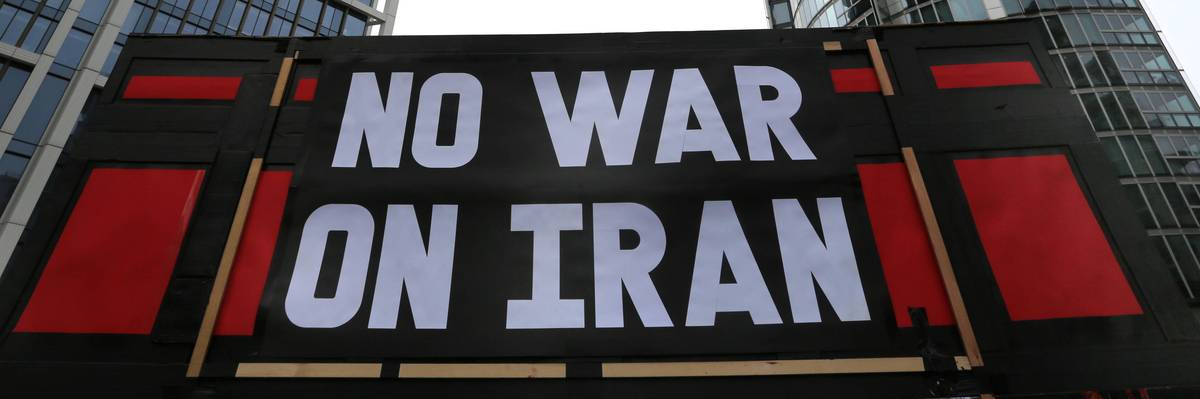
A protester holds a sign saying ‘No War On Iran’ during the ‘Stop The War’ rally against the strikes on Iran on March 7, 2026 in London, England.
(Photo by Martin Pope/Getty Images)

Eric Morrissette
Mar 12, 2026
Common Dreams


On Saturday, February 28th, Americans woke up to find their country at war with Iran. Breaking news alerts carried word that the United States had joined Israel in an unprecedented joint military operation aimed at overturning the Iranian government. The human cost is already jarring: one week in, Al Jazeera’s live tracker counts over 1,300 dead in Iran, at least 11 in Israel, 9 in Gulf states, and six American soldiers. But for millions of Americans already struggling through an affordability crisis, a different and urgent question is forming: what will this war cost their families at the pump, in the store, and in their economic futures?

We know that wars are costly. Having extricated ourselves from protracted Middle East conflicts just three years ago, we have clear reference points which are not reassuring. The Costs of War Project at Brown University’s Watson Institute estimates that from late 2001 through FY2022, the U.S. spent or obligated $8 trillion on post-9/11 wars: $5.8 trillion in direct costs and at least $2.2 trillion in future veterans’ care through 2050. Every dollar in that accounting was a dollar that did not go toward schools, bridges, or health care.

These numbers reflect a long campaign, advocates of this war will say. President Trump has promised resolution in weeks, perhaps months — not years. His supporters point to Venezuela, where a targeted strike deposed a dictator, or to the June 2025 strikes on Iran’s nuclear program, as models of swift, decisive action. The math tells a different story.

Operation Midnight Hammer, the June 2025 Iran strikes, alone cost an estimated $2.04 billion to $2.26 billion, according to the Costs of War Project. The regional operations—Yemen, sustainment, Israel support — costed $4.8B to $7.2B. The January–February 2026 naval buildup added another $450M to $650M. In total, from October 2023 through September 2025, the U.S. spent between $9.65 billion and $12.07 billion on military activities across the wider Middle East. These costs were before a single shot was fired in this new war. These are dollars not spent on healthcare, childcare, or the rising prices Americans keep asking policymakers to address.

There is a cost beyond the spending that comes from buying bombs, and Americans are already paying it. Over the course of about a week, oil prices surged 43% to over $100 a barrel. Their highest in years. As of March 9th, gas hit a nationwide average of $3.48 per gallon. When President Trump delivered his State of the Union two weeks ago, gas stood at $2.92, down from $3.11 at his January 2025 inauguration, a benchmark he routinely cited as proof of his economic stewardship. That ground was surrendered in under seven days. Economists estimate that every $10 rise in crude translates to roughly 25 cents at the pump. And gas pricing is not simply about commutes to school and work. It is about getting goods to consumers, which multiplies inflationary pressure across the entire economy.

Transportation disruption along the Strait of Hormuz is no incidental detail. Nearly 20% of the world’s oil passes through that narrow chokepoint, which abuts Iran directly. Iran does not need to win a war to impose economic pain on the United States and out allies, it merely needs to threaten that passage credibly. That is what we are seeing in recent fuel price fluctuation.

Critically, this war does not arrive in a vacuum. Before the first bomb dropped, American consumers were already absorbing the most significant tariff increases as a share of GDP since 1993. An estimated average cost of $600 to $800 per household in 2026, with that figure rising toward $1,000 should remaining tariffs be made permanent, according to Yale Budget Lab’s analysis following the Supreme Court’s February 20th ruling on emergency tariffs. Inflation had cooled to 2.4% in January but remained above the Fed’s 2% target, limiting its ability to respond to new economic shocks. Businesses that in 2025 absorbing tariff costs rather than passing them to customers are now widely reported to be making that shift. The war’s oil shock lands directly on top of all of it. The war did not create this affordability crisis. It accelerates one already well underway.

Beyond the debt this war will accumulate there is the inflation it will drive into everyday goods, and the fuel costs it will impose on everyone who drives to work, drops children at school, or simply needs to get somewhere. Things are going to cost more. In good times, that would be frustrating. During an affordability crisis, it is what millions can least afford, literally and figuratively.

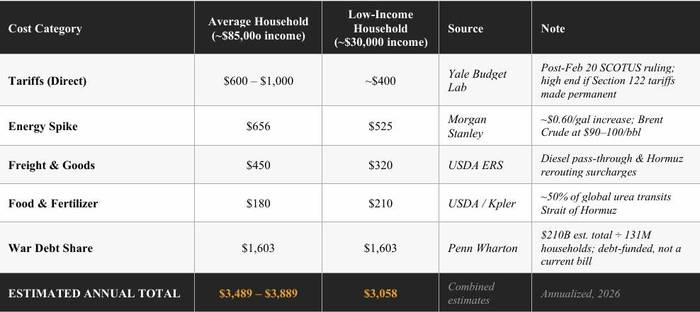
What does this all mean in real terms for real people? For an average family making around $85,000, based on some of the current fallout of the conflict and tariff pressures there is a tax of between $3,489 and $3,889 annually. And for low-income families, making around $30,000 the cost is over $3,000. It is important to note that this is not exhaustive in what the costs are these families.

History offers three lessons worth holding onto. First, the United States does not have a reliable track record of quick exits from Middle East conflicts. What begins as weeks becomes years, and what is promised as surgical becomes protracted. Second, the financial costs of war consistently exceed early projections; the $8 trillion post-9/11 reckoning was not visible in the confident early days of those campaigns. Third, the burden of those costs, through inflation, debt, higher prices on everyday goods, and lives falls hardest not on those who wage wars. The cost of war falls hardest on those who fill their tanks, buy their groceries, and pay their bills: the poor, the underemployed, and those least equipped to absorb rising prices and stagnant wages.

Sadly, there is a war that weary Americans are urgently waiting to see fought. It is the war on affordability. Right now, painfully few shots are being fired on that front.


* Sources: Yale Budget Lab “State of Tariffs” Feb 21, 2026 (post-SCOTUS update) · CSIS Cancian & Park “Operation Epic Fury Cost Estimate” Mar 5, 2026 · Penn Wharton Budget Model (Kent Smetters) via Fortune/Daily Beast, Mar 2026 · USDA ERS Farm Policy News · Kpler trade data via Axios Mar 5, 2026 · Morgan Stanley energy analysis Mar 2026 · Stimson Center “Global Markets and the Strait of Hormuz” Mar 4, 2026

**Note: All figures are estimates from independent research institutions. Actual household impact will vary based on income, geography, spending patterns, and the duration and resolution of the Iran conflict. These estimates will be revised as the situation evolves.
One-Third of Americans Skipped Meals or Cut Back on Spending to Afford Healthcare in 2025

“No one is safe from making these trade-offs,” said a researcher at Gallup, which found even insured Americans in higher income brackets have avoided daily expenses to pay medical bills.


People rally in favor of single-payer healthcare for all Californians as the US Senate prepares to vote on the Senate GOP healthcare bill on June 27, 2017 in South Gate, California.
(Photo by Robyn Beck/AFP via Getty Images)

Julia Conley
Mar 12, 2026
COMMON DREAMS

As the Trump administration spends an estimated $1 billion per day in taxpayer money bombing targets across Iran that have reportedly included an elementary school and healthcare facilities, Gallup released a survey Thursday that found one-third of Americans reported making financial trade-offs in order to pay for medical expenses last year.

The West Health-Gallup Center on Healthcare in America polled nearly 20,000 US adults between June and August 2025 and found that roughly one-third of them—equivalent to about 82 million people in the richest country in the world—were forced cut back on at least one expense in order to afford healthcare.

Eleven percent of respondents—equivalent to 28 million Americans—skipped a meal or intentionally drove less in order to pay a medical bill. Fifteen percent, the equivalent of nearly 40 million people, said they prolonged a current prescription or borrowed money, and 9% cut back on utilities.

Those numbers were strikingly similar among people who have health insurance, with 14% of insured people prolonging prescriptions to avoid paying for a new one and 9% skipping meals. Among insured Americans, 29% made at least one trade-off to afford healthcare.

The crisis is also not exclusively affecting low-income people. A quarter of people in households earning $90,000 to $120,000 per year skipped meals or other expenses to pay medical bills, and 11% of people in households earning $240,000 or more did the same.

“No one is safe from making these trade-offs,” Ellyn Maese, a senior researcher at Gallup and research director for the West Health-Gallup Center, told The New York Times.

Sixty-two percent of people without healthcare coverage were forced to make trade-offs, and 55% of people with household incomes lower than $24,000 per year as well as 47% of people earning $24,000 to $48,000 avoided expenses.

Gallup also released the results of a separate poll taken between October and December 2025, which showed how Americans are delaying major life decisions as well as altering their daily lives to afford healthcare under the for-profit insurance system.

As the Trump administration’s policies slashed healthcare for 15 million Americans and raised healthcare premiums for tens of millions of people—and as the White House demanded that families have more children—6% of respondents said they had postponed having or adopting a child due to healthcare costs, equivalent to about 16 million Americans.

Nearly 30% said healthcare costs led them to avoid taking a vacation, 18% said they delayed finding a different job, 15% said they postponed pursuing education or job training, and 14% said they postponed buying a home.

The polls are “telling a consistent story here,” Maese said.

The survey results were released weeks after the Trump administration proposed new regulations for healthcare plans purchased through the Affordable Care Act marketplace that would charge deductibles as high as $15,000 for individuals and $31,000 for families to offset lower monthly premiums—underscoring how the healthcare law passed 16 years ago has left American households vulnerable to rising costs under the for-profit health insurance system.

A survey taken last November by Data for Progress found that 65% of voters support expanding the Medicare system to everyone in the US, a proposal that would save an estimated $650 billion annually.

But as Rep. Pramila Jayapal (D-Wash.)—who has sponsored Medicare for All legislation in the House—noted on Wednesday, Republicans and establishment Democrats continue to claim the proposal is unaffordable.

“When we ask for Medicare for All it’s ‘too expensive,’ and we ‘don’t have the money,’” said Jayapal. “When the president drags us into his own personal war, no expense is spared. Our priorities are backwards.”