Thursday, March 12, 2026

Leftist Journalist Owen Jones Vindicated in Libel Case Over BBC’s Biased Coverage of Gaza Genocide

The BBC has long been accused of centering Israel and dismissing the humanity of Palestinians in its coverage of Gaza.


Journalist Owen Jones (right) is seen leaving the Royal Courts of Justice in London, where he was being sued by Raffi Berg for libel, on March 6, 2026.
(Photo by Yui Mok/PA Images via Getty Images)


Julia Conley
Mar 12, 2026
COMMON DREAMS

British journalist Owen Jones on Thursday celebrated a UK High Court judge’s ruling in his favor in a libel lawsuit that a BBC editor brought against him—and said that should the editor choose to move forward with his case despite the decision, he was looking forward “to defending my article in court.”

The High Court ruled that Jones was expressing an opinion when he wrote an article for Drop Site News in December 2024 titled “The BBC’s Civil War Over Gaza,” in which he spoke to BBC staffers about Middle East online editor Raffi Berg’s influence over the news outlet’s coverage of Israel and Palestine.

The court also said Jones had expressed his opinion and that of his sources based on concrete examples of Berg’s editorial role and journalism.


Jones’ article described staffers’ allegations that “internal complaints about how the BBC covers Gaza have been repeatedly brushed aside” as Berg “sets the tone” for the outlet’s online coverage of Israel’s onslaught in the exclave, where more than 75,000 Palestinians have been killed since October 2023 in what’s been called a genocide by top Holocaust scholars and human rights groups.

It noted that the BBC failed to report on Amnesty International’s finding that Israel was committing genocide in Gaza and displayed an on-screen chyron reading, “Israel rejects ‘fabricated’ claims of genocide.’”

“Journalists expressed concerns over bias in the shaping of the Middle East index of the BBC news website,” wrote Jones. “Several allege that Berg ‘micromanages’ this section, ensuring that it fails to uphold impartiality.”

The BBC has long been criticized for centering Israel and “dehumanizing” Palestinians, as more than 1,000 artists said in a letter last year when they condemned the network for refusing to air a documentary about the impact of Israel’s attacks on children in Gaza, on the grounds that it featured the child of the exclave’s deputy minister of agriculture—suggesting “that Palestinians holding administrative roles are inherently complicit in violence.”

The article also pointed to Berg’s own history of pro-Israel coverage, including a 2002 story “that presented young [Israel Defense Forces] soldiers as courageous defenders of their country while failing to mention the occupation and settlement of Palestinian land or the widespread allegations of crimes” documented by human rights groups and the US government.

Berg also presented Israeli settlers in the West Bank as “victims seeking ‘a better quality of life’ and did not mention the fact that the settlements have been repeatedly deemed illegal,” and wrote about the Mossad “in glowing terms” in a book he wrote with extensive cooperation from the Israeli intelligence agency.

He also posted a photo on social media showing Prime Minister Benjamin Netanyahu with a copy of Berg’s book on his bookshelf, Jones reported.

Berg’s lawyer said last year that Jones’ reporting attacked Berg’s “professional reputation as a journalist and editor,” and led to death threats.

In order for his case against Jones to proceed, Berg would now need to prove in court that “Jones did not genuinely hold the opinion he expressed in his reporting, or demonstrate that the opinion is not one an honest person could hold on the basis of any fact that existed at the time of its publication,” Middle East Eye reported.

“I am proud to stand by my journalism,” said Jones Thursday.


“How On Earth Do You Justify That?”


Laura Kuenssberg’s Selective Empathy


Seyed Ali Mousavi, the Iranian ambassador to the UK, with Laura Kuenssberg

On 8 March, on the BBC politics programme, Sunday with Laura Kuenssberg, the former BBC political editor put these impassioned words to Seyed Ali Mousavi, the Iranian ambassador to the UK:

‘Since we last spoke, your government has killed thousands of its own people in the streets who had the courage to stand up to protest against the suffering that they have been experiencing at the hands of the regime. Thousands of people were killed. How on earth do you justify that, Ambassador?’

Clearly feeling deep emotion, Kuenssberg continued:

‘Just this morning, I looked at many of the images and watched some of the videos from what happened to protesters in your country in January. I looked at images and videos, verified independently [sic] by our colleagues at BBC Verify, that show body bags littered over the courtyard of a mortuary, the Kahrizak Forensic Medical Centre in Iran. I saw images of young, old, teenagers, people killed by your government, beaten faces, bloodied bodies, gunshot wounds.’

In a strongly accusatory tone, she confronted him:

‘How on earth do you justify that and sit there today saying, “Our people have some complaints”? Your government killed thousands of their own people and the world saw that’.

When has Kuenssberg ever expressed such heartfelt revulsion at the genocide being committed by Israel in Gaza, with likely in excess of 100,000 Palestinians slaughtered?

Has she expressed similar horror for 175 schoolgirls, staff and parents killed by the US in a ‘double-tap’ attack on a primary school in Minab in Iran? It seems some victims matter more.

On the same politics programme last year, Kuenssberg said this about the genocide in Gaza:

‘Often when it comes to the debate about Gaza, it gets very binary and very aggressive very, very quickly and there’s no room for nuance.’

What possible nuance could there be about genocide?

Her tone then was light, devoid of outrage for the tens of thousands dead Palestinians, the mangled and bloodied corpses, many of them babies and children, ripped apart by brutal Israeli firepower.

Kuenssberg also aggressively challenged Mousavi about Iran’s supposed drive towards a nuclear weapon and how Iran could not be trusted to stick to international agreements.

Mousavi pointed out that, on the contrary, Iran is a signatory to the Treaty on the Non-Proliferation of Nuclear Weapons, whereas Israel is not. Moreover, as we noted in our previous alert, in 2015, Iran signed up to the Joint Comprehensive Plan of Action (JCPOA), an agreement to limit the Iranian nuclear programme in return for lifted sanctions. Trump tore up this agreement when the US unilaterally withdrew from it in 2018.

It should be obvious that to state such salient facts is not to side with the Iranian regime, nor to excuse its crimes.

Journalist Peter Oborne, the Daily Telegraph’s former chief political commentator, reports that Iran stuck completely to the JCPOA agreement until the US withdrew in 2018. Until the US and Israel began their attacks, Iran was negotiating in good faith in order to avoid any war. The Omani foreign minister, who was involved in the negotiations, stated that Iran had agreed that they would never have the material needed to make a nuclear bomb, adding:

‘There would be zero accumulation, zero stockpiling. And full verification. Even United States inspectors will have access.’

Oborne spelled out what happened next:

‘Iranians were negotiating really hard to avoid a war. They’d actually offered a better deal than they’d signed off on in 2015. That was on the table and that, of course, is when America and Israel struck.’

Note, also, that in the very same programme on Sunday when Kuenssberg asked propagandistic, emotion-laden questions of the Iranian ambassador she had nothing to say about the Gaza genocide when interviewing Israel’s president, Isaac Herzog. She did not say to him:

‘Since we last spoke, your government has killed tens of thousands of Palestinians in what human rights organisation and genocide scholars have said is a genocide. How on earth do you justify that, Mr President?’

What does it say about the state of politics and news that the president of a genocidal and apartheid state was given carte blanche to proclaim that in attacking Iran and Lebanon, ‘we are doing this for the entire free world’?

Empathy by a prominent BBC journalist for one set of victims – Iranian – is permitted, even required. Permitted, that is, when the finger of blame points the right way. But as the Minab school bombing shows, not when it points the other way; in this case, conclusively towards the US.

‘Unpeople’ And ‘Unworthy’ Victims

British historian Mark Curtis, co-founder and co-director of Declassified UK, has applied the concept of ‘Unpeople’ as a framework for understanding Western foreign policy. In his 2004 book, Unpeople: Britain’s Secret Human Rights Abuses, and in his earlier work, Web of Deceit, Curtis argued that the political system separates victims into two categories: those whose deaths matter (‘People’) and those whose lives are considered expendable (‘Unpeople’).

The concept of ‘People’ and ‘Unpeople’ has its roots in the work of Edward Herman and Noam Chomsky in their classic 1988 book, ‘Manufacturing Consent’, where they discuss examples of ‘worthy’ and ‘unworthy’ victims.

Worthy victims are people who are killed or oppressed by Official Enemies of the West, such as the Soviet Union (and now Russia), North Korea or China. These victims garner considerable media attention in the propaganda system, marked by sympathy, indignation and fury. Their suffering is humanised, described in detail, and used to generate moral outrage directed at the offending regimes or governments, often as part of a concerted attempt to topple them for the benefit of Western geostrategic interests.

‘Unworthy’ victims, by contrast, are people who are killed or whose democratic aspirations are crushed by the West or ‘our allies’; such as Suharto’s Indonesia in the 1960s, Pinochet’s Chile in the 1970s, the US-backed Indonesian invasion of East Timor in 1975, and Israel in the present day. These victims are less prominent, even absent, in western media coverage or are often discounted as ‘collateral damage’: a lesser kind of human, robbed of their individuality, their life stories; even their names and faces.

Herman and Chomsky’s analysis focused on the treatment of ‘worthy’ and ‘unworthy’ victims in the propaganda system. Curtis has expanded the discussion by examining declassified UK government files, released under the ‘Thirty-Year Rule’, showing how the British state structurally ignores or downplays the importance of those it regards as ‘Unpeople’.

Curtis highlights a prominent example occurring right now:

‘In the case of Gaza, Palestinians are seen as unpeople since supporting them holds little merit or gain for British planners. What does Palestine have to offer Whitehall in comparison with Israel?’

Curtis continues:

‘In supporting Israel, Whitehall can demonstrate British subservience and usefulness to its major ally, the US. Israel is a buyer of British arms, a strategic ally to police the region and an increasing, albeit still fairly small, trade partner.

‘And a quarter of the UK’s entire parliament of MPs has received funding from the Israel lobby, buying an influence over UK policy-making that is way beyond anything the Palestinians can induce.’

The fact that there is a well-funded Israel lobby in the UK parliament is beyond the pale for the ‘mainstream’ media to discuss and analyse. To do so would almost inevitably lead to the insidious and often fake charge of ‘antisemitism’. Is it really antisemitic to point out, as Declassified UK did in 2024, that fully half of Keir Starmer’s Cabinet were funded by the Israel lobby?

It is highly doubtful that an in-depth investigation into the Israel lobby in the UK, such as the 2009 Channel 4 Dispatches programme by Oborne, would ever be aired today.

And so there remain approved sets of victims that the ‘mainstream’ media will systematically highlight; and there are other groups of victims that are to be regarded as dispensable.

Laura Kuenssberg’s paired interviews with the Israeli president and the Iranian ambassador, on the same BBC programme, no less, are a case study in the selective empathy required by high-profile corporate journalists.

Media Lens is a UK-based media watchdog group headed by David Edwards and David Cromwell. The most recent Media Lens book, Propaganda Blitz by David Edwards and David Cromwell, was published in 2018 by Pluto Press. Read other articles by Media Lens, or visit Media Lens's website.
US Appeals Court Upholds Verdict Against Contractor Liable for Abu Ghraib Torture

“This is a huge moment, a win that builds a foundation for a new precedent in the US,” said one plaintiff. “Those who believe they are above the law will now think twice before violating human rights.”


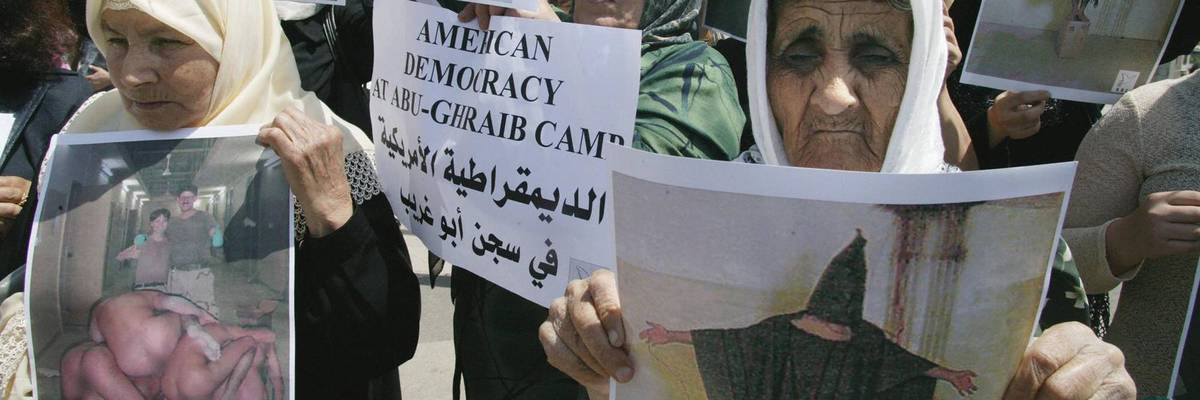
Lebanese women hold copies of the released photos showing US troops torturing Iraqi prisoners in Abu Ghraib during a May 4, 2004 protest in front of the United Nations headquarters in Beirut.

(Photo by Haitham Mussawi/AFP via Getty Images)

Jessica Corbett
Mar 12, 2026
COMMON DREAMS

A federal appellate court on Thursday upheld a historic verdict against CACI Premier Technology, a military contractor found liable for its role in the torture of three prisoners at Abu Ghraib during the George W. Bush administration’s invasion of Iraq in the early 2000s.

The three plaintiffs—middle school principal Suhail Al Shimari, fruit vendor Asa’ad Zuba’e, and journalist Salah Al-Ejaili—are represented by the Center for Constitutional Rights and two law firms. CCR noted Thursday that Al Shimari v. CACI was first filed in 2008 under the Alien Tort Statute and “is the only lawsuit brought by Abu Ghraib torture victims to make it to trial.”

These three survivors of Abu Ghraib—where US captors subjected prisoners to broken bones, death threats, electric shocks, extreme temperatures, sexual abuse, and more torture—finally got their day in court in April 2024. The following November, a federal jury in Virginia ordered CACI to pay each plaintiff $3 million in compensatory damages and $11 million in punitive damages, for a total of $42 million.

“This victory isn’t only for the three plaintiffs in this case against a corporation,” Al-Ejaili said after the verdict. “This victory is a shining light for everyone who has been oppressed and a strong warning to any company or contractor practicing different forms of torture and abuse.”

CACI unsuccessfully sought a new trial at the US District Court for the District of Virginia, then turned to the 4th Circuit, which heard arguments last September.

“We affirm the jury’s verdict in full,” wrote Senior Judge Henry Floyd, joined by Judge Stephanie Thacker—both appointees of former President Barack Obama. Judge A. Marvin Quattlebaum Jr., who was appointed by President Donald Trump, dissented.

CCR legal director Baher Azmy, who argued the appeal, said Thursday that “we are gratified yet again that the 4th Circuit rejected CACI’s cynical arguments for impunity for its responsibility for the torture of our clients, which the jury confirmed in a historic judgment last year. Our courageous clients have waited so long for recognition and justice, and we are happy for them that this judgment affirmed their entitlement to it.”

Al-Ejaili also celebrated the development, declaring that “this is a huge moment, a win that builds a foundation for a new precedent in the US.”

“This will cause a positive difference in the future. Those who believe they are above the law will now think twice before violating human rights,” the plaintiff added. “Thank you to the US legal system and thank you to everyone who had anything to do with this win.”

The appellate court’s decision notably comes as the Trump administration and Israel have launched another war in the Middle East: a joint assault of Iran, alongside Israeli bombing of Lebanon. Evidence of war crimes—including attacks on schools, hospitals, and other civilian infrastructure—has quickly mounted, fueling global demands for a diplomatic resolution.
Why the Democrats Are Not Radical Enough

Until left Democrats are willing and able to support meaningful job guarantees, they have little chance of reaching the working people they have lost over the past 40 years of wholesale job destruction.


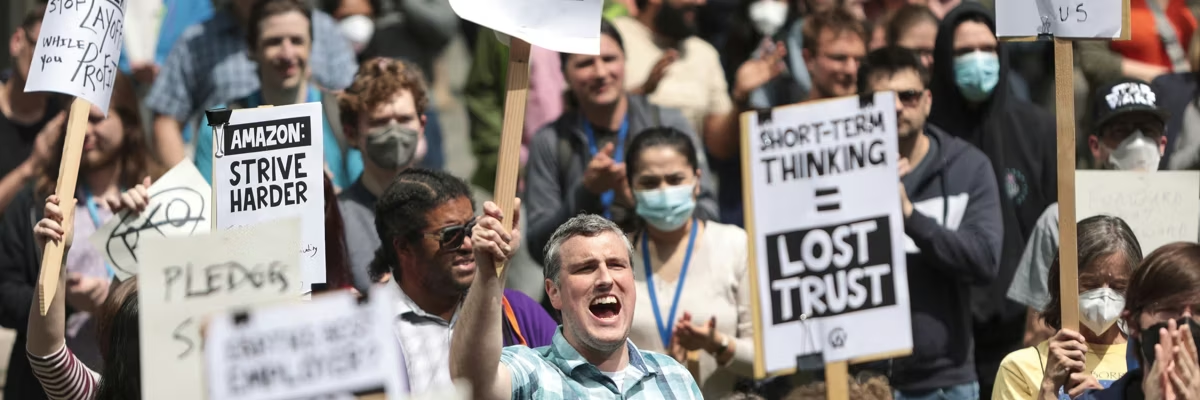
Amazon employees and supporters gather during a walk-out protest against recent layoffs, a return-to-office mandate, and the company’s environmental impact, outside Amazon headquarters in Seattle, Washington, on May 31, 2023.

(Photo by Jason Redmond / AFP via Getty Images)

Les Leopold
Mar 11, 2026
Common Dreams

Centrist Democrats argue that the party should not “go so far left in a primary that they can’t win against MAGA in the general.” As the Center for Working Class Politics observes, these “Third Way” Democrats stress “affordability” and “abundance” without taking on the billionaire class. Progressive Democrats, including groups like the Democratic Socialists of America and Working Families Party, are seen as just too radical to attract working-class voters.

I disagree. I think the problem is that Democrats, even progressive Democrats, are not radical enough.

We have only to look at former President Franklin D.. Roosevelt’s 1941 “Four Freedoms” State of the Union address to be reminded of what our politics could be and should be. The “Four Freedoms” (of speech and religion, from want and fear) are properly the best remembered parts of the address. But just before these “four essential human freedoms,” Roosevelt listed “the simple, basic things that must never be lost sight of in the turmoil and complexity of our modern world.” They are:Equality of opportunity for youth and for others.

Jobs for those who can work.
Security for those who need it.
The ending of special privilege for the few.
The preservation of civil liberties for all.
The enjoyment of the fruits of scientific progress in a wider and constantly rising standard of living.

What did he want? He thought we “should bring more citizens under the coverage of old-age pensions and unemployment insurance,” which (thankfully!) has been done, although the support should be increased.

He believed we should “widen the opportunities for adequate medical care,” which has been done in part, with much more to do.

And he called for the nation to “plan a better system by which persons deserving or needing gainful employment may obtain it,” which we have pretty much stopped talking about altogether, except to mouth empty phrases about economic growth and job creation.

And this is where, in particular, progressive Democrats are not radical enough, at least not for the thousands of workers I have talked to, worked with, and taught. The economic plans offered by the Democratic Party, even those from left Democrats, fail to offer “a better system by which persons deserving or needing gainful employment may obtain it.” And until they do, Democrats will continue to lose traction with working people, who live with job fear each and every day.

Why Are Democrats Not Talking About Guaranteeing a Job at a Living Wage for Everyone Who Wants to Work?


The government guarantees everyone with money to spare a safe place to put it to earn a fair market rate of return. It is called a US Treasury bond. Why doesn’t the government also guarantee everyone with labor to spare—everyone who wants to work but can’t find a job—with a place to work at a fair market rate?

There are no voices, except for Sen. Bernie Sanders (I-Vt.), who proclaim loudly and clearly that all working people should be guaranteed a job at a living wage. Why not? Members of the moneyed class are able to protect themselves from financial risk by easily diversifying their investments. But the working class’ most critical investment—their job—is always at risk.

The jobs of working people are increasingly precarious as corporations lay off workers whenever they please, whether for good reasons, bad reasons, or no reasons at all. Today we see millions of layoffs taking place to finance mergers (watch out Hollywood!), leveraged buyouts, and stock buybacks to enrich the richest of the rich. And who knows what AI holds in store?

The millions of workers in rural America who have suffered one mass layoff after another need the power that comes from employment security—jobs that don’t just depend on the profit-maximization strategies of corporate America.

A government-backed guarantee of a job at a living wage would end the wholesale immiseration of families and communities hit by mass layoffs. It would end the kind of job blackmail that makes it difficult for workers to form unions to seek higher wages and better working conditions. This is what counterbalancing corporate power really looks like!

How would it work? Corporations would remain free to reduce their workforces. But every laid-off worker who wants to keep working would be able immediately to find equally remunerative work nearby in the public sector if private sector jobs are not available.

Also, just as employers are able to lay off anyone for business reasons, workers would be free to quit any job they no longer want and easily find another. This kind of “employment assurance” is the worker equivalent of the portfolio diversification and hedging that the wealthy use to protect and enhance their wealth. (And as we all know, when this financial system crashes, the federal government always protects the assets of the wealthy, but not the jobs of working people.)

Is there sufficient public sector work to support such a program? Of course there is, especially if the country commits to rebuilding its physical and human infrastructure. Surely every municipality and state agency needs more workers right now to meet their current goals, let alone new ones to enhance the public’s interests. There’s no shortage of public goods that need to be produced.

Could we afford it? Yes, it would be costly. But the money would be well spent to build better communities. Just ask any group of workers what their communities need, and they will quickly rattle off how to improve them.

And if we all share the costs in proportion to our wealth, we can certainly afford it. Warren Buffett’s tax rate should not be lower than his secretary’s! A small tax on the trade of stocks, bonds, and derivatives might even cover it.

Working-Class Empowerment

Funding and practicality are not the only things holding progressive Democrats back. I worry that power of capital has, if just unconsciously, narrowed their vision. Too many Democrats of all stripes seem to believe that corporate control over employment is an unalterable fact of economic life. Therefore, they don’t go for the jugular—employment guarantees.

The millions of workers in rural America who have suffered one mass layoff after another need the power that comes from employment security—jobs that don’t just depend on the profit-maximization strategies of corporate America.

Until left Democrats are willing and able to support meaningful job guarantees, they have little chance of reaching the working people they have lost over the past 40 years of wholesale job destruction. Massaging the messages is no match for saying loudly and clearly that if you want to work, there is an acceptable job waiting for you.

Many left Democrats believe that we need to shift from a profit-first to a people-first economy. All to the good. But that has little meaning unless working people are assured of a decent paying job if they are looking for work. And also, able to leave a bad job without suffering economic annihilation!

It’s time for the left to become economic radicals again!

(Many thanks to labor historian Mike Merrill for his assistance on this piece.)


Our work is licensed under Creative Commons (CC BY-NC-ND 3.0). Feel free to republish and share widely.


Les Leopold

Les Leopold is the executive director of the Labor Institute and author of the new book, “Wall Street’s War on Workers: How Mass Layoffs and Greed Are Destroying the Working Class and What to Do About It." (2024). Read more of his work on his substack here.
Full Bio >


Chuck Schumer: Man of Peace


For many years, Senator Charles Schumer demanded tougher and tougher sanctions on the people of Iran, as he shamelessly documents on his own website. He insisted on a Cuba-like blockade, punishing and deterring any company or nation from providing life support to Iran. He predicted, ludicrously but proudly, that such punishing sanctions might lead to an overthrow of the Iranian government.

Like all Congressional supporters and opponents of the Obama-era nuclear deal, Schumer pretended that Iran was pursuing nuclear weapons, but never pretended his only goal was to prevent that fictional behaviour:

“The actual Iranian people are secular and pro-American. And they are not poor. They are rising into the middle class… If we can squeeze them economically, you might get them to take to the streets again and at the very minimum put pressure on their government to back off their nuclear escapade and at the very best overthrow the government.”

For Schumer, the long-enjoyed imaginary nightmare of a nuclear Iran was always a justification for lawless U.S. actions because it was a threat to Israel, while meanwhile always pretending (with one exception obtained via great persistence) that Israel had no nuclear weapons and was a threat to no one.

During the debate over a nuclear deal with Iran, the two common positions in Congress were (1) we need this deal because Iran is trying to build nuclear weapons, and (2) we need no deal and ideally a war because Iran is trying to build nuclear weapons. Schumer opposed Obama’s deal.

When Trump 1.0 wanted to tear up the deal, Schumer claimed to oppose that, even while relentlessly demanding more sanctions in apparent violation of the deal. Even when admitting that Iran was not violating the deal, Schumer never stopped denouncing Iran as the enemy of the United States, engaged in behaviour that he claimed required ever more sanctions in (unstated) violation of the deal by the United States.

Nine months ago, Schumer posted a video solemnly accusing Trump 2.0 of being too “chicken” to take on Iran. When Israel has attacked Iran (or done anything else whatsoever) Schumer’s focus has been on praising Israel.

As of February 24 and 25 of this year, we could read reports on how Schumer and other leading Democrats were working to avoid a vote on a war powers resolution until the war could be begun.

And once the war was begun, Schumer and gang didn’t denounce mass murder, but mumbled about procedures, as if a Congressional vote could have legalised a blatant violation of the UN Charter, or as if proper planning could turn slaughter and destruction into respectable acts. Schumer published a statement mixing opposition to Trump’s war with tougher-on-Iran-than-thou rhetoric and insistence on knowing the supposed goals of the war — were they tough enough?

This was followed by a new statement claiming to support a war powers resolution and to oppose the war because of a handful of U.S. deaths, without a word for the many Iranians killed or the rule of law — and another statement about how unpopular the war should make Trump, and yet another about how senators should vote yes on war powers — but not a word in public or, as far as we know, in private about Democratic Senator John Fetterman who was already publicly saying that he would vote no.

After the failed vote, Schumer focused on Republicans and gas prices, with still never a word for those killed or the likely long-lasting consequences of all this large-scale violence, never a word on the need to block efforts to give Trump an Iran War Slush Fund of $50 billion, never a word on the need to block Congress from giving the Pentagon $1 trillion a year or upping it to $1.5 trillion, never a word on the need to close U.S. bases in Gulf region dictatorships, never a word on the need to cosponsor and pass the Block the Bombs Act to finally halt the illegal shipment of weapons to Israel — shipments still passionately and proudly supported by Schumer despite the genocide he loves having been joined by the new war on Iran that he claims to oppose.

I’ve talked with a number of people about this latest war who oppose it — people I don’t think have ever before opposed any of the hundreds of endless U.S. bloodbaths of recent history. While I find this vaguely encouraging, I’m struck by their usual next comment: “Well, at least the Democrats are trying their hardest.”

David Swanson is an author, activist, journalist, and radio host. He is director of WorldBeyondWar.org and campaign coordinator for RootsAction.org. Swanson's books include War Is A Lie. He blogs at DavidSwanson.org and War Is a Crime.org. He hosts Talk Nation Radio. Follow him on Twitter: @davidcnswanson and FaceBookRead other articles by David.
Trump’s Attempt at Wagging the Dog Has a Real Body Count

Trump has consistently tried to change the subject whenever the issue of the Epstein scandal crops up, but nothing as dramatic as starting a war... until now.


Thick plumes of smoke rise over the residential areas of the Iranian capital following airstrikes amid ongoing US-Israel attacks as multiple explosions are heard across the city in Tehran, Iran on March 01, 2026.
(Photo by Fatemeh Bahrami/Anadolu via Getty Images)


Elliott Negin
Mar 12, 2026
Common Dream

On Christmas Day in 1997, Wag the Dog, a dark political satire directed by Barry Levinson and co-written by David Mamet, opened in theaters across the country. Hardly typical Christmas fare, the movie centered on crisis-management expert Conrad Brean, played by Robert De Niro, and Hollywood producer Stanley Motss, played by Dustin Hoffman, who fabricate a war to distract public attention from a presidential sex scandal.

Sound familiar?

In the film’s opening scene, presidential adviser Winifred Ames (Anne Heche) and other administration staff summon Brean to the White House to help clean up a mess. The president had just met with a group of teenage Firefly Girls from Santa Fe, they explain, and one of them expressed an interest in seeing a Frederick Remington sculpture in the Oval Office. The president escorted her there and sexually assaulted her.

The story leaked, and not only was The Washington Post about to run with it, but the president’s opponent also was about to air a TV commercial referencing it. With less than two weeks to go until election day, the story could derail the president’s reelection bid.

His attack on Iran will always be remembered as Trump’s war, a war started, in his own words, by a president who apparently “has absolutely no ability to negotiate.”

“We have to distract them” with a fake crisis, Brean tells the staffers, and after brainstorming a bit, hits upon a solution: “We have to go to war with somebody.” He concocts a story that Albania, a “shifty” country that “wants to destroy our way of life,” has smuggled a nuclear suitcase bomb into Canada and plans to sneak it across the border. He then enlists the help of Motss, and together they bamboozle the news media, the CIA, and the general public into believing the country is at war. The Oval Office sex scandal story gets lost in the shuffle and the president’s approval ratings rebound in time to win the election.

President Donald Trump also has a sex scandal that he wants to go away.

After simmering for months, the Jeffrey Epstein sex-trafficking story reached a full boil in February following the Justice Department’s January 30 release of 3.5 million additional file pages. On February 9, the department granted members of Congress access to unredacted files for the first time, and the next day, Rep. Jamie Raskin (D-Md.) told Axios that he found more than a million references to Trump. On February 11, Raskin and other members of the House Judiciary Committee grilled Attorney General Pam Bondi about the files, attracting quite a bit of attention even though she avoided answering their questions.Then, on February 24, came the potential coup de grâce. NPR reported that the Justice Department removed documents that mention Trump from the public Epstein database, including files related to allegations that Trump had sexually abused a minor.

NPR’s investigation found that a specific allegation only appeared in copies of the FBI list of claims and a Justice Department slideshow. Its details are explosive. As spelled out by NPR: “The woman who directly named Trump in her abuse allegation [to the FBI] claimed that around 1983, when she was around 13 years old, Epstein introduced her to Trump, ‘who subsequently forced her head down to his exposed penis which she subsequently bit. In response, Trump punched her in the head and kicked her out.’”

Four days after the NPR story ran, the United States and Israel attacked Iran and poof, the Epstein sex scandal story disappeared from the headlines. Unlike Wag the Dog, however, Trump started a real war, and as of this writing Al Jazeera was reporting that more than 1,000 Iranians are dead and more than 6,000 are wounded, according to Iranian state media.
Art Imitating Life (and Life Imitating Art)

Of course, the launch of Trump’s war at a time of heightened public interest in the Epstein files could be merely coincidental. The administration has offered various rationales for the attack, from regime change to eliminating Iran’s nuclear program and ballistic missiles, neither of which posed an imminent threat. Others have speculated that Trump is retaliating for alleged Iranian attempts on his life or squeezing China’s oil supplies to force it to rely more heavily on Saudi Arabia. Even so, there are at least two other notable examples of presidential attempts to divert attention from a politically damaging event by attacking another country.

One example was cited in Wag the Dog. In a scene in which Brean reassures Ames that a fake crisis would distract the public, he says, “That was the Reagan administration’s M.O.: Change the story.” Twenty-four hours after 240 Marines were killed in Beirut, he explains, Reagan invaded the tiny Caribbean nation of Grenada.

It is doubtful that many people are going to forget about Trump’s role in the Epstein saga. His victims are certainly not going to forget.

Brean was referring to an incident that happened on October 23, 1983, when a truck bomb destroyed the US Marine barracks in Beirut, Lebanon, killing 241 American servicemen. That same day, President Ronald Reagan approved final plans to invade Grenada during an attempted coup, ostensibly to protect 600 American medical students who, as it turned out, were not in any danger. On October 25, just two days after the Beirut bombing, US forces invaded Grenada. Story changed.

The second example falls into the category of life imitating art. According to Michael De Luca, production head at New Line Cinema when the studio released Wag the Dog, screenwriter David Mamet “was trying to think of something that would never happen in real life, like a president diddling a Girl Scout.” Just a few weeks after the film opened in US theaters, however, news of an eerily similar incident broke.

On January 17, 1998, the Drudge Report reported that Newsweek editors had killed a story exposing President Bill Clinton’s relationship with a 22-year-old White House intern, Monica Lewinsky. Four days later, the story of their tryst appeared in, ironically, The Washington Post.

On August 17, 1998, Clinton appeared on television following his testimony before a grand jury and finally acknowledged that he had “inappropriate intimate contact” with Lewinsky. Three days after that—the same day Lewinsky testified for a second time to the grand jury—Clinton launched 75 to 100 Tomahawk missiles at al-Qaeda targets in Afghanistan and Sudan in retaliation for the terrorist group’s August 7 bombings of US embassies in East Africa. Many said the timetable was more than a mere coincidence.

The Stakes Are Higher Now

Trump has consistently tried to change the subject whenever the issue of the Epstein scandal crops up, but nothing as dramatic as starting a war. Even abducting Venezuela’s president doesn’t compare. But the stakes are now much higher than when Reagan invaded Grenada or Clinton hit back at al-Qaeda. The Iran conflict has quickly spiraled out of control. In less than a week, it involves at least 11 countries besides the main combatants Iran, Israel, and the United States.

It is more than ironic that Trump, who fancies himself a virtuoso dealmaker, started this unnecessary war. After all:Trump’s top negotiators, Middle East envoy Steve Witkoff and son-in-law Jared Kushner, were in the middle of negotiations with the Iranians just before the United States and Israel launched their attack.
Trump routinely heckled President Barack Obama about his first administration’s negotiations with Iran over its nuclear weapons program, predicting that because of his incompetence, Obama would—out of desperation—resort to starting a war. For years, Trump charged that a “weak and ineffective” Obama would at some point attack Iran “to save face,” “to show how tough he is,” and “to get reelected” because “he has absolutely no ability to negotiate.” Obama never attacked Iran, and the coalition he built with China, France, Germany, Russia, and the United Kingdom negotiated an agreement with Iran in 2015 to restrict its nuclear program, which Trump as president trashed in May 2018.
During the 2016 Republican presidential primary season, Trump belittled Florida Gov. Jeb Bush by tying him to his brother’s disastrous invasion of Iraq in 2003. “So George Bush made a mistake,” he said during a mid-February televised debate. “We can make mistakes. But that one was a beauty. We should have never been in Iraq. We have destabilized the Middle East. They lied. They said there were weapons of mass destruction. There were none. And they knew there were none.”

From the looks of it, Trump lied that Iran posed an imminent threat and—like Bush—has just destabilized the Middle East. It’s reminiscent of that line about the “Pottery Barn rule” attributed to Bush’s secretary of state, Colin Powell: “You break it, you own it.” His attack on Iran will always be remembered as Trump’s war, a war started, in his own words, by a president who apparently “has absolutely no ability to negotiate.”

Finally, keep in mind that despite Clinton’s attack on al-Qaeda, no one forgot that he perjured himself about his affair with Monica Lewinsky, which ultimately led to his impeachment. Likewise, it is doubtful that many people are going to forget about Trump’s role in the Epstein saga. His victims are certainly not going to forget. It only remains to be seen if it—along with his other transgressions—brings down his presidency.

This article first appeared at the Money Trail blog and is reposted here at Common Dreams with permission.

Our work is licensed under Creative Commons (CC BY-NC-ND 3.0). Feel free to republish and share widely.

Elliott Negin
Elliott Negin is the executive editor of Money Trail. His articles have appeared in The Atlantic, Common Dreams, HuffPost, LA Progressive, Scientific American, The Washington Post, and many other publications.
Full Bio >