Sunday, March 22, 2026

ECOCIDE

War threatens Gulf’s dugongs, turtles and birds


By AFP
March 17, 2026


The Persian Gulf hosts the world's second-largest population of dugongs, herbivorous marine mammals listed as vulnerable, with an estimated 5,000 to 7,500 individuals - Copyright AFP/File Sirachai ARUNRUGSTICHAI, -


Delphine PAYSANT

From sea turtles to birds and the gentle dugong, the Persian Gulf’s diverse but fragile marine life is threatened by the bombs and oil of the war in the Middle East.

The ecosystem was already under pressure from climate change and maritime traffic before the United States and Israel launched their war on Iran at the end of February, leading to Tehran’s region-wide retaliation.

More than 300 incidents involving environmental risks — including attacks on oil tankers — have been recorded in the region since the conflict broke out, according to a March 10 report by the Conflict and Environment Observatory, a UK non-governmental organisation.

The geography of the Gulf makes its ecosystem particularly vulnerable.

A semi-enclosed and shallow sea about 50 metres (165 feet) deep on average, it is connected to the Indian Ocean through the Strait of Hormuz. Its slow water renewal — every two to five years — limits the dispersion of oil or other pollutants.

The region hosts the world’s second-largest population of dugongs — herbivorous marine mammals known as “sea cows” that are listed as vulnerable — with an estimated 5,000 to 7,500 individuals.

About a dozen species of marine mammals are also found there, including humpback whales and whale sharks.

In total, more than 2,000 marine species have been recorded in the warm Gulf waters, including over 500 fish species and five types of sea turtles, among them the critically endangered hawksbill sea turtle.

There are also about 100 species of corals which, together with mangroves and seagrass beds, form essential breeding and nursery grounds for fish and crustaceans.


– ‘Time bomb’ –


Greenpeace warned last week that dozens of tankers carrying around 21 billion litres (5.5 billion gallons) of oil were trapped in the Persian Gulf.

“This is an ecological ticking time bomb,” said Nina Noelle, of Greenpeace Germany, who has been mapping oil tankers in the region.

Since March 1, nine incidents involving oil tankers, including attacks,have been reported to the United Kingdom Maritime Trade Operations centre (UKMTO), eight of which were later confirmed by the International Maritime Organization (IMO).

Three additional attacks were claimed by Iran’s Islamic Revolutionary Guard Corps, though these have not been confirmed by international bodies.

On land, Iran’s Foreign Minister Abbas Araghchi said Monday that Israeli strikes on Tehran fuel depots constituted “ecocide”, contaminating soil and groundwater and causing long-term risks to people’s health.


– Past experiences –


“The wars in the 1980s and 1990s demonstrate how exposed the ecosystems of the Persian Gulf are to conflict pollution, whether this is from damage to on- or offshore oil facilities or through spills from attacks on shipping,” CEOBS director Doug Weir told AFP.

The Gulf War in 1991 triggered one of the largest marine oil spills linked to armed conflict, when retreating Iraqi forces deliberately opened oil valves in Kuwait and destroyed oil infrastructure.

It took decades to recover: up to 11 million barrels of oil (1.75 billion litres) were released, contaminating 640 kilometres of Saudi coastline and killing more than 30,000 seabirds, according to several studies.

The studies, however, “largely showed minimal impacts on coral reefs”, said John Burt, biology professor at the Mubadala Arabian Center for Climate and Environmental Sciences at New York University Abu Dhabi.

“This is largely because oil floats, so the dispersal of oil remains on the surface and doesn’t really interact with corals except in the most shallow areas,” Burt said.

“However, the same cannot be said for intertidal systems” such as salt marshes and mudflats that line the coast and are exposed at low tide, he added.

“Here, oil spills can have significant and medium-term impacts, if the spills become coastal,” Burt said.

Seabirds are especially at risk because oil destroyed the waterproofing of their feathers, leading to hypothermia and drowning.


– Bomb noise –


Bombs are also a threat to the area’s birds.

Their migration could be disrupted by the noise of explosions and by plumes of toxic smoke, as the Arabian Peninsula sits at the crossroads of major migratory routes linking Europe, Central Asia, Africa and South Asia.

“Sea mines and other explosive devices can cause acoustic disturbance impacting sea mammals and other animals, and blast damage to natural undersea structures such as reefs,” Weir said.

In 2003 and 2020, two studies published in Nature and in a journal of the Royal Society found links between the use of mid-frequency military sonar and whale strandings.

Brute Force Prevails The Global Order – OpEd


March 22, 2026 

By Ramesh Jaura


Wars no longer announce themselves with official proclamations. They creep forward, strike by strike, each retaliation erasing another line once thought uncrossable. In April 2024, Israel’s unprecedented strike on an Iranian military facility near Isfahan shattered former red lines and signalled a new phase of confrontation. Days later, Iran responded with swarms of drones and missiles aimed at Israeli targets, marking the first openly acknowledged Iranian attack against Israeli territory.

What was once unthinkable soon becomes routine, as these real-world escalations play out in full view. The Israel-Iran conflict now unfolds, intensifying with every blow. The old guardrails that kept wider war at bay are dissolving, endangering not only the Middle East’s tenuous balance but also the very trust in the global order.

The latest eruption of violence between Israel and Iran constitutes a watershed in the region’s history. Once waged in the shadows amidst covert raids, cyberattacks, and proxy battles stretching from Lebanon to Syria, the conflict has now exploded into daylight. Direct strikes on critical targets and unmistakable reprisals have replaced secrecy with spectacle.

Israel’s deep incursions into Iran, reportedly backed by the U.S., have smashed through boundaries once held sacred. These are not just warnings. They are bold demonstrations of force, aimed at crippling Iran’s strategic heart and sending a clear message: Israel is prepared for open conflict.

Iran’s response, cautious though resolute, has shifted from rhetoric to action. Missiles fly, drones hover, and allies rally—Tehran makes clear it will not remain silent. Still, every move is calculated, stopping short of the spark that could set the region ablaze.Subscribe

The Paradox

This is the paradox at the heart of the current moment: escalation without total war.

What once lurked behind veils of denial now stands exposed. The shadow war has stepped into the sun, and every disclosure multiplies the risks and raises the stakes.

What makes this moment so unnerving is not only the speed of escalation, but the stage on which it unfolds. The institutions built to contain chaos, especially the United Nations, are pushed aside just when they are needed most. Diplomacy limps behind the roar of missiles, and pleas for restraint sink into the noise.

The result is a growing sense of impunity. States, especially those protected by powerful friends, act boldly with little fear of consequences from the wider world.

Meanwhile, Europe—once a hopeful mediator—has faded from the spotlight. Its words are heard, but its influence barely registers. In a region longing for urgent diplomacy, that absence is impossible to ignore.

This is more than another chapter of Middle Eastern turmoil. It is a revealing moment for the global order itself, as raw power steadily overshadows principle and the instruments meant to prevent catastrophe fall behind.
The United Nations: Presence Without Power

The United Nations remains the most visible embodiment of the post-1945 international order. Its General Assembly convenes, its agencies operate across countries, and its resolutions continue to articulate the norms that support global governance.

But visibility is not the same as influence.

The UN was built on a fundamental compromise: that the major powers would retain decisive influence—through the veto in the Security Council—in exchange for their participation in a system of collective security. That compromise reflected the realities of 1945. It is assumed that great-power cooperation, however limited, would remain possible.

Today, that faith is fraying, stretched nearly to breaking.

The Security Council has become less an instrument of action than a stage for geopolitical division. When the interests of its permanent members collide, paralysis is inevitable. On Ukraine, Russia blocks action. On Middle Eastern crises, the United States shields Israel. On other issues, China asserts its own strategic constraints.

This is no mere hiccup. It is the inevitable outcome of a system designed to reflect power rather than transcend it.

The consequences are deep. The UN continues to speak in the language of international law, but it lacks the means to enforce it. It can condemn violations but not prevent them. It can mobilise humanitarian aid but not halt the conflicts that make such aid necessary.


To address these enforcement gaps, some have suggested reforms such as strengthening the mandate and resources of UN peacekeeping operations, strengthening the International Court of Justice’s capacity to address violations, or creating independent monitoring bodies with real investigative powers.

Others point to alternative mechanisms—such as regional organisations stepping up their involvement in dispute mediation or new forms of international coalitions dedicated to upholding specific norms—that might complement the UN’s limited reach. While no single solution can easily restore credibility or effectiveness, such proposals reflect the urgent search for more robust tools in the face of persistent impunity.

Peacekeeping missions, once seen as one of the UN’s most tangible contributions, are increasingly constrained by limited mandates and political ambiguity. In many cases, they are deployed not to resolve conflicts, but to manage their consequences.

As the gulf between ideals and reality widens, authority quietly drains away.

The UN has not vanished, but when the stakes soar, it is left watching from the sidelines.
The U.S.–Israel Axis and the Politics of Alignment

The alliance between the United States and Israel has long been a defining feature of Middle Eastern geopolitics. In the current crisis, however, it plays a more complex and consequential role.

For Washington, Israel remains a critical strategic partner—a technologically advanced military ally in a region marked by volatility and competing influences. For Israel, U.S. support provides both material assistance and diplomatic cover, mainly within international institutions where criticism might otherwise translate into binding action.

Yet this alliance sends shockwaves far beyond its two architects.

In much of the Global South, U.S. policy is increasingly perceived as selective, even partisan. The application of international norms appears uneven, bolstering a sense that power determines not only outcomes but also the interpretation of rules.

This perception erodes the credibility of the entire global system. It makes diplomacy an uphill battle and stokes the belief that international rules are rigged and unjust. For instance, a 2023 Pew Research Center survey found that majorities in countries such as Indonesia, South Africa, and Brazil viewed key Western powers as applying international norms inconsistently in global crises.

Recent international diplomatic incidents, such as the collective walkout by several African and Latin American delegations during UN debates on Middle Eastern conflict resolution, further demonstrate the deepening scepticism toward perceived double standards. The result is a growing chorus—among both officials and global publics—that multilateral institutions are shaped more by political alignment than by universal principles.


Meanwhile, Israel’s military actions—framed as essential for security—risk throwing fuel on the fire. Strikes on critical Iranian sites spark fresh cycles of escalation that soon spiral beyond control.

Iran, under Ali Khamenei, operated within a strategic framework that blends ideological resolve with pragmatic caution. Its rhetoric emphasised resistance, endurance, and the willingness to bear sacrifice. Yet its actions suggested a keen awareness of limits. Tehran’s strategy has long relied on indirect influence—through allied groups and asymmetric capabilities—rather than confrontation with superior military forces.

Yet this unstable balance wobbles on a knife’s edge.

The true peril lies not in a deliberate march to war, but in a single fatal miscalculation. A warning shot could be read as a declaration. An attempt to restore balance might only stoke the blaze.

In this volatile climate, alliances built to prevent conflict can instead accelerate it, ensnaring all sides in spirals of action and reaction that quickly spin out of control.Subscribe
Europe’s Strategic Absence

While the United States remains deeply engaged, Europe stands in stark contrast—its strategic voice barely a whisper when the world most needs it.

The European Union has long positioned itself as a normative power, shaping global affairs through diplomacy, economic leverage, and legal frameworks. This model proved effective in a period characterised by relative stability and institutional cooperation.

But today’s world is an unfamiliar landscape.

In an era defined by rapid escalation and hard power, Europe’s tools are less decisive. Internal divisions among member states complicate collective action. Differing national interests, historical experiences, and political priorities limit the EU’s ability to respond cohesively.

Moreover, Europe’s security dependence on the United States constrains its strategic autonomy. In major crises, European policy often aligns with Washington, reducing its capacity to act as an independent mediator. Yet opportunities remain for Europe to chart a more influential course.

The EU could accelerate steps to build up its own defence and crisis-response capabilities, reducing reliance on external actors. Regularly convening dedicated diplomatic tracks on regional security, with European envoys engaging all relevant parties, could offer an independent forum for mediation. Renewed investment in energy diversification and resilience would also bolster Europe’s leverage in global affairs.

Some policy analysts have proposed reforms such as revising qualified majority voting within the EU’s foreign policy decision-making and deepening partnerships with key actors in the Global South. By pursuing these and similar strategies, Europe could begin to reclaim a seat at the table where the rules of the emerging order are set.


The result is a strategic vacuum that reverberates far beyond Europe’s frontiers.

Europe recognises its own shackles and strains to break free, but its efforts fall flat.

In a more balanced international system, Europe might serve as a bridge—facilitating dialogue between competing powers, offering alternative pathways to de-escalation, and reinforcing the role of international institutions.

Today, that promise remains unfulfilled.

This absence widens global rifts, leaving even fewer voices to bridge the chasm between adversaries.
Multipolarity Without Stability

Some call this a move toward multipolarity, but what emerges is neither stable nor orderly. Instead, we face a restless, splintered world, riddled with shifting alliances and competing power centres.

New platforms such as BRICS and the G20 reflect the growing influence of emerging powers and the desire for more inclusive forms of governance.

They provide important forums for dialogue and coordination. But they lack the universality, institutional depth, and enforcement mechanisms of the UN.

At the same time, states turn to nimble, smaller coalitions—so-called minilateralism. These quick partnerships enable swift action among allies, but they also splinter the global order.

What takes shape is not a new order, but the slow unravelling of the old.

We are stepping into a world of tangled frameworks, unfinished alliances, and sudden twists—a system where rules survive but are bent or brushed aside whenever power demands.
A World of Interconnected Crises

Unlike the period preceding World War II, today’s risks do not arise from a single, clearly defined trajectory toward global conflict.

Instead, today’s dangers arise from the collision of polycrises—regional wars, economic shocks, and strategic rivalries that amplify one another.

A clash in one region can send tremors rippling across continents. Escalation now spreads like a web, branching in every direction instead of following a single path.

The Israel–Iran confrontation exemplifies this dynamic. It intersects with broader geopolitical rivalries, influences global energy markets, and shapes strategic calculations across continents.

In this tangled web, the margin for error vanishes. Even small missteps can trigger consequences far beyond their intent.

The Limits of Reform

Calls to reform the United Nations have grown louder, reflecting widespread recognition that its structures no longer align with contemporary realities.

Yet genuine reform drifts ever further out of reach.

Proposals to expand the Security Council, limit the veto, or enhance representation for the Global South face a fundamental obstacle: they require the consent of those whose power would be diminished. Yet even as broad reforms remain out of reach, a focus on incremental changes may offer a more realistic path forward.

Feasible steps include enhancing transparency within the Security Council’s deliberations, increasing the frequency and weight of informal consultations with non-permanent members, and establishing independent expert panels to provide regular, public assessments of council action and compliance.

Additional mechanisms, such as strengthening early-warning and prevention mandates within the UN Secretariat or expanding the Peacebuilding Commission’s authority to support fragile states, could be adopted without altering the core power structure. Though limited, these measures could provide tangible improvements and help restore a measure of trust and relevance to the UN’s daily work.

That consent is almost certain to remain out of reach.

The result is a stubborn paradox: the need for reform is plain to all, yet the road to change remains barricaded.

In the meantime, the UN continues to operate within constraints that limit its effectiveness in precisely those areas where it is most needed.
Caught Between Worlds

We are living in an age of transition, suspended in the gap between fading worlds.

The post-1945 order has not disappeared, but it no longer defines global politics as it once did. At the same time, no coherent alternative has emerged to replace it.

This limbo is, by its nature, precarious.

Institutions continue to function, but with diminished authority. Power is more dispersed, but not necessarily more balanced. Cooperation persists, but it is increasingly conditional and situational.

In this world, uncertainty is the only constant.
The Return of Responsibility

The UN’s waning strength exposes a deeper reality: no institution can substitute for the force of political will.


The unfolding confrontation between Israel and Iran illustrates this reality with stark clarity. The mechanisms designed to prevent escalation exist, but they are not decisive. The actors involved are aware of the risks, yet they continue to act in ways that increase those risks.

This does not guarantee a wider war, but it makes the task of managing conflict far more uncertain and fraught.

In this shifting landscape, responsibility passes from one set of hands to another.

It no longer rests solely with institutions, but with states themselves and with their willingness to choose restraint, even when they hold the power to act otherwise. This willingness is not based solely on altruism. States may find compelling incentives for restraint in the desire to avoid catastrophic escalation, preserve regional stability, maintain valuable alliances, or safeguard economic interests that could be jeopardised by broader conflict.

Reputation and the risk of international isolation also play a role, as do calculations about long-term security and the internal costs of war. Even hostile rivals may recognise that unchecked escalation carries risks that can outweigh momentary gains. By identifying and strengthening these underlying motivations, policymakers can seek to encourage more responsible behaviour in an increasingly turbulent world.

Whether that restraint endures is the question that will shape our era.

For now, the direction is clear: escalation surges ahead, institutions lag, and the global order—once anchored in shared rules—drifts toward a world increasingly governed by brute force.


Ramesh Jaura

Ramesh Jaura is a journalist with 60 years of experience as a freelancer, head of Inter Press Service, and founder-editor of IDN-InDepthNews. His work draws on field reporting and coverage of international conferences and events.
Sri Lanka And India Dodge US Dragnet With Mix Of Firmness And Tact – Analysis


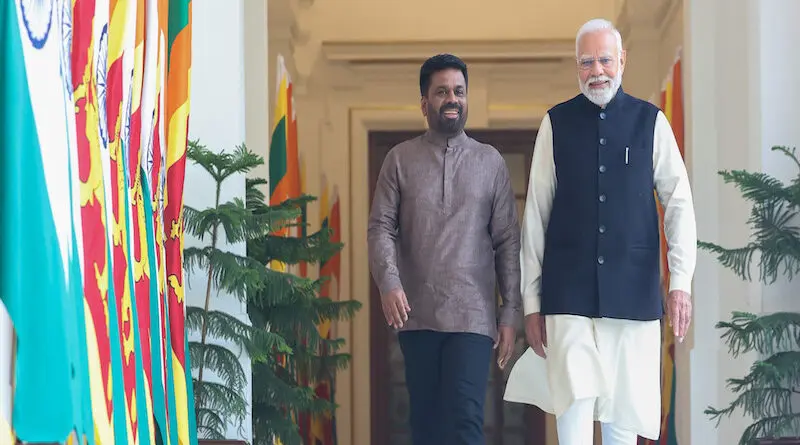
Sri Lanka's President Anura Kumara Dissanayake and India's Prime Minister Narendra Modi. 
Photo Credit: PM India Office


March 22, 2026 
By P. K. Balachandran


With a mix of tact and firmness, Sri Lanka and India recently dodged US attempts to drag them into the ongoing US-Iran war. Both countries refused to bow to America’s demand that the stranded Iranian naval vessels and their crew, currently under their care, should not be repatriated to Iran.

Sri Lanka also denied permission to the US to land two of its armed military aircraft to land at Mattala airport in South Sri Lanka.

By doing so, they had escaped, by the skin of their teeth, an American plan to drag them into its war with Iran. America is lacking in allies as its only supporter is Israel, which is also a combatant in the Iran war. Europe and NATO have been dilly-dallying. They are now being subjected to Trump’s threat to abandon them in their hour of need. The Gulf and Arab States have been of no active help, but they allow the US to use its bases among them.

The US not only needs active allies but also strategic depth, in case the theatre of operations has to be expanded to the Indian Ocean and the Indo-Pacific. The need for such an extension was evident when Iran fired missiles into the US air base in Diego Garcia in the Indian Ocean near the Maldives. In case the US needs to act in the Indian Ocean, east of Diego Garcia, it will need facilities if not bases in Sri Lanka and India. The Maldives will not be suitable because it is a 100% Muslim country with close ties with the Islamic world.

Some strategic thinkers suspect that the torpedoing of the Iranian vessel IRS Dena off Galle, south of Sri Lanka, was deliberate and meant to signal to Sri Lanka and India (the net security provider for the region) the US is supreme, can do what it likes and countries in the will be well advised to cooperate with the US, including bases and facilities the US may seek.

US-Sri Lanka Agreements

The US already has agreements with Sri Lanka and India covering US warships.

The US-Sri Lanka Acquisition and Cross-Servicing Agreement (ACSA) was first signed in 2007 and renewed/expanded in 2017. This agreement facilitates reciprocal provision of logistics support, supplies, and services (e.g., refuelling, maintenance) between the militaries only during exercises, humanitarian operations, or peacekeeping.

The Status of Forces Agreement (SOFA) has a more complex history. An earlier version dates back to 1995, but a proposed expanded or updated SOFA (draft sent by the U.S. in 2018) faced significant opposition in Sri Lanka over fears it would grant broad legal immunities to US personnel, access rights, and potential impacts on sovereignty. It was never signed.

Recent developments focus on a Memorandum of Understanding (MOU) signed in November 2025 under Sri Lanka’s current NPP government (led by President Anura Kumara Dissanayake). This MOU formalises a defence partnership under the US Department of Defence’s State Partnership Program (SPP), linking Sri Lanka’s armed forces with the Montana National Guard and US Coast Guard District 13. It covers “non-binding” cooperation in areas like joint training, maritime domain awareness, disaster response, humanitarian assistance, aviation/maritime operations, and professional military education.
US-India Agreements

As for India, a Logistics Exchange Memorandum of Agreement (LEMOA) was signed with the US in 2016. It is the primary framework governing logistical support for US warships (and other military assets) in Indian ports. This agreement is a tailored version of the US’s standard Acquisition and Cross-Servicing Agreements (ACSA), adapted to India’s sensitivities on sovereignty and non-alignment.

LEMOA enables reciprocal, case-by-case provision of logistics support, including refuelling, supplies, repair and maintenance, port services, billeting, transportation, spare parts, medical services, and other essentials. But support is strictly limited to predefined activities, such as joint exercises, training, port calls, humanitarian assistance, or disaster relief.

There is no automatic right of access—each request requires mutual consent and is evaluated individually by the Indian government.

LEMOA does not permit permanent basing, establishment of US military bases on Indian soil, or use for combat operations without explicit Indian approval. It preserves India’s strategic autonomy, with no obligation for India to provide support in conflicts or alliances.

Overall, facilities for US warships remain limited to logistical and exercise-related support under LEMOA—no basing rights, no routine combat staging, and full Indian oversight. This aligns with India’s multi-alignment policy.
Lankan President’s Tact

Sri Lankan President Anura Kumara Dissanayake told parliament on Friday that Sri Lanka refused to allow US war planes to land at the Mattala airport in South Sri Lanka on March 4 and 8. Colombo also rejected a US demand that the Iranian ship IRS Bushehr and the crew in its care should not be repatriated to Iran. Sri Lanka has told the US that it plans to repatriate them to Iran, but only after the US-Iran conflict ends.


“We want to maintain our neutrality despite many pressures. We won’t give in. The Middle East war poses challenges to us, but we will do everything possible to remain neutral. They (the US) wanted to bring in two warplanes armed with eight anti-ship missiles from their base in Djibouti to the Mattala International Airport and we said no,” the Sri Lankan President said.
Meeting With Sergio Gor

Dissanayake’s statement came a day after his meeting with the US Special Envoy for South and Central Asia, Sergio Gor. Gor and Dissanayake discussed US efforts to safeguard vital sea lanes and ports, reinforce mutually beneficial trade and commercial ties, and advance a free, open, and prosperous Indo-Pacific, a US State Department statement said.

Following the torpedoing of IRIS Dena and the shelter given to IRIS Bushehr, a total of 204 of the sailors are now accommodated at the Sri Lanka naval facility near Colombo. The US had pressed Sri Lanka not to repatriate the men and the vessel Bushehr to Iran. The US State Department said that the Sri Lankan authorities should minimise Iranian attempts to use the detainees for propaganda.

But the Sri Lankan President negatived the request saying that his country had a “humanitarian responsibility” to shelter the crew.
Dissanayake’s firmness made the US back off. As regards India, deft diplomacy by External Affairs Minister S.Jaishankar prevented the US from exploiting Prime Minister Narendra Modi’s speech at the Israeli Knesset in which he pledged India’s support to Israel “now and beyond”. The dithering US-Israeli military action against Iran, Iran’s successfully blocking the Strait of Hormuz and the energy crisis the blockage created, softened the US stand on the Iranian vessels in India.

India on its part, gave up its standoffish attitude to the war and held out a hand of friendship to Iran. Prime Minister Modi talked to the Iranian President and told him that India is a friend of Iran. Iran, which has had a very close relationship with India, responded quickly and meaningfully by permitting three Indian tankers to pass the Strait of Hormuz. India had been buying Iranian oil and was building a port at Chabahar before the war began.

But Jaishankar said that Iran will be giving permission to vessels only on a case-by-case basis. About 22 Indian vessels are awaiting.


P. K. Balachandran

P. K. Balachandran is a senior Indian journalist working in Sri Lanka for local and international media and has been writing on South Asian issues for the past 21 years.
Op-Ed: US allies are right. US policy can’t pass through Hormuz, either

By Paul Wallis
EDITOR AT LARGE
DIGITAL JOURNAL
March 17, 2026


Thailand's Navy said a Thai ship was attacked in the Hormuz Strait - Copyright ROYAL THAI NAVY/AFP Handout

Forget the rhetoric about allies helping the US in Iran. In military terms, the polite description is “overcommitment”. Things can’t stay as they are. The next move must exist and must be made. In chess, it’s called “zugzwang”, a move you have to make. In policy terms, it’s called a glaringly obvious booby trap. The US has allowed itself to get sucked into a problem it can’t solve. It can’t exit without losing face badly.

There’s no easy exit from such an open-ended, self-inflicted situation. The US was under no compulsion to do anything. The result has been abysmal. All it takes is an occasional missile to keep Hormuz locked and shipowners refusing to take risks. The US has written a blank check to fund a thankless task, spending billions like flakes of dandruff. The best that can happen is a return to normality, as if it had never happened.

Trump’s floundering, unrealistic demands for help went beyond absurd. His constant attacks on NATO were always going to backfire; it was just a matter of how and when.

The lack of diplomatic skills and military insight also apparently extends to Australia. Committing major fleet units is out of the question. The Australian Navy is effectively rebuilding itself from the ground up with new acquisitions to revitalize a fleet long in need of generational upgrades.

The Australian fleet is also trying to maintain its own local regional responsibilities in four oceans. It’s not a hard point to make, and it shouldn’t need making. Could it be that other countries may also have military commitments?

This seemingly bottomless lack of basic comprehension on the part of the US isn’t going down at all well. The world simply can’t fight wars on the basis of whims. Or for the sake of appearances. Or for no clear objective. The allies have quite rightly rejected any involvement.

Israel has a long ongoing direct conflict with Iran, regardless of whether the Straits of Hormuz are open or not. The rest of the world doesn’t have that problem.

The economics of this war are unforgiving. Global commerce and trade don’t need more cost pressures. This war is already costing the world big money. Oil prices famously impact inflation. Other oil producers are making big money out of the spike in oil prices.

This is usually the way with oil. Any excuse, let alone a war, will spike oil prices. If a pipe somewhere in Nigeria blows up, the price of oil goes up $10 a barrel. Start a war, and it goes much further up and stays up. These are the normal market reactions.

There’s no exit unless Iran decides to negotiate a deal in its own favour. That means a US backdown in some form, which seems unlikely.

For somebody who claims to know what cards other players have, this war is a truly lousy call. Iran has been given a very high card. They’ve added another good card with “selective Hormuz passage.” The US has devalued its own hand and can’t even make a pair with Australia. The strategic long game always beats the compulsive Adderall of US politics. America didn’t understand the long games of Vietnam or Afghanistan, either.

This war can be lost badly and ignominiously. It’s hard to envision Saigon 1975 in Pennsylvania Avenue 2026, but with the right people in charge, it’s possible.

_________________________________________________________

Disclaimer
The opinions expressed in this Op-Ed are those of the author. They do not purport to reflect the opinions or views of the Digital Journal or its members.

 The War Against Iran: Does It Mark The Beginning Of A New Middle East? – Analysis


March 22, 2026
By Dr. Mohamed Chtatou

Introduction

On February 28, 2026, in a joint military operation, the United States and Israel bombed several major cities in Iran. The Israeli operation was named “Roaring Lion,” and the American one, “Epic Fury.” Iran retaliated the same day with Operation Honest Promise 4. Within hours, the Iranian Supreme Leader, Ayatollah Ali Khamenei, was killed in the attack. For the first time since the 1979 Islamic Revolution, an open and direct war broke out between Israel, the United States, and the Islamic Republic of Iran. The Middle East, already weakened by years of accumulated tensions, entered a new era whose contours remained uncertain.

This war did not arise from nothing. It is part of a long sequence of escalation that began with the Hamas attack of October 7, 2023, continued with the exchanges of airstrikes in 2024, culminated in the Twelve Day War between Israel and then the United States against Iran from June 13 to 24, 2025, and in the American operation “Midnight Hammer” targeting the Iranian nuclear sites of Fordow, Natanz, and Isfahan. Each stage has altered the balance of power, undermined mechanisms of restraint, and reduced diplomatic space to the point that direct confrontation has become inevitable in the eyes of the belligerents.

The question posed by this essay concerns the historical and geopolitical significance of this conflict: does the war against Iran mark the beginning of a new Middle East? The central hypothesis is that this conflict represents a triple rupture—strategic, political, and normative—the effects of which will permanently reshape the regional order. To answer this question, this essay will first analyze the dynamics that led to the war (I), before examining the ongoing transformations within the region (II), then considering the implications for the international order and the uncertainties surrounding the future (III), before updating the analysis in light of the first nineteen days of the conflict (IV and V).

1. From the “Regional Cold War” to Open Confrontation: The Drivers of a Shift

1.1 A Forty-Five-Year-Old Structural Hostility

The Iranian-Israeli antagonism is not a product of recent circumstances. Since seizing power, the rulers of the Islamic Republic of Iran have called for the destruction of the State of Israel. From the very first days of the Islamic Republic in 1979, Khomeini referred to Israel as the “little Satan,” a “cancerous tumor” that must be “wiped off the map.” This hostility was long expressed indirectly, through Iranian support for non-state actors—Lebanese Hezbollah, Palestinian Hamas, Iraqi Shiite militias, and Yemeni Houthis—forming what Iranian doctrine calls the “axis of resistance.” This proxy architecture allowed Tehran to project its power without exposing itself to a direct response, and Israel to inflict blows without triggering a full-scale war.


Iran seeks to expand its political and military influence in the region, while Israel attempts to limit this influence, particularly in the face of Iran’s nuclear program, which it considers a major threat. Thus, even without direct war for a long time, the two states have clashed through allies, clandestine operations, and diplomatic tensions. Since the 2000s, Israel has waged a shadow war against this program — assassinations of scientists, cyberattacks (the Stuxnet virus in 2010), sabotage — while the United States alternated between economic sanctions and diplomatic negotiations, notably the 2015 Vienna agreement (JCPOA), from which the American withdrawal in 2018 under Trump had led Tehran to accelerate its uranium enrichment.

1.2 The Escalation 2023–2025: The Stages of a Flare-Up

The Gaza War of October 2023 was the triggering turning point. By radically undermining Israel’s deterrent posture, Hamas’s attacks forced Israel to respond with considerable force, leading to an unprecedented regional mobilization. Hezbollah opened a “northern front,” Iran increased its arms deliveries to its proxies, and the Houthis disrupted shipping in the Red Sea. In April 2024, Iran launched its first direct strike on Israeli territory, followed by a measured Israeli response. These exchanges broke a taboo: direct confrontation became conceivable.


On June 13, 2025, Israel launched a surprise attack against Iran, Operation Rising Lion, targeting key sites of the Iranian nuclear program and their scientists, the Islamic Revolutionary Guard Corps, Iranian air defenses, and energy infrastructure. On the night of June 21-22, 2025, the US Air Force and US Navy launched Operation Midnight Hammer, using B-2 Spirit stealth bombers and Tomahawk missiles to strike Fordow, Natanz, and Isfahan. This Twelve-Day War ended without Iranian surrender, leaving Tehran humiliated but resilient, and the nuclear issue unresolved.

The winter of 2025-2026 was marked by a dual crisis in Iran: the economic collapse of the rial and a wave of nationwide anti-government protests that were brutally suppressed. On February 27, 2026, Donald Trump stated during a press briefing that the Islamic Republic had “killed at least 32,000 protesters.” It was in this context of internal weakening and indirect nuclear negotiations under Omani auspices—which the Omani mediator present in Geneva described as close to an agreement, with Iran having finally accepted enormous concessions—that the strikes of February 28, 2026, were launched. This paradoxical timing fueled an intense debate about the true motivations behind the decision: was it strategic urgency or a political and electoral calculation, both in Washington and in Tel Aviv?

1.3 The Stated Objectives and Their Contradictions

On February 28, after weeks of negotiations between Washington and Tehran under Omani auspices, the American and Israeli armed forces launched a massive strike campaign against Iran with the explicit aim of destroying its ballistic missile capabilities, annihilating the Iranian navy, preventing Iran from developing nuclear weapons, ensuring that the regime could not continue to arm, finance, or direct armed groups outside its borders, and bringing about its overthrow.

These objectives conceal deep internal tensions. Destroying the nuclear program is one thing—and even then, doubts remain about the capabilities still available in Iran’s underground arsenal. Overthrowing a 46-year-old regime that has developed structures of resistance, succession, and decentralized command is quite another. Iran responded to the attacks much more quickly than many observers expected, suggesting that a highly redundant continuity plan is indeed in place: multiple successions, pre-authorized strikes, and a decentralized chain of command in the event of the regime’s decapitation. The Assembly of Experts is meeting via videoconference to elect a new Supreme Leader, following the death of Ayatollah Ali Khamenei in the strikes. The regime is not a man.

2. Ongoing Transformations: Towards a Recomposition of the Regional Order

2.1 The Destruction of the Iranian Proxy Architecture


The first structural transformation concerns the axis of resistance. Even before the 2026 strikes, this axis had suffered considerable losses. Israeli strikes against Hezbollah had already killed 850 people on Lebanese soil. Hamas had been decimated in Gaza. The Houthis appear to be respecting their May 6, 2025 peace agreement with the United States. If the destruction of Iranian ballistic missile capabilities and the navy is confirmed, Tehran would be deprived of its main regional bargaining chip: a credible armed threat.

This dismantling of Iran’s proxy strategy creates a vacuum that could either be filled by local actors seeking to break free from regional control or generate new dynamics of instability. In Lebanon, the question is whether Hezbollah can survive as a political and military force without its Iranian patron. In Iraq, Shiite militias will have to redefine their position between a weakened Tehran and Baghdad, which is concerned about its sovereignty. In Yemen, does the peace agreement with the Houthis signal a lasting normalization or simply a respite?

2.2 The Realignment of the Gulf Arab Powers

The geography of the conflict reveals a fracture within the Arab world. The Gulf monarchies—Saudi Arabia, the United Arab Emirates, Qatar, Kuwait, and Bahrain—find themselves in an uncomfortable position: their territories host American bases that have been targeted by Iranian missiles, involuntarily exposing them to war. Explosions were heard in Riyadh, Abu Dhabi, Doha, Dubai, Kuwait City, and Manama. Many airspaces in the region were closed, leading to a series of flight cancellations to the Middle East. The US embassy in Riyadh was targeted by drones; explosions caused a major fire within the diplomatic compound, but no injuries were reported.

This paradox is forcing the Gulf monarchies to undertake a profound strategic reassessment. Saudi Arabia, which had begun a discreet normalization process with Iran under Chinese auspices in 2023, sees this effort rendered meaningless. The United Arab Emirates, which had developed substantial economic ties with Tehran despite political tensions, are facing unprecedented pressure. Ultimately, if the Iranian regime falters or transforms, these countries will have to decide what kind of Iran they want as a neighbor: a weakened and fragmented Iran could generate as much instability as a powerful and hostile one. The Israeli-Arab normalization process, initiated with the 2020 Abraham Accords, is also on hold. Arab public opinion, mobilized by images of Gaza and now of bombed Tehran, is a constraint for leaders who sought to separate the Palestinian issue from their strategic interests. The current conflict makes this separation politically untenable in the short term.

2.3 The Question of Iran’s Future


Khamenei’s death constitutes an unprecedented political earthquake since the 1979 revolution. For forty-six years, he embodied the regime’s transcendent legitimacy—the wilayat al-faqih, the tutelage of the jurist-theologian. A significant number of key figures in power have been eliminated, including the Supreme Leader of the Revolution, Ali Khamenei, the Secretary of the Supreme National Security Council, Ali Shamkhani, the Minister of Defense, Aziz Nasirzadeh, and his successor, Majid Ebnelreza. Iranian media also reported the deaths of the Supreme Leader’s daughter, son-in-law, and granddaughter.

The scenarios are numerous. The first is that of resistance: the regime survives, becomes more radicalized, and the war drags on indefinitely. The second scenario is fragmentation: the central state collapses, the Revolutionary Guards splinter, and Iran enters a period of chaos similar to that experienced by Iraq or Libya after foreign interventions. The third—the one Washington and Tel Aviv hope for—is an orderly transition to a more moderate regime. Ali Larijani, a close ally of Khamenei whom Donald Trump seems to have chosen to stabilize the regime, is presented as pragmatic and diplomatic, capable of ensuring continuity of power while offering assurances to the United States. However, the experience of forced regime changes since 2001 suggests extreme caution regarding this last scenario. Iranian civil society, which has been demonstrating en masse since December 2025, finds itself in a precarious position. For many Iranians, foreign bombings do not liberate—they humiliate. The convergence between internal opposition and external military pressure is not automatic: it can just as easily turn into defensive nationalism, as evidenced by the history of foreign interventions in the Middle East.

2.4 Israel: Military Victory, Strategic Uncertainty


For Israel, the neutralization of the Iranian nuclear program and the dismantling of the resistance axis represent considerable strategic gains, objectives pursued for decades. According to a poll by the Israeli Institute for National Security Studies (INSS), 81% of the Israeli public supports the strikes against Iran, while 63% of respondents believe the campaign should continue until the regime falls.

But military victory does not resolve the fundamental political issues. The Palestinian question, far from being resolved by the destruction of Hamas and the weakening of Iran, would resurface in new forms. Israel’s international legitimacy, already severely damaged by the Gaza war, is once again being challenged by strikes that the United Nations and numerous states describe as violations of international law. The Israeli Prime Minister has every interest, for domestic political purposes, in prolonging the conflict as long as possible, with parliamentary elections approaching in October 2026.

3. Implications for the International Order

3.1 A Crisis of International Law and Multilateralism


Although the operation is supported by some regional allies, it has drawn condemnation from the United Nations and several states, which denounce it as a violation of international law and a destabilization of the Middle East. Legal criticisms have also emerged, deeming the strikes illegal under US domestic law and violations of Iranian sovereignty.

Europe is not entirely absent from the conflict. Several states have granted access to their bases for logistical or defensive support operations, particularly in the Gulf and Cyprus. Some governments, such as Spain, refuse any direct participation, while others, such as the United Kingdom and Italy, leave the door open to more active cooperation. The European Union has not activated its mutual military assistance clause. Giorgia Meloni’s statement—”this war is not ours”—aptly summarizes the predicament of allies caught between Atlantic solidarity and rejection of a conflict they did not want.

This normative crisis is all the more serious because, in a context of great power resurgence—where Russia is attacking Ukraine and China is projecting its power in the Indo-Pacific—the principles of sovereignty and non-aggression that underpin the UN order are being severely tested. The war against Iran reinforces the perception, particularly in the Global South, of a West with a flexible approach to international law.

3.2 Global Energy and Economic Stakes

The Strait of Hormuz, through which approximately 20% of the world’s oil production passes, has become a major point of contention. Iran is maintaining pressure in this strategic waterway and increasing its attacks against oil installations in the Gulf. The closure or partial blockade of the Strait would have immediate global economic consequences, with a surge in hydrocarbon prices that would primarily affect importing economies. Air travel disruptions are already significant: numerous regional airspaces have been closed, leading to a cascade of flight cancellations. Global supply chains, already weakened by Houthi attacks in the Red Sea since 2023, are experiencing a further shockwave.

3.3 The Role of Non-Western Powers


In one year, Donald Trump ordered more airstrikes than Joe Biden did during his four years in office. The United States has bombed seven countries since Trump’s return to the White House—Yemen, Syria, Iraq, Iran, Somalia, Nigeria, and Venezuela. This hyper-interventionist stance exposes Washington to increasing challenges to its legitimacy in the Global South.

China, which had carefully balanced its relations with Iran and its economic interests in the Gulf states, finds itself in a delicate position. Beijing condemns the strikes and calls for de-escalation, but its influence over the belligerents remains limited. Russia, bogged down in Ukraine, derives an indirect benefit from the American mobilization in the Middle East, which reduces Washington’s focus on Eastern Europe. These dynamics fuel the growing polarization between a Western bloc—whose legitimacy is increasingly challenged—and a group of revisionist powers that see each crisis as an opportunity to challenge American hegemony.

4. The Conflict Becomes a Quagmire: From Blitzkrieg to Strategic Trap

4.1 A Battlefield Extending Beyond Iran’s Borders


What was initially thought to be a short and surgical campaign quickly transformed into a conflict with multiple regional ramifications. Late in the day on March 1, Israel announced the launch of a new phase of massive attacks against Iranian missile launch sites. Hezbollah fired several rockets at northern Israel, drawing Israel into a simultaneous two-front war. Since Lebanon was drawn into the regional conflict, 826 people have been killed, including 106 children, and more than 830,000 have been displaced, according to authorities. The geography of the conflict expanded unexpectedly once again. An Iranian missile landed in Turkey, in Hatay province. Ankara asserted its right to self-defense, and NATO Secretary General Mark Rutte stated that the alliance was committed to defending Turkey. Iran officially denied deliberately targeting Turkey, attributing the incident to a “technical anomaly.” The possible invocation of NATO Article 4 has become a focal point of urgent diplomatic discussions between Turkish Foreign Minister Hakan Fidan and his allies. The expansion of the conflict to a NATO member state constitutes a qualitative threshold whose implications could prove decisive for the future of the Atlantic alliance.

The war also reached the Indian Ocean. On March 4, 2026, the Iranian frigate Dena was sunk by a submarine attack off Galle, in the far south of Sri Lanka. The provisional death toll was at least 101 missing and 78 wounded among the 180 crew members. This was the first ship sunk by an American submarine since World War II. This singular feat illustrates both the global reach of the conflict and the American determination to eliminate any Iranian naval projection capability.

4.2 Iran Resists: Stockpiling Depletion and the Logic of a Protracted Conflict

Contrary to Trump’s hopes for a swift victory, Iran’s ballistic missile launch rate had decreased from the start of the war until March 4. Analysts point to a depletion of Iranian missile and launcher stocks, as well as a rationing strategy in preparation for a protracted conflict. On March 5, an Iranian military source indicated that Iran had launched more than 500 ballistic and naval missiles and nearly 2,000 drones since February 28. Nearly 40% of the attacks were directed toward Israel, and almost 60% toward American targets in the region.

Iran has carried out at least 7,171 strikes against Gulf states since February 28. The cost of the war is rising considerably for the belligerents: in the first 96 hours of the war alone, the Americans and Israelis reportedly spent the equivalent of more than a thousand precision weapons. Experts are questioning the ability to maintain this operational tempo in the event of a prolonged conflict. Furthermore, a fire aboard the USS Gerald R. Ford lasted more than 30 hours, according to sailors’ accounts—a duration far exceeding what the U.S. Central Command (CENTCOM) described in its official statement. More than 600 sailors have lost their bunks since the incident.

4.3 The Humanitarian and Heritage Dimension: A War with Civilizational Costs

Beyond military losses, the conflict is inflicting unique damage on Iran. UNESCO has warned of the damage caused to Iran’s cultural heritage: four of the 29 Iranian World Heritage sites have been hit by airstrikes. The Iranian Ministry of Cultural Heritage has reported damage to at least 56 museums and historical sites across Iran. In Tehran, the bombings damaged the Golestan Palace, a UNESCO World Heritage site sometimes compared to Versailles, and one of the oldest in the Iranian capital, in the first few days. In Isfahan, Naqsh-e-Jahan Square, a 17th-century architectural gem surrounded by mosques, a palace, and a historic bazaar, was among the sites damaged. These acts of destruction against national heritage fuel a narrative of national victimization that could unite Iranian society around the regime rather than turn it against it. Unprecedentedly large-scale demonstrations of mourning were organized to pay tribute to Khamenei. Videos show Isfahan’s main square completely filled with demonstrators chanting “Allahu Akbar.” Similar scenes were filmed in Tehran’s Revolution Square. The paradox is stark: in seeking to liberate the Iranian people, the strikes initially appear to rally them around their regime.

5. The Fault Lines of the International Community

5.1 NATO Divided, Europe Without a Compass


France will not participate in securing the Strait of Hormuz “in the current context” of the war in Iran, stated Emmanuel Macron. Donald Trump criticized the refusal of several NATO allies to respond positively to his request for assistance in securing this strategic waterway. This transatlantic rift is unprecedented in its form: Washington is demanding direct military participation from its allies in the name of a conflict they have explicitly refused to endorse. Emmanuel Macron has convened a new defense council on the situation in the Middle East, while Trump is pressuring France to respond positively to his request for assistance in securing the Strait of Hormuz, whose disrupted access poses risks to rising interest rates and French debt.

German Chancellor Friedrich Merz called for an end to the war in the Middle East, stressing that it “benefited no one and was economically damaging to many,” while affirming that “all diplomatic channels” were being used. The E3, comprising the United Kingdom, France, and Germany, met to try to prevent further Iranian strikes, resolving to support, if necessary, “proportionate defensive military measures” against drones and ballistic missiles. This convoluted wording reflects a Europe attempting to reconcile its rejection of war with its need not to completely abandon its allies.

5.2 China, a reluctant actor


China is directly impacted by the blockade of the Strait of Hormuz: more than half of its seaborne crude oil imports come from the Middle East and transit primarily through this waterway. Beijing announced it would release $200,000 in humanitarian aid through the Red Cross Society of China, particularly after the explosion that killed more than 150 people, including many children, at a school in Minab, southern Iran. Symbolically modest given the scale of the crisis, this aid nevertheless marks the first concrete Chinese intervention since the start of the conflict.

5.3 The “Day After” Dilemma

On the 16th day of the war, Iran dismissed the idea of ​​negotiating with the United States, even though Donald Trump had stated that Tehran wanted to “reach an agreement.” Iran, through its Foreign Minister, asserted that it “sees no reason to negotiate.” The United States and Israel have repeatedly insisted that they intend to prolong the conflict for several more weeks, until all their objectives are achieved.

The question of “what happens next” is haunting the capitals. A transitional triumvirate composed of Ali Larijani, the Speaker of Parliament, and the head of the judiciary is managing day-to-day affairs in Iran, while the Assembly of Experts deliberates on the succession. Among the candidates being considered is Ali Khomeini, grandson of the founder of the Islamic Republic, who is married to the granddaughter of Grand Ayatollah Ali al-Sistani. This choice would allow for a revival of the revolutionary narrative by opting for a younger, more charismatic figure, while also benefiting from the dual religious legitimacy of the Shiite clergy in Iran and Iraq.

Conclusion


Does the war against Iran mark the beginning of a new Middle East? The answer is necessarily nuanced. Yes, in that the conflict is causing profound and likely irreversible ruptures: the death of Khamenei and the ensuing succession crisis; the structural weakening of the axis of resistance; The dismantling of the indirect confrontation paradigm that had prevailed since 1979; the first destruction of a warship by an American submarine since 1945; the involuntary involvement of a NATO member country in the conflict. These elements alter the fundamental dynamics of regional and global geopolitics.

But no, if by “new Middle East” we mean a stabilized order reconfigured on consensual grounds. What the war is currently producing is less a new order than increased disorder: an Iran in existential crisis with an unpredictable outcome; exposed and disoriented Arab Gulf powers; a militarily victorious but diplomatically isolated Israel; a NATO fractured by contradictory demands; a Europe adrift; an international community divided between power politics and the defense of international law. UNESCO reminds us that the preservation of heritage sites has been an international obligation since the 1954 Hague Convention—and their mass destruction adds a civilizational dimension to an already profoundly destabilizing war.

The history of the Middle East teaches us to be cautious about pronouncements of a clean slate. Regional realignments take time, generate unforeseen effects, and encounter resistance from societies and identities. The “regional cold war” between Sunnis and Shiites, between Arab nationalism and foreign influence, between democratic aspirations and persistent authoritarianism, cannot be resolved with bombs. The question of whether the current violence will give rise to order or lasting chaos remains, as of March 18, 2026, entirely open. The answer will depend less on the belligerents’ military capabilities than on their diplomatic wisdom—and this has proven a rare commodity in the region for several decades.



Dr. Mohamed Chtatou

Dr. Mohamed Chtatou is a Professor of education science at the university in Rabat. He is currently a political analyst with Moroccan, Gulf, French, Italian and British media on politics and culture in the Middle East, Islam and Islamism as well as terrorism. He is, also, a specialist on political Islam in the MENA region with interest in the roots of terrorism and religious extremism.



Iran War Aftermath: War Reparations Claim – OpEd


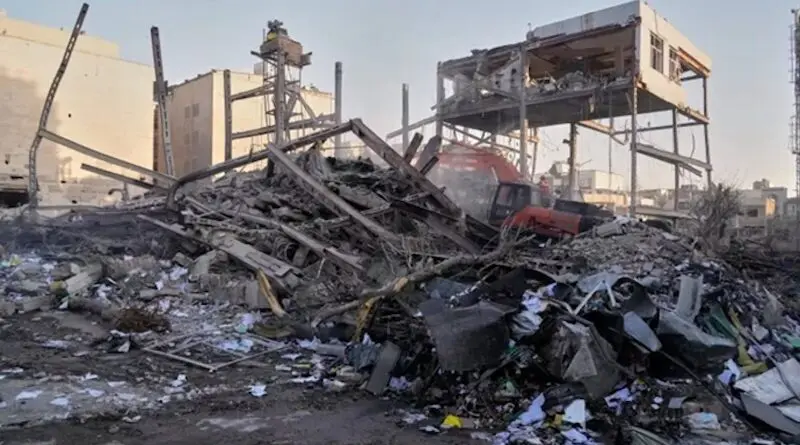
Aftermath of airstrikes in Tehran, Iran. Photo Credit: PMOI

March 22, 2026 

By Lim Teck Ghee


The law of reparations for war damage dictates that a State responsible for an internationally wrongful act – such as illegal warfare – must make full reparation for injury caused — Ref: Articles 1, 31, 34, and 35 on Responsibility of States for Internationally Wrongful Acts (ARSIWA), International Law Commission (ILC), 2001.

When asked by a reporter during Japan’s prime minister Sanei Takaichi visit, “Why didn’t you tell US allies in Europe and Asia and Japan about the war before attacking Iran”, Trump responded: “One thing you don’t want to signal too much, you know, when we go in, we went in very hard and we didn’t tell anybody about it because we wanted surprise. Who knows better about surprise than Japan? Why didn’t you tell me about Pearl Harbor?”

The surprise Japanese strike on the US naval base in Pearl Harbor, Hawaii, on 7 December 1941 killed 2,390 Americans and the US declared war on Japan the next day. Then president Franklin Delano Roosevelt called it “a date which will live in infamy”.

Supporting Trump, his son Eric posted on the X social media platform: “One of the great responses to a reporter in history”.

Trump failed to emphasise that not only was the strike an act of war but that it was initiated whilst Iran and the U.S. were in negotiations aimed at addressing American concerns about Iran’s nuclear capability.

War Reparations

Historical precedent, international law on war reparations which allows the victim of a “surprise” military strike such as that launched by Japan and Germany during the 2nd WW to claim reparations, and Iran’s ultimate position on the issue will likely be an important aftermath of the war.

As of March 2026, Iranian President Masoud Pezeshkian has demanded that the U.S. and Israel pay reparations and provide guarantees against future aggression as core conditions to end the war. Foreign Minister Abbas Araghchi has reinforced this, asserting that “reparations will be paid” and demanding a permanent end to attacks, not just a temporary ceasefire.

Iran has also demanded compensation from Bahrain and the United Arab Emirates, charging that their territory was used for US-Israeli strikes, which violated international law and constitutes “material and moral damages”.

​Estimated War Damage and Casualty Metrics (Mid March 2026)

​Under international law, reparations typically cover restitution, monetary compensation, and guarantees of non-repetition.

​While a final fully accounted total by Iran awaits the end of the war, the following data points, including those by US and Israel official sources providing daily assessments of the impact of their bombing strikes, gives some indication of the scale of reparations that Iran can claim.

Direct Civilian Damage and Human Casualties

This category covers the physical destruction of property and the human cost of the conflict, which are central to any war reparations claim. Reports indicate highly significant damage, though the exact numbers vary by source.
Category of Damage Reported Estimate And Source

1.Civilian Structures Damaged
42,914 buildings Iranian Red Crescent Society .
22,000 buildings UN International Organization for Migration (IOM) .

2.Breakdown of Damaged Structures 36,489 residential units
6,179 commercial facilities Official data from the Iranian Red Crescent Society
10,000 damaged homes in Tehran alone Anadolu Ajansı .

3.Civilian Casualties Over 1,245 killed; over 12,000 injured. Reported by the U.S.-based Human Rights Activists News Agency (HRANA) and Amnesty International. Under precedent, such as the United Nations Compensation Commission (UNCC) for Kuwait*, the compensation for “serious personal injury or death” is a primary category for liability.

4.Attacks on Civilian InfrastructureSchools, hospitals, cultural heritage sites, and critical infrastructure. A specific attack on a girls’ school in Minab killed at least 168 people .

5. ​Infrastructure & Military Assets The strikes have targeted nuclear facilities, missile production sites, and air defense systems across 9,000 targets in Iran. Historical comparisons suggest that rebuilding modern military and nuclear infrastructure involves costs in the tens of billions of dollars.

6. Economic & Energy Damages Iran’s Foreign Ministry has characterized strikes on fuel depots in Tehran as “ecocide,” citing long-term health and environmental damage. Damage to energy infrastructure (like Kharg Island) is often calculated not just by repair costs, but by lost revenue—which can reach hundreds of millions of dollars per day during outages. The war has also undoubtedly disrupted all normal economic activity within Iran, from manufacturing and agriculture to services and trade. The cost of this internal economic paralysis would form a major part of any reparations calculation.
​Historical Precedents for Calculation

​If Iran were to pursue these claims through a mechanism like the International Court of Justice (ICJ) or a specialized compensation commission, the “amount” would likely be built on these benchmarks.

The final liability amount would likely be a “global” figure—combining direct physical repairs, environmental cleanup for “ecocide,” and massive payouts for civilian loss of life—potentially exceeding several hundred billion US$ based on the scale of modern infrastructure destruction.


For now Iran has argued that U.S. “maximum pressure” campaigns constitute economic warfare and some Iranian officials have frequently cited damages exceeding $1 trillion in lost oil revenue, industrial stagnation, and social and economic crises (health, education, utilities shortages).

Although the U.S. and Israel currently maintain that their strikes are legally justified as “preemptive self-defense” or “maximum pressure”, international law experts contest this, labeling the February 2026 strikes as a violation of Article 2(4) of the UN Charter.

Trump’s assertion of a surprise military strike on Iran in the fashion of Japan’s Pearl Harbour attack leaves no doubt as to who started the war and is the belligerent. How much this surprise attack and continuing war will cost the US may come back to haunt Trump, his administration and the American public in more ways than just the moral and ethical concerns.

*The United Nations Compensation Commission (UNCC) was established in 1991 to process claims and pay compensation for damages resulting from Iraq’s 1990–1991 invasion and occupation of Kuwait. The UNCC awarded approx. US$3 billion for environmental remediation, including groundwater treatment and desert restoration. By 2022, the UNCC paid over $50 billion in total reparations to individuals, corporations, and governments, with the final payment made in early 2022, effectively concluding the compensation process.


War will deepen Iran’s water crisis

War will deepen Iran’s water crisis
Iran’s deepening water crisis, driven by drought, climate change and decades of mismanagement, is straining supplies for millions and exposing the vulnerability of the country’s ageing water infrastructure. / bne IntelliNews
By Ben Aris in Berlin March 21, 2026

An Israeli missile fell a few hundred metres from the Bushehr nuclear power plant during the South Pars missile strike on March 18, threatening not only a nuclear disaster on the order of Chernobyl but cutting off the entire region from its fresh drinking water supplies. However, even if Bushehr is not hit, the war with Israel and the US is going to make Iran’s dire lack of water problem a lot worse.

The Iranian authorities warned the International Atomic Energy Agency (IAEA) on March 18 that the Bushehr NPP may be included as a possible Israeli target as Israel seeks to collapse the Iranian economy by destroying its source of income and its energy sector.

Built on the shores of the Gulf, the danger is that nuclear fuel, or even just the reactor’s cooling fluid, would spill into the Persian Gulf and contaminate it. The Gulf countries have little fresh water and are heavily dependent on approximately a hundred desalination plants along the coast. The production of dozens of these plants would be threatened and they would have been closed, causing a major humanitarian crisis that could force millions to leave the region.

So far Bushehr has been untouched, but the war itself is making Iran’s already dire water problem a lot worse. The lack of drinking water could play a decisive factor in the war if hostilities drag on.

As bne IntelliNews reported, Tehran was already facing the possibility of water rationing in December due to a record drought last year. By the end of January the crisis was becoming acute after fourteen dams across Iran's most densely populated provinces saw reserves fall below 10% capacity. The authorities warned that if “day zero” arrived, the capital might have to be evacuated.

Decades of overbuilding and mismanagement of some 600 dams have left Iran with silted, leaky reservoirs and critically low storage levels. Global warming and extreme temperatures as the Climate Crisis accelerates faster than scientists predicted is exacerbating the problem. Work to counter these problems is now impossible after the beginning of Operation Epic Fury has drained away all resources and decapitated the government.

In the summer of 2025, Tehran, along with several other large cities, had to reduce its water consumption as the dams that feed the city completely dried up. This summer the situation will be a lot worse as the region is on track for more record breaking heatwaves. The last three years have already been the hottest in recorded history.

Tehran is a city of about 9mn people and in the frontline for a potential water crisis. In November, President Masoud Pezeshkian took the unusual step of releasing a video warning residents evacuation of the capital could become necessary if rainfall did not arrive soon.

Iran has been enduring its worst drought since 2020 and years with very little rainfall are now ten-times more likely than they were before industrialisation, according to World Weather Attribution, which studies the role of greenhouse gas emissions in extreme weather.

Climate change has compounded the long standing structural problems with Iran’s water system, due to decades of poor water management, misallocation of resources, an inappropriate agriculture policy and corruption.

Iran is the fourteenth most water-stressed country in the world and more than four-fifths of its 93mn population faces extremely high water stress, Bloomberg reports.

And now its infrastructure is under threat from the war. The US took the radical decision and struck Iran’s desalination plant on the island of Qeshm in Strait of Hormuz March 7. Iran struck back, hitting a water facility in Bahrain, and raising the nightmare scenario of Iranian retaliatory strike on all the desalination plants in the region that would make the Gulf effectively uninhabitable. The US denied Tehran’s accusation that it was responsible for the Qeshm incident.

The Middle East hosts more than 40% of the world’s desalination capacity, yet Iran relies on it far less than its neighbours. Only about 3% of the country’s drinking water comes from desalination plants, compared with more than half in Saudi Arabia and around 90% in Kuwait. Iran’s water problem is not caused by its lack of naturally occurring water, but the shoddy state of its infrastructure.

The development of the infrastructure was shaped by political patronage rather than long-term planning. Contracts were handed out to allies of the state and military – a network widely referred to inside Iran as the “water mafia”, a term used by Donald Trump in May in a speech in Riyadh.

Poor agricultural policy has added to the strain on the system -- agriculture accounts for roughly 90% of water use - by promoting water-intensive crops and attempting to be self-sufficient in food production, when it would make more sense to use the water for other means and import goods from more verdant neighbours.

The heavy use of water in agriculture was exacerbated by expanding farming into some of Iran’s driest regions which accelerated groundwater depletion and drained aquifers.

Iran’s short lived rainy season is already over and the intense heat of summer is on its way. Authorities fear a repeat of 2023 when Iran declared a two-day holiday in August after temperatures topped a record 50°C – one of the hottest summers on record. As the disaster season gets underway, this year could be at least as bad, or possibly worse. Climate models from bodies such as the World Meteorological Organization (WMO) and Copernicus predict a high probability (around 80–90%) that one of the next few years will set a new all-time global temperature record.

Iran Can Escalate The Energy War In The Gulf To Water – Analysis


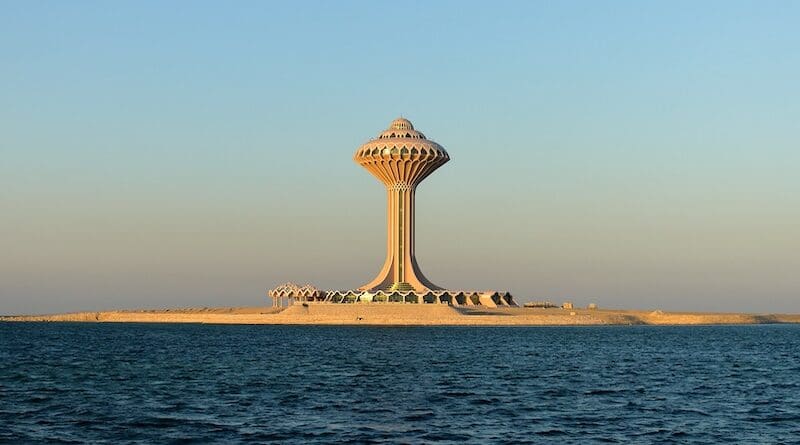
Al Khobar Water Tower located in Al Khobar Corniche, Saudi Arabia.

 Photo Credit: Francisco Anzola, Wikipedia Commons

March 21, 2026 
By Hudson Institute
By Can KasapoÄŸlu

Energy Warfare and The Expansion of the Gulf Battlespace

On March 18, the Israel Defense Forces struck upstream energy production facilities at Iran’s South Pars gas field. South Pars is not a peripheral asset—it sits at the core of Iran’s energy system and is the world’s largest natural gas field. It underpins roughly three-quarters of Iran’s domestic output.

Damage on this scale directly affects electricity generation and industrial output. It also undermines regime stability. In Iran, energy shortages are not technical issues; they are leverage points. In effect, the Epic Fury–Roaring Lion campaign is introducing a new dimension of political warfare. The focus is no longer solely on degrading the Islamic Revolutionary Guards Corps’ (IRGC) military capabilities. Instead, the campaign is now shifting toward shaping internal conditions within Iran—applying sustained pressure on the regime’s ability to provide services, govern, and uphold its already weakened social contract with a population under immense strain. Over the past twenty days without internet, for example, Iranian society has experienced Orwellian isolation from the rest of the world.

Tehran’s response expanded the scope of the conflict. Iranian drones and missiles struck energy infrastructure across the Gulf, including facilities connected to Qatar’s North Field—the geological twin of South Pars and a key global liquid natural gas (LNG) hub. The conflict escalated beyond bilateral exchanges. Iranian retaliation has grimly introduced systemic risk into an already unstable Middle East threat environment.

In the meantime, the United States Central Command conducted strikes against hardened Iranian anti-ship missile positions along the Strait of Hormuz. These strikes can either reflect the American effort to reopen the critical chokepoint for good or, in a low-probability and high-impact scenario, the prelude of an amphibious assault on the Kharg Island, particularly given recent American strikes on the military targets on the island. Kharg looms large as the nerve center of Iran’s economy and a hub of almost 90 percent of the country’s oil exports.

Energy markets responded swiftly to the chain of escalatory trends. Prices increased as upstream production and LNG infrastructure came under pressure. However, a more significant development underpins market volatility: water may shape the next phase of the conflict.

Marking the Hydro-Strategic Threat in the Gulf

When the political and military elite of the Islamic Republic assessed their strategic options after the United States and Israel began Operations Epic Fury and Roaring Lion, they calculated what few analysts anticipated: that the path to fracturing the coalition arrayed against Tehran ran not through Israel but through the Gulf Arab states. The IRGC, the regime’s praetorian deterrent, know they cannot defeat the American-led coalition militarily. Instead, they seek to raise the economic and diplomatic costs of the war sufficiently to break President Donald Trump’s will to continue waging it.

Iran has aimed almost half its long-range strikes at the United Arab Emirates. It hopes to weaken the resilience of America’s Gulf Arab allies. The Islamic Republic’s military strategy is designed to make a sustained US war effort politically unsustainable in Washington.

To achieve this, Iranian missile and drone forces might target a resource that is scarce and crucial in the Gulf Arab region: water. Iran has tried to close the Strait of Hormuz and struck oil and gas sites throughout the area. Oil markets dominate the strategic picture for now. Yet the vulnerability of desalination infrastructure is a different category of risk. Energy disruptions primarily trigger economic consequences by raising prices and constraining supply. Water disruption, by contrast, directly threatens daily survival in some of the world’s most water-scarce states.

Desalination is the Gulf Arab nations’ primary way of providing drinkable water to their people. About 90 percent of Kuwait’s drinking water comes from desalination, as does 86 percent of Oman’s and around 70 percent of Saudi Arabia’s. As a result, any postwar settlement that ignores Iran’s ability to threaten the desalination infrastructure that allows the Gulf Arab nations to function leaves the region exposed to continued Iranian blackmail. From the Guards’ perspective, this asymmetry makes water infrastructure an attractive coercive lever even if oil remains the region’s most globally visible strategic commodity.

US intelligence agencies raised a red flag on this danger long before the current war began. A declassified Central Intelligence Agency assessment, approved for release in 2010, concluded that potable water had already become a strategic commodity across the Gulf Arab states. The region’s leaders view this resource as more vital to national survival than oil. The CIA report identified Iran as the greatest threat to the region’s desalination infrastructure and cautioned that more than 90 percent of the region’s drinkable water production depended on just 56 plants. Damaging these facilities could trigger consequences more severe than the loss of any other industry. Today’s battlefield shows the CIA’s warnings come to fruition. Thus far, Iran has already struck a desalination plant in Bahrain, marking a dangerous path ahead. The Islamic Republic, moreover, has threatened to continue widespread strikes against the Gulf’s water resources.

When it comes to water, geography makes the region even more vulnerable. This exposure cannot be engineered away. Desalination needs direct seawater intake, so plants are built along coastlines. That means nations must put critical infrastructure on narrow, low-lying coastal strips with little defensive depth. The Islamic Republic sees these strips as sitting ducks.


Militarily, desalination plants are classic soft-skin targets. They are sprawling facilities, not hardened structures. Moderate physical damage to pumps and intake systems can disable plants for long periods. Repairing complex, specialized equipment can take time. Oil supply fluctuations can be managed with reserves or price changes, but water scarcity cannot. When water is disrupted, the situation can quickly turn into a public health crisis.

Damaging desalination plants fits Iran’s likely operational playbook in any future conflict. The regime can rebuild its missile arsenal with support from China, North Korea, and Russia. Hardline elements supporting new Supreme Leader Mojtaba Khamenei will likely stay in power. The Islamic Republic may become a new North Korea of sorts: a military dictatorship with both the capability and will to threaten neighbors—especially their water facilities.

While Epic Fury aims to dismantle Iran’s drone and missile programs, the Revolutionary Guards’ economic blackmail can hold Gulf water supplies hostage. Washington must make clear that threats to Gulf Arab water are intolerable and will incur overwhelming consequences.

Previous diplomatic frameworks for dealing with Iran have focused almost exclusively on Tehran’s nuclear program, as the nuclear deal inked during the Obama presidency. In seeking to resolve the current conflict, Washington and its partners should realize that Iran does not need nuclear weapons to threaten the region’s military balance.

About the author:
 Can KasapoÄŸlu is a nonresident senior fellow at Hudson Institute. His work at Hudson focuses on political-military affairs in the Middle East, North Africa, and former Soviet regions. He specializes in open-source defense intelligence, geopolitical assessments, international weapons market trends, as well as emerging defense technologies and related concepts of operations.


Source: This article was published by the Hudson Institute