Thursday, April 02, 2026


With a smile on his face and a bottle of champagne in his hand, Israel’s hardline National Security Minister Itamar Ben-Gvir celebrated on the Knesset floor Monday the passing of the new Israeli death penalty law targeting Palestinian detainees. First introduced as a bill by Ben-Gvir’s own Jewish Power party in November of last year, the law underwent its second and third readings in the Israeli parliamentary body earlier this week, passing with a majority of 62 to 47 votes. The objective of the law? To seek the death penalty for Palestinians convicted of acts that led to the death of Jewish Israelis.

The bill first sparked controversy when introduced over four months ago due to its explicitly discriminatory wording, which at the time was phrased as targeting individuals convicted of killing Israelis on “nationalistic or racist” grounds, and with the intent of “harming the state of Israel or the rebirth of the Jewish people.” Since then, Israeli lawmakers have sought to mitigate the controversy by tweaking the bill’s wording.

The final version that was passed into law targeted those convicted of actions that led to the death of Israelis, with the intent of “ending Israel’s existence.” 

Despite the slightly less racially-charged language, the text of the law still applies almost exclusively to Palestinians, even pushing the Foreign Ministers of Australia, Germany, France, Italy, and the United Kingdom to condemn the law in a joint statement due to its “de facto discriminatory character.” UN human rights head, Volker Türk, said that the law’s application to Palestinians would be considered a “war crime,” and was “deeply discriminatory.”

Meanwhile, the global human rights community lambasted the law as yet another legal facet of Israeli apartheid. Amnesty International emphasized that the law is the first in “what threatens to be a series of laws” that would execute Palestinians “in a public display of cruelty, discrimination and utter contempt for human rights,” adding that the law “dismantles fundamental safeguards to prevent the arbitrary deprivation of life” while further entrenching “Israel’s system of apartheid.” For its part, Human Rights Watch stated that the law “entrenches discrimination and a two-tiered system of justice, both hallmarks of apartheid.”

Shawan Jabarin, the head of Palestine’s leading human rights group, Al-Haq, told Mondoweiss that “this is the first time that a law is passed by one group to apply exclusively to another, without at least a formal equality of application.” 

Jabarin clarified that “there is an Israeli military order concerning Palestinians in the West Bank and Gaza that allows for the death penalty, but it requires that the death penalty be sought by the military prosecutor and approved by a consensus of judges.” The law passed by the Knessset on Monday, in contrast, is not a military order, but a “penal law,” Jabarin explained, “which makes it possible for judges to issue the death penalty by majority, not consensus, and without being sought by the prosecutor.”

Jabarin points out that despite the fact that the law is formally different from military orders, the logic behind it is the same as the military judicial system that applies to Palestinians. “In Israeli military courts, the rate of conviction of Palestinians is higher than 99%, because there are no guarantees of a fair trial,” he explains, as they accept confessions extracted under torture or coercion, “making the possibility of appeal completely futile.”

Families of prisoners ‘left alone’

Palestinian families of prisoners have been bracing for this law to be passed for months, and yet the passing of the law with such ease came as “a shock” to them, according to Ayah Shreiteh, spokesperson for the Palestinian Prisoners’ Club.

“The law does not apply retroactively, which means that it doesn’t apply to prisoners who have already been convicted,” Shreiteh told Mondoweiss. “However, there are some 40 Palestinian prisoners charged with acts that led to killing Israelis who haven’t yet received sentences, and they are in the direct crosshairs of the death penalty law,” she added. 

Out of the roughly 9,000 Palestinians currently in Israeli prisons, only a few hundred are charged with attacks leading to the death of Israelis, and more than 4,000 are held without charge, 3,000 of whom are held under “administrative detention,” a policy that allows Israel to hold Palestinians based on a “secret file” that is not shown to the defense.

“Many families are from a simple background, and they came to the club completely devastated, anxious about the fate of their loved ones and asking if they will be executed,” she said. “The most difficult thing for families is the feeling of being left alone.”

Shreiteh says that Palestinians have been subjected to one tragedy after another over the past two years, from the Gaza genocide, to starvation, to settler violence, and annexation plans, while the question of prisoners remained in the background of most news. “This makes families of prisoners feel that they are alone in this,” Shreiteh explained. 

This is further compounded by the fact that the Palestinian Authority has recently cut off the salaries of families of Palestinian prisoners and martyrs under international pressure, based on Israeli propaganda painting the fund as a “pay-for-slay program” rewarding “terrorism.”

“There is a feeling of helplessness in the face of the impunity in how prisoners are being treated,” Shreiteh added. “And this law came as an additional blow to the morale of the families of Palestinian prisoners.”Email

Qassam Muaddi is the Palestine Staff Writer for Mondoweiss.

The Useful Lie of ‘Domestic Terrorism’

Source: Freedom Socialist newspaper, Vol. 47, No. 2, April-May 2026

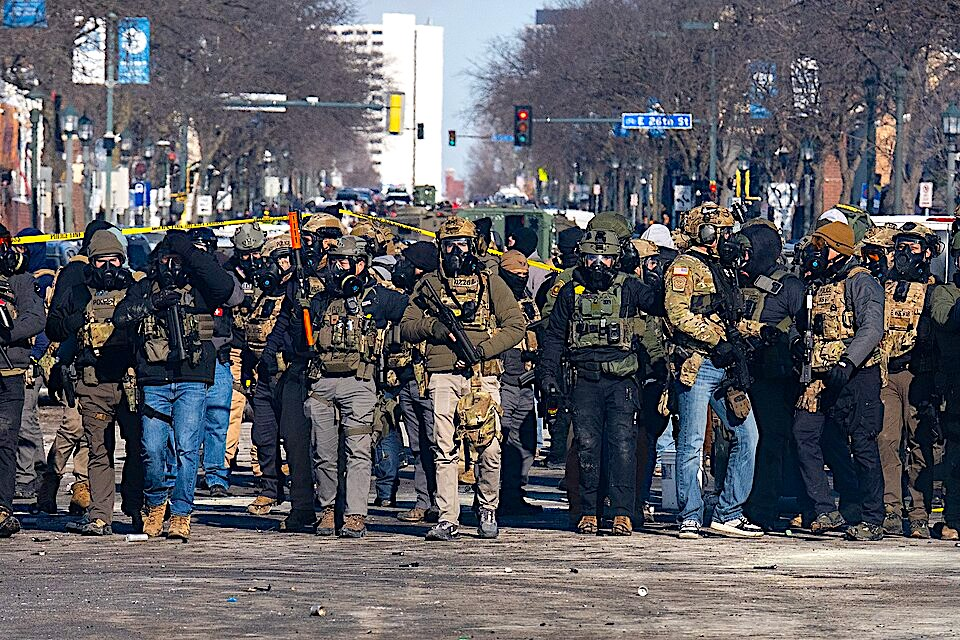
Alex Pretti was fatally shot on Jan. 24, 2026 by ICE agents during a protest in Minneapolis against Trump’s anti-immigrant “surge.” Only a little over two weeks earlier they had murdered Minneapolis resident Renee Good in a similar fashion. And in October 2025, a Border Patrol agent shot Marimar Martinez five times during an immigration crackdown in Chicago. She survived.

None of these victims, all U.S. citizens, were doing anything to threaten agents, as was clearly shown by video and eyewitness testimony. But Trump’s regime quickly smeared them as domestic terrorists and claimed the trigger-happy agents were just defending themselves.

Palpable outrage over the obscene justification of the Minneapolis street executions erupted in Minnesota and around the country. Pretti was an ICU nurse at the Veterans Administration. His union, the American Federation of Government Employees, slammed the Trump administration, saying, “Kristi Noem, who was responsible for carrying out the policy that led to Alex’s needless killing, and … Stephen Miller, the architect of that policy, must resign immediately. If they refuse, President Trump must dismiss them.” Noem has since been replaced.

Machinery of repression

A government apparatus that goes after critics is nothing new. But now it is leaning heavily on the charge of domestic terrorism to ramp up attacks and solidify an authoritarian state.

A historical example is the infamous Counterintelligence Program, typically referred to by its acronym COINTELPRO. This program, initially launched to undermine the activities of the Communist Party, morphed into a way to disrupt a wide range of organizations that were challenging the status quo in the 1960s. A favorite target of then-FBI Director J. Edgar Hoover was Black civil rights groups, especially the Black Panther Party. COINTELPRO investigated, surveilled, and even sent informants into organizations to sow internal divisions.

The program cast a wide net, targeting Native American and Chicano groups, feminists, the Left, and unions as well.

Violence was also a tool. In 1969 the FBI, as part of COINTELPRO, planned and carried out the murder of Fred Hampton, the dynamic leader of the Chicago Black Panther Party.

Shredding the First Amendment

No one has talked openly about doing away with the First Amendment. But the state has erected an elaborate framework to subvert the rights to free speech and assembly. This might be deemed illegal by the courts at times, but ICE is prepared to let the bullets fly to establish suppression of democratic rights as a fact on the ground.

Joint Terrorism Task Forces (JTTFs) are a key mechanism for persecuting political opposition. The first was established in New York City in 1980. Now there are over 200 throughout the country, operating under the direction of the FBI and coordinating local, state, and federal agencies in what often turn out to be fishing expeditions aimed at political opponents, especially radicals.

The ability of government agencies to share intelligence and data on U.S. residents was greatly expanded by the USA PATRIOT Act, passed after the Sept. 11, 2001, World Trade Center attack. Both major parties voted for that gutting of privacy rights, and the JTTFs got even busier spying on a range of folks.

Early in Trump’s second term an executive order, national security memo, and FBI directive broadened the definition of domestic terrorism so much (for example, describing anti-Christian activity as terrorist) that it could threaten organizations and individuals based solely on their ideology. No evidence of criminal behavior, or even intent, is required. Not surprisingly, this golden opportunity is being used to spy on dissenters.

Trump aims his ire particularly at antifa, which is more a set of anti-fascist ideas than an organization.

In a chilling move in March, nine Prairieland ICE Detention Center protesters were convicted in Texas for supposedly shooting an agent in the first federal domestic terrorism case involving antifa activists.

Pushing back

Obviously, this rollback of democratic rights could be a disaster for anyone who is organizing for social change or trying to form a union. Fortunately, working people are not going along quietly.

Millions of people have been protesting the Trump regime. And the general strike in Minnesota in response to the ICE killings has inspired folks across the nation. Hundreds of thousands of marchers in Minneapolis braved sub-zero temperatures to stand in solidarity with their immigrant siblings.

The next step is to wage a national general strike. Even some labor leaders are pondering that possibility. Members of unions and workers’ organizations can promote that as the best way to exert the power of a united working class.

Another way to resist is to expose local JTTFs as unaccountable arms of the assault on free speech. Local and regional governments must be pushed to end their collaboration with and participation in JTTFs.

Most importantly, it must be made clear that everyone has plenty at stake in this fight and must unite. Typically cautious groups, like unions, must join with folks they are not accustomed to working with such as radicals and antifa activists. They must not fall for the Trump regime’s mudslinging. This is the time to stick together and fight.


A German Journalist’s ‘Civil Death’

Source: Consortium News

The following note appeared in the thread of my “X” account at 7:47 Saturday morning. It was posted by Hüseyin Dogru, a German journalist who lives, such as he and his family can, under European Union sanctions:

Hüseyin Dogru is not given to histrionics or self-dramatizations, if this is what you’re thinking. He has been on the E.U.’s (increasingly long) sanctions list since May 20 of last year. While Dogru joins others dedicated to the truth of our time and the defense of their own integrity, he is the first E.U. citizen to be sanctioned and the first journalist to land on the list because of his work. 

What is Dogru’s crime? Don’t ask: He has not committed one, has not been charged with one, and has not been permitted any opportunity to respond in court to those accusing him of … of practicing his profession and exercising his rights to free expression. 

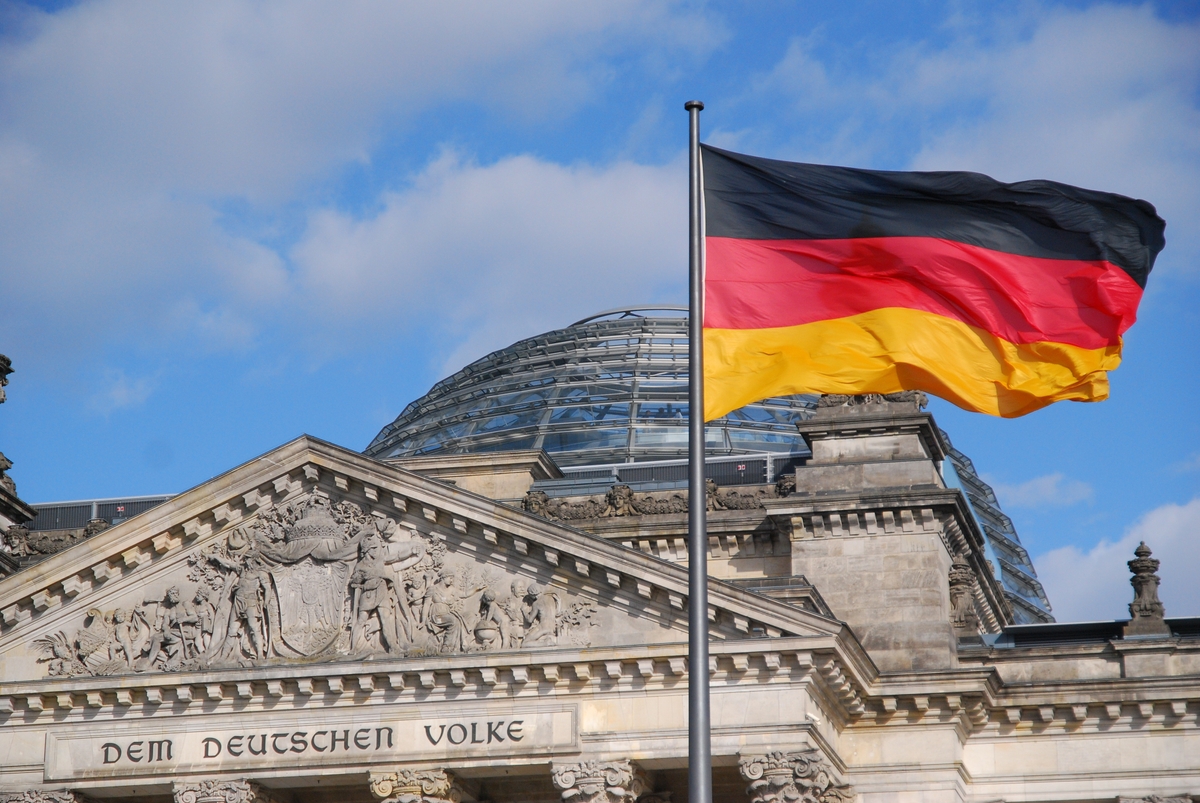
I will get to the particulars of the official documents in a sec. For now, this: Hüseyin Dogru, whose family is of Turkish origin, was born in Berlin and is a German citizen. As a journalist he has been critical of Israel, taken a strong position against the genocide in Gaza and written in support of the Palestinian cause. More later.

With the seizure of his spouse’s bank accounts last Friday, Dogru and his family now face what amounts to a starvation blockade of the kind the Trump regime (not to change the subject) currently imposes on Cuba and Israel imposes on Gaza. 

This story reads like something out of Dostoyevsky or Kafka, I have to say. We are talking about a family of five going hungry in the capital of the Federal Republic of Germany as punishment for… what?… for seeing with his eyes open, for thinking about what he sees, then commenting on what he sees?

I would love to suggest various ways readers could support the Dogru family, but there are none. Were someone to donate so much as a loaf of bread to help sustain them the German authorities would count it a criminal offense punishable by a prison term of up to several years. 

I discussed this question of assistance with a German friend over the weekend. The only way to come to the aid of Hüseyin Dogru, we determined, would be to hand him, in person, an envelope of euros or a bag of groceries. And this would be to take a risk, of course.    

The above quoted social media post was addressed to some names readers will recognize: Yanis Varoufakis, Stella Assange, Alan MacLeod, Clare Daly, Mary Kostakidis, Chris Hedges and on down a long list. The best coverage of the Dogru case I have seen has appeared in Berliner Zeitung, which I have read courtesy of the translations sent me by Eva–Maria Föllmer Müller, a German friend and colleague.

European Media Silence

As to the rest of European media, including Germany’s, there has been a resolute silence these past 11 months. In a series of social media posts over the weekend, Dogru reported that many people have written — your columnist is among them — to offer him and his family some mode of support.  

Here are two of his replies: “People ask me what we can do. Legally, I cannot comment, as it could link me to the act and put my family at risk. All I can say is that resisting injustice through civil disobedience is legitimate and morally justified.”

And then this: “Also a call to journalists who know about my case and had access to the files — you chose to stay silent. You are also responsible for the situation of my children.”

On March 15 Berliner Zeitung published an interview with Alexander Gorski, Dogru’s attorney. Here is a little of what Gorski said when asked how nearly a year’s sanctions has affected Dogru’s life:

“The impact on him and his family is devastating. From one day to the next, his accounts were frozen. He is not permitted to conduct any financial transactions and must have every use of his assets approved by the Bundesbank. Currently, only €506 per month are authorized, with which he must make ends meet….  Furthermore, his bank, Comdirect, repeatedly imposes additional restrictions on the use of these €506…. The risk of committing a criminal offense by having financial contact with my client is very high…. Leading a normal family life under these circumstances is virtually impossible. This situation is often described as “civil death” — and that is exactly what applies here….”

Nine days after this interview appeared, the District Court in Frankfurt am Main rejected an emergency appeal Gorski filed, requiring Dogru’s bank to unblock funds he needs to meet routine obligations — fees to service providers, insurance payments, and the like. The court ruled that Dogru has no “right to an injunction.” 

It was four more days until, last Saturday, the Central Office of Sanctions Enforcement, a federal authority in Berlin, seized the accounts of Dogru’s spouse.

This is the same treatment accorded others on the E.U. sanctions list. “Civil death” is precisely the term.

Jacques Baud, the noted Swiss commentator, is prominent among these others. The paying-attention population of Europe was shocked when he was sanctioned, last December, a case I wrote of in The Floutist under the headline, “Free Speech and its Enemies.”

Here is Baud’s entry in the E.U. Sanctions Tracker, the list of those the E.U. has summarily blacklisted: 

“Jacques Baud, a former Swiss army colonel and strategic analyst, is a regular guest on pro–Russian television and radio programmes. He acts as a mouthpiece for pro–Russian propaganda and makes conspiracy theories, for example accusing Ukraine of orchestrating its own invasion in order to join NATO.”

Hüseyin Dogru’s rap sheet is similarly preposterous. In sum, the E.U. runs miles with his previous association with a now-defunct digital channel called Redfish, which was partly funded by a subsidiary of the Novosti–RT group.  

Here is an extract from Dogru’s entry in the E.U. Sanctions Tracker. His case is No. 20 in the document linked here. In it you find a salad of factual inaccuracies along with the beyond-flimsy case it purports to document against him:

RED [Redfish] has used its media platforms — often publishing under ‘redstreamnet’ or ‘thered.stream’ — to systematically spread false information on politically controversial subjects with the intent of creating ethnic, political and religious discord amongst its predominantly German target audience, including by disseminating the narratives of radical Islamic terrorist groups such as Hamas….

Through AFA Medya [a media company based in Istanbul, the purported sponsor of “RED”], Hüseyin Dogru thus supports actions by the Government of the Russian Federation which undermine or threaten stability and security in the Union and in one or several of its Member States, including by indirectly supporting and facilitating violent demonstrations and engaging in coordinated information manipulation….”

This is a hard bouncing ball to follow, as readers may note. Dogru wrote critically of Israel and the Gaza genocide (among various other topics, including German foreign policy) and this was in the service of spreading Russian disinformation in the cause of destabilizing E.U. member states.  

Got it?

When Berliner Zeitung asked Alexander Gorki, Dogru’s attorney, why the E.U. singled out Dogru, he replied, “We don’t know that. What we observe, however, is that the German government, in particular, is cracking down on people who express dissenting opinions on the Russia–Ukraine war or the issue of Palestine.”

Just parenthetically, Dogru opposed the Russian intervention in Ukraine and quit Redfish in protest immediately after it began in February 2022.

“The Commission in Brussels banned him, a European Union citizen, from the European Union,” Yanis Varoufakis remarked in the course of an appearance on The Chris Hedges Report last week. “They turned him into a non-person, ‘an asset of Putin,’ just because they could.”

It is those last four words that rattle me most. They resonate across the Western post-democracies.  

Eva–Maria Föllmer–Müller contributed invaluable research and translations.il

Patrick Lawrence, a correspondent abroad for many years, chiefly for The International Herald Tribune, is a columnist, essayist, lecturer and author, most recently of Journalists and Their Shadows. Other books include Time No Longer: Americans After the American Century.

What Is to Be Done? Toward a Praxis of Resistance

Source: Originally published by Z. Feel free to share widely.

We are living through times where the architecture of global peace is not merely crumbling; it is being deliberately dismantled. The drums of global war beat louder than ever, drowning out the voices of reason. Across the globe, imperial power grinds forward, indifferent to human lives. In the face of such force, silence is complicity. We are compelled to speak, not because words alone will stop bombs, but because refusing to speak means surrendering our humanity.

Yet, things have only escalated. Our voices are barely audible beneath the barrage of projectiles. Nevertheless, I do not miss an opportunity to speak or write, hoping to reach the Macedonian public and the wider world: there is no more time to wait! But an old Macedonian saying goes: there is no point waking someone who pretends to be asleep. I confess a personal “sin”: I write because it helps me stay mentally and intellectually sane.

The problem is serious even among those aware of the Armageddon before us. A woman of Iranian origin on Substack wrote bitterly: “Are you really just going to keep talking? Where is the global collective action?.” It hit the mark. Today, we lack not analysis, but action. As Lenin asked: What is to be done? (I use his title fittingly, aware that historical circumstances differ). At the recent Tricontinental Institute’s assembly, Vijay Prashad said: “We must take a step forward!” We must conceptualize resistance against barbarism and what comes after. We seem to have lost the power to imagine a just society transcending frameworks of market economics and classical political science. We must define the ultimate goal. My peace colleagues would easily answer: positive peace! Found in Johan Galtung’s works, this encompasses human emancipation, social justice and dignity, de facto containing basic elements of the communist idea. Unfortunately, most peace activists fear ideology, standing on the safe shore of the liberal horizon.

This is my modest attempt to frame things radically, meaning “from the root.” Peace studies still speak of peace through peaceful means, invoking the UN Charter. It sounds moving and beautiful only if the UN were not complicit in silencing crimes. The UN is neither an abstraction nor autonomous; it is created by governments that are either perpetrators or vassals (or both). Few today are genuine democracies, just, and moral. The UN is what states made of it, primarily those self-appointed as guarantors of peace after WWII. They granted themselves rights above all others, like gods. Consequently, the military-industrial complex expanded like a giant octopus, metastasizing all spheres of human activity, alongside military blocs and bases. Humanitarian aid arrives only after blood is spilled. Many believe replacing kakistocrats or reforming the UN will guarantee peace. The new “Aryan race” has evolved into an “Epstein caste”, just as capitalism has been transformed into an overt form of neo-fascism and US hyperimperialism, perpetuating inequality defended by military power. Dissident voices diagnose problems but do not know what is to be done. Even though many were excited from the mass protests in the US and many other cities on 28 March, the cynical mind is correct: The performances seen, the celebrities heard—it all looked like a circus. They do know they don’t want a king (Trump), yet they do not challenge the system that allowed oligarchy to govern their lives. There is a growing consensus across the Global South that Western public opinion is functionally irrelevant to the fight against imperialism.

The official doctrine of the most powerful empire is “peace through strength.” Its executors do not mind the UN Charter, the Genocide Convention, or even the Geneva Conventions. Such force is not answered with suggestions, proposals for peaceful conflict resolution and performances on the street. Force is met with force. Resistance. Responses with poetry, appeals, and art are moving and beautiful at the same time, but insufficient. Currently, only people of Palestine, Lebanon, Iran, Cuba, and fragmented anti-colonial movements really fight back against the Empire of Evil. They show what it means to stand when babies are tortured, and existence must be defended with bodies. The Vietnamese were in such a battle, but we seem to have forgotten them. “Peace through peaceful means” was the slogan then, too—but until they inflicted enormous losses on US citizens, they were not left in peace. They proved the power of resistance against the military Goliath. Honestly, if I were a Palestinian mother seeing my child/children killed, I would immediately take up arms. Better to die fighting than die a little every moment.

The answer to this madness is our own “madness”: peace through resistance! Recently, on 27 March, recalling Yugoslav history, it came to mind that the protests rose against the Pact with Nazi Germany. Slogans we still remember read: “Better the grave than a slave,” “Better war than the Pact!” That was the seed of the Partisan movement. My peace friends want a global anti-war movement (by often excluding “others”, like China for instance), but slogans and street protests soothe consciences without striking the Empire where it hurts. Some people more courageous than us defend dignity with blood and lives. That is the right to self-defense in international law! It is also in the UN Charter. Yet, those far from battlefields must develop methods of struggle against the war machinery, fleeing neither the mad Nero in Washington nor the silence.

From the academic sphere, I start with professors: they must “corrupt” youth like Socrates! Even in physics classes, they must speak about war. On militarization and numbness, everyone can teach. Dedicate one hour a week! Unions and farmers can strike; this war hits those who live by sweat everywhere in the world. Journalists must remember Robert Fisk and Julian Assange, showing solidarity with colleagues used as clay pigeons who lost their lives with unprecedented courage. Medical workers can follow Mads Gilbert’s example! Culture and civil society can screen anti-war films like Hair or Dr. Strangelove or any other anti-war film (including documentaries). But those ‘inside the belly of the beast’ can do the most: boycotts, sabotage, and conscientious objection. Many US military professionals do not support the war, greeting with the code “Epstein.” Now is the moment for objection. Before Joe Kent’s resignation, many others showed that character and conscience would not let them work at universities or the UN, obedient to the military superpower. Workers in military industries can exert pressure, as can local communities near military bases. I am not sure if global cohesion will emerge, but each of us must start by sweeping our own doorstep.

Resist authorities allied with the degenerate Epstein caste of child-killers! The time is NOW! We are on the brink and have no excuses left for dreaming with eyes wide shut about the universal organization and its documents that are spattered with the blood of innocents. Extending the agony of the current system works against us. Let’s help the new one to be born, even in pain—as it usually happens.

This article was produced by Globetrotter.Email

Biljana Vankovska is a professor of political science and international relations at Ss. Cyril and Methodius University in Skopje, a member of the Transnational Foundation of Peace and Future Research (TFF) in Lund, Sweden, and the most influential public intellectual in Macedonia.