Sunday, April 12, 2026


How the Iran War Could Reignite Global EV Demand

  • Rising oil and petrol prices are making EVs more attractive to cost-conscious consumers.

  • Used-EV sales are gaining momentum in Europe and the United States as interest grows.

  • Analysts say the shift could boost EV demand, though likely gradually rather than suddenly.

The war in Iran and broader Middle East conflict are making consumers and policymakers more aware of the vulnerabilities that face the global energy market. The price of fossil fuels is rising higher and higher, as supply chain disruptions are spurring oil shortages around the world. As governments worldwide evaluate their next moves, consumers appear to be increasingly turning to electric vehicles (EVs) to reduce their reliance on petrol.

Many governments have introduced policies that aim to encourage the purchase of EVs and dissuade consumers from buying new internal combustion engine (ICE) vehicles. Following the Covid-19 pandemic, the move formed part of a broader global trend to support a green transition, thereby reducing reliance on polluting fossil fuels. This led automakers around the world to pump billions into EV production. However, over the past couple of years, it has become clear that the EV boom is happening at a slower pace than previously anticipated, leading many EV-makers to backtrack on higher production aims.

Now, recent predictions suggest that higher prices at the pumps could drive a resurgence in EV demand. The Iran war has severely disrupted oil trade through the Strait of Hormuz, where around a fifth of the world’s oil and liquified natural gas (LNG) is typically transported. This has led to severe energy shortages in several areas of the world and has driven up energy prices in recent weeks. Many analysts now expect this trend to spur interest in EVs among consumers looking for an alternative to a petrol-fuelled vehicle.

Multiple car-sale platforms in the United States and Europe have reported a significant rise in consumer interest for EVs since the beginning of the Iran war, in late February. On March 26, the online vehicles marketplace Autotrader stated that inquiries into buying a new EV had risen by 28 percent, and for used EVs, inquiries increased by 15 percent. Meanwhile, the EV specialist Octopus Electric Vehicles said that inquiries into EV leasing had risen by 36 percent over a similar period.

With oil prices set to rise even further, many consumers are now exploring their options. People that need to travel long distances by car on a regular basis may find it more cost-effective to invest in an EV, rather than increasing their spending on petrol each week, as the benefits of investing in an EV could outweigh those of owning an ICE vehicle. Several EV-makers are already using the high cost of petrol as part of their marketing technique.

A senior consultant at JATO Dynamics, Steffen Michulski, explained, “To shorten and summarise it: Yes, elevated oil prices and the renewed focus on energy security are likely to provide a midterm boost to BEV demand… But this is best understood as an incremental shift rather than a sudden market-wide acceleration.”

Meanwhile, CarMax’s Edmunds.com stated, “Fuel prices have long influenced how drivers think about their next vehicle because they are one of the most visible costs of car ownership. But whether the latest spike translates into meaningful shifts toward electrified vehicles may depend less on the price of gasoline itself and more on how long consumers expect fuel costs to remain elevated.”

In Europe, used-EV sales have increased in recent weeks, according to several websites. Between February 23 to March 16 the average cost of petrol in the European Union rose by 12 percent, to 1.84 euros ($2.12) per litre. The French online used-car retailer Aramisauto reported that its share of EV sales almost doubled from February 16 to March 9, growing from 6.5 percent to 12.7 percent. Meanwhile, the share of sales of ICE vehicles decreased from 34 percent to 28 percent over the same period, while its diesel vehicle sales share fell from 14 percent to 10 percent. A similar trend was seen following the Russian invasion of Ukraine in 2022, according to Aramisauto.

While the ongoing conflict, and resulting higher fuel price, is an obvious reason for the resurgence of interest in EVs, the figures suggest that consumers may already have been showing greater interest in EVs in recent months. The CEO of Amsterdam-based Olx, Christian Gisy, stated, “What’s particularly telling is that EV interest was already trending upward before recent events… The instability appears to have accelerated a transition that was already underway.”

Luckily for consumers, the price of used EVs has been gradually falling, meaning that it is becoming easier to purchase a second-hand EV for a fraction of the price of a new model or a new ICE vehicle. This has led used-EV sales to increase in recent months, even as the sale of new EVs has fallen. This could encourage more consumers to take the gamble and make the switch from an ICE vehicle to an EV, especially in the face of global energy shortages and higher fuel prices.

By Felicity Bradstock for Oilprice.com

AU

New woe besets British Columbia’s two biggest gold projects


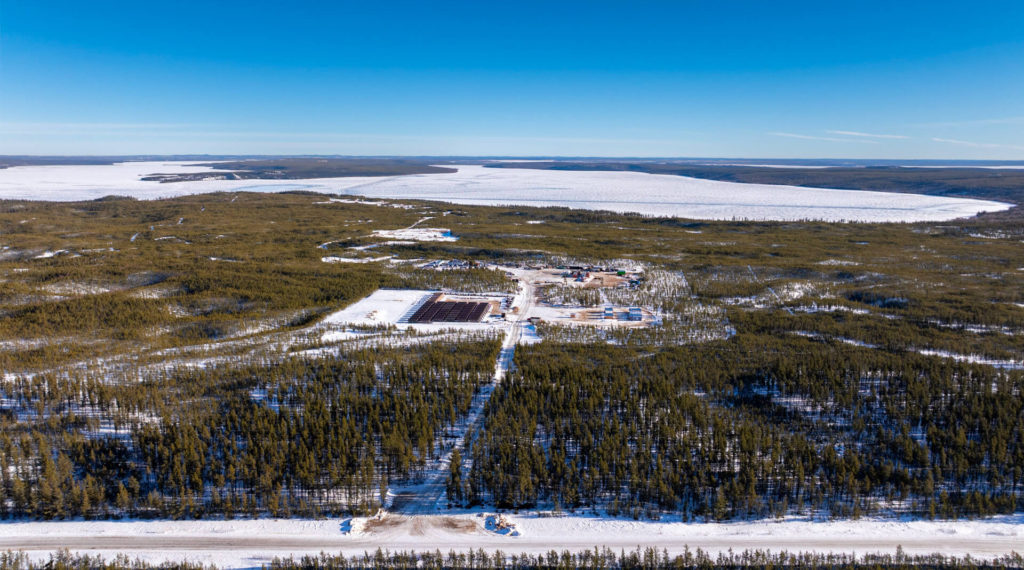
British Columbia’s KSM is the world’s largest undeveloped gold project by resources. Credit: Seabridge Gold

Seabridge Gold’s (TSX: SEA; NYSE: SA) push for permits to dig tunnels at its giant KSM project is being delayed by British Columbia until the miner’s court fight with neighbour Tudor Gold (TSXV: TUD) is resolved.

The twin tunnels are a core link in the $6.4 billion capex KSM project, carrying ore from mining in the Mitchell Valley to processing facilities in the Treaty Valley. Part of the route crosses Tudor claims and Seabridge already holds some permits. But the province won’t rule on the rest of them while Tudor challenges Seabridge in provincial court.

“We have always been clear that if Tudor has an approved and permitted mine plan for its Goldstorm project, then we are willing to sit down and find an amicable solution to the Mitchell Treaty tunnels (MTT) issue,” CEO Rudi Fronk said Friday in a news release. “However, agreeing to move the MTT route before Tudor has a defined project makes no sense.”

The delay comes after Seabridge’s KSM had cleared other major hurdles. These include the mid-2024 ‘substantially started’ designation from the BC government which cemented KSM’s Environmental Assessment Act permit for the life of the project; the narrowing of its search for a development partner to one company; and last month’s small victory in court when Tudor dropped one of its appeals.

Several fights

The details of the court fight concern whether Seabridge’s conditional mineral reserve for KSM, first granted in 2012, binds claims that predate it, and whether the province has authority to grant tunnel-related rights across them. The ministry has on several occasions confirmed in writing that the reserve applies to Tudor’s ground, Seabridge said.

Tudor has argued for months that the tunnel route, as planned, would cut through the Goldstorm deposit and the nearby Perfectstorm target on its Treaty Creek project. In October, it proposed a northern reroute that it said could let both projects advance. In December the company reiterated that negotiation with Seabridge and the province offered the best path, even as it said it was pressing ahead with court proceedings to preserve its rights.

“We continue to believe that negotiation is the best path forward to resolve the issues for the benefit of all parties,” president Joe Ovsenek wrote in an October newsletter to investors. “We are counting on the BC government to support the potential of Treaty Creek and not sacrifice it for the sake of KSM.”

Seabridge said it still has no plans to begin tunnel construction before it completes a final feasibility study and announces a project partner.

Tudor started compiling a preliminary economic assessment due by the third quarter for a 10,000-tonne-per-day underground mine at Goldstorm after updating the resource in January. Seabridge, meanwhile, said last month that securing a KSM partner is its top goal this year and updated KSM’s resources days later.

Seabridge’s Toronto-listed shares fell 4.3% on Friday-afternoon trades to C$42.89 per share, giving it a market capitalization of C$4.6 billion ($3.3 billion). Tudor shares were trading down 1% at C$0.99 by midday, giving it a market cap of C$404 million ($292 million).

Big resources

The size of the resources helps explain why neither side has backed down. Tudor’s January resource estimate outlined 912.3 million indicated tonnes grading 0.85 gram gold, 5.07 grams silver and 0.15% copper for 24.9 million oz. gold, 148.7 million oz. silver and 3.1 billion lb. copper.

Inferred resources add 86.1 million tonnes grading 1.43 grams gold, 5.22 grams silver and 0.17% copper for 4 million oz. gold, 18.6 million oz. silver and 327.7 million lb. copper.

Seabridge’s resource update last month showed higher metal price assumptions lifted measured and indicated resources by 6.8 million oz. gold and inferred resources by 12.9 million oz. without changing the underlying geology model. The project carries proven and probable reserves of 2.3 billion tonnes grading 0.64 gram gold, 0.14% copper and 2.2 grams silver for 47.3 million oz. gold, 7.3 billion lb. copper and 160 million oz. silver. The same study outlined a 33-year mine life and average yearly output of 1.03 million oz. gold and 178 million lb. copper.


$3 billion Canadian deal is fast-tracking gold production in Guyana


ByAnam Khan
Updated: April 09, 2026 


G Mining Venture’s $3 billion acquisition catapults itself to become a significant immediate gold producer with one of the highest current gold profiles, says the company’s CEO.

The company announced an agreement to acquire G2 Goldfields on Tuesday.

The deal will see both the Canadian companies combine their two adjacent projects in Guyana, G2’s Oko-Ghanie Project and GMIN’s Oko West Project into a large-scale, low cost mining hub.

The combined Tier-1 Oko Project is expected to yield over 500,000 ounces of gold per year, says Louis-Pierre Gignac, CEO of G Mining Venture.

“I think there’s tremendous value for all shareholders given the very important synergies that come about with this transaction,” he said.

The transaction will result in GMIN and G2 shareholders holding roughly 80.1 per cent and 19.9 per cent of the combined company.

It also includes a high premium of 72 per cent premium, which Gignac says is justified by the high asset value and clear operational synergies of the acquired deposits.

“That was a premium that we were prepared to pay, and one that generates significant accretion for our shareholder shoulders on a Net Asset Value (NAV) per share basis,” says Gignac.

$1 billion in saved costs

The deal was a long time coming, says Gignac, noting that the two properties are across the fence from each other.

“We see approximately $1 billion in synergies, with a mix of CapEx synergies over the life of the mine and operating cost synergies as well,” says Gignac.

The deal will also create a total resource of seven million ounces, which will extend the life of the Oka West mine to over 15 years.

Support from Guyanese government.

The company has strong support from the Guyanese government and is already fully permitted for its current operations, says Gignac.

He says because its new project is an extension of existing work, it can update its current environment assessment and permits rather than starting a new application process.

He also says the transaction consolidates land around the Oka West project into a 362-square-kilometer, land package,

“This becomes district scale, allows for a lot of upside opportunities for us from an exploration point of view,” says Gignac.

“We’re quite excited about the combination that this creates.”

The company plans to conduct infill drilling to support an updated feasibility study targeted for 2027. This study will define the expanded project scope, with construction slated for 2028 and the expansion becoming operational in 2029, says Gignac.

He says the company is fully self funded with a $350 million undrawn credit facility and $255 million in post-transaction net cash from its Tocantinzinho mine in Brazil.

Anam Khan

Anam Khan

Opens in new window

Journalist, BNNBloomberg.ca


Ghana awards Gold Fields’ Damang mine lease to local firm Engineers & Planners

Crushed ore stock pile at Damang Gold mine in Ghana. (Image courtesy of Gold Fields)

Ghana has selected local mining services company Engineers & Planners Ltd to take over Gold Fields’ Damang gold mine, the mines minister said on Tuesday.

Ghana, which is seeking to boost local ownership in its mining sector, ​rejected Johannesburg-based Gold Fields’ lease‑renewal bid and took control of the mine last year, breaking with years of automatic extensions.

It then began assessing local bids for a potential $1 billion revival of the asset.

In a statement, Emmanuel Armah‑Kofi Buah said mining regulator, the Minerals Commission, had recommended E&P as the successful bidder.

The company demonstrated it had access to $505 million in financing, meeting the government’s requirement that bidders show funding capacity of at least $500 million. It also scored strongly on technical experience, equipment, safety and local content, the statement said.

Gold Fields, which has operated Damang for more than two decades, initially said it may sell the mine, citing its limited remaining life and lack of economic reserves.

It said last month it was working to ensure the smooth transition of the mine to a new operator.

Authorities have said the tender aims to keep the mine operating, protect jobs and increase local participation in Ghana’s mining sector.

(By Christian Akorlie, Emmanuel Bruce and Maxwell Akalaare Adombila; Editing by Barbara Lewis)

BRICS+ nations hold over 17% of world’s gold reserves: Report


Stock image.

Global central banks have been buying up gold at a record pace, purchasing on average about 1,000 tonnes over the past four years, and the momentum has continued into 2026.

A large part of that can be attributed to emerging economies, led by BRICS+ nations, which have used bullion as a go-to strategy to shield themselves against geopolitical risks and US currency influence.

new report by EBC Financial Group estimates that the bloc now holds about 6,000 tonnes of the world’s gold reserves, or 17.4% of the global total, up from 11.2% in 2019. Russia leads the group with 2,336 tonnes, followed closely by China at 2,298 tonnes. The next largest holder is India at 880 tonnes.

Between 2020 and 2024, BRICS+ nations accounted for more than half of all gold bought by central banks globally, EBC said, highlighting what it views as a “structural shift” in their reserves strategy tracing back to Western sanctions against Russia in 2022, after which gold purchases doubled from about 500 tonnes to 1,000 tonnes.

Shift in reserve strategy

But, as the London-based financial group notes, the gold accumulation is only one side of the shift. The other is the declining share of the US dollar in global reserves. IMF data shows that dollar’s share fell from 71% in 1999 to roughly 57% by the end of 2025, its lowest reading since 1994.

Since 2014, central bank holdings of dollar-denominated assets have remained essentially flat, ECB noted.

Meanwhile, gold’s share of official reserve assets has more than doubled from below 10% in 2015 to over 23% today. Much of this reflects gold’s price appreciation, but it unmistakably highlights that central banks are allocating a growing share of their portfolios to gold, and the war in the Middle East only reinforced this urgency, the group said.

The report also cited the World Gold Council’s 2025 survey, which revealed that 73% of central bankers globally believe the dollar’s reserve share will decrease further over the next five years, and 43% of surveyed central banks plan to increase their gold holdings, both record-high readings.

On whether the gold-buying would accelerate, the ECB report highlighted several key developments that could be worth monitoring.

One is China, such as whether it would resume public reporting of gold reserve additions, which it has not done since May 2024. As of the end of March, the Chinese central bank has bought gold for 17 straight months.

Another potential driver is whether nations like Saudi Arabia or the UAE would follow the Russia-China playbook and increase their formal allocations of gold. Saudi Arabia, in particular, is considered as a wild card. A move to just 5% gold allocation would require purchases equivalent to the entire projected central bank demand for 2026 from a single buyer, ECB noted.

In addition, the group said to watch for further declines in the dollar’s reserve share in the next IMF COFER release, since each incremental drop reinforces the narrative driving sovereign gold demand.


MAX Power says discoveries could position Saskatchewan as natural hydrogen hub


Image: Max Power Mining

MAX Power Mining (CSE: MAXX) has announced a series of new milestones that it says could “significantly expand the scale and commercial potential” of its natural hydrogen portfolio situated in Saskatchewan, Canada.

The news is highlighted by the successful drilling of the Bracken Well, the completion of a high-resolution 3D seismic survey covering the Lawson discovery and a broad area surrounding the 15-19 discovery well, and the identification of a new Lawson “look-a-like” target just 12 km southwest of the original discovery based on a further review of legacy 2D seismic data.

In January, MAX Power identified a robust target for drill testing of a second natural hydrogen discovery in Saskatchewan. The company reported helium values as high as 8.7% and averaging 4.4% in core desorption tests from nine samples from a zone within the Cambrian Basal sands immediately above the natural hydrogen discovery in the Basement Complex.

These developments, it said, set the stage for a rapid acceleration of plans to establish Saskatchewan as the world’s birthplace of natural hydrogen commercialization, at a time when the world’s need for reliable, clean, affordable baseload energy has never been greater.

MAX Power said its Saskatchewan project benefits from a historic rise in the price of helium, which is often found in association with natural hydrogen, as demonstrated now at Bracken and earlier at Lawson.

The recently completed C$20.5 million raise would allow the company to target multiple new short-term milestones including a follow-up well at Lawson to validate potential commerciality, it said. Funds would also be used to support the completion and testing at Bracken, acquisition of new seismic data at Genesis, Grasslands and elsewhere, further evaluation of dozens of prospects.

In Saskatchewan, Bell Canada has proposed Canada’s largest data centre development within the industrial corridor that adjoins the 475-km Genesis Trend, adding a new potential demand dynamic for natural hydrogen and helium in the region.

By market close in Toronto, MAX Power Mining’s stock was down 6.8%. The Vancouver-based explorer has a market capitalization of C$155.67 million ($112.4 million).

Saskatchewan

Paladin targets 2027 uranium decision on Patterson Lake South

Fission Uranium’s Patterson Lake South project in Saskatchewan. (Image courtesy of Fission Uranium)

Australia’s Paladin Energy (ASX, TSX: PDN) expects making a final investment decision on its Patterson Lake South (PLS) uranium project in Saskatchewan by the end of 2027 as the company pushes the high-grade Triple R deposit through front-end engineering and design (FEED) and permitting.

PLS has become Paladin’s clearest shot at adding a second uranium mine and diversify production from the Langer Heinrich uranium mine in Namibia which is ramping up after years standing idle.

After securing provincial environmental approval for PLS in February, the Canadian Nuclear Safety Commission’s construction-licence process remains pending. Paladin said the FEED study is due later this year as drilling continues at Triple R and the nearby Saloon East trend.

“There’s been a lack of exploration over the last 10 years,” CEO Paul Hemburrow told The Northern Miner in an interview. “Mines are being depleted and so, the supply-demand gap is continuing to open up.”

With 438 nuclear power reactors operating globally and 79 under construction, advanced uranium projects in established jurisdictions are drawing renewed attention.

Paladin’s peers include NexGen Energy’s (TSX, NYSE: NXE; ASX: NXG) permitted Rook I project in the western Athabasca and Denison Mines’ (TSX: DML) construction-stage Phoenix project at Wheeler River, while African developers such as Global Atomic (TSX: GLO), Global Atomic (TSX: GLO), Deep Yellow (ASX: DYL) and Bannerman Energy (ASX: BMN) compete more broadly for the same uranium-cycle capital and contracting window.

Challenge

There is, however, a legal wrinkle. On March 31, Paladin disclosed that Métis Nation–Saskatchewan had applied for judicial review in the Saskatchewan Court of King’s Bench to challenge the Feb. 19 environmental approval, alleging inadequate consultation.

Paladin said it denies the claims and intends to defend its position.

Paladin, which bought Fission Uranium in Dec. 2024, has secured an exemption from Canada’s non-resident ownership policy for the project, signed mutual benefits agreements with the Buffalo River Dene Nation and Clearwater River Dene Nation and completed an engineering review, culminating in approval of the provincial environmental impact assessment now challenged.

Location, location

Paladin’s own benchmarking places PLS in the top rank of undeveloped uranium projects on grade and cost, and the project’s Athabasca location. Shallow geometry and exposure to market-related pricing also contribute to strong project economics.

“Not many advanced uranium projects of this size, grade and jurisdictional quality are close enough to permitting to matter now,” Hemburrow said.

Canada reviewing Paladin’s Fission takeover on national security grounds
Paladin Energy’s Patterson Lake South project in Saskatchewan. (Credit: Fission Uranium.)

What makes the western Athabasca matter is the Patterson Lake corridor: a structurally fertile belt where recent discoveries such as Triple R and Arrow showed that Saskatchewan can host shallow, basement-hosted, high-grade uranium deposits outside the basin’s traditional eastern stronghold.

PLS carries about 93.7 million lb. uranium oxide in probable reserves grading 1.41%, starting just 50 metres from surface, with average annual production targeted at 9.1 million lb. over an initial 10-year mine life.

A Jan. 2023 feasibility study puts the pre-production capital at $1.2 billion, life-of-mine operating cash cost at $11.7 per lb., all-in sustaining cost at $15.2 per lb. and first uranium in 2031.

Growing resource

Paladin is also trying to grow PLS beyond its initial 10-year mine life through drilling at Triple R and the broader project area.

Current work is focused on extending Triple R mineralization along trend, converting 25.1 million lb. U3O8 indicated resources and 10.9 million lb. of inferred resources into reserves and the mine plan, and following up on significant radioactivity intersected last year at the Saloon East zone.


Vale advances Oman maintenance shutdowns to counter war impacts

Brazilian iron ore exports hit the highest monthly volume in two years.
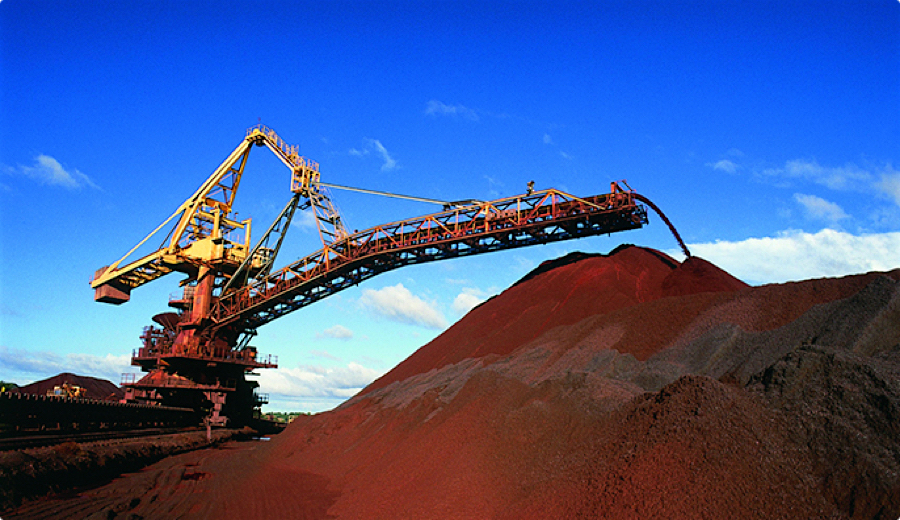
Vale’s Ponta da Madeira iron ore terminal in Brazil. (Image courtesy of Vale SA.)

Vale SA, the world’s top iron ore producer, has brought forward a scheduled maintenance shutdown of its two pellet plants in Oman as a strategy to mitigate potential impacts from the Iran war, according to a person familiar with the matter.

The shutdowns, initially planned for the first half of the year, have been brought forward by a few weeks, said the person who asked not to be identified discussing private matters. The person declined to provide specifics, including the length of time the plants would be offline.

Vale’s Oman operations have an annual production capacity of 9 million tons of iron ore pellets — roughly 29% of the company’s overall output last year.

The Brazilian company sells to clients in Gulf nations including Saudi Arabia, Qatar and the United Arab Emirates, though Iran’s blockade of the Strait of Hormuz is preventing deliveries, the person said. The plant closure plans help explain why ships carrying Vale’s Brazilian iron ore have been diverted from the Middle East.

Vale isn’t considering changing its full-year output guidance, the person said, with forecast pellet production at 30 million to 34 million tons this year.

A Vale spokesperson declined to comment.

(By Mariana Durao)

Africa to pilot bond aimed at formalizing artisanal mining

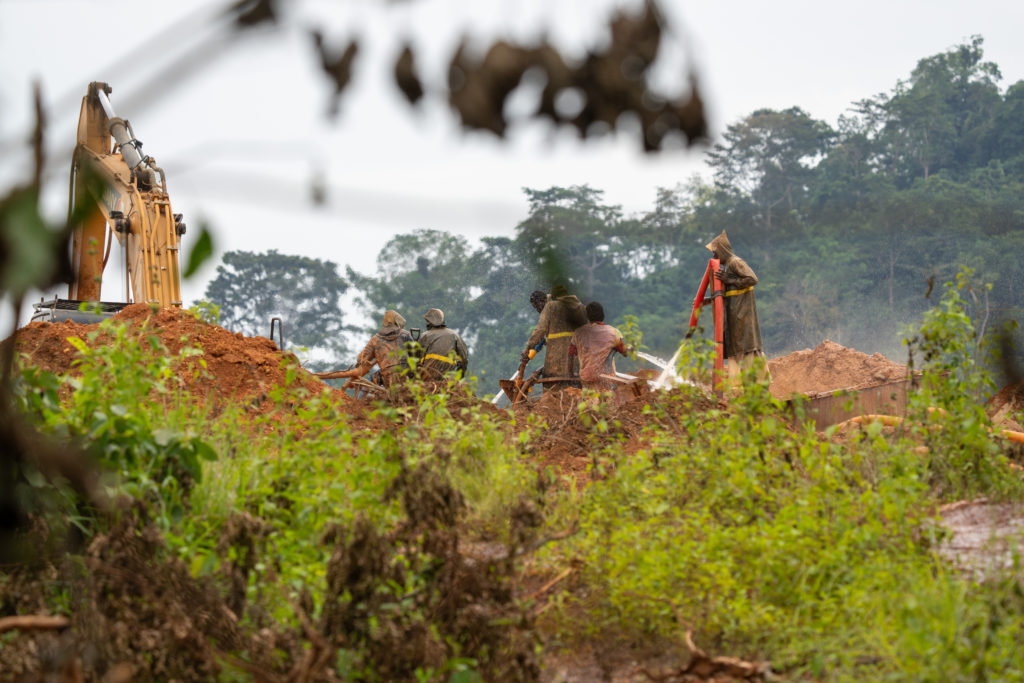
Close-up of an artisanal gold miner panning for gold in a stream in Atewa Forest. Stock image.

A sustainability bond aimed at integrating artisanal miners into formal supply chains will be piloted by a Canada-based advisory firm and a mid-tier Zambian copper miner this year, the firms said.

Artisanal mining provides livelihoods for hundreds of millions globally. In Africa, it often operates informally on or near company-run mines, hitting their profits, spreading pollution and depriving nations of revenue.

The proposed “stakeholder prosperity bond” developed by the advisory firm Veridicor with Zambia’s Metalex Commodities, aims to address that, said Rob Karpati, its finance director.

“Instead of pushing artisanal miners off land, this model professionalizes them,” he told Reuters.

The instrument links investor returns to predefined social and environmental outcomes for workers, communities and host economies rather than output.

The debut issuance would raise between $100 million and $200 million by year-end to help Metalex Commodities integrate artisanal and small-scale miners through regulated offtake agreements as well as shared infrastructure and equipment investment.

Potential investors

Potential investors include European sustainability bond funds, impact and mining investors, banks and wealthy individuals focused on sustainability, the firms said.

Zambia, Africa’s second-largest copper producer, hosts tens of thousands of artisanal miners, including around Metalex’s northwestern permit.

“Large mines tend to be the anchor of these [bonds] because it’s got to go on someone’s balance sheet,” said Karpati.

“They end up gaining financially because they get offtake from it, and the artisanal miners gain financially because it’s a fair price, not some predatory intermediate.”

Industrial mines would sit at the centre of each bond structure to support repayment, while sustainability-linked terms would adjust interest rates based on social and environmental performance, Karpati said.

Metalex founder and chief executive Ayo Sopitan said the bond would allow the company to run large programs integrating artisanal miners into its supply chain.

“We plan to source around 30% of our ore from trained, licensed local miners,” he said. “The bond lets us do that at a much larger scale than our balance sheet alone would allow.”

The bond is also planned in Democratic Republic of Congo and Ghana.

(By Maxwell Akalaare Adombila; Editing by Philippa Fletcher)


Mining executives accused of hijacking Brazil lithium claims


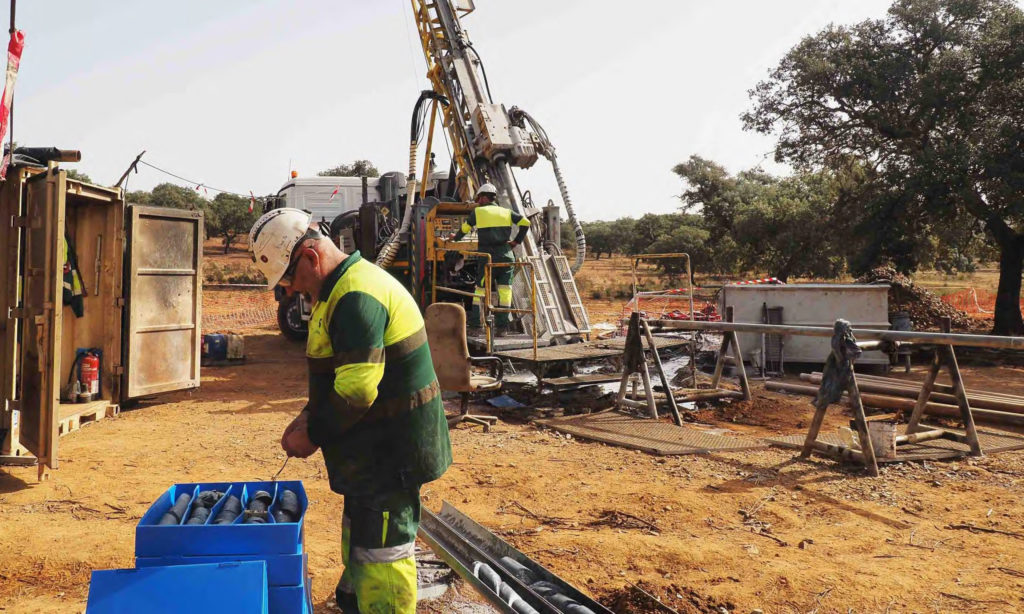
Drilling at Emerita Resources’ Iberian Belt West project in Spain. Credit: Emerita Resources.

Executives at Canadian minerals explorer Emerita Resources Corp. have been accused by Ontario’s securities regulator of diverting the firm’s lithium project rights to a new company they controlled.

The Ontario Securities Commission alleges the group established Lithium Ionic Corp. to pursue mining claims from Emerita’s Falcon project in Brazil, conduct that defrauded Emerita and its investors, according to a Friday statement from the regulator

Shares of Emerita fell as much as 38% in Toronto to their lowest level in nearly five years after the release, while Lithium Ionic plunged as much as 45%. Both Toronto-based companies are penny stocks, with market values below C$175 million ($126 million).

The regulator alleges Emerita chief executive officer David Gower, chairman Michael Lawrence Guy, chief financial officer Gregory Duras and corporate secretary Sergio Damian Lopez caused Emerita to say it had “relinquished” the Falcon project, which was misleading, while senior insiders were actually pursuing the project through Lithium Ionic.

Further, Gower and Hélio Diniz, a director with Lithium Ionic, misled the OSC during the investigation regarding the project, the regulator alleged.

The OSC’s allegations also encompass a high-grade zinc project in Spain called Plaza Norte.

The regulator claims that Gower, Lopez, Duras and Emerita president Joaquin Merino-Marquez approved untrue or misleading statements about Plaza Norte in public filings from 2017 to 2023. Those statements concerned Emerita’s permit status and ownership interest in the joint venture behind the development.

Emerita said in its own statement late Thursday that it has established a special committee to review and respond to the OSC allegations, which it describes as “unproven.”

“Plaza Norte and Falcon are legacy projects and are not related to the company’s current core business and operations,” Emerita said. “Both projects were previously assessed as having no relevance to the company’s go-forward strategy.”

Lithium Ion said it’s not a respondent in the “regulatory matter” outlined by the OSC, and that no orders have been sought against it, according to a statement on Friday. The company has established a special committee of independent directors to oversee “communications and disclosure” relating to the issue, it added.

The companies did not respond to separate emails requesting further comment on behalf of the individuals named.

A hearing is scheduled for May 8 in Toronto.

(By Sybilla Gross)


Chile uncovers criminal networks shipping millions of dollars of copper to Peru and China


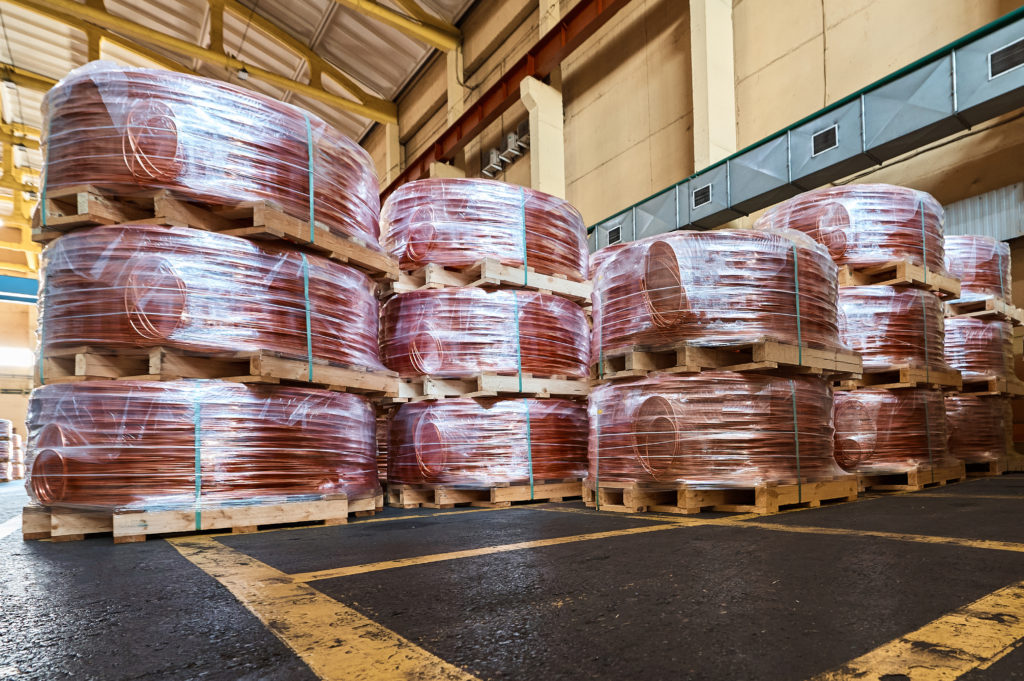
Rows of copper wire rod. Stock image.

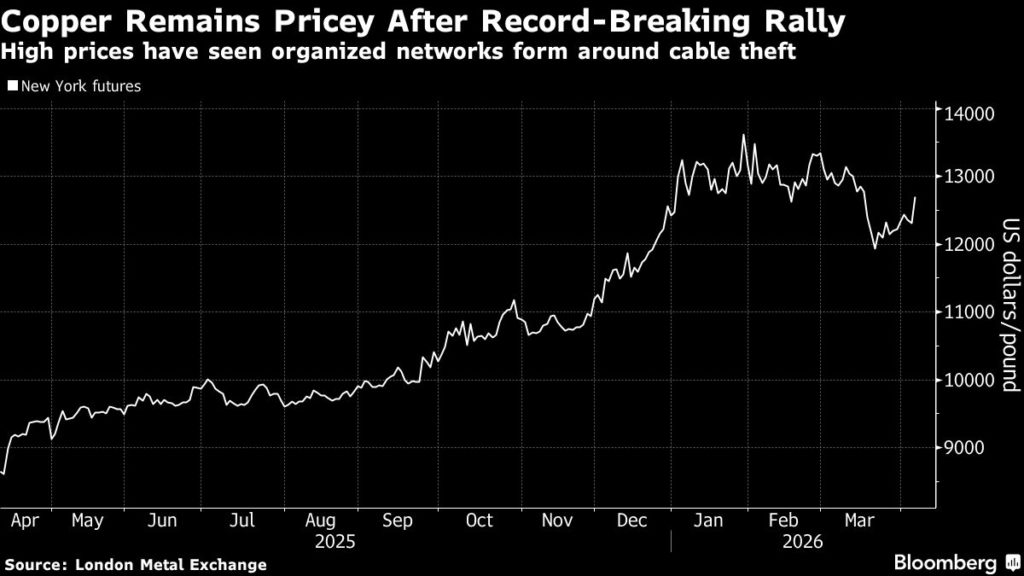
Chilean investigators have exposed how organized criminal groups steal, process and ship copper on a previously unreported scale as perpetrators seek to capitalize on high metal prices.

On Wednesday, authorities dismantled a network that had moved an estimated 817 billion pesos ($917 million) worth of copper between 2020 and 2025, first trucking the metal to the northern port of Iquique and then shipping it to China. Two weeks earlier, police seized cables, chips and cathodes from a storage site in the city of Arica which was set to be smuggled to Peru and then on to China.

The illicit organizations show both the profitability and sophistication of theft in a country that’s the world’s largest producer of copper. They also lay bare the scale of challenges facing the new administration of President José Antonio Kast, who has vowed to crack down on crime. His administration is considering stronger penalties to combat cable theft.

“This has been taken over by organized crime,” Energy Minister Ximena Rincón said in an interview. “We are reviewing whether the current legal framework is enough.”

Increasingly, thieves use heavy trucks to knock down power poles, strip cables and funnel copper into cross-border networks — a structured trade authorities say is driven by prices that hit record highs in January.

The method is blunt and effective: a truck plows into a row of power poles, bringing down entire sections of cable in minutes. The copper is quickly stripped, loaded and moved out — often before authorities can respond.

“It’s a very profitable business,” Rodrigo González, a prosecutor targeting organized crime in the northern border town of Arica, said in an interview, describing a pattern that has left communities without power and caused losses of as much as 60 million pesos in a single incident. “A few dozen meters can mean millions of pesos.”

In the most recent investigation, dubbed “Operation High Voltage,” police carried out coordinated raids on 49 properties across seven regions, leading to the arrest of 25 people, including alleged leaders and key operational members. Authorities seized 187 tons of copper, worth about $2.2 million at current prices.

The seven-month probe found that the organization relied on intermediaries that purchased copper from storage or aggregation sites, charged a commission and then sold it to exporters, said Santiago Bravo, an inspector with Chile’s Investigative Police and member of the copper task force. Each transfer helps obscure the origin, gradually eroding traceability, he said in an interview.

Organized crime

The thefts are no longer isolated acts. Authorities say they have identified organized groups with distinct roles: crews that steal cables, intermediaries who store and process the material and transporters who move it across borders.

The crimes have hit both public infrastructure and mining operations. In remote regions, attackers target electricity networks, temporarily cutting power to broad areas.

Once stolen, the copper is processed locally. Thieves burn or strip the plastic coating — often in informal sites — leaving behind bare metal that is harder to trace.

Some appears to be mixed with higher-grade metal linked to mining operations. Authorities have found melted copper plates and ingots — likely reprocessed to remove identifying marks such as serial numbers, González said.

So far this year, officials in one northern region have seized more than 10 tons of stolen copper, with estimates suggesting 30 to 50 tons annually could be moving through the area. The trade is facilitated by geography, with proximity to borders making overland transport relatively simple.

The scale of the problem has grown with copper prices. In response, authorities have begun centralizing investigations and using data analysis tools — including heat maps and pattern tracking — to identify hotspots and storage sites. Drones and other surveillance tools are also being deployed to monitor suspected areas.

Still, officials acknowledge the challenge of containing a trade that remains highly lucrative and relatively easy to replicate.

“It’s like car theft,” González said. “You dismantle one group, and another one appears.”

(By James Attwood and Antonia Mufarech)