Why the US hates Cuba
An assault on Cuba needs excuses for hating it. But given that any exchanges between the US and Cuba have been blocked out of the news for decades, it is a bit difficult for many to figure out why they are supposed to hate Cuba and starve its people. So, let us look through the eyes of those who promote an attack to find the real reasons.
Going back to Cuba’s 1959 revolution, we can see that it occurred during the Cold War anti-Communist hysteria of the McCarthy era, which permeated that time. Though the Cuban Revolution was (and continues to be) portrayed as a “Communist” revolution, it was not. When Fidel Castro visited New York in April 1959, he described it as a “humanist revolution,” which focused on land reform, literacy and the hostility of the Batista regime to granting those.
However, then vice-president Richard Nixon played no small part in converting Castro to communism. When Castro met him in New York, Nixon showed no interest in the social reforms Castro tried to explain. Being “gratuitously snubbed” by Nixon, Castro left convinced that Cuba would not receive any US support.
Defeat of the US and its proxy forces
Today’s hostility toward Cuba is part of a broader onslaught by the US against any country that fails to submit to its imperial power. The US has been outraged that it and its proxy forces have been defeated by popular movements. Three stand out.
The backbone of Cuba’s revolutionary alliance was the July 26 Movement, headed by Fidel and Raul Castro and Ernesto Che Guevara. It was only when the fanatically anti-Communist John and Bobby Kennedy gave the green light to the April 1961 Bay of Pigs invasion that Cuba first announced the revolution was “socialist.” That attack from Florida by Cuban counterrevolutionaries was soundly defeated by Cuban forces under Fidel Castro’s leadership.
The second victory of a popular movement was in Viet Nam in the 1960s and early 1970s. That US onslaught was defeated so badly that Nixon had to order the last troops to run out as fast as they could in 1973.
Guevara helped set the stage for the third defeat. Beginning in 1964, Guevara made multiple trips to get a first-hand look at African movements in Algeria, Ghana, the Congo, Guinea, Mali, Benin, Tanzania and Egypt. In April, 1974 Portugal dictator Marcello Caetano fell, unleashing a wave of popular movements in its former colonies. The greatest struggle occurred in Angola. Revolutionary forces were backed by Cuba; South African forces did the US’ dirty work.
Though not often recognised, Viet Nam became a spectacular win for Africa. The Viet Nam war and military draft were despised so much by US youth that not even southern racists could envision US ground troops in another war in Angola. Terrified that its youth would refuse to participate in a war to suppress Angola and defend apartheid, the US let South Africa do the fighting.
Suffering a tremendous defeat at the hands of Angolan/Cuban troops, South Africa withdrew in August 1988. South African society changed and elected Nelson Mandela to head the country in 1994. Cuba had been the critical actor in the victorious struggle. When South Africans opened Freedom Park in Pretoria in 2007, its Wall of Names recognised the more than 2000 Cubans who lost their lives in the Angolan war. Cuba is the only foreign country represented on the Wall.
The US was first defeated by Cuban forces, then by a Vietnamese peasant army and then again by Angolan/Cuban troops. The US military brass seethed at the thought of a people’s army defeating one with vastly more weapons and resources.
A special hatred of Blackness
It is hardly an accident that victimisation by US imperialism is against people of colour in whatever corner of the world they live. Yet there has always been a particular loathing of Black people, whether in Africa or slave descendants in the Americas.
The most extreme early hatred of the Cuban Revolution was from white southern aristocrats and politicians who went berserk at the spectacle of Black Cubans taking up arms against their oppressors. It was much like the vitriol of their wealthy ancestors who had glared at images of Toussaint Louverture leading slaves to victory over masters and muttered that they would destroy Haiti for that outrage.
Shortly after 1959, Black Cubans, especially those living in the most impoverished rural areas, glared back as they were the first generation taking their children to see doctors and saw clinics and hospitals being erected for them. At the same time, Black Cubans saw media portrayals of Black Americans in the South demanding the right to sit at lunch counters being beaten and bitten by dogs and police putting cattle prods to the breasts of Black women.
US rulers had long felt an affinity for South African apartheid. US President Donald Trump revealed this openly, when he announced that whites in that country deserved special immigration status due to supposed mistreatment at the hand of Blacks. It was not unlike France demanding money from Haiti for the financial “loss” of their slave property as the price for recognising the revolution.
What medical care has meant for the Cuban people
Another reason the rich and powerful hate Cuba is because it does so much better than the US in caring for its own people. Intentional efforts to destroy the Cuban medical system have occurred without documentation of any harm to any US citizen from the island nation.
The revolution continued to be very real for Cubans as thousands received land and learnt to read and write. Cuba greatly expanded non-toxic agriculture during the post-1991 embargo. But nowhere has Cuba exceeded more spectacularly than its medical revolution.
Soon after 1959 pharmaceutical production was nationalised, so people could afford medicines; clinics opened where there had been none; and a series of redesigns transformed the entire medical system.
Cuba greatly expanded medical education, admitting students who had previously been shut out. When students graduate from medical school they have no debts to repay, unlike in the US where debt forces graduates to search for high-paying jobs in the sickness industry.
Infant mortality rose for the first few years after the revolution. But as the new medical approach took hold it dropped, and by 1998 the infant mortality rate in Cuba was down to 7.1 per 1000 live births, dropping below the US, which stood at 7.6 per 1000 live births. Life expectancy (LE) also surpassed that in the US: by 2016, Cuba’s LE was 79.0 years, when it was 78.5 years in the US.
The Soviet Union collapsed in 1991, leaving Cuba without its best trading partner. During the extreme hardship of the “ Special Period” of the 1990s, Cuba’s economy shrank by 40-45%. Tightened sanctions from the US left Cuba with serious damage to its economy, including higher costs for drugs, such as those for treating HIV/AIDS. The Cuban Democracy Act of 1992 (also known as the Torricelli Act) and Helms-Burton Act of 1996 were designed to isolate and strangle Cuba by limiting its trade.
Cuba’s extensive medical research allowed it to have a rapid response to the HIV/AIDS crisis that arrived in the 1980s. The nation focused its resources on developing treatment, which was provided at no charge to everyone infected. At the same time that New York City (with a population similar to Cuba) had 43,000 deaths from AIDS, Cuba suffered 200 deaths.
Its research also prepared the island nation for COVID-19, even before its first fatality. Without a nationalised medical system, the US was woefully incompetent in responding to the epidemic. US LE dropped by 1.36 years for whites, 3.25 years for Hispanics, 3.88 years for Blacks, and an incredible 6.6 years for Native Americans. Meanwhile, Cuba had a slight increase in LE by 0.2 years. This difference was a testimony to the extreme racism which persists in the growth-oriented US.
Routine healthcare and crisis care for the world’s poor
Another reason the rich and powerful hate Cuba is the way it cares for people throughout the world. Both the US and Cuba have sought to influence other countries. But their techniques have been quite different.
The US seeks to prove that it is better at killing than any other nation. Cuba seeks to show the world’s poor that it can help them develop health care for all of their people at an affordable level. Both the US and Cuba both have been succeeding at their goals.
Shortly after its revolution, Cuba began sending doctors and nurses around the world. In 1963, Cuba’s first official medical brigade went to Algeria with 55 staff, including 29 doctors. Brigades soon expanded across the globe, especially in Africa and Latin America. By 2014, 135,000 Cuban medical staff had worked in 158 countries.
For countless people in many countries, the first time they saw a doctor it was either one from Cuba or one trained in Cuba. In fact, as of 2009, “almost 2 million people throughout the world owe their very lives to the availability of Cuban medical services.” By now the number of patients far exceeds 2 million.
A second form of Cuban medical internationalism has been responses to crises. Even before going to Algeria, during the year following its revolution, Cuba sent medical aid to Chile for earthquake assistance.
Just a few of the large number of Cuban crisis interventions include: an aggressive anti-malaria campaign in Africa in 2002-2004; medical teams going to Sri Lanka and Indonesia after the huge tsunami of December 2004; and 2000 personnel assisting Pakistan following a huge 2005 earthquake.
The 1986 Chernobyl nuclear meltdown resulted in 125,000 deaths and 150,000 being evacuated. In perhaps its largest undertaking, Cuba supported victims throughout its harsh “Special Period” — in March 1990 it took in a group of 25,000 patients, mostly children.
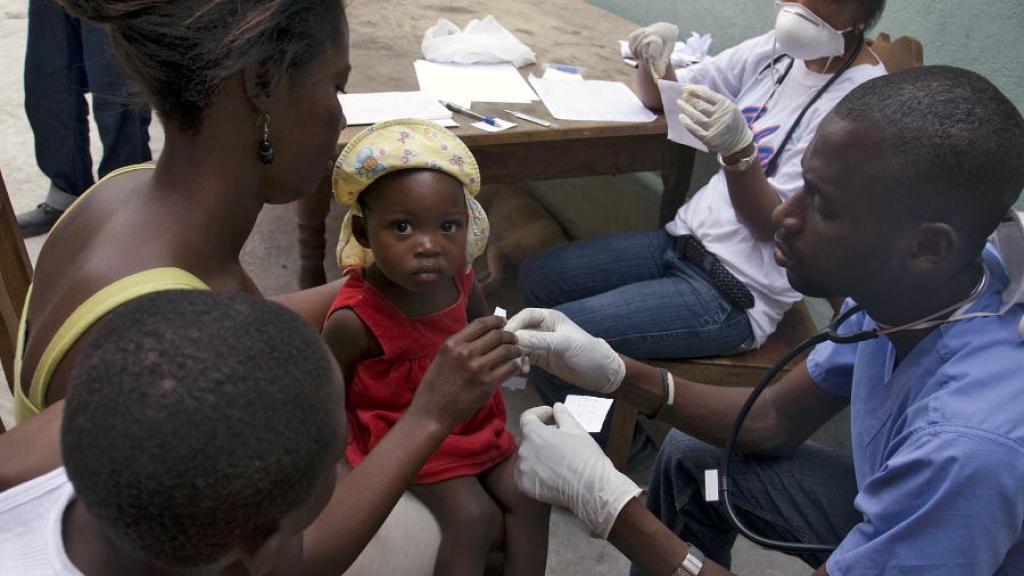
The 2010 earthquake in Haiti brought medical staff from both the US and Cuba. However, US physicians practiced “medical tourism” as they stayed in luxury hotels at night and did disaster relief during the day. In contrast, Cuban doctors had been in Haiti before the crisis, stayed after disaster recovery was completed, and, during the crisis, lived and slept in the same camps as earthquake victims, smelling the smells of non-sanitation and attending to the dying even at night.
As decades went by Cuba developed an internationalism that outshone the US by far. Cuba even sent doctors to aid richer countries, such as Italy during COVID-19, inspiring suggestions, such as that from Code Pink, that they should receive the 2021 Nobel Prize for their medical aid.
Of all countries needing help, only one refused assistance from Cuba. Following Hurricane Katrina in 2005, US president George W. Bush ignored Cuba’s offer to send 1500 medical staff to New Orleans.
Medical education and medicines for the world’s poor
The rich and powerful also hate Cuba due to its knowledge-based sharing. By the late 1990s the small island nation had often brought students from overseas to study to become doctors.
In October 1998 Hurricane Mitch wrought incredible destruction to Nicaragua, Guatemala, Belize and El Salvador. Mitch was a unique event because it sparked the creation of ELAM, the Escuela Latinoamericana de Medicina (Latin American School of Medicine). After the hurricane, Fidel Castro decided to bring students from other countries to Cuba to study medicine.
ELAM began in 1999 and sought to reverse the “brain drain” of medical student graduates leaving their homes in poor countries to earn far higher salaries in the rich world. After its 1964 independence, only 50 of 600 doctors trained in Zambia remained there. A student in Sierra Leone could earn 20 times more by practicing in South Africa than practicing at home.
At ELAM, students prepare to return as doctors in their own under-served communities. Cuban medical training focuses on public health and primary care to provide what the poor world needs most.
In January 2014, there were 11,000 students from 123 countries at ELAM. Three quarters of students accepted for ELAM come from worker or small farmer families.
ELAM students are integrated into 21 faculties and 444 polyclinics throughout Cuba’s 15 provinces. All have courses in traditional and natural medicine, which proves invaluable if they practice medicine in indigenous communities where shamans are often the trusted health providers.
When visiting my daughter at ELAM in 2009-2010, I spoke with students from Mexico, Honduras, Brazil, Peru, St. Lucia (in the Caribbean), Sierra Leone, Kenya, São Tomé and Príncipe (off the African coast) Lesotho, and Tuvalu.
I found that many students had arrangements with their governments to pay for their medical training. In exchange for having it paid for, they will work for several years (often five) at a public medical institution. Students from Latin America and Africa typically attend ELAM immediately after high school.
No student I spoke with ever raised the possibility of becoming wealthy by studying medicine in Cuba. Most of them would not have been able to go to medical school had it not been for ELAM. This indicates that the shortage of doctors in impoverished areas has nothing to do with a lack of young people willing to become doctors and working in those communities.
Cuban medicine has been critical to the world’s poor due to the way it makes drugs available. Though people in the US are highly unlikely to learn it from the corporate media, Cuba spreads medical assistance by providing drugs to the poor world at low cost.
Before the revolution, 70% of Cuba’s pharmaceutical industry was foreign-controlled and only 1000 of 4000 medications in use had therapeutic value. In 1961, the new government nationalised 35 warehouses and 370 pharmacies. By 1968, urban pharmacies had decreased by more than half, but rural pharmacies, where the poorest Cubans lived, had increased five-fold.
Cuba has produced new medicines and shared its knowledge about them in ways that empower rather than subdue poor countries. Use of Heberprot B to treat diabetes has reduced amputations by 80%. Cuban researchers have created an effective vaccine against type-B bacterial meningitis. Cuba developed the first synthetic vaccine for Haemophilus influenzae type B (Hib). Providing vaccines such as these has resulted in the immunisation of millions of Latin American children.
Collaboration with Brazil has resulted in meningitis vaccines at a cost of 95 cents rather than $15–$20 a dose. Cuba and Brazil are also working together on Interferon alpha 2b for hepatitis C and recombinant human erythropoietin (rHuEPO) for anaemia.
In contrast to this international medical solidarity, the US sickness industry has the compassion of a school of leering sharks about to begin a feeding frenzy. The US is one of many rich countries expanding the length of patent protection for pharmaceuticals, as happened with the Trans-Pacific Partnership in 2011. The result is increasing death tolls in the poor world because generic drugs cannot be sold at a vastly cheaper rate during the protection period.
Cuba stands as a significant barrier to the US pushing a high-cost, insurance based-sickness model that leaves out the poorest people in the rest of the world. US corporations do not smile at this.
Efforts to destroy Cuban medicine are an attack on the world’s poor
When Trump imposed the most vicious tariffs ever visited on Cuba in early 2026, racists were not-so-secretly grimacing with glee as they wondered if the US president could turn that nation into a second Haiti for the crime of resisting its would-be masters.
The US has effectively imposed a total fuel and financial blockade by threatening punitive tariffs on any country that supplies fuel to Cuba. The amount of food that must be imported has zoomed upward as fuel supplies have plummeted. This has cut services to primary schools and elderly care homes and wrecked transportation.
Sources of financing have been deeply slashed as international festivals are without fuel. Cuba’s most important source of foreign revenue, tourism, is all but destroyed. Probably the most vile aspect of the blockade has been sharp reductions forced on hospitals for medical supplies, regular care and emergency services.
For Cubans, this is their lives. For the US elite, it is little more than video game entertainment as they ponder if they can actually force Cuba’s collapse. A major factor threatening the US medical-insurance complex is that Cuban healthcare concepts have spread not only to poor countries but to many low-income US communities.
ELAM graduates do the best job of spreading its message. Kathryn Hall-Trujillo founded the Birthing Project USA (BPUSA) in 1998 as the first community-based birthing program for African-Americans in the US.
She explains that “It trains people to work with pregnant women and to connect with them during the first year of the life of the infant.” Hall-Trujillo is grateful for the BPUSA’s partnership with Cuba, saying: “We are a coming home place for ELAM students.” By 2019 BPUSA was replicated over 70 times in the US, Canada and Honduras.
Similarly, ELAM graduate Dr Melissa Barber looked at her South Bronx neighbourhood during COVID-19 and realised that though citizens were typically told to go to public health agencies, what people need is a community approach that recruits trained organisers to go to the people.
Dr Barber worked with tenant associations that identified those who are most vulnerable. The coalition went to homes to ensure that people did not fall through the cracks. As they concretised what is truly needed, BPUSA and the South Bronx communities have been in sharp contrast with big money in the US.
For most people who think rationally and with at least some human compassion, Cuba’s success in international health solidarity has been outstanding. But those who profit from medicine may be aghast when they see it. The Cuban model could well become a serious drain on investment opportunities in the sickness industry and its insurance accomplice.
Trump’s attack on Cuba is more than the fantasy of a demented mind. His actions are the culmination of US policy since 1959. From the very first days of vice-president Nixon and the Kennedy brothers, the US has sought to destroy the promises and accomplishments of the Cuban Revolution. This has nowhere been more clear than hostility toward its medicine.
It is not only the US that despises Cuban medicine. When many ELAM graduates return home they face hostility from medical associations who do not want their monopolisation of service-for-cash systems challenged. For example, when Dr Patrick Dely returned to Haiti in 2010, he heard the complaint that “I’m taking money directly from the established doctors.”
The US realised it could incorporate this tension into a plan to undermine Cuba’s international medical work. Under the “Cuban Medical Professional Parole,” in 2006 the George W. Bush administration announced it was encouraging Cuban medical staff on international missions to desert and move to the US.
Of roughly 40,000 employed medical staff, 500 accepted asylum, becoming some of the few US doctors with no student debt to pay. The “Parole” program reflects awareness that Cuba depends on income for medical services and student training. Trump’s actions in 2026 are an expansion of what Bush did 20 years earlier.
Cuban medical services bring in more income than tourism and nickel. Knowing that Cuba has trained roughly 60,000 Venezuelan physicians, the US seeks to economically paralyse the island by destroying the exchange of oil for medical training that exists between the two countries. The South African government pays Cuba $60,000 a student for each of the 1200 enrolled at ELAM.
Several Latin American countries have caved into US pressure and cancelled arrangements to pay Cuba for its medical services. These efforts to eliminate international medical solidarity result in an unknown increase in sickness and death.
In spite of never ending US attacks, Cuba has remained dedicated to the ideals of the revolution. There are strong interconnections that manifest hatred by the US elite for Cuba.
Where does hatred of liberation struggles give way to a special hatred of Blackness? When does ultra racism kneel before greed for profit? Or, when does monetary greed become secondary to idolising acts of oppression?
It is impossible to say because all are so woven into each other. That is the true nature of US hatred of Cuba. It is also why defence of Cuba must be core to efforts at fighting racism.
Don Fitz (fitzdon@aol.com) has taught Environmental Psychology at Washington University and is author of Cuban Health Care: The Ongoing Revolution. He is Outreach Coordinator for the Green Party of St. Louis and on the Editorial Board of Green Social Thought, where a version of this article first appeared.
Notes for reading the Cuban reality
Published in Spanish at Segunda Cita. Translation by Jackson Remple for LINKS International Journal of Socialist Renewal.
I believe that it is important to emphasise that, to understand Cuba objectively, it is necessary to set aside personal passions and prejudices, as well as simplistic interpretations that are almost always driven by a more or less conscious intention to promote political propaganda in favour of one’s own preconceived ideas or that express different ideological perspectives. This does not mean giving up hope of promoting the kind of society that one believes to be the best future scenario for the country.
Cuban society is suffering from an economic and social crisis whose most severe phase began in 2020. The country had previously experienced a difficult period in the 1990s. This was followed by a limited recovery during the first two decades of the 21st century. The crisis of the 1990s was produced by the combination of three fundamental factors: the collapse of the socialist bloc, the tightening of the US economic blockade, and the exhaustion of Cuba’s centralised and inefficient economic model whose obsolescence has continued to deepen over time.
Some reforms and sound economic policy measures were implemented during the second half of the 1990s. Along with a favourable shift in the international context, these made it possible for Cuba to emerge from the crisis and experience several years under better conditions. However, all of the causes that had produced the crisis remained latent. Why? Because the partial reforms did not alter the fundamental nature of the centrally planned, low-efficiency economic model.
The model’s flaws led to another major crisis that began in 2020. That crisis was also precipitated by the COVID-19 pandemic that struck the island. This new crisis has deepened year after year, from 2020 to 2026. Cuba’s Gross Domestic Product is now about 15 percentage points below what it was in 2019. High rates of inflation, a social crisis, and increased inequality have accompanied the economic crisis.
Since Donald Trump’s first administration, continuing through the mediocre Joe Biden administration and, above all, during Trump’s second term, US policy toward Cuba has been one of maximum pressure, reaching extremes such as Trump’s current blockade of oil shipments and his constant threats of military intervention. The goal of US policy has not changed. It aims to do everything possible to turn the current economic and social crisis in Cuba into a political crisis that undermines the stability of the Cuban government and the prevailing system on the island, in order to replace it with an executive power that is subservient to the policy of US domination of the Western Hemisphere, now reinvigorated under the so-called Donroe Doctrine.
Regardless of one’s various positions, sympathies or antipathies towards Cuba, its government and its system, if one wishes to be objective and not fall prey to the propaganda that often emerges from both sides, it is necessary to understand that the causes of the current crisis are manifold. They range from the extremely severe and criminal US blockade, in all its forms; the effects of the current international situation; and also, and no less importantly, the mistakes that have been made in the management of Cuba’s economy and the delay in implementing economic reform, the need for which has been evident for more than three decades now.
The current situation is multi-dimensional: it is not only an economic crisis, it is also a social and demographic crisis that features an aging population and a decline in skill levels, compared to earlier periods of strong growth in professional qualifications across a large segment of society. Space limitations do not allow me to provide a more detailed explanation of these different elements of the crisis.
I will conclude with a key point. The national crisis that Cuba is experiencing can only be resolved by implementing a comprehensive and far-reaching program of economic reforms that restores the country’s efficiency and productive capacity. This means transforming many aspects of the current system while we move toward a model in which markets play a much more active role, subject to the necessary regulations of a state that must guarantee social justice and the country’s sovereignty, while also promoting a new strategy for economic and democratic development.
The lifting of the blockade and a change in US policy could play an essential role in the process. However, that is beyond Cuba’s control. Solutions must be devised and implemented on an urgent basis despite this increased pressure, although the first priority is defending Cuba’s sovereignty.
Julio Carranza is a Cuban economist and a Tenured Professor at the University of Havana. Among his many professional activities he has served as Director of the Ecuador office of the United Nations Educational, Scientific and Cultural Organization (UNESCO) in Quito and as its regional representative for Bolivia, Colombia, Ecuador, and Venezuela.
“Breaking news: Members of Congress meet with ambassadors of other countries every day. That’s literally our right and responsibility,” said the congresswoman.
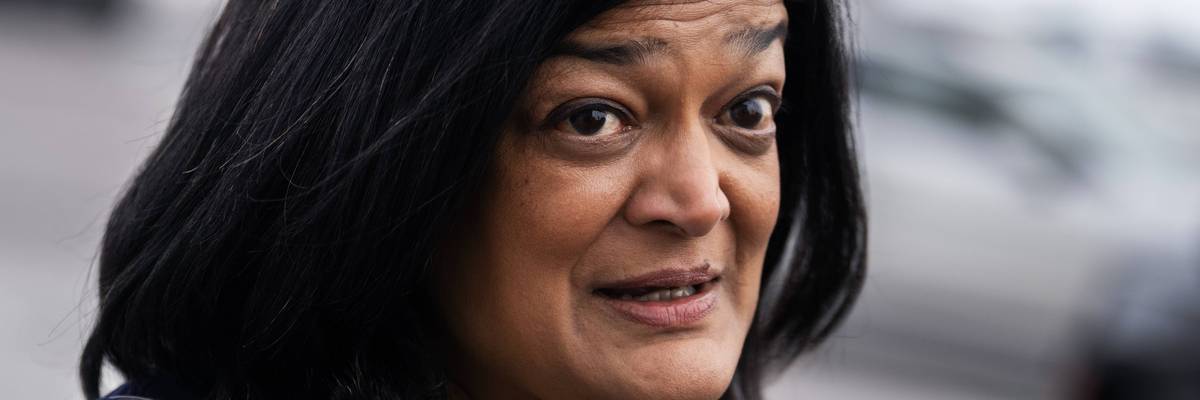
Rep. Pramila Jayapal (D-Wash.) talks with reporters outside the US Capitol after the House passed a spending package to end a partial government shutdown on February 3, 2026.
(Photo by Tom Williams/CQ-Roll Call, Inc. via Getty Images)
Julia Conley
May 07, 2026
COMMON DREAMS
Two days after US Secretary of State Marco Rubio asserted that “there’s no oil blockade on Cuba,” appearing to deny that President Donald Trump issued an executive order threatening countries with tariffs if they provide energy to the island, Republican members of Congress accused a progressive lawmaker of “treasonous behavior” for her efforts to alleviate the crisis unfolding in Cuba due to its US-caused fuel shortage.
Rep. Ashley Moody (R-Fla.) appeared on Fox News Thursday morning to suggest Jayapal (D-Wash.) violated the US Constitution by participating in talks with foreign ambassadors about efforts to send oil to Cuba.
“Treason is outlined right there in our Constitution, you can’t give aid or comfort to enemies,” said Moody. “This is astounding.”
Moody continued with what appeared to be a diatribe linking Jayapal to New York City Mayor Zohran Mamdani, who has frequently been accused by the GOP of being a “communist” and has unveiled a plan to open a network of city-run grocery stores to compete with corporations: “Look at what they’re espousing around the nation by cracking down on businesses, government-run businesses, pushing people out of these areas. Making people rely on government. That’s communism 101.”
She then accused Jayapal of “meeting with cartel members,” an apparent reference to the congresswoman’s comments at an event on Monday, when she said she had been “in conversations with the ambassadors from Mexico and some other places, and I know other countries in Latin America are trying to figure out how to get oil [to Cuba].”
Right-wing conspiracy theorist Laura Loomer, who is reportedly highly influential in President Donald Trump’s White House, also called for Jayapal’s arrest, prompting the lawmaker to issue a reminder of the regular duties of members of Congress.
“Breaking news: Members of Congress meet with ambassadors of other countries every day. That’s literally our right and responsibility,” said Jayapal.
The executive order Trump signed in January alleges that Cuba harbors terrorists and poses a threat to the security of the US, a claim that Cuban officials and experts have decried as baseless. The president has suggested he could take military action against Cuba numerous times, and last Friday he announced expanded sanctions impacting Cuba’s finance, energy, and security sectors, citing “national security threats posed by the communist Cuban regime.”
At the event on Monday, Jayapal noted that the White House itself has coordinated the arrival of a Russian oil tanker in Cuba after it began imposing the new policy.
“Since January, only one Russian tanker of oil has made it to Cuba,” said Jayapal. “In fact, it landed just a couple of days before I landed, and one tanker has enough oil basically for 10 to 14 days of Cuba’s oil needs—so it’s a very limited amount of time.”
Rep. Claudia Tenney (R-NY) also appeared on Fox News to accuse Jayapal of treason, while Rep. Clay Fuller (R-Ga.) said her discussions with the ambassador of Mexico—a close US ally—were “deeply un-American” and a “clear violation of the Logan Act,” which prohibits US citizens from taking party in negotiations with foreign governments that are in disputes with the US.
“By definition, you can only commit treason in regards to a country against which the United States has declared formal war (you know, that power the Constitution gave to Congress, not the President),” said Aaron Reichlin-Melnick, a senior fellow with the American Immigration Council.
Ryan Grim, co-founder of Drop Site News, recalled the comments of Rubio—the son of Cuban immigrants and a longtime proponent of regime change in the country—at his press conference Tuesday.
“Wait, Rubio said there is no blockade,” said Grim. “How can it be a problem to get oil to Cuba if there is no blockade?”
After the US president again threatened invasion, Cuban President Miguel Díaz-Canel Bermúdez said he would only “find a people determined to defend sovereignty and independence in every inch of the national territory.”
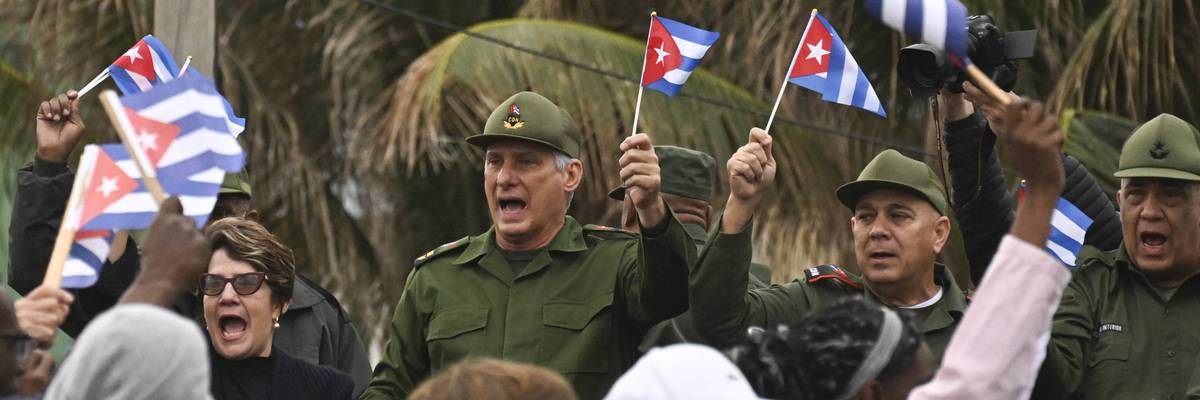
Cuba’s President Miguel Diaz-Canel (C) takes part in the “Anti-Imperialist” protest in front of the US Embassy against the US incursion in Venezuela, where 32 Cuban soldiers lost their lives, in Havana on January 16, 2026.
(Photo by Yamil Lage/ POOL / AFP via Getty Images)
May 02, 2026
COMMON DREAMS
President Miguel Díaz-Canel Bermúdez of Cuba on Saturday responded with stark and defiant words to the latest attacks coming from US President Donald Trump, who on Friday signed a new executive order authorizing even more aggressive sanctions against the island nation and later threatened to invade the country.
“The President of the United States escalates his threats of military aggression against Cuba to a dangerous and unprecedented scale,” said Díaz-Canel in a statement. “The international community must take note and, together with the people of the United States, determine whether such a drastic criminal act will be allowed to satisfy the interests of a small but wealthy and influential group, driven by desires for revenge and domination.”
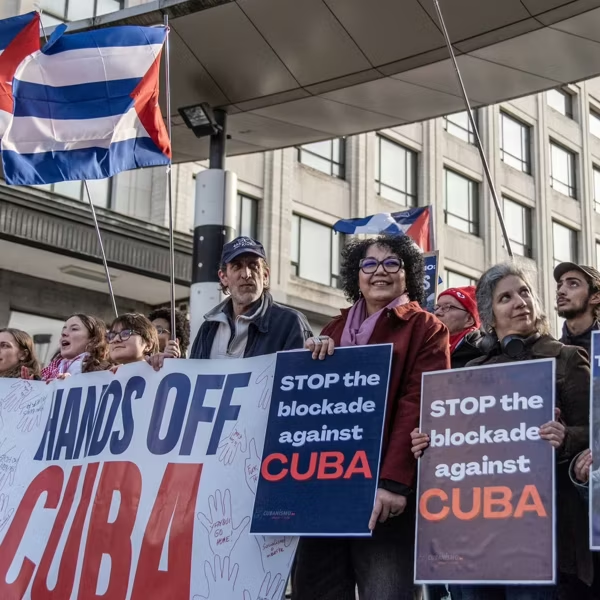
‘This Is Insane’: Alarm Bells Follow New Report of Looming US Plan to Attack Cuba
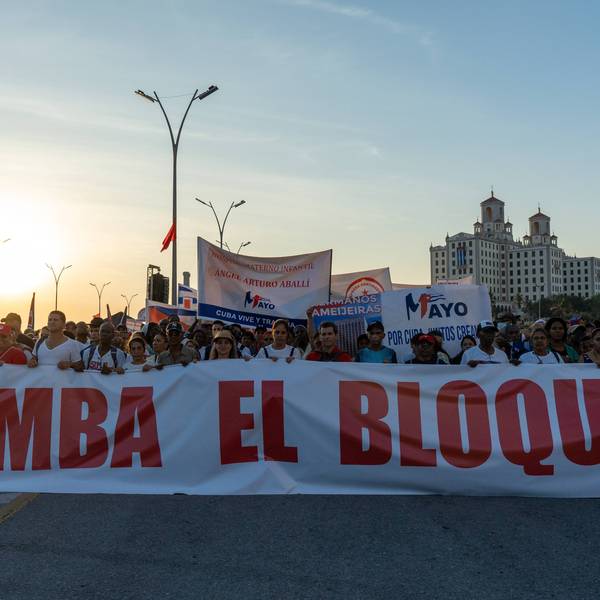
Citing Bogus ‘Threats’ to US, Trump Expands Already Devastating Sanctions on Cuba
“No aggressor, no matter how powerful, will find surrender in Cuba,” he added. If Trump were to attack the country, the Cuban president said, “he will find a people determined to defend sovereignty and independence in every inch of the national territory.”
“What does ‘No Kings’ mean when one man can snap his fingers and kill innocent Cubans on a whim?”
In addition “to blocking the US assets of foreign individuals and entities operating in Cuba’s energy, defense, financial services, metals, mining, and security sectors, as well as anyone acting on behalf of the Cuban government,” as Drop Site News notes, Friday’s executive order also “authorizes sanctions on foreign financial institutions that conduct significant transactions with designated Cuban entities, potentially cutting them off from US correspondent banking.”
As such, the outlet continued, the new sanctions “could further isolate Cuba from the international financial system, limit foreign investment, and exacerbate the island’s already severely restricted access to medicine, food imports, and basic goods.”
In addition to the signed executive order, Trump said during a Friday campaign-style event in Florida that the US “will be taking [Cuba] over almost immediately.”
Upon their return from Iran, where Trump has waged a deeply unpopular war, the US president told the crowd, “We’ll have maybe the USS Lincoln [aircraft carrier] come in offshore, and they’ll give up.”
In a floor speech earlier this week, Sen. Chris Van Hollen (D-Md.) rebuked the Trump administration for the humanitarian disaster it has unleashed in Cuba, which follows what he described as a “failed” policy towards the island country over decades.
“If we want to avoid war with Cuba,” said Van Hollen, “we must rein in this lawless president and learn from the failed, bipartisan policies that led us to this point.”
David Adler, the co-general coordinator of Progressive International, condemned the relative silence of US opponents to the Trump administration, who have not done, in his mind, nearly enough to challenge the blockade or condemn the administration’s repeated and ongoing threats to invade the island nation or overthrow its government.
“ Donald Trump has given [Secretary of State] Marco Rubio the green light to annihilate a peaceful nation and its people—and the ‘resistance’ is silent,” said Adler. “What does ‘No Kings’ mean when one man can snap his fingers and kill innocent Cubans on a whim?”



.jpg)