Friday, May 08, 2026

Plutonium Pit Bomb Production:  the Beginning of the End

 May 8, 2026

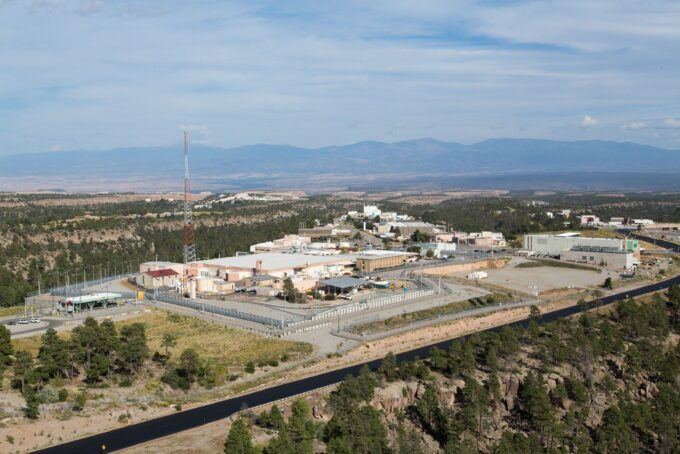
Plutonium facility at Los Alamos Labs. Photo: Department of Energy.

One portion of a gargantuan plan to modernize the entire U.S. nuclear arsenal, costing $1.5 trillion over the next twenty years, has been opened for public scrutiny and comment beginning this week.

Thanks to years-long legal challenges by environmental and community groups in California, New Mexico and South Carolina, the National Nuclear Security Administration, NNSA, was ordered by a federal district court to reveal plans for the manufacture of plutonium “pits” at the Savannah River Site (SRS) in South Carolina and Los Alamos National Laboratory in New Mexico. Citing the National Environmental Protection Act,1969, U.S. District Judge Mary Geiger Lewis, South Carolina, found that NNSA had ignored NEPA statutes, and required the Department of Energy, and its semi-autonomous nuclear weapons bureau, National Nuclear Security Administration, NNSA, to produce a Programmatic Environmental Impact Statement, PEIS, that details the manufacture, transport and waste deposition associated with plutonium pit production in Aiken, S.C. and Los Alamos, N.M.

Plutonium pits are the core of a thermonuclear weapon (hydrogen bomb). Tens of thousands of pits were manufactured during the Cold War. Pit production was concentrated almost entirely at Rocky Flats, Colorado, near Denver. The FBI raided Rocky Flats in 1989, after numerous fires, accidental plutonium releases, and whistleblower reports of dangerous working conditions at the plant. Rockwell International, the general Contractor at Rocky Flats, settled criminal charges of environmental violations for $18. 5 million (less than the bonuses it received from the government) and closed the plant in 1991. Rocky Flats was declared a Superfund site, and after costly remediation was converted into a national wildlife sanctuary. Some of the most polluted sections of Rocky Flats remain radioactive and will be sequestered forever. Communities near Rocky Flats received $375 million in compensation for increased incidents of cancer. The U.S. has manufactured very few plutonium pits since Rocky Flats closed.

Congress mandated renewed production of plutonium pits in 2015 with funding from the Defense Authorization Act. Lawmakers required the manufacture of 30 pits by this year (2026) and 80 pits per year by 2030, an entirely fanciful schedule. During the Cold War, Savannah River Site had produced plutonium but never pits, and Los Alamos National Laboratory (LANL), produces up to ten pits per year for research purposes, but has never produced pits approaching the Congressionally mandated 30 pits per year. Due to frequent accidents and safety violations, LANL has in some years produced zero pits.

NNSA’s Programmatic Environmental Impact Statement describes the intricate sequence for producing new pits for new nuclear weapons. Existing plutonium pits, around 12,000 plutonium pits, are stored at the Pantex facility in Amarillo, TX, and will be driven in specialized semi-trucks across the country on public highways to LANL and SRS. Once secured at these facilities, any oxidized impurities from aging will be removed using hot sulfuric acid and other agents. The pits are then melted, molded into spheres and machined to extremely precise dimensions. Large volumes of transuranic wastes are produced in the pit production process. Tons of transuranic wastes will be transported over public highways to the Waste Isolation Pilot Plant in Carlsbad, N.M. Radioactive waste from SRS will pass through Atlanta and follow I-20 and I-10 to the WIPP facility.

WIPP is the only facility designed to accept and store transuranic waste from nuclear weapons production. However, the New Mexico Environment Department only permitted WIPP to accept “legacy” transuranic waste from LANL, originating from the first Manhattan Project, 1942-45. NMED has not yet agreed to permit increased volumes of waste at WIPP. Plutonium waste could be stored on site at Los Alamos and Savannah River, though this would generate an entirely new set of environmental problems.

Mandated by the Defense Authorization Act of 2015, NNSA is required to produce 30 plutonium pits by this year, and 80 pits per year by 2030. SRS, slated to fabricate 50 pits per year, has never made a plutonium pit. New buildings to house the pit production in South Carolina “repurposed” a defunct mixed oxide plant. The MOX plant was designed to downblend plutonium pits from nuclear weapons decommissioned per the agreement between the U.S. and Russia to reduce their nearly 100 tons of surplus weapons-grade plutonium. While the Russians constructed and operated their MOX plant, the MOX plant at Savannah River experienced massive cost overruns and decades of delays. Putin suspended the agreement in 2016, blaming non-compliance on the part of the U.S.

The abandoned MOX plant at Savannah River 32 years behind schedule and $10 billion over budget, is 70% complete. Its conversion to the Savannah River Plutonium Pit Facility is already years behind schedule and billions of dollars over budget. Scheduled to open this year, it now is slated to make its first pit in 2035. Savannah River Site remains one of the most polluted places in the U.S. and is near the top of the EPA’s hazardous sites.

Robert Oppenheimer selected Los Alamos for the design and construction of the first fission atomic bombs dropped on Hiroshima and Nagasaki. In the decade since, LANL’s research and development of plutonium pits has created thousands of massive transuranic waste dumps on site. Plutonium has leaked into groundwater and has crossed canyons, contaminating native communities like the adjacent San Ildefonso and more distant pueblos. Plutonium is one of the most carcinogenic materials on Earth and has a half-life of 27,000 years.

LANL has never produced 30 pits per year, as mandated by Congress. Between 2007 and 2011, LANL produced 31 pits in total. Selected for its isolation and inaccessibility, LANL has chronic difficulties recruiting and retaining workers. LANL has experienced serious fires and accidents, and has been fined $16 million by the New Mexico Environment Department for neglecting the “legacy” wastes stored on site.

Whether the plutonium pit production, costing tens of billions of dollars, is even necessary, though required by Congressional statute, is contentious. NNSA’s own studies indicate that the thousands of pits stored at Pantex are viable for at least another 100 years. One study by Lawrence Livermore National Laboratory found the pits in the strategic security stockpile would be reliable for 150 years. Other classified studies about the dependability of existing plutonium pits could demonstrate the same result, and should be released.

The new plutonium pits proposed in NNSA’s Environmental Impact Statement are designed for entirely new thermonuclear weapons. The W87-1 warhead will arm the new Sentinel missile system, replacing the aging fleet of Minuteman III intercontinental missiles. The Sentinel program is years behind schedule and hundreds of billions of dollars over budget. Cost estimates for the 50 years of Sentinel deployment are over $300 billion.

Ironically, while the NEPA plutonium pit program is being presented to the public this week, the Eleventh Review of the Non-Proliferation Treaty (NPT) is ongoing at the United Nations in New York. The NPT was first ratified by 192 countries in 1970, including the U.S. The NPT is the only remaining international nuclear treaty. It calls for the right for countries to peacefully develop nuclear power reactors, and stipulates that nuclear-armed states are obligated to reduce and eventually eliminate their nuclear weapons arsenals.

NNSA’s Draft PEIS describes new plutonium pit production to be “consistent with the NPT while maintaining nuclear weapons competencies and capabilities at the weapons laboratories.”(p.1-6). The glaring dichotomy if this determination is refuted by the International Court of Justice, finding in 1996 that signatories to the NPT must adhere to

The legal import of [the NPT Article VI] obligation… goes beyond that of a mere obligation of conduct; the obligation involved here is an obligation to achieve a precise result – nuclear disarmament in all its aspects – by adopting a particular course of conduct, namely, the pursuit of negotiations on the matter in good faith.” [Para. 99]

NNSA violated the NEPA requirements to address the environmental damage of federally funded projects. The public now has an opportunity to submit comments to the NNSA until July. In particular, the plutonium pit fabrication for new nuclear weapons contravenes the Non-Proliferation Treaty despite what the draft PEIS asserts, per the decision by the ICJ.

Submit comment by email to  NEPA-SRS@srs.gov

Romania and Hungary’s Recent Elections: the Rinse and Repeat Alternating Electoral Wins of Liberalism and Nationalism 


 May 8, 2026

Photograph Source: © European Union, 1998 – 2026

Romania was late to politics which saw parties representing the left and right unite against liberals. But unite they did this week, in what the founder of Russia’s former “National Bolsheviks,” Alexander Dugin, presciently described in 2008 as movements “against the center.” Dugin predicted these left/right alliances would crush liberalism. Instead, they mostly acted performatively to knock off liberals while nationalists opportunistically seized state power to chiefly benefit themselves in new clientelist clans, rather than acting as transformative agents for advancing any national interest. The result was to just replace one set of elites (usually anchored to global interests) with another set of elites (typically anchored at the national level).

Meanwhile, two weeks prior, neighboring Hungary saw populist-right Viktor Orban replaced by his former understudy Péter Magyar and his Tisza center-right party, promising the return of Hungary to the pro-EU camp. But, the 2026 parliamentary elections were the first in post-communist Hungary where left parties failed to garner the minimum vote necessary for legislative representation.

European electorates have increasingly proved fickle in the 21st century, and more so since the 2008 financial crash. Electorates no longer are anchored to parties as they were in the previous century, where parties in power often implemented party programs and represented real class interests, at least they did before the European Union and the victory of neoliberalism under the EU’s Maastricht Treaty of 1992. Whether inside or out of the eurozone, neoliberal globalizing forces have transferred ever more power to banks and created infrastructures for capital flight from “uncooperative” states, making real change difficult.

This is all to say that much of Central and Eastern Europe lacks much of a genuine democratic left force in politics. The last popular democratic threat was Greece’s Syriza, which, 11 years ago, under their Finance Minister, Yanis Varoufakis, challenged, if not threatened, the European Central Bank’s (ECB) power over national economies. When Syriza’s Prime Minister surrendered to the ECB, the European left was mostly killed off thereafter as electorates saw them unwilling to truly confront austerity. Thus, the political terrain has chiefly been dominated by political liberals and rightists, with the latter often being oligarchs cosplaying nationalists, or at least funding them from behind the curtain in the Emerald City of the Wizard of Oz.

Following the global 2008 financial crisis, Viktor Orban won power in 2010 in Hungary then suffering under the economic crisis. Orban might not have lasted 16 years in power if it were not for his gerrymandering of Hungary’s parliament and taking control of their judiciary. But make no mistake, Fidesz and its program of anti-immigration and taxing foreign capital once was popular.

Only a year ago, Romania soundly defeated the nationalist George Simion. Simion had to be called in as a substitute for the right-wing Călin Georgescu who was banned from running due to some trifling sums funding his social media campaign that likely was of Russian provenance. To be direct, he was really banned because he voiced Kremlin-friendly policies and had solid prospects for winning. Georgescu repackaged old superstitions as New Age hokum and combined this with policy privileging the nation over the state (EU as superstate). Simion by contrast, was a political novice coming from football ultras. That alone didn’t defeat the upstart Simion. He needed Romania’s Hungarian minority vote, but part of Simion’s youthful hooliganism consisted of kicking over Hungarian gravestones, thus blunting any sales pitch directed at Hungarians. By contrast, his liberal opponent, an all-around nice guy, math whiz and European-friendly relatable to urban educated youth, NicuÈ™or Dan, sailed to an easy victory.

What to do in power? Romania became the EU’s tiger economy over the past decade. But Dan’s election coincided with Romania hitting the proverbial “middle-income trap” as it hit the ceiling of its development model. With public debt mounting, Romania’s liberal government imposed budget cuts (austerity) in hopes of restoring macro-economic fundamentals. The effect was to turn off the money spigot off to the many clientelist centers of power in government. These areas were represented by the Social Democrats, largely the inheritors of state institutions under communism. This clientelist “left” and then united with the nationalist political right to move “against the (liberal) center” of Romania’s government.

Thus, outside of tiny Kosovo, no left-wing party has risen to rule in Europe today, as the legacy of Syriza’s surrender to the ECB in 2015 remains. What has, however, operated since 2008 have been alternating cycles of nationalist clientelist parties that win office until electorates tire of them. At such points, liberals assume power again, until the limits of neoliberal economics reveal it can’t sustain socio-economic health. The cycle then repeats with nationalists again taking power, or as in the case of Romania, with the old sclerotic left clientist parties uniting with the nationalist right “against the center.” The question remains how long this cycle of alternating rinse and repeat takeovers of power, and failure to deliver, can continue, until a genuinely democratic movement, or truly extreme right-wing party, captures power? Sadly, unless the former can prevail before the latter, we are likely to eventually find out.

Jeffrey Sommers is a visiting professor at Babes-Bolyai University’s Center for Political Economy and professor of political economy and public policy at the University of Wisconsin-Milwaukee.

Cosmin Marian is a professor and department chair of the Center for Political Economy at Babes-Bolyai University, and a research affiliate at Central European University.

The other 8 May, 1945: a mass colonial massacre in Algeria

Friday 8 May 2026, by Fabrice Riceputi


While VE (Victory in Europe) is celebrated on 8 May, a huge massacre began on that day in 1945 in Algeria. Fabrice Riceputi, historian and author of several books, looks back at the events which occurred 81 years ago. [1]

In 1942, the Anglo-American landings in North Africa reignited nationalism in Algeria. As early as 1944, a mass movement unified all its factions: the AML (Friends of the Manifesto and of Liberty, a reference to the Manifesto of the Algerian people demanding independence).

But the European minority refused any challenge to the colonial order. The authorities feared revolts and prepared for them. On 25 April, 1945, the deportation to Brazzaville of Messali Hadj, leader of the main militant force, the Algerian People’s Party (PPA), “set the stage for the fire” according to the historian and FLN (National Liberation Front) member Mohamed Harbi.

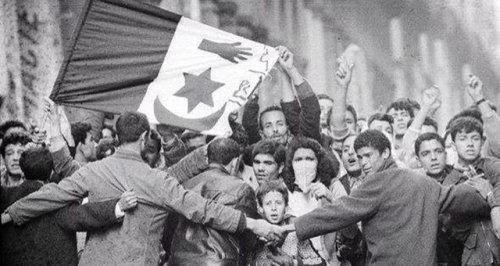
On 1 May, 1945, the PPA (Party of the Algerian People) and the AML (Military Liberation Army) organized separate marches throughout Algeria, distinct from those of the PCF (French Communist Party) and the CGT (General Confederation of Labour), with the slogans “Free Messali” and “Independent Algeria.” The Algerian flag, strictly forbidden, was displayed for the first time. In Algiers and Oran, the police opened fire and killed demonstrators. Numerous AML and PPA activists were arrested.

The celebrations on 8 May were the next opportunity for nationalists to make their voices heard. They took place in all Algerian cities without major violence, except in the North Constantine region.

Two large areas near Constantine were affected, one around Sétif to the west and the other Guelma to the east. The events, participants, and timelines are different, but the extreme brutality of the repression is the same.

As during the conquest of the country after 1830, and during all subsequent Algerian revolts, France practiced “pacification” through terror, based on the principle of the collective responsibility of the “natives.”

In Sétif

In Sétif, the “capital” of Algerian nationalism, the “muslim” procession had been carefully prepared by the AML and the PPA: it followed the parade of European women, with the strict instruction that it be peaceful. Searches were carried out to ensure compliance. The slogans were the same as on 1 May and the Algerian flag had to be waved.

The procession set off from the mosque at 8:30 am in an impressive order: 200 Muslim scouts at the head, followed by a wreath and Allied flags for laying at the war memorial, then 6,000 to 7,000 people. The Algerian flag was waved by a young man. At the entrance to the European district, the procession was stopped at 9:15 am by the police who demanded the removal of the banners and the flag.

A 26-year-old man, Bouzid Saâl, seized the fallen flag and was shot dead by Commissioner Olivieri. Gunfire from police officers, as well as from balconies in the European district, caused panic and killed about twenty Algerians. The demonstrators retreated towards the market, where many people from the countryside had gathered.

This sparked an explosion of anger and accumulated hatred against European settlers, 21 of whom were killed. In the countryside, a full-blown insurrection then broke out, spreading as far as Petite Kabylie and particularly Kherrata: roadblocks, sabotage, attacks on the farms of French settlers, and the murder of some European women.

The number of insurgents is estimated at 40,000. In total, the insurrection, which lasted until May 12, resulted in 90 European deaths in the Sétif region.

The repression

There was a full military operation against mostly unarmed civilians, conducted almost exclusively by the army, under the command of General Duval and on the orders of De Gaulle. On 11 May, the head of government sent a laconic telegram: “Please take all necessary measures to repress all anti-French activities by a minority of agitators.” A communiqué from the Governor General, dated 10 May stated from Algiers that “disturbing elements, inspired by Hitler, launched an armed attack in Sétif against the population celebrating the capitulation of Nazi Germany. The police, aided by the army, are maintaining order, and the authorities are taking all necessary steps to ensure security and suppress any attempts at disorder.”

2,000 soldiers “pacified” the region through terror. Armoured cars mowed indiscriminately. The air force, called in from Morocco and Tunisia, strafed and bombed. Forty-one tons of bombs were dropped on the rebel villages. The guns of the cruiser Duguay-Trouin fired eleven times at the coast. The artillery fired 858 shells. Corpses were left on the roads. In Kherrata, hundreds of bodies were thrown into gorges. European militias joined in the killings in several areas of the region until 24 May.

In Guelma

In Guelma, the AML and PPA were very active. On 8 May, their march began at 5:00 pm, unaware of what was happening in Sétif. Approximately 1,500 Algerians marched, mostly youth from the city and countryside who had come to the souk, with the same organization as in Sétif. Five hundred meters from the war memorial where it was supposed to end, the procession was stopped by Sub-Prefect Achiary, a former Vichy police commissioner and torturer, now a Gaullist. Following a scuffle, police gunfire caused one death. The demonstration ended at 6:00 pm. Here, there was no deadly riot like in Sétif, and no European casualties. However, the repression was extremely violent.

A curfew was imposed, and roundups began in the city. These operations were carried out in Guelma by a European militia trained and armed by Achiary, with the police and gendarmerie as auxiliaries. There were nearly 800 Europeans, representing all political opinions and professions. A so-called “Military Tribunal” carried out mass executions. From 9 May to 26 June, 13% of the city’s male population was killed. Eighty percent of these deaths were based on their political affiliation: the Muslim Scouts, the AML (Association of Muslim Students), or the CGT (General Confederation of Labour). To prevent any investigation, mass graves were dug, and 600 bodies burned in the lime kilns of a settler in Heliopolis.

Around Guelma, from May 9 onwards, air raids provoked an insurrection in the countryside that lasted until 11 May. The army then proceeded with what it called the “cleansing” of the mountains where tribes had taken refuge, as in the Sétif region.

How many Algerians died?

Only the number of “European” deaths is known with certainty: 102. As in all colonial massacres, the number of “native” victims remains impossible to establish precisely. Concealing or destroying the bodies of the colonized was easy. Furthermore, the tribes that had been bombed did not report their dead to the French authorities. The latter admitted to 1,165 “Muslim” deaths. The range accepted by many historians is between 15,000 and 30,000 deaths.

In France, the colonial dimension of the events is, of course, denied. An insurrectionary “plot” of “Hitlerist” persuasion was invented by the government led by De Gaulle to justify the repression, including in the French Communist Party press.

Spectacular ceremonies of collective humiliation were then organized. The assembled tribes had to publicly atone for their guilt, ask for forgiveness, and swear loyalty to France.

A point of no return

Historian Mohamed Harbi wrote that “the Algerian War began in Sétif.” Many Algerians understood then that their liberation from colonialism could only be achieved through armed struggle. General Duval, who commanded the repression, told the French government: “I have given you peace for ten years.” It was only nine years later that the FLN began the Algerian War of Independence.

Translated by Anti*Capitalist Resistance from l’Anticapitaliste.

Footnotes

[1Photo: Setif 8 May 1945.