Friday, May 08, 2026

Timothy Snyder’s Imperialist Anti-Trumpism and the Notion of Russian-Inflicted “Superpower Suicide”


 May 8, 2026

The esteemed liberal bourgeois and Russophobic historian and “Council on Foreign Relations (CFR) democracy expert” Timothy Snyder’s anti-Trumpism/anti-fascism is the anti-fascism of his fellow Democratic Party capitalist-imperialists, not the anti-fascism of decent people who want to live in a world beyond exploitation and oppression.

“Superpower Suicide”

“I’ve been thinking about how best to characterize what the United States is doing to itself on the scale of the world,” said Snyder on his Substack two weeks ago, “and I think ‘superpower suicide’ is probably the best term.” (Snyder said the same thing to his CFR comrades the day before.)

Snyder means “what the United States is doing to itself” under Trump, including the following, by his analysis:

* Privileging the enrichment of the president and his cronies building a cult around that president over sustaining the institutions of a coherent imperial state.

* Undermining proper succession in the imperial elite by calling into question past and future elections.

* Lacking a coherent imperialist ideology to justify and guide the nation’s reigning imperial position in the world.

* Failing to defeat adversaries: “Over the course of the past year,” Snyder says, “Trump has declared and quickly lost a trade war with China, then a war with Iran, and a consequence of both has been the enrichment of Russia.”

* “Shred[ding] essential alliances” (a reference primarily to Trump’s tangling with NATO).

* Attacking science and education by decimating US K-12 and university systems.

* Surrendering green energy leadership and development and thus “the future” to the Chinese.

Tears for (Supposedly) Declining US Power? Really?

Did Snyder, a longtime, often dead-on domestic political critic of Donald Trump, really mean to make an advertisement for Trump? Of course not, but that’s how many might interpret his thoughts on “superpower suicide.” That’s because for much of humanity, the US committing “superpower suicide” would be a welcome development. Dr. Martin Luther’s King’s 1967 identification of the United States as “the greatest purveyor of violence in the world today” has stood the test of time. In his book Endless Holocausts: Mass Death in the History of the United States Empire, the political scientist David Michael Smith calculates that the US has been responsible or shared responsibility for the death of 54 million people between 1945 and 2020. Add in domestic social killing and move the date back to the founding of the American Empire in 1776 [1] and the body count climbs to 300 million.

In his 2013 book America’s Deadliest Export, William Blum reported that the United States after World War II: worked to overthrow more than 50 foreign governments; interfered in elections held by 30 sovereign nations; tried to assassinate more than 50 foreign leaders; bombed more than 30 nations; and tried to suppress nationalist, leftist, and populist movements in at least 20 nations. (These numbers need to be updated for the last three years of the Obama administration and for the Trump and Biden presidencies to include, among other things, US funding and protection of Israel’s 2023-20?? genocide in Gaza, Trump’s boat strikes in the Caribbean and Pacific, Trump’s kidnapping of Venezuela’s sovereign elected president, and Trump’s reckless and failing fiasco of a war on Iran.)

The United States is the only country to have attacked human beings (unnecessarily) with nuclear weapons (twice) and has brought the world remarkably close to nuclear annihilation on multiple occasions. It is also now the clear leader in the global march to societal collapse if not human extinction via climate collapse, ecocide (broadly understood), nuclear proliferation, pandemicide, and artificial intelligence.

The Trump fascist regime (not Snyder’s language even if he occasionally refers to Trump as a fascist) is terrible and should be removed from power as soon as humanly possible (more on this below), but, in light of all this terrible and ongoing US imperialism, how upset does Snyder expect decent and informed people to get about Trump (supposedly) leading US “superpower suicide”?

It’s difficult to determine precisely how far the United States’ superpower status has declined under Trump or the extent to which this decline is self-inflicted (“suicidal”) as opposed to a consequence of objective historical-material and structural changes in the world capitalist and imperial system (changes happening independent of who sits atop the US government). But it clear that the United States is still very much and will remain (minus a long overdue North American peoples’ revolution) for some time a rapacious global superpower with the capacity to annihilate millions if not billions of people and to cook and poison the planet beyond repair.

Because Russia

Another question arises: why on Earth would the United States commit “superpower suicide” (if that’s what actually happening)? It seems like an absurd thing for “us” (as Snyder refers to the US-American Empire) to do. The resolution of this seeming contradiction is that, like Hillary Clinton, like the late Madeline Albright, (author of a book released during Trump45 titled Fascism: A Warning) and like others in the (neo-)liberal imperialist elite, Snyder mistakenly thinks (or deceptively claims) that Trump is an agent of one of “our adversaries,” Russia. Snyder believes (or purports to believe) that Putin exercises seemingly supernatural power over the US Empire (others give Israel this power), like Rasputin’s influence over the Romanov dynasty before the Russian Revolution.[2]

A Homegrown and Systemically Rooted Menace to Humanity

Wrong. Trump is a homegrown product of American capitalism, imperialism, racism, sexism, and nativism.[3] Trump represents not so much “superpower suicide” as the rise of a fascist section of the American ruling class that is responding to the limits of their competitive capitalist-imperialist system, including the rise of a new economic and potential military superpower (China), by shredding previously normative bourgeois-democratic rules and norms both at home and abroad. The problem with the Trump regime is not that it is committing “superpower suicide.” It’s that the underlying system of capitalism-imperialism has brought a fascist regime that represents a grave existential danger to humanity to power atop the most lethal global power in history a – a regime that urgently requires removal before it’s too late to sustain prospects for a decent future. This regime must be opposed and removed out of concern for humanity and life itself, not because it may be eroding the global power of an imperialist, mass-murderous Goliath that has never exhibited any such concern.

Notes

+1. One theme that emerges strongly from Ken Burns’ recent PBS series on the American Revolution is that the North American colonists’ move for independence from the British Empire was driven largely by their lust for a continental empire of their own. The United State of America was born imperialist.

+2. Here it is worth noting that Snyder’s main historical work Bloodlands; Europe Between Stalin and Hitler largely blames the rise of the German Third Reich on big bad Soviet Russia, Hitler on Stalin, resurrecting a previous right-wing German historical narrative. See Daniel Lazare’s properly critical review of that volume, titled “Timothy Snyder’s Lies.”

+3. For more on this topic, including a beginning bibliography, see Paul Street, “Timothy Snyder Needs to Study Some American History,” The Paul Street Report, May 4, 2026.

Paul Street’s latest book is This Happened Here: Amerikaners, Neoliberals, and the Trumping of America (London: Routledge, 2022).

Blind Eyes at the United Nations While the U.S. Bombs for Nonproliferation


 May 8, 2026

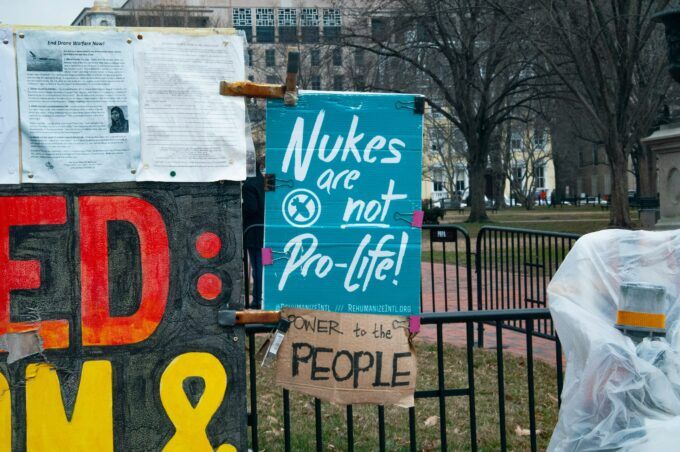
Image by Maria Oswalt.

There is deadly irony in the juxtaposition of Trump’s ‘anti-nuclear war’ on Iran, and the ongoing United Nations Review Conference for the Nuclear Non-proliferation Treaty, or NPT RevCon.

The decision to initiate a war of aggression against Iran killing thousands of civilians was made (among other public pretexts) in order to prevent Iran’s allegedly intended future construction of a nuclear weapon.

The 1970 NPT prohibits the development of nuclear weapons or the transfer of nuclear weapons among or between nations that ratify the treaty. The NPT has slowed the spread of such weapons, while pushing the spread of nuclear reactors. The U.S., Iran, and 187 other UN member states are parties to the NPT.

Iran’s civil nuclear program is lawful under NPT rules, and its representatives are here in New York attending the RevCon which runs until May 22. Still, one after another UN member representative used their ‘general debate’ time to attack Iran for its processing of uranium and Russia for its invasion of Ukraine, but not the United States for its unprovoked, internationally illegal war on Iran.

No friend or military ally of the United States except Israel was consulted or informed about the U.S.’s February 28 Middle East blitzkrieg — with plenty of reason. Trump’s war of distraction would never have been supported much less joined by U.S. allies because: 1) Iran’s nuclear facilities were “totally obliterated” in June 2025 by U.S. Air Force and Navy bombardments; and 2) the International Atomic Energy Agency — the UN body that oversees compliance with the NPT — has reported since 2025 that it has found no evidence of an ongoing Iranian nuclear weapons program.

The catastrophically ill-advised and criminal U.S. war on Iran had to be launched by surprise, without NATO, or UN or U.S. authorization, because the White House’s justifications were so easily debunked, and because the NPT is already working to stop the spread of nuclear arsenals.

During the first days of the NPT RevCon, member states spoke with a shocking and confounding display of double standards, with one after another condemning Russia’s invasion of Ukraine, and Iran’s alleged violations of NPT inspection rules, but not one criticizing the U.S. attack on Iran, its January 3rd bombing of Venezuela, or its June 2025 bombardment of Iran’s nuclear facilities. Argentina for example said, “This Review Conference is taking place against a backdrop that we cannot ignore …. the nuclear program of the Islamic Republic of Iran…,” while the Nordic States together singled out Russia, saying its “war of aggression against Ukraine is a blatant violation of international law, including the United Nations Charter….” The U.S. war on Iran was evidently aggression non grata.

The nuclear weapons states’ 56-year-long violation of the NPT’s Article VI — requiring good-faith efforts to eliminate nuclear weapons — was often bemoaned, but the U.S., U.K., Russian, Chinese, and French violators were never called out by name. (North Korea, India, Israel, and Pakistan have nuclear weapons but have not joined the NPT.) Likewise, open, ongoing U.S. violations of the Treaty’s Articles I and II — which forbid the U.S. transfer of nuclear weapons to non-nuclear States Parties including Germany, Italy, Holland, and Belgium — were ignored, while the European Union’s delegate said, “The EU condemns in the strongest possible way Russia’s … announced deployment of nuclear weapons in the territory of Belarus.”

Comically, a few ministers openly excused the U.S.’s Article I & II violations — its stationing of B61 thermonuclear gravity bombs at six air bases in Europe — as when the representative of the Nordic States, asserted that “NATO’s nuclear sharing arrangements are fully consistent with the NPT”. The 110-member Non-Aligned States Parties Group politely pushed back and condemned the practice, noting without naming names, “The Group reiterates its deep concern over … practices that run contrary to the principles and objectives of the Treaty such as … nuclear weapons sharing arrangements”.

The most brazenly selective and myopic presentation to date was the “Joint Statement on Russia’s Aggression Against Ukraine” signed by 43 NPT States Parties. The paper said, “Russia’s war of aggression against Ukraine is a blatant violation of international law, including the UN Charter….” Every use of the word ‘Russia’ in the text could have been replaced with ‘the U.S.’ and still made perfect sense. The letter endorsed Ukraine’s but not Iran’s “independence, sovereignty, and territorial integrity”; Ukraine’s but not Iran’s “inherent right to self-defense” in accordance with the UN Charter “against Russia’s”, but not the United States’ “ongoing illegal war of aggression.” The paper acknowledged the critical danger of attacking nuclear sites and condemned Russia, but not the U.S., both of whom continue to put “nuclear facilities at risk.” The group did manage to generally denounce “indiscriminate attacks that have resulted in civilian deaths and destruction of critical infrastructure….” Yet, the 43 states urged the General Assembly “to condemn Russia’s irresponsible nuclear rhetoric”, but not Trump’s mindless threat to bomb Iran “back to the Stone Ages” or his genocidal outburst that “a whole civilization will die tonight, never to be brought back again.”

For UN member states to ignore U.S. government violations of the UN Charter and the Laws of War is evidence of not just hypocrisy and double standards, but a submissiveness reminiscent of the groveling fear of state terrors of 1930s. More than just Spain’s PM Pedro Sánchez and Pope Leo XIV the have to stand up to the megalomaniacal madman of the hour. ### [905 words]

John LaForge is a Co-director of Nukewatch, a peace and environmental justice group in Wisconsin, and edits its newsletter.

Medical Teams Still Struggling to Treat Gaza Malnutrition Crisis ‘Entirely Manufactured’ by Israel

“Every six months, we might get a food parcel once. It’s barely enough,” said one mother. “We are forced to eat whatever is in front of us.”


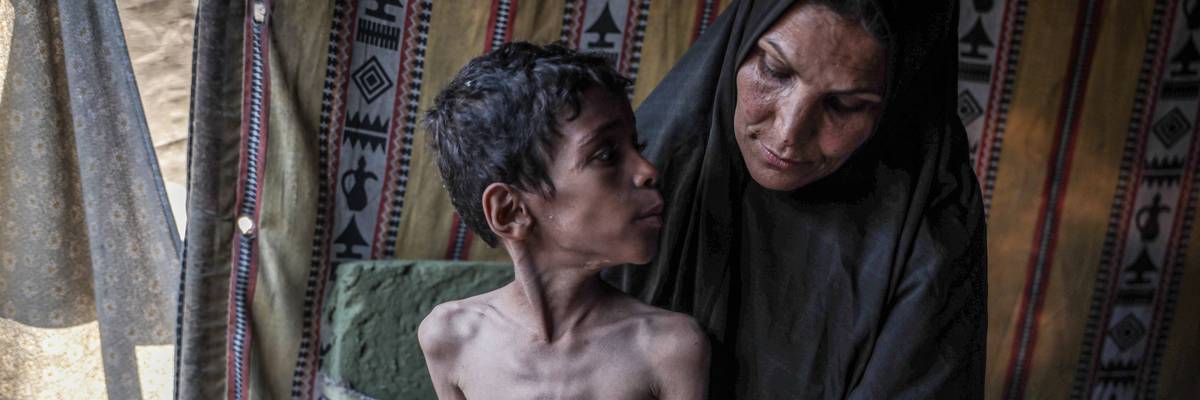
Ten-year-old Palestinian Mohammed Ahmed Masoud al-Susi struggles with malnutrition due to Israel’s attacks on the Gaza Strip and restrictions on aid entry, in Gaza City on April 30, 2026.
(Photo by Abdalhkem Abu Riash/Anadolu via Getty Images)

Julia Conley
May 07, 2026

A ceasefire was declared between Israel and Hamas seven months ago, but just as the deal has not stopped the killing of hundreds of Palestinians in Gaza, it has failed to alleviate the acute malnutrition crisis that was created when Israel began blocking almost all humanitarian aid in October 2023.

The international aid group Doctors Without Borders, also known by its French name, Médecins Sans Frontières (MSF), on Wednesday accused Israel of imposing a “manufactured malnutrition crisis” that is proving particularly devastating for pregnant and breastfeeding women, newborns, and infants

At four clinics operated by MSF in Gaza between late 2024 and early 2026, medical teams found higher levels of miscarriage among mothers who experienced malnutrition.

The group also analyzed data on 201 mothers of newborns who required treatment in neonatal intensive care units at Nasser Hospital in Khan Younis and Al-Helou Hospital in Gaza City between June 2025 and this past January. More than half of the mothers had been affected by malnutrition at some point in their pregnancy.

Ninety percent of the babies had been born prematurely and 84% had low birth weight.


“Neonatal mortality was twice as high among infants born to mothers affected by malnutrition compared to those born to mothers without malnutrition,” said MSF.

Samar Abu Mustafa, a displaced mother from Abasan al-Kabira, said she was diagnosed with malnutrition while pregnant with her 3-month-old baby.

“I don’t know how I will provide diapers and milk, nor how I will provide food for my other daughters. There is no income and no support,” said Abu Mustafa. “There is nothing apart from food parcels from the World Food Program and community kitchens. Every six months, we might get a food parcel once. It’s barely enough. It is all rice and lentils. We are forced to eat whatever is in front of us.”

“For a long time, we haven’t eaten anything nutritious and the baby does not get enough milk from me, so I am forced to provide formula, but I don’t have money for it,” she said. “I have just one remaining can of milk.”

Mercè Rocaspana, MSF’s medical referent for emergencies, emphasized that malnutrition in the exclave was “almost nonexistent” before Israel began bombarding Gaza and blocking humanitarian aid—an action Israeli and US officials persistently claimed Israel was not taking before the ceasefire was reached, even as the number of deaths from starvation climbed to nearly 500.

“The malnutrition crisis is entirely manufactured,” said Rocaspana. “For two and a half years, the systematic blockade of humanitarian aid and commercial goods, on top of insecurity, have severely restricted access to food and clean water. Healthcare facilities have been forced out of service and living conditions have profoundly deteriorated. As a result, vulnerable groups of people are at heightened risk of malnutrition.”

Before the war, there were no dedicated therapeutic medical feeding units in Gaza’s hospitals, but MSF teams admitted more than 500 infants under six months of age to outpatient feeding programs between October 2024-December 2025—programs that the bombardment has made impossible for many families to complete.

“Of those admitted, 91% were at risk of poor growth and development. By December, 200 infants were no longer in the program—only 48% of them were cured, while 7% died, another 7% were referred to a program for older children, and a staggering 32% defaulted due in part to insecurity and displacement.”

The 20-point ceasefire agreement stipulated that at least 600 aid trucks must enter Gaza daily and that border crossings must be reopened, but as Common Dreams reported in April, five leading aid groups gave “humanitarian aid access” a failing grade in a scorecard rating conditions in Gaza six months after the deal was reached.

Israel was still restricting deliveries, and food items sold in Gaza were anywhere from 3% to 233% more expensive than they were before the war started.

Al Jazeera’s Hind Khoury reported Thursday that only 150 aid trucks are being allowed in daily.

Last week, the United Nations Office for the Coordination of Humanitarian Affairs said that while there’s been a 72% increase in the amount of humanitarian aid reaching Palestinians in Gaza since the ceasefire was brokered, 11% of coordinated humanitarian missions are still being denied.

“Many lives have been saved in Gaza because of scaled up humanitarian effort since the ceasefire. But much more to do: We need to sustain access, protection of civilians, neutrality, and partnership,” said Tom Fletcher, UN under-secretary general for humanitarian affairs.


Sahar Nafez Salem, who lives with her children in a tent in Khan Younis, told MSF that her family has been relying on a charity kitchen to eat.

“We eat lunch from it and save some for dinner,” she said. “We try to manage getting lunch for our poor children every Friday, so we can bring them joy, but all week long, almost everything is from charity kitchens... The last time I received aid was during Ramadan... There is rice and lentils... Other things, like vegetables, are expensive. We can’t get them all the time. So sometimes we go without vegetables for months.”
NAKBA II

West Bank Faces Economic Crisis as Israel Withholds Tax Revenue and Work Permits

Israel is choking off financial prospects in the West Bank, pushing Palestinians there toward a breaking point.
May 7, 2026

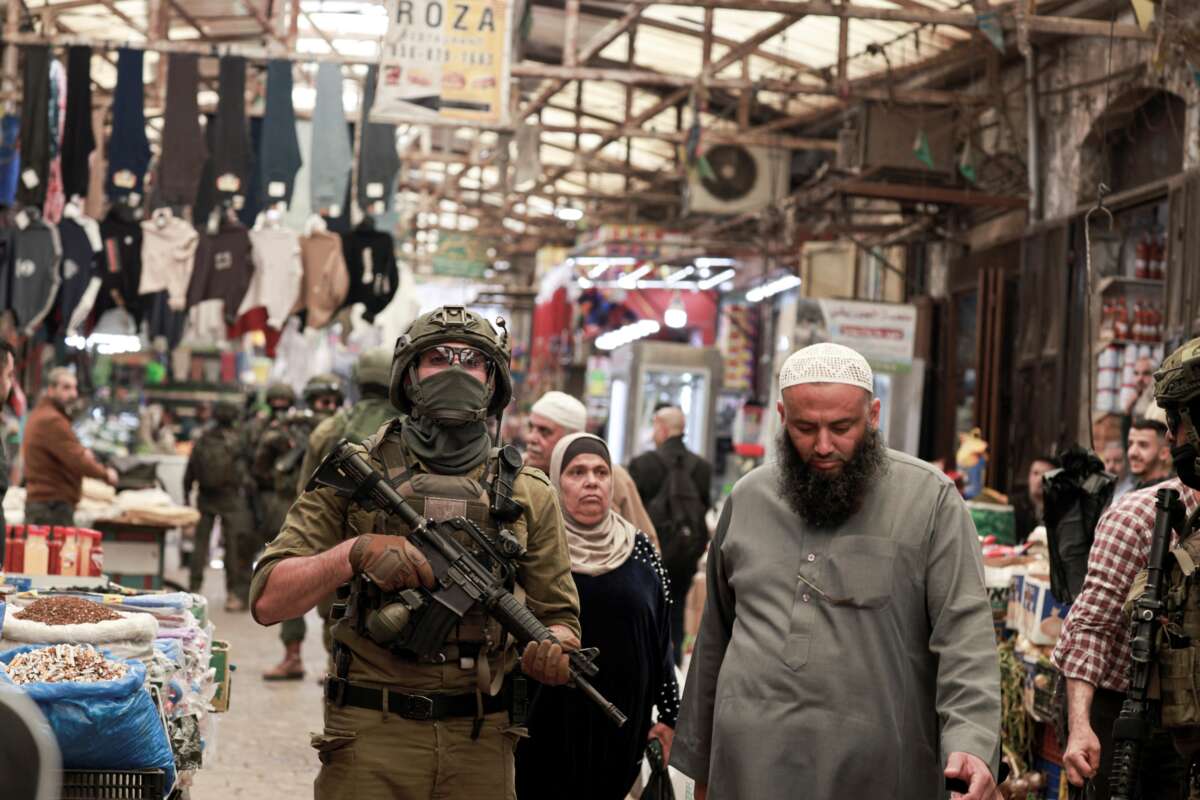
Palestinian shoppers walks past as Israeli soldiers patrol the market in the Old City of Nablus, in the northern Israeli-occupied West Bank, on April 27, 2026.Jaafar ASHTIYEH / AFP via Getty Images

If it had not been stopped at an Israeli military checkpoint in the West Bank, the garbage truck carrying more than 70 Palestinian laborers seeking work would likely have been able to enter Israel without incident.

But on April 13, the driver was held outside the Israeli settlement of Ariel for failure to carry a license fit for the vehicle, and upon further inspection, Israeli border police discovered dozens of workers hiding inside the truck’s garbage compartment, on the verge of suffocation.

The Palestinians were held at gunpoint on suspicion of “attempted infiltration,” according to the Israeli authorities, or in other words, attempting to cross the “Green Line” into Israel without a permit.

But as Haaretz reported, the Palestinian laborers were all unarmed and were only attempting to enter Israel in order to work. They had paid smugglers thousands of shekels in the hopes of passing through the checkpoint, allowing them to earn wages in Israel before returning to their families.

The incident captured the desperation of Palestinians living in the West Bank, who are facing an economic crisis of unprecedented proportions: GDP has contracted by around 17 percent since October 7, and unemployment currently sits at around 28 percent.


Palestinians Observe May Day Amid a Deepening Crisis for Workers
Years of war and genocide have devastated our labor market and living standards.
By Eman Abu Zayed , Truthout May 1, 2026


Two factors are at play: Israel’s closure of permit access for Palestinian laborers from the West Bank, and the withholding of Palestinian Authority (PA) revenues by far right Finance Minister Bezalel Smotrich, all of which has brought the economy to a functional standstill.

On the eve of October 7, 2023, more than 100,000 Palestinians from the West Bank held permits to enter Israel as laborers, and even more entered without permits, primarily in the construction and agriculture industries.

Wages in Israel are more than double those in the West Bank, and jobs are easier to find. The longstanding permit policy was just as much an attempt by the Israeli government to capitalize on the cheap labor costs of Palestinian workers.

Since Israel occupied the West Bank after the Six-Day War in 1967, Palestinian laborers have long been an integral part of Israel’s economy, including in its illegal settlements. Many Palestinians built the very settlements that surrounded their home villages, on land that the state had requisitioned.

All of this changed after October 7, when Israel imposed a complete and immediate ban on entry for Palestinian workers. This shut off a critical economic lifeline for the Palestinian economy, which had come to depend on the cash injection from the comparatively higher salaries paid inside Israel, even in the agriculture and construction industries in which Palestinian workers primarily worked.

Hop in a taxi in Ramallah and the driver has likely once held one of those work permits, but was forced to find other work after they were revoked.

Abdelrahim Abu Ahmad, 32, was one of those workers. He is from the Palestinian village of Bir Nabala, which was once a white-collar stronghold on the outskirts of Jerusalem until the separation barrier cut it off from the Jerusalem municipality.

Abu Ahmad depended on the wages he earned working construction in Israel to support himself and his three children. “But now we have nothing,” he said. “I go to work, maybe have one or two people in the taxi by lunch, and it’s barely enough to cover gas.”

Abu Ahmad is not alone. Ride the bus from the heart of Jerusalem toward Ramallah, and as you pass the separation barrier in Beit Hanina and on the edge of al-Ram, two Palestinian communities located within the Jerusalem municipality but cut off from the West Bank, you might see Palestinian laborers descending the wall, dodging the concertina wire at the top, and climbing down a rope on the other side.

Doing so last week, I watched five Palestinians, lucky not to be caught by the Israeli military, hurriedly climb down from a makeshift rope before running off. Under Israeli military policy, any illegal crossing of the separation wall constitutes an infiltration attempt. It carries a hefty prison sentence, and in many cases, those caught are shot on sight.

The Israeli military has killed at least 13 Palestinians and injured at least 170 others crossing the barrier since October 7, 2023, according to the United Nations, though the Palestinian General Federation of Trade Unions puts the figure closer to 50. Abu Ahmad knows this and said he will likely attempt to cross anyway: “I have nothing to lose. We can’t buy bread, my children are skipping meals, and I have debt to pay.”

Even during the First and Second Intifadas, when Israeli authorities imposed significant movement restrictions within the West Bank in tandem with their military operations, including Operation Defensive Shield, launched by Prime Minister Ariel Sharon in April 2002, the economic collapse was only temporary.

After the fighting subsided and strikes in protest of Israeli authorities were put on hold, economic activity largely returned to normal, an analyst at the Palestine Economic Policy Research Institute confirmed to Truthout.

Debt loads have skyrocketed in the West Bank, both for consumers and for the PA itself, which is approaching insolvency after Smotrich cut off its revenue after October 7, 2023.

Per the Oslo Accords, Israel is obligated to distribute tax revenue it collects on behalf of the PA, but in the wake of October 7, citing payments the PA makes to relatives of those held in Israeli prisons, Smotrich has withheld those revenues altogether.

The Palestine Economic Policy Research Institute condemned the action, stating that “politically motivated suspensions or conditional transfers exceed the scope of the agreement and therefore constitute a form of economic coercion, particularly when used to influence PA actions in diplomatic or legal arenas.”

The result has been a follow-on effect, forcing the Palestinian Authority to cut salaries for more than 140,000 public sector workers. Employees are being paid only 50 percent of their salaries and are still months behind. The PA submitted a funding request to the European Union and donor countries, but it was turned down.

Shadya Saif, 40, has felt the effects of the revenue cuts acutely. She teaches at a private girls’ school in Ramallah, and her child has a rare form of muscular dystrophy requiring frequent treatment at Ramallah Government Hospital. “I worry about when we will not be able to bring my daughter in for treatment,” she said. “She is always sick or dealing with an infection because of her weak immune system. We are trying to keep up with the bills, but if we are not paid soon, we won’t know what to do.”

Ramallah’s community Facebook groups, which were once filled with questions about where to purchase specific brands of American hair products or makeup, are now filled with anonymous pleas from neighbors for food donations. This sense of economic desperation has become commonplace even in the West Bank’s largest cities.

As reported by Middle East Eye in January, Ramallah is far from alone.

“This is absolutely unheard of, that Palestinians would ask for aid from their neighbors. Even in areas hardest-hit by settler violence, we would often distribute aid packages, but nobody would take them,” Abbas Melhem, executive director of the Palestinian Farmers Union, told Truthout in an interview at their offices in al-Bireh. “Now we get 50 calls a day asking for food distribution. People have had to abandon their shame out of desperation.”

It is just one indication of how fast economic conditions have deteriorated since October 7. “They have reached a breaking point,” said Melhem, warning that it is only a matter of time before the tension explodes.