It’s possible that I shall make an ass of myself. But in that case one can always get out of it with a little dialectic. I have, of course, so worded my proposition as to be right either way (K.Marx, Letter to F.Engels on the Indian Mutiny)
Thursday, May 14, 2026
Europe keeps scrambling fighters to 'intercept' American jets
Under the leadership of President Donald Trump, the U.S. has taken an increasingly hostile stance toward its membership in the North Atlantic Treaty Organization (NATO). And now, according to Stars and Stripes, one NATO nation has scrambled fighter jets to confront U.S. aircraft twice in the past week.
According to Austrian defense ministry spokesman Michael Bauer, the incidents on Sunday then Monday involved Austrian Eurofighters intercepting American PC-12s. Bauer described it as a “priority A” situation, which is typically reserved for urgent military matters, saying that the fighters were dispatched to verify whether the American aircraft matched relevant flight registration. He asserted that the matter would be addressed through diplomatic channels.
All of this comes amid growing tension not only between the U.S. and NATO in general, but between Washington and Austria specifically, as the country was one of several that denied the use of its airspace for U.S. missions relating to the war with Iran. Trump’s aggression toward NATO — which he calls a “paper tiger” — has strained relations between the U.S. and its European allies as the president has sought to leave the security organization. The conflict in the Middle East has further complicated the situation as NATO has balked at Trump’s repeated pleas for help with the war. Now the Austrian interception of American planes suggests a widening divide between the U.S. and its allies across the Atlantic.
While the PC-12 is a Swiss-made jet, as the U.S. military publication Stars and Stripes explained, “Air Force Special Operations Command’s fleet includes the U-28A, which is a modified variant of the PC-12. The planes are typically used for airborne intelligence, surveillance and reconnaissance operations.”
“It wasn’t clear why the Austrians felt compelled to scramble fighters to identify the aircraft,” noted Stars and Stripes. “Assuming that the U.S. planes were traveling with their transponders on and in radio contact, they should have been visible to air traffic control.”
U.S. European Command said in a statement Wednesday that the two American aircraft were following “standard protocol” when they passed over Austria en route to an exercise in Eastern Europe on Monday. The statement did not mention the incident on Sunday.
“This flight took place after an administrative error in the overflight clearance paperwork was corrected,” claimed EUCOM. “The United States continues to work closely with Austrian authorities on any questions regarding overflights and fully complies with Austrian laws and procedures.”When asked on X why Austria felt the need to scramble an air response to the Americans, Bauer said simply that “some things you just have to see.”
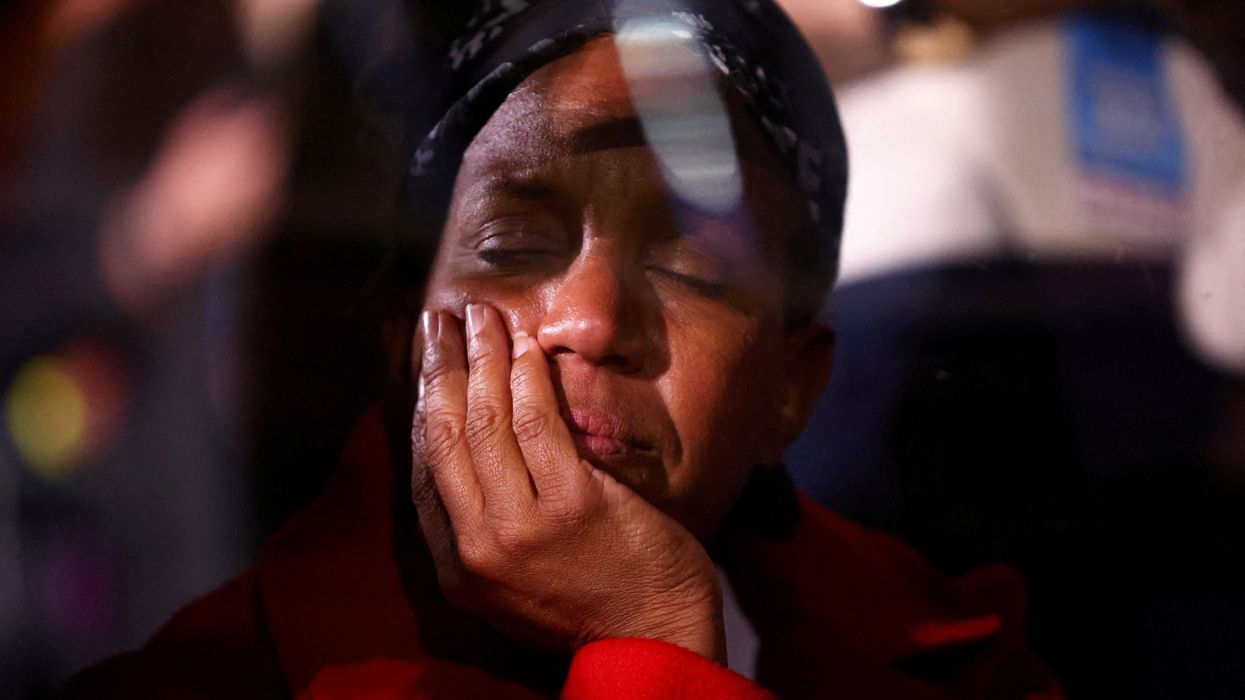
'Backwards at warp speed': How the South is systematically erasing Black power A supporter reacts to early election results at Democratic presidential nominee U.S. Vice President Kamala Harris' election night rally during the 2024 U.S. presidential election, at Howard University, in Washington, U.S., November 5, 2024. REUTERS/Daniel Cole TPX IMAGES OF THE DAY/File Photo
Yesterday I spoke with Tennessee state representative Justin Jones, one of the nation’s young Black leaders who’s been a rising star in Tennessee politics, about the Supreme Court’s shameful April 29 decision in Louisiana v. Callais, gutting Section 2 of the Voting Rights Act.
Jones told me that, at Trump’s urging, Tennessee Republicans had prepared a redistricting map even before the Court announced its decision. Then, despite pleas from Black voters and voting rights advocates, the white Republican legislators moved their meeting to another room without allowing the public in to watch, passed the new map out of committee, and enacted it within 24 hours.
The new map has eliminated Tennessee’s one remaining Democratic district around Memphis, a city of about 610,000 people, about two-thirds of whom are Black — by cracking it into three majority-white district, one stretching hundreds of miles. The map has also divided Nashville, another city with a Black majority, into five white-majority districts.
Jones described Tennessee house speaker Cameron Sexton as the “grand wizard in chief,” explaining that “that’s what they want to do. They want to create a process that is unfair and unequal.”
Louisiana’s governor has ordered that the state’s ongoing congressional election be set aside while state lawmakers redraw maps to eliminate a Democratic-majority – that is, a Black-majority – seat covering Baton Rouge.
At Trump’s request, Alabama Republicans have approved legislation directing the governor to schedule new primary elections this year under a GOP-friendly map that would end districts represented by Black lawmakers, if courts lift an injunction on its redistricting.
The Mississippi legislature will soon convene in a Confederate-era capitol building that it hasn’t used in 100 years, presumably to eliminate the Democratic majority in the one Mississippi district held by a Black representative.
South Carolina’s Republican majority in the statehouse voted Wednesday to extend its legislative calendar, allowing time to consider whether they should eliminate the state’s sole Democratic-majority, Black-majority district, held by long-serving representative James Clyburn.
Florida was already in a special redistricting session when the Supreme Court announced its decision, enacting a congressional map for its 28 districts that packs Black and brown voters into four districts on the south Florida coast and Orlando, eliminating every other Democratic majority.
“We’re going backwards at warp speed,” Jones told me. “In just over a week, we’ve gone from the 1965 Voting Rights Act back to the era of Jim Crow.”
I asked him what he and other Black political leaders in the South were planning to do.
“There’ll be a lot of litigation,” he said, “but we can’t be optimistic with this Supreme Court.”
“So, what’s the strategy?”
“We need the biggest voter turnout in history this fall. Every Black person, every Brown person, every Democrat, everyone who cares about the moral soul of this nation has to vote for equal voting rights. Take over Congress. Increase our power in state legislatures. This is the only way to respond.”
“I’m with you,” I said, “but I really wonder whether that’s possible.”
“How about a new Freedom Summer?” Jones responded, with a smile. “A multi-racial force of young people fanning out across the South, registering voters, getting them to the polls, just like they did in 1964.”
“I remember. I lost a dear friend in Mississippi Freedom Summer.”
“I have no direct memory, of course,” Jones said. “I was born in 1995, thirty-one years after Freedom Summer. But the South is almost back to where it was then. So, yes, it’s possible. It’s got to be possible.”
I told him I’d share his idea with you, and ask you for your responses.
Robert Reich is a professor of public policy at Berkeley and former secretary of labor. His writings can be found at https://robertreich.substack.com/
ABC Learns from Past Mistakes, Takes Stronger Stance Against Carr and Trump’s Censorship Campaign
WASHINGTON - In a filing made public on Friday, ABC accused Federal Communications Commission regulators of violating its free-speech rights and called out FCC Chairman Brendan Carr for attempting to punish the broadcaster for airing political content that displeased the Trump White House.
The FCC had reportedly ordered Houston station KTRK-TV, which ABC owns and operates, to file a formal request asking whether The View qualified for the Equal Time Rule exemption when it booked an interview with Texas senatorial candidate James Talarico. The request wasn’t warranted as the FCC had specifically granted The View this exemption in a 2002 order.
The Equal Time Rule, under Section 315 of the Communications Act, requires that broadcast stations provide equal access and airtime to all legally qualified political candidates if they permit any one candidate to use their facilities. The rule does not apply to bona fide newscasts, news interviews, news documentaries or on-the-spot news events (like political debates).
“The Commission’s actions threaten to upend decades of settled law and practice and chill critical protected speech, both with respect to The View and more broadly,” reads ABC’s filing. “It is therefore imperative that the Commission act quickly to assure broadcasters that it will uphold its long-established standards protecting broadcasters’ good faith news judgment in including political candidates in bona fide news programming.”
ABC has not always defended its free-speech rights. In December 2024, the company paid $15 million to resolve a meritless Trump defamation lawsuit against the network and its anchor George Stephanopoulos. In September 2025, Disney decided to temporarily suspend Jimmy Kimmel’s late-night program after Chairman Carr threatened to take action following comments the comedian made during his opening monologue.
Free Press Co-CEO Jessica J. González said:
“I’m pleased that ABC has finally learned that bullies don’t stop when companies cower in a corner. The FCC chairman has blatantly and repeatedly abused his power to silence speech that displeases Trump. This doesn’t just violate the First Amendment rights of broadcasters on the receiving end of Brendan Carr’s tactics; it also harms the broadcasters’ audiences. People deserve access to diverse viewpoints over the airwaves, and the ways in which ABC and other broadcasters have repeatedly capitulated to the administration has chilled free expression and access to information.
“Chairman Carr’s overreach is startling and unpopular across the political spectrum. After Donald and Melania Trump demanded that ABC fire Jimmy Kimmel for making a joke they didn’t like, Carr announced that he would conduct an early review of ABC’s broadcast licenses — an abuse of power that Senator Ted Cruz and people of all political stripes condemned. I urge ABC and its parent company Disney to continue fighting for free speech. Doing anything less deprives audiences of the diversity of viewpoints that are critical to the health of a democracy.”
Free Press was created to give people a voice in the crucial decisions that shape our media. We believe that positive social change, racial justice and meaningful engagement in public life require equitable access to technology, diverse and independent ownership of media platforms, and journalism that holds leaders accountable and tells people what's actually happening in their communities.
Nebraska Democrat Wins Senate Primary—But Signals She’ll Drop Out and Back Working-Class Independent Dan Osborn
“We believe Dan Osborn... represents the best opportunity to defeat Pete Ricketts and deliver real results for working families,” said the chair of the state Democratic Party. Independent US Senate candidate Dan Osborn talks to a voter in Nebraska. (Photo by Osborn for Senate)
The winner of the Democratic US Senate primary in Nebraska has no expectation that she’d be able to win the general election in November, and her official website alludes to a plan to drop out of the race—which could ultimately help the party in its goal of wresting control of the chamber from Republicans.
The campaign website of Cindy Burbank, a pharmacy technician who jumped into the Democratic primary race after hearing the Republicans were plotting to place a right-wing “plant” on the ballot, suggests Burbank did some maneuvering of her own to secure a favorable result—even if she has no intention of actually going to the US Senate and instead aims to help Independent candidate Dan Osborn win.
Sen. Pete Ricketts (R-Neb.) “knows he’s losing to Dan Osborn and this is his plan to cheat his way to victory. We can’t let that happen,” reads Burbank’s website. “Support me—and I’ll make sure Pete Ricketts’ stooge never gets anywhere near our November ballot!”
Osborn, a former organizer who came within seven points of beating Sen. Deb Fischer (R-Neb.) in 2024, has been endorsed by the state’s Democratic Party, which poured money into Burbank’s campaign before Tuesday’s primary.
In March, state Democratic Party Chair Jane Fleming Kleeb said William Forbes, an anti-abortion rights pastor who has voted for President Donald Trump in recent elections and attended a training run by a right-wing group, had joined the Democratic Party to “deceive Nebraska voters.”
“The Nebraska Democratic Party made a deliberate, principled decision not to field a candidate in the US Senate race,” said Kleeb. “We believe Dan Osborn—a veteran, a mechanic, a Nebraskan, and an independent voice—represents the best opportunity to defeat Pete Ricketts and deliver real results for working families.”
Forbes has denied being a “Ricketts plant,” as Kleeb has called him, and Burbank on Tuesday denied she had joined the race with the intention of dropping out to help Osborn win in a state where a Democrat has not won a Senate race since 2006. She told NBC News that “some people” she had worked with on previous political campaigns had spoken to her about running, but said they were not connected to Osborn’s campaign or to the state Democratic Party.
But she added that following her overwhelming win, with 89% of primary voters supporting her, that Osborn is “a great guy, and we have to keep in mind that he might be able to be on [the ballot].”
“For me to stay on the ballot and take votes away from Osborn, it’s not fair,” she told the outlet.
Burbank added that she “will drop out when and if the time comes that I cannot win in November. And I think anybody with any dignity should do that.”
David Dayen, executive editor of The American Prospect, said Burbank’s resounding victory “suggests a well-educated [Democratic] electorate” and a well-organized push by Kleeb.
Osborn, who has emphasized that he would caucus independently if elected to the Senate, came closer than expected to beating Fischer in 2024, when Trump carried Nebraska by 20 points.
Polling has been limited so far, but Tavern Research found ahead of the primary election that 47% of likely voters were supporting Osborn while 42% backed Ricketts. The same survey found Ricketts 16 points ahead of Forbes, 9 points ahead of Burbank, and 7 points ahead of a generic Democrat. Earlier polls sponsored by Osborn’s campaign found Ricketts just one point ahead of the Independent.
Tavern Research said the polls pointed to “an Independent problem in Nebraska” for Ricketts, whose wealth and financial industry ties have earned him the nickname “Wall Street Pete.”
The state has long been a stronghold for Trump and the GOP, but Cook Political Report currently rates the state’s Senate race as “likely Republican,” downgrading it from “solidly Republican,” ahead of the November election.
Osborn, a US Navy veteran and mechanic, became president of his union while working at the Kellogg’s plant in Omaha and led a successful strike there in 2021, securing benefits for his fellow union workers. He has called his platform the Nebraska Fairness Plan and is vowing to “take on the corporations and their chosen political lapdogs to restore economic liberty and fairness for the working Americans who make this country run.”
He has called to overturn the Citizens UnitedSupreme Court ruling that allowed unlimited corporate spending in elections, refuses corporate political action committee donations, and has demanded an end to corporate practices like “shrinkflation” and surveillance pricing.
“We deserve a government that is truly of the people, by the people, and for the people,” reads Osborn’s platform. “But for decades, career politicians in both parties have been bought and paid for by the corporate cronies and lobbyists pouring money into our political process to bend the system to their will. When I’m in the Senate, I will champion the strongest anti-corruption platform Washington has ever seen.”
Judge puts Trump's immigration regime on ice with major rebuke: lawyer
A member of the Special Response Team (SRT) holds his weapons at a protest against the fatal shooting of Renee Nicole Good by a U.S. Immigration and Customs Enforcement (ICE) agent, during a rally against increased immigration enforcement across the city outside the Whipple Building in Minneapolis, Minnesota, U.S., January 8, 2026. REUTERS/Tim Evans/File Photo
A judge appointed by President Donald Trump just put the president's immigration regime on ice with a major rebuke, according to one lawyer.
Recently, a federal appeals court in New York ruled that the Trump administration's policy of detaining suspected illegal immigrants without bond is illegal. The judge in the case, Joseph F. Bianco, who was appointed to the bench by Trump during his first administration, ruled that the administration's "government’s novel interpretation of the immigration statute defies their plain text" and ordered the administration to provide bond hearings for the detainees.
Shant Karnikian, a lawyer and host of the "Civil Action" podcast on the Legal AF Network, said in a new episode that the ruling is a "major loss" for the administration.
"When your own nominee writes the majority opinion rejecting your policy as the broadest mass deportation without bond mandate in American history, that's not just a legal setback. It's a major, major loss for the Trump administration," Karnikian said.
The Trump administration has faced mounting legal challenges over its immigration detention practices, including holding U.S. citizens and legal residents without due process, deporting individuals to third countries without notice, and circumventing habeas corpus protections.
Federal courts have repeatedly ruled against the administration, which has defied or slow-walked several judicial orders.
The case in New York stemmed from a Trump administration policy that reclassified long-term residents who entered without being screened as being eligible for deportation. In turn, they were detained without a bond hearing.
However, that plan relied on what Karnikian described as "legal fiction" that long-term residents are still "seeking admission" to the country. That ruling could be used to squash future detentions of a similar kind.
"It's a fiction," he said. "I mean, you can't do that. You can't have it like kind of retroactively treat them, look at their history, and go, 'Well, he was seeking admission at one point.'"
FILE PHOTO: An ICE officer is seen at Otay Mesa immigration detention center in San Diego, California, U.S. May 18, 2018. REUTERS/Lucy Nicholson/File Photo
In the early morning hours of late February, a 911 call was made from a U.S. Immigration and Customs Enforcement facility in Mesa because a man was having a seizure after immigration agents used pepper spray on a group of 47 detainees in an enclosed room.
“Um, yeah we had, uh, a officer safety issue here,” ICE Ofc. Gene Rivero told a dispatcher with the Mesa Fire and Medical Department, according to a 911 call obtained by the Arizona Mirror through a public records request. “Pepper spray was used and we have a couple subjects that need to be looked at and one subject specifically that appears to be seizing.”
The incident had occurred at the Arizona Removal and Operations Coordination Center housed at the Mesa-Gateway Airport. The facility, first exclusively reported on by the Mirror, is a 25,000-square-foot facility at the airport. It opened in 2010 to little fanfare and can house up to 157 detainees and 79 ICE employees.
But a Mirror analysis of data of ICE detention records that the Deportation Data Project obtained via the Freedom of Information Act showed that, in some cases, detainees have stayed for longer than the 12 hours ICE has said the facility is meant for.
window.addEventListener("message",function(a){if(void 0!==a.data["datawrapper-height"]){var e=document.querySelectorAll("iframe");for(var t in a.data["datawrapper-height"])for(var r,i=0;r=e[i];i++)if(r.contentWindow===a.source){var d=a.data["datawrapper-height"][t]+"px";r.style.height=d}}});
And AROCC has regularly held far more detainees than it is supposed to. The day that ICE agents pepper sprayed the inmates as they were housed in a small room — each room has a capacity of no more than two dozen, though nearly 50 were in the room this day — there were a reported 332 detainees being held.
The pepper spray incident happened a week after a congressional oversight visit, prior to which ICE had shuffled around detainees so that AROCC had some of the lowest numbers it had seen all year.
ICE said the officers used pepper spray to quell disruptive behavior in the overcrowded detention room.
“Oleoresin Capsicum (OC) spray was deployed on a group of detainees at the Arizona Removal Operations Coordination Center in Mesa, AZ, following repeated verbal commands to cease kicking the cell door, banging the windows, and exhibiting aggressive behavior toward officers,” ICE said in a statement to the Mirror. “At approximately 2:15 a.m., an ICE detainee was transported to East Valley Emergency Room (EVER) due to an asthma episode. The detainee was released from EVER at approximately 3:15 a.m.. There is no evidence to suggest that the asthma episode experienced was caused by exposure to OC spray with the detainee’s pre-existing medical condition.”
ICE did not respond to questions asking about the comments made by its own employee about the detainee “seizing,” if any employees of the agency also required treatment or what policies the agency has for the use of pepper spray in confined spaces.
From the 911 call, it’s clear that ICE agents were affected by the spray. As he spoke with the dispatcher, Rivero repeatedly paused to cough, and others can be heard coughing in the background. Rivero told the dispatcher that ICE agents were attempting to “air out” the facility to clear out the chemical agent.
Firefighters said they “found one individual outside with security that was struggling from the exposure to the pepper spray.”
“We also found many people sitting in the breeze way (sic) shackled at the feet. Security was bringing inmates out five at a time and placing them in the breeze way,” according to a fire department report obtained by the Mirror.
“At the beginning we only had the one patient. Eventually we ended up
evaluating a second patient who ended up refusing transport,” the report says.
A report of the incident obtained by the Mirror shows that firefighters said that there was only one patient, but approximately 30 others were “getting out of cells” and that they “may need a lot of ppl wash down” due to the pepper spray.
Both the Queen Creek Fire Department and Gilbert Fire Department helped respond to the call.
Last month, three Arizona Democratic members of Congress showed up at AROCC unannounced for a surprise oversight visit. They said afterward that the holding rooms had roughly double the number of people than the maximum capacity posted outside each room. One said that detainees were packed in the rooms “like sardines.”
One of those lawmakers, U.S. Rep. Yassamin Ansari, told the Mirror in a written statement that the audio from the 911 call made her sick.
“This makes me sick to my stomach. You could hear detainees coughing and struggling to breathe,” Ansari said. “ICE is cruel — I’ve witnessed that cruelty firsthand. I’ve seen my constituent, Yari, coughing up blood while suffering from medical neglect. I’ve seen people packed into small concrete cells at Mesa Gateway, sick and crowded together like sardines.
“Time and time again, I’ve demanded answers from ICE and they’ve failed to show basic humanity or accountability. That’s why I’ll continue to vote NO on any additional funding for ICE.”
An airplane sits on the tarmac at Mesa Gateway Airport on the evening of April 9, 2026, outside of the Arizona Removal Operations Coordination Center, an ICE facility where detainees are temporarily housed before they are put on a plane to either be deported or moved to a different ICE facility. (Photo by Jerod MacDonald-Evoy/Arizona Mirror)
Another one of those lawmakers, U.S. Rep. Adelita Grijalva, said in a statement to the Mirror that she is “deeply concerned” with the increased use of force against ICE detainees.
“People who are simply asking for food, water, and medical care should not be met with force,” Grijalva said. “Equally concerning is the severe overcrowding at this facility, where the population on the day of the incident far exceeded the facility’s maximum capacity. When detention facilities become overcrowded and conditions deteriorate, the risk of escalation and harm increases significantly.”
The Tucson Democrat said she is also troubled by ICE’s response to questions about the incident and is calling for greater transparency on this incident as well as what protocols the agency has on use-of-force “particularly in confined spaces and against medically vulnerable individuals.”
“ICE’s immediate attempt to dismiss any possible connection between the medical emergency and the deployment of pepper spray is equally concerning and reflects a broader pattern of deflecting accountability and gaslighting the public,” she said. “I’m calling on ICE to provide full transparency regarding this incident, including whether proper protocols were followed and what steps are being taken to ensure the health and safety of individuals in custody.”
An internal report, obtained by the Washington Post and published as part of a larger database of use of force incidents at detention centers, gives a little more insight into the incident.
“On February 27, 2026, (Enforcement and Removal Operations) Phoenix reported the use of force on a group of 47 detainees while housed at the AROCC in Mesa, Arizona,” ICE wrote. “No injuries were reported, ERO leadership. (Mesa Fire and Medical Department), and the ICE (Office of Professional Responsibility) Intake Center were notified.”
In late January, the local agency responded to a medical call at AROCC, where it found such severe overcrowding that it gave ICE a list of corrections it needed to make.
ICE told Mesa Fire that the 238 people records show were detained that day was an aberration because of a measles outbreak at another Arizona facility. The agency promised the number of detainees would be back under the listed maximum capacity of 157 within a week.
But the next day, records show the daily population was 646 people. The day after that, it was 526. Within a couple of days, there were 777 people being housed at AROCC. On Feb. 4, the day ICE had said the overcrowding would be resolved, there were 513 people locked in the facility’s detention rooms.
window.addEventListener("message",function(a){if(void 0!==a.data["datawrapper-height"]){var e=document.querySelectorAll("iframe");for(var t in a.data["datawrapper-height"])for(var r,i=0;r=e[i];i++)if(r.contentWindow===a.source){var d=a.data["datawrapper-height"][t]+"px";r.style.height=d}}});
The use of force incident at AROCC is one of many this year.
In 2024, there were 23 reported use of force incidents for the entire year at detention centers in Arizona. In 2025, that number rose to 34. In just the first two months of 2026, there were 13 incidents, putting ICE on pace to use force on immigrant detainees 78 times.
From the start of January to the end of February in 2024, there were three use of force reports and in 2025, there were five. This year marks a 333% and 160% increase from the same timeframe in previous years.
The majority of use-of-force incidents are taking place at the Eloy Detention Center, and the reports offer little information on what happened.
So far in 2026, the Eloy Detention Center has reported 4 use of force incidents; the narrative supplied in the official database only lists the nationalities of those involved, the date of the incident and that there was a “use of force.”
In 2024, under the administration of President Joe Biden, reports included more information.
For example, a report on Jan. 6, 2024, provides a narrative about how “contract staff” issued verbal commands to a “Senegalese national detainee” to “stop punching and kicking his cell door.”
“The EDC staff deployed a short burst of OC spray into the detainee’s cell to gain compliance. The detainee was extracted and escorted to the shower area for decontamination,” the narrative says. It goes on to say that the detainee was evaluated and later released in “administrative segregation pending a disciplinary hearing.”
Reports since President Donald Trump began his second term in January 2025 have become less transparent. While reports in 2025 continued to include some information about the use of things like pepper spray and why use of force was used, reports on incidents in 2026 have virtually no details.
“ERO Phoenix reported the use of force on a Jamaican national detainee and a Syrian national detainee while housed at the EDC in Eloy, Arizona. No injuries were reported. ERO leadership was notified,” the narrative for one 2026 report states.
“ERO Phoenix reported the use of force on two Mexican national detainees and two Cuban national detainees while housed at the EDC in Eloy, Arizona. No injuries were reported. ERO leadership was notified,” another report says.
None of the 2026 narratives supply information about what force was used or what led up to the use of force.
ICE did not respond to the Mirror’s questions as to why the narrative section of the use of force reports has become less detailed this year.
But getting a glimpse behind the curtain on use of force by ICE has never been simple.
“It’s never been easy to get data on this,” Katherine Hawkins, senior legal analyst of the Constitution Project at the Project on Government Oversight, told the Mirror.
Requests for use-of-force data often are withheld as sensitive law enforcement information, and incidents are generally learned about via detainee lawyers.
“It has never been particularly transparent,” Hawkins said.
A detainee boards a 747 that is part of Immigration and Customs Enforcement’s Air Operations at Mesa Gateway Airport on Sept. 23, 2025. (Photo by Jerod MacDonald-Evoy/Arizona Mirror)
Reporting by the Washington Post has found that, during Trump’s second administration, use of force at ICE detention centers has surged. Their analysis found that detention staff have used force 37% more times than the previous year and a 54% increase from under Biden.
Meanwhile, populations at these centers, like AROCC, are continuing to grow and outpace the size of the facility.
The airport where AROCC is located has raised concerns that conditions there could be a violation of the lease agreement with the private company that sub-leases the space to the federal government.
At AROCC, ICE is detaining more people for longer periods than it ever has. The average length of stay in 2026 is about 36 hours, compared to the same time frame in 2025, when detainees were housed for just about 12 hours on average.
In 2025, the average daily population was approximately 21 people for the same timeframe. So far in 2026, there have been an average of 274 detainees each day. The Mirror found one individual in the data who stayed for 18 days, coinciding with a time when the population of the facility was near its peak of 777 people.
Conditions at the Eloy facility and the Florence Detention Center, where there have been multiple reports of abuse that has led to deaths, have garnered headlines.
Oversight of facilities like AROCC, Eloy and Florence exists in theory, but appears to be minimal, at best. Such oversight generally is done internally by the Office of the Inspector General or internal DHS units that have all been gutted by the Trump administration.
“Accountability has always been very, very limited and in short supply,” Hawkins said, adding that finding people willing to come forward about issues inside can be considerably difficult, as well. “The witnesses may be deported before it can even be investigated.”
Additionally, facilities like the one in Eloy and the Central Arizona Florence Correctional Complex are run by private companies, meaning that there is a “less clear chain of command for discipline.”
Those facilities are run by CoreCivic who reported a 25% increase in total revenue for the first quarter of this year, largely attributing government contracts with DHS and ICE to their success. Arizona Mirror is part of States Newsroom, a nonprofit news network supported by grants and a coalition of donors as a 501c(3) public charity. Arizona Mirror maintains editorial independence. Contact Editor Jim Small for questions: info@azmirror.com.
‘Morally Reprehensible’: For-Profit Immigrant Detention Centers Exploiting Prison Labor With $1 Per Day Wages
“The dichotomy between the contractors’ profits and the detainees’ pay is outrageous.”
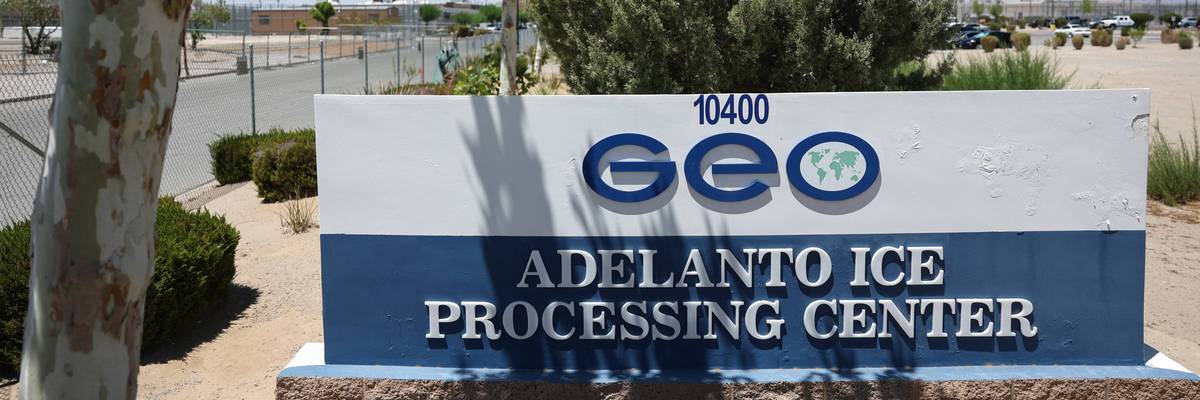
The GEO Group logo is displayed outside of the Adelanto ICE Processing Center detention facility in Adelanto, California on July 10, 2025. (Photo by Patrick T. Fallon/AFP via Getty Images)
As President Donald Trump continues his mass detention and deportation agenda and expands the use of privately owned immigrant prisons, with more than 60,000 people detained across the country, the profits of private contractors like the GEO Group and CoreCivic are skyrocketing—and a new report by a government watchdog reveals one method the multibillion-dollar firms have of extracting profits from detainees.
Public Citizen researcher Douglas Pasternak wrote in a report released Wednesday that approximately 50% of immigrants who are detained for more than a few days end up in the government’s so-called Voluntary Work Program (VWP), earning just $1 per day—12.5 cents per hour—while they keep the detention centers running.
At facilities like Adelanto Detention Center in Adelanto, California, run by the GEO Group, and CoreCivic’s Stewart Detention Center in Lumpkin, Georgia, detainees work as many as 14 hours in a day for just $1—cooking, cleaning, performing maintenance work, and completing other labor essential to the facilities’ operations—and in many cases are forced to use their meager wages only at commissaries also run by the corporations.
“This entire $1-a-day pay scheme is economically unjustifiable, fundamentally unfair, and morally reprehensible,” said Pasternak in a statement.
The companies are notorious for price gouging, forcing the so-called “voluntary worker” to work full-time for 11 days to afford a tube of Sensodyne toothpaste—priced at $11.02 at Stewart Detention Center, compared to just $5.20 on Amazon.
“At these rates, it may take a detainee more than three days of work to purchase a can of tuna fish or more than two days of work to purchase a bar of soap,” said Public Citizen.
The business model has saved the contractors millions of dollars and allowed them to reap massive profits.
Former CoreCivic CEO Damon Hininger made $7.2 million in compensation last year before retiring, and the company’s profits grew from $68.9 million in 2024 to $116.5 million last year. Both CoreCivic and the GEO Group reported well over $2 billion in revenue in 2025.
“The private contractors running immigrant detention centers are pocketing millions of dollars in profits as tens of thousands of detainees struggle to afford to purchase a bar of soap or a tube of toothpaste.”
When it was sued over its use of the VWP in Washington State, the GEO Group testified that it would have had to pay 85 full-time employees at the state’s minimum wage—$17.13 per hour—if it hadn’t used the labor of detainees. Hiring workers would have cost the company over $3 million per year, but instead the GEO Group spent just over $22,000 paying imprisoned immigrants $1 per hour.
“The private contractors running immigrant detention centers are pocketing millions of dollars in profits as tens of thousands of detainees struggle to afford to purchase a bar of soap or a tube of toothpaste,” said Pasternak. “The dichotomy between the contractors’ profits and the detainees’ pay is outrageous.”
In the case in Washington state, a court found that the GEO Group owed $17 million in back pay to thousands of detainees and owed nearly $6 million to the state for “unjust enrichment.” The company has appealed to the Supreme Court. There are at least six other federal court cases challenging private companies for paying immigrant detainees $1 per day.
The report also describes a nine-bedroom, 11-bathroom, 18,523-square-foot home owned by GEO Group co-founder George Zoley in Boca Raton, Florida—estimated to be worth more than $22.5 million.
“The disparity between Zoley’s wealth and the $1 per day pay to detained immigrants is striking,” reads the report. “The tens of thousands of immigrants detained by the US government deserve better than being paid $1 per day, and the federal contractors building an extensive network of detention camps across the country should not be making excessive profits at their expense.”
Report Details How Trump Did Big Tobacco’s Bidding on Flavored Vapes Despite Risk to Kids
“Trump could not care less about the health consequences and costs of giving teenagers access to addictive flavored poison if it means his tobacco industry donors can make record profits,” said one public health advocate. Fruit flavor vape refills for e-cigarettes on shelves of a vaping shop, England, UK on December 15, 2025. (Photo by Alex Segre/UCG/Universal Images Group via Getty Images)
The resignation of a pair of top health officials in the Trump administration this week has brought to light efforts by the president to help Big Tobacco executives and lobbyists sell addictive flavored e-cigarettes that could be marketed to children.
On Friday, the Food and Drug Administration (FDA) issued new guidance allowing cigarette makers to begin marketing and selling fruit- and candy-flavored vape products on store shelves, which were banned under previous administrations due to evidence that they were driving youth vaping.
The policy was enacted despite the strong opposition of then-FDA Commissioner Marty Makary, who resigned on Tuesday, reportedly because he could not in good conscience support it.
Makary’s resignation was followed by the departure of Rich Danker, the chief spokesperson for Health and Human Services (HHS) Secretary Robert F. Kennedy Jr., who similarly warned that the policy “would appeal to children and expose them to nicotine addiction, lung damage, and higher risk of cancer” in a letter addressed to Trump on Wednesday.
Danker did not blame Trump for the policy in his letter; instead, he attributed it to “senior HHS officials in the immediate office of the secretary.”
This is despite the fact that The Wall Street Journal reported last week that Trump had personally berated Makary over his hesitation to enact the policy and had signed off on a plan to fire him.
A New York Times report on Wednesday confirms the extent of Trump’s direct involvement in strong-arming the FDA into enacting the policy. It found that he pressured higher-ups in HHS to move the policy forward amid a tongue-lashing from tobacco industry lobbyists and executives angry that they could not get in on the highly profitable sale of fruit- and candy-flavored vapes. Despite being illegal and mostly imported to the US from China, these vapes make up about 60% of the total e-cigarette market.
Trump, who ran in 2024 on a pledge to “save vaping” as part of an effort to appeal to young voters, has raked in huge sums of money from the tobacco industry. According to data from OpenSecrets, his inaugural committee took over $3 million from vaping special interests, including $1.25 million from the Vapor Technology Association, and $1 million apiece from Altria and Breeze Smoke.
Altria, which owns Marlboro maker Philip Morris, and Reynolds American, which owns Lucky Strike and Camel, have also offered donations to Trump’s $400 million White House ballroom project. Reynolds, the biggest producer of menthol cigarettes, also gave $10 million to the super PAC backing Trump in 2024.
According to The New York Times, executives for Altria and Reynolds were turning the screws on Trump over lunch at his golf club in Jupiter, Florida, in early May because they were “unhappy with the way the Food and Drug Administration was regulating their industry.”
Trump interrupted the conversation to call up RFK Jr. and Mehmet Oz, the head of the Centers for Medicare and Medicaid Services (CMS), and complained to them about the FDA’s regulation of e-cigarettes.
Within a week, the new policy had been enacted, and its leading opponent, Makary, was gone. He has since been replaced by Kyle Diamantas, whom the healthcare advocacy group Protect Our Care described as “a 30-something lawyer whose qualifications for such a critical public health role seem to begin and end at being Donald Trump Jr.'s ‘hunting buddy.’”
“Donald Trump’s fury at FDA head Makary was motivated by gross political opportunism and fat checks from the big vape industry,” said Jeremy Funk, the deputy director of Protect Our Care’s Public Health Watch team. “Trump could not care less about the health consequences and costs of giving teenagers access to addictive flavored poison if it means his tobacco industry donors can make record profits.”
While youth vaping is at a 10-year low, about 1.6 million middle and high school students were estimated to use vape products in the Centers for Disease Control and Prevention’s 2024 National Youth Tobacco Survey. Nearly 90% of them said they used fruit and candy-flavored vapes.
Dr. Jerome Adams, a physician and professor at Purdue University, said in a post on social media that the rise of vaping has fueled a rebound in nicotine usage among college-aged adults.
“Youth combustible cigarette smoking was already at an all-time low and consistently dropping before vaping came on the scene. There is literally no reason to believe that the majority of young people who are now vaping would have otherwise been smoking combustible cigarettes,” he said. “Amongst college-age and young adults, nicotine use is going back up to incredibly high rates—largely due to vaping.”
The new policy enacted by the FDA has so far only authorized the sale of flavored products by one company, the Los Angeles-based Glas Inc., which will be allowed to sell vapes in flavors like mango and blueberry under names like “Gold” and “Sapphire.”
The FDA sought to assuage fears of underage use by pointing to the Glas’ digital age-verification system, which requires the product to be connected to the Bluetooth of a phone owned by a person over the age of 21. However, it is expected that, especially amid industry pressure, more companies will have their products approved soon.
Kayla Hancock, director of Protect Our Care’s Public Health Project, said that while Makary had a “terrible record” as FDA commissioner, having taken actions that slowed vaccine development and launched dubious, politically charged “reviews” of abortion pills long found to be safe, “apparently, it wasn’t terrible enough for Donald Trump.”
“Hesitating to approve flavored vapes and not put American teens on a fast-track to lifelong addiction to harmful nicotine products is the bare minimum anyone could hope for from the Trump FDA,” she said. “But that was a bridge too far for Donald Trump, who sees young people as disposable political pawns that he can appeal to with poison while lining the pockets of his big vape donors.”
She said the ouster of Makary and his replacement with Diamantas “all but guarantees an FDA further consumed by chaos and driven by the wish lists of special interests that want profits put before public health.”
House Democrat Warns Trump on Verge of ‘Largest Single Act of
Grand Larceny in American History’ “Trump is considering stealing billions of dollars from the American people” with a $10 billion lawsuit against the IRS, said Rep. Don Beyer.
Democrats in Congress are warning that President Donald Trump is on the verge of “stealing” billions of dollars from American taxpayers in the coming days as his Department of Justice reportedly considers settling his lawsuit against the Internal Revenue Service.
The New York Timesreported on Tuesday that the DOJ, headed by the Trump loyalist acting Attorney General Todd Blanche, was holding internal discussions about whether to settle the suit that was brought by Trump and his sons, as well as the family’s business empire, in January.
The case centers on the IRS’s leak of Trump’s tax returns during his first term, which occurred after he broke decades of precedent by refusing to release them. The lawsuit alleges that the IRS failed to prevent former IRS contractor Charles Littlejohn from unlawfully disclosing tax information to media outlets, for which he pleaded guilty in 2024.
The leaks, reported by The New York Times and ProPublica, revealed that Trump had engaged in what was described as “outright fraud” and other “dubious” schemes to avoid taxation, and that he paid no federal income taxes in many of the years leading up to his presidency.
The Trumps are seeking a payout of at least $10 billion from the IRS, which is currently being headed by Trump’s handpicked Social Security Administration head, Frank J. Bisignano, who reports to Treasury Secretary Scott Bessent.
This creates an extraordinary legal situation widely described as a blatant conflict of interest, since Trump is suing an IRS that he effectively controls, which is being represented by a DOJ he also effectively controls.
For a case to be valid, however, the parties must demonstrate that they are actually on opposite sides; otherwise, the case can be thrown out of court.
US District Judge Kathleen M. Williams of the Southern District of Florida, who is overseeing the case, questioned its constitutionality last month and required the parties to file briefs by May 20 demonstrating whether there is an actual conflict between them.
According to the Times, however, the DOJ is considering settling the case with Trump before that happens, and there’d be little Williams could do to stop it.
Not only could Trump walk away with a payout of several billion dollars—if not the full $10 billion he asked for—according to the Times, the White House and DOJ have also discussed a deal for the IRS to drop all audits into Trump, his family, and his businesses.
Presidents and vice presidents are required under IRS to undergo audits of their annual tax returns, and a 2024 Times report found that if Trump failed an audit, it could cost him more than $100 million.
Trump’s presidency has been defined by him and his family profiting from their positions of influence. According to a live tracker from the Center for American Progress, Trump and his family have used the White House to rake in more than $2.6 billion worth of cash and gifts.
In addition to about $1.5 billion from their cryptocurrency ventures, which they’ve used the White House to promote, they have received direct gifts—like a $400 million luxury jet from the government of Qatar—and legal cash settlements from media and tech companies worth over $90 million. On top of the IRS lawsuit, Trump has also demanded that the DOJ pay him $230 million over past criminal investigations into him.
But if Trump received even a fraction of what he demanded in a payout from the IRS, it could make the graft from the first year and a half of his presidency look like pocket change, potentially netting him several billion more dollars and possibly even doubling his net worth.
“Trump is considering stealing billions of dollars from the American people,” said Rep. Don Beyer (Va.), the ranking House Democrat on the Joint Economic Committee. “He’s already the most corrupt president ever by a wide margin, but this would be fraud and theft on a scale even he has never attempted. The largest single act of grand larceny in American history.”
Sen. Elizabeth Warren (D-Mass.), the ranking member on the Senate Banking, Housing, and Urban Affairs Committee, added that for the DOJ to hand Trump a settlement “before a court rules” would be a “massive, unprecedented scandal.”
“Congress must stop him,” the senator added, noting that she had introduced a bill last month that would bar presidents, vice presidents, and their families from collecting settlement payments from the federal government while in office. If they file administrative claims, Warren’s bill would also require that the agencies be represented by independent counsels appointed by the court. However, her bill has gotten little traction in a Republican-controlled Congress.
Bharat Ramamurti, who served as the deputy director of the White House National Economic Council under former President Joe Biden, said the IRS lawsuit was a “massive scam” that was “much worse” than Trump’s proposal for Congress to provide $1 billion in taxpayer money to pay for his White House ballroom project.
Of the IRS lawsuit, he said, “Democrats should raise hell over it.”
Chris Hayes lays bare how Trump is about to pull off 'greatest heist in American history'
Half of Republicans line up behind Trump in fight with FBI-Reuters/Ipsos
MS NOW's Chris Hayes kicked off Wednesday night's edition of "All In" by breaking down the details of President Donald Trump's highly controversial $10 billion lawsuit against the IRS for allowing his tax returns to be leaked — effectively, a demand to have his own administration pay him money.
This comes amid reports that President Donald Trump's own Justice Department is considering a possible settlement to the suit, although it is unclear whether that settlement would include a monetary payout and, if so, how much.
"It is hard, dear viewer, to keep track of the very, very long list of shady deals and no-bid contracts and outright corrupt crypto schemes that have been the hallmark of the presidency of Donald Trump, particularly this second version of it," said Hayes. "But I ask you tonight to pay attention to the one that he appears to be about to pull off, because it's got to be the greatest heist in American history, a direct transfer of billions of your taxpayer dollars directly into the bank account, and the pockets of Donald Trump, all dressed up as a settlement of a lawsuit in which Donald Trump is both the plaintiff and also the defendant. It would be a maneuver that could nearly triple his net worth."
"All of this happening as the Trump administration is literally making your life harder and more expensive with wars and tariffs," said Hayes. "None of that has stopped Trump from trying to get his hands on more of your money."
"The president, in effect, sued himself for more than $10 billion, or he sued the government he controls," said Hayes. "$10 billion, by the way, is nearly the entire annual IRS budget. And those dollars have paid out would come from the U.S. Treasury, which he also oversees. Now, this is so novel, I don't really know how you characterize it legally, like we're out past the frontier, whether legal or not. I am of the strong opinion, and I think many would be also that this is an attempt at the largest theft ever by an American politician, plainly, flagrantly. Blatantly, in plain daylight. It is a conflict of interest so enormous the term itself, conflict of interest hardly begins to capture what's happening."
"In fact, get this: last month, a federal judge in the case ... gave them until May 20th to come back and explain how the case isn't a scam to enrich Trump," said Hayes. "She's like, wait a second, wait a second. The constitution requires cases or controversies, but I don't see one here, she writes. 'Although President Trump avers he is bringing this lawsuit in his personal capacity, he is a sitting president and is named adversaries or entities whose decisions are subject to his direction,' she added ... What the judge is saying is, like, I don't think this is actually a real case. It can't be. You're on both sides."
"So the lawyers have one more week to file briefs that would convince the judge to let Trump's $10 billion lawsuit continue," said Hayes. And this, he said, is why the Justice Department is considering settlement talks now, before that deadline: to "shovel tons of cash over to him in return for him dropping the suit. The mob has a word for that: shakedown."
"Think of it again," Hayes continued. "Your taxes may come out of your paycheck every week. Or you wrote a check April 15th. Some part of that is going to end up in Donald Trump's bank account. No one has ever taken as much money in the history of the nation as Donald Trump is attempting to hoover up from the federal government right now, I don't think there's ever been a $10 billion theft, $10 billion. That's the same amount in child care subsidies that Trump froze last year. $10 billion is almost enough to fund federal disaster relief for a year. It is enough to fund the entire National Park Service, one of the great jewels of this nation, for five years. You could fund the Peace Corps for 20 years. It could all go straight into the Trump family coffers."
"I am telling you, there is no scale or precedent for corruption like this in the United States," he added. "It would put every other Trump grift to shame."
‘This Is War Profiteering’: Fertilizer Giants See Fortunes Boom as Trump Militarism, Tariffs Hurt Farmers
“While a few agrochemical giants shamelessly reap bumper profits, farmers are watching their livelihoods wither on the vine,” said one Greenpeace campaigner. Farmer Russell Hedrick prepares a blend of minerals, biologicals, and fertilizers to be sprayed onto his fields while they are being seeded in Hickory, North Carolina, on April 10, 2026. (Photo by Grant Baldwin/AFP via Getty Images)
Democratic lawmakers on Wednesday underscored how the US-Israeli war on Iran and Trump administrationtrade policies are hurting farmers and consumers while Big Ag profits from fast-rising fertilizer and food prices.
President Donald Trump’s illegal war of choice has resulted in the closure of the Strait of Hormuz, through which around 30% of the world’s fertilizer and 20% of its oil previously passed. In addition to increasing the risk of a global food crisis, the strait’s closure has sent fuel and fertilizer prices soaring, with US farm diesel costing nearly 50% more than it did on the war’s eve in February and nitrogen fertilizer rising by a similar percentage.
Meanwhile, Trump’s erratic tariff war has further squeezed farmers and consumers. Tariffs have increased short-term prices, market volatility, and farmer costs while temporarily reducing import flows.
Vermont farmers “are footing the bill for Trump’s reckless war in Iran,” Rep. Becca Balint (D-Vt.) said Wednesday on social media. “Fuel and fertilizer costs are surging right amid planting season, hitting family farms that are already stretched thin. This needs to end.”
Rep. Shri Thanedar (D-Mich.) said on X that “food prices are skyrocketing because 70% of farmers can’t afford fertilizer, due to Trump’s reckless Iran War,” adding that “perhaps Trump should help them out by lending some, given that he’s full of crap.”
Rep. Betty McCollum (D-Minn.) noted Tuesday on Bluesky that “Minnesota’s farmers are dealing with tariffs, high fertilizer costs, expensive feed, and exorbitant fuel prices,” while Trump is “planning to lay off dozens” of US Department of Agricultureworkers “who help farmers protect their land and water.”
The lawmakers’ posts followed Tuesday’s US Senate Agriculture Committee hearing on fertilizer market challenges, during which members of the Republican majority spoke vaguely of “trade disputes” and the “recent conflict in the Middle East” without naming names.
When it was her turn to speak, Ranking Member Amy Klobuchar (D-Minn.) noted the “direct link” between the soaring price of nitrogen fertilizer components and Trump’s actions.
“In the months since the president started the war, with no consultation or authorization from Congress... urea has spiked more than 40%, the cost of diesel has hit near record highs in Midwest states,” she said. “Now, why? Well, nearly half of the global urea goes through the Strait of Hormuz. Thirty percent of ammonia goes through the Strait of Hormuz.
“Yet, even before the war, farmers were walloped by the presence of across-the-board tariffs,” Klobuchar continued. “An analysis by North Dakota State University... found that [International Emergency Economic Powers Act] tariffs added nearly $1 billion in costs to critical inputs like fertilizer, seed, machinery, and chemicals from February through October of last year.”
“Acting now will ultimately help stabilize prices and give farmers the certainty they need,” the senator added. “But it is going to have to be a combination of things: ending the tariffs, or reducing them, or making them much more targeted; ending this war; finding a way to resolve it, so the Strait of Hormuz is open again; and then going at this long-term systemic problem about the lack of competition in this area.”
According to the advocacy group Farm Action, a handful of companies—primarily Nutrien, Mosaic, and CF Industries—dominate the North American fertilizer market, operating as an oligopoly that controls over 90% of nitrogen and potash production. Saskatchewan-based Nutrien, the world’s leading potash producer, last week reported net first-quarter earnings of $139 million, up from $19 million one year ago.
“Fertilizer companies raise their prices because they can, and that’s the market power that they have,” Sen. Tina Smith (D-Minn.) said during Tuesday’s hearing.
Noting record gains reaped amid the tumult of Russia’s ongoing invasion of Ukraine, Smith said that during 2021-22, “the nine largest fertilizer companies made an estimated $84 billion in profits.”
“In 2022, major fertilizer companies saw profits increase somewhere between 100 and 200%,” she continued. “Their input costs did not go up by that much... How much do you think the profits of the average farmer in South Dakota [went] up during that time period?”
Pointing to new reports of robust fertilizer industry profits, South Dakota Corn Farmers president Trent Kubik replied, “during these last 75 days, a lot of money was being made, but it wasn’t by farmers.”
Addressing the question of “what can we do to change the behavior of companies that are in a position where they can charge such high prices and get such exorbitant profits,” Smith suggested considering a “windfall profits tax” to “make the market more fair, particularly for folks that are doing the work.”
The Trump administration’s plan to counter high fertilizer prices includes reopening the Biden-era Fertilizer Production Expansion Program, which provides grants and financing to build or expand domestic manufacturing capacity. Some critics have slammed the program as a form of corporate welfare.
The administration is also considering further expanding a multibillion-dollar bailout program, which critics say has mainly benefited large-scale, export-oriented commodity farms.
Responding to recent reports of strong profits for nitrogen fertilizer producers, Greenpeace Aotearoa (New Zealand) Big Ag project lead Amanda Larsson said Tuesday that “the illegal US-Israeli attack on Iran has sent global fertilizer prices soaring, and while a few agrochemical giants shamelessly reap bumper profits, farmers are watching their livelihoods wither on the vine.”
“This is war profiteering facilitated by a broken, fossil fuel-dependent food system—with farmers and consumers paying the price,” she continued.
“Synthetic nitrogen fertilizer causes water and climate pollution, while propping up a system of industrial over-production, particularly to produce monoculture feed crops for livestock,” Larsson said. “We are sacrificing our rivers, our climate, and our financial security to prop up a system that serves billionaires, not communities.”
“We cannot buy food security on a volatile global chemical market,” she added. “The only path to true food sovereignty and resilience is through a transition to ecological farming. By moving away from synthetic fertilizers and toward diverse, nature-based practices, we can break the cycle of chemical dependence, protect our water, and ensure that the price of food is no longer dictated by the whims of war and corporate greed.”








.jpg)