Saturday, May 16, 2026

Middle East War Threatens Renewable Energy Rollout

  • Renewable energy projects across the Middle East face delays of three to 12 months.

  • Solar imports into Gulf markets have collapsed as maritime disruption and cost pressures intensify.

  • Higher oil and LNG prices strengthen the long-term case for Gulf states to deploy renewables domestically.

War in the Middle East has reshaped near-term energy market expectations, with direct implications for hydrocarbon supply affecting power sectors across liquified natural gas (LNG) imports, oil imports, and spot gas-dependent economies, mainly in Europe and Asia. While Middle Eastern countries retain access to abundant domestic fossil fuels, the effective closure of the Strait of Hormuz and the crisis extends disruption beyond hydrocarbons. The combination of conflict proximity, supply chain vulnerability, capital diversion, and institutional resilience is critical for renewables deployment. Rystad Energy analyzes how the conflict is affecting renewable energy deployment across key Middle Eastern markets.

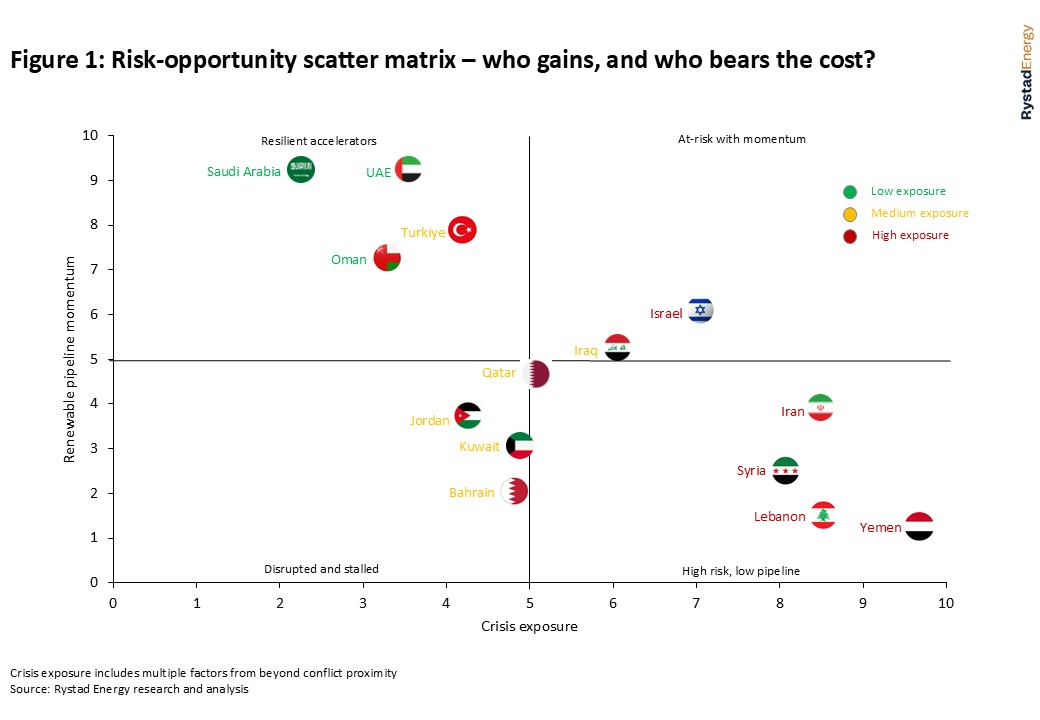
The crisis is expected to result in a net delay of between three and 12 months across the active renewable energy pipeline in the Middle East, while simultaneously strengthening the medium to long-term strategic commitment to the energy transition. The overall effect is a short-term delay followed by a sharper medium-term acceleration in Saudi Arabia, the UAE, Oman, and Turkiye, while Qatar, Kuwait, Iraq, Bahrain, and Jordan are expected to face moderate delays with recovery contingent on market stabilization. Additionally, Iran, Israel, Syria, Lebanon, and Yemen remain high risk and are likely to face prolonged delays in renewables deployment (Figure 1).
Renewable Energy

Supply chain disruption

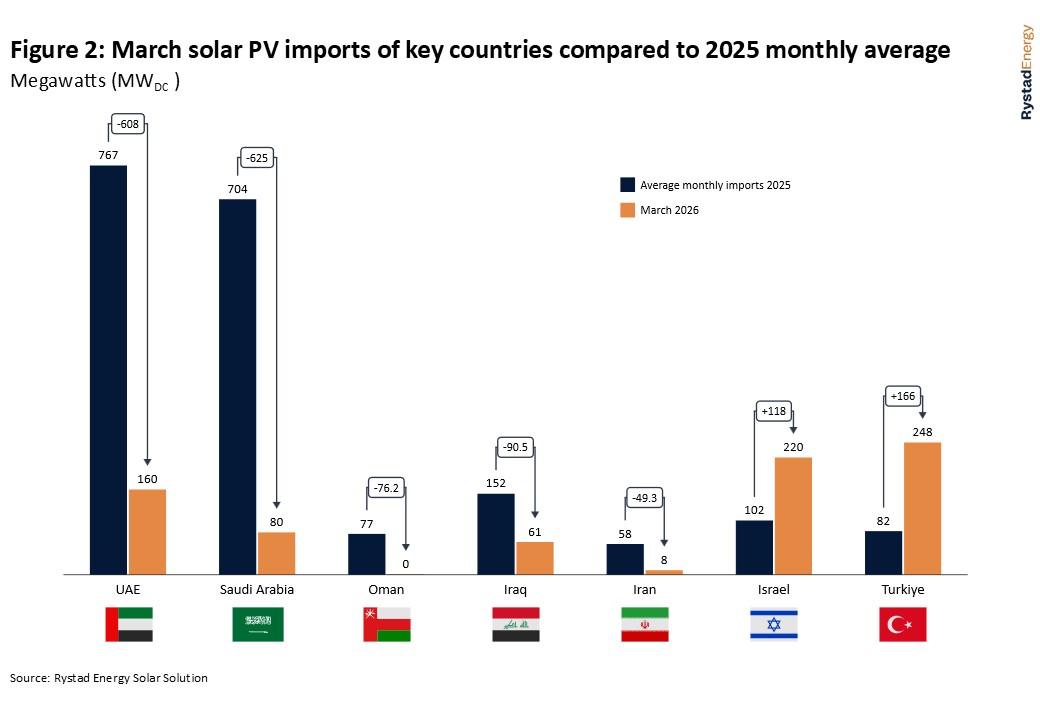
There is a clear disruption across key maritime routes that is already pushing back project timelines. While other regions have registered high module imports due to China's elimination of the VAT export rebate on 1 April, the Middle East region lagged behind. The March 2026 solar PV imports collapsed against 2025 monthly averages across every Persian Gulf market- the UAE fell 608 MW from 767 MW to just 160 MW, Saudi Arabia dropped 625 MW from 704 MW to 80 MW, and Oman fell to zero from 77 MW. The contrast with Türkiye importing 248 MW (+166 MW above its 2025 average) and Israel at 220 MW (+118 MW), reflecting their independence from Hormuz and Red Sea routing (Figure 2).

The impact is more severe because multiple cost pressures have materialized simultaneously. The freight rates for the Asia-Mediterranean route are up from $2,826/FEU in late February to $3,594/FEU by early April. Additionally, China's elimination of the VAT export rebate on 1 April added a direct 9% cost impact on module pricing, while silver prices in the USD 70–80/oz range are pushing up cell costs, prompting OEM suppliers, EPC contractors and developers to revisit signed contracts, repricing risk, and consider redirecting capital toward more stable, lower-risk markets within the Middle East.

The region's highly competitive auction market, which results in world-record bids in the range of USD 10.5 - USD 20/MWh, gives a thin margin to the developers. To achieve this, the CAPEX intensity for these projects is already at a lower end. Multiple cost pressures and with war risk premium now being embedded into project finance, EPC contractors are repricing force majeure and logistics exposure into new bids. Countries like Kuwait, progressing to awarding their first large-scale solar projects totaling 1.6 GW, are particularly vulnerable to this repricing. For projects that have already reached financial close across the Middle East, the result is margin compression.
Solar pv

Middle East solar module manufacturing capacity is expected to grow from 4.7 GW in 2025 to 35.8 GW by 2030 — a sevenfold expansion in five years. Türkiye, already plateaued at 22.2 GW of domestic manufacturing capacity from 2026 onward, is effectively import-independent for solar modules and fully insulated from any future Hormuz disruption.

The financial incentive for renewables deployment for oil and gas-exporting Gulf states such as the UAE, Saudi Arabia, Qatar, Kuwait, and Iraq has strengthened under this crisis. At more than $90 per barrel of Brent crude oil and between $15 and $20 per million British thermal units of LNG, every megawatt of solar or wind deployed domestically frees up hydrocarbons for export at elevated prices. The opportunity cost of burning liquids/gas in a domestic power station has never been higher. However, the effective closure of the Strait of Hormuz remains a significant constraint for countries reliant on the route for exports. Gulf renewables programs are facing logistical and financial delays, not strategic ones, and striking the right balance between restoring hydrocarbon exports and renewables deployment will result in an optimal outcome.

By Rystad Energy

Who Really Rules Iran Now?

  • The IRGC has emerged as the dominant force in Iran following Ali Khamenei’s death and Mojtaba Khamenei’s limited public role.

  • Hard-line military and security figures now wield growing influence over Iran’s domestic politics and foreign policy.

  • Reformists and moderates remain sidelined as competing power centers shape Iran’s postwar future.

For decades, power in Iran was centralized in the hands of a single man: Supreme Leader Ayatollah Ali Khamenei. But since his killing at the onset of the US-Israeli war with Iran on February 28, decision-making in Tehran has become increasingly decentralized, experts say.

Mojtaba Khamenei has not been seen in public since he succeeded his father in early March. In his absence, a cohort of senior Iranian officials have been effectively running the country.

The Islamic Revolutionary Guards Corps (IRGC), a dominant political player, has now become the decisive force in Iran, experts say. Reformists and moderates have been relegated to the political fringes, leading to a more hard-line and ideologically rigid system.

Key power centers and figures have emerged in what some observers call the Islamic republic 3.0. While many of these figures are aligned on major policies, some fissures have surfaced.

Mojtaba Khamenei: New Supreme Leader

As supreme leader, the 56-year-old has the ultimate say on all state matters. But his authority has been undermined from the outset.

Khamenei was a controversial pick as supreme leader. The cleric had never held public office, and some argued a move toward "hereditary rule" would betray the very anti-monarchist roots of the Islamic Revolution in 1979.

Seriously wounded in the same Israeli air strike that killed his father, Khamenei has also been absent from public view since his appointment on March 8. He suffered injuries to his head, lower back, and foot but was now "in complete health," Mazahar Hosseini, head of protocol in the supreme leader's office, said on May 8.

US intelligence has said it believes Khamenei plays a prominent role in war strategy and managing peace talks with the United States. But in a system where the supreme leader is omnipresent -- issuing audio messages, making video addresses, and appearing in public to display his authority -- his absence is striking.

"Iran has entered a period of transition after the death of Ali Khamenei and the end of his 36-year leadership," Ali Afshari, an Iranian political analyst based in Washington, told RFE/RL's Radio Farda. [It's] a challenging period in which the postwar alignment of forces will be decisive."

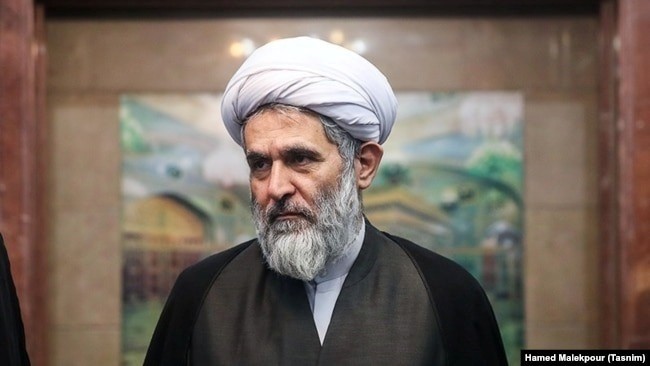
Hossein Taeb: Behind-The-Scenes Operator

A hard-line cleric, Taeb led the IRGC's intelligence branch for 13 years until 2022, when he was dismissed as part of a major security shakeup.

Hossein Taeb
Hossein Taeb is a longtime confidant of Iran's new supreme leader and considered a key figure behind the scenes.

Taeb, who is blacklisted by the United States and European Union for his alleged role in state repression, worked in the supreme leader's office before he was appointed as the IRGC's intelligence chief in 2009.

A longtime confidant of the younger Khamenei, Taeb is considered a key figure behind the scenes. Experts say he could play an important role in managing Khamenei's relationships with key players inside the system.

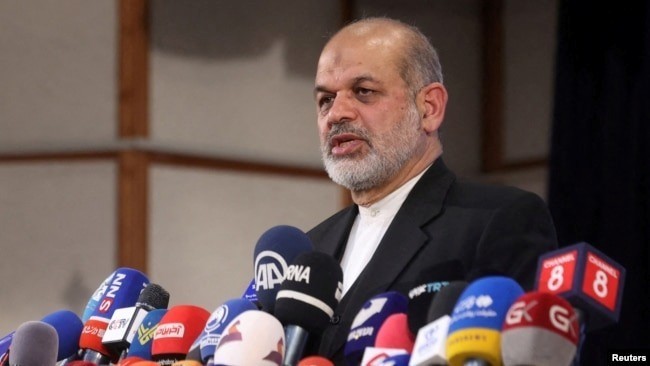
Ahmad Vahidi: IRGC Chief

The IRGC, the elite branch of Iran's armed forces, has always played a key role in politics. But it is now the dominant political force in the Islamic republic after the killing of Ali Khamenei.

That's despite Israel and the United decimating the leadership of the IRGC, including killing its commander in chief, Mohammad Pakpour.

Ahmad Vahidi
Ahmad Vahidi, a former interior and defense minister, took over the IRGC in March.

Pakpour's deputy, Ahmad Vahidi, a former interior and defense minister, took over the IRGC in early March. But experts say it is unclear if Vahidi has the clout and credibility to unite the competing factions within the IRGC.

Experts say the war and the securitization of Iran following Ali Khamenei's death has allowed the IRGC to pay a central role in the domestic and foreign affairs of the country.

"The era after Ali Khamenei remains ambiguous. However, one key fact is visible: the increasing role and power of the IRGC in the administration of the Islamic republic," Mojtaba Najafi, a France-based Iranian political commentator, told RFE/RL's Radio Farda.

"Today, a significant part of the country's administration is in the hands of the IRGC," he added. "Militarization in the economy, politics, culture, and society has also now reached a stage of maturity."

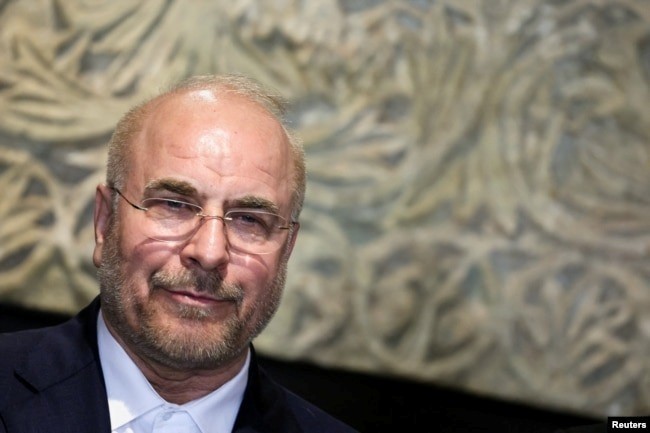
Mohammad Baqer Qalibaf: The Intermediator

Qalibaf is a conservative politician and former military commander who spent decades cultivating ties to Iran's supreme leadership and the IRGC.

After a career overshadowed by corruption scandals and failed presidential bids, he arguably finds himself as the most powerful figure left standing in the Islamic republic.

Experts describe the role of Qalibaf, the parliament speaker who is also Iran's top negotiator with the United States, as a mediator between the different centers of power in Iran. He is considered close to the new supreme leader.

Baqer Qalibaf
Mohammad Baqer Qalibaf, the parliament speaker who is also Iran's top negotiator with the United States, is as a mediator between the different centers of power in Iran.

This was the role played by Iran's powerful security chief Ali Larijani before his assassination in March. Larijani was a unifying figure who brought together competing political factions and maintained strong ties with the IRGC, intelligence apparatus, and clerical establishment.

"Qalibaf has always been a pawn" used by the leadership, Hossein Razzaq, a political analyst based in Germany, told Radio Farda.

"Today, with the elimination of other key pawns, the role he plays for the system has become more prominent."

Mohammad Baqer Zolqadr: Security Chief

A former commander in the IRGC, Zolqadr succeeded Larijani as the head of Iran's Supreme National Security Council, the country's key policymaking body.

While Larijani was known as a shrewd and pragmatic politician, Zolqadr is a hard-line security and military official.

Razzaq considers the general's appointment as an attempt by Khamenei to divide power among his loyalists. His selection, he said, also underscored the dominance of the IRGC in the different centers of power in Iran.

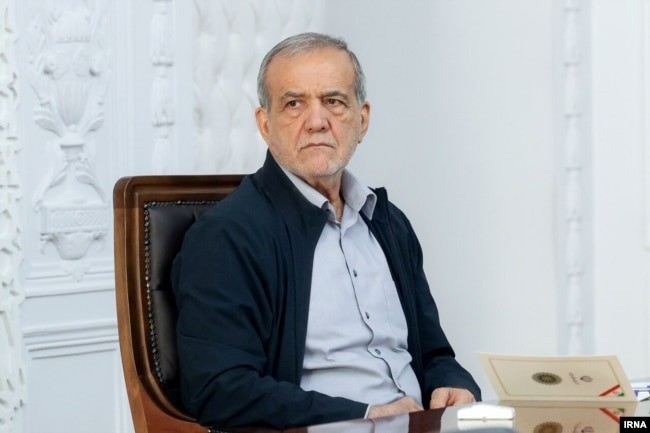
Masud Pezeshkian: The Powerless President

The reformist president is not a major political player and not considered a threat by the hard-liners who dominate the system.

Masud Pezesh
Iranian President Masud Pezeshkian

Pezeshkian's role is administrative, running the day-to-day affairs of the government. But the final decision on major issues, including war and diplomacy, is made elsewhere.

He and Foreign Minister Abbas Araqchi are the only members of the reformist and moderate political camps to play a visible role in the new power structure. Like Pezeshkian, Araqchi does not have decision-making power but follows orders from above.

Still, differences have emerged that pit figures like Pezeshkian and Araqchi who are pushing for diplomacy against generals who oppose making concessions to the United States in negotiations to end the war.

By RFE/RL

Chinese Tankers Resume Hormuz Transit Under Iran Coordination

  • During Donald Trump’s visit to China, Washington and Beijing agreed that no country should impose tolls or restrictions on shipping through the Strait of Hormuz.

  • Iranian state media said around 30 Chinese vessels have been granted safe passage through Hormuz in coordination with Iran’s IRGC naval forces.

  • China is pushing to restore Persian Gulf energy flows as it remains heavily dependent on Middle Eastern oil imports

During President Trump's ongoing state visit to China, he and President Xi Jinping agreed that the ‌Strait of ‌Hormuz must be open for ‌the free flow of energy. They along with their senior officials have expressed agreement that no country can be allowed to exact shipping tolls in the Strait of Hormuz.

Following this, Thursday saw Iranian state media proclaim that some 30 Chinese vessels are being allowed safe passage by IranBloomberg also reports, "The vessels were allowed to pass the Strait of Hormuz with the coordination of the Iranian authorities and Islamic Revolutionary Guard Corps’ navy, state TV reports, citing an IRGC naval official." While it's as yet unknown or unclear whether the US Navy side of the de facto blockade will also let them pass, Reuters has also reported the following:

Iran ‌has begun allowing some Chinese vessels to transit through the Strait of Hormuz following an understanding over Iranian management protocols for the waterway, the semi-official Fars news agency said on Thursday, citing an informed source.

via Reuters

In particular the move also follows formal requests by China's foreign minister as well as Beijing's ambassador to Iran, with Tehran reportedly agreeing based on safeguarding the two allies' strategic partnership.

Bloomberg cited the IRGC official as saying of the Iranian protocol for passage, "A new era in the Strait of Hormuz has started as many countries of the world and fleets have accepted that the best, quickest and simplest way for transiting this very important waterway is only though coordination with the IRGC’s naval forces."

This was after Wednesday saw the key milestone of a Chinese supertanker carrying 2 million barrels of Iraqi crude having successfully passed through the Strait of Hormuz, after previously being stranded for more than two months.

Also of note is that the Chinese Cosco Shipping tanker did not have to pay tolls. According to The Wall Street Journal:

Lloyd’s List Intelligence data show the Yuan Hua Hu crossed the waterway through the corridor in the north controlled by the Islamic Revolutionary Guard Corps.

Ship trackers said the vessel switched off its transponder while sailing from an anchorage in Dubai towards Larak, then came back online for a couple of hours before going dark again. Ships crossing through Larak pay an average of $2 million each, according to brokers.

The Yuan Hua Hu is the third Chinese state-owned tanker to leave the Gulf since the start of the war.

State Department spokesperson Tommy Pigott emphasized earlier this week that Washington and Beijing "agreed that no country or organization can be allowed to charge tolls to pass through international waterways like the Strait of Hormuz."

China imports the bulk of its energy from the Middle East, and while it has amassed substantial crude oil stockpiles that are helping it weather the worst of the crisis - anecdotally over 1.4 billion barrels - restoring normal flows from the Persian Gulf is important for one of the world’s top energy importers.

By Zerohedge.com

India’s Oil Crisis Deepens as Hormuz Remains Shut

  • The rupee hit a new all-time low this week and foreign investors have pulled more than $20 billion from Indian equities in the first four months of 2026, already surpassing last year’s full-year record outflows.

  • India’s GDP growth is forecast to slow to 6.7% in fiscal 2026/2027 from 7.7% last year, with analysts warning fuel price hikes are likely in Q2 if the Middle East conflict drags on.

India’s economic pains are intensifying every day that the Strait of Hormuz remains closed.

Two and a half months after the Middle East conflict began, one of the highest-performing emerging markets in recent years and the world’s third-largest crude oil importer is scrambling to contain the oil shock that is spreading to consumer prices, foreign exchange reserves, and economic growth.

Since the war began and cut off over 40% of India’s crude oil flows, those that passed through the Strait of Hormuz, one of the highest-flying economies in Asia has seen its oil import bill soar, investors fleeing the capital market, and the local currency plunging to an all-time low against the U.S. dollar.

Analysts have started to raise inflation estimates and reduce forecasts of this year’s economic growth in India, which is beginning to feel the oil supply shock well beyond the actual disruption of deliveries of oil, LNG, and liquefied petroleum gas (LPG), the primary cooking fuel in the world’s most populous country.

Fuel Crunch

While India still has enough supply and reserves of all these fuels for dozens of days, authorities are urging conservation to reduce consumption and the resulting strain on public finances and foreign exchange reserves and rates.

India’s Prime Minister Narendra Modi this weekend urged Indians to curb gasoline and diesel consumption, use public transportation where possible, and car pool as much as possible.

“Measures such these will help the nation conserve energy, save on the energy import bill and overcome the challenges arising out of the serious military conflict involving many energy producing nations,” Oil Minister Hardeep Singh Puri said.

Some LPG tankers have passed through the Strait of Hormuz since the war began, including one that exited the chokepoint for the first time since the U.S. blockade was placed mid-April.

Meanwhile, India is paying higher prices for LPG imports from elsewhere, as well as higher prices for crude oil that doesn’t need to pass through the Strait of Hormuz, pressuring the current account and foreign reserves.

The government, while urging fuel conservation, is avoiding any panic rhetoric. Puri, the oil minister, earlier this week said that India doesn’t have a supply issue and it has 69 days’ worth of crude oil stocks and 45 days of LPG supply.

To address the collapse of LPG supply from the Middle East, India has asked state refiners to maximize the output of the cooking fuel, and redirected LPG supply from industrial users to household consumers.

To shield consumers from high gasoline and diesel prices, India has kept prices at the pump much lower and has cut taxes on gasoline and diesel.


Economic Pain

But this policy is hitting local oil marketing companies (OMCs).

“Our energy sector is absorbing the brunt of the impact,” Puri said.

“OMCs are buying crude, gas and LPG at higher cost, but in order to protect consumers, they are selling final products at lower cost leading to massive mounting losses of up to ?1,000 crore per day. However, the OMCs have ensured uninterrupted energy imports and supply,” he added.

This policy may not be sustainable for much longer, and eventually retail fuel prices would have risen if the supply shock from the Middle East persists, analysts say.

“I am assuming that sometime in Q2, rather sooner than later, they will have to hike retail fuel prices because neither the fiscal buffers nor (the) buffers with the OMCs (oil marketing companies) are enough to withstand a prolonged shock,” Dhiraj Nim, an economist at ANZ bank, told Reuters last week.

The energy sector is not the only one suffering from the war-induced oil shock. India’s currency, the rupee, hit a new all-time low against the dollar on Wednesday amid high oil prices and importer demand for hedging.

PM Modi’s call on Indians this weekend also included urging citizens to reduce foreign travel and gold purchases to help conserve foreign currency reserves, which India is splashing for increasingly costly imports because of the higher oil prices.

Due to the higher oil prices, India’s annual inflation accelerated in April from March, although it was below projections. But analysts warn further acceleration is in the cards in the coming months if the Middle East crisis drags on.

If the Strait of Hormuz remains closed for more months, India’s central bank may have to intervene with monetary policy and India may have to eventually raise gasoline and diesel prices, Reserve Bank of India (RBI) Governor Sanjay Malhotra said this week.

Moreover, a massive withdrawal of foreign investors from the local capital markets is also weighing on forex reserves. Foreign investors pulled more than $20 billion out of Indian equities in the first four months of 2026, government data showed this week. These outflows have already topped last year’s record annual withdrawals, as investors have become averse to India and other emerging markets amid the Iran war.

The oil shock that the war has created will weigh on India’s economic growth in the current fiscal year to March 2027. BMI, part of Fitch, expects India’s GDP growth to slow to 6.7% in the 2026/2027 fiscal year, down from 7.7% in 2025/2026, largely due to the oil price shock.

By Tsvetana Paraskova for Oilprice.com


StanChart Warns Physical Oil Premium Collapse May Be Temporary

  • Physical oil premiums have fallen sharply after spiking during the Hormuz crisis, as buyers delayed purchases, drew down inventories, reduced refinery runs, and relied on alternative non-Middle Eastern supplies.

  • Analysts at Standard Chartered expect physical crude prices to rebound once reserve releases end and refinery demand rises again, unless a geopolitical deal eases supply disruptions.

  • U.S. crude exports reached an all-time record high of 6.4 million barrels per day (bpd) for the week ending April 24, 2026, eclipsing the previous high of 5.3 million bpd set in late 2023.

Over the past couple of months, physical oil cargo premiums have surged as markets reacted to the threat of physical supply disruption, forcing buyers to pay significantly higher prices for guaranteed, prompt delivery of crude oil. As the conflict escalated and Iran blocked the Strait of Hormuz, buyers scrambled to secure immediate, non-Middle Eastern "prompt barrels", driving up the spot price premiums for available cargoes. North Sea Forties crude spiked to nearly $150 a barrel by mid-April, exceeding the 2008 peak. Many commodity experts predicted that oil futures would eventually trade up to the physical; however, we have lately been seeing just the opposite, with the physical trading down to the futures. Whereas physical prices still indicate market tightness, they have recently returned to a more normal range. Dated Brent (the primary physical benchmark for crude oil in the North Sea) settled just $0.43/bbl higher than front-month Brent on 11 May, good for a w/w fall of $11.31/bbl. Saudi Aramco’s official selling price (OSP) remains historically high; however, June saw m/m reductions to both Europe (~2/bbl) and Asia (~4/bbl) after May’s OSP recorded the largest ever m/m price increase. And now commodity experts at Standard Chartered have predicted that this downward adjustment will reverse before long.

According to StanChart, physical oil cargo premiums have collapsed--with some grades dropping 90%--due to a combination of intentional buyer restraint, increased reliance on inventory and increased supplies from non-disrupted regions. 

The sharp fall in the price of physical oil can be chalked up to buyers remaining hopeful the Iran conflict would be resolved rapidly, at least in terms of the Strait of Hormuz blockades, and were dissuaded from purchasing cargoes at extremely elevated prices. High volatility and regular price swings in excess of $10/bbl in a day (front-month Brent traded in a $35/bbl intraday range on 9 March ) have increased the risk of a VaR shock i.e., an acute increase in Value at Risk.

Deferring purchases in the near term has also allowed buyers to benefit from strategic reserve and inventory drawdowns, reduced refinery run rates (and adjustments to maintenance schedules), and alternative supply sources, which have cushioned oil price spikes.

StanChart says physical prices are likely to rise once more when purchases can no longer be deferred, refinery runs pick up and strategic reserve releases are complete, unless a deal to end the conflict can be agreed. This will likely eventually pull futures prices up towards elevated physical benchmarks.

U.S. producers continue to be among the primary beneficiaries of the ongoing energy crisis. According to the latest data from the U.S. Energy Information Administration (EIA), U.S. crude exports reached an all-time record high of 6.4 million barrels per day (bpd) for the week ending April 24, 2026, eclipsing the previous high of 5.3 million bpd set in late 2023. Combined U.S. crude oil and refined petroleum product exports hit a record peak of 12.9 million bpd in the same week. International refiners, particularly across Asia and Europe, are aggressively buying American light sweet shale oil to replace stranded Persian Gulf barrels.

Asian buyers, particularly in Japan, South Korea, and Taiwan, have sharply increased purchases. To meet this massive international demand, the U.S. has drawn heavily from commercial storage and the Strategic Petroleum Reserve (SPR), pulling down domestic inventories by over 2 million bpd. The Trump administration has initiated the sale of ~53 million barrels of crude oil from the SPR  to nine energy companies, and is working toward a total release of 172 million barrels.  This move is part of a coordinated international effort with the IEA to release roughly 400 million barrels worldwide following supply disruptions in the Middle East.

The European Union Aviation Safety Agency (EASA) recently authorized the broader use of US-grade Jet A fuel in Europe, over the standard Jet A-1 specification with “no regulatory obstacles”. By allowing the use of US-grade jet fuel, the supply pool has been effectively enlarged, removing some of the reliance on imports from the Middle East. However, Jet A has a higher freezing point than Jet A-1, meaning it’s mostly useful for lower altitude, short-to-medium haul flights. The development has allowed Jet fuel differentials to come off recent highs while front-month contracts are now in contango. The U.S. has maintained healthy jet fuel inventories, remaining above seasonal norms and in excess of the five-year range at 43.57 million barrels on 1 May. Meanwhile, inventories in Europe, as evidenced from measures in the larger Amsterdam-Rotterdam-Antwerp (ARA) region, have tightened quickly, falling from ~1.1 million metric tonnes (Mt) held from September to end-December 2025, to just 0.56Mt in the latest weekly data.

By Alex Kimani for Oilprice.com