What you need to know as the deadline for formally extending CUSMA approaches
Updated:
WASHINGTON — A major benchmark is coming up for the Canada-U.S.-Mexico Agreement on trade, known in Canada as CUSMA.
July 1 is the deadline for the three countries to either formally extend the agreement for 16 years or continue under annual reviews.
Here’s what you need to know about the mandatory review:
Where does each country stand on CUSMA?
Canada and Mexico sent letters to Washington recently indicating that both want to extend the agreement for 16 years to 2042.
The Trump administration has not publicly stated its intention but signals from U.S. President Donald Trump and other officials have strongly suggested the United States will blow past the deadline.
Trump said earlier this month that he is “not looking to renew” the agreement.
Greta Peisch, the former general counsel for the Office of the U.S. Trade Representative, said the Trump administration is expected to refrain from agreeing to extend CUSMA in July.
“If that is the case, the parties will discuss what changes could be made to address concerns about the operation of the agreement,” Peisch, a partner at Wiley Rein in Washington, D.C., said in an email.
“The parties have already started this conversation, particularly between Mexico and Canada.”
What happens if there is no extension on July 1?
The trade pact will remain in place even if the United States doesn’t agree to extend CUSMA on July 1.
Peisch said CUSMA will continue for another 10 years before “automatically terminating if the parties can’t come to agreement on extension.”
In the near term, Peisch said, the countries will continue to negotiate possible changes to the agreement that could lead to an extension.
Negotiations between Mexico and the United States have launched but Ottawa and Washington have not started official talks yet.
Canada-U.S. Trade Minister Dominic LeBlanc has met recently with United States Trade Representative Jamieson Greer in Washington and on the sidelines of the G7 in France.
The three countries will continue to talk until they either agree to extend the deal or let it expire in 2036.
Can a country leave CUSMA?
If the United States does not agree to the extension on July 1, the trade agreement stays in place unless one of the countries gives six months’ notice that it is pulling out of CUSMA.
Canada and Mexico both have indicated they want to keep the trilateral deal in place.
Trump has rattled the agreement’s future by calling it “irrelevant.” He also has said it may have served its purpose.
Greer has said both that he’d be open to two separate bilateral agreements and that there are “pillars” of the continental trade pact that work well.
Given how integrated many industries are in North America, most experts do not think the United States would be quick to leave the agreement.
Many business, agriculture and lobby groups have told Congress that CUSMA is important to their industries while also calling for some changes to the trade pact.
Do changes to CUSMA have to be passed by U.S. Congress?
CUSMA was negotiated during the first Trump administration to replace the North American Free Trade Agreement. It was approved by Congress — which has authority over trade agreements — with strong bipartisan support.
But Peisch said the Trump administration may take the position that modifications to CUSMA don’t require a change to U.S. law and therefore don’t need to be approved by Congress.
“The (CUSMA) implementing bill contains procedures for making many changes to tariffs and rules of origin, and many other provisions could be amended without impacting U.S. law,” Peisch said.
Prime Minister Mark Carney has said that the Trump administration has made it clear it doesn’t want to bring the agreement to a vote in Congress by changing the “fundamental architecture” of the trade pact.
This report by The Canadian Press was first published June 17, 2026.
Kelly Geraldine Malone, The Canadian Press
Carney says he had several talks with Trump during G7 despite no official meeting
Updated:
ÉVIAN-LES-BAINS — Prime Minister Mark Carney says he had several informal discussions with U.S. President Donald Trump during the G7 summit in France, despite not having an official meeting.
Carney told reporters during the final day of the summit Wednesday that the president only had scheduled bilateral meetings with French President Emmanuel Macron and Indian Prime Minister Narendra Modi.
While Macron is the only G7 leader Trump has met with at the G7 so far, he has held bilateral meetings with the leaders of Qatar and the United Arab Emirates.
On Wednesday, he had meetings scheduled with the leaders of Egypt and India.
“I had seven or eight discussions with President Trump over the course of the last 36 hours,” Carney told reporters in the picturesque resort town of Evian-les-Bains in the French Alps.
He said they spoke about the economy, artificial intelligence, Ukraine and the U.S.-Iran peace deal. Carney also said he got Trump a birthday present and that he “likes it a lot.”
Asked why no bilateral meeting took place, Carney said: “There’s no message in that.”
The summit was delayed by a day after Trump announced that the White House would host a UFC fight on June 14, which is Flag Day in the United States and was Trump’s 80th birthday.
On Sunday, U.S. President Donald Trump announced an agreement to end the war in Iran and that he had authorized an end to the U.S. blockade in the Strait of Hormuz. He later said the strait wouldn’t open until Friday when the deal is set to be signed in Switzerland.
In a Tuesday interview with CNN, Carney said he had seen the preliminary agreement for Iran and it “exceeded” his expectations.
He said Canada will do what it can to help put the deal in place.
“It creates a possibility of a game changer,” Carney told reporters Wednesday, adding there has been a change in tone and possibilities in Lebanon and in Ukraine.
“The very fact of it, and the fact that so many countries were involved in its development and are vested in its development, does create positive knock-on effects.”
Carney said there’s no Canadian money involved in the deal.
The summit comes as trade talks between Canada and the U.S. remain tense, with no clear decision on whether to extend the Canada-U.S.-Mexico Agreement, or CUSMA.
Canada-U.S. Trade Minister Dominic LeBlanc met with U.S. Trade Representative Jamieson Greer on the sidelines of the G7.
Canada recently agreed to reduce its 100 per cent tariff on Chinese-made electric vehicles to 6.1 per cent, with an annual import cap of 49,000 vehicles -- about three per cent of Canada’s market. In turn, China suspended its retaliatory tariffs on Canadian agricultural products.
Trump previously criticized the deal, threatening new tariffs and saying Canada wouldn’t be allowed to be a “drop-off port” for Chinese vehicles to enter the U.S.
But on Tuesday, Carney was heard telling Trump about Canada’s plan. The president responded: “That’s good, I like it.”
Carney later told reporters they had a followup conversation about it.
“We are only interested in Chinese investment in Canada when it’s material Canadian production,” Carney said. “We’re not interested in kits being put together in Canada.
“We will only do what’s in the interest of Canadian consumers (and) Canadian workers.”
While at the summit, Carney met with the leaders of Ukraine, United Arab Emirates, India, Italy, South Korea and Germany.
During his meeting with Modi, Carney said the countries are aiming to complete their trade agreement by the G20 summit later this year.
Tuesday also included Canadian announcements of more sanctions on Russia and talks to purchase military jets from Italy.
Over the course of the summit, G7 leaders issued six joint statements, making several pledges such as reforming how developing countries access financing, collaborating more on cancer research and responding to Ebola.
There was also a commitment to preventing the smuggling of migrants and tackling drug trafficking.
In a statement on geopolitical issues, the leaders said they stood united in their support for Ukraine and the peace deal between the U.S. and Iran.
The document said the leaders recognize “the breakthrough and the opportunity” in the Middle East and that they support and are ready to contribute to the implementation of the peace deal between the U.S. and Iran. It also said they committed to accelerate the diversification of energy supply routes to reduce global vulnerability to the Strait of Hormuz and to increase our energy stocks.
“We welcome the potential for Canada to deliver significant additional capacity to global markets in coming years,” said the document.
On Wednesday, Carney said there’s diversification within that region so not all energy is coming out through the strait, but not enough.
“There’s intention to build out a series of energy infrastructure there. Canada has the ability to do several things, and we’re on the path to do several things,” he said, noting liquefied natural gas and the expansion of the Trans Mountain pipeline, which he said will go ahead.
In another document, the leaders said they stand united in their “unwavering” support for Ukraine in defending its freedom, sovereignty and territorial integrity. They said they agreed to increase defence supports and consider extending licences to allow for an increase in Ukraine’s military production.
The leaders also said they would strengthen their sanctions on Russia, including those on the oil and gas sectors.
Before returning to Canada, Carney is taking part in a G7 working session on economic growth and will attend a luncheon with AI companies.
Earlier this month, the Liberal government introduced an online harms bill that includes a plan to force social media companies to ban kids under 16 from their platforms. Bill C-34 would also regulate AI chatbots.
International support for age restrictions on social media has been mounting since Australia became the first country to introduce a ban, with countries including Malaysia, Brazil, Indonesia, Britain, France, the U.K., Spain, Denmark, Thailand and South Korea introducing or considering similar measures.
This report by The Canadian Press was first published June 17, 2026.
Catherine Morrison, The Canadian Press
RBC CEO downplays tensions, confident Canada-U.S.-Mexico trade will last
Updated:
RBC’s chief executive says trade talks with the United States are part of a normal process and that ultimately, the CUSMA agreement is too important to Canada, Mexico and the U.S. for any of them to walk away.
Speaking at an event hosted by Bloomberg on Tuesday, CEO Dave McKay played down suggestions the relationship between the U.S. and Canada is increasingly fraught at a time when the bank has been expanding south of the border.
He says trade between the two countries remains strong and largely balanced, even as Canada continues to diversify its trade relationships with other countries outside of North America.
“We want to maintain our $1.3 trillion relationship with the United States and grow that at the same time,” he said of diversified trade.
The Canada-U.S.-Mexico trade agreement is approaching a July 1 deadline for the countries to rubber-stamp an extension, but McKay noted the agreement will remain in place until at least 2036 regardless.
McKay says trade negotiations aren’t out of the ordinary as economies evolve, and that he’s confident the countries will come to an agreement over time, even though it’s a protracted process.
However, an unresolved CUSMA negotiation is muting businesses’ appetite for spending in Canada compared with the U.S., which continues to be in risk-on mode, McKay said.
“We’re certainly seeing some demand coming out of (the) Canadian economy, but I would say it’s slowing,” he said.
Meanwhile, RBC is open to taking on more risk in the U.S. as that economy performs well and supports a larger part of the bank’s balance sheet, he said.
There’s higher demand for investments in the U.S. as AI startups and hyperscalers suck up all the capital in the markets.
“There’s also, on the other side, a fear of: Will there be enough capital for all demand out there?” he said. “It’s driving a huge amount of not only bank-to-bank debt ... but also high yield issuance and equity issuance.”
Aside from dominating the markets, AI has also enthralled the RBC CEO’s personal life.
“I get lost in it a little bit,” he said of a suite of agentic CEO office tools custom-made for him.
“I would spend at least an hour on it in the morning.”
McKay said the agentic models keep him updated on the goings-on within and outside the bank. A range of those agentic models synthesize information on the macro economy, global economy, banks’ forecasts, foreign exchange and even markets and consumer behaviour.
“I can get a feel for how the consumer is behaving and I can link that back into what the economy’s doing,” he said.
“It gives me this unique view on understanding external and internal at the same time.”
RBC hasn’t disclosed how much it has invested in its AI capabilities, but it spends more than $5 billion a year on technology, according to a piece from American Banker from March that was reposted by RBC. The bank is expecting AI investments to generate between $700 million and $1 billion in revenue and cost savings by next year.
McKay said AI at RBC will enable employees to serve more customers efficiently as the back-office work gets simplified and offer expansion capabilities.
“We’ll be more efficient, we’ll maybe need less people, but a lot of that’s coming through attrition and through demographic change,” he said. “We need that in our society. We need these tools.”
---
Ritika Dubey, The Canadian Press
This report by The Canadian Press was first published June 16, 2026.
Head of Canada’s top bank says U.S. trade deal too crucial to ‘cancel’
Published:
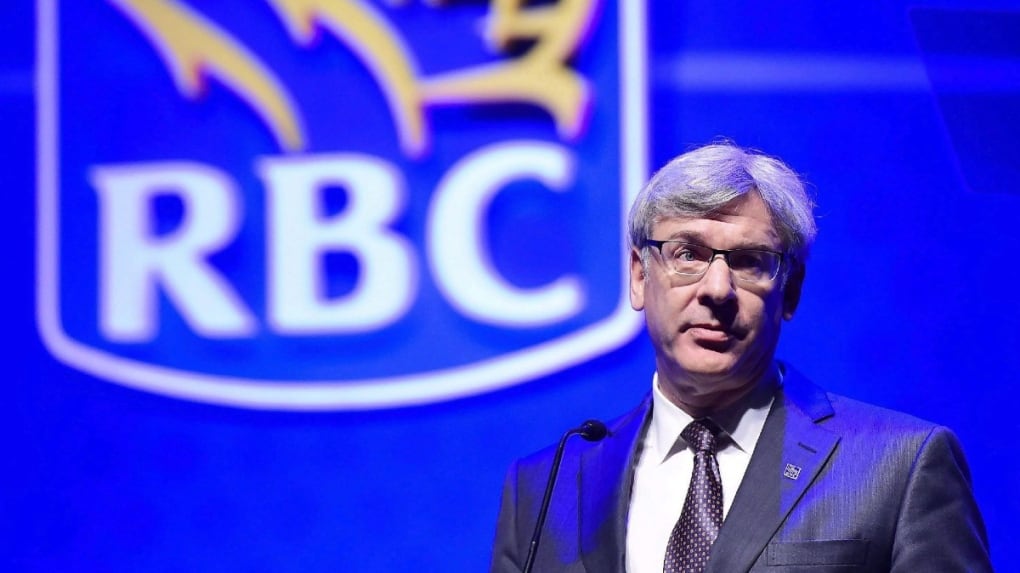 Royal Bank president Dave McKay speaks in Toronto on April 6, 2017. (Frank Gunn / THE CANADIAN PRESS)
The North American free trade agreement is too important for the United States, Canada and Mexico to ditch, the head of Canada’s largest bank said Tuesday, voicing confidence the deal would endure.
U.S. President Donald Trump said last week that he was not “looking to renew” the agreement known as the USMCA, which he signed and praised during his first term.
If it is not renewed by July 1, the USMCA will remain in force but will be subject to annual reviews, unless one party withdraws entirely.
Trump has described the deal as “irrelevant” and insisted the United States does not need anything Canada produces.
For Royal Bank of Canada CEO Dave McKay, the fact that there has been no discussion of terminating the USMCA is crucial.
“There’s been no mention of cancelling the agreement,” McKay told reporters in Toronto at an event hosted by Bloomberg.
“Cancellation means you’re giving notice of a permanent withdrawal. This agreement is too important to the United States and to Canada and to Mexico, I believe, to cancel,” he said.
McKay was asked about a core message of Prime Minister Mark Carney’s government: that Canada needs to reduce its reliance on the United States, a historically vital ally that Carney says Canada can no longer trust.
McKay said trade diversification was crucial for Canada.
“Canada has 80 percent of its trade with the United States,” he said, stressing that if he were advising a client whose business was 80 percent reliant on one customer, he would suggest they “diversify a little bit to de-risk that.”
But he said broadening Canada’s overseas markets should come as an addition to US trade, not a replacement.
“We want to maintain our CAN$1.3 trillion ($930 billion) relationship with the United States,” he said.

.jpg)