Sunday, June 21, 2026

New Poll Finds Most Americans Back Adopting Popular Vote to Select President

Americans back abolishing the Electoral College by a 2 to 1 margin, the survey shows.

June 18, 2026

An artist rendition of the Electoral College map.Getty Images

A new poll demonstrates strong support for amending the U.S. Constitution to abolish the Electoral College and replace it with a popular vote model.

Under the Electoral College — the archaic system of selecting the president of the United States — states are given electoral votes based on how many members of Congress they have. Candidates obtain these votes by winning statewide races, or, in the case of Nebraska and Maine, by winning individual districts.

In most circumstances, the Electoral College selects the same winner a popular vote model would. But a handful of times in U.S. history — including in the 2016 race won by President Donald Trump — the Electoral College has selected a winner who did not win a majority or even a plurality of votes, choosing the second-place candidate instead.

Although other pathways to implementing a popular vote system are being explored, the most lasting and legally sufficient way to enact such a model would be through a constitutional amendment. According to an Economist/YouGov poll published on Tuesday, a majority of Americans are in favor of such an amendment.

The survey found that 56 percent of Americans would approve of an amendment to abolish the Electoral College and replace it with a popular vote system. Only 23 percent of Americans didn’t like the idea, while another 21 percent said they weren’t sure.

Across the entire 21st century so far, more Americans than not have preferred changing the system of picking the president to a popular vote model. Only in 2016, when Trump won the presidency, did majority support slip to a plurality. After that, voters’ sentiments shifted again, with a majority backing the change ever since.

The dip in support for the idea was likely due to Republican supporters of Trump wanting to preserve the system that helped him win the White House. Following years of decision-making leading to lower approval numbers, this week’s Economist/YouGov poll now shows that even a narrow plurality of GOP-leaning voters support shifting to a popular vote system for the presidential election, with 43 percent backing an amendment for that purpose and 40 percent opposed.

Notably, Trump himself once opposed keeping the Electoral College in place. In 2012, when it initially appeared on Election Night that former President Barack Obama might win the election with only the Electoral College and not the popular vote, Trump wrote on social media that “the electoral college is a disaster for a democracy.”

Even in the week after he won in 2016, Trump insisted he still didn’t like the Electoral College, preferring future elections to be decided by popular vote. Said Trump in an interview:

I’m not going to change my mind just because I won. I would rather see it where you went with simple votes. You know, you get 100 million votes and somebody else gets 90 million votes and you win.

Days later, Trump reversed his position. He has vehemently defended the Electoral College ever since.

The Economist/YouGov poll also asked respondents their views on terminating the 22nd Amendment to the Constitution, which places term limits on presidents. Trump has frequently toyed with the idea of running for a third term, despite the amendment limiting him to the two he has already served.

“No person shall be elected to the office of the President more than twice,” the text of the Amendment states.

In spite of that directive, Trump has claimed in the past that “there are methods” around the 22nd Amendment. He also once stated in an interview that he is “not joking” about the possibility of running again.

Americans largely favor keeping the amendment in place, the poll found, with 70 percent opposed to changing the 22nd Amendment and only 16 percent in favor of lifting its restrictions. Even a majority of people who voted for Trump in 2024, 56 percent, said they want the two-term limit to remain.
ARREST THE FASCIST

Far Right Israeli Minister Ben Gvir to Attend UNCops Conference in NYC in July


Ben Gvir has a long history of hostility toward the UN, including smearing UN staff as “terrorist supporters.”
June 18, 2026

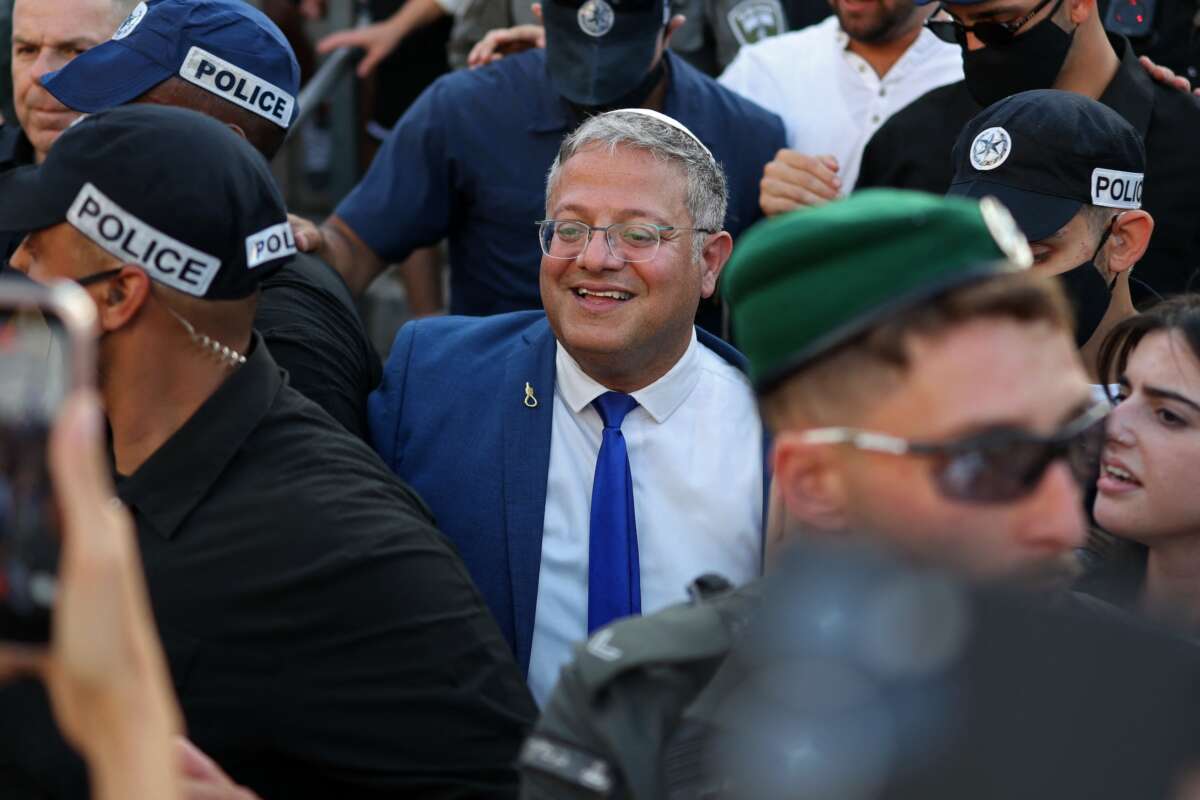
Israel's National Security Minister Itamar Ben Gvir takes part in the Jerusalem Day parade at the Damascus Gate in the old city of Jerusalem on May 14, 2026. Every year, thousands of Israeli nationalists march through Jerusalem and its occupied Old City, including in predominantly Palestinian neighborhoods, waving Israeli flags and shouting inflammatory slogans. Ben Gvir is shown wearing his noose pin celebrating Israel's new death penalty law against Palestinians.Ilia Yefimovich / AFP

Israeli National Security Minister Itamar Ben Gvir — a far right extremist who is notorious for escalating settler violence against Palestinians in the occupied West Bank — is set to attend a United Nations policing conference in New York City in early July.

The UN Chief of Police Summit will be held at the UN Headquarters in New York City on July 7 and 8. The conference, dubbed “Investing in Peace,” will feature security ministers and police chiefs. Discussions will focus on “strengthening international peace, security, and development for all,” a UN writeup claims.

Four previous UN policing conferences have focused on cooperation across law enforcement internationally.

Ben Gvir will lead a delegation from Israel’s national security ministry to the policing conference.


While Ben Gvir is not expected to face difficulties entering the U.S. to attend the conference, Israeli officials are reportedly concerned about the possibility of protests against his presence in New York City.


Ben Gvir Taunts Flotilla Activists, Highlighting Israel’s Abuse of Detainees
Israel is “employing a criminal policy of abuse and humiliation against activists,” said a human rights center. By Shireen Akram-Boshar , Truthout May 20, 2026


Ben Gvir has a long history of hostility toward the United Nations, including smearing UN staff as “terrorist supporters.” Just last month, Ben Gvir decried the UN for its report listing Israel as a perpetrator of conflict-related sexual violence. “The UN’s shameful report proves once again that this organization has lost all moral compass,” he posted on X.

In January, Ben Gvir led the demolition of the UN headquarters in the Sheikh Jarrah neighborhood of East Jerusalem, calling it a “historic day.” Israel has announced that it will construct a military complex in its place.

The security minister has frequently made headlines for his genocidal remarks regarding Palestine and neighboring countries. Last week, Ben Gvir said that Israel should kidnap Lebanese “women and youth” to put pressure on Hezbollah. “Let’s start thinking outside the box about Hezbollah,” he said, suggesting that taking “their women and youth” is what “hurts them the most.”

In May, Ben Gvir posted a video of himself taunting flotilla activists who were physically restrained after Israel kidnapped them in international waters for their attempt to deliver humanitarian aid to Gaza.

Ben Gvir faces sanctions and travel bans from countries including Ireland, France, and the U.K. Francesca Albanese, UN special rapporteur on the occupied Palestinian territories, has repeatedly condemned Ben Gvir, saying that he has institutionalized torture and collective punishment in his control over Israeli police and prisons since 2022.

Ben Gvir has also led numerous incursions into the Al-Aqsa Mosque in attempted provocations against Palestinians. And over the past six months, he and other members of his far right Otzma Yehudit party – which translates to Jewish Power – have worn noose-shaped pins to promote and celebrate their death penalty law for Palestinians.

Earlier this month, far right Israeli politicians attended New York City’s annual Israel Day Parade, including Bezalel Smotrich and members of Ben Gvir’s Otzma Yehudit party. Local Democratic politicians also took part in the parade, with individuals like New York Gov. Kathy Hochul only criticizing Smotrich’s presence after the fact.

On the campaign trail last year, New York City Mayor Zohran Mamdani promised to arrest Israeli Prime Minister Benjamin Netanyahu if he came to New York City, citing an arrest warrant from the International Criminal Court for alleged war crimes and crimes against humanity. But the mayor has not yet remarked on Ben Gvir’s upcoming visit.
Op-Ed

Emergency Loans Are Costing US Schools Millions — and Lining Wall Street Pockets

States’ political failures are causing a massive transfer of wealth from classrooms to the richest banks in the nation.
PublishedJune 19, 2026

An empty Chicago Public Schools classroom is seen on December 15, 2025, in Chicago, Illinois.Antonio Perez / Chicago Tribune / Tribune News Service via Getty Images

In school districts from Pennsylvania to Illinois, Kentucky to West Virginia, state and local budget delays are putting the pinch on classrooms and costing districts tens of millions of dollars in additional borrowing fees — money going straight to Wall Street.

In effect, political failures like budget delays, faulty tax software programs, or just political impasses are forcing some of the poorest school districts to borrow money unnecessarily. It is a massive transfer of wealth out of our local classrooms directly to the richest banks and individuals in the nation.


The Problem Is Nationwide

In June, the Whitman-Hanson School District south of Boston had to issue $6 million in emergency loans to bridge a summer cash flow shortage. In May in Fayette County, Kentucky, that number was $110 million to bridge their shortfall. In Union Local School District in Belmont, Ohio, schools needed $2.6 million in emergency financing earlier this year. And in Cook County, home to Chicago’s public schools, districts across the county had to borrow tens of millions of dollars because the county had trouble collecting and distributing its property taxes.

In Cook County, the Palatine School District, for example, had to borrow $25 million to make up for the cash flow shortfall. That borrowing cost them $450,000 in interest and fees for Wall Street, and another estimated $700,000 in lost investments. That’s money that could have been spent in the classroom.

“We’ve done everything by the book,” said Mary Gorr, the superintendent for Mount Prospect School District, and we are “being forced to waste this significant amount of money on interest and emergency borrowing.” She told the Chicago Tribune, “[it] feels deeply unfair to our taxpayers and incredibly irresponsible of the county.”

A Philadelphia Story


While schools all over the United States face the problem of paying for emergency funding for their classrooms, there is no greater example of this fiscal and political crisis than what is happening in Philadelphia.

Political failures like budget delays, faulty tax software programs, or just political impasses are forcing some of the poorest school districts to borrow money unnecessarily.

The Philadelphia School District is one of the most chronically underfunded districts in the region, in one of the U.S.’s poorest major cities. The underfunding crisis in Pennsylvania is so acute that in 2023 a lawsuit from some of the poorest districts in the state provoked a Republican judge to rule Pennsylvania school funding unconstitutional, a violation of equal protection rights.

While there have been some efforts to address chronic underfunding, Philadelphia schools continue to suffer from a lack of resources. In the last month, the School District of Philadelphia faced another budget crisis that threatened to close 17 schools, losing 340 school-based jobs. After a regressive tax proposed by the city’s mayor, Cherelle Parker, failed to pass the city council, Parker found creative solutions to shore up school funding.

Taking money from the capital budget, the mayor has promised to stop the cuts. But the long-term source of these funds are still unidentified. In effect, the mayor’s budget is robbing Peter to pay Paul, taking from the schools’ already crumbling physical infrastructure to prevent the cuts. And uncertainty remains about what these budget moves will mean for the district long term.


Teachers or Bankers?

In the background to this crisis, just eight months ago, in the fall of 2025, the district was forced to pay tens of millions of dollars in interest and fees to Wall Street. These costs were incurred through no fault of the district but instead came from a Republican-created state budget impasse that suspended state payments to schools across the commonwealth for four months.

In the fall of 2025, Pennsylvania Republican legislators held hostage the state budget in the capital, Harrisburg. They were demanding cuts to social programs like public transit, limits on taxes, and to stop caps on greenhouse gas emissions. In the longest impasse in the state’s history, come September, the state still had no funding plan. Due in June, in 2025 Pennsylvania legislators couldn’t pass a budget until November.

That impasse left the Philly school district — and districts across the state — in a major bind. With the school year approaching, districts had expenses to meet: Teachers, staff, and paraprofessionals needed paychecks, instructional materials were due in classrooms, service contracts had deadlines.

Without money coming from the state, the School District of Philadelphia had to finance its operations through private lenders.

Without money coming from the state, the School District of Philadelphia had to finance its operations through private lenders. The school board approved up to $1.5 billion in “anticipation note” bonds — issuance to help the district meet its ongoing expenses on the promise of a future revenue stream.

The district didn’t use all of that allowance. In September, it sold more than $585 million in bonds and in November, on the eve of the resolution of the budget crisis, it sold another $146.6 million. With “yield rates” — the interest paid on the bonds — just over 3.4 percent, Philadelphia schools paid an estimated $25 million for the privilege of having the state cut off their payments. This was on top of the $200,000 paid to Wall Street for servicing the note sale in the first place.

In the view of School District of Philadelphia Chief Financial Officer Michael Herbstman, the estimated $25 million could fund close to 200 teacher positions.

In short, a fiscal crisis created by political failures at the state level cost Philadelphia schoolchildren tens of millions of dollars — money syphoned directly out of the poorest classrooms straight into the pockets of Wall Street financiers.

“It’s Unconscionable”


Philadelphia schools were not alone.

“This is not just a problem for the poorest school districts,” said Aaron Chapin, a middle school teacher and president of the state’s teacher’s union, the Pennsylvania State Education Association. By October it was “beginning to hurt students everywhere, in school districts large and small — rural, urban, and suburban.”

The Pennsylvania State Education Association estimated that 27 school districts across Pennsylvania had already taken or were “exploring” emergency financing measures. In Uniontown it was $5 million in anticipation note issues. The Central Fulton School District took out $7.1 million. Greater Johnstown and William Penn each sold $10 million in anticipation bonds. And a $35 million bond in Lancaster cost the district $200,000 in interest and service fees — funds that were never coming back.

“[It’s] unconscionable,” Northampton County Executive Lamont McClure told Spotlight PA. The state’s failure was “forcing the County to consider loans that will accrue interest we can never recoup.” On top of the estimated $25 million that Philadelphia forked over, Wall Street profits were easily in the tens of millions more when considering the impacts statewide.

Budget Politics

Nothing better signifies the profound dysfunction afflicting U.S. society than this episode, all too common in municipalities and states across the country.

A fiscal crisis created by political failures at the state level cost Philadelphia schoolchildren tens of millions of dollars — money syphoned directly out of the poorest classrooms straight into the pockets of Wall Street financiers.

In state houses from Augusta, Maine, to Salem, Oregon, legislators — Democrats and Republicans — routinely fail to reach budget agreements in time to avoid crisis. Currently, the state of North Carolina is nearly an entire year late on approving its budget. This is also true at the federal level, where national budget impasses have increased in both frequency and duration since 2000. In Pennsylvania, 13 of the last 20 budget cycles have resulted in significant delays, culminating in the longest: a four-and-a-half month shutdown in 2025. The 2026 federal shutdown of 43 days was also the longest, breaking the 34-day record from 2019.

The causes of this political crisis are complex. Primary blame must reside with a new breed of Republican politician, unbothered by the norms of liberal governance, constitutional obligation, or basic decorum. Enabled by a quiescent Democratic Party, they have discovered how to manipulate flaws in the federated constitutional system to create absolute political inertia, and in the case of government shutdowns, social collapse.

Solutions

There are immediate solutions to this problem. Currently, Pennsylvania has $7.7 billion in reserve, so-called “rainy day” funds that it could use to address the crisis. Democratic Gov. Josh Shapiro is already suggesting spending $4.7 billion of the funds to address a new, multibillion-dollar funding crisis that besets the state’s budget cycle yet again in 2026. Republicans are promising to block it. These “rainy day” funds could easily reimburse city and school debt service on emergency financing.

Another potential solution is to find new sources of revenue, and a spate of wealth taxes across the country are designed to do exactly that. Massachusetts is the most famous case here. In 2022 it passed the “Fair Share Amendment,” a millionaire tax that provides free community college tuition, free school meals, free regional buses, and other benefits.

And the trend is growing. In March, Washington State passed a “millionaires tax” that taxes the state’s richest residents to create $3.5 billion in additional revenue, much of which will go to the state’s schools. Another version is the California “billionaires tax” referendum going before voters in November. The California bill is a one-time 5 percent assessment on roughly 200 billionaire families in the state.

In Pennsylvania, outside of a small handful of lawmakers and progressive think tanks, no one is discussing a wealth tax. So Philadelphia students and districts across the state are forced to pay the costs created by the state from their political failure in 2025.

A Structural Problem


This political crisis, mostly fabricated by our two faltering parties, highlights a bigger fiscal problem that besets our system of governance — private finance. When politics fail and the richest don’t pay adequate taxes, it reveals how reliant our schools and cities are on debt from Wall Street.

The problem, however, is bigger than this new terrain of political failure-producing fiscal crisis.

Private finance of public policy gives Wall Street a veto over what happens in our society. As we’ve seen recently with Zohran Mamdani’s administration in New York City, rating agencies can downgrade municipal credit, markets can price social projects at exorbitant rates, and buyers can refuse to purchase the notes for projects they disagree with.

These big structural problems require big, structural solutions. In the short term, the state owes Philadelphia, not the other way around. The premium that Philadelphia school children paid for the problem created by state Republicans should be picked up by the state. In the longer term, finding public financing for public policy projects is necessary. Until then, we remain subject to Wall Street priorities.


Special thanks to David I. Backer for his help with this article.


This article is licensed under Creative Commons (CC BY-NC-ND 4.0), and you are free to share and republish under the terms of the license.


Michael Beyea Reagan
Michael Beyea Reagan is an assistant teaching professor at Rutgers University. He is the author of Intersectional Class Struggle: Theory and Practice, and a forthcoming cultural history of public finance. Find him on X/Twitter.


Jason Wozniak
Jason Wozniak is an associate professor at West Chester University and a member of the Debt Collective.
Interview

Trump’s Attacks on Black Power and Freedom Show How Far We Still Have to Go


Thinking on the Black freedom struggle from June 19, 1865, to now, where do we collectively want to see ourselves next?
June 18, 2026


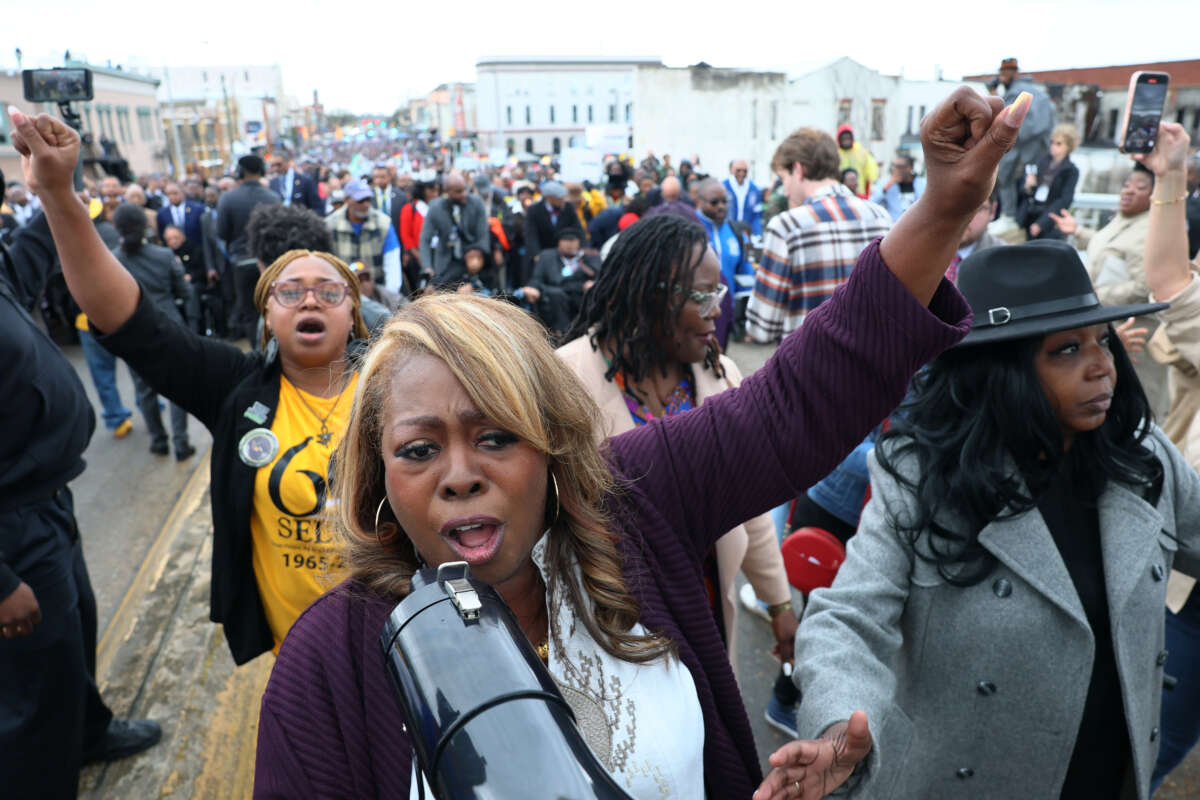
LaTosha Brown, co-founder of the voting rights group Black Voters Matter, leads people in a chant as they walk across Edmund Pettus Bridge as they commemorate the 60th anniversary of "Bloody Sunday" on March 9, 2025, in Selma, Alabama.Michael M. Santiago / Getty Images


Honest, paywall-free news is rare. Please support our boldly independent journalism with a donation of any size.

How should Juneteenth be understood, be celebrated, be remembered, given this moment of deep anti-democratic machinations and authoritarian/fascistic ambitions cultivated at the “highest” offices within this land? The tension between the sense of renewed freedom that Juneteenth engenders and the profound unfreedom that this country perpetuates is not lost on me. Indeed, as the 250th anniversary of this nation’s independence is on the horizon, on July 4, 2026, the tension screams of a biting contradiction that forces the observation that the Fourth of July was never meant for Black people. It is within the context of this tension and contradiction that I conducted this exclusive interview with Jeanelle K. Hope, who is an independent scholar and a lecturer at the University of California–Washington Center, and co-author of The Black Antifascist Tradition.

George Yancy: It is such a pleasure to be in conversation with you again, Jeanelle. I am particularly excited to talk with you about what Juneteenth means to you. But first I want to return to our previous discussion and connect it to the recent attacks on the Voting Rights Act. In our last exchange, you laid bare the historical dimensions, political commitments, and courageous spirit of the Black anti-fascist tradition. In that exchange, you argued that we must remember that “fascism attacks on all fronts, so we must develop a strategy that recognizes this.” As I reread your instructive and powerful words, I was reminded of the Supreme Court’s conservative majority decision, on April 29, 2026, in Louisiana v. Callais, which has been characterized as an evisceration of — or, at minimum, a significant weakening of — “Section 2 of the Voting Rights Act (VRA) and opened the door for states to enact discriminatory voting maps and laws.”

Justice Samuel Alito wrote in the majority opinion in Louisiana v. Callais that Section 2 of the Voting Rights Act imposes liability “only when circumstances give rise to a strong inference that intentional discrimination occurred.” This standard requires Black plaintiffs to demonstrate intentional racial discrimination. In her book Where Is Your Body?, critical race theorist Mari J. Matsuda critiques the concept of a narrow “linear, intent-based notion of causation” when it comes to racism, arguing that “if the effects of racism exist, that is cause for action.” My colleague, historian Carol Anderson, states: “Jim Crow was a political project designed to preserve racial hierarchy through law and the power structure that depended on it. When we see coordinated efforts to purge voters, centralize election control, dismantle the Voting Rights Act, and dilute Black political power, we should call it what it is.” Within the context of your important historical and political work, let’s call it what it is: the unabashed continuation of anti-Black fascism.


U.S. philosopher George Santayana warned, “Those who cannot remember the past are condemned to repeat it.” I would argue that the problem for Black people is not a failure to remember the past; rather, it is that the past is not past. We are witnessing the continuation of systems and practices that remind us, repeatedly, that we have no rights that the white state is bound to respect. In short, Black people continue to have their rights violated, their freedoms politically constrained, and their ontology, their being, rendered abject. Speak to how you see this latest attack on Black people’s voting power and freedom — which amounts to a form of civil death — as a manifestation of anti-Black fascism. For those who may not view it as such, what are they missing?

Jeanelle K. Hope: During this election season, we are seeing an all-out conspiracy to effectively roll back voting rights, which Black people have steadily fought for, with redistricting being the main strategy that has effectively sanctioned mass disenfranchisement. The efforts, largely taken up by Southern states, elucidate two major pillars of anti-Black fascism: anti-democracy and dual application of the law. The recent Louisiana v. Callais decision is another example of how the law is being weaponized to cement major objectives within the fascist project. It is evident that the primary goal of Southern state redistricting efforts, and gerrymandering, is to starkly dilute Black voting power, smashing any remaining illusion of democracy for Black people in Texas, Louisiana, Tennessee, Alabama…


The Black Anti-Fascist Tradition Recognized Fascism Didn’t Begin in Europe
Black anti-fascists have long warned about creeping fascism, from slavery to mass incarceration to ICE terror. 
By George Yancy , Truthout February 21, 2026

As I shared in our last interview, the law is such an integral player in shaping fascism. Despite the liberal belief that the law will save us from fascism, what we are seeing unfold within the courts is the strategy of autocratic legalism — or the creeping dismantling of legal frameworks that have long aided democracy to bolster the consolidation of power for authoritarian and fascist regimes.


“What we are seeing unfold within the courts is the strategy of autocratic legalism — or the creeping dismantling of legal frameworks that have long aided democracy to bolster the consolidation of power for authoritarian and fascist regimes.”

The legal analyses of Matsuda, Derrick Bell, and Kimberlé Crenshaw have long served as sharp critiques of the law’s failure to recognize intersecting forms of oppression, systemic racism, and the upholding of a dual application of the law along racial lines. Moreover, they have been most vocal about the high, and shifting, burden of proof required by the courts when victims name racist and discriminatory actions as stymieing their life, liberty, and freedom. The core arguments of critical race scholars and lawyers can similarly be applied to the dismantling of the Voting Rights Act. The law has once again proven to not be a tool of justice, but a chisel to decide those that should and should not benefit from democracy.

For the last four years, critical race theory (CRT) has been vehemently attacked by far right and conservative-led school boards and think tanks, with history, English, and ethnic studies K-12 teachers and librarians also caught in the crosshairs. Perhaps it is CRT’s keen explication of U.S. law’s fascist and anti-democratic tendencies that was most threatening, not the thousands of books by Black authors that were banned in the name of CRT.

Living in the Washington, D.C., metro area and having been born and raised in California, it’s not lost on me that redistricting has also been adopted by Democratic-led states as a means of “fighting fire with fire” to “settle the score.” While it looks like California’s redistricting efforts are largely being upheld by the courts, the strategy, though blessed by a majority of voters, is dead in the water in Virginia. In a state where Black people comprise nearly 20 percent of the population and Northern Virginia is nearing “minority majority” status, you can’t unsee the glaring contradictions of the law that once again favors anti-Black fascism over justice.

In response to Virginia’s redistricting referendum, a member of Congress introduced the “Make DC Square Again Act” that would restore the District’s original boundaries for the sole purpose of disenfranchising Northern Virginians by leveraging Washington, D.C.’s lack of statehood. This bill and far right commentary (including the growing position of conservative women willing to give up their right to vote for a more conservative future) regarding redistricting lay bare that disenfranchisement is a priority for the modern American fascist project.

Just last year, Black historical associations and legal groups celebrated 60 years since the passage of the Voting Rights Act, a commemorative moment that felt quite hollow, considering how the legislation was being gutted. In this moment, we must wrestle with what to do over the next 60 years to regain ground lost and to transform what democracy looks like. Redistricting (from the Democrats and Republicans) is a race to the bottom, toward fascism. In the words of Audre Lorde, “the master’s tools will never dismantle the master’s house.” We must stop trying to meet the rise of the far right with the same fascist strategies dressed up in progressive and liberal language. The recent release of “Project 2029” (which leaves much to be desired), the Democrats’ supposed response to Project 2025, is another example of this. Fascism must be met with radical imagination and ambitious world-remaking — not with a reactionary policy framework that is always five steps behind. We must radically reimagine voting, elections (Election Day should be a national holiday), political parties (no more duopoly and get rid of dark money in elections), the Electoral College (how about just the popular vote), and much more.

I began with that recent major attack on the Voting Rights Act as a way of highlighting the deep sense of the tragicomic reality of Black life. As Black people, we constantly strive for freedom, empowerment, and joy. Yet, the viciousness of anti-Blackness forces us into various states of unfreedom, disempowerment, despair. When I think of Juneteenth, I think of the tragicomic. There was the brutality of American slavery, and yet there was that sense of celebration and elation “on June 19, 1865, when some 2,000 Union troops arrived in Galveston Bay, Texas. The army announced that the more than 250,000 enslaved black people in the state, were free by executive decree.” That joyous reality would only be followed by involuntary servitude through the criminalization of the Black body, the creation of Black Codes, convict leasing, and sharecropping. Add to this the reality of mass incarceration of Black people; disproportionate vulnerability to police and state violence; inequitable access to health care, housing, and education; disproportionately high poverty rates; and limited access to economic opportunities and growth. Given these realities, we find ourselves in what Saidiya Hartman terms “the afterlife of slavery” and what Christina Sharpe calls being in “the wake” — that is, that we are still mourning the effects of the transatlantic slave trade. How do you think about Juneteenth within the context of so much anti-Blackness; indeed, the continuation of anti-Black fascism?

There’s a bittersweetness to Juneteenth. On the one hand, there remains a level of excitement as the holiday moves into its sixth year of national recognition following decades of advocacy by people like Ms. Opal Lee. Yet, Juneteenth is probably the single most consequential American holiday as it forces us to truly grapple with the meaning of freedom in a more critical way than the Fourth of July. To borrow from Angela Davis, Juneteenth is a reminder that “freedom is a constant struggle,” and that the old seeds of slavery continue to germinate, taking root in many systems, institutions, and facets of modern Black life — from state-sanctioned violence and mass incarceration to varying structural inequalities.


“To borrow from Angela Davis, Juneteenth is a reminder that ‘freedom is a constant struggle,’ and that the old seeds of slavery continue to germinate, taking root in many systems.”


Juneteenth urges us to consider how we can work in the spirit of abolitionists to root out every seed of slavery. And as anti-Black fascism continues to evolve from its colonial and chattel slavery foundations to more sophisticated outcomes, the Juneteenth holiday demands that we reimagine what freedom fighting looks like. With our nation’s current march toward fascism, so many of our supposed freedoms are on the line — from voting rights and citizenship, freedom of speech, academic freedom, the freedom to protest, and beyond. Let the Juneteenth holiday serve as a reminder of the ever-shifting grounds of freedom.

Thus, celebrating Juneteenth must entail study, organizing, and dreaming. I hope that those celebrating Juneteenth engage in much-needed consciousness raising. Read. Not only about the history of slavery, abolition, and Juneteenth, but also more contemporary works that help elucidate slavery’s afterlives. Juneteenth is a communal event and holiday. So before firing up the barbeque, breaking out the seafood boil, or busting open a box of crabs, I hope folks sit with one another in critical reflection and discussion. We must all consider what freedom fighting looks like within our communities and strategize how to work together in those efforts. As Robin D.G. Kelley’s early work reminds us, for the enslaved and so many Black activists, freedom was only a dream. We must use the Juneteenth holiday to also dream of what new iterations of freedom look like — a freedom beyond anti-Black fascism.


“For the enslaved and so many Black activists, freedom was only a dream. We must use the Juneteenth holiday to also dream of what new iterations of freedom look like.”

Despite the bitterness of Juneteenth, it is Black joy that encompasses the sweetness of the holiday. It is a sweetness that extends to glasses of red drinks, plates of red velvet cake, and slices of watermelon. There is something especially sacred in commemorating Juneteenth through gathering, partaking in Black foodways, dancing, and laughing. I hope that we all revel in joy this Juneteenth.

Juneteenth will precede the 250th anniversary of this nation’s independence on July 4, 2026. I am reminded of the scathing critique by Frederick Douglass, where he writes, “What, to the American slave, is your 4th of July?I answer: a day that reveals to him, more than all other days in the year, the gross injustice and cruelty to which he is the constant victim. To him, your celebration is a sham.” As I celebrate Juneteenth, I’m simultaneously aware of the sham of this country’s “greatness” in relationship to the continued violent and dehumanizing logics of anti-Blackness. As this nation celebrates its 250th anniversary, Douglass’s truth-telling to this nation continues to hold: “Your boasted liberty, an unholy license;your national greatness, swelling vanity; your sounds of rejoicing are empty and heartless; your denunciations of tyrants, brass fronted impudence; your shouts of liberty and equality, hollow mockery.” Reading your work militates against perpetuating shams. There are times when living in bad faith — lying to ourselves — can feel easier than facing social and civil death. But willfully remaining ignorant will not stop anti-Black fascistic violence, just as remaining critically conscious will not, on its own, stop it either. Yet we still need to remain critically conscious. How do we do so, especially in the context of the upcoming 250th anniversary of this nation’s independence, a day which will be filled with praise, celebration, and, for me, deep hypocrisy? Talk about how necessary it is that we maintain a critical consciousness of this nation’s bloody history, pretense, and anti-Blackness.


The 250th anniversary of the nation’s independence has presented a unique narrative and branding (dare I say grifting) opportunity that has largely been used to support America’s march toward fascism. Living in the Washington, D.C., metro area, the thick veneer of patriotism and nationalism expressed via “America 250” and “Freedom 250” programming and branding is inescapable. Plans to celebrate this moment involve completely reshaping the cultural atmosphere and ethos of Washington, D.C. A few highlights include: the construction of a 250-foot arch (a Western architectural symbol of power and expansion) near Arlington National Cemetery, a mixed martial arts UFC fight recently held on the White House lawn (the event somehow ended with a racist and misogynist jab at former first lady Michelle Obama), the National Mall is currently being transformed into a “State Fair” (it should be noted that this “State Fair” is being held in a District long denied statehood), and a Grand Prix auto race is slated to take place around major monuments. Ironically, much of the National Mall is surrounded by tall fencing, making the space look more like a police state rather than the projected freedom playground. Furthermore, institutions and artists are being called to “promote American and Western values” in a manner that conveys “greatness,” “grandeur,” and “abundance,” while limiting discussions that underscore the very roots of the nation — colonialism, slavery, and Native American genocide. America 250 has effectively served as a narrative tool to reshape U.S. culture through far right politics, Christian nationalism, hypermasculinity, and fascism. The 250th anniversary of U.S. independence, especially under the current political climate, must be understood as a paradoxical moment to interrogate U.S. democracy and freedom, not a moment to lean into the cultural spectacle of “America 250” and “Freedom 250” branding.

With the residents of Washington, D.C., being forced to host all these events across their communities, I challenge folks to shift their gaze from America 250 to the renewed Free DC movement. Since the late 1700s, Washingtonians (who are predominantly Black) have been denied statehood, self-determination, and full participation in democracy — an enduring punishment for the District’s predominantly Black population that traces back to debates around slavery in the region. If we are to celebrate independence and freedom in the nation’s capital, why is it that the people who live year-round in the capital aren’t afforded the fundamental freedom of statehood?

I want to underscore that what UFC fighter Josh Hokit said about Michelle Obama was vile, ignorant, and racist. Given the importance of Juneteenth, I don’t want to end on a pessimistic note, even if pessimism is fully justified. James Baldwin, who was passionately dedicated to radically transforming this country through love — and by demanding that it look at itself in a disagreeable mirror and admit to the lie of its “innocence” — was still skeptical. In The Fire Next Time, he asks, “Do I really want to be integrated into a burning house?” It seems to me that if the house is burning, we have been locked in it — and never fully integrated — since the beginning of our arrival. Despite this, we have found ways of pushing back and talking back. We have been able to create, invent, love ourselves, find joy, and deploy our Black imaginations to think and be otherwise.

In your book The Black Antifascist Tradition, you stress the importance of abolition. In fact, I would argue that if the house has been burning for so long, then perhaps it is no longer habitable until the ashes have been swept away to allow for forms of clarity, insight, and wisdom that will begin with the kind of profound and mature love, as Baldwin understood it, that might function as the foundation for a radically new, unprecedented way of political belonging.

You don’t stop at abolition. You write, “The endpoint of abolition is not destruction but futurity.” You link abolition to Afrofuturism. How do you understand the creative dynamics of Afrofuturism? As you know, not all Black people will experience or celebrate Juneteenth with a sense of political exuberance or reflect on how we have made so much “progress.” I’m interested in how you think about Afrofuturism alongside abolition, because the latter suggests a radical future — something yet to come.

As mentioned earlier, in celebrating Juneteenth we must incorporate dreaming. When we dream, we can imagine futures that go beyond the status quo and reform. We place our future selves somewhere anew, with environments that are defined by our holistic well-being. With all that we know about the Black freedom struggle from June 19, 1865, to the present, where do we collectively (not individually) want to see ourselves next?Art and culture are often great avenues to explore this type of imagining and radical world-building. This is why fascism actively works to co-opt and control art, media, and cultural production.

There is no greater entry point to discussing the intersection of Black anti-fascism and Afrofuturism than the work of pioneering Afrofuturist writer Octavia Butler. Folks have long discussed how Parable of the Sower outlines the rise of fascism in the 21st century, but it is her follow-up work, Parable of the Talents, where Butler engages in this deeply Black anti-fascist world rebuilding. Beyond Butler, there are so many artists that are creating various forms of art and culture that help us dream of a new future. For example, I’m still sitting with Boots Riley’s film I Love Boosters and the vision he lays out for the future of organizing under technofascism. I’m similarly wrestling with Aleshea Harris’s disturbing yet liberating journey through a tale of Black women’s vengeance in Is God Is. Both films offer poignant meditations on Black futures and freedom, while not shying away from the pessimism of it all. I think it’s important to let art and culture — particularly independent, political, and Afrofuturist art — serve as a guiding light as we dream.


This article is licensed under Creative Commons (CC BY-NC-ND 4.0), and you are free to share and republish under the terms of the license.


George Yancy

George Yancy is the Samuel Candler Dobbs professor of philosophy at Emory University and a Montgomery fellow at Dartmouth College. He is also the University of Pennsylvania’s inaugural fellow in the Provost’s Distinguished Faculty Fellowship Program (2019-2020 academic year). He is the author, editor and co-editor of over 25 books, including Black Bodies, White Gazes; Look, A White; Backlash: What Happens When We Talk Honestly about Racism in America; and Across Black Spaces: Essays and Interviews from an American Philosopher published by Rowman & Littlefield in 2020. His most recent books include a collection of critical interviews entitled, Until Our Lungs Give Out: Conversations on Race, Justice, and the Future (Rowman & Littlefield, 2023), and a coedited book (with philosopher Bill Bywater) entitled, In Sheep’s Clothing: The Idolatry of White Christian Nationalism (Roman & Littlefield, 2024).


‘Mistakes Are Made’: Trump Rejects Accountability for US Massacre at Iran Girls’ School

“War is nasty,” the president said when asked about the February cruise missile strike that killed 156 students and staff in Minab, continuing the centuries-old presidential tradition of dismissing American atrocities.


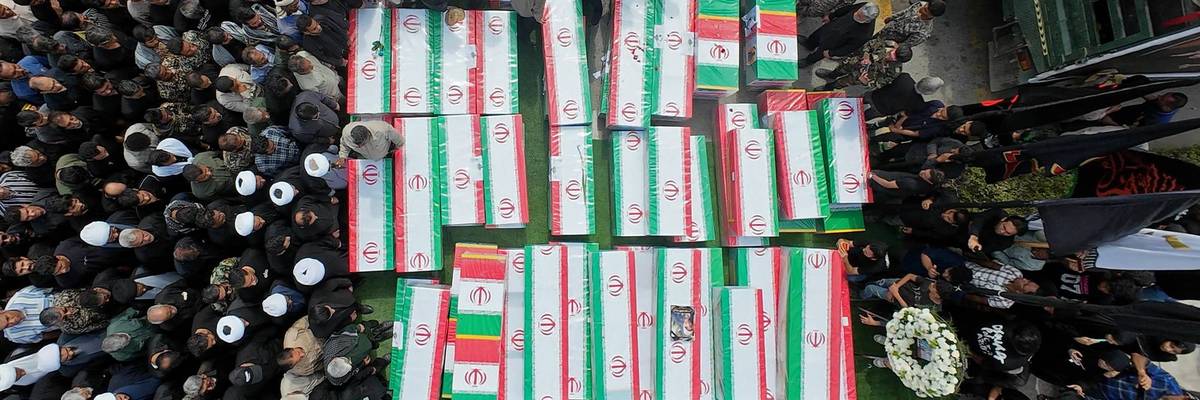
Coffins of victims of the February 28, 2026 US cruise missile strike on a girls’ school in Minab, Iran are surrounded by mourners during funeral services on March 3, 2026 in Minab.
Photo by Handout/Getty Images

Brett Wilkins
Jun 18, 2026
COMMON DREAMS


President Donald Trump on Wednesday joined a long line of US leaders to brush off atrocities committed by American forces when he dodged questions about responsibility for the February cruise missile strike on an Iranian girls school that massacred students and staff.

On February 28—the first day of the illegal US-Israeli war of choice on Iran—a US strike on the Shajareh Tayyebeh girls’ elementary school in Minab killed 156 people, at least 120 of them children, and wounded 95 others.

Satellite imagery analyses confirmed eyewitness accounts that the attack was a “triple-tap” airstrike, in which an initial bombing was followed up with two additional strikes meant to kill survivors and rescue workers.

Asked by a journalist at the G7 meeting in France if anyone would be held accountable for the bombing, Trump replied, “It’s such a strange question to be asked at this date, because you’re talking about a long time ago.”

“Nobody did that on purpose,” Trump said of the school strike. “Mistakes are made. War is nasty. But I know it’s under investigation.”

“I would ask Pete Hegseth,” the president added, referring to his defense secretary, who said at the war’s start that US forces would not be bound by “stupid rules of engagement” and would instead prioritize “lethality.”


Fragments of a Tomahawk cruise missile found at the school and marked with the names of US weapons companies, a Pentagon contract number, and “Made in USA” added to the body of evidence pointing to the United States as the perpetrator of what numerous experts called a likely war crime.

Trump first claimed that Iran bombed the school, and when it was revealed that a Tomahawk missile was used in the strike, he risibly asserted that Tehran had such highly restricted US missiles in its arsenal. The US has not sold weaponry to the Iranian government since the 1970s, with the extraordinary exception of during the Iran-Contra Affair, in which the Reagan administration secretly sold arms to Iran in the 1980s to fund anti-communist Contra terrorists in Nicaragua.

A preliminary Pentagon probe indicated US responsibility for the Minab massacre—and that the building was struck intentionally, raising questions about the possible use of artificial intelligence for targeting purposes. The US military has confirmed use of AI in the Iran War, which is being carried out in partnership with Israeli forces that have used artificial intelligence extensively in their genocidal assault on the Gaza Strip. More than 250,000 Palestinians have been killed or wounded—most of them civilians—since the Hamas-led attack of October 7, 2023.

Numerous investigative journalism outlets and rights groups—including Bellingcat, The New York Times, Sky News, NPR, The Associated Press, the BBC, Reuters, Al Jazeera, CNN, and Amnesty International—also investigated the attack and concluded the US was responsible.

Trump administration officials and Republican US lawmakers dismissed or stonewalled efforts by journalists, activists, and Democratic legislators to seek accountability for one of the deadliest US civilian massacres in modern times.


The Minab strike ranks up with the bombing of a Baghdad bomb shelter during the 1991 Gulf War—which killed more than 400 people, mostly women, children, and elders—and the March 2017 slaughter of at least 105 people in an apartment building in Mosul, Iraq during Trump’s first-term “war of annihilation” against the so-called Islamic State.

The school massacre also drew comparisons with the 1968 wholesale slaughter of 504 unarmed villagers, mostly women and children—at least some of them raped before being killed—by US troops at My Lai in Vietnam.

Trump joins a long line of US leaders who have ducked accountability for—or worse, tried to justify—atrocities committed on their watch.

Faced with what was then commonly called the “Indian problem,” a young Virginia governor named Thomas Jefferson justified what he called “their extermination, or their removal,” because “the same world would scarcely do for them and us.”

During the Civil War, Gen. William Tecumseh Sherman, commander of an indiscriminate scorched-earth campaign during his March to the Sea, wrote that “war is cruelty, and you cannot refine it.”

President Theodore Roosevelt attempted to defend US troops accused of mass murder and torture—including what’s now known as waterboarding—during the Philippines War by shaming critics who condemned those crimes but turned blind eyes to the lynching of Black Americans in the South.

After ordering the only nuclear war in human history, against a defeated enemy making efforts to surrender, President Harry S. Truman said of his Japanese victims, “The only language they seem to understand is the one we have been using to bombard them.”

After US forces killed hundreds of thousands of Vietnamese, Cambodian, and Laotian civilians in the 1960s and 1970s, US Army Chief of Staff Gen. William Westmoreland attempted to rationalize the slaughter by explaining: “The Oriental doesn’t put the same high price on life as does the Westerner... Life is cheap in the Orient.”

As US-driven United Nations sanctions reportedly killed hundreds of thousands of Iraqi children in the 1990s, Madeleine Albright, President Bill Clinton’s secretary of state, opined that “we think the price is worth it.”

During President George W. Bush’s invasion of Iraq, US Central Command chief Gen. Tommy Franks said, “We don’t do body counts” when asked about the staggering number of civilian casualties, while Vice President Dick Cheney dismissed waterboarding as a mere “dunk in the water” amid a worldwide torture scandal.

When President Barack Obama’s drone war killed an American teenager in Yemen, administration spokesperson Robert Gibbs deflected blame by arguing that the child should have had “a far more responsible father.”


As Trump loosened rules of engagement meant to protect civilians during his first-term campaign to “bomb the shit out of“ Islamic State militants in Iraq and Syria and ”take out their families,“ his defense secretary, James ”Mad Dog“ Mattis, announced that the US was shifting from a policy of ”attrition“ to one of ”annihilation.“

“Civilian casualties are a fact of life in this sort of situation,” he said.
Trump’s Iran Disaster an Even Bigger US Strategic Defeat Than Vietnam: Expert

“The United States is inarguably in a weaker position than when it began this war of choice, with core US strategic objectives harmed.”


US President Donald Trump hosts a cabinet meeting in the Cabinet Room of the White House in Washington, DC, on March 26, 2026.
(Photo by Jim Watson/AFP via Getty Images)

Brad Reed
Jun 17, 2026
COMMON DREAMS

President Donald Trump’s illegal war of choice with Iran has dealt the United States an even bigger strategic defeat than the one it suffered in the Vietnam War, according to one expert.

In an essay published on Tuesday by Foreign Policy, Paul Musgrave, associate professor of government at Georgetown University in Qatar, made the case that the damage done to the United States’ reputation and credibility in the wake of the Iran war are significantly more severe than anything the country suffered in the wake of Vietnam.


Even though the Vietnam War went on for far longer and resulted in far more deaths than Trump’s Iran war, Musgrave argued, the US nonetheless exited it with little long-term damage to its global power.

“Compare that situation with the aftermath of Trump’s war,” Musgrave continued. “The United States is inarguably in a weaker position than when it began this war of choice, with core US strategic objectives harmed.”


Musgrave noted that while the US and Israel had initial success in decapitating Iran’s leadership at the beginning of the conflict, this only left the hardliners in the Islamic Revolutionary Guard Corps (IRGC) to run the country.

By failing to achieve the stated aim of regime change and by empowering even more radical elements within Iran, Musgrave added, Trump has severely damaged other nations’ willingness to trust the US for national security protection.

“Regional allies, many of whom reportedly argued against the venture, bore the brunt of the costs of the fighting,” the scholar wrote. “Most tellingly, Iran learned that its capacity to throttle the Strait of Hormuz could deliver economic leverage on a worldwide scale.”

Writing in The New York Times on Wednesday, national security journalist WJ Hennigan argued that the United States’ strategic defeat has laid bare the limits of US military power to bend weaker nations to its will.

In particular, he pointed out that the US, which spent $1 trillion on its military last year, could not take out even a majority of Iran’s missile stockpiles.

“Yes, the wonder weapons that American industry cranks out, like cruise missiles and air-defense interceptors, have proven impressive on the battlefield,” Hennigan wrote. “But the war has exposed the underlying weaknesses of depending on weaponry that’s extremely expensive and time-consuming to deliver. During an April 30 congressional hearing, Defense Secretary Pete Hegseth estimated it could take ‘months and years’ to replenish the stocks that had been used in the war.”

Matt Duss, executive vice president at the Center for International Policy, similarly said that Trump’s Iran war had resulted in a strategic defeat for the US. However, he also expressed hope that this defeat could mark a turning point in US foreign policy circles regarding the applications of American power throughout the world.

“There’s a longstanding US bipartisan consensus around wildly inflating the Iranian threat,” Duss wrote in a social media post. “Trump’s war, a strategic defeat, was an expression of that consensus. If... ending the war puts the US and Iran on path to a more normal relationship, that will be a positive thing.”
Trump May Be Drawing Down Iran War, But He’s Demanding Billions More for Bombs

The GOP is souring on Trump’s $1.5 trillion military budget as the president pushes for yet another reconciliation bill.
June 20, 2026

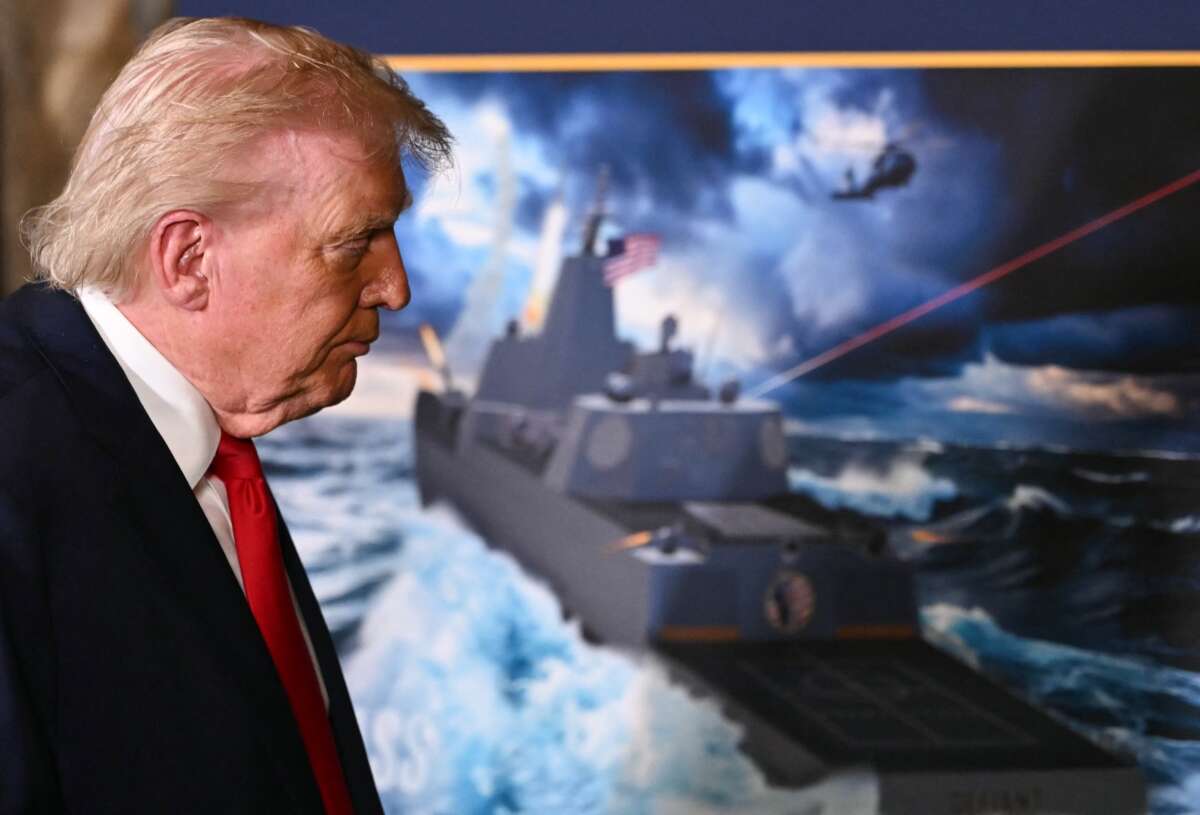
Donald Trump leaves after announcing the U.S. Navy's new Golden Fleet initiative, unveiling a new class of warships, at Mar-a-Lago in Palm Beach, Florida, on December 22, 2025.ANDREW CABALLERO-REYNOLDS / AFP via Getty Images

The day before he signed a memorandum of understanding with Iranian leaders, President Donald Trump said he wants to put the joint U.S.-Israeli war on Iran in the “rearview mirror.” But even if the memorandum — which puts an end to the war for at least the next 60 days — holds, the enormous costs of the war itself will not disappear with the next news cycle.

In Iran, at least 3,468 people were killed over several weeks of U.S.-Israeli strikes. Recovery for Iran is expected to be costly after the strikes hit critical infrastructure like bridges, manufacturing, and oil depots, as well as civilian infrastructure like hospitals and schools. As part of the agreement signed this week, the U.S. has said it would work with regional partners create a $300 billion reconstruction fund.

Meanwhile, in the U.S., as Trump seeks nearly $1.5 trillion in military spending and puts pressure on military contractors to rapidly replenish depleted weapons stockpiles, critics say Congress must reject funding for more wars and reverse harmful cuts to the social safety net.

While the memorandum puts the U.S. and Iran on a path toward more substantive diplomatic negotiations, Trump suggested that bombing could resume if the Iranians “don’t behave.” Meanwhile, the White House is quietly scrambling to replenish stockpiles of high-tech missiles and interceptors after expending massive resources bombing Iran and defending Israel from retaliatory strikes in a bloody war that even some Republicans openly call a foreign policy blunder.

To speed up weapons manufacturing, Trump has reportedly repeatedly summoned military contractors to the White House. On June 11, Trump invoked the Defense Production Act of 1950, a law that gives the president broad authority to compel private companies to produce goods for the government in emergency situations. In the order, Trump declared that “conditions exist which may pose a direct threat to the national defense or its preparedness programs,” including fragile supply chains and limited manufacturing capacity for replacing “munitions, missiles, and equipment.”

However, as many analysts have pointed out, Iran poses no direct threat to the U.S. homeland. The invocation of the Defense Production Act was the latest sign that the Iran’s military capabilities surprised Trump as the war unfolded — and also yet another sign that private military firms could continue to make excessive profits, even as the war draws down.

The same day Trump invoked the Defense Production Act, the Republican-led Senate Armed Service Committee vote 18-9 to advance a $1.2 trillion budget for the Pentagon in 2027, with multiple Democrats voting against the legislation. Companion legislation advanced in the House on June 5. But to pay for the war on Iran, Trump is demanding Republicans pass an additional $350 billion budget reconciliation package on a party-line vote.

Since the president unilaterally decided to launch the all-out assault on Iran with Israel in February without seeking congressional approval, his request for an additional $350 billion is being met with skepticism by some members of the Senate GOP majority, which faces an angry electorate in the November midterm elections.

Under Trump’s direction, the Republican-led Congress slashed budgets in 2025 for health care, food assistance, and international aid while pumping the administration with increased funding for foreign wars and a dramatically increased budget for immigration policing and his deadly mass deportation campaign. Now Trump is asking Congress for a “spending bonanza” on weapons that he can use to start more wars overseas, according to Lindsay Koshgarian, the program director of the National Priorities Project at the Institute for Policy Studies and an expert of military spending.

“Just one short year ago, Trump and his friends in Congress cut food stamps and Medicaid for millions of Americans,” Koshgarian said in an email. “Just weeks ago, Trump bragged about not thinking of Americans’ financial struggles in his decisions about whether or not to stop the war on Iran.”

Where an Additional $350 Million Could Be Spent by the Military

On February 28, a U.S.-made ballistic missile was used in an attack that struck a gym and adjacent elementary school near a military facility in Lamerd in southern Iran, according to a visual analysis by The New York Times. A women’s volleyball team was using the sports facility at the time, and more than 20 people, including children, were killed in the strike.

With help from munitions efforts, the Times determined the attack was conducted with a short-range ballistic missile designed by military contractor Lockheed Martin and known as a Precision Strike Missile, or PrSM. The missile is designed to explode above the target and spray small tungsten pellets as deadly shrapnel. A single PRsM missile costs $1.6 million. Trump’s military budget request for 2027 includes $95 billion to buy more bombs and missiles, according to the National Priorities Project.

The attack on the gym occurred on the first day of the war, the same day that a long-range U.S. Tomahawk cruise missile struck a school in the city of Minab, killing more than 150 people, most of them children.

Secretary of “War” Pete Hegseth disbanded internal military watchdogs that worked to prevent civilian casualties, and the U.S. has not taken publicly responsibility for the civilian massacres. However, Hegseth and his underlings are keenly focused on producing more of the high-tech missiles used in attacks like the one on Lamerd. Trump has “expressed anger” about weapons stockpiles running low as cheap Iranian drones evaded U.S. defense systems across the Persian Gulf, according to NBC News.

In May, Lockheed Martin announced monthly, direct discussions with the Department of “War” as part of a broader effort among military suppliers to significantly increase productions of PrSM missiles and other high-tech weapons. One of five major defense contractors that dominate Pentagon contracts, Lockheed Martin alone plans to spend up to $9 billion building precision missiles and interceptors by 2030. The White House’s proposed budget for the Department of “War” includes $2.2 billion for PrSM missiles and $5.8 billion for Tomahawks.

Between 2020 and 2024, $771 billion in Pentagon contracts went to the top five firms: Lockheed Martin ($313 billion), RTX (formerly Raytheon, $145 billion), Boeing ($115 billion), General Dynamics ($116 billion), and Northrop Grumman ($81 billion), according to the Costs of War project at Brown University. In comparison, the U.S. spent $356 billion during the same period of time on foreign policy initiatives devoted to diplomacy, development, and humanitarian aid. Shortly after taking power, the Trump administration dismantled the U.S. Agency for International Development (USAID) and cut humanitarian aid programs by 85 percent.

The push for an additional supplemental budget to cover the cost of the war on Iran comes as U.S. consumers face rising war-related inflation over things like food and fuel. For several weeks, the U.S. and Iran held dueling blockades of the Strait of Hormuz, a major shipping artery for fossil fuels and agricultural fertilizer. Since the start of the war, additional fuel costs to consumers have topped $40 billion, or more than $300 per household, according to Costs of War. That’s more money than is needed to completely redo the U.S. air traffic control system after recent deadly accidents.

“Americans need health care, child care, affordable food, and a roof over their heads,” Koshgarian said. “No one should have to give those things up so that Trump can fight more wars.”


Trump's motive for insulting allies nailed by conservative reporter

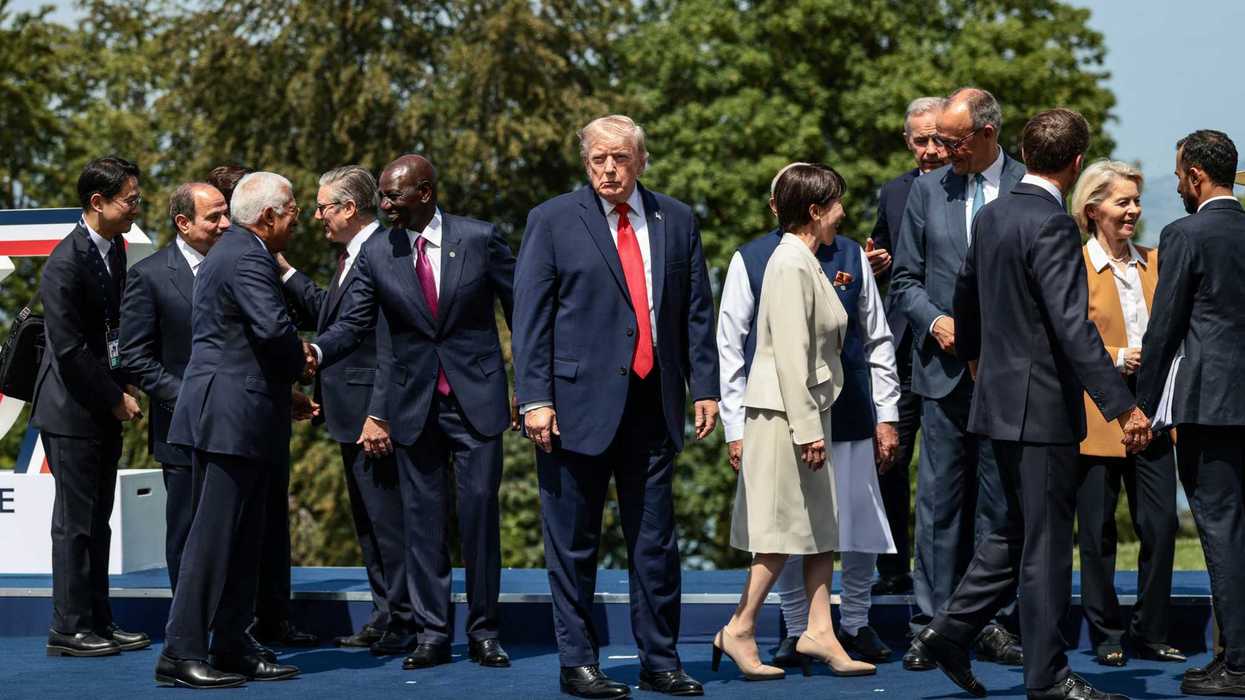
U.S. President Donald Trump stands among other leaders as they gather for a family photo during the G7 summit in Evian-les-Bains, France, June 16, 2026. REUTERS/Evelyn Hockstein

June 19, 2026 
ALTERNET


On Friday, there came a sudden fracturing of the relationship between President Donald Trump and Italian Prime Minister Giorgia Meloni over the latter’s claims that the former lied about her, and as one conservative reporter observed, this latest controversy highlights something interesting about who Trump favors and who he offends.

“It really is fascinating,” posted Billy Binion of the conservative outlet Reason, “that Trump seems to delight in offending important allies while calling Xi Jinping ‘brilliant’ and ‘handsome’ and waxing poetic about how he ‘fell in love’ with Kim Jong Un.”

He posted this along with a retweet of a video from Meloni in which she denies, in Italian, Trump’s claim that she had “begged” him for a photo at the G7 summit. “Neither I nor Italy ever beg,” she declared.

Italy and the EU organization are both key U.S. allies, but Trump’s actions have increasingly strained those relationships. Trump’s tariffs against the EU, threats to invade Greenland, and disagreements over the Iran war dealt major blows to the trans-Atlantic alliance. And though Meloni — a far-right politician with ties to neo-fascist groups — came into office as a staunch MAGA ally, rising energy costs in Italy due to the closure of the Hormuz Strait have driven a rise in political pressure for her to break with Trump.

At the same time, as Binion notes, Trump has actively sought to court the favor of some of the world’s most notorious dictators and strongmen. Following his recent visit to China, many argued that Trump’s “elaborate” praise of Chinese President Xi Jinping not only made the American president look deferential, but also made the U.S. look “weak.” Trump has praised North Korean dictator Kim Jong Un directly to the face of the president of South Korea — the latter of whom is a vital U.S. military ally. And Trump has repeatedly celebrated Russian President Vladimir Putin, expressing thanks to the notorious authoritarian at the G7 summit for remaining “totally neutral” in the Iran war, even though the U.S. intelligence community has reported that Russia helped Iran target American forces.

All of this is part of a troubling trend that Trump himself is all too willing to admit. As he said in April, he is easily “seduced” by anyone who is nice to him, “even if they’re bad people.”

Now, Trump’s disputed claim that Meloni wanted a photo with him isn’t the only photograph that has people talking about G7 and his growing political isolation. Early this week, the internet erupted with taunts over a photo that portrayed Trump standing alone and scowling on a stage while other smiling world leaders shook hands and spoke.

“Nobody wants to talk to Trump,” noted one person. Said another, “That picture encapsulates the current state of America pretty well.”