Sunday, June 21, 2026

INDIA


Telegram & NEET: When Governance Fails, Censorship Steps in


Tanya Arora | 


Invoking exam security to suspend access to a platform used by millions raises serious questions about proportionality, transparency and the growing tendency to restrict communications whenever governance challenges arise.

Days before the NEET (UG) 2026 re-examination scheduled for June 21, the Union government took the unprecedented step of blocking Telegram across India. Acting on recommendations made by the National Testing Agency (NTA), the Ministry of Electronics and Information Technology (MeitY) reportedly issued directions under Section 69A of the Information Technology Act, 2000, restricting access to the platform until June 22. In addition, Telegram has reportedly been directed to disable its message-editing feature for Indian users until June 30.

The government has justified these measures as a response to organised examination fraud, alleged paper-leak scams and misinformation campaigns. According to statements carried by Mint, WION and other media outlets, authorities identified several Telegram channels allegedly offering access to examination papers in exchange for money. The NTA further claimed that Telegram’s message-editing feature had been exploited to create fabricated evidence of paper leaks by allowing administrators to insert examination papers into older messages while retaining original timestamps.

The importance of maintaining the integrity of national examinations cannot be disputed. The future of lakhs of students depends upon a fair and credible examination process, and organised cheating networks undoubtedly deserve stringent action. However, the constitutional question raised by the Telegram ban is not whether examination fraud should be prevented. The question is whether the State can suspend access to an entire communication platform used by millions because some actors are allegedly misusing it. Once that question is asked, the government’s decision begins to appear far less straightforward than official statements suggest.

The real problem is not Telegram

The government’s explanation begins from a fundamentally flawed premise. The recurring problem in India’s examination system is not Telegram, WhatsApp or any other communication platform. Paper leaks do not originate on social media. They originate within the examination apparatus itself. Every leak necessarily begins somewhere in the chain of printing, storage, transportation, administration or distribution of examination materials. By the time a question paper appears on a messaging platform, the breach has already occurred.

Detailed report on paper leaks may be read here.

This distinction is critical because it reveals the extent to which the government’s response is directed at symptoms rather than causes. Telegram may be one of the channels through which leaked material is circulated, but it is not the source of the leak. The source lies within the institutions responsible for safeguarding examination integrity. A serious response to examination fraud would therefore focus on identifying vulnerabilities within the examination system itself: who had access to the papers, how the chain of custody was compromised, where security protocols failed and what reforms are required to prevent future breaches.

Instead, the government’s intervention directs public attention towards the platform through which information allegedly travels. This approach risks obscuring the more uncomfortable reality that examination fraud is ultimately a governance failure. Blocking Telegram may create the appearance of decisive action, but it does little to address the institutional weaknesses that make such fraud possible in the first place.

The NTA’s own explanation undermines the ban

Perhaps the most striking aspect of the government’s justification is that it appears to undermine the necessity of the measure it seeks to defend. The NTA’s own statement acknowledges that the Indian Cyber Crime Coordination Centre (I4C), state police forces and specialised cybercrime units had already identified and removed numerous Telegram channels, groups and bots allegedly involved in examination fraud. Law enforcement agencies had reportedly conducted investigations, tracked financial transactions and made arrests.

These admissions raise a difficult question for the government. If authorities were already capable of identifying specific channels and specific offenders, why was it necessary to block the entire platform? If targeted interventions were available and functioning, what justified the escalation to a nationwide platform-wide restriction affecting millions of lawful users?

The significance of these questions becomes even clearer when viewed through constitutional principles. Democracies do not permit governments to adopt the broadest possible restriction merely because it is administratively convenient. The burden lies on the State to demonstrate why less restrictive alternatives were inadequate. Yet the government’s own account suggests that channel-level takedowns, criminal investigations and targeted enforcement actions were already underway. The NTA therefore appears to have supplied the strongest argument against its own decision.

A constitutional problem of proportionality

The Supreme Court has repeatedly held that restrictions on fundamental rights must satisfy the doctrine of proportionality. In Justice K.S. Puttaswamy v. Union of India (2017), the Court made clear that even where the State pursues a legitimate objective, it must demonstrate that the measure adopted is necessary, that less restrictive alternatives are unavailable and that the benefits of the restriction outweigh the harm caused.

Preventing examination fraud is undoubtedly a legitimate objective. The difficulty lies in establishing that a nationwide platform ban was necessary to achieve it. The government’s own statements reveal the existence of multiple alternatives. Channels could be removed. Fraud networks could be investigated. Individuals could be arrested. Financial transactions could be traced. Criminal prosecutions could be initiated.

Once these alternatives are acknowledged, the constitutional burden shifts to the State to explain why they were insufficient. The public explanation offered thus far does not convincingly do so. Instead, it suggests that a platform-wide restriction was adopted despite the existence of narrower measures. That is precisely the scenario the doctrine of proportionality seeks to prevent.

What Anuradha Bhasin case actually says about internet restrictions

The Telegram ban also cannot be separated from the Supreme Court’s landmark decision in Anuradha Bhasin v. Union of India (2020). While that case arose in the context of internet restrictions in Jammu and Kashmir, the principles articulated by the Court have broader relevance for all forms of digital restrictions.

The Court recognised that access to the internet is closely intertwined with the exercise of freedom of speech, access to information, education, trade and professional activity. It held that restrictions affecting digital communications must satisfy standards of necessity and proportionality and cannot be imposed through opaque executive processes. Most importantly, the Court emphasised transparency. Orders restricting communications must be published. Citizens must know why their rights are being restricted. Affected parties must have an opportunity to challenge such restrictions before courts.

In the present instance, however, the public has largely been presented with press releases and official explanations rather than the actual legal order. The reasoning adopted by the authorities remains unavailable. Whether Telegram was given an opportunity to be heard remains unclear. Whether less restrictive alternatives were seriously considered is unknown. These omissions are not procedural technicalities; they go to the heart of the constitutional safeguards identified by the Supreme Court.

The Shreya Singhal problem

The legal basis of the government’s action raises another serious concern. The reported reliance on Section 69A of the Information Technology Act immediately invites scrutiny because the Supreme Court upheld the constitutionality of that provision in Shreya Singhal v. Union of India (2015) only because it was presented as a narrow and carefully structured mechanism.

The Court accepted Section 69A because it involved targeted blocking of specific information under limited circumstances and subject to procedural safeguards. Its constitutional validity depended upon its narrow scope.

The Telegram ban raises the question of whether that narrow provision is now being transformed into a sweeping power capable of disabling entire communication platforms. As the Internet Freedom Foundation (IFF) has argued, there is a significant difference between blocking particular content and shutting down an intermediary used by millions. If Section 69A is interpreted broadly enough to justify platform-wide restrictions, the reasoning that underpinned its constitutional validity begins to weaken considerably.

The message editing direction may be even more troubling

The direction requiring Telegram to disable its message-editing feature raises concerns that extend even beyond the platform ban itself. While the government has publicly explained why it believes the feature was being misused, it has not clearly identified the legal authority under which it can compel a platform to redesign a feature for an entire country’s user base.

This distinction matters because blocking information and redesigning technological architecture are fundamentally different exercises of power. One concerns content regulation; the other concerns direct intervention in the design of digital infrastructure.

The implications are far-reaching. If governments can order the removal of editing functions today, similar arguments could potentially be invoked tomorrow against encryption, anonymous communication or other platform features. The issue is therefore not confined to Telegram. It concerns the broader relationship between state power and digital architecture.

Another example of India’s growing shutdown culture

The Telegram ban is not an isolated incident. It forms part of a broader pattern in which communication restrictions increasingly become the preferred response to administrative challenges. Over the last decade, multiple states have suspended internet services during recruitment examinations, teacher eligibility tests and competitive entrance examinations. These shutdowns are almost always justified as temporary and necessary measures to prevent cheating.

Yet despite repeated restrictions, examination leaks continue to occur. Fraud networks continue to operate. Recruitment scandals continue to emerge.

What persists is not the effectiveness of these measures but their repetition. Instead of reforming institutions, authorities increasingly appear to restrict communications. The result is a governance model in which the burden of institutional failure is shifted onto citizens rather than addressed at its source.

The real danger is the normalisation of censorship

The most significant concern raised by the Telegram ban is not its duration but the principle it reflects. Every time the State confronts a difficult administrative problem, there appears to be a growing willingness to restrict communications as part of the solution. Each restriction is presented as temporary. Each is described as exceptional. Yet collectively they establish a troubling precedent.

Over time, extraordinary measures become ordinary ones. Communication restrictions become routine administrative tools. Fundamental rights become subject to considerations of convenience and expediency.

The future of lakhs of students deserves protection. But constitutional freedoms deserve protection as well. A secure examination system will ultimately be built through accountability, transparency, stronger institutions and effective criminal investigation—not through platform bans and communication restrictions. The Telegram ban therefore raises a question that extends well beyond NEET. It forces us to confront whether India is becoming increasingly comfortable with restricting communications whenever governance becomes difficult. If that trend continues, the consequences will be felt far beyond a single examination cycle.

Courtesy: sabrang India

What Does Hindu Rashtra Mean?


Prabhat Patnaik |


A Hindu State, unlike what its name suggests, is nothing else but a dictatorship of monopoly capital, which is being unabashedly promoted by Modi.

Indian Prime Minister Narendra Modi with leading industrialists of the country.

The objective of the Rashtriya Swayamsevak Sangh (RSS) is to establish a Hindu state (“Hindu Rashtra”) in India. But what exactly does a Hindu State mean? The obvious and immediate answer would be that instead of the present Constitutionally-guaranteed equality for all citizens irrespective of religion, there would be in such a State a superior status of the Hindus compared with those belonging to other religions, especially the Muslims who constitute the largest religious minority in the country.

Such an inequality, however, cannot be sustained without a specifically repressive State; all states in a class-oppressive society are repressive but a state that institutionalises inequality in this manner would have to be even more specifically repressive. Would a Hindu State then mean a dictatorship of a collectivity, called the  Hindus, exercised over those belonging to other religions?

The moment this question is posed, the answer is obviously “no”. A rickshaw puller would remain a rickshaw puller no matter what his religion in a Hindu state; a peon would remain a peon no matter what his religion in a Hindu state; a gig-worker would remain a gig-worker no matter what his religion in a Hindu state.

The so-called Hindu State does not promise and would not achieve any change in the material condition of life for the majority of the Hindus; then in whose interests would the dictatorship, the form with which such a State would necessarily be associated, be exercised? The obvious answer is: in the interests of monopoly capital. A Hindu state, unlike what its name suggests, is nothing else but a dictatorship of monopoly capital.

There would, of course, be a veneer of Hindu rituals and Hindu religious practices before State functions, and there would no doubt be a preference for Hindus compared with others in selections for jobs; but new jobs themselves would not just be as non-existent as they are today, but there would even be a disappearance of existing jobs owing to the introduction of Artificial Intelligence (AI) by the corporates. While the Muslims and other members of religious minorities would face severe and multiple oppressions, the Hindus would not experience any alleviation of their oppression.

The class whose power would be greatly strengthened is monopoly bourgeoisie, and even within this class the new group of monopoly bourgeoisie. A Hindu State, in other words, would be a State lorded over by the Indian big corporates in general, and the Adanis and the Ambanis in particular.

This is reminiscent of the situation in Germany in the 1930s where the Nazis claimed to be giving effect to “Aryan superiority” by victimising “non-Aryan” populations like the Jews (the Nazis considered it impossible for a person to be an “Aryan Jew”) and the Gypsies (an “Aryan Gypsy” was likewise considered impossible).

The Nazi State, however, was not an “Aryan state”. The dictatorship it set up was, in the words of Georgi Dimitrov, President of the Communist International, at its Seventh Congress in 1935, the “open terrorist dictatorship of the most reactionary, most chauvinistic and most imperialist elements of finance capital”.

The description of the State by those who lead it does not necessarily correspond to its reality; the question to ask is: which is the class that is using the State to further its own interests, and all States that claim in contemporary times to be furthering the interests of some ethnic or religious or linguistic group by scuttling democracy and reducing other groups to the status of second-class citizens, are in reality furthering the interests of monopoly capital by instituting its dictatorship and seeking to divide the working people along ethnic, religious or linguistic lines. The imposition of a sectional State in a modern, multi-sectional society amounts in reality to a dictatorship of monopoly capital.

The question may be raised: since even the existing “secular” State is already dominated by monopoly capital, why should monopoly capital need, and hence aid the coming into being of, a new, and altogether different, Hindu-supremacist, State that embodies its dictatorship? The need for such a change obviously arises only when the earlier form of the State faces a serious threat; and that happens in a period when the economy runs into stagnation and greatly increased unemployment. The current move toward a dictatorship of monopoly capital, under the guise of a Hindu State, reflects the dead-end of the neo-liberal regime that has brought stagnation to the economy, and greater unemployment and acute distress to the vast mass of the working people.

Democracy provides greater scope for resistance and struggle to the working people, because of which in any period of crisis efforts are made to attenuate democracy, so that the threat to the hegemony of monopoly capital is kept in check; but when the crisis is protracted and the threat to its hegemony is persistent, monopoly capital adopts more extreme measures. It forms an alliance with whatever force is most capable of dividing the people, in order to generate an alternative distractive discourse, to prevent the working people from launching a united fight, and to justify the scuttling of democracy in the name of instituting a sectarian State, which in the Indian context is the promised Hindu State.

The distractive nature of the RSS-BJP discourse is absolutely obvious at present. When the country’s workforce, especially its youth, is weighed down by unemployment, when the incidence of educated unemployment is extremely high, the country’s rulers have not a word to say on this pressing problem; instead, they are crying hoarse about infiltration from Bangladesh! Ironically, since by the BJP’s own reckoning a nation’s per capita gross domestic product is the index of its progress, Bangladesh, which according to the IMF has a higher per capita income at present than India, should be considered more advanced than India; how then can the BJP explain such massive infiltration as it claims from a more advanced to a less advanced country?

Liberal opinion has been trying to explain for some time why there has been such an upsurge of Hindutva in India of late. But it fails to notice that the rise of Hindutva in India is part of an upsurge of neo-fascism all over the world, because of which no India-specific explanation of this rise would be adequate. The rise of Hindutva in other words is not a sui generis phenomenon; to a significant extent it is orchestrated by monopoly capital through financial and media support, in India, as elsewhere in the capitalist world from Argentina, to the US, Italy, France, Germany, and the UK, in the context of the dead-end that neoliberal capitalism has brought to the world economy.

The RSS recently celebrated its centenary; the fact that it suddenly finds itself ensconced in power while for a hundred years it had been nowhere near it, and can boast today to be the “richest political party” in the world, is to be attributed to the massive support it receives from monopoly capital at present.

But it is not only monopoly capital that has become well-disposed toward Hindutva. The Hindutva elements, too, have changed their attitude toward monopoly capital. The main support base of the RSS had originally been among shop-keepers, small capitalists and the urban middle class, and it had enjoyed the financial backing of certain feudal elements. It had never, of course, adopted an anti-monopoly rhetoric, unlike, say in Germany, where the Nazis had adopted an outwardly anti-monopoly stance before coming to power; but the RSS had not been exclusively pro-monopoly capital either. There had been alternative voices within the Hindutva camp regarding economic policy, though economic policy itself had not been explicitly an area of great concern to the Hindutva forces.

The contribution of Narendra Modi has been to change all this. His importance in the Hindutva hierarchy arises because he became an architect of the corporate-Hindutva alliance; and it is by forming this alliance that Hindutva came to power. Indeed, the very idea of promoting Modi as the Prime Minister of the country was mooted at a gathering of capitalists at an “Investors’ Summit” in Gujarat when Modi was the Chief Minister of that state. And Modi became an unashamed, no-holds-barred, promoter of monopoly capital, especially of the newer elements within it.

In the process he also became a promoter of international finance capital with which Indian monopoly capital had become integrated in the neo-liberal era. In the era of stagnation of neo-liberal capitalism, Modi with his neo-fascist agenda has become a particularly useful asset to Indian monopoly capital.

The writer is Professor Emeritus, Centre for Economic Studies and Planning, Jawaharlal Nehru University, New Delhi. The views are personal.


Should RSS be Accountable to People of India?


Ram Puniyani |


The time has come to give importance to our Constitution and Indian nationalism and demand registration of not only RSS but all such organisations that take donations and spend hugely.


After the Rastriya Swayamsevak Sangh (RSS)-trained pracharak (propagator) Nathuram Godse pumped three bullets in to the lean chest of ‘Father of the Nation’, Mahatma Gandhi, because Gandhi held that the nation belongs to people of all religions, Godse and his parent organisations, RSS-Hindu Mahasabha held that the nation is only for Hindus.

A hate propaganda was spread against the Indian national movement and Gandhi, leading to his assassination at point blank range. Due to this Sardar Vallabh Bhai Patel, the Deputy Prime Minister and Home Minster, banned the RSS. “All their speeches were full of communal poison,” he wrote after banning the Sangh in 1948. As a final result of this poison, the “country had to suffer the sacrifice of the invaluable life of Gandhiji." The ban on RSS was lifted after it gave an undertaking that it will have a written constitution and will work only as a cultural organisation.

As a matter of fact, RSS became a “supra political” organisation in the garb of culture. It had already founded Akhil Bharatiya Vidyarthi Parishad (ABVP) and was later instrumental in the formation of Bharatiya Jansangh, the predecessor of Bharatiya Janata Party or BJP, which is currently in power at the Centre and many state governments.

The RSS claims that it is run by money from ‘Guru Dakshina’, collected on the day of Dasara festival. The Income Tax tribunal somehow has exempted this source of income from taxation. However, RSS has been spending infinite money in its programmes, running shakhas (branches) even on public land. The expenses involved in its route marches are not disclosed. The value of the RSS head office in Delhi is reported to be above Rs 100 crore. All these massive expenditures are above State scrutiny.

This ‘cultural organisation cover’ was accepted by the State and people at large at face value and it has been merrily expanding itself to lakhs of shakhas and lakhs of swayamsevaks. Nehru had understood the nature of RSS quite early. But till a few years ago no political party, including the Indian National Congress (INC), raised any questions on the issues such as how this organisation has been enjoying a free ride, ignoring the laws and morality of the State.

But better late than never, from the past few years, the INC and Rahul Gandhi, in particular, has been raising logical and legal questions on RSS. Rahul Gandhi had stated that it was RSS people who had killed Mahatma Gandhi, for which he is facing a legal case.

In the line of confronting RSS, now Priyank Kharge, the Home Minister of Karnataka, has ask RSS to get itself registered and be accountable to the State of India.

In a letter (June 13, 2026) to RSS supremo, Mohan Bhagwat, Kharge sought details on the organisation’s legal status, finances, office-bearers and tax compliance. The Karnataka Home Minister also details and type of activities, which has RSS officially claimed that it had over 60,000 shakhas and crores of swayamsevaks across India and abroad.

Kharge outlined in this in his publicly released communication, saying that registration was not simply a legal requirement but also a moral issue. He wrote, “It is precisely because of this scale, influence and reach that the RSS must be held to the highest standards of transparency, accountability and constitutional compliance.”

In response to this letter, the RSS Sarsanghchalak, Mohan Bhagwat, said that he was ignoring the letter and would not reply to it. This smacks of Bhagwat thinking that he and his organisation are above the law and Indian Constitution.

As such, RSS does not believe in the Indian Constitution. Three days after the Indian Constitution was implemented, the RSS mouthpiece, Organiser, in its editorial, stated that this Constitution coming from the Indian Constituent Assembly and drafted by Babasaheb Ambedkar was not fit for our country as the glorious values of Indian holy books were not there. RSS chief Rajendra Singh had said that it should be scrapped.

K. Sudarshan, another RSS chief, went on to say that this Constitution was based on Western values, so it should be replaced by the Constitution based on an Indian holy book. Changing the Indian Constitution was one of the undercurrents of BJP’s slogan of ‘400 paar’ in the 2024 general elections.

Bhagwat’s feeling that his organisation is above the Constitution may also be stemming from the fact that though he does not hold any official position in the government of India, he enjoys security on par with the the Prime Minister.

In response to Priyank Kharge, Bhagwat said, “We are not secretive; we are working on open ground. We are calling people and telling them about us. This is politics, and all kinds of gimmicks are being tried… Hindu Dharma is not registered, and many other entities are not registered.” So, did they discuss the demolition of Babri Mosque in the open?

One recalls that the United States Commission on International Religious Freedom (USCIRF) recently recommended that the US government impose targeted sanctions on RSS. The proposed measures include freezing the organisation's assets and denying visas to its members.

One of the arguments proffered by Bhagwat for non-registering is that even Hindu religion is not registered! This statement equating Hinduism with RSS is an insult to Hindu religion in a way. Hinduism has many streams of thought-- Nath, Tantra, Shaiva, Siddhanta and Bhakti. The Hinduism which RSS projects is Brahmanism, the one based on caste and gender hierarchy. This argument does not hold water in the least.

The surprise is not that the demand for registration of RSS is coming up. What is surprising is why this demand did not come up earlier. Many officials sympathetic to Hindu nationalist ideology are there to protect the RSS. But the simple rule of donations and expenditure needs to be the major reason for registration. Similarly, political activities in the name of culture need to be admitted. Also, how RSS is violating the commitments it gave while requesting for lifting of ban need to be kept in mind.

The time has come to give importance to the Indian Constitution and Indian nationalism and demand registration of not only RSS but all other organisations fulfilling such conditions.

The writer is a human rights activist, who taught at IIT Bombay. The views are personal.


OP ED

World Professional Association for Transgender Health Is US Government’s New Target


WPATH’s advocacy has led to expanded insurance coverage for trans health care — and now it’s in the crosshairs.

By Erin Reed
June 20, 2026

People march through Manhattan on Trans Day of Visibility on March 31, 2025, in New York City.Spencer Platt / Getty Images


Between the 1940s and 1950s, the House Un-American Activities Committee and Senator Joseph McCarthy’s investigations targeted Americans for their beliefs, their associations, and their speech. The mechanism was not primarily criminal prosecution — it was investigation, subpoena, and the threat of institutional destruction. Its goal was compliance through fear. That fire burned through Hollywood, through the federal government, and through universities, before finally being recognized for what it is today: one of the most extreme government overreaches in American history, wielding extraordinary powers to persecute a disfavored group. Now, the federal government is engaged in a structurally identical campaign — but this time, it is waged against transgender people and the institutions that serve them, targeting hospitals with subpoenas, threatening organizations and nonprofits with funding cuts, and hauling medical societies before kangaroo courts in an attempt to beat them into submission. And with a lawsuit filed against the World Professional Association for Transgender Health (WPATH) in a transparently forum-shopped court in Texas, the administration has turned toward its most prized target of all: the central organization that advocates for trans healthcare worldwide.

The lawsuit, brought by the FTC and the attorneys general of Texas, Alaska, Iowa, and Nebraska, alleges that WPATH has violated the FTC Act by engaging in “deceptive acts or practices in or affecting commerce” — weaponizing federal consumer protection law, statutes designed to go after companies selling snake oil and fake cancer cures. The complaint alleges that WPATH “provided the means for medical providers to make false and unsubstantiated claims to parents in order to sell pediatric medical transition services,” and that this makes them a target under consumer protection laws. This is despite the fact that WPATH sells nothing — it is a nonprofit medical advocacy organization that publishes guidelines based on its assessment of the available science, advocating for a transgender patient population that governments and medical institutions had historically forsaken. Its advocacy has led to expanded insurance coverage for transgender healthcare, recognition by every major American medical organization that gender-affirming care is legitimate medicine, and an infrastructure of clinical standards that thousands of providers rely on. For this — for succeeding in its mission — the government has deployed an unprecedented legal theory to destroy it.

Or, mostly unprecedented. During the Red Scare, the federal government targeted organizations and individuals not for crimes but for their published views. In 1949, Owen Lattimore, a professor of international relations at Johns Hopkins University, was accused by McCarthy of being “the top Russian espionage agent.” The evidence was Lattimore’s published academic writings on China policy, which McCarthy deemed too sympathetic to communism. Lattimore was indicted over testimony about his scholarly work — charges that were eventually dismissed, but not before his reputation was destroyed and he was placed on leave. The government simultaneously maintained a Hollywood blacklist that affected more than 300 people in the entertainment industry — actors, screenwriters, directors — none of whom were convicted of crimes. The government weaponized its investigatory powers specifically to make it impossible for anyone in a position of institutional influence to associate with, employ, or support people whose views ran counter to the government’s preferred ideology. This is exactly the architecture we are seeing deployed against transgender healthcare today: the government is threatening any organization that opposes its stance on transgender people, the blacklist is developing in real time, and anyone who pushes back is investigated.

So, too, is there a parallel in the choice of tribunal. During the Red Scare, McCarthy chose the Senate Permanent Subcommittee on Investigations because it gave him maximum control — everyone on the committee was sympathetic to his crusade. The FTC’s forum shopping follows the same logic. The government first targeted WPATH with subpoenas in Washington, D.C. — the natural venue for an action by a federal agency headquartered there. When that failed, when Judge Boasberg found “extensive evidence of animus and wafer-thin justifications” behind the investigation, the government did not accept its loss. Instead, it ran to the Northern District of Texas — where Trump-appointed Judge Mark Pittman and George W. Bush appointee Reed O’Connor handle virtually every civil case, and where the administration has already centralized its legal campaign against gender-affirming care. The venue justification? WPATH was originally incorporated in Texas in 1980, even though it actually operates out of Illinois and its principal place of business is in East Dundee, outside Chicago. A 46-year-old incorporation filing is the thread on which the government hangs its choice to bypass the D.C. court that already ruled against it and bring its case before a judge it knows will be sympathetic.

Not that this justification even matters, because the government is weaponizing the same forum-shopping playbook against hospitals across the country. The DOJ has been issuing criminal grand jury subpoenas to hospitals demanding lists of doctors and trans youth. When the government attempted to enforce similar subpoenas in the states where the hospitals actually operate, it lost virtually every time. So what was the tactic they used afterwards? The DOJ “based its investigation” in the Northern District of Texas — convening a grand jury there to subpoena hospitals in New York, Rhode Island, and elsewhere — specifically to land before Judge Reed O’Connor, another reliable conservative appointee. Even a federal judge acknowledged from the bench that “it’s pretty clear to me that this was shopped to Texas.” Harvard Law’s Alejandra Caraballo called it “a blatant unlawful effort by the DOJ to intimidate providers of gender affirming care to trans youth by engaging in judge and forum shopping.” The rationale is extraordinary: if you base an investigator in Texas, you can use a Texas grand jury to demand the private medical records of children treated at a hospital in Manhattan. The government lost in the courts that play fair. So it found one that wouldn’t.


In the Face of Anti-Trans Escalation, We Need More Than Legal Strategies
The swiftness with which Trump dismantled decades of meager, hard-fought protections exposed the limits of legal work.  By Chase Strangio , Truthout December 31, 2025


This campaign extends far beyond medical organizations and doctors, but into all organizations for any perceived political or social support of transgender people people. During McCarthyism, the government did not just investigate suspected communists — it demanded that institutions purge any association with disfavored views. Federal employees were screened for loyalty. Teachers were forced to sign oaths. Libraries were pressured to remove books. The goal was not just to punish the accused but to make the ideology itself unspeakable in public life. The Trump administration is executing the same strategy against transgender people.

The administration’s latest proposed federal rule would evaluate every federal grant recipient in America—not the grants themselves, but the recipients — for promotion of “gender ideology,” defined as any acknowledgment that gender identity differs from sex assigned at birth. It has already forced the National Center for Missing and Exploited Children to erase all references to transgender people from its materials and ordered it to deadname transgender children in its missing persons reports. It pressured RAINN, the nation’s largest anti-sexual-violence organization, into removing all support for LGBTQ+ survivors. It has scrubbed federal websites of scientific studies on transgender health, removed data on transgender populations, and erased the word “transgender” from the Stonewall National Monument — the birthplace of the modern LGBTQ+ rights movement. Republican-controlled states have in some cases barred transgender teachers from classrooms. During the Red Scare, the Attorney General maintained a list of “subversive organizations.” Today, the federal government is building something just as powerful: a regulatory infrastructure that treats the mere acknowledgment of transgender people as grounds for institutional punishment.

This chapter in American history will be remembered alongside the darkest abuses of government power against disfavored groups. What is happening now to transgender people is structurally identical to those prior abuses. The administration has rejected every check on its power: when courts rule against it, it moves to friendlier courts. When medical organizations push back, it investigates them too. WPATH is its latest target. But this will not stop with WPATH. It will continue until transgender people have nowhere left to turn for care, for recognition, or for the basic dignity of being acknowledged as human beings — unless, as in every previous era of persecution, enough people recognize what is happening and say “enough.”

This piece was republished with permission from Erin In The Morning.

This piece was reprinted by Truthout with permission or license. It may not be reproduced in any form without permission or license from the source.


Erin Reed  is a transgender journalist reporting on LGBTQ+ legislation, news and life every day.


US Is Terrorizing Its Own Citizens With “Less-Lethal” Weapons, Victim Says

Human rights experts condemn the increasing use of weapons like tear gas, pepper balls, and rubber bullets.
June 15, 2026

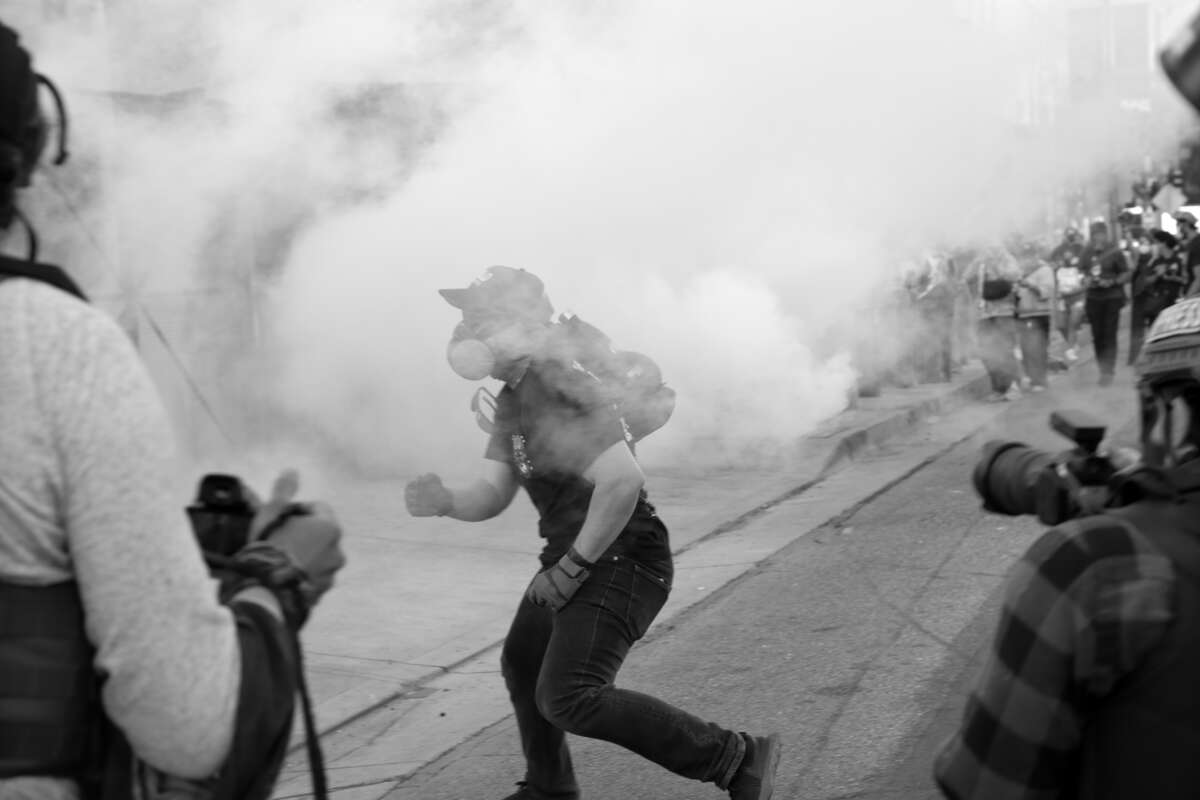
A protester throws tear gas back at federal agents on March 28, 2026, in downtown Los Angeles.Kevin Foster

On March 28, 18-year-old University of Southern California student Tucker Collins documented a protest outside the Los Angeles Metropolitan Detention Center.

“I didn’t even see any of the officers who had their weapons out,” Collins told Truthout. “[I was] standing back from the crowd and, you know, focused on trying to frame up the crowd, and then the next thing I know, I can’t see anything.”

A federal agent shooting from behind a fence struck Collins in his right eye with a .68 caliber FN 303 projectile, destroying Collins’s eyeball and fracturing his orbital bone.

While often mislabeled as common pepper balls, FN 303 projectiles carry more than just the chemical irritants found in typical paintball-style rounds. They have a hard plastic casing and a metal front payload, adding weight and kinetic energy to “temporarily disable” targets with “a sufficiently dissuasive level of pain,” according to their manufacturer.

A protester holds up a cardboard shield against federal agents firing projectiles on March 28, 2026, in downtown Los Angeles.Kevin Foster

“Less-lethal” weapons are broadly defined by the Department of Homeland Security (DHS) as weapons or instruments that are “designed or intended to be used in a manner that is not likely to cause death or serious bodily injury.” Such weapons include pepper balls, rubber bullets, tear gas, and more. While many of these weapons have the capacity to kill, they are often referred to as “less-than-lethal,” according to DHS.


Police Use “Less Lethal” Weapons to Crush Social Movements Across the World
A new report finds that more than 121,000 people globally were injured or killed by crowd-control weapons since 2015.  By Mike Ludwig , Truthout  March 24, 2023


Despite their “less-lethal” designation, FN 303 projectiles have proven deadly. A Boston police officer killed Victoria Snelgrove in 2004 by shooting her in the eye with an FN 303 round.

In January 2026, federal agents shot two people in the eye with FN 303 rounds in Santa Ana, California, at least one of which was at point-blank range and reportedly left the individual with a piece of metal near his carotid artery.

In spite of the risks, officers continue to use them.

Under Customs and Border Protection’s 2021 use-of-force policy, firing FN 303 projectiles within 10 feet of a target is only authorized when deadly force is considered “reasonable and necessary,” such as when an individual is determined to pose an imminent threat of death or serious bodily injury to an officer or another person. The updated overarching policy from DHS also considers “uses of impact weapons to strike the neck or head” deadly force.

“I think a troubling sign is that this has become the new norm for how law enforcement deals with mass assemblies.”

Scott Reynhout, a researcher with Physicians for Human Rights, studies what he calls the “misuse” of less-lethal weapons, with a special focus on DHS.

“The first thing that’s clear is that there’s a lot of it,” Reynhout told Truthout. “I’d say the biggest alarming trend of misuse that we’ve seen is people getting shot in the face. This is something that is not necessarily new.”

Critics argue against the use of these weapons altogether because of the potential deadly risks, as well as officers using them to suppress free speech and the right to protest.

A megaphone sits on the ground in front of a line of DHS officers on March 28, 2026, in downtown Los Angeles.Kevin Foster

Collins says he was shot while standing among many other people filming. He believes such individuals are targeted because they’re filming federal agents committing illegal acts, including shooting him.

“They shot at me with no cause or justification,” Collins said. “And they have no need to be using these weapons anyways, especially in this scenario where there was no imminent threat to them.”

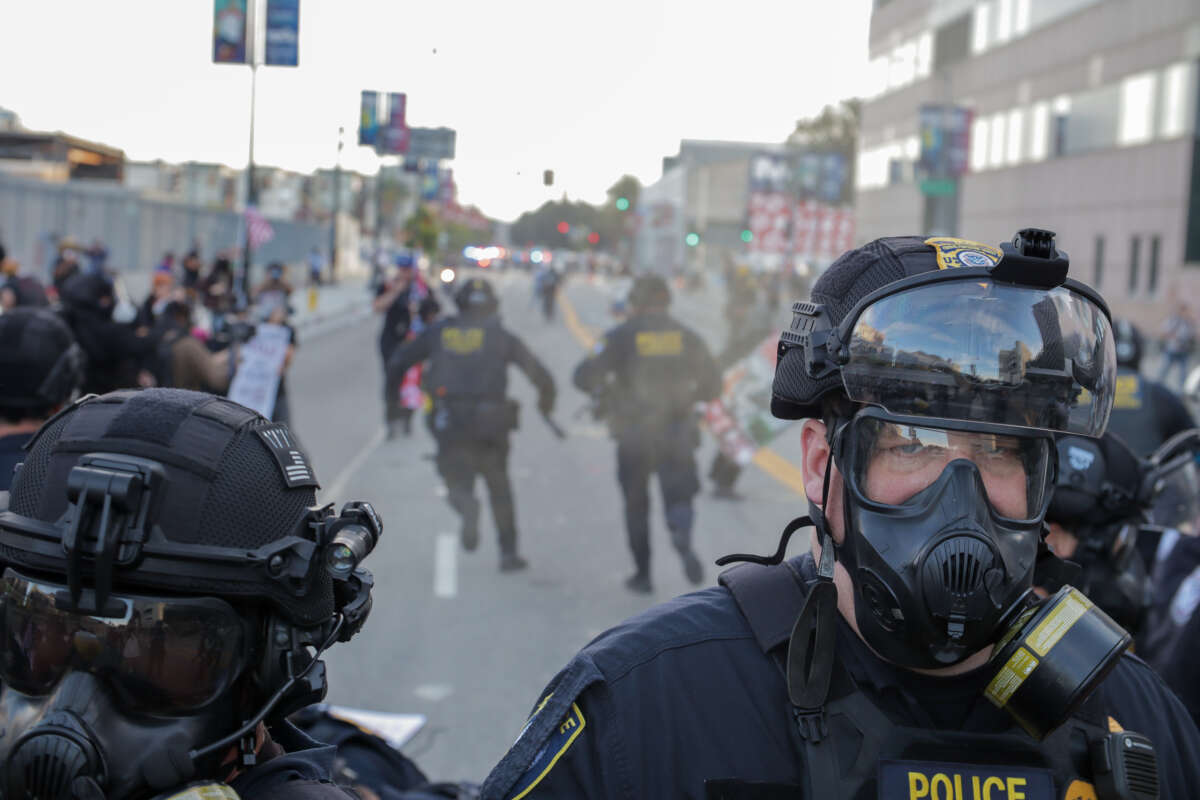
Following the attack on Collins, federal agents continued firing pepper balls and tear gas in waves from behind a fence and into the crowd. They nearly hit more individuals in the face and struck journalists (including me) and protesters.
No Sign of Slowing Down

Both Immigration and Customs Enforcement and Customs and Border Protection have dramatically increased weapons spending since Donald Trump took office for his second term, according to a report from the office of California Sen. Adam Schiff. DHS is reportedly spending upward of $50 million on “less-lethal” weaponry.

Reynhout and other researchers with Physicians for Human Rights recently released a report on how U.S. law enforcement escalated the use of certain weapons to crack down on immigration protests. Notably, they highlight the use of inherently indiscriminate scattershot munitions that send multiple small projectiles in different directions — these munitions are included in the DHS purchasing spree.

“Their deployment against crowds cannot be rationalized as crowd-control under any reasonable interpretation of international standards and cannot be considered legal, even under existing frameworks that already inadequately regulate less-lethal munitions,” the report states.

Federal agents chase after a protester as others make an arrest on March 28, 2026, in downtown Los Angeles.Kevin Foster

Reynhout said previous Physicians for Human Rights research on crowd-control weapons indicated that 82 percent of all injuries reported between 2016 and 2021 came from metal birdshot projectiles, which he says are very similar to the rubber-ball scattershot munitions DHS is purchasing.

The report also highlights federal agents using powder blast dispersion munitions, also known as “muzzle blast” munitions, in the most dangerous way possible. These munitions, also included in the DHS purchasing contract, discharge a cloud of tear gas or pepper irritant from a grenade launcher. While they aren’t technically considered a projectile, materials such as wadding and other debris can leave the muzzle and exceed speeds of 200mph, according to the PHR report.

These muzzle blast munitions appear to have been shot through the fence at protesters in Los Angeles in the hour following Collins’s injury.

“I think a troubling sign is that this has become the new norm, I would say, for how law enforcement deals with mass assemblies,” Reynhout said. “It’s just, ‘Let’s just throw more money at the problem and hope it goes away.’”


“It’s one of the most threatening things to us as a nation: the increasing force and authoritarianism that this administration is using to essentially terrorize its own citizens.”

The PHR report offers multiple recommendations, from prohibiting the use of scattershot kinetic impact projectiles to limiting or restricting the use of powder blast munitions and certain chemical obscurants — most importantly, banning the use of HC smoke, a highly hazardous chemical obscurant used by DHS as recently as January 2026 in Portland, Oregon.

Crowd-control weapons are commonly referred to as “less-than-lethal,” or even “non-lethal,” and the Physicians for Human Rights report concludes that this creates a pattern of risk where such weapons are subject to fewer regulations. The report adds that this may also lead to law enforcement using these weapons without exhausting deescalation techniques, something critics have pointed out at protests around the country.

A federal agent aims a weapon at protesters on March 28, 2026, in downtown Los Angeles.Kevin Foster

Whether it’s indiscriminate crowd-control weapons or more targeted munitions that can be deadly, both DHS officers and police departments around the country have demonstrated a willingness to utilize them broadly, even if it means suppressing free speech or injuring people in their line of fire.

“I do think about that day often, just in the events of it, just of what could have happened,” Collins said. “I’m enraged, but I’m not surprised. This is not the first time something like this has happened, nor will it be the last. I think it’s one of the most threatening things to us as a nation: the increasing force and authoritarianism that this administration is using to essentially terrorize its own citizens.”


This article is licensed under Creative Commons (CC BY-NC-ND 4.0), and you are free to share and republish under the terms of the license.


Kevin Foster is an independent journalist covering activism, politics, and accountability.
Elon Musk Celebrated Imminent Trillionaire Status by Stoking Pogroms in Belfast

Dozens of people have been burned out of their homes after Musk used X to incite anti-immigrant mobs in Ireland.
Published
June 16, 2026

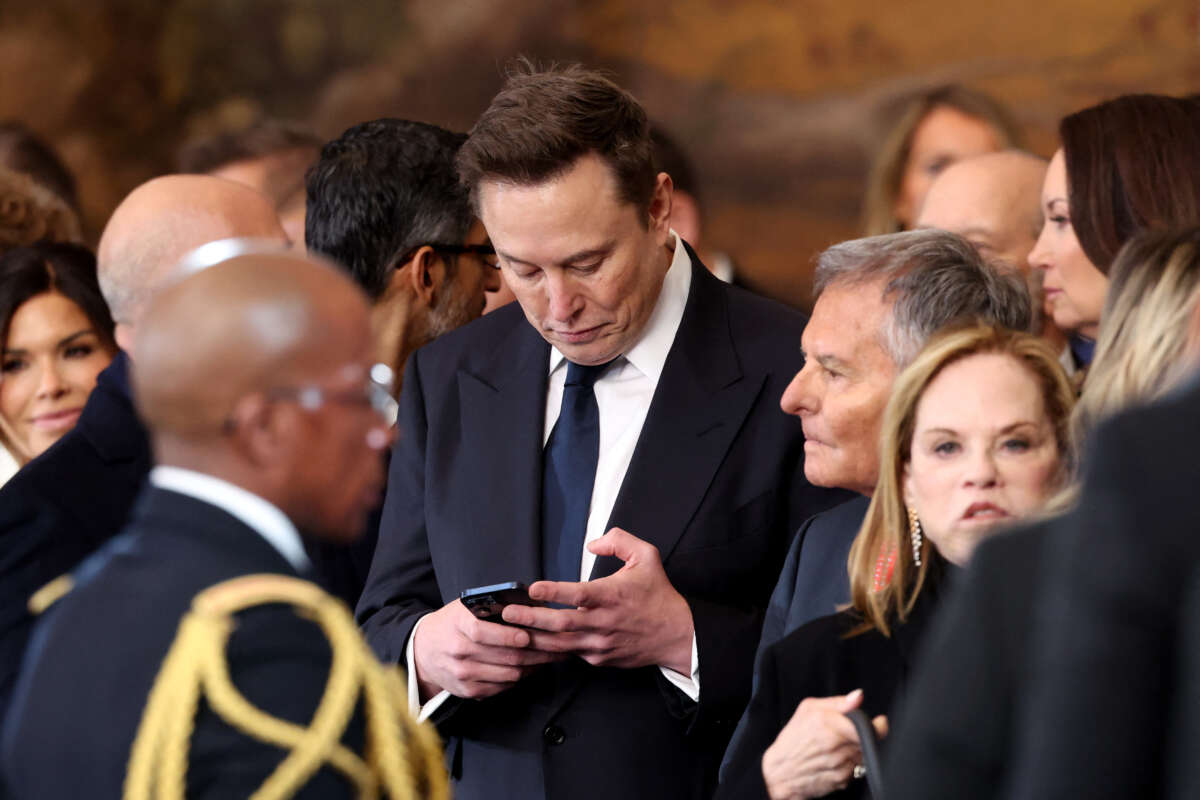
SpaceX, X, and Tesla CEO Elon Musk looks at his phone during the inauguration of Donald Trump as the 47th president of the United States in the Rotunda of the U.S. Capitol in Washington, D.C., on January 20, 2025.KEVIN LAMARQUE / POOL / AFP via Getty Images

Two years ago, as far right thugs in Britain launched a series of attacks on hotels housing asylum seekers, Elon Musk took to X to gleefully predict that the U.K. was on the verge of civil war, and urged the English to forcefully oppose immigration. Last year, in a speech live-streamed to a huge fascist rally in the center of London, Musk told his audience that “violence was coming” to England and “you either fight back or you die.”

This past week, as Musk prepared for an initial public offering (IPO) of SpaceX that would, on paper, end up making him the world’s first trillionaire, the tycoon openly sided with the masked arsonists terrorizing non-white asylum seekers and refugees in the northern Irish city of Belfast. Musk has posted and reposted statements about “murderous migrants,” U.K. Prime Minister Keir Starmer “hating white people,” and how “millions must go,” referring to fascist demands to “remigrate” non-white peoples out of Europe.

It’s impossible to overstate the irresponsibility and dangerousness of Musk’s actions at a moment when Belfast, which was riven by Protestant-Catholic hostility and anticolonial violence for generations, is witnessing a fresh bout of communal rage, this time directed against non-white immigrants. In the last few days, dozens of people, including children, have been burned out of their homes by roving anti-immigrant hoodlums, who were marshalled to sites of “protest” by the U.K.’s preeminent fascist leader, Tommy Robinson. Musk shared the list of these sites, some of which appear to be the addresses of immigrants, with his followers.

By midweek, the violence fueled by a network of white supremacist youth groups had become so fierce that the U.K. government belatedly authorized the police to use water cannons in an effort to regain control of city streets. Musk was anything but contrite. He took to X to proclaim that the “very deliberate policy of mass uncontrolled immigration and open borders” was responsible for the mob violence.

As an individual, Elon Musk’s net worth — post-IPO, an astounding $1.2 trillion — is now more than the annual GDPs of all but 20 countries on earth. On paper, he is now on a par with the Swiss GDP. And as a social media presence, his reach is, arguably, second to none. On X alone, the tycoon — whom the well-known economist and commentator Paul Krugman has recently accused of basically running the world’s largest Ponzi scheme — has roughly a quarter of a billion followers. He is somewhat like a one-man superpower, using his outsized influence to openly support white supremacist mobs burning immigrants out of their homes, and refashioning X as something of a clearing house for white supremacist conspiracy theories and hate speech.


British Politicians Accuse Elon Musk of Stoking Racist Violence in Belfast
Musk encouraged his base to take to the streets shortly before rioters stormed immigrant neighborhoods in Belfast. By Shireen Akram-Boshar , Truthout June 10, 2026


U.K. government figures have, somewhat halfheartedly, condemned Musk’s comments. And Liberal Democrat party leader Ed Davey used a speech in Parliament to urge the Labour government to crack down on X in the wake of Musk’s interventions in British politics. But, to date, none of Starmer’s ministers have stated whether Musk could or should be prosecuted for incitement to violence.

And so, Musk’s assault on the concept of multiracial democracy continues to pick up steam. In this, he is ably backed up by the evermore overtly white nationalist Trump administration.

This past week, Defense Secretary Pete Hegseth used his podium at the annual D-Day commemorations to warn Europe’s leadership against complacency in the face of boatloads of migrant “invaders.” And JD Vance took to X to lambast Europe’s “elites” for letting their civilization die by not standing up to a “mass invasion of migrants.”

The administration has also ratcheted up its white nationalist offensive by launching a raft of additional investigations and lawsuits into universities for supposedly lowering standards by admitting too many Black and Latino students into medical schools. This comes just days after the launch of a truly despicable “Aliens.gov” website, linked to the White House website, that attacks immigrants who have arrived in the six-plus decades since the U.S.’s immigration system was liberalized and ominously warns that “they” do not belong here. Meanwhile, a World Cup is underway that will exclude the attendance of residents of nearly a third of the world’ s countries, due to Trump’s travel bans.

In April of this year, the Washington Post reported that Elon Musk had tweeted on race 850 times over the previous few months. His tirades are, as the article detailed, anything but subtle. The SpaceX CEO warns his followers that “whites are a rapidly dying minority”; that the West is beset by “poisonous propaganda” against straight, white men; that whites face the risk of “genocide” against them; that white job applicants are routinely discriminated against. Each one of these posts reaches millions of readers. Each one further inflames white resentment and anti-immigrant racism not only in the United States but also in other countries all over the world.


Faced with criticism for his words, Musk doubled down. “Only Restore Britain can save Britain,” he wrote, endorsing Britain’s newest far right, nativist political party.

Last year, as Musk used his “Department of Government Efficiency” shock troops to destroy USAID and other foreign assistance programs, thus all but guaranteeing that millions of people in poor countries would die from preventable diseases, Musk averred that too much empathy leads to civilizational death; and that empathy is a “fundamental weakness” of Western societies. This week, Musk’s anti-empathy crusade is on full display in Belfast. Empathy for terrified non-white immigrants, facing masked mobs who want to burn them out of their homes? That’s for the birds.

In fact, faced with criticism for his words, Musk doubled down. “Only Restore Britain can save Britain,” he wrote, endorsing Britain’s newest far right, nativist political party — a political party whose members, endorsing the “remigration” of millions of British residents and citizens, are too extreme even for Nigel Farage’s fascist-tinged Reform Party. It was, even by Musk’s debased standards, a truly repugnant endorsement.

Around the U.K., including in Belfast, over the past few days, anti-racists have organized protests to counter the anti-immigrant mobs and to push back against Musk’s particularly appalling statements. Yet, Musk has a massive structural advantage in this fight. The Center for Countering Digital Hate estimated last week that his Belfast posts reached tens of millions of people. It takes an awful lot of grassroots campaigning to counter a built-in audience on that scale.
New Poll Finds Most Americans Back Adopting Popular Vote to Select President

Americans back abolishing the Electoral College by a 2 to 1 margin, the survey shows.

June 18, 2026

An artist rendition of the Electoral College map.Getty Images

A new poll demonstrates strong support for amending the U.S. Constitution to abolish the Electoral College and replace it with a popular vote model.

Under the Electoral College — the archaic system of selecting the president of the United States — states are given electoral votes based on how many members of Congress they have. Candidates obtain these votes by winning statewide races, or, in the case of Nebraska and Maine, by winning individual districts.

In most circumstances, the Electoral College selects the same winner a popular vote model would. But a handful of times in U.S. history — including in the 2016 race won by President Donald Trump — the Electoral College has selected a winner who did not win a majority or even a plurality of votes, choosing the second-place candidate instead.

Although other pathways to implementing a popular vote system are being explored, the most lasting and legally sufficient way to enact such a model would be through a constitutional amendment. According to an Economist/YouGov poll published on Tuesday, a majority of Americans are in favor of such an amendment.

The survey found that 56 percent of Americans would approve of an amendment to abolish the Electoral College and replace it with a popular vote system. Only 23 percent of Americans didn’t like the idea, while another 21 percent said they weren’t sure.

Across the entire 21st century so far, more Americans than not have preferred changing the system of picking the president to a popular vote model. Only in 2016, when Trump won the presidency, did majority support slip to a plurality. After that, voters’ sentiments shifted again, with a majority backing the change ever since.

The dip in support for the idea was likely due to Republican supporters of Trump wanting to preserve the system that helped him win the White House. Following years of decision-making leading to lower approval numbers, this week’s Economist/YouGov poll now shows that even a narrow plurality of GOP-leaning voters support shifting to a popular vote system for the presidential election, with 43 percent backing an amendment for that purpose and 40 percent opposed.

Notably, Trump himself once opposed keeping the Electoral College in place. In 2012, when it initially appeared on Election Night that former President Barack Obama might win the election with only the Electoral College and not the popular vote, Trump wrote on social media that “the electoral college is a disaster for a democracy.”

Even in the week after he won in 2016, Trump insisted he still didn’t like the Electoral College, preferring future elections to be decided by popular vote. Said Trump in an interview:

I’m not going to change my mind just because I won. I would rather see it where you went with simple votes. You know, you get 100 million votes and somebody else gets 90 million votes and you win.

Days later, Trump reversed his position. He has vehemently defended the Electoral College ever since.

The Economist/YouGov poll also asked respondents their views on terminating the 22nd Amendment to the Constitution, which places term limits on presidents. Trump has frequently toyed with the idea of running for a third term, despite the amendment limiting him to the two he has already served.

“No person shall be elected to the office of the President more than twice,” the text of the Amendment states.

In spite of that directive, Trump has claimed in the past that “there are methods” around the 22nd Amendment. He also once stated in an interview that he is “not joking” about the possibility of running again.

Americans largely favor keeping the amendment in place, the poll found, with 70 percent opposed to changing the 22nd Amendment and only 16 percent in favor of lifting its restrictions. Even a majority of people who voted for Trump in 2024, 56 percent, said they want the two-term limit to remain.