It’s possible that I shall make an ass of myself. But in that case one can always get out of it with a little dialectic. I have, of course, so worded my proposition as to be right either way (K.Marx, Letter to F.Engels on the Indian Mutiny)
Sunday, June 28, 2026
Dismantling Underway for the Beached Wreck of MSC Baltic III in Canada
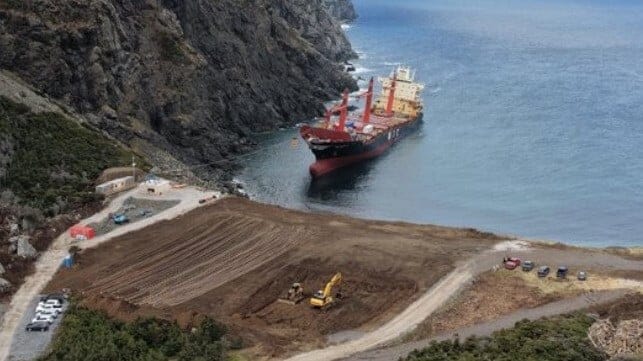
Access has been created and the area in front of the ship is being prepared for the bow section to be pulled ashore for dismantling (Canadian Coast Guard)
The efforts are underway to dismantle the containership MSC Baltic III, according to the most recent update from the Canadian Coast Guard. It will be a complex operation requiring possibly a year or more, involving breaking the ship into pieces and pulling it onto the beach to be cut up and trucked away for recycling.
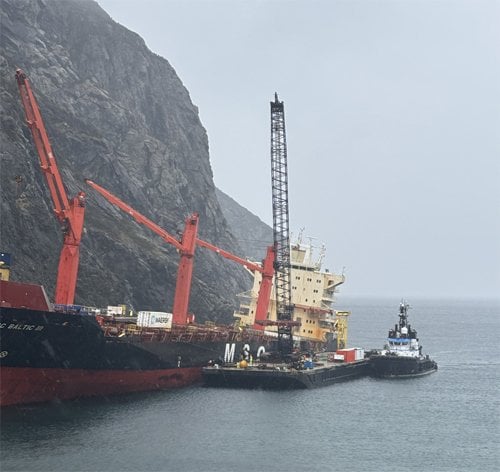
Favorable weather at the site, which is in a remote area of Newfoundland, about 30 miles from Corner Brook, permitted the wreck removal team increased access to the vessel. A barge was positioned alongside, and they have been removing material from the ship.
Preparation work is also underway on shore. A switchback road is being created down to the beach in front of the vessel to get equipment and trucks to the site, while improvements were also made to the access road to Cedar Cove, where the vessel came to rest in February 2025.
MSC Mediterranean Shipping Company and its insurers retained Resolve Marine earlier in the spring for the second phase of the recovery operation. Resolve will be undertaking the removal of the ship and the restoration efforts in the area.
During the first phase of the clean-up conducted in 2025, the Canadian Coast Guard reported that 409 of the 462 containers aboard the ship, including dangerous goods, had been removed. All the bulk fuel, approximately 1,700 metric tons, was also removed.
A barge is alongside as material is being removed from the wreck (Canadian Coast Guard)
Resolve reported that in the first phase, it would complete the removal of the remaining containers, many of which were reported to be waterlogged. The Canadian Coast Guard also said that, in addition to residual amounts of fuel, the ship has contaminated water aboard.
So far they have reported to have removed approximately 23 additional containers. Works has also begun to remove furnishings from the accommodations area. The hatch covers are also being removed. Cutting of the vessel is expected to start during the summer.
Preparation work aboard the MSC Baltic III, Resolve reported, would include the welding of rigging points. The plan calls for separating the ship at the break point in the hull. The forward section will be pulled onto the beach and cut apart. The fuel tanks will be further cleaned, and work on the removal of the accommodation block will also get underway. The cut will be forward of the engine room of the vessel. After the bow section has been recycled and similar operation will pull the stern section to shore.
Resolve Marine has said it will get the first phase completed during 2026 and that work will continue until winter conditions set in over the area. Additional removal work is likely for 2027.
The Canadian Coast Guard currently says the wreck is stable with no significant change to its condition recently. In May, it had reported that the wreck, however, was in poor condition after heavy weather and ice conditions during the winter. There is significant damage to the hull, including a crack in the port side. There is also buckling on the starboard side and a crack that was worsening on the deck of the vessel.
MSC Baltic III had been heading for Newfoundland in February 2025 when the vessel blacked out in a strong winter storm. It was driven into the cove, and the Canadians organized a daring helicopter rescue of the crew. The ship ended up aground on the shoreline in Cedar Cove, with the stern settling to the seafloor. Under Canadian law, MSC and its insurers are responsible for the removal operation and the cost of the cleanup.
Kenya Seeks to Get Rid of a Tanzanian Ship Beached for Six Weeks
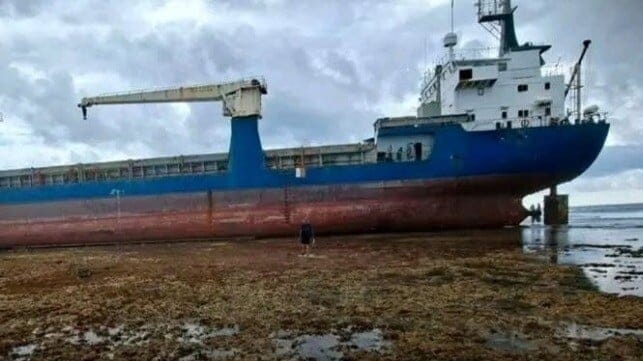
Dan has been on the beach since mid-March with an effort to reflot it now expected in mid-July (Emmanuel Ernest on Facebook)
Salvors in Kenya are attempting to coordinate efforts to be rid of a Turkish-owned vessel that has been aground near a marine protected park for six weeks. The ship remains high and dry as environmentalists are raising concerns.
The MV Dan (IMO: 8415160), a general cargo ship that sails under the flag of Tanzania, grounded within Kenyan waters off Nyali beach on May 17, igniting concerns that a hull breach or fuel leak could have catastrophic impacts on the marine ecosystem. The vessel grounded after drifting off course while on its way from Tanga, Tanzania.
The Kenya Maritime Authority (KMA) has come out to allay fears that the 99-meter (326-foot) vessel owned by SLA Maritime Co. is a danger to the environment. It said in a briefing on June 23 that it has been maintaining close oversight of the situation to ensure the safety of navigation, protection of the marine environment, and the welfare of the crew on board.
Built in 1985, the 4,900-dwt vessel, however, remains firmly aground. According to the authority, a detailed inspection of the vessel has established that its hull integrity remains intact with no evidence of structural failure or leakage.
“Consequently, the likelihood of a pollution incident is currently assessed to be minimal. Nevertheless, precautionary measures remain in place, and the situation continues to be closely monitored,” said Omae Nyarandi, KMA Director General.
He added that the Kenya Coast Guard has been maintaining a round-the-clock security and surveillance of the vessel to ensure the safety of the crew, prevent unauthorized access, and facilitate rapid response should the need arise.
To prevent a major environmental disaster, SLM Maritime, working with Kenyan authorities, is engaging in efforts to refloat the vessel. The operation is expected to be undertaken around July 13, when the salvors intend to take advantage of the next favorable tide period.
KMA highlights that the vessel will be refloated in accordance with maritime and environmental protection requirements. This is because Nyali beach is renowned for its pristine, white-sand shoreline and calm, turquoise waters that transition into a rich, protected marine ecosystem.
The beach serves as an accessible gateway to the vibrant marine life and coral formations of the adjacent Mombasa Marine National Park and a reserve.
The ship was cited for safety problems in 2025 during an inspection in Slovenia. Among the listed issues were concerns over the safety of navigation and bridge operations. The inspection also cites fire safety issues, problems with the closing devices for the watertight doors, and various shortcomings in its certificates.
Day of the Seafarer: Labor Rights and Safety at Sea
(Article originally published in Mar/Apr 2026 edition.)
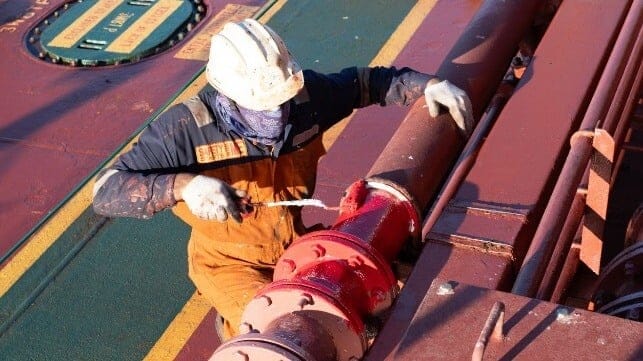
Every year, the maritime industry takes a pause to celebrate the essential work of 2.5 million seafarers, without whom world trade would not be possible. Men and women from every nation keep the 74,000 vessels of the merchant fleet moving, enabling the movement of 90 percent of all traded goods. Without their behind-the-scenes efforts, the smooth-running supply chains for food, energy, industrial supplies and consumer products would grind to a halt. It takes them away from home for up to 11 months at a time, and it exposes them to inherent risks that - even when appropriately managed - have always been a part of life at sea.
"To all seafarers: thank you. Your work is essential to the functioning of the global economy and the daily lives of people around the world. While it may not always seem visible, your safety, security and welfare remain our highest priority," said IMO Secretary-General Arsenio Dominguez.
Working through risk
Seafaring is tough work, and though the data show that it has gotten much safer in recent years, seafarers take on an inherent level of risk when they step aboard - as illustrated by new numbers from Gard. The leading insurer took in about 850 claims for crew injuries in 2025, and the pattern shows that everyday tasks are responsible for a large share of the total. These are familiar occurrences: accidents during mooring, cargo movement and maintenance are among the most common. Simple slips and falls account for fully 29 percent of the total. Most incidents occur in the morning, at the start of the day-work shift, and most occur early in a seafarer's rotation, during the first few months on board. These risks do not go away with age and experience.
"Accidents causing injuries do not only happen to inexperienced crew or during unusual situations. They often occur during normal work when experienced crew carry out familiar tasks," said Gard chief claims officer Christen Guddal. "Ultimately, the data reminds us that this is less about human failure and more about the realities of human limitations in demanding operational environments."
The best operators in the industry make great efforts to manage those risks and ensure that the crew's well-being is taken care of; labor regulations help incentivize that effort. This year marks the 20th anniversary of the adoption of the Maritime Labour Convention 2006 (MLC), the comprehensive regulation for seafarer rights, and the International Chamber of Shipping is taking the opportunity to highlight the MLC's advantages - and the problems that arise when it is sidelined or ignored.
"Where the MLC, 2006 is fully implemented, shipping is safer, more predictable and more sustainable. Where it is weakened, not applied or applied inconsistently, both seafarers and fair competition become more vulnerable," ICS cautioned.
To strengthen the convention, ICS called for its full ratification by all IMO member states, and its full implementation in practice. The MLC offers seafarers a minimum wage floor, guarantees of a positive shipboard culture, freedom from abusive recruiting practices, and protection from abandonment - when enforced.
"We are against the backdrop of heightened geopolitical tension, climate transitions, and systematic pressure on global supply chains, which can have grave knock-on effects to our seafarers. They are vulnerable to decisions taken outside of the maritime sector, weakened or inconsistent applications of the MLC, and being placed in dangerous situations despite doing everything correct in their job," ICS said. "On this Day of the Seafarer, [ICS] calls on political leaders, policy makers, and senior public officials, including those outside traditional maritime portfolios, to recognize shipping and seafarers as essential to socio-economic global stability."
Given the internal and external risks, recruitment and retention can be an issue in shipping, particularly for well-trained officers. With the constant growth of the fleet, demand for STCW-trained officers has risen 23 percent in the last five years. According to ICS and BIMCO, the industry now faces a shortage of officers, and will need more than 100,000 more of them in the workforce by 2030 as the fleet continues to expand. To meet demand, the associations predict that shipping will need to add 23,000 officers and more than 8,000 ratings every year across the fleet.
"The recruitment, training and retention of the seafarer workforce will be crucial to ensuring that our industry is prepared for the future. We have a big collective task ahead of us in working with all stakeholders and the countries that are the biggest suppliers of the seafarers operating our ships," said BIMCO Secretary General & CEO David Loosley.
The opinions expressed herein are the author's and not necessarily those of The Maritime Executive.
Deepening Crisis as Global Shipping Grapples with Workforce Shortage
Shipping faces widening shortage of officers and ratings (IMO)
The global shipping industry is staring at a deepening workforce crisis over the coming years, owing to the fact that the recruitment of certified officers and seafarers has failed to keep up with the growth in fleet numbers. A new report warns that the problem is likely to grow more acute unless actions are taken.
The trade group BIMCO and the International Chamber of Shipping (ICS) released their five-year assessment on the state of the global shipping workforce. They are calling for continued investment in both recruitment and training, coupled with retention efforts, saying that the workforce gap risks growing at a time when the industry needs skilled seafarers more than ever.
The Seafarer Workforce Report 2026 paints a picture of an industry grappling with perennial workforce shortfalls, a trend that is bound to continue in the coming years, exacerbated by an unprecedented growth in fleet. Compared to 2021, when the report was last published, the workforce crisis seems to be worsening, with the 2026 report indicating that the global shipping industry will need an additional 113,735 officers by 2030 to operate the world merchant fleet. In 2021, the trade group and union had predicted the industry would be in need of 90,000 officers by 2026.
The latest report provides a comprehensive overview of the supply and demand imbalance for certified seafarers, showing that the global merchant fleet has not made progress in tackling workforce crises. It continues to grapple with persistent challenges like high turnover, an aging seafarers’ population, and a lack of gender diversity. The crisis for the industry is being heightened by geopolitical tensions, specifically the evolving situations in the Strait of Hormuz, where over 11,000 seafarers are stranded.
“As shipping continues to evolve, attracting more people to careers in maritime is essential. We must continue our long-standing efforts to engage with young people early and build a strong pipeline of future talent. At the same time, retaining and developing our existing workforce is equally important,” said Thomas A. Kazakos, ICS Secretary General.
According to the report, an estimated 2.57 million seafarers are currently serving the global fleet, operating 85,148 merchant ships. Of the total, slightly over a million are officers, while 1.51 million are ratings. Notably, while the number of officers and ratings has increased by 22 percent and 47 percent, respectively, a huge disparity continues to be noticeable in the industry. This emanates from the fact that this year, the industry will see a shortage of 39,100 officers and a surplus of 56,890 ratings.
Going by the rate at which the global merchant fleet is growing, the report estimates that an additional 22,747 officers and 8,475 ratings will need to join the workforce each year until 2030 to meet the future demand. This represents an average annual increase of two percent and 0.5 percent, respectively. The increase is, however, minimal compared to the past five years, in which demand for certified seafarers increased by 35 percent.
The report goes on to highlight that general cargo ships, bulk carriers, and cruise ships will be the main segments driving the demand for both officers and ratings.
“The recruitment, training, and retention of the seafarer workforce will be crucial to ensuring that our industry is prepared for the future,” said David Loosley, BIMCO Secretary General & CEO.
The report shows that in 2026, five countries, the Philippines, India, China, Russia, and Indonesia, were the biggest suppliers of the global seafarer workforce at 56.2 percent of the industry’s total. In terms of nationalities, the Philippines, Ukraine, India, Romania, and Poland account for the biggest workforce.
Age and diversity continue to be major issues in the industry. The report shows that compared to 2021, the average age of officers serving at the management level has decreased slightly, while the average age of operational level officers and support level ratings has coalesced around 31–40 years. In terms of diversity, the increase in supply of female seafarers is mainly concentrated among officer positions.
Australia Continues to Record High Numbers of Maritime Safety Incidents
In one of the most dramatic incidents of 2025, the commercial vessels Wide India (left) and Volans (center), with Viking Passama on the right, broke away during a violent storm in Brisbane (ATSB)
Maritime safety in Australian waters continues to be a major concern after the country recorded another year of significantly high numbers of incidents, according to an annual report by the Australian Maritime Safety Authority (AMSA).
In its Marine Incident Annual Report 2025, AMSA highlights that safety risks in the country’s maritime sector remain prevalent, with recorded incidents yet again exceeding 4,000 in 2025. During the year, AMSA received a total of 4,174 marine incident reports from domestic commercial vessels (DCVs), foreign-flagged vessels (FFVs), and regulated Australian vessels (RAVs).
Though the 2025 recorded incidents show a drastic decline from 2024, in which 5,639 incidents were reported, the reduction was primarily attributed to a change in classification introduced on January 1, 2025. Under the amended classification, defect reports for RAVs and FFVs were no longer captured within the marine incident reporting process. This means that a substantial number of reports that would have been previously recorded as marine incidents were excluded in 2025, including approximately 1,272 recorded defect reports.
Apart from incidents, AMSA also received 452 reports of marine safety concerns, representing a 14.7 percent increase compared to 394 reports in 2024. During the year in which four fatalities were recorded, and 434 injuries, collisions, groundings, and power, propulsion and system failures remained among the most common incident types.
“Understanding what is driving marine incidents helps vessel owners, operators, and crew focus on where action will have the greatest impact, strengthening onboard procedures, maintaining vessel systems, and managing risks before incidents occur,” states AMSA.
With a coastline extending across 60,000 kilometers (more than 37,000 miles), including 12,000 islands, Australia occupies the third-largest exclusive economic zone in the world. For the country, the maritime sector is critical, with over 99 percent of international trade carried by sea. The country receives more than 29,000 visits per year from international trading ships, ranks as the world’s largest bulk commodities exporter, and its ports handle over 1.6 billion tonnes of cargo annually.
At the national level, Australia’s domestic commercial fleet is made up of around 31,000 vessels comprising 61 vessel classes that range in size from less than 7.5 metres to over 45 metres.
The fact that Australia’s waters are some of the busiest when it comes to maritime activities means that safety risks also remain high, with DCVs being a major contributor to reported incidents, with 1,229 reports received in 2025. This represented a four percent increase from 1,186 in 2024 and an overall 28 percent increase since 2021, when 962 marine incidents were reported. During the year, DCV marine incidents resulted in four fatalities, 228 injuries (including 44 serious injuries), and 92 person overboard incidents.
The AMSA data show that in 2025, a total of 2,697 FFV marine incidents were recorded, comprising 150 serious and 2,547 less serious. Most of the incidents involved bulk carriers, which accounted for 60 percent of the incidents, followed by container vessels with 15 percent, and general cargo/multi-purpose ships with six percent.
AMSA has been intensifying its crackdown on substandard and unseaworthy vessels sailing into the country’s waters. These actions are partly informed by the noticeable trend in causes of marine incidents. In 2025, power propulsion and steering failures accounted for the largest proportion of reported incidents, with 664 occurrences, making them the predominant technical issue. They were followed by engineering systems failures with 492 occurrences and vessel systems with 330. AMSA has become well-known for its bans on vessels it deems a risk or failing to follow regulations.
Canada Qualifies First Companies to Bid for Offshore Wind Energy Licenses
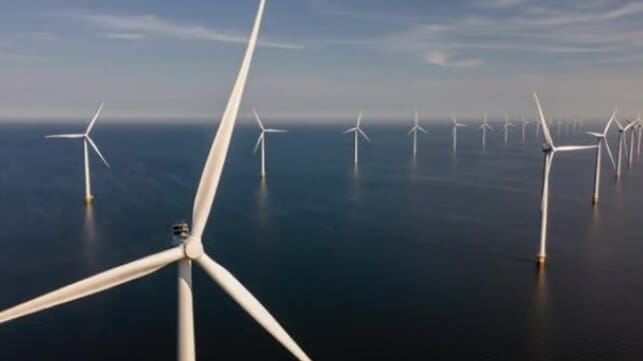
Prequalification of companies for Canada's first offshore wind energy license auction were completed (Nova Scotia Government)
Canada and the province of Nova Scotia took a key step forward in their ambitions to develop offshore wind energy by designating the firms prequalified to enter the bidding. Government officials highlighted a strong field of international participants, saying it further confirms the opportunities to become a world-class site for offshore wind energy.
The Canada-Nova Scotia Offshore Energy Regulator (CNSOER), an independent joint agency created by the government of Canada and Nova Scotia, conducted the pre-qualification. It established criteria for the financial status of the bidder as well as technical, legal, and social elements that were considered during the review process.
“By attracting companies with the experience and know-how to deliver large energy projects, we are setting the stage for a successful offshore wind industry here at home,” said Nova Scotia Premier Tim Houston.
Among the five companies that were announced as having been pre-qualified were well-known names of developers, including DEME from Belgium, Jan De Nul based in Luxembourg, and Ming Yang from China. Two groups were also among those pre-qualified, and included in one of the groups is Hanwha Ocean, which would be working with Q Energy France. The regulator noted, however, that companies also had the option of not revealing their status in this phase of the program.
Canada plans to open the formal bidding for the first offshore wind sites in the country later this year. Bids will be reviewed both at the federal and provincial levels before the designees for the licenses are announced.
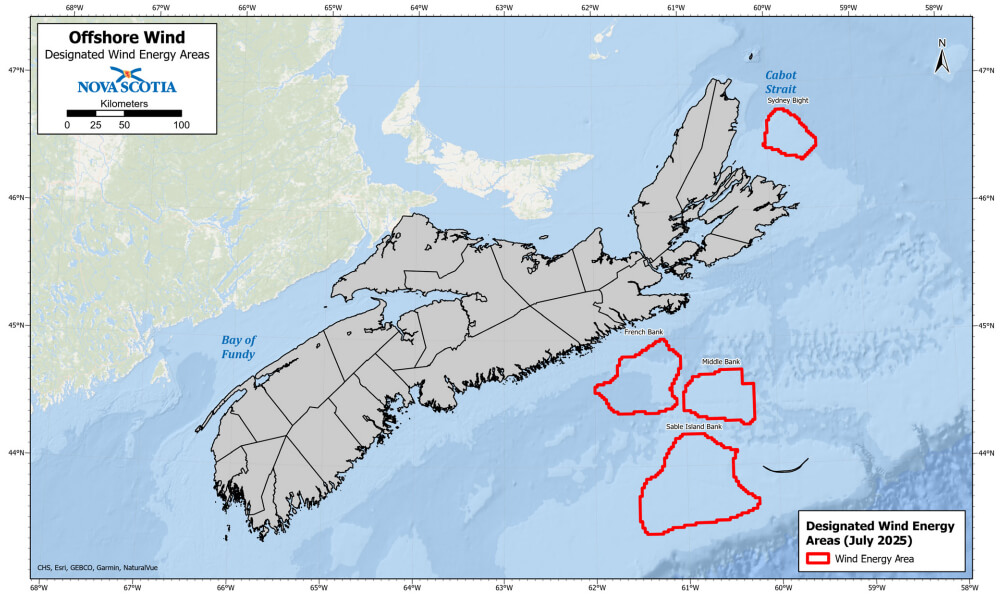
The first areas designated for the leases were announced in July 2025 (Province of Nova Scotia)
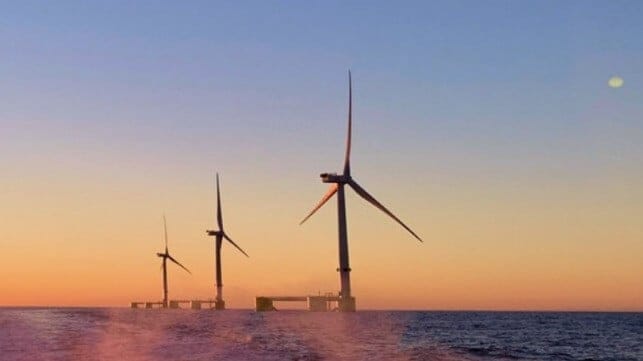
The first wind lease areas that will be put up for auction were designated in July 2025. A total of four areas were announced, including three to the east of Nova Scotia and one to the north. Three (Middle Bank, Sable Island Bank, and Sydney Bight) would each be at least 25 kilometers (15 miles) from shore and are at depth for fixed-bottom turbines. The fourth, French Bank, would be closer at 20 kilometers (12.5 miles), with significantly deeper waters, which could require floating turbines. The province has additional areas under consideration.
The government said the first call for bids would be for a modest 2.5 GW and would be followed by additional rounds. The goal is to license 5 GW by 2030.
Nova Scotia’s Premier, Tim Houston, is advocating a bold vision for the industry. He looks to make Nova Scotia an energy exporter. While Nova Scotia currently has peak electrical usage of approximately 2.4 GW of power, Houston predicts the industry could grow to a generation capacity of 40 to 50 GW by 2050, making it an energy exporter.
Massachusetts is reported to be one of the potential markets for Canadian wind power. The state is looking to develop new sources of renewable energy after the Trump administration stalled New England’s efforts to develop more offshore energy capacity.
California to Sue Trump Administration for Canceled Offshore Wind Lease
Golden State Wind was to be one of the first floating wind farms in the United States (rendering from Ocean Winds)
California Attorney General Rob Bonta and the California Energy Commission filed a notice of intent on Tuesday, June 23, to challenge the Trump administration’s deal to cancel a California offshore wind lease in exchange for investments in fossil fuel energy projects. The state contends the effort puts at risk its energy policy and more than $100 million in investments in an unlawful agreement that violates the Outer Continental Shelf Lands Act.
The Trump administration’s latest step to end offshore wind energy has focused on a series of deals that it says reimburse the bidders for the money spent on leases in exchange for reinvestment in other energy projects. The first deal was struck for nearly $1 billion with TotalEnergies, followed by a second that canceled California’s Golden State Wind (GWS) and another project in the New York Bight, and a third deal which cancels projects in the New York Bight, the central coast of California, and the Gulf of Maine. All told, the administration has promised nearly $2.6 billion of reimbursements.
“At a time when the country needs more reliable and sustainable power supply, the Trump administration is busy using taxpayer money to strike backroom buyouts that make clean-energy projects disappear. California won’t stand idly by as the Trump administration illegally strikes deals to kill offshore wind projects and replace them with more windfalls for his fossil fuel friends; we’re putting the administration on notice that we intend to sue,” said Attorney General Rob Bonta.
The California Energy Commission in May served an administrative investigative subpoena to GSW seeking documents and information related to the company’s buyout deal with the Department of the Interior. Under the law, the state filed its notice of intent today, and the federal government and GSW have 60 days to correct the alleged violations, or the state can then proceed to file the lawsuit.
The lease for Golden State Wind was acquired in 2022 as a 50/50 joint venture between Ocean Winds (a 50/50 joint venture of EDP Renewables and ENGIE) and Reventus Power, a portfolio company of the Canada Pension Plan (CPP). They paid $120 million for the lease in the Morro Bay Wind Area. The proposal called for a 2 GW floating wind farm located 53 miles northwest of Morro Bay and 22 miles from the closest point to shore. The project was in the early stages, having started in 2024 with its geophysical survey after receiving its permits. It had not filed environmental or construction and operations plans with the Bureau of Ocean Energy Management.
The Department of the Interior announced on April 27 that Golden State Wind had committed to voluntarily end its offshore wind lease. It is the project would be eligible to recover approximately $120 million in lease fees after an investment has been made of an equal amount in the development of U.S. oil and gas assets, energy infrastructure, and/or LNG projects along the Gulf Coast.
California, in its notice, alleges this violates the Outer Continental Shelf Lands Act, which requires that California have a say in the offshore wind leasing program. Bonita said in a statement that the Department of the Interior alleges the agreement settles purported litigation. However, Bonita asserts that Golden State Wind never brought litigation, and it was not challenging actions that the Department of the Interior had never taken. He said DOI claimed unspecified national security concerns justified the cancellation, although the federal government had already reviewed and approved the lease area after years of analysis and consultation with the U.S. Department of Defense.
The Trump administration made similar claims to challenge the first under-construction offshore wind farms on the East Coast. Five separate courts found for the wind farm developers and issued injunctions to prevent stop-work orders on the construction.
The California Energy Commission, last week, after the DOI announced another deal, this time with Invenergy, to cancel offshore wind leases in California, New York, and Maine, also moved to challenge the strategy. It served an administrative investigative subpoena to Invenergy regarding the planned cancellation of another lease in Morro Bay for a further 2 GW of capacity. The subpoena demands a copy of the settlement agreement and information concerning its basis, negotiations, and impact.
California says it has invested more than $100 million to ready its ports, transmission systems, and industries to support offshore wind energy. Further, it says the actions threaten to set back California’s wind strategy, which calls for 25 GW of offshore wind power by 2045, which is critical to the state’s energy transition and increased energy demands. It highlights that the agreements also redirect the investments to other states.
A coalition of eastern states filed a similar challenge against the administration’s agreement to cancel the wind farms planned by TotalEnergies. They also contended it jeopardizes their economies, efforts to meet growing energy demands, and significant investments made to support the projects.
First U.S.-Built Rock Installation Vessel Delivered into a Changed Market
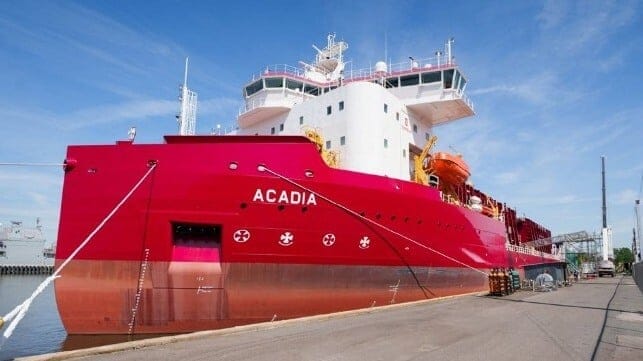
Arcadia was delivered and will pivot to the international market after completing two U.S. offshore wind contracts (Hanwha Philly Shipyard)
A first-of-its-kind vessel, a rock installation vessel designed originally to focus on the emerging U.S. offshore wind energy industry, was delivered today, June 25, to Great Lakes Dredge & Dock Company by the Hanwha Philly Shipyard. The vessel, however, faces a different market, which has caused its owners to pivot to a new strategy.
Ordered in November 2021, it was hailed for the opportunities as the first Jones-Act compliant vessel of its kind. Great Lakes Dredge & Dock ordered the ship as part of a growth strategy to expand its well-established dredging business with new opportunities in the offshore market, but during the construction, the outlook for the industry changed dramatically.
The ship is state-of-the-art and, as such, will be able to pursue broader opportunities. Today, they highlighted that it is equipped to safely and efficiently transport and precisely place rock material on the seabed to protect subsea infrastructure, including cables and foundations for offshore wind. They also highlighted the opportunities with pipelines and the expansion of its deployment internationally.
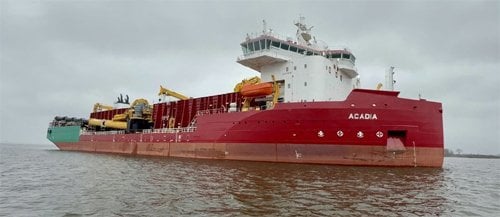
Named Arcadia, the ship is 140 meters (460 feet) with a capacity to transport 20,000 metric tons of rocks. It is equipped with a DP-2 dynamic positioning system, which the company reports makes it accurate to a 65-meter (nearly 215-foot) depth. It has an advanced design, is biofuel-ready, and has battery and shore power capabilities for when it is docked. It can accommodate up to 45 people.
“This highly specialized vessel positions us at the forefront of subsea rock installation in the U.S. and international markets," said Lasse Petterson, President and Chief Executive Officer of Great Lakes Dredge & Dock Company. He highlighted that the vessel also marks a significant milestone for the company’s strategic expansion into the offshore energy sector, both in the U.S. and internationally.
Arcadia is the only vessel of her kind built in the U.S. (Great Lakes Dredge & Dock Co.)
Following delivery, Acadia will mobilize to begin work on Equinor’s Empire Wind 1 project offshore New York. Upon completion, the vessel is expected to proceed directly to Ørsted’s Sunrise Wind project, also located offshore New York. Other U.S. contracts, including Empire Wind II, did not materialize as the Trump administration has sought to shut down the offshore wind sector. As such, Great Lakes reports that upon completion of the two U.S. projects, the Acadia will mobilize to Europe to begin rock installation for a major offshore wind developer, keeping the vessel utilized for the majority of 2027.
"This delivery of Acadia represents far more than the completion of a vessel," said David Kim, CEO of Hanwha Philly Shipyard. He points out that the project demonstrates the yard’s capability to deliver highly specialized vessels that support critical infrastructure.
The project was one of the legacy contracts that Hanwha took over after acquiring the yard. The project, however, was fraught with delays and disputes between the companies, including a lawsuit in late 2024 by Great Lakes. The company had originally said the vessel was expected to be sea-ready by Q4 2024. In the suit, it was reported that the yard had communicated an “estimated delivery date of September 30, 2026.”
Hanwha Philly Shipyard highlights the project as one of the legacy contracts that it is completing. It still has two training vessels to deliver for MARAD. The Lone Star State recently completed sea trials and is expected to be delivered before the end of the summer, while work is progressing on the training ship for California. The shipyard also has assembly now underway on two of the three Matson-ordered containerships. Matson expects to receive the first new vessel in the first quarter of 2027, with subsequent deliveries in the third quarter of 2027 and the second quarter of 2028.
The yard continues to look to position itself with the anticipated revival of American shipbuilding with Korean investments. It has already been linked to projects for its sister company Hanwha Shipping, which ordered 10 medium range (MR) oil and chemical tankers last year and ordered the outfitting of an LNG-carrier, which would be the first ordered in the U.S. in many years. The vessel would be for the U.S. export market, as it will be using a Korean-built ship.
Robotic bird helps uncover the mysteries of flight turbulence
A bio-inspired robotic bird capable of mimicking the key movements of kestrels is helping researchers unravel the mysteries behind the species’ exceptional hovering capabilities.
A bio-inspired robotic bird capable of mimicking the key movements of kestrels is helping researchers unravel the mysteries behind the species’ exceptional hovering capabilities.
With atmospheric turbulence expected to worsen due to climate change, understanding how birds naturally cope with rough air could help engineers design small unmanned aerial vehicles (sUAVs) that are safer, more efficient and fly more smoothly.
sUAVs are commonly used for applications including aerial photography, search and rescue, agricultural monitoring and package delivery but are often grounded in turbulent conditions.
The research, published across two papers in the Journal of the Royal Society Interface, is part of a multi-year collaboration between RMIT University and the University of Bristol, and has delivered significant outcomes in the field of bio-inspired flight and turbulence mitigation.
Learning from the best
Among the most stable fliers in the avian world is the nankeen kestrel, whose movements in gusty and turbulent conditions were tracked by researchers using motion capture technology in RMIT’s Industrial Wind Tunnel facility – one of the largest of its kind in Australia.
RMIT researcher Matt Penn, who led part of the research into how birds handle turbulence, said birds have a range of strategies for enduring rough air, allowing them to fly in complex conditions that would typically ground sUAVs.
“Birds don’t rely on a single response to wind gusts,” he said.
“They constantly adjust their wings and tails to stay balanced, while the natural flexibility of their feathers and joints helps absorb sudden changes in airflow. They can also sense disruptions very quickly, which allows them to respond almost instantly and maintain control.”
The robotic replica
A robotic replica capable of imitating the movements most crucial to kestrels’ remarkably stable flight, has enabled further investigation into the subtle wing and body adjustments that contribute to this ability.
Dr Mario Martinez Groves-Raines, who completed the research during his studies at RMIT and the University of Bristol, said the robotic bird allowed the team to more precisely measure the forces involved.
“By creating a robot replica, we were able to measure how specific movements were contributing to steadiness in flight,” said Groves-Raines, who is now at the Royal Veterinary College in London.
“We uncovered several unique techniques behind the kestrel’s impressive stability. Many of these techniques have the potential to improve manoeuvrability of small aircraft, which encounter similar challenges to kestrels."
RMIT senior researcher Associate Professor Abdulghani Mohamed said the research highlights the benefits of cross-institution collaboration and holds significant promise for the future of aviation design.
“This research shows what’s possible when engineers look to nature for solutions,” Mohamed said.
“Our findings open new pathways for designing aircraft that can better handle turbulence.”
Next steps
While sUAVs already use a range of mitigation techniques similar to those seen in birds, few have been implemented effectively in operational aircraft due to complexity and efficiency trade-offs.
The team plans to build on its understanding of kestrels' exceptional flight abilities by examining their capacity to sense their environment, including small amounts of turbulence encountered in environments where sUAVs operate.
While initially focused on smaller aerial vehicles, the researchers hope to simplify the data collected so it can be adapted for larger-scale aircraft.
RMIT is seeking industry partners to help advance this research and translate these insights into next generation aircraft design. Interested organisations can contact research.partnerships@rmit.edu.au.