Dismantling Underway for the Beached Wreck of MSC Baltic III in Canada
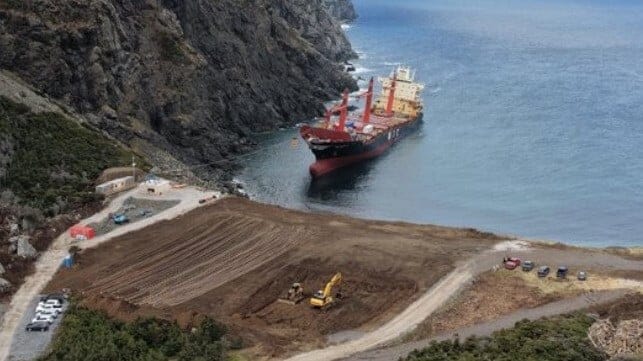
The efforts are underway to dismantle the containership MSC Baltic III, according to the most recent update from the Canadian Coast Guard. It will be a complex operation requiring possibly a year or more, involving breaking the ship into pieces and pulling it onto the beach to be cut up and trucked away for recycling.
Favorable weather at the site, which is in a remote area of Newfoundland, about 30 miles from Corner Brook, permitted the wreck removal team increased access to the vessel. A barge was positioned alongside, and they have been removing material from the ship.
Preparation work is also underway on shore. A switchback road is being created down to the beach in front of the vessel to get equipment and trucks to the site, while improvements were also made to the access road to Cedar Cove, where the vessel came to rest in February 2025.
MSC Mediterranean Shipping Company and its insurers retained Resolve Marine earlier in the spring for the second phase of the recovery operation. Resolve will be undertaking the removal of the ship and the restoration efforts in the area.
During the first phase of the clean-up conducted in 2025, the Canadian Coast Guard reported that 409 of the 462 containers aboard the ship, including dangerous goods, had been removed. All the bulk fuel, approximately 1,700 metric tons, was also removed.
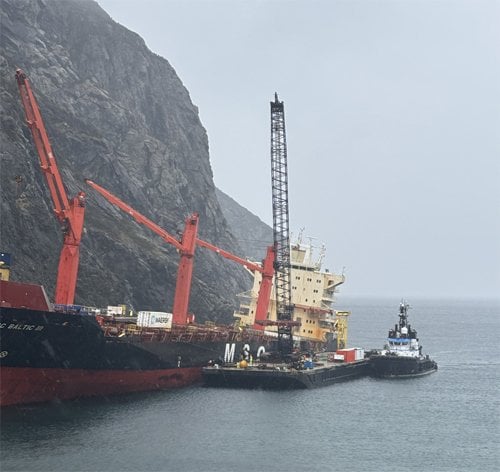
A barge is alongside as material is being removed from the wreck (Canadian Coast Guard)
Resolve reported that in the first phase, it would complete the removal of the remaining containers, many of which were reported to be waterlogged. The Canadian Coast Guard also said that, in addition to residual amounts of fuel, the ship has contaminated water aboard.
So far they have reported to have removed approximately 23 additional containers. Works has also begun to remove furnishings from the accommodations area. The hatch covers are also being removed. Cutting of the vessel is expected to start during the summer.
Preparation work aboard the MSC Baltic III, Resolve reported, would include the welding of rigging points. The plan calls for separating the ship at the break point in the hull. The forward section will be pulled onto the beach and cut apart. The fuel tanks will be further cleaned, and work on the removal of the accommodation block will also get underway. The cut will be forward of the engine room of the vessel. After the bow section has been recycled and similar operation will pull the stern section to shore.
Resolve Marine has said it will get the first phase completed during 2026 and that work will continue until winter conditions set in over the area. Additional removal work is likely for 2027.
The Canadian Coast Guard currently says the wreck is stable with no significant change to its condition recently. In May, it had reported that the wreck, however, was in poor condition after heavy weather and ice conditions during the winter. There is significant damage to the hull, including a crack in the port side. There is also buckling on the starboard side and a crack that was worsening on the deck of the vessel.
MSC Baltic III had been heading for Newfoundland in February 2025 when the vessel blacked out in a strong winter storm. It was driven into the cove, and the Canadians organized a daring helicopter rescue of the crew. The ship ended up aground on the shoreline in Cedar Cove, with the stern settling to the seafloor. Under Canadian law, MSC and its insurers are responsible for the removal operation and the cost of the cleanup.
Kenya Seeks to Get Rid of a Tanzanian Ship Beached for Six Weeks
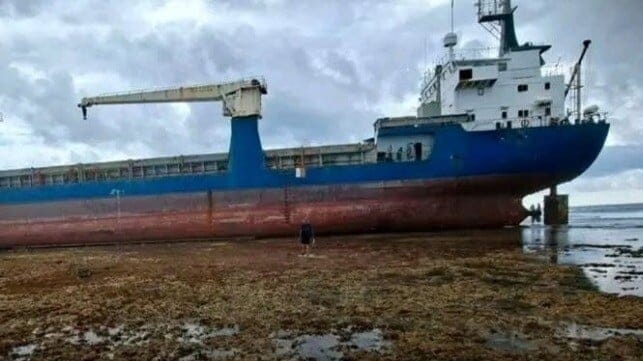
Salvors in Kenya are attempting to coordinate efforts to be rid of a Turkish-owned vessel that has been aground near a marine protected park for six weeks. The ship remains high and dry as environmentalists are raising concerns.
The MV Dan (IMO: 8415160), a general cargo ship that sails under the flag of Tanzania, grounded within Kenyan waters off Nyali beach on May 17, igniting concerns that a hull breach or fuel leak could have catastrophic impacts on the marine ecosystem. The vessel grounded after drifting off course while on its way from Tanga, Tanzania.
The Kenya Maritime Authority (KMA) has come out to allay fears that the 99-meter (326-foot) vessel owned by SLA Maritime Co. is a danger to the environment. It said in a briefing on June 23 that it has been maintaining close oversight of the situation to ensure the safety of navigation, protection of the marine environment, and the welfare of the crew on board.
Built in 1985, the 4,900-dwt vessel, however, remains firmly aground. According to the authority, a detailed inspection of the vessel has established that its hull integrity remains intact with no evidence of structural failure or leakage.
“Consequently, the likelihood of a pollution incident is currently assessed to be minimal. Nevertheless, precautionary measures remain in place, and the situation continues to be closely monitored,” said Omae Nyarandi, KMA Director General.
He added that the Kenya Coast Guard has been maintaining a round-the-clock security and surveillance of the vessel to ensure the safety of the crew, prevent unauthorized access, and facilitate rapid response should the need arise.
To prevent a major environmental disaster, SLM Maritime, working with Kenyan authorities, is engaging in efforts to refloat the vessel. The operation is expected to be undertaken around July 13, when the salvors intend to take advantage of the next favorable tide period.
KMA highlights that the vessel will be refloated in accordance with maritime and environmental protection requirements. This is because Nyali beach is renowned for its pristine, white-sand shoreline and calm, turquoise waters that transition into a rich, protected marine ecosystem.
The beach serves as an accessible gateway to the vibrant marine life and coral formations of the adjacent Mombasa Marine National Park and a reserve.
The ship was cited for safety problems in 2025 during an inspection in Slovenia. Among the listed issues were concerns over the safety of navigation and bridge operations. The inspection also cites fire safety issues, problems with the closing devices for the watertight doors, and various shortcomings in its certificates.

No comments:
Post a Comment