Thursday, February 19, 2026

THE EPSTEIN CLASS


Ro Khanna Demands Action After UN Panel Says Epstein Files Point to ‘Crimes Against Humanity’

The UN Human Rights Council on Tuesday said evidence in the files is “suggestive of the existence of a global criminal enterprise.”


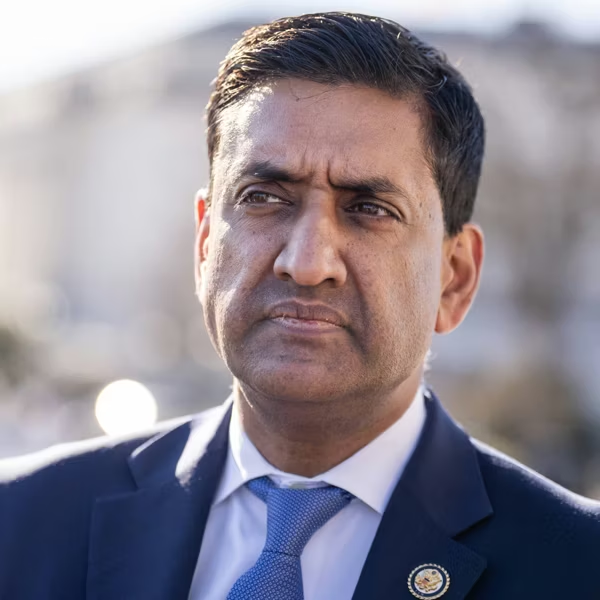
Rep. Ro Khanna (D-Calif.) arrives at a Department of Justice office in Washington, DC, on February 9, 2026.
(Photo by Brendan Smialowski/AFP via Getty Images)


Brad Reed
Feb 18, 2026
COMMON DREAMS

Rep. Ro Khanna on Wednesday demanded action from both the Trump administration and US Congress after the United Nations Human Rights Council said it found evidence of a potential “global criminal enterprise” in the US government’s files related to the investigation of late sex offender Jeffrey Epstein.

In a video posted on social media, Khanna (D-Calif.) issued a series of demands in the wake of the UN council’s Tuesday declaration that the actions of Epstein and his associates “may reasonably meet the legal threshold of crimes against humanity.”



Khanna Names 6 Men ‘Likely Incriminated’ by Epstein Files That ‘DOJ Hid for No Apparent Reason’


It’s a ‘Cover-Up,’ Says Khanna, If Official FBI Survivor Statements Not Included in Epstein File Dump

First, Khanna said that the United States Department of Justice (DOJ) must assemble a special prosecution committee to build criminal cases against Epstein associates who are alleged to have participated in the trafficking of underage girls.


He then demanded that House Speaker Mike Johnson (R-La.) set up a congressional select committee to have hearings where “every person who went” to Epstein’s private island in the Caribbean where he trafficked girls is forced to testify.

Finally, Khanna said that the DOJ must release the remaining Epstein files that are still under wraps, without any redactions for names of the “predators” within.

Experts on the UN Human Rights Council said that the evidence contained in the Epstein files is “suggestive of the existence of a global criminal enterprise” that has “shocked the conscience of humanity and raised terrifying implications of the level of impunity for such crimes.”

The experts added that “so grave is the scale, nature, systematic character, and transnational reach of these atrocities against women and girls, that a number of them may reasonably meet the legal threshold of crimes against humanity.”

Khanna and Rep. Thomas Massie (R-Ky.) last year authored the Epstein Files Transparency Act, which mandated that the DOJ publish all materials related to the FBI’s investigation into Epstein and his associates, with redactions made only to protect the identities of the victims.

Despite this law, the DOJ proceeded to release files that revealed victims’ identities, while also blacking out names of alleged abusers.

Trump Promised to Drain the Swamp—Turns Out He’s Best Friends With the Swamp Monster

When given the opportunity to seek justice for countless women and children who were trafficked, abused, and exploited by the world’s wealthiest, most powerful people, the MAGA movement and its leaders have shown a startling disinterest in accountability.


Sonali Kolhatkar
Feb 19, 2026
OtherWords


Attorney General Pam Bondi’s contentious House hearing about the Justice Department’s handling of the Epstein files offered a clear message to the nation: Sex trafficking of women and minors is perfectly acceptable as long as wealthy white men do it.

Jeffrey Epstein, the disgraced late sex trafficker, fixer, and political networker, was found to have ties to huge number of the world’s elites on both sides of the political aisle—including Elon Musk, Peter Thiel, Ehud Barak, Bill GatesSteve Bannon, Larry Summers, Bill Clinton, and of course, Donald Trump.


Three-Time Trump Voter Calls C-SPAN to Apologize for ‘Supporting This Rotten, Rotten Man’


For years, Trump’s conservative backers have attacked LGBTQ+ peopledrag queens, immigrants, and others, claiming a desire to protect women and children from rapists and groomers. Trump even boasted that “whether the women liked it or not,” he would “protect” them from migrants, whom he slandered as “monsters” who “kidnap and kill our children.”

But when given the opportunity to seek justice for countless women and children who were trafficked, abused, and exploited by the world’s wealthiest, most powerful people, the MAGA movement and its leaders have shown a startling disinterest in accountability. During her hearing Bondi tried desperately to deflect attention, claiming that the stock market was more deserving of public attention than Epstein’s victims.

For elites like Epstein, ideological differences were superficial. The real distinction was money, power, and connections.

Even the Republican rank and file is now mysteriously detached from the Epstein files.

Polls show that in summer 2025, 40% of GOP voters disapproved of the federal government’s handling of the Epstein files. But by January 2026, only about half that percentage disapproved—even after the Trump administration missed its deadline to release millions of files and then released them in a way that exposed the victims while protecting the perpetrators.

While some European leaders are facing harsh consequences for associating with Epstein, no Americans outside of Epstein and his closest associate Ghislaine Maxwell have faced any consequences, legal or otherwise.

That’s despite very concrete ties between the Trump administration and the sex trafficker. Not only did Trump’s Commerce Secretary Howard Lutnick admit to visiting Epstein island after lying about it (and has so far faced no consequences), but Trump himself is named more than a million times in the files, according to lawmakers with access to the unredacted documents. Several victims identify Trump by name, alleging he raped and assaulted them.

And it’s not just Trump. Epstein was an equal opportunity fixer. He was just as friendly with liberals as he was with conservatives, including Summers, Clinton, and, disconcertingly for the American left, Noam Chomsky. For elites like Epstein, ideological differences were superficial. The real distinction was money, power, and connections.

Epstein was a glorified drug dealer, and his drugs of choice were the vulnerable bodies of women and children, offered up to his friends and allies as the forbidden currency he traded in. A useful moniker has emerged to describe the global network of elites whose power and privilege continues to protect them from accountability: the Epstein Class.

Georgia Sen. John Ossoff, who faces reelection in 2026, is deploying this label, understanding that voters—at least those who haven’t bought into the MAGA cult —are increasingly aware of the double standards that wealthy power players are held to.

“This is the Epstein class, ruling our country,” said Ossoff in reference to those who make up the Trump administration. “They are the elites they pretend to hate.”

He’s right. And if the Trump administration won’t hold them to account, Americans should demand leaders who will.


This column was distributed by OtherWords.


Sonali Kolhatkar

Sonali Kolhatkar is currently the racial justice editor at YES! Media and a writing fellow with Independent Media Institute. She was previously a weekly columnist for Truthdig.com. She is also the host and creator of Rising Up with Sonali, a nationally syndicated television and radio program airing on Free Speech TV and dozens of independent and community radio stations. Sonali won First Place at the Los Angeles Press Club Annual Awards for Best Election Commentary in 2016. She also won numerous awards including Best TV Anchor from the LA Press Club and has also been nominated as Best Radio Anchor 4 years in a row. She is the author of Bleeding Afghanistan: Washington, Warlords, and the Propaganda of Silence, and the co-Director of the non-profit group, Afghan Women's Mission. She has a Master's in Astronomy from the University of Hawaii, and two undergraduate degrees in Physics and Astronomy from The University of Texas at Austin. Watch her 2014 Tedx talk, My journey from astrophysicist to radio host. She can be reached at www.sonalikolhatkar.com
Full Bio >

This ugly truth about America's rulers was unmasked in Epstein's emails


Robert Reich
February 17, 2026 
RAW STORY


Jeffrey Epstein is seen in this image released by the Department of Justice. Handout via REUTERS


Here’s how Kentucky Republican Congressman Thomas Massie responded on ABC last weekend, to a question about the Trump regime’s handling of the Epstein files:

“This is about the Epstein class …. They’re billionaires who were friends with these people, and that’s what I’m up against in Washington, D.C. Donald Trump told us that even though he had dinner with these kinds of people, in New York City and West Palm Beach, that he would be transparent. But he’s not. He's still in with the Epstein class. This is the Epstein administration. And they’re attacking me for trying to get these files released.”

The Epstein Class. Not just the people who cavorted with Jeffrey Epstein or the subset who abused young girls. It’s an interconnected world of hugely rich, prominent, entitled, smug, powerful, self-important (mostly) men. Donald Trump is honorary chairman.

Trump is still sitting on two and a half million files that he and Pam Bondi won’t release. Why? Because they implicate Trump and even more of the Epstein class. The files that have been released so far don’t paint a pretty picture.

Trump appears 1,433 times in the Epstein files so far. His billionaire backers are also members. Elon Musk appears 1,122 times. Howard Lutnick is there. So is Trump-backer Peter Thiel (2,710 times), and Leslie Wexner (565 times). As is Steven Witkoff, now Trump’s envoy to the Middle East, and Steve Bannon, Trump’s consigliere (1,855 times).

The Epstein Class isn’t limited to Trump donors. Bill Clinton is a member (1,192 times), as is Larry Summers (5,621 times). So are LinkedIn founder Reid Hoffman (3,769 times), Prince Andrew (1,821 times), Bill Gates (6,385 times), and Steve Tisch, co-owner of the New York Giants (429 times).

If not politics, then what connects the members of the Epstein Class? It’s not just riches. Some members are not particularly wealthy, but they’re richly connected. They trade on their prominence, on whom they know and who will return their phone calls.

They exchange inside tips on stocks, on the movements of currencies, on IPOs, on new tax-avoidance mechanisms. On getting into exclusive clubs, reservations at chic restaurants, lush hotels, exotic travel.

Most members of the Epstein Class have seceded into their own small, self-contained world, disconnected from the rest of society. They fly in one other’s private jets. They entertain at one other’s guest houses and villas. Some exchange tips on how to procure certain drugs or kinky sex or valuable works of art. And, of course, how to accumulate more wealth.

Many don’t particularly believe in democracy; Peter Thiel (recall, he appears 2,710 times in the Epstein files) has said he “no longer believes that freedom and democracy are compatible.” Many are putting their fortunes into electing people who will do their bidding. Hence, they are politically dangerous.

The Epstein Class is the by-product of an economy that emerged over the last two decades, from which this new elite has siphoned off vast amounts of wealth.

It’s an economy that bears almost no resemblance to that of mid-20th-century America. The most valuable companies in this new economy have few workers because they don’t make stuff. They design it. They create ideas. They sell concepts. They move money.

The value of businesses in this new economy isn’t in factories, buildings, or machines. It’s in algorithms, operating systems, standards, brands, and vast, self-reinforcing user networks.


I remember when IBM was the nation’s most valuable company and among its largest employers, with a payroll in the 1980s of nearly 400,000. Today, Nvidia is nearly 20 times as valuable as IBM was then and five times as profitable (adjusted for inflation), but it employs just over 40,000. Nvidia, unlike the old IBM, designs but doesn’t make its products.

Over the past three years, Google parent Alphabet’s revenue has grown 43 percent while its payroll has remained flat. Amazon’s revenue has soared, but it’s eliminating jobs.

Members of the Epstein Class are compensated in shares of stock. As corporate profits have soared, the stock market has roared. As the stock market has roared, the compensation of the Epstein Class has reached the stratosphere.

Meanwhile, most Americans are trapped in an old economy where they depend on paychecks that aren’t growing and jobs in short supply. They’re one or two paychecks away from poverty. The Federal Reserve Bank of New York just reported that mortgage delinquency rates for lower-income households are surging.

Affordable housing isn’t a problem that occurs to the Epstein Class. Nor is income inequality. Nor the loss of our democracy. Nor the deleterious effects of social media on young people and children.

When Silicon Valley’s biggest tech proponent in Congress — Rep. Ro Khanna (D-CA) — recently announced his support for a tax on California billionaires, to help fill the void created by Trump’s cuts in Medicare and Medicaid (which, in turn, made way for Trump’s second huge tax cut for the rich), the Epstein Class blew a gasket.

Vinod Khosla, one of Silicon Valley’s most prominent venture capitalists, with a net worth estimated at more than $13 billion (and who’s mentioned 182 times in the Epstein files but is no friend of Trump), called Khanna a “commie comrade.”

Khosla, by the way, is best known by the public for purchasing 89 acres of California beachfront property in in 2008 for $32.5 million, then trying to block public access to the ocean with a locked gate and signs. Despite losing multiple court rulings, including a 2018 Supreme Court appeal, he carries on with the dispute.

Not classy, but, shall we say, a typical Epstein Class move.


Robert Reich is an emeritus professor of public policy at Berkeley and former secretary of labor. His writings can be found at https://robertreich.substack.com/. His new memoir, Coming Up Short, can be found wherever you buy books. You can also support local bookstores nationally by ordering the book at bookshop.org


A new statue shows besties Trump and Epstein frolicking in DC.
(Photo by The Secret Handshake)


Big Tech Faces More Probes Over AI-Generated Child Sexual Abuse Material

“These platforms are attacking the mental health, dignity, and rights of our sons and daughters,” said the Spanish president. “The state cannot allow it. The impunity of the giants must end.”


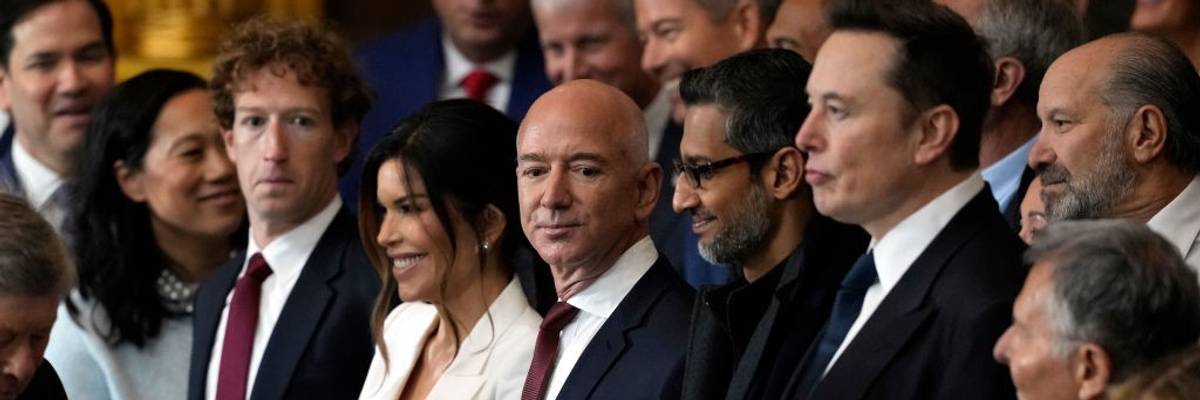
Guests including Mark Zuckerberg, Lauren Sanchez, Jeff Bezos, Sundar Pichai, and Elon Musk attend the Inauguration of Donald J. Trump in the US Capitol Rotunda on January 20, 2025 in Washington, DC.
(Photo by Julia Demaree Nikhinson - Pool/Getty Images)


Brad Reed
Feb 17, 2026
COMMON DREAMS

Big Tech firms are coming under greater scrutiny for the proliferation of child sexual abuse material generated by artificial intelligence-powered chatbots on their social media platforms.

Ireland’s Data Protection Commission (DPC) announced on Tuesday that it was invoking the European Union’s data privacy regulations to open an investigation into Grok, the AI chatbot featured on Elon Musk’s X platform, after it was used to generate nonconsensual deepfake images, including sexualized images of children.


Big Tech’s ‘AI Climate Hoax’: Study Shows 74% of Industry’s Claims Unproven


In announcing the investigation, DPC Deputy Commissioner Graham Doyle said that the commission has been in contact with X for weeks after reports first emerged of Grok being used to generate child sexual abuse material (CSAM).

Doyle said DPC has since decided to launch “a large-scale inquiry which will examine [X’s] compliance with some of their fundamental obligations” under European privacy laws.

Spanish President Pedro Sánchez said on Tuesday that his government would ask Spain’s Public Prosecution Service to “investigate the crimes that X, Meta, and TikTok may be committing through the creation and dissemination of child pornography by means of their AI.”

“These platforms are attacking the mental health, dignity, and rights of our sons and daughters,” Sánchez emphasized. “The state cannot allow it. The impunity of the giants must end.”

The probes announced by Ireland and Spain mark just the latest actions by European governments against US-based tech giants. Earlier in February, law enforcement authorities in France raided the office of X in Paris, which the Paris prosecutor’s office said was part of an investigation aimed at “ensuring that the X platform complies with French laws, insofar as it operates on national territory.”

The UK government’s Information Commissioner’s Office has also announced an investigation into X that the agency said encompasses “their processing of personal data in relation to the Grok artificial intelligence system and its potential to produce harmful sexualized image and video content.”
Big Tech’s ‘AI Climate Hoax’: Study Shows 74% of Industry’s Claims Unproven

“Tech companies are using vagueness about what happens within energy-hogging data centers to greenwash a planet-wrecking expansion.”


Attendees await the arrival of Texas Gov. Greg Abbott and Alphabet and Google CEO Sundar Pichai at the Google Midlothian Data Center on November 14, 2025 in Midlothian, Texas.
(Photo by Ron Jenkins/Getty Images)


Brad Reed
Feb 17, 2026
COMMON DREAMS


A report released on Tuesday says that the tech industry is blowing hot air with its claims that generative artificial intelligence will be beneficial for the climate.

The report, titled “The AI Climate Hoax,” was commissioned by a broad consortium of environmental advocacy organizations and authored by climate and energy analyst Ketan Joshi.

In total, it analyzes more than 150 statements made by both big tech companies and organizations such as the International Energy Agency about the supposed benefits of generative AI.

The report finds that 74% of such claims made by these institutions are unproven, with 36% not bothering to cite any evidence whatsoever.

One key finding in the report is that many claims about the purported benefits of the technology conflate traditional AI systems with more recent generative AI systems, which require massive amounts of energy and are spurring demand for the construction of power-and-water-devouring data centers across the US.

“Even if these benefits are real,” the report writes of traditional AI systems, “they are unrelated to—and dwarfed by—the massive expansion of energy use from the generative AI industry,” which is projected to to consume 13 times as much energy as traditional AI by the year 2030.

Even the more supportable claims about the benefits of traditional AI deserve serious scrutiny, the report notes, since “they tend to rely on weaker forms of evidence, such as corporate websites, rather than published academic research,” which was only cited in 26% of claims made about AI benefits.

The report also knocks big tech companies for using assorted strategies to conceal the true extent of their energy use, including buying renewable energy certificates even while relying on fossil fuels to power their operations, and vowing to implement highly implausible solutions to mitigate the climate impact of data centers, including carbon capture technologies and even building orbital data centers in space.

Commenting on the report, study author Joshi said its findings seem to show “tech companies are using vagueness about what happens within energy-hogging data centers to greenwash a planet-wrecking expansion.”

“The promises of planet-saving tech remain hollow, while AI data centers breathe life into coal and gas every day,” Joshi added. “These claims of climate benefit are unjustified and overhyped, and could cover up irreversible damage being done to communities and society.”

Jill McArdle, international corporate campaigner at study sponsor Beyond Fossil Fuels, said the study shows “there is simply no evidence that AI will help the climate more than it will harm it,” and accused Big Tech companies of “writing themselves a blank cheque to pollute on the empty promise of future salvation.”

AI data centers have become a major controversy throughout the US in recent months, as their massive energy needs have pushed up utility bills and put a strain on communities’ water supplies.

A study published in the journal Nature Sustainability last year found that data centers could soon consume as much water as 10 million Americans and emit as much carbon dioxide as 10 million cars, or roughly the same amount of consumption as the entire state of New York.
Billionaires Are ‘Becoming a Problem for the Economy,’ Declares Wall Street Journal Report

“Debate about how much tax billionaires pay is likely to grow as America’s fiscal situation deteriorates and its wealth gap widens.”


Amazon and Blue Origin founder Jeff Bezos, Google CEO Sundar Pichai and Tesla CEO Elon Musk attend the inauguration of President Donald Trump on January 20, 2025 in Washington, DC.
(Photo by Chip Somodevilla/Getty Images)

Brad Reed
Feb 18, 2026
COMMON DREAMS

A report published Wednesday by the Rupert Murdoch-owned Wall Street Journal outlined how billionaires’ tax evasion schemes are causing problems for the US economy.

The report, written by London-based columnist Carol Ryan, began by noting how completely the US economy has come to depend on the spending habits of its richest households, whose wealth is primarily tied to the fortunes of the stock market, which “could mean the entire economy pays a steep price in the next market correction.”


‘Billionaires Are Waging War Against the Rest of Us’: James Talarico Responds to Class Warfare Accusations

Ryan then walked through some of the plusses and minuses of the wealth tax being debated in the state of California, which has more billionaires than any state in the nation.

Even while personally finding flaws with the California proposal, Ryan said that plans to extract wealth from the super-rich aren’t going away, even if the California tax plan is ultimately defeated.

“Debate about how much tax billionaires pay is likely to grow as America’s fiscal situation deteriorates and its wealth gap widens,” Ryan wrote. “Data from the Federal Reserve shows that only the richest 1% of households have grown their share of overall US wealth since 1990.”

Ryan also broke down how the very richest Americans have tax evasion options that mere multimillionaires don’t have.

“A common strategy is to avoid salaries, which are heavily taxed,” she wrote. “Billionaires prefer to be paid in shares, which are subject to capital-gains taxes when sold. But they don’t need to sell to fund their lifestyles. Billionaires use borrowed money for living expenses, pledging their shares or other assets as collateral.”

Ryan added that “the interest on the debt is much lower than a capital-gains tax bill would be,” and billionaires compound this wealth by passing it off to their children as part of a “buy borrow die” tax avoidance plan.

Boston College law professor Ray Madoff told Ryan that the wealth at the very top has grown so concentrated that even “very well-off Americans with high incomes” are now aligned “much more with the middle class” than in the past.

Ryan’s report isn’t the only one published by the Journal in recent weeks to warn of dangerous levels of US wealth inequality.

Chief Wall Street Journal economics commentator Greg Ip last week posted data showing that corporate profits’ share of gross domestic income is now the highest it has been in more than 40 years, while the share of income paid out in workers’ wages is at the lowest.

“Profits have soared since the pandemic, and the market value attached to those profits even more,” wrote Ip. “The result: Capital, which includes businesses, shareholders, and superstar employees, is triumphant, while the average worker ekes out marginal gains.”

Ip also said that this problem could grow worse if artificial intelligence lives up to its creators’ hype and starts replacing human workers on a mass scale.

In such a scenario, wrote Ip, the “biggest winners” of the economy would be shareholders who, as Ryan explained in her piece, have ample tools to avoid paying taxes.
Sanders to Oligarchs Opposing California Billionaire Tax: ‘You’re Treading on Very, Very Thin Ice’

“Starting right here in California, these billionaires are going to learn that we are still living in a democratic society where the people have some power,” said Sen. Bernie Sanders.


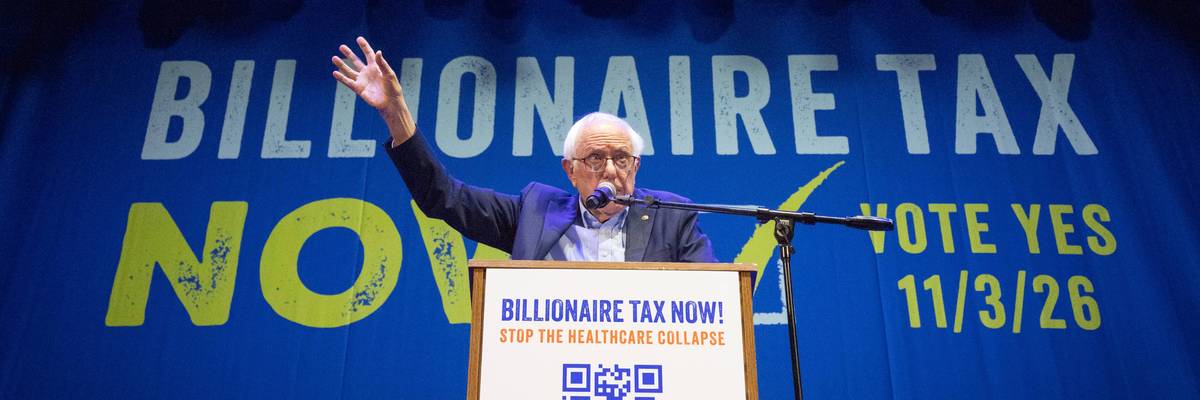
US Sen. Bernie Sanders (I-Vt.) speaks at the Billionaire Tax Now rally on February 18, 2026 in Los Angeles, California.
(Photo by Jason Armond/Los Angeles Times via Getty Images)


Jake Johnson
Feb 19, 2026
COMMON DREAMS

US Sen. Bernie Sanders used his appearance at a rally in Los Angeles on Wednesday to call out—in some cases by name—the billionaires using tiny slices of their fortunes to fight a proposed wealth tax in California.

“What I can tell the oligarchs is that the American people are sick and tired of their greed,” Sanders (I-Vt.) told an enthusiastic audience gathered at The Wiltern theater, with members of the crowd donning “Tax the Billionaires” T-shirts. “They are sick and tired of people like Sergey Brin, the co-founder of Google, who is spending $20 million to defeat this tax on billionaires.”


“It’s not just Mr. Brin,” the senator continued. “Mark Zuckerberg is the wealthiest man in California and the fourth-wealthiest person in the world, worth $226 billion. And for Mr. Zuckerberg, it is apparently not good enough to own one yacht. He had to buy three yachts worth $530 million. He had to buy 11 homes in Palo Alto to make a family compound. Mr. Zuckerberg, you can afford to pay your fair share of taxes so that people have healthcare.”

The senator also condemned billionaires’ fearmongering about the supposed negative impacts of wealth taxes and threats to flee the state if the levy proposed in California is enacted.

“I would say to these oligarchs: Be careful, because you are treading on very, very thin ice,” said Sanders. “At a time when the very rich are becoming phenomenally richer, when the very rich have been given a massive tax break by Donald Trump, when millions of people in this state are struggling to be able to afford healthcare, maybe billionaires should start paying their fair share of taxes.”


Sanders’s remarks came as California organizers, led by Service Employees International Union-United Healthcare Workers West (SEIU-UHW), continued their efforts to collect the roughly 875,000 signatures necessary to get the billionaire wealth tax proposal on the November ballot. Supporters of the proposal are facing opposition from some of the most powerful forces in California, including Democratic Gov. Gavin Newsom.

If approved, the measure would impose a one-time 5% tax on billionaires living in California as of the start of 2026, with the revenue aimed at offsetting the impacts of federal Medicaid cuts on the state’s healthcare system.

“Massive federal healthcare cuts could force many of our local hospitals and emergency rooms to close their doors forever—all because billionaires insist on paying lower tax rates than the rest of us,” Suzanne Jimenez, chief of staff for SEIU-UHW, said at Wednesday’s rally. “If we don’t act, hospitals and ERs across California will close, and patients will suffer.”

“If we don’t act, millions of people will lose access to the healthcare services they rely on,” Jimenez continued. “If we don’t act, our neighbors, our patients, and our loved ones will have to drive twice as far, and wait twice as long, to receive emergency care. And for what? So billionaires can have another yacht? I don’t think so!”

Sanders to Rally for Billionaire Tax in California as Crypto Industry Joins Newsom in Opposition


“While US billionaires became $1.5 trillion richer last year, the average worker in America has just $955 in retirement savings,” said Sen. Bernie Sanders. “That’s why I’ll be in LA this week fighting for a wealth tax on billionaires.”


US Sen. Bernie Sanders (I-Vt) speaks at a rally in Folsom, California on April 15, 2025.
(Photo by Paul Kuroda for The Washington Post via Getty Images)


Jake Johnson
Feb 18, 2026
COMMON DREAMS


US Sen. Bernie Sanders is set to rally in California on Wednesday with frontline healthcare workers and other supporters of a proposed ballot measure that would impose a one-time 5% tax on the wealth of the roughly 200 billionaires who reside in the Golden State.

Sanders (I-Vt.), a longtime champion of efforts to redress massive income and wealth inequality nationwide, said in a statement ahead of Wednesday’s rally that he “strongly” supports the proposed wealth tax in California, which is home to more billionaires than any other state in the US.


“While US billionaires became $1.5 trillion richer last year, the average worker in America has just $955 in retirement savings and 21% of seniors are trying to survive on less than $15,000 a year,” Sanders wrote in a social media post earlier this week. “That’s why I’ll be in LA this week fighting for a wealth tax on billionaires.”

Sanders’ appearance at Wednesday’s rally in Los Angeles, which is set to begin at 5 pm local time, comes as organizers behind the California wealth tax push are working to collect the roughly 875,000 signatures required to get the proposal on the November ballot.

“Union leaders believe the visit by Mr. Sanders will energize their campaign, which has already trained more than 1,000 volunteers and doubled the amount per signature that it is paying petition circulators,” the New York Times reported on Tuesday.

“We are very grateful for the support of US Sen. Sanders, who for years has been telling the truth about the threat that income inequality poses to our nation—and to working people.”

The Times also reported that “an opposition campaign committee with ties to the crypto industry, called Golden State Promise, officially formed on Friday” and “was expected to report this week $10 million in donations, including $5 million from Chris Larsen, a founder of the cryptocurrency company Ripple.”

The proposal has also drawn opposition from Democratic California Gov. Gavin Newsom, who has close ties to Silicon Valley elites—some of the most vocal opponents of the state wealth tax plan. (Notably, the billionaire CEO of the most valuable company in the world, Nvidia, said earlier this year that he is “perfectly fine” with the proposal as others in his class pumped millions into the effort to defeat it.)

Newsom, widely seen as a possible 2028 presidential candidate, has publicly vowed to defeat the proposed wealth tax, which is aimed at raising funds to prevent a looming healthcare crisis spurred by federal Medicaid cuts that US President Donald Trump and congressional Republicans approved last summer.

“This will be defeated—there’s no question in my mind,” Newsom said in January. “I’ll do what I have to do to protect the state.”

Proponents of the tax estimate that it would raise around $100 billion in revenue—much of which would be placed in a “Billionaire Tax Health Account” designed to help shore up the state’s healthcare system.

Mayra Castaneda, an Ultrasound Technologist at St. Francis Medical Center in Lynwood, said that “we are very grateful for the support of US Sen. Sanders, who for years has been telling the truth about the threat that income inequality poses to our nation—and to working people.”

“If we let these healthcare cuts stand, my patients will suffer. Hospitals and ERs will close, others will be strained by taking on more patients, and people will lose access to life-saving care,” said Castaneda. “This is all avoidable if billionaires just pay their fair share in California, so I’m going to do whatever is in my power to see this proposal pass in November. I’ll be telling my story alongside Sen. Sanders and urging my fellow Californians to take action to save lives.”
Meta Drops $65 Million on Super PACs to Back Pro-AI Candidates Against Big Tech Critics

“We can’t afford more corrupt politicians bought by Big Tech,” said one Democratic US House candidate.


Meta CEO Mark Zuckerberg shows a prototype of computer glasses that can display digital objects in transparent lenses at the Meta Connect developers conference in Menlo Park, California on September 25, 2024.
(Photo: Andrej Sokolow/picture alliance via Getty Images)


Brad Reed
Feb 18, 2026
COMMON DREAMS


Meta, the parent company of social media giants Facebook, Instagram, and WhatsApp, is spending big bucks to ensure that government regulations don’t interfere with its ambitions in artificial intelligence.

The New York Times reported on Wednesday that Meta is planning to spend $65 million on this year’s midterm elections, with one super political action committee (PAC) dedicated to electing AI-friendly Democrats, and another dedicated to electing AI-friendly Republicans.


‘What Oligarchy Looks Like’: AI Giants Pledge to Pump $100 Million Into 2026 Midterms


‘What a Surprise’: Sanders Undeterred by Bezos-Owned Washington Post’s Dismissal of AI Data Center Pause

The pro-Democratic super PAC, called Making Our Tomorrow, will work to influence congressional races in Illinois, while the pro-GOP PAC, called Forge the Future Project, will be focusing on congressional races in Texas.

The Times noted that Meta has in the past been “cautious about campaign engagements, making small donations out of a corporate political action committee and contributing to presidential inaugurations,” but it has decided to ramp up its spending to defend its AI business from governmental interference.

Meta’s spending splurge to elect pro-AI candidates is just one of many efforts by the AI industry to ensure a friendly regulatory environment.

CNN reported last week that Leading the Future—a super PAC backed by venture capital firm Andreessen Horowitz, Palantir co-founder Joe Lonsdale, and other AI heavyweights—is pledging to spend at least $100 million to influence the 2026 midterm election.

The goal of the PAC will be to elect lawmakers who will pass legislation to set a single set of AI regulations that will take effect throughout the US, overriding any restrictions placed on the technology by state governments.

The PACs’ big spending comes as a nationwide backlash to Big Tech has been forming across the US, as many communities are fighting against the construction of energy-devouring AI data centers that are raising electricity prices and have been accused of degrading the quality of local water supplies.

Reed Showalter, a Democratic US House of Representatives candidate running in Illinois’ 7th Congressional District, said the report of Meta’s big spending showed the importance of ensuring that voters elect leaders who will hold the major tech companies accountable.


“We deserve representatives who are going to take an honest look at AI and regulate it accordingly,” he wrote in a social media post. “We can’t afford more corrupt politicians bought by Big Tech.”

Democratic New York congressional candidate Alex Bores, who is running on a platform of regulating AI, said during an interview with CNN on Wednesday that the tech companies’ actions show they are “terrified” of being held accountable by elected officials.

He also noted that being attacked by the Leading the Future super PAC has ironically helped his candidacy.

“The fact that they’re being so aggressive with it, I think, has been redounding to my benefit,” he told host Dana Bash. “I’ve had a lot of constituents who have reached out and said, ‘I hadn’t even heard of you until all these text messages [from the AI super PAC].”

Watchdog social media account @OilPACTracker predicted that Meta’s major political spending could turn into a liability if voters are made aware of its machinations.

“We would make sure the electorate knows about it,” the watchdog wrote. “Big Tech money is toxic.”
CRIMES AGAINST HUMANITY

Warning of ‘Lasting Risk to Civilians,’ Groups Urge Congress to Block Purchase of Israeli Cluster Bombs

“The Trump administration’s decision to purchase cluster munitions shows that the Pentagon no longer considers protecting civilians a priority,” said one critic.


US soldiers carry a cluster munition in this undated Pentagon photo.
(Photo by US Department of Defense)

Brett Wilkins
Feb 18, 2026
COMMON DREAMS

A coalition of advocacy groups is imploring US lawmakers to stop the purchase of next-generation cluster bombs from an Israeli state arms maker, citing “severe, foreseeable dangers” that the internationally banned weapons pose to civilians.

Responsible Statecraft said Wednesday that the 36 human rights, peace, and faith groups shared an open letter they sent to lawmakers urging them to cancel a $210 million no-bid contract with Tomer to produce weapons, including a new generation of US 155-millimeter cluster munition shells for land-based artillery.

The letter’s signatories—who include Amnesty International USA, Arms Control Association, Centers for Civilians in Conflict, Center for International Policy, Human Rights Watch, the Quincy Institute for Responsible Statecraft, RootsAction, and United Methodist Church—note that these weapons are “dramatically out of step with civilian protection practices” because they “disperse submunitions across broad areas, making it exceedingly difficult to confine their impact to lawful military targets.”

“We urge members of Congress to take immediate action to oppose this purchase and prevent the transfer of cluster munitions, which pose well-documented and lasting risks to civilian populations,” the letter states.

Congressional efforts to ban the transfer of cluster bombs have failed, most recently in late 2023, when House lawmakers voted down a proposed amendment to the 2024 military spending bill a week after then-President Joe Biden said the US would send some of its stockpiled cluster munitions to Ukraine to help defend against Russia’s invasion.

Last year, a group of congressional Democrats led by Reps. Delia Ramirez (Ill.), Sara Jacobs (Calif.), Pramila Jayapal (Wash.), and Mark Pocan (Wis.) introduced the Block the Bombs Act, stalled legislation that would withhold the transfer of offensive weapons to Israel as it wages a genocidal war on Gaza. The bill is backed by the Congressional Progressive Caucus.

Cluster bombs are no longer manufactured domestically. However, the United States has not joined the 2008 Convention on Cluster Munitions, which has been ratified by more than 111 nations but not some of the world’s biggest military powers, including China, Russia, India, and Israel. Last year, Lithuania became the first country to withdraw from the treaty, citing threats from Russia.

According to the Intercept, which first reported the proposed new sale:
Known as the XM1208 munition, America’s new cluster shells are designed to have a dud rate—or risk of failure to explode—of less than 1%. They rely on more complex fuses and self-destruct features to reduce long-term danger to civilians, according to army procurement documents and weapons experts. But researchers say those low failure rates in testing do not reflect real-world performance, and advocates argue that cluster weapons’ battlefield effectiveness cannot justify their humanitarian costs.

“These weapons’ humanitarian impacts vastly outweigh any possible tactical benefit that they provide,” Ursala Knudsen-Latta of the Friends Committee on National Legislation, which signed the letter, told Responsible Statecraft. “Unfortunately, it is really sowing seeds of terror for generations to come anywhere they are used.”

A 2025 report published by the governance board of the International Campaign to Ban Landmines and the Cluster Munition Coalition revealed that 100% of reported cluster bomb casualties in 2024 were civilians, and 42% were children.

Unexploded cluster bomblets are often found by children, who sometimes mistake them for toys. Unexploded ordnance (UXO) including cluster munitions have killed and maimed at least tens of thousands of people since the US stopped dropping them on countries like Vietnam, Cambodia, Laos, and Iraq.

“They are inherently indiscriminate,” Brian Castner, an Amnesty International weapons investigator and former US Air Force explosive ordnance disposal officer, said of cluster bombs in an interview with the Intercept earlier this month. “There’s not a way to use them responsibly, in that you can’t control where they land, and with this high dud rate you can’t control the effect on the civilian population afterwards.”

Rights groups have been sounding the alarm on the Trump administration’s systematic erosion of policies meant to minimize civilian harm and uphold international law. For example, last year Defense Secretary Pete Hegseth lifted restrictions on US use of antipersonnel landmines, which killed or wounded more than 6,000 people worldwide in 2024, according to Landmine Monitor.

“The US government’s revival of indiscriminate weapons that the world has worked to ban puts civilian lives at risk,” Sarah Yager, Washington director at Human Rights Watch, said Tuesday. “The Trump administration is simply disregarding foreseeable harm to civilians, from children who pick up unexploded bomblets to communities forced to live with unmarked minefields long after a conflict ends.”

“The Trump administration’s decision to purchase cluster munitions shows that the Pentagon no longer considers protecting civilians a priority,” Yager added.
Don’t Call 1 Study a ‘Bombshell’: Microplastics Science Is Doing Exactly What It Should

The biggest threat isn’t scientific uncertainty, since there’s a considerable amount of scientific consensus that there is plastic in us. The biggest threat is weaponized uncertainty used to delay regulations.


A biologist looks at microplastics found in sea species at the Hellenic Centre for Marine Research near Athens, Greece on November 26, 2019.
(Photo by Louisa Gouliamaki/ AFP via Getty Images)
Marcus Eriksen
Feb 18, 2026
Common Dreams

“Microplastics are everywhere, and they’re harming us.”

“Actually, maybe not.”


Lancet Study Warns Plastics Could Cost Humanity 83 Million Years of Healthy Life


“Hold on, that study might be flawed.”

Bombshell… the whole field is in doubt.”

The headline isn’t “microplastics in people might be wrong,” but rather “quantifying microplastics in human samples is challenging, and the science is evolving in the right direction.”

If you’ve been hearing about microplastics recently, you may have been getting whiplash from the headlines. But you shouldn’t be.

Because this is what science looks like when it’s working: Researchers test new ideas and challenge each other’s methods. This helps refine what we know. What isn’t supposed to happen is a normal, healthy, scientific process getting manipulated into a dramatic storyline about a fictional scandal—a story that can leave the public confused.
The Myth Machine: How a Story We Tell Can Become a Trap

For over two decades, we’ve studied plastic pollution in the ocean. Scientists started describing the accumulation zones of plastic in the subtropical gyres, the places where wind and water currents concentrate floating debris. The research pointed to a truth that was complicated but clear: Most of the pieces are tiny, fragmented plastic—microplastics—along with some larger marine debris, like fishing gear.

But the media put a spin on it, and gave the world a simpler picture: a floating island of trash, “twice the size of Texas.” Some even called this a “garbage patch” you could supposedly walk on. People cried, “Why can’t I see it on Google Maps?” Some wondered if the US should plant a flag, and a handful of naive entrepreneurs fabricated fantastic ocean cleanup contraptions.

It was dramatic. Word spread. But eventually, it backfired.

All those who went looking for an island, didn’t find one. Instead they concluded, “It’s more like smog than a landfill,” and some pointed out, “Maybe it was exaggerated and the world had been duped.”

The pattern—one that goes oversimplify, sensationalize, backlash, dismissal—can drain urgency from a real crisis. Misinformation gets the headline. This gets repeated, as we’ve seen before in other environmental debates, such as the hole in the ozone layer, or climate change. The same thing is unfolding now with microplastics and human health.
What the “Bombshell” Reporting Gets Wrong

The recent article in The Guardian that sparked this debate focuses on a real issue. In our research studying microplastics in the environment and animal studies, measuring micro- and nanoplastics in human tissue is incredibly hard. It is particularly difficult when researchers are looking for very small particle sizes, where laboratory contamination from airborne sources becomes harder to rule out. This is especially the case in human tissue.

Microplastics are not like other contaminants, such as lead in water, where you can measure parts per billion, and lean on decades of standardized instruments and test methods. Plastics come in many polymers, sizes, and shapes. Nanoplastics behave differently than microplastics. And plastic is everywhere, meaning background contamination is always a risk. This is sometimes called the “pig pen effect”—it is a challenge to study a material that is so widespread.

The Guardian article is not a devastating blow. It’s a scientific debate around specific methods in a research field that is rapidly improving.


What’s the Real Headline?

The headline isn’t “microplastics in people might be wrong,” but rather “quantifying microplastics in human samples is challenging, and the science is evolving in the right direction.”

That difference matters. If the public hears “doubt cast,” then it translates it as “maybe plastic pollution isn’t really there or not that bad.” The question is, does it hold up across methods, across labs, across time?

So what has science taught us?Yes, we do have microplastics in our bodies. A number of peer-reviewed research shows that plastics, or plastic-associated signals, are present in human samples. Some findings claims will hold up better with time. That’s normal.
Scientists criticize each other’s studies. This is how science becomes more reliable over time. How methods get stress tested. By challenging assumptions, doing repeated studies, etc. weak studies get corrected or critiqued. In rare cases retracted. This isn’t chaos. It’s science.


Some headlines are hype. Microplastics science is new enough that every new study can feel like a “first,” which incentivizes media toward shock value. But, when scientific findings revise our understanding, the correction isn’t “nothing to see here.” The correction should be that science is a self-improving enterprise.
Scientists have been, and will continue revising the numbers. For example, early reporting suggested we each eat a “credit card” of plastic each week (subsequent studies estimated much less). Is that a bombshell? No, not really. And if it’s widely seen as such, it might suggest we should wait before we act (e.g., until every uncertainty is resolved). But, that’s not how public health works. We make decisions based on the best available science, and assess risk with limited data.
Weaponized Uncertainty

The biggest threat here isn’t scientific uncertainty, since there’s a considerable amount of scientific consensus that there is plastic in us. The biggest threat is weaponized uncertainty.

Environmental health has a predictable plot—when evidence starts piling up that a pollutant is harmful, a well-funded countermovement doesn’t always try to prove it’s safe. On the contrary, it tries to prove that the science is messy, uncertain, and “we need more data.”.

We’re not asking journalists to avoid urgency. Plastic pollution is urgent. Certain phrases, however, may signal that you’re being pulled into a pattern of mythmaking.

The industry has a playbook with favorite phrases, such as: “not conclusive,” “uncertain,” “scientists disagree,” “lack of consensus.” Disagreement in science is healthy. However, this (very routine) component of science can also become a winning political strategy used against science and public policy. Casting doubt can delay regulation.

Naomi Oreskes writes in Merchants of Doubt, “The industry had realized you could create the impression of controversy simply by asking questions.” That’s why our concern isn’t that researchers are debating methods. Our concern is that sensational headlines can warp debate, and give merchants of doubt an opportunity to skew public perception.
Red-Flag Language—It Should Make You Pause

We’re not asking journalists to avoid urgency. Plastic pollution is urgent. Certain phrases, however, may signal that you’re being pulled into a pattern of mythmaking, such as “bombshell,” or “debunked,” when what’s really happening is refinement. Those phrases shock and entertain, but do little to foster understanding.

What we actually need next is for the microplastics field to keep growing. Researchers across the board—from those that think studies are exaggerated to those that stand behind their research findings—are making calls for better lab protocols, contamination controls, reporting requirements, and inter-lab studies to validate results. These are unglamorous, but they’re what solidify early research findings into trusted science. A first-of-its-kind finding of plastic somewhere in the human body shouldn’t be framed like the final truth. It should be heralded as the beginning of a more complete picture.


Our work is licensed under Creative Commons (CC BY-NC-ND 3.0). Feel free to republish and share widely.


Lisa Erdle
Lisa Erdle, PhD, is a biologist and ecotoxicologist and director of science and I inovation at The 5 Gyres Institute. As a biologist and ecotoxicologist, Lisa has published her work in leading scientific journals, including PLOS One, Marine Pollution Bulletin, and Environmental Science & Technology.
Full Bio >

Marcus Eriksen
Marcus Eriksen, PhD, is the co-founder and scientist at The 5 Gyres Institute. Marcus has led expeditions around the world to research plastic marine pollution, co-publishing the first global estimate and the discovery of plastic microbeads in the Great Lakes, which led to the federal Microbead-free Waters Act of 2015.
Full Bio >
P3; PUBLIC PENSIONS FUND PRIVATIZATION
Investing Public Pensions in Fossil Fuel and AI Companies Is More Than Amoral – It’s Bad Business

Corporations are using the hard-earned money of today’s workers to further their own goals—many of which are directly at odds with the goals, livelihoods, and futures of public employees.


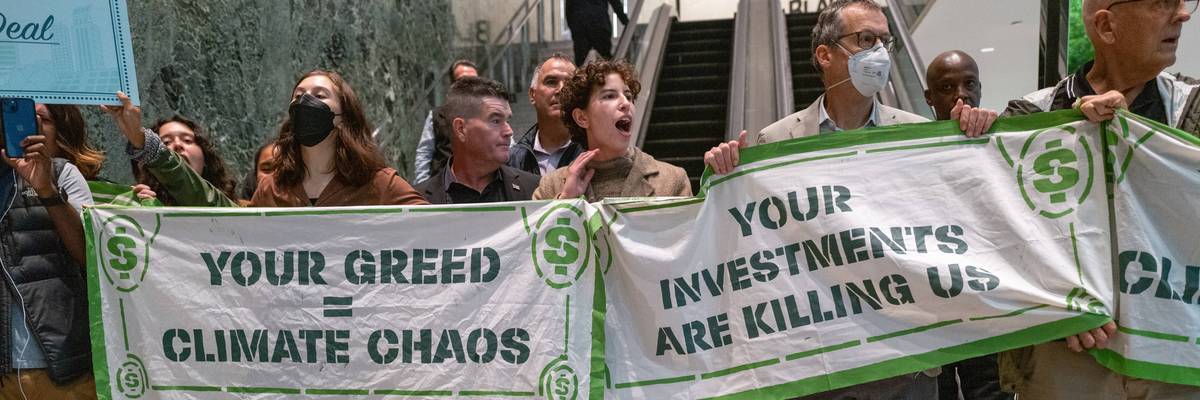
Climate activists block an escalator and throw coal on the ground at the New York headquarters of the financial investment firm BlackRock on October 26, 2022 in New York City.
(Photo by Spencer Platt/Getty Images)
Stephen Lerner
Feb 18, 2026
Common Dreams

Our country faces an affordability crisis amidst fundamental attacks on democracy. Public employee pension plans can either be part of the solution or part of the problem.

Late last year, New York City Comptroller Brad Lander recommended the city’s pension boards drop BlackRock and other portfolio managers that don’t have decarbonization plans up to the city’s standards. Lander’s initiative was blocked, and the editorial board of The Washington Post accused him of playing politics. But Lander argued that his recommendation was in line with the government’s fiduciary duty to protect the long-term value of pension funds, the retirement systems most public sector workers rely on—and have been paying into their entire careers. He’s right. In this critical moment in history, companies that are actively hastening climate change, threatening housing security, eliminating jobs and industries, and destabilizing our democracy and economy do not deserve our investment. Yes, they are acting immorally but they are also very bad investments with little promise of future returns for public sector workers. It’s not “playing politics” to refuse to fund their efforts to dismantle our society. That’s why we’re calling on pension boards across the country to take a hard look at their portfolios and make the smart business decision: stop investing in companies like this today.

The stakes could not be higher: pension funds account for $6.1 trillion in state and local defined-benefit funds alone. Every month, nearly 15 million workers across the country contribute part of their paycheck to ensure they have enough income to retire securely. This is a big pot of money and the companies that boards choose to invest it with matter. For public sector workers, pensions are not only retirement funds, but deferred current compensation. Workers are forsaking their hard-earned money today for the potential of a dignified future. Meanwhile, corporations are using that money today to further their own goals—many of which are directly at odds with the goals, livelihoods, and futures of public employees.

The interests of public workers and these companies dangerously diverge, but even the one area of alignment is fraught: secure return on investment.

Public pension systems across the country, including the California State Teachers’ Retirement System (CalSTERS), California Public Employees’ Retirement System (CalPERS) and New York City retirement funds, are heavily invested in Blackstone, the private equity company turning profits by hiking up rents during a housing affordability crisis. RealPage, the company sued last year by the DOJ for allegedly operating a nationwide rental price-fixing scheme, has investments from over a dozen pension funds through private equity funds. Public workers are watching their deferred compensation funnel into corporate exploitation while they fight to pay their own rent or mortgages.

Palantir, the data surveillance software company whose co-founder has stated his support for public hangings and apartheid, has multi-million dollar investments from The Teacher Retirement System of Texas, the Ohio Public Employees Retirement System, CalPERS, CalSTERS and other pension funds. Palantir’s tools have been used by the military to conduct destabilizing wars around the world, by DOGE to gather and merge data on millions of US residents, endangering the safety and security of us all, and by ICE to terrorize individuals and families across the country— threatening our democracy at home and abroad.

The interests of public workers and these companies dangerously diverge, but even the one area of alignment is fraught: secure return on investment. We are almost undeniably in the midst of an AI bubble, much larger than the dot com bubble that came before. With so many pension fund portfolios overly concentrated in the tech industry, funding new data centers built on speculative calculations and crypto companies propped up by hype—Palantir, Coinbase, VC firms like Andreessen Horowitz and others, NVIDIA and many more—a shift in the global appetite for new technology could empty the pockets of millions of workers. Short-term gains are not a good predictor of long-term returns for investors like public employees, who are stuck with the terms of their retirement funds and can’t pull out when markets turn. When the editorial board of the Washington Post writes that “the job of pension fund managers is to maximize returns for retirees who depend on them,” they should take these very real—and apolitical—risks into account.

Public pension funds are an enormous engine driving the economy today, and the investment choices that pension boards make are critical to the future of the country and the world. When boards invest workers’ money, they contribute to the specific visions and plans of companies and the people who run them. And when those plans include the destruction of our environment, our right to housing and fair work, and our democracy, it’s assisted suicide. Today we are urging pension boards to think beyond short-term gains and market bubbles. We’re calling on leaders to speak out and push for change as Former Comptroller Brad Lander did. Public worker retirement money must be invested responsibly in a secure future for us all.


Our work is licensed under Creative Commons (CC BY-NC-ND 3.0). Feel free to republish and share widely.


Liz Perlman
Liz Perlman is the executive director of AFSCME 3299, the University of California’s first employee union — representing more than 40,000 Service workers (SX), Patient Care Technical workers (EX), Skilled Craft workers (K7), and more at UC’s 10 campuses, 5 medical centers, numerous clinics, research laboratories, and UC Hastings College of Law.
Full Bio >

Stephen Lerner
Stephen Lerner is a fellow at Georgetown University's Kalmanovitz Initiative for Labor and the Working Poor and is one of the architects of the Justice for Janitors Campaign.
Full Bio >
Honoring Jesse Jackson, Who Helped Create the America Trump Wants to Destroy

Jackson’s “rainbow coalition” helped open the doors for Blacks, Hispanics, Arab and Muslim Americans, and the LGBTQ community while sharing a powerful populist economic message at the height of Reaganism.


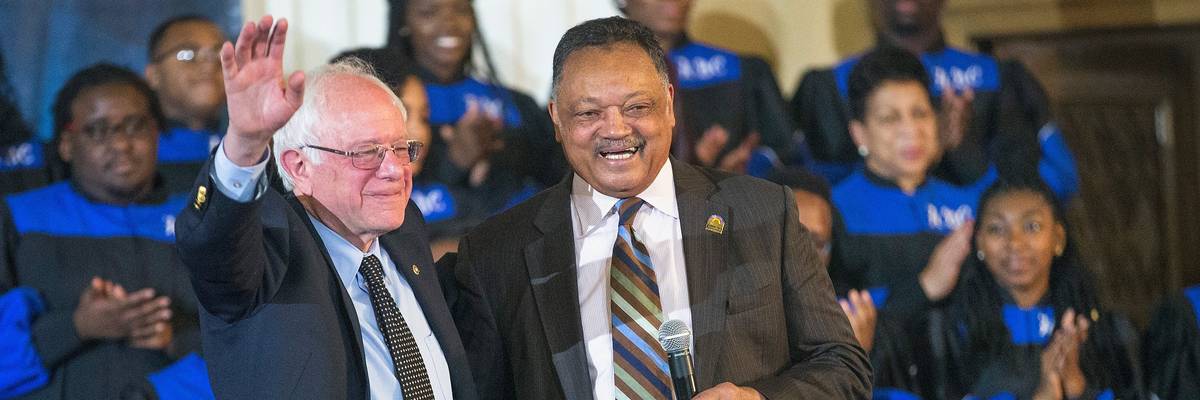
Democratic presidential candidate Senator Bernie Sanders (D-VT) waves to guests after being interviewed by Rev. Jesse Jackson at Operation Rainbow Push on March 12, 2016 in Chicago, Illinois.
(Photo by Scott Olson/Getty Images)

Dean Baker
Feb 18, 2026
Beat the Press

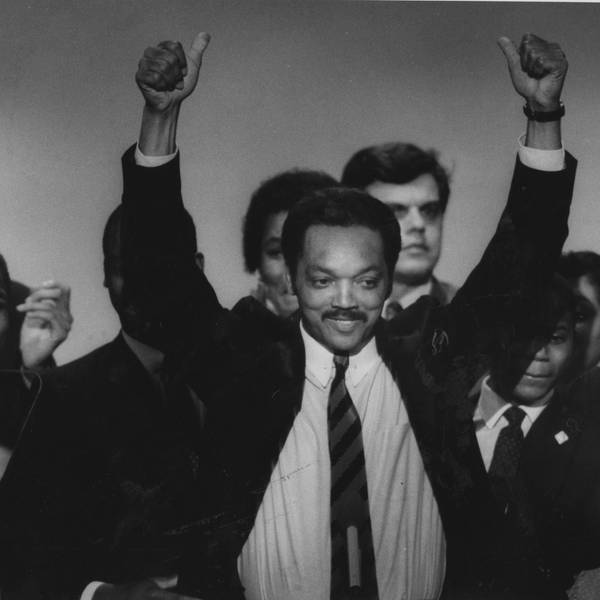
It would be hard to overstate Jesse Jackson’s importance in opening up American politics and society, not just to Black Americans, but also to Hispanics, and the LGTBQ community. It is probably difficult for younger people to imagine, and even old-timers like myself to remember, how bad discrimination was in the not very distant past.

When Jackson ran the first time in 1984, and even the second time in 1988, there was not a single Black governor in the United States. There had been no Black governors since the end of Reconstruction. There were also no Black senators.


Jesse Jackson, Civil Rights Leader Who Fought for Economic Justice, Dies at 84

The only Black person to serve in the Senate since Reconstruction was a Republican, Edward Brooke, who was elected in Massachusetts. When Carol Mosley Braun got elected to the Senate from Illinois in 1992, it was widely noted that she was first Black women to be elected to the Senate. She was also the first Black Democrat to be elected to the Senate.

It wasn’t just in politics; Blacks were largely excluded from the top reaches in most areas. I recall when I was a grad student at the University of Michigan in the 1980s. There we just two Black tenured professors in the whole university. There was a similar story in corporate America.

This was a period of serious upward redistribution and the losers, as in most people, were not happy campers. Jackson spoke to those people.

Jackson’s campaign didn’t turn things around by itself, but it certainly helped to spur momentum for larger changes. Back then people seriously debated whether a Black person could be elected president in the United States. Jackson’s campaign raised that question in a very serious way.

Barack Obama (the second Black Democrat to be elected to the Senate) answered that question definitively two decades later. While President Obama is obviously an enormously talented politician, without Jackson’s campaigns it is hard to envision Obama ever having been a serious presidential contender.

And Jackson was serious about a “rainbow coalition.” He also helped open the door for Hispanics, for Arab and Muslim Americans, and for the LGBTQ community. At a time when there were no openly gay or lesbian members of Congress, and even liberals were afraid to be associated with anyone who was openly gay, Jackson stood out in offering a welcome mat.

Jackson also pushed a powerful economic message. At a time when Ronald Reagan was busy cutting taxes for the rich and cutting back social programs, and trade was devastating large parts of the industrial Midwest, Jackson was advocating a populist agenda that focused on building up the poor and the working class. His message resonated with many white workers who felt abandoned by the mainstream of the Democratic Party, and even many farmers who were devastated by over-valued dollar in the early and mid-1980s.

There is a bizarre revisionism that has gained currency among people who pass for intellectuals that says the baby boomers grew up in Golden Age in the 1970s and 1980s. The unemployment rate averaged over 7% from 1974 to 1992. The median wage actually fell from 1973 to the mid-1990s. This was a period of serious upward redistribution and the losers, as in most people, were not happy campers. Jackson spoke to those people.

I had the opportunity to work in Jackson’s campaign in Michigan in 1988, and I still remember it as one of the high points of my life. Even though Jackson had vastly outperformed anyone’s expectations in the early primaries (probably even his own), he was not taken seriously in the Michigan race. Most of the pundits considered it a race between the frontrunner Michael Dukakis and Congressman Dick Gephardt, who had strong union support. As it turned out Jackson handily beat both, getting an absolute majority of the votes cast in the state.

In my own congressional district, which centered on Ann Arbor, all the party leaders lined up for Dukakis. The Jackson campaign was composed of a number of people who worked in less prestigious jobs, like salesclerks and custodians, and grad students like me. It really was a multiracial coalition.

We managed to totally outwork the party hacks. First, because it was a caucus and not a primary, it meant that people would not go to their regular precincts to cast their votes. We made sure that our supporters had a neatly coded map that told them where their voting site was.

Also, since it was a caucus and not a primary, the state’s usual rules on being registered 30 days ahead of an election did not apply. We had a deputy registrar at every voting site who would register people who had not previously registered.

We also made a point of having all our workers knocking on doors on election day and offering to drive people to the polls who needed a ride. The Dukakis people were all standing around the voting sites, handing out literature with their big Dukakis buttons, apparently not realizing that anyone who showed up had already decided how to vote.

I remember talking to a reporter late that night after the size of Jackson’s victory became clear. Up until that point, there had been numerous pieces in the media asking, “What does Jesse Jackson really want?” as though the idea that a Black person wanting to be president was absurd on its face.

I couldn’t resist having a little fun. I pointed out that with his big victory in Michigan, Jackson was now ahead in both votes cast and delegates. I said that I think we have to start asking what Michael Dukakis really wants.

Anyhow, the high didn’t last. The party closed ranks behind Dukakis, and he won the nomination. He then lost decisively to George Bush in the fall. His margin of defeat was larger than in any election since then.

All the gains of the last four decades are now on the line, as Donald Trump and his white supremacist gang look to turn back the clock. We have the battle of our lives on our hands right now.

But Jesse Jackson was a huge player in the changes that created the America that Donald Trump wants to destroy. He had serious flaws, like any great political leader, but for now we should remember the enormous impact he had in making this a better country.