Sunday, April 12, 2026

Why Artemis II Changes The New Moon Race – Analysis


Four astronauts aboard NASA’s Orion spacecraft atop the SLS (Space Launch System) rocket launch on the agency’s Artemis II test flight, Wednesday, April 1 from Launch Complex 39B at NASA’s Kennedy Space Center in Florida. Photo Credit: NASA


April 12, 2026 
By Collins Chong Yew Keat


The Artemis II astronauts on Friday made a triumphant return to Earth. After travelling nearly 700,000 miles, and hurtling back home to Earth at 24,000 mph, the Artemis II mission projects a new moment of historic breakthrough for mankind, and is one of the most consequential space missions of the modern era.

It is the first human journey around the Moon in more than 50 years, and it has now carried humans at the farthest point from Earth in history. In the 10-day voyage, Artemis II is not just a lunar landing mission but a decisive proving ground for the entire ecosystem of systems, crew operations, deep-space navigation, and high-speed re-entry capabilities that will underpin America’s return to the Moon and, eventually, missions to Mars.

The mission completed a successful lunar flyby in the Orion craft, passed within about 4,067 miles of the lunar surface, and reached a maximum distance of roughly 252,760 miles from Earth, eclipsing the record set by Apollo 13 in 1970. It then went on a free return trajectory that loops around the Moon and carries them home.

This further upped the space race, with China still targeting a crewed lunar landing by 2030, and Artemis II has pinpointed a lunar return target in 2028.

China is developing the Long March 10 rocket, Mengzhou spacecraft, and Lanyue lander to deliver the target by 2030, while Artemis II changes the psychology of that contest.


The job for Artemis II was to show that it could sustain a crew in lunar space and bring them back safely, and it has proven that.

It remained a highly complex mission built around data production and gathering, using the crew as scientific instruments alongside cameras and telemetry, to get the needed data for future Moon landings.
Why the 2026–2028 Window is Strategically Decisive

The success of Artemis II has paved the way for the U.S. to establish a greater headstart in the first sustained lunar infrastructure – in habitats, power systems, mobility, and communications.


The new race to the Moon is really about two realistic fronts. The first remains obvious: who will land astronauts there and also prove they can keep going back. The second contest matters just as realistically in the long run: who gets to shape the rules, partnerships and economic system around the Moon once there, in the long term.

In space, the country that builds the broadest coalition and sets the standards often gains an added long term edge that lasts far beyond a single mission. On that front, the United States is ahead by all indicators. NASA says the Artemis Accords had reached 61 signatories by early this year. China and Russia are promoting their own International Lunar Research Station framework, but it remains much smaller. This means that the American-led approach enjoys wider international support, with greater legitimacy.

If NASA can stay on track for an early 2028 landing, the United States will have a bigger advantage in shaping the next long trajectory in the space race.

Russia, by contrast, is no longer in the same league and its lunar plans have suffered repeated delays, further limited by the ongoing Ukraine crisis.

Russian lunar missions – Luna-28, Luna-29, and Luna-3, were postponed to between 2032 and 2036 and its launch rate also trails far behind both the United States and China.

In the new Moon race, the United States still holds the broader strategic advantage, China remains the most serious challenger, and Russia is falling behind.
America’s Systemic Edge Beyond NASA

America’s biggest advantage in the new Moon race is not based on NASA alone, but on a more strategic structure and a larger system behind NASA. Too often, the Moon and the space race is framed as a simple contest between governments. Artemis II shows something more important: where the United States combines the synergy of government direction, private-sector innovation, allied support and industrial scale in a way that no rival has the capacity to match.


NASA did not rely on a single company for the future lander. It awarded SpaceX the first Human Landing System contract, then later brought in Blue Origin as a second provider with another multibillion-dollar award. This is also an intended strategy to spread risk, preserve competition and improve mission resilience.

This also explains why and how this second Moon race is systemically different from the Apollo era. America’s space effort is no longer driven by government spending alone, the commercial space economy is now huge, and private capital is helping to both expand and sustain it.

SpaceX is the clearest and easiest example. It has formed an overwhelming majority of U.S. orbital launches in 2025. This large-scale capacity helps produce revenue, supports rapid testing and allows constant reinvestment.

The second example is Blue Origin, serving as a second provider that strengthens long-term resilience and avoids dependence on a single company.

This U.S. model is hard to replicate elsewhere. It remains difficult for China and Russia to possess a similar model. China is capable and serious, but the American system combines multiple plus points in parallel: private capital, commercial markets, exportable services, allied participation and government demand across both civil and national security sectors.
Space Force and Full-Spectrum Space Power

Trump’s space strategy is not solely on prestige launches but increasingly on fusing civil exploration, military positioning, and commercial dominance into one comprehensive architecture of national power.

By focusing on the Artemis project, it is not merely a NASA project. This is where Trump’s Space Force project becomes far more consequential and strategic. The Space Force’s own strategy emphasises “hybrid architectures” that combine military, allied, and commercial systems, with capacity for missile warning, missile tracking, launch, secure communications, and resilient orbital networks. This suits the modern space supremacy where it is not just about having a few powerful satellites but about having a layered, survivable system that can deter and react faster.

When this military architecture is combined with the Moon programme, the U.S. gains an advantage in linking launch dominance, satellite resilience, deep-space logistics, alliance integration, and long-term strategic presence.


The United States still stands alone in combining Space Force, unmatched commercial launch and satellite capacity, allied interoperability, and an expanding lunar agenda within one strategic vision.

This deepens the gap between the U.S. and other rivals in the broader ecosystem of counterspace advantage through missile-warning constellations, tracking layers, GPS, command-and-control, secure communications, and the capacity to detect, withstand, and respond to hostile action in space.

Compared with its earlier phase during its formation, the Space Force under Trump is now far more operational, better funded, and more lethal where modern war matters most. Its budget request jumps from about $40 billion to $71 billion. Paired with Artemis and the wider lunar push, this gives the United States not just prestige in space, but a full-spectrum space power advantage that no rival has yet matched.
Public Momentum and the Human Future on the Moon

The release of the much-hyped movie, Project Hail Mary starring Ryan Gosling during the Artemis II period further added to the public excitement, curiosity and interest in the wonders and power of space, reinforcing a sense of momentum.

When a major deep-space mission unfolds alongside popular science-fiction culture and movie impact, it strengthens the overall objective of elevating ambition, public interest and technological confidence.

Beyond strategy, rivalry and geopolitics, a sustained human presence on the Moon would be monumental for mankind itself.
NASA frames Artemis as a programme for scientific discovery, economic benefits, and preparation for future missions to Mars, which will be another frontier in the feat of humanity.

A long-term footprint on Moon the will also benefit technology testing, international cooperation, and the development of local resource use such as water, oxygen, and fuel production.

A new prolonged foothold on the Moon will be the key not only to showcasing new pride for mankind but also to unlocking new breakthroughs in energy, robotics, communications, and life-support technologies for the future of Earth.

This explains why the value of a sustained lunar presence is not just national prestige or confined to a country alone, but could be the precursor to becoming a global laboratory, an economic frontier, and a stepping stone that expands new openings for humanity, and perhaps in searching for a new continuity beyond Earth as a fallback option.

For now, the second Moon race is not over. But Artemis II has shown that the United States still has the reach and the strategic depth to lead it, while global rivalry for space dominance will still be prevalent.

Collins Chong Yew Keat

Collins Chong Yew Keat has been serving in University of Malaya, the top university in Malaysia for more than 9 years. His areas of interests include strategic and security studies, American foreign policy and power analysis and has published various publications on numerous platforms including books and chapter articles. He is also a regular contributor in providing op-eds for both the local and international media on various contemporary global issues and regional affairs since 2007.



New Crisis In The Making As Central Asia Lacks Enough Water For Spring Planting – Analysis

April 12, 2026 
By Paul Goble

The Central Asian countries lack sufficient water for spring planting of food this year, setting the stage for potentially massive population flight and even for military conflicts across the region (RITM Eurasia, April 2). The causes and consequences of this water shortage, however, lie far beyond that region (Vostochniy Express, August 7, 2025; RITM Eurasia, April 5; Bugin.Info, April 6). Global warming and rapid population growth are the main ones. They also include decaying infrastructure, Afghanistan’s diversion of water for its own population’s use, and the disruption of supply chains as a result of the conflict in Iran (see EDM, February 10, 2025; Window on Eurasia, December 21, 2025; The Times of Central Asia, April 3).


The region’s countries and their neighbors are now actively discussing various solutions, including talk about diverting Siberian river water to Central Asia, with some such as the People’s Republic of China (PRC) already sending in water (Window on Eurasia, July 31, 2025; RITM Eurasia, December 17, 2025; The Times of Central Asia, February 3; The Astana Times, March 30; The Moscow Times, April 7). These efforts, similar to earlier ones to save the Aral Sea and ongoing efforts to save the Caspian, are likely to prove too little too late (see EDM, March 26).

Declining water levels in the rivers and reservoirs of Central Asia have been the focus of increasing attention from officials in all five countries over the last year. Some warn that these declines now represent a serious threat to the national security of their states (RITM Eurasia, April 2). All have called for cooperation to address this problem, but most have adopted national policies that are at odds with that goal. Many agree only that it is a worthy cause and that they should work together against Afghanistan’s plans to withdraw water from rivers that flow into the region and for other countries to provide them with more water lest Central Asians be forced to flee (RITM Eurasia, February 21, 2024,December 17, 2025). Fears about water shortages leading to the forced evacuation of Central Asian capital cities have been spreading since the end of 2025 (Window on Eurasia, December 6, 2025). Now, officials and experts are sounding the alarm that declines in the availability of water will make it impossible for these countries to plant anything like all the food they need to supply their populations, as the situation has escalated (Interstate Commission for Water Coordination of Central Asia, February 20; RITM Eurasia, April 2).

Experts in the region concede that Central Asian countries are losing much of the water they need because they have failed to replace outdated irrigation networks. They also argue that their governments lack the resources necessary to bring them up to date (Window on Eurasia, December 21, 2025). In recent months, such commentators have focused on the region’s water loss due to Afghanistan’s diversion plans (see EDM, February 10, 2025). Most recently, they have been discussing the effect of the conflict in Iran on food supplies to Central Asia, which makes the much-reduced crop planting this spring all the more serious (The Times of Central Asia, April 3). Appeals by these countries to neighboring powers have met with only minimal success. Beijing is now providing more water to Kazakhstan, but not nearly enough to solve the entire region’s problems (Window on Eurasia, July 31, 2025). Moscow has been making promises, including plans for the revival of a new Siberian river diversion plan, but few expect it will be realized anytime soon, if at all, given the costs and domestic opposition in Russia (see EDM, April 1, 2025). Such a project will inevitably spark opposition, which similarly killed off this endeavor at the end of Soviet times (The Moscow Times, April 7).

Some scholars in the region have expressed frustration at the failure of Russia, the PRC, and other international actors to recognize the seriousness of the water shortage in Central Asia. This has prompted some of these scholars to threaten Moscow with the prospect that if it does not help, as many as 100 million Central Asians will soon flood the Russian Federation because they will no longer have food or water to drink at home. One scholar who has done so is Ravshan Nazarov, an instructor at the Tashkent branch of the Moscow University of Economics (Vostochniy Express, August 7, 2025). He argues that the time for Siberian river diversion is now and not some distant point in the future, and that if Moscow does not respond quickly, then it will have no one to blame but itself when millions of Central Asians will be forced to flee their homelands.


Few want to believe that Central Asia is running out of water, Nazarov points out. Then again, few wanted to believe that the Aral Sea would disappear. At present, he says, the only place for Central Asians to look is the Russian Federation, which now consumes 30,000 cubic meters of water per person annually, while in Central Asia, residents use only 1,500 cubic meters each year, far, far less than half what it used to be. Now, the issue is not only water but food. According to Nazarov, growing populations, declining domestic water flows, and a dam in Afghanistan that will soon block even more water that had been coming into the region will force Moscow to agree, lest its failure to help Central Asia leads to the kind of massive and uncontrolled immigration flows that will certainly anger the Russian population. In this way, he and other Central Asians are seeking to force Moscow to recognize that water shortages in Central Asian countries are not distant problems to be ignored, but are about to become part of Moscow’s domestic problems (see EDM, July 3, 2025).


Nazarov’s predictions are likely hyperbolic. His concerns and fears, however, are very real, although perhaps not quite as immediate as he suggests. This water and food crisis in Central Asia is brewing, but it will only reach its full extent later this year. In ordinary times, Central Asians would be consuming food grown a year ago, along with imports from Iran, and thus would not face shortages from the spring planting until the fall. These are not ordinary times. Afghanistan’s river diversion plan is nearing completion. The conflict in Iran has disrupted supply chains into Central Asia while raising questions about trade corridors through that region as well (see EDM, February 2, 2025; Window on Eurasia, February 12). As a result, Central Asians are already facing shortages and dramatically rising prices (The Times of Central Asia, April 3). The crisis is likely to hit earlier, especially since many of these countries, Turkmenistan in particular, have relatively recent histories of food supply problems (Window on Eurasia, May 7, 2020).

Time is of the essence for the countries of the region and leading countries abroad to come together to address the water shortage and, in turn, the looming food shortage in Central Asia. If not addressed in the near future, Central Asians are going to be living less well off than they have been, and there will be compelling reasons for them to flee and for their governments to engage in military action either to seize water supplies or at least distract attention.
 
This article was published by The Jamestown Foundation

Paul Goble

Paul Goble is a longtime specialist on ethnic and religious questions in Eurasia. Most recently, he was director of research and publications at the Azerbaijan Diplomatic Academy. Earlier, he served as vice dean for the social sciences and humanities at Audentes University in Tallinn and a senior research associate at the EuroCollege of the University of Tartu in Estonia. He has served in various capacities in the U.S. State Department, the Central Intelligence Agency and the International Broadcasting Bureau as well as at the Voice of America and Radio Free Europe/Radio Liberty and at the Carnegie Endowment for International Peace. Mr. Goble maintains the Window on Eurasia blog and can be contacted directly at paul.goble@gmail.com .


Pakistan’s Ghazab Lil-Haq operation and the prospect of regime change in Afghanistan

Pakistan’s Ghazab Lil-Haq operation and the prospect of regime change in Afghanistan
Taliban forces in Afghanistan found themselves under attack from Pakistan's Operation Ghazab lil-Haq (Righteous Fury). Does Kabul have plans to try to push its military action all the way to regime change? / mod.gov.afFacebook
By Syed Fazl-e-Haider April 11, 2026

On February 26, Pakistan launched Operation Ghazab lil-Haq (Righteous Fury) against the Taliban regime in Kabul. The operation is seen by some as an attempt by Islamabad to pursue regime change in Afghanistan.

Under Taliban rule, Afghanistan has effectively become a base for terrorist activities targeting not only Pakistan but also other Central Asian states, including Tajikistan. Russia has warned that Afghanistan-based ISIS seeks to expand its so-called caliphate in Central Asia, while China has expressed concern over the presence of Uyghur militants and other anti-China groups in the country. In this context, regime change in Kabul has emerged as a strategic priority for Islamabad and Beijing.

Meanwhile, the persistence of terrorist safe havens in Afghanistan and the ongoing war has stalled major trans-Afghan connectivity projects intended to link Central Asia with Pakistani seaports. 

BACKGROUND

Since 2021, following the Taliban’s takeover of Afghanistan after the US withdrawal under the Doha Agreement, Pakistan has experienced a significant increase in terrorist attacks. Islamabad has accused Afghanistan-based militant groups of conducting cross-border operations within its territory.

Prominent among these are Tehreek-e-Taliban Pakistan (TTP) and the Balochistan Liberation Army (BLA), which have been responsible for numerous high-profile attacks. Pakistan has repeatedly urged the Taliban government to take action against these groups, which continue to operate from Afghan territory with relative impunity; however, these requests have largely gone unheeded.

China, which shares a 47-mile (76-kilometre) border with Afghanistan, has long been concerned that the country could become a sanctuary for Uyghur separatists in proximity of its Xinjiang region.

The Taliban government has assured Beijing that Afghan territory will not be used for activities against China. In return, China has offered economic assistance and investment to support Afghanistan’s reconstruction and development and has since emerged as the largest foreign investor in the country.

Other anti-China groups operating from safe havens in Afghanistan include the TTP and the BLA. Both organisations have been implicated in several high-profile attacks targeting Chinese nationals in Pakistan.

In March 2024, a suicide attack on a van killed five Chinese engineers working on the Dasu dam project in Khyber Pakhtunkhwa. A similar attack at the same site in 2021 resulted in the deaths of nine Chinese engineers. The TTP was implicated in both incidents. The BLA, in turn, has conducted more attacks on Chinese nationals and assets than any other separatist organisation.

Notably, in 2022, the BLA deployed its first female suicide bomber, who carried out an attack outside the Confucius Institute at the University of Karachi, killing three Chinese instructors.

Although China has pursued a pragmatic engagement policy toward the Taliban since the US withdrawal in 2021, investing in mining, energy, and infrastructure, the Taliban have shown limited willingness or capacity to dismantle militant networks such as the TTP and BLA operating from Afghan territory.

Tajikistan, which shares a 1,400-kilometre (870-mile) border with Afghanistan, has also been affected by cross-border militancy. In two separate incidents in November 2025, five Chinese nationals were killed. Additional casualties resulted in subsequent clashes between Tajik security forces and suspected militants attempting to infiltrate Tajik territory.

Russia, the only country that has formally recognised the Taliban regime in Afghanistan, has expressed concern that the regime undermines regional stability by allowing jihadist groups to operate from Afghan territory. These concerns intensified following a suicide attack on February 24 outside Moscow’s Savyolovsky Railway Station, which killed a police officer. Foreign Minister Sergey Lavrov linked the incident to Afghanistan-based groups. 

The Russian Ministry of Foreign Affairs has estimated that Afghanistan hosts between 20,000 and 23,000 militants, including approximately 5,000 to 7,000 affiliated with the TTP. Notably, Russia released this assessment of terrorist networks in Afghanistan two days before Pakistan initiated its military campaign against the Taliban, a move that may be interpreted as implicit political support.

The Taliban have also moved closer to Pakistan’s regional rival, India. Islamabad has alleged that groups such as the TTP and BLA operate as Indian proxies, a claim that New Delhi denies. The Taliban’s growing engagement with India has further raised concerns in Beijing.

Amid mounting frustration over the Taliban’s inaction against militant groups operating from Afghan territory, Pakistan launched a large-scale military operation against the Taliban government on February 26, involving airstrikes across major Afghan cities, including Kabul.

IMPLICATIONS

Operation Ghazab lil-Haq can be interpreted as an attempt to impose regime change in Kabul, though Pakistan is unlikely to achieve such an objective independently, without securing China’s support and involving Tajikistan. It must also obtain backing from anti-Taliban groups such as the National Resistance Front (NRF), led by Tajik leader Ahmad Massoud, son of the late Ahmad Shah Massoud. Tajikistan presently hosts the NRF leadership.

Pakistan’s airstrikes against the Taliban regime may create opportunities for the NRF and other opposition forces to weaken the Taliban’s internal control over Afghanistan.

Officially, Beijing has called on both Islamabad and Kabul to exercise restraint and has advocated a ceasefire. However, Pakistan’s ongoing military campaign against the Taliban likely carries tacit Chinese approval and support for a potential regime change effort.

For such an operation, Islamabad would first need to secure control over the Wakhan Corridor in northeastern Afghanistan. This narrow strip of territory, often referred to as Afghanistan’s “Chicken Neck,” extends approximately 350 kilometres (217 miles) to China’s Xinjiang region, separating Tajikistan from Pakistan. Control of the corridor would provide Pakistan with direct access to Tajikistan and Central Asia beyond Afghanistan.

For China, the Wakhan Corridor represents a critical node for safeguarding its strategic connectivity with South and Central Asia under the Belt and Road Initiative (BRI). While China appears to be adopting a cautious, “wait and watch” approach, Pakistan is actively seeking to reshape Afghanistan’s political landscape.

The Pakistan–Afghanistan conflict is likely to adversely affect trans-Afghan connectivity projects aimed at linking Central and South Asia, whether in the planning, negotiation or implementation stages. For example, regional connectivity featured prominently in Pakistan–Kazakhstan discussions during President Kassym-Jomart Tokayev’s visit to Islamabad in February 2026. A proposed $7bn railway project envisaged connecting Kazakhstan to the Pakistani ports of Karachi and Gwadar via Afghanistan and Turkmenistan.

Similarly, the Uzbekistan–Afghanistan–Pakistan (UAP) railway project is a trilateral initiative designed to connect Central Asia with the ports of Gwadar and Karachi through Afghanistan. Envisioned in 2021, the 528-kilometre corridor is expected to provide the first direct railway link between Central and South Asia. The $4.8bn project, scheduled for completion by 2027, will connect Tashkent to the Pakistani city of Peshawar via Kabul.

The $10bn Turkmenistan–Afghanistan–Pakistan–India (TAPI) gas pipeline is a major strategic energy project intended to transport gas from Turkmenistan’s Galkynysh field, the world’s second largest, to energy-deficient markets in South Asia, particularly India and Pakistan. However, the project has already been delayed for over three decades due to persistent instability and conflict in Afghanistan.

Any attempt at regime change in Kabul that ensures peace and stability in Afghanistan would facilitate a conducive environment for the implementation and completion of strategic connectivity projects between Central and South Asia. Conversely, if such efforts intensify conflict in the already war-torn country, these projects are likely to face indefinite delays.

CONCLUSIONS

Officially, Islamabad frames its military campaign as an effort to compel the Taliban regime to withdraw support for Afghanistan-based militant groups targeting Pakistan. However, the operation also appears intended to convey that regime change is a clear option, should the Taliban fail to take verifiable action against such groups operating from Afghan territory.

For a comprehensive regime change effort, Pakistan, China, and Tajikistan would have to align their positions on the jihadist threats emanating from Afghanistan, which, after more than four years of Taliban rule, has effectively become a safe haven for militant groups. The outcomes of the current operation will in turn have a significant impact on the future of trans-Afghan connectivity projects.

This article was originally published by the Central Asia-Caucasus Analyst and is reprinted under a partner post arrangement with Eurasianet. It appears in Eurasianet here.

Syed Fazl-e-Haider is a Karachi-based analyst at Wikistrat. He is a freelance columnist and the author of several books. He has contributed articles and analysis to a range of publications. He is a regular contributor to Eurasia Daily Monitor, Jamestown Foundation. Email: sfazlehaider05@yahoo.com.

 Japan PM tells Deep Purple: ‘You are my god’

Japan PM tells Deep Purple: ‘You are my god’
/ Prime Minister's Office of JapanFacebook
By IntelliNews April 12, 2026

Japan’s first ever female prime minister Sanae Takaichi told British rock band Deep Purple “you are my god” during a meeting in Tokyo.

According to the BBC, Takaichi, who has said she has listened to the band since primary school, met the group’s drummer Ian Paice at her office in the Japanese capital, where she presented him with a pair of signed Japanese-made drumsticks.

An avid amateur drummer herself, the 65-year-old conservative leader said she played in a Deep Purple tribute band as a child after first becoming a fan in primary school. She added that she used to play Burn when arguing with her husband, describing it as a way of casting a curse on him.

The band met Japan’s first female prime minister as they returned to tour the country where they recorded their 1972 live album Made in Japan, widely regarded as one of the most influential rock records.

Takaichi said she could not believe Deep Purple were in front of her, and expressed respect for the band’s continued ability to evolve while producing music that remains compelling. Speaking through an interpreter the BBC reports she said she hoped the tour would excite fans across Japan and strengthen cultural exchange between the UK and Japan.

Paice said it was always a pleasure to visit Japan, describing the meeting with Takaichi as an added bonus.

In a post on Instagram, the band said Takaichi was a lifelong fan of hard rock and heavy metal, and had often named Deep Purple among her favourite groups. It also noted she had told them she bought their Machine Head album while still a student.

Formed in England in 1968, Deep Purple became one of the so-called unholy trinity of British heavy metal alongside Black Sabbath and Led Zeppelin. Their best-known track, Smoke on the Water, appeared on the 1971 album Machine Head


Viktor Orban concedes loss in Hungary election, congratulates Peter Magyar

Viktor Orban concedes loss in Hungary election, congratulates Peter Magyar
/ Facebook/Viktor OrbanFacebook
By bne IntelliNews April 12, 2026

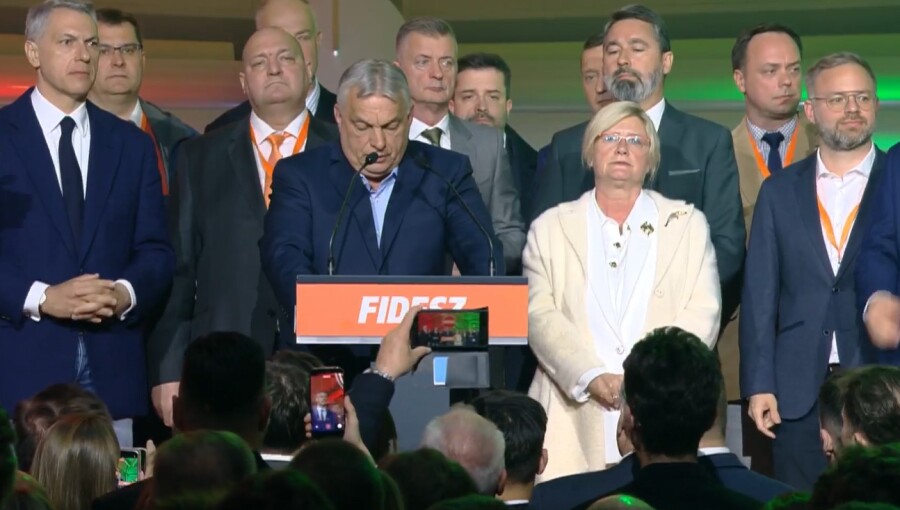
Hungarian Prime Minister Viktor Orbán has conceded defeat in the April 12 general election and congratulated the winner, according to statements made following the announcement of preliminary results.

Tisza leader Peter Magyar posted a short message on Facebook saying the prime minister had congratulated "our victory".

Orban, speaking to his supporters at the conference hall by the Danube, acknowledged what he described as a "painful and clear" election result, but he did not name either Magyar or the Tisza party in his concession speech.

The outgoing prime minister told supporters that, regardless of the outcome, he would continue to serve the nation from the opposition, adding that his party would not abandon its voters. 

Orban told supporters that the coming period would focus on recovery and rebuilding the political community, emphasising that Fidesz would continue its work in opposition and would not abandon its supporters. Orban specifically thanked ethnic Hungarians from across the border and said that Fidesz would continue to support them. 

At 53.45% of votes processed, projections indicated that the Tisza Party could win 136 seats, three seats over the supermajority, compared to 56 for the ruling Fidesz. Radical right-wing Our Homeland could also pass the 5% threshold and send 7 MPs to Parliament.

On the national list vote at 39.30% of the votes processed, Tisza stood at 52.49%, while Fidesz was at 38.83%, Our Homeland at 6.08%, the Democratic Coalition at 1.19%, and the Two-Tailed Dog Party at 0.78%.

The Tisza Party is holding its election campaign event across from parliament on the Buda side, where tens of thousands of supporters have filled the riverbank. The atmosphere is carnival-like, with people singing and waving flags.

Tisza on the verge of a supermajority in Hungary, final polls show

Tisza on the verge of a supermajority in Hungary, final polls show
/ Facebook/Peter MagyarFacebook
By bne IntelliNews April 12, 2026

Polling data from the three most reliable pollsters conducted in the last days of the Hungarian election campaign indicate a decisive victory for the opposition Tisza Party, with projections at or close to a two-thirds majority.

According to Median, which conducted surveys over five days last week, the Tisza Party is projected to receive 55% of the vote, compared to 37% for the ruling Fidesz. This would give 135 seats for Tisza of the 199 total and 63 seats for the ruling party. 

Our Homeland is estimated at 3.9%, below the parliamentary threshold, as are two other parties fielding a national list, the Democratic Coalition and the Two-Tailed Dog party.

Similar findings were reported by the 21 Institute, which recorded a 55-38% lead for Tisza, indicating a result close to a two-thirds majority, and projected that Our Homeland could pass the 5% threshold.

Meanwhile, Zavecz Research published estimates showing a 54-40% result in favour of Tisza, with radical right Our Homeland falling short of parliamentary entry.

Government-leaning institutions did not release their forecast.

Voter turnout reached a record level, with 77.8% of eligible voters having cast their ballots by 6:30 p.m., 30 minutes before the polls closed. Turnout in Budapest, the stronghold for Tisza exceeded 81%.

Head of the Prime Minister's Office, Gergely Gulyas, held a brief briefing for the press, thanking voters and saying the high voter turnout represents an unprecedented public mandate. He expressed hope that Fidesz would receive a strong authorisation to govern.

Tisza leader Péter Magyar described the April 12 vote as historic, saying that Hungary and millions of its citizens had "written history again." He said more than 6mn people cast their ballots in what he called a symbolic election, held 23 years after Hungary’s referendum on joining the EU.

He stated that the Tisza Party had received thousands of reports of alleged electoral irregularities, including claims of direct payments to voters.

Magyar said that anyone involved in unlawful activity would face legal consequences. He also thanked around 50,000 volunteers for their role in monitoring the election and helping to prevent irregularities.

From insider to rival: how Magyar became Orbán's most serious challenger in 16 years

Péter Magyar at the 15 March ceremony
Copyright AP Photo

By Zoltan Siposhegyi
Updated 

Just a few years ago, Péter Magyar was an insider within the ruling Fidesz elite in Hungary. This Sunday, he goes into an election that could see him oust Orbán after 16 years of uninterrupted rule in a spectacular shift.

In just two years, Péter Magyar has grown from a virtually unknown figure in Hungarian politics to becoming the biggest threat to the Fidesz Party - his former political home - and its 16-year uninterrupted stretch in government.

Magyar burst into prominence in 2024 as the government faced a presidential pardon scandal that involved a child abuser's accomplice. Prior to that, he was raised in a conservative family and was anything but an outsider when it came to the politics of of Fidesz.

Born into a family of conservatives

Born into a family of prominent conservatives, his grandfather was well-known TV personality and lawyer Pál Erőss, while his godfather Ferenc Mádl was the President of Hungary. Magyar received his degree from the law faculty of Pázmány Péter Catholic University in 2004.

While at university, he befriended Gergely Gulyás, now Minister of Prime Minister Viktor Orbán's office. Gulyás introduced Magyar to Judit Varga, with whom he had three children after marrying her in 2006. Varga later became the country's justice minister under Orbán.

Former Hungarian justice minister Judit Varga at an EU summit AP Photo


After being sent to Brussels by the Orbán government to serve as a diplomat dealing with EU affairs, the family moved back to Hungary in 2018. Magyar was appointed to the board of directors of state-owned road operation and maintenance company Magyar Közút ZRT. He later became head of of the government's student loan provider and was on the board of several other state companies.

He and Judit Varga, who became justice minister during that period, divorced in 2023.

It all started with an interview

Magyar was largely unknown to the public until a scandal broke out in early 2024, where the pardoning of a convicted child abuser's accomplice led to the resignation of the president as well as Varga's retirement from politics.

The Fidesz Party blamed Varga, who signed the pardon decision in her capacity as justice minister.

Péter Magyar was so outraged that he took to Facebook within hours and spoke out against the Orbán government. From that moment onwards, his relationship with the party was turned on its head.

His post accused the government of widespread corruption and outlined abuses which he had personally witnessed, such as being forced to favour people close to Orbán during his time as head of the national student loan provider.

He subsequently did an interview with online channel Partizán, an event which is credited with playing a major role in his fast-growing popularity.

Péter Magyar became so popular, in fact, that within a matter of days he organised a rally in Budapest on Andrássy Avenue which attracted tens of thousands.

Péter Magyar holds a rally in Andrássy Avenue, Budapest on 15 March 2024. AP Photo

Capitalising on his newfound support, he took over the previously unknown Tisza Party and ran as a candidate in the 2024 European Parliament elections. He won a seat as MEP, with Tisza finishing second behind the ruling coalition.

The result of that election showed that Hungarian voters appeared to have become increasingly disillusioned with other opposition parties, which Magyar referred to as "old opposition".

Scandals and accusations did little to hurt Magyar's rise

A number of allegations have been made against at him since then, including accusations of domestic abuse from his former wife, spying and drug consumption. A document was recently posted by media online, claiming to be the Tisza Party's tax programme, but its authenticity was never confirmed.

In a bizarre incident that took place in February this year, Magyar said he was blackmailed by government figures with a sex tape showing him and his former partner, secretly recorded in a Budapest flat in 2024. Fidesz representatives denied the claim.

Nevertheless, polls indicate that Magyar's popularity has been largely unaffected.

Péter Magyar at a campaign rally. AP Photo

The Tisza president has made a point of travelling extensively to meet voters, positioning himself as different to out-of-touch opponents. Towards the end of the election campaign, he spoke in seven cities within a single day.

Magyar has promised to improve public services in the country, and undertake reforms that will unfreeze billions of Euros that the EU had allocated for Hungary.

His position on LGBTQ issues is vague, while his views on immigration are even stricter than Orban's as he has said he would end the government's guest worker programme. He is generally distrustful of the media, and often clashes with them.

Overall, his promise to voters is simple: a functioning country with a Western identity and Christian-conservative politics, but without what he calls the corruption of Fidesz.


Viktor Orbán: From student dissident to Europe's most polarising leader

By Gábor Tanács & Euronews
Published on 11/04/2026 - 

Viktor Orbán rose from liberal student activist to a self-professed illiberal, reshaping Hungary’s rule, foreign policy and relations with the EU and Russia.

Prime Minister Viktor Orbán has governed Hungary for nearly 16 years, reshaping its institutions, challenging EU norms and positioning himself as the leading voice of nationalist conservatism on the continent.

His trajectory from liberal student activist to self-described champion of "illiberal democracy," is one of the most striking — and polarising — political reinventions in post-communist central and eastern Europe.

Orbán first came to public attention in June 1989, when as a 26-year-old student he addressed the crowd at the state reburial of Imre Nagy and other victims of the 1956 anti-Soviet uprising.

His call for the withdrawal of Soviet troops — delivered at a moment when many opposition figures remained cautious — made him a voice of a new political generation.

The party he helped lead, Fidesz, began as a liberal youth movement. Over the following decade, Orbán transformed it into a centre-right nationalist force, as post-communist Hungary made its shift from a planned to a market economy.

Sharpening his message


Orbán first became premier in 1998 at the age of 35, making him one of the youngest leaders to hold the office in central Europe at the time.

His first government oversaw Hungary's accession to NATO in March 1999 and advanced the country's EU membership path, completed under a subsequent administration in 2004.

But then, Fidesz lost both the 2002 and 2006 elections to the Hungarian Socialist Party. During his years in opposition, Orbán sharpened a political argument focused on national sovereignty, arguing that liberal dominance in media and public institutions constrained Hungary's self-determination.

Critics describe that framing as the precursor to a systematic challenge to democratic checks and balances.

Orbán won the 2010 election with a two-thirds supermajority, giving Fidesz the parliamentary votes to amend the constitution.

His government introduced a new Fundamental Law — Hungary's replacement constitution — along with a series of electoral and institutional reforms.

Supporters argued these measures restored political stability and asserted national sovereignty; opponents said they concentrated power in the executive and weakened judicial and media independence.

Fidesz has won every parliamentary election since. The government has faced repeated legal challenges from EU institutions over the rule of law, press freedom and judicial independence. Budapest has consistently rejected those characterisations.


'Illiberal state' shift

In a July 2014 speech at Băile Tușnad in Romania, Orbán set out his governing philosophy explicitly, arguing that Hungary should move beyond liberal democratic frameworks while preserving core freedoms. He described his model as an "illiberal state."

The term drew criticism from Western governments and EU institutions but became a favourite among nationalist movements across Europe and beyond.

Orbán has since promoted Hungary as a model for right-wing and far-right parties in France, Italy, Spain, the US and elsewhere. His annual speech at Băile Tușnad draws European conservatives every summer.

Hungary under Orbán has maintained membership of NATO and the EU while simultaneously cultivating relationships with Russia, China and Turkey that have repeatedly brought it into conflict with partners in both blocs.

Orbán met Russian President Vladimir Putin on multiple occasions before the full-scale invasion of Ukraine in February 2022 and has maintained economic ties — including a major gas supply contract and a nuclear energy agreement with the Russian state company Rosatom — since then.

Since 2022, Hungary has been the most prominent EU member state to resist the 27-member bloc's consensus on military support for Ukraine as it continues to defend itself from Russia's all-out war.

Orbán has argued that arms transfers prolong the war and that Hungary's priority is keeping the country out of the war.

Other EU governments and NATO allies have described that position as effectively providing diplomatic cover for Moscow, a charge Budapest rejects.

Support from US, trouble with EU

Meanwhile, Orbán's governance has drawn sustained interest from the American right.

US Vice President JD Vance travelled to Budapest earlier this week and addressed a rally days before the Hungarian parliamentary election, urging voters, "we have got to get Viktor Orbán re-elected as prime minister of Hungary."

US President Donald Trump, whom Vance called by phone during the event, told the crowd that Orbán "kept your country good" and that the US was "with him all the way."

Vance had previously said in 2024 that Orbán "made some smart decisions that we could learn from in the United States."

Other prominent US conservatives, like Marco Rubio, Steve Bannon and CPAC chairman Matt Schlapp have all visited Budapest.

Former Fox News host and influential right-wing commentator Tucker Carlson devoted a week of broadcasts from Budapest, and Orbán keynoted the Conservative Political Action Conference (CPAC) in 2023, while Hungary hosts its European spinoff.

The Heritage Foundation described Hungary's institutional model as a governing template, and analysts have documented links between architects of the Project 2025 policy blueprint and Fidesz-aligned think tanks.

As his star power grew in the US, Orbán and his policies were met with significant pushback from Europe and its leadership.

The European Parliament triggered the Article 7 rule of law procedure against Hungary in 2018 — the mechanism that can strip a member state of voting rights, although the European Council never brought it to a vote.

The European Commission has frozen around €18 billion in EU funds over rule of law concerns, and Hungary forfeited more than €1 billion in cohesion funding at the end of 2025 after failing to implement required anti-corruption reforms by the deadline.

Fidesz left the centre-right European People's Party (EPP) grouping in 2021.

The tensions came to a head in October 2024, when European Commission President Ursula von der Leyen confronted Orbán directly at the European Parliament in Strasbourg, asking whether he would "blame the Hungarians for the Soviet invasion of 1956" — drawing a parallel to his position on Ukraine.

Orbán called the comparison "a humiliation" and rejected it outright.

What comes next

Orbán, now 62, wants to extend a political dominance that has lasted more than a quarter century.

After more than 15 years of continuous government, Fidesz faces a domestic political challenge that analysts and opposition figures say is more competitive than at any point since 2010, among economic pressures and the emergence of a more consolidated opposition embodied in the Tisza Party.

Yet Orbán remains one of the most influential figures in European conservative politics — and one of the most contested.