Showing posts sorted by relevance for query EVITA UKRAINE. Sort by date Show all posts

Sunday, March 26, 2006

Tymoshenko 'Evita'of the Ukraine

Or Maria Ukrayna the icon of the Ukraine the mother goddess motif which Tymesheko has milked in a media savy campaign out of the Eva Peron play book.


Hundreds Cheer Fallen Queen
The Moscow Times, Russia - 23 Mar 2006
... Yushchenko fired Tymoshenko as his prime minister, and since then the diminutive blond firebrand many have compared to Eva Peron has been out in the cold


The image “http://jamestown.org/photos/yulia_tymoshenko2.jpg” cannot be displayed, because it contains errors.The image “http://upload.wikimedia.org/wikipedia/en/8/8d/Yulia.Tymoshenko.Elle.jpg” cannot be displayed, because it contains errors.http://www.theage.com.au/ffximage/2005/03/04/pt_tymoshenko_0503_ent-lead__200x222.jpg


I am speaking of her media and political savy in going wheat blonde and wearing a sacred cross hair braid, instead of her more Modern Euro look of long straight black hair pre the Orange Revolution. Ukraine: Interview -- Yuliya Tymoshenko Marks First 100 Days as PM

The image “http://img.photobucket.com/albums/v508/cesaresc/YuliaTimoshenko-300.jpg” cannot be displayed, because it contains errors.http://burntelectrons.org/img/yulia-t/yulia_tymoshenko1.jpgThe image “http://www.w3ar.com/i/4/1689.jpg” cannot be displayed, because it contains errors.

Her hair braid is based upon the sacred bread braids of the mother goddess of the fields of pagan Ukrainian tradition. It is specially used on Paska for Christmas and Easter pagents of the Christian faith.

On our trip to Russia, we saw numerous female "Babas" dating from as early as the Bronze Age (2000 BCE) and as late as the Middle Ages, and many of them have protruberances coming from the tops of their heads that later marked Shiva or the Buddha.


http://incentraleurope.radio.cz/pictures/c/ice/paska.jpghttp://incentraleurope.radio.cz/pictures/c/ice/paska1.jpg

Tymeshenko needs to smile less severly, and more often. The Stern Mother though wins the Slavic heart far more than the Tzar/Batko. But like Evita she has the voice of the people.

And for her battles with both
Yushchenko the privateer and Yanukovich Putin's puppet, she needs to be severe.YUSHCHENKO CHOOSING BETWEEN TYMOSHENKO AND YANUKOVYCH?


http://www.cprf.ru/clipart/misc/babka.jpghttp://www.idsystem.cz/mushrooms/fotos/babka.jpg
Babka from Polish Cooking (Ex Libris Books)


Strong willed, for all the babka's, which is also a sacred bread , a mushroom (which of course is how Ukrainians felt before the Orange Revolution last year),as well as being the affectionate name of the grandmothers who have faced the worst brutality of the Russian Ukranian rush to privatize.

Ukrainians' deal blow to reformist leadership

Maria Kompaneyets, 63, voted for Yanukovich in 2004, but had hopes that Yushchenko would use his popular mandate to improve life, especially the economy and pensions, recurrent complaints among those who are less well off.
"Nothing changed, at least nothing changed for better, neither in the country nor in our own life," she said, voting with her husband, Pyotr. "Of course we had hopes. So much had been said in those days. Who could expect that it would turn out so bad?"
Still, faced with the chance to turn again to Yanukovich and his party, which has promised to undo the mistakes of Yushchenko, she decided on Tymoshenko.

The politician's confrontational style has been blamed for much of the economy slowdown since 2004, but her fiery, charismatic oratory remains popular, as the initial results of the election showed.
"When I listen to her speaking," Kompaneyets said, "I get goose bumps."

Just like the people of Argentiana would get when they hear Evita Speak.

http://www.mrdowling.com/712eva.jpgThe image “http://humano.ya.com/flasheva/retrato3.jpg” cannot be displayed, because it contains errors.The image “http://www.latinamericanstudies.org/peron/eva-peron-10.jpg” cannot be displayed, because it contains errors.

And in the grand theatrical tradition of the media and political savy Evita too knew how to gain focus with her hair style, forcing it into a wave, but unlike Tymoshenko, Evita had the winning smile. And there are other similarities with Evita; they are both wealthy.

The millionaire revolutionary
She has been a powerful voice during this week's protests in Kiev. But who is Yulia Tymoshenko?


And so the news from the Ukranian election is that the Revolution continues with Tymoshenko being the icon most likely to succeed. It was never about Yuskenko he is yesterdays man. A straw man, the real reformists were with Tymoshenko and Yuschenko buried himself when he booted her out of government.


But in a shock result, Ms Tymoshenko beat Mr Yushchenko into third place, raising new doubts about how the warring leaders will now be able to form a governing coalition.

According to three different exit polls earlier, Mr Yanukovich's Regions Party was forecast to win 27-33 per cent of the vote.

Mr Yushchenko's Our Ukraine was set to occupy an embarrassing third place with 13-17 per cent, behind Bloc Yulia Tymoshenko with 21-23 per cent.

But the Regions Party was expected to fall well short of an overall parliamentary majority, leaving the country with the prospect of prolonged political uncertainty as politicians struggle to form a coalition. Ukraine set to snub leaders of Orange revolution


http://gdb.rferl.org/bd272541-e2d3-45f5-9b23-b047105d996d_w220.jpg


Find blog posts, photos, events and more off-site about:
, , , ,, , , ,

Tuesday, July 05, 2022


"The Third World War has begun - peace is an illusion"

Hopes for a peace agreement with Vladimir Putin are "mere illusions," Yulia Tymoshenko, leader of the 2004 Orange Revolution in Ukraine told British Telegraph.

SOURCE: THE TELEGRAPH 
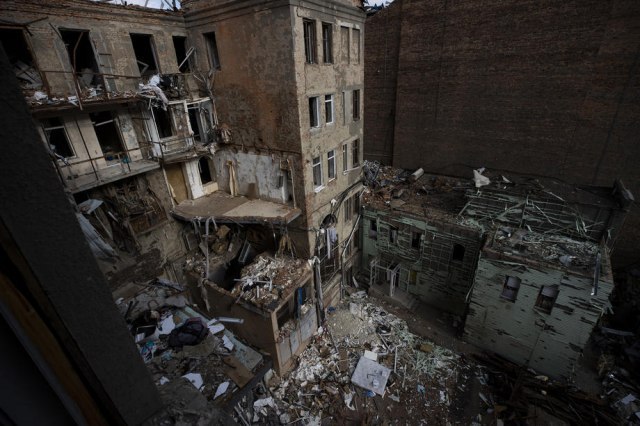
EPA-EFE/ORLANDO BARRIA

Tymoshenko, who came to power as prime minister during the first Ukrainian rebellion against the Kremlin, warned that any deal that would cede part of Ukraine's territory to Vladimir Putin would only encourage Russian President to further seize the country.

The only solution, according to Tymoshenko, is to "finish" it with the complete destruction of the Russian army, despite the evident increase in the number of dead Ukrainian soldiers, writes the Telegraph.

According to the British newspaper, her remarks are a kind of rebuke to Western leaders who hinted that giving up parts of Donbas would be a necessary compromise for peace.

France and Germany are open to the idea of ​​handing over part of Ukrainian territory to Russia, despite harsh comments after the G7 summit when French President Emmanuel Macron said "Russia cannot and must not win".

Tymoshenko fears that as the economic cost of the conflict for Europe rises, the initiative to push Kyiv towards a peace agreement will become increasingly popular. "I am surprised that some countries continue to advocate a policy of giving in to Putin. This is unacceptable for all of Ukraine. A peace agreement is an illusion, the only way out is victory in the battle. Any peace agreement will be the first step towards the next war," she said.

Tymoshenko added that despite the losses, Putin wants to prolong the war in the hope that divisions within NATO will eventually emerge. She supported Ukrainian leader Volodymyr Zelensky's appeals for the West to send as many missiles as possible to Ukraine in order to somewhat balance power in Donbas.

These days, Ukrainian forces are reportedly losing up to 100 soldiers a day in Donbas.
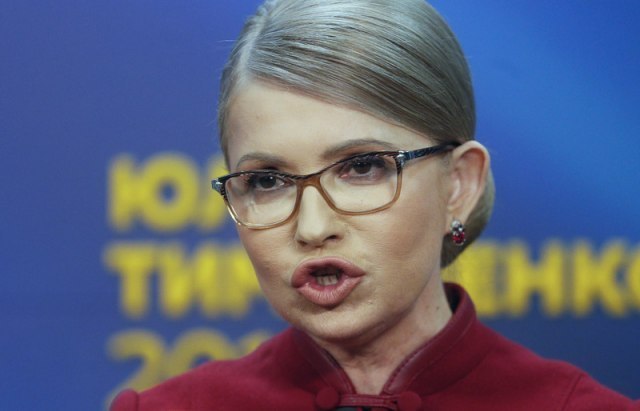
Foto: EPA-EFE/ SERGEY DOLZHENKO

The political career of Yulia Tymoshenko very well outlines the unstable post-Soviet path of Ukraine, a period divided by internal conflicts, as well as Moscow's interventions, writes Telegraph.

In 2004, Tymoshenko participated in the Orange Revolution, which led to mass street protests that nullified elections rigged in favor of pro-Russian candidate Viktor Yanukovych. Tymoshenko was then called the Slovenian "Joan of Arc", and her braids were copied on the world's fashion runways.

However, the Orange Revolution quickly turned into internal strife, allowing Yanukovych to take power in 2010. Tymoshenko was then sentenced to seven years in prison on charges of abuse of office. She said the charges were politically motivated, and she was acquitted after the second pro-Western uprising in Ukraine in 2014, when Yanukovych fled to Russia.

Tymoshenko lost to Zelensky in the 2019 election, but supported him after the Russian invasion in February. The former Ukrainian Prime Minister believes that it is very likely that Russia will try to occupy other neighboring countries, primarily Moldova, Belarus, Georgia, Kazakhstan, as well as the Scandinavian and Baltic countries.

"My advice to those countries would be to not waste time and start building strong armed forces and become NATO members if they haven't already," she said. Tymoshenko also believes that Putin is ready to use nuclear weapons.

"He is ready to cross all lines and play against all rules, that is the source of his strength," Tymoshenko said.

TYMOSHENKO EVITA OF THE UKRAINE

LA REVUE GAUCHE - Left Comment: Search results for EVITA UKRAINE 

Wednesday, June 08, 2022

EVITA OF UKRAINE
Interview
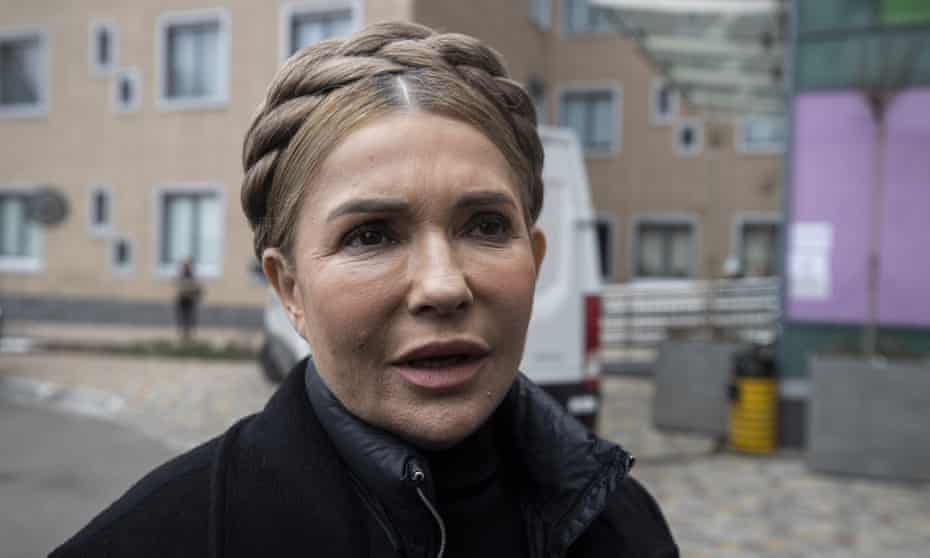
Yulia Tymoshenko on war in Ukraine: ‘It’s a chance for the free world to kill this evil’


Exclusive: Former PM discusses ‘cold, cruel’ Vladimir Putin and the west’s response to the Russian invasion
Yulia Tymoshenko in Kyiv in early March, two weeks after the Russian invasion. Photograph: Anadolu Agency/Getty Images


Luke Harding and Dan Sabbagh in Kyiv
THE GUARDIAN
Wed 8 Jun 2022 

Ukraine’s former prime minister Yulia Tymoshenko has described Vladimir Putin as “absolutely rational, cold, cruel, black evil” and claimed he is determined to go down in Russian history alongside Stalin and Peter the Great.

In an exclusive interview, Tymoshenko dismissed the suggestion that the Russian president was “crazy”. “He acts according to his own dark logic,” she said. “He’s driven by this idea of historic mission and wants to create an empire. That’s his hyper-goal. It comes from a deep inner desire and belief.”


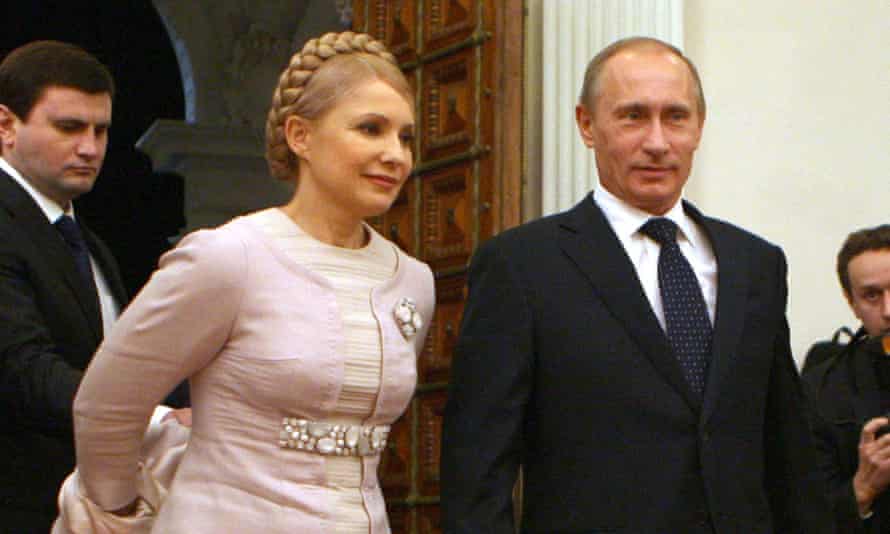
Tymoshenko, a leader of the 2004 Orange revolution and twice prime minister, had several one-on-one meetings with Putin. They held negotiations in 2009 after Putin, then prime minister, turned off the gas supply to Ukraine. Tymoshenko stood for president in 2010, 2014 and 2019, finishing second twice and then third.

Close up, Putin was “always cautious” in what he said and always suspicious that he might be being taped, she said. “He is from a KGB school,” she said. Before Russia’s full-scale invasion in February, he made no secret of his belief that there was “no such nation as Ukraine, and no such people as Ukrainians”, she said.

His ambitions went beyond seizing Ukrainian territory and toppling its pro-western, pro-Nato government, Tymoshenko suggested. His geopolitical aim was to take over Belarus, Georgia and Moldova as well, and to control central and eastern Europe including the Baltic states, just as Moscow did in Soviet times, she said.

Yulia Tymoshenko and Vladimir Putin in Yalta, Ukraine, in November 2009. 
Photograph: Aleksandr Prokopenko/EPA

Tymoshenko was in Kyiv on 24 February when Russia launched a multi-pronged attack in the early hours. She said peacetime political rivalries and grudges immediately vanished. That morning she went to the presidential administration together with other senior opposition figures and met Volodymyr Zelenskiy, whom she ran against in 2019.

“We hugged each other and shook hands. Everyone was shocked, pale and afraid. None of us planned to leave Kyiv,” she said. “Everyone knew we should stand until the last. We agreed to support our president and our army and to work for victory.” Zelenskiy’s decision to remain in the capital and to “overcome his fear” was important, she said.

As Russian bombs fell, Tymoshenko took refuge in the basement of the modern office building belonging to her Batkivshchyna political party in Kyiv’s Podil district, which was hit several times by missiles. Asked if she was ready to shoot Russian soldiers, she said: “Yes. I have legal weapons. The Kremlin put me on a kill list, according to sources. We were prepared.”

The Russian government had always considered her an enemy, Tymoshenko said. She pointed to her support for Ukraine’s membership of the EU and Nato. In the 2010 presidential election she stood against Viktor Yanukovych, who was backed by Moscow. She blamed her defeat on the outgoing president at the time, Viktor Yushchenko, a one-time Orange revolution ally.

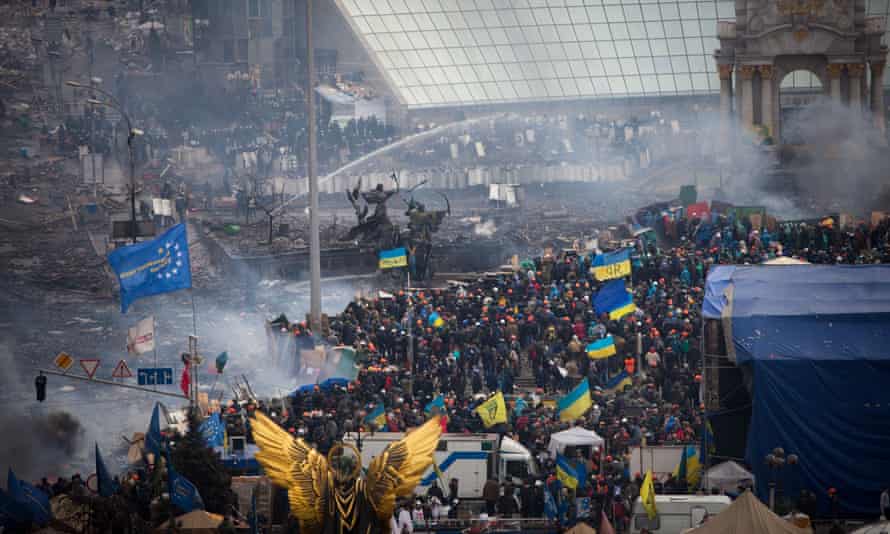
The following year Yanukovych had Tymoshenko jailed in a case widely seen as politically motivated. “Putin and Yanukovych imprisoned me. Yanukovych was never an independent player. He was always Putin’s puppet,” she said. She got out of prison in 2014 when Yanukovych fled to Moscow after the Maidan anti-corruption protests. Weeks later Putin annexed Crimea and instigated a separatist uprising in the east of Ukraine.

Protesters in Maidan Square, Kyiv, in February 2014.
 Photograph: Emeric Fohlen/NurPhoto/REX

Tymoshenko spoke in her downtown office decorated with the Ukrainian flag and photos showing her with western leaders including Margaret Thatcher. She praised the “unbelievable unity” of the “anti-Putin coalition” and singled out the UK and Boris Johnson for special mention, as well as the US, Canada and Poland. “We see Britain as a part of the broader Ukrainian family,” she said.

Last weekend France’s president, Emmanuel Macron, said it was important not to “humiliate” Putin – a phrase interpreted as meaning Ukraine should sacrifice some of its territory in exchange for a realpolitik deal with Moscow. Tymoshenko said France and Germany – criticised for slow-pedalling on arms deliveries – should not be ostracised as Europe grappled with its worst security crisis in decades.

But she said Ukraine’s international partners had to understand that the only way to end the war was to crush Russian forces on the battlefield. Without naming anybody, she said they should not become “co-conspirators with evil”. She added: “There is no such thing as a peace agreement with Putin because it doesn’t lead to peace. It would lead to a new war several years later.”

The stakes for her country were existential, she said. The Kremlin’s objective was to “depersonify” Ukraine, stripping it of its language and culture, and leaving it weak and “atomised”. The civilised world had a unique opportunity to stop Russia and to prevent it from spreading “war, corruption, blackmail, disinformation and unfreedom,” she said.
Sign up to First Edition, our free daily newsletter – every weekday at 7am BST

Russia had largely given up on the pretence that it was only targeting Ukrainian military infrastructure, Tymoshenko said. The murder of civilians – in cities in the Kyiv region such as Bucha and Irpin, as well as in other areas – was cruel and deliberate, she said, with Russian soldiers following Moscow’s instructions.

“It’s an inseparable part of their genocide against the Ukrainian nation,” she said. “What happened in Mariupol was even worse than in Bucha, Irpin and Hostomel. I’m convinced we will be able to take back Mariupol and to uncover the scale of the horrible killings there. It was a tragedy, a human catastrophe of an unthinkable scale.”

Considering her words, the veteran politician concluded: “This is a great battle for our territory and our freedom. It’s a historic chance for the free world to kill this evil.”

Saturday, May 12, 2007

Queen Of EuroVision


Not since Dame Edna have we had a Queen worthy of her name......And if these creeps are protesting I say go Verka go....

Ukrainian nationalists are protesting the nation's official entry in the Eurovision Song Contest - a single by drag queen Verka Serdyuchka.

After all it's not like she is really imitating the real Queen of the Ukraine; Evita Tymoshenko.....


Ukraine aims for Eurovision glory

Verka Serdyuchka
Ukraine is tipped to win with Dancing Lasha Tumbai
Twenty-four nations will compete in Helsinki on Saturday to win this year's Eurovision Song Contest.

Eastern European states dominate the finals after they scored a near clean sweep in Thursday's semi-finals.

Ukrainian drag queen Verka Serdyuchka is the bookies' favourite, just ahead of Marija Serifovic from Serbia.


UKRAINE
Verka Serdyuchka

Artist: Verka Serdyuchka
Title: Dancing Lasha Tumbai

Hello everybody!
My name is Verka Serdyuchka
Me English don't understand!
Let's speak DANCE!

Seven, seven, ai lyu lyu
Seven, seven, one, two
Seven, seven, ai lyu lyu
One, two, three!

And the Ukrainian entrant was accused of slipping in a reference to the 2005 Orange Revolution by using the phrase: "Russia goodbye".

It later transpired the artist, a drag queen called Verka Serdyuchka, was singing "condensed milk" in Mongolian.

Eurovision’s got American Idol beat

Russian slam or reference to Mongolian ‘churned butter’?
But that spat pales in comparison to the current controversy surrounding Ukraine’s cross-dressing entry, Verka Serdyuchka (real name: Andrei Danilko).

VIDEO: Verka Serdyuchka's performance of "Dancing Lasha Tumbai"

The controversy surrounds one phrase of Serdyuchka’s song, where it sounded like the singer was saying "I want to see/ Russia goodbye."

Serdyuchka’s management has since denied any anti-Russian sentiment in the song and has said that the phrase is actually "I want to see/ Lasha tumbai," in reference to the Mongolian for "churned butter." Mongolian speakers have debunked this translation, though, and the real meaning of lasha tumbai is still a mystery.

This could be costly for Ukraine in a contest where friendly relations count for a lot of points (I guarantee you that Greece and Cyprus give each other top votes). Not to mention that Serdyuchka could be out-dragged by Peter Andersen, a famous drag queen who is representing Denmark.

Ukraine's extravagant drag queen vows to bring smiles to European song contestions.

On stage, Verka Serdyuchka portrays herself as a simple village girl living her dream. Not all her countrymen are beguiled by her charms.

Serdyuchka, a drag queen whose real name is Andriy Danilko, takes her extravagant costumes and ribald song-and-dance routine to Helsinki next week to compete for Ukraine in the annual Eurovision song contest.

When she gets there, a busload of Ukrainian protesters plan to confront her: Serdyuchka, they complain, makes this former Soviet republic look like a nation of philistines, tasteless peasants shaped like sacks of potatoes - not sleek, chic Europeans.

"Guys, let's not quarrel," said an exasperated Danilko, a comedian who dresses like a man when he's not in character, adding he was "sick" of all the criticism.

The 33-year-old performer, whom Ukrainians chose to represent them at Eurovision in a popular vote in March, said some Ukrainians are taking the annual pop song extravaganza - and the fun-loving Serdyuchka - too seriously.

"Let's dance," he said. "That's the message Serdyuchka is sending to Europe."

Danilko dreamed up his stage character more than 10 years ago, following a long Soviet tradition of male comedians impersonating over-the-top females for big laughs. He got them, and Serdyuchka became a hit across the former Soviet Union.

Audiences loved her risque humor, her bouncing dance routines and her colorful costumes - she appears onstage laden with gaudy costume jewelry, heavy makeup and elaborate headgear, including rhinestone-studded berets.

Serdyuchka won hearts by making good-natured fun of her homely looks and large size, and singing about the single woman's yearning for love. In one song, Serdyuchka sings: "Beauties have it good, everybody likes them ... But I am ugly. They ride in a car but I ride in the subway."

"She is a Ukrainian Cinderella," Danilko said. And the way he sees it, this is her chance to go to the ball.

Olexander Lirchuk, a disc jockey in Kyiv, fumes. His Europa-FM radio station is leading the protest against Serdyuchka's appearance at Eurovision, arguing that Ukraine should send a band that can showcase the country's hip, young talent.

Lirchuk rallied about a dozen protesters and burned the performer in effigy. Now he and some other Serdyuchka critics plan to continue their protests in Helsinki.

"Serdyuchka is in poor taste," he said, motioning toward his svelte co-DJ, Yuliya Vladina: "Look, that's a real Ukrainian woman."

Many Ukrainians, though, embrace the performer and his character, homely and awkward as she may be. Some say Serdyuchka even has the best chance to win the Eurovision contest, which is judged by television viewers from all 42 countries that participate.

"Serdyuchka fits Eurovision 100 percent," said lawmaker Dmytro Vydrin.

The annual Eurovision contest is no stranger to outlandish acts. The Finnish band Lordi, which performs in monster masks, was the shock winner of the competition last year with "Hard Rock Hallelujah." Israeli diva Dana International - who was a man until a sex-change operation - won the contest in 1998, triggering a bitter rift between Israel's secular majority and its ultra-religious minority.

Ukraine was thrilled to win in 2004, just a year after its debut in the contest; a singer called Ruslana - known for her leather-and-fur outfits - triumphed with an energetic piece called Wild Dances. As the winner, Ukraine got to host the event the following year, and as a measure of its importance in this nation of 47 million, President Viktor Yushchenko attended and presented the prize. Ruslana later won a seat in parliament.

Some accuse Danilko of dabbling in politics as well. He caused an uproar with the song he plans on performing. Many listeners say the lyrics include a veiled insult to Russia, with whom Ukraine has had tense relations since the breakup of the Soviet Union.

Some hear the words "Russia, Goodbye," - but Danilko insists the phrase actually is "Lasha Tumbai," which is Mongolian for "Whipping Cream."

Danilko insists that he and his alter ego just want to have fun.

As he prepared for the contest, he filmed a daring video in which Serdyuchka and her mother - who wears a headscarf and goes by the name Mutter - visit a disco where they take turns playing with special glasses that reveal the crowd of young dancers in their underwear.

"I wanted to show that Ukrainians have the best bodies in the world," said Danilko.


Find blog posts, photos, events and more off-site about:
, , , ,, , , ,

Wednesday, April 04, 2007

Crisis in the Ukraine


Despite all the protest flags and mobilizations of party faithful the reality behind the political crisis in the Ukraine stripped of the rhetoric;
a privatization putsch.

Competing Oligarchs
and their political parties vying for the transformation of the Ukraine from State Capitalism to Monopoly Capitalism.

The death of the Orange Revolution and the continuation of the capitalist revolution in the Ukraine.


Although the two leaders are separated by such ideological differences as whether Ukraine should join NATO or more closely align with Russia, much of the wrangling has been widely viewed as efforts by their financial backers and power-brokers seeking to protect business interests. Several business groups are known to be vying for influence over lucrative enterprises — for example, ventures connected to the country`s natural gas transport system.

Yanukovich has signed up to a government programme that is broadly in favour of a market economy and a pro-western foreign policy. The government will try to complete talks on joining the WTO before the end of this year; it will allow private sales of agricultural land; and it will start to negotiate a free trade area with the EU. Those who have met Yanukovich recently report that he has made a big effort to spruce up his style and become a more "western" politician - perhaps his American PR advisers have helped.
Expensive Enemies
Even these expenses pale, however, in comparison with the real cost of the ongoing struggle for power. Viktor Yanukovych's return to power last year was not only his personal triumph and that of his Party of the Regions – it was also a victory for the many business interests associated with the prime minister, particularly the company System Capital Management (SCM), which belongs to Rinat Akhmetov, the richest man in Ukraine; the corporation Interpipe, headed by Leonid Kuchma's son-in-law Viktor Pinchuk; and the group UkrSib, which belongs to Alexander Yaroslavsky and Ernest Goliev.

Consequently, businessmen sympathetic to the prime minister's opponents, the Our Ukraine and Bloc of Yulia Tymoshenko parties, have been cut out of the loop. Incidentally, the last few months have seen privatization actively moving forward in Ukraine under the supervision of the government Property Fund (FGI), whose leader Valentina Semenyuk is a member of the Socialist Party, which is a partner in Viktor Yanukovych's "national unity coalition." Coincidentally or not, the decisions that the FGI has been making lately have been unfavorable for businessmen associated with Yulia Tymoshenko. The noisiest scandal involved the recent privatization of the holding company Luganskteplovoz: although Privat Group, which is owned by long-term Tymoshenko associate Igor Kolomoisky, wanted to bid on shares in the company, the FGI ruled that only two Russian companies, Demikhovsky Mashinostroitelny Zavod (Moscow Oblast) and the managing company of Bryansk Mashinostroitelny Zavod (both companies are controlled by the group Transmashkholding), would be allowed to participate in the auction. When Luganskteplovoz eventually went to Bryansk Mashinostroitelny Zavod for $58.5 million, the Bloc of Yulia Tymoshenko (BYuT) charged that the deal was illegal and initiated a parliamentary investigation lead by BYuT deputy Andrey Kozhemyakin, the head of the Committee for Privatization Issues.

The fiercest battles over privatization still lie ahead, however. This year the FGI is preparing to auction off shares in Ukrtelekom, and Mr. Akhmetov's SCM has already expressed interest. The Ukrainian government has also given its consent to a broad privatization campaign in the electrical energy sector. Shares will be offered for sale in numerous government-owned regional energy companies, including Prikarpatenergo, Lvovenergo, Sumyenergo, Chernigovenergo, and Poltavaoblenergo, and experts are already predicting that SCM, Interpipe, and Privat will fight tooth and nail over the spoils.

Such a state of affairs does not sit well with the rest of the heavyweights in the Ukrainian market, who are now determined to see a change in the current political landscape. In large measure, the actions of Yulia Tymoshenko and Our Ukraine are driven by the expectations of businessmen claiming offense at the hands of the government. "Yanukovych is lobbying not only for the interests of Akhmetov but also for those of Russian business, which the Luganskteplovoz affair shows," believes Vadim Karasev, the head of the Kiev Global Strategy Institute. "If BYuT and Our Ukraine succeed in getting early elections called and form a coalition that ends up holding the reins of power, the oligarchs standing behind them, i.e., Privat, will also win. That is the cost of dissolving the Rada – Ukraine as a business asset."

OP-ED by Anders Aslund, International Herald Tribune (IHT)
Europe, Thursday, February 10, 2005

The economic programs of the two presidents are remarkably similar. Both

advocate a free but social market economy. Both countries have a flat
personal income tax of 13 percent. Ukraine needs to catch up with Russia
in market economic legislation, but with rising authoritarianism, the role
of the state is growing in Russian business.
.
The critical issue is the property rights of the oligarchs. Putin has given
up much of his initially good economic policies by ruthlessly going after
one oligarch, leaving the property rights of others in doubt. Yushchenko
must avoid repeating his mistake. Yet he campaigned for the re-privatization
of Kryvorizhstal, the last, biggest and most controversial privatization in
Ukraine. Having been bought by Ukraine's two wealthiest oligarchs (Rinat
Akhmetov and Viktor Pinchuk), it is a palatable political target. The
challenge to Yushchenko is to limit re-privatization to the politically
necessary and then sanctify property rights. For economic growth,
Ukraine needs more privatization rather than re-privatization.
.
Ukraine's "orange revolution" has made democracy look modern again.
Yushchenko's challenge now is to balance calls for social justice with the
need for secure property rights. -30-

Foreign Affairs - Ukraine's Orange Revolution - Adrian Karatnycky

Corruption accelerated after Kuchma's election as president in 1994. The former director of the Soviet Union's largest missile factory, Kuchma brought with him ambitious and greedy politicians from his home base, the eastern city of Dnipropetrovsk. The greediest of the crew was Pavlo Lazarenko, who, in June 2004, was convicted in U.S. District Court of fraud, conspiracy to launder money, money laundering, and transportation of stolen property. Lazarenko, currently free on $86 million bail, was accused of having stolen from the state and extorted from businesses hundreds of millions of dollars between 1995 and 1997, when he served for 12 months as first deputy prime minister and for 7 months as prime minister. When the scale of Lazarenko's corruption became known, some Ukrainian leaders were outraged. But Kuchma could not have been surprised. In 2000, his former bodyguard leaked hundreds of hours of transcripts of the president's private conversations. On the tapes, Kuchma is heard dispensing favors, paying massive kickbacks, and conspiring to suppress his opponents--making it clear that the president sat at the head of a vast criminal system.

Several factors facilitated Ukraine's massive corruption. High inflation meant that until the mid-1990s, many cross-border financial transactions were conducted using a barter system, which was easily falsified to understate the amount of goods traded; resources that were exported to Russia ostensibly for energy often brought huge kickbacks instead. Wide-ranging privatization also enabled government insiders and cronies to buy state enterprises at bargain-basement prices. Steel mills, today worth several billion dollars, were bought for a few million. Regional energy companies fell prey to the same forces. The tax inspectorate was another weakness in the system, as the government manipulated it to gain financial and political advantages: competitors could be harassed or forced out of business by inspections and fines, and oligarchs could easily evade paying taxes.

In general, the oligarchs were able to operate their businesses without fear of independent oversight. Under Ukraine's constitution, local government officials are not elected but appointed by the president, who allowed oligarchic groups to create local enclaves headed by their allies. In the Zakarpattya (Transcarpathia) region, local and central government officials enabled one oligarchic consortium to amass vast fortunes from the lumber industry by stripping the forests of their trees. Now, parts of this once richly forested mountain region have been dangerously depleted, compounding the problems caused by deforestation in the Soviet era.

Over time, several Ukrainian oligarchic clans became dominant in the young nation. Medvedchuk, who became presidential chief of staff in December 2002, represented the Kiev clan, which controlled regional energy and timber companies and invested in broadcast media. The Dnipropetrovsk clan, which invested in the energy pipeline industries, included Viktor Pinchuk, now Kuchma's son-in-law. A powerful group from the eastern coal-mining Donbass region included metallurgy baron Rinat Akhmetov, the postcommunist world's second-wealthiest man, with a net worth of $3.5 billion.

Each interest group established its own political party in parliament. The Kiev clan ran the Social Democratic Party of Ukraine (United). The Donetsk oligarchs created the Party of Regions, the ranks of which included a local governor who later became prime minister: Yanukovich. The Dnipropetrovsk group created and backed the Labor Party. And the influence did not stop there. The oligarchs owned or controlled their own national broadcast media and local and national newspapers. Each was capable of massively funding political campaigns in the emerging pseudodemocratic system.

In the late 1990s, the oligarchic clans largely remained under the control of Ukraine's powerful president. But in 2000-2001, Kuchma's power began to weaken as the wealth of the robber barons grew significantly and Kuchma's personal corruption and criminality started coming to light. Eventually, Kuchma even faced a vigorous opposition campaign to impeach him for his role in an abduction that ended with the murder of the investigative journalist Heorhiy Gongadze. But the campaign stalled as the president and his backers blocked efforts to institute the legal procedure needed to formally make the charges.

CHANGES

It was this turbulent period that saw the metamorphosis of Yushchenko from colorless central banker into charismatic opposition leader. In December 1999, pressure from Western donor countries seeking deeper economic reforms resulted in his appointment as prime minister. As chairman of the National Bank of Ukraine in the 1990s, Yushchenko had tamed rampant inflation and introduced responsible fiscal controls. In taking the reins of the government, he was determined to impose fiscal discipline and rigorously collect tax revenues and privatization receipts. To achieve these goals, Yushchenko needed to crack down on Ukraine's crony capitalism. He formed an alliance with one of the system's own--Yulia Tymoshenko, a former energy mogul who had run afoul of the Kuchma regime. With Tymoshenko's help, Yushchenko managed in just a year to recoup more than $1 billion in revenues that had been siphoned off by energy oligarchs.

Ukrainian society was also experiencing profound changes of its own, including the rise of a significant middle class in Kiev and other urban centers. In 2002, thanks in part to the ongoing effects of policies enacted by Yushchenko when he was prime minister, GDP grew by 5.2 percent; the next year, it increased 9.4 percent; and in 2004 it grew by 12.5 percent. From 1999 to 2004, Ukraine's GDP nearly doubled. Although this growth mostly benefited a narrow circle of oligarchs, it also spawned many new millionaires and a new middle class. These new economic forces resented the latticework of corruption that constantly ensnared them--from politically motivated multiple tax audits to shakedowns by local officials connected to business clans.

For Richer and For Poorer

The FSU's troubled relations with its wealthy

To Ukrainians, the wealthy are like thieves who stole all the money they had in the bank, along with the titles to their homes, then drive up in luxury cars and threaten to beat up their families if they don't pay the rent.

Take Renat Akhmetov, Ukraine's richest man with $2.3bn, now under investigation in a murder case going back a decade. Rather than face questioning, he skipped town. Now the authorities have raided his company in search of evidence. Of course we all hope that if Akhmetov does go to court, it will be for legitimate reasons, the court proceedings will be fair, and the outcome will be just. Yushchenko said rule of law would be a priority, but the strange lack of closure on the case against Borys Kolyesnykov, Akhmetov's fellow Donetsk tycoon, makes it seem as though the Ukrainian justice system is still not up to doing its job.

What goes on in the court may or may not be just, but what the average voters see is the following: in the course of a decade or so, while ordinary Ukrainians lost all their savings, this man made $2.4bn. Did he create any companies? No, he bought them or cobbled them together from other companies. Did he rebuild the crumbling businesses of Eastern Europe? No, they're still crumbling. Did he create new processes, invent new machines, formulate effective new management strategies? No, no, and no. Akhmetov did not make his money on innovation. He and the people like him are not like capitalists as I know them from Silicon Valley, they are like the Marxist ideal of capitalists: people who make money without adding anything. Like robber barons without Rockefeller Center, or the Carnegie Endowment, or new railroads, for that matter. [update: Reader dlm has rightly reminded me how deeply connected the philanthropic work of, for example, Carnegie was connected to his belief in Christian charity. Of course this is also something that is not yet a strong positive influence in Eastern Europe after decades of state opposition to Christianity.]

The “evolving oligarch”


Business oligarchs like Fridman continue to power the Russian economy — and to hold the fate of minority shareholders in their hands. According to a December 2001 study by Brunswick UBS Warburg, a Moscow-based investment bank, eight financial-industrial groups control the 64 largest private companies in Russia. Among the prominent oligarchs cited in the study alongside Fridman and Khodorkovsky were Roman Abramovich (Russia's second-richest man, who is merging his oil operations with Khodorkovsky's), Oleg Deripaska (who owns the largest aluminum producer in the country) and Vladimir Potanin (who used part of his oil proceeds to corner Russia's nickel output). Critics contend that this concentration of wealth creates barriers to competition, makes it more difficult for new businesses to get started and offers portfolio investors very limited choices on the local equity markets. The big financial-industrial groups “aren't acting very differently from monopolies anywhere else,” says Christof Ruehl, chief economist at the World Bank's Moscow office.“

Defenders of the Russian capitalist model argue not only that it isn't broken but that it doesn't need fixing. Only China's economy is expanding faster, they note. Besides, say the optimists, oligarchs have moderated their hard-boiled approach to business. But skeptics remain. “With Russia's kind of growth, it's hard to convince people that business and banking reforms are urgent,” says Stephen Jennings, chief executive officer of Renaissance Capital, a leading Moscow-based investment bank.

Fridman is often cited as a paragon of the evolving oligarch. “He played some rough games earlier in his career,” says Marshall Goldman, a Harvard University economics professor whose recent book, The Piratization of Russia: Russian Reform Goes Awry, offers a scathing vision of buccaneer capitalism. “But nowadays he looks like one of the more enlightened entrepreneurs.”
Nothing better illustrates Fridman's progress from notoriety to celebrity than his dealings with his new partner, U.K. oil giant BP. Even though BP once sued Fridman for seizing valuable petroleum fields for which the British company had paid close to a half-billion dollars, this past June BP signed a deal to pay $6.15 billion — the largest foreign investment in post-Communist Russia's history — for half of Fridman's TNK, which controls the same oil fields. Between these two bookends is a rough-and-tumble saga about “learning to do business in Russia — the hard way,” says Robert Dudley, the BP vice president who has been named chief executive officer of the joint venture, TNK-BP.

Speech before the Los Angeles World Affairs Council on March 12, 1999:

Dimitri K. Simes
President, The Nixon Center
Author, After the Collapse: Russia Seeks Its Place as a Great Power

Russian robber barons were not builders. Russian robber barons were manipulators who knew how to build connections which would allow them to privatize on the cheap without paying almost anything, and then they would immediately open bank accounts in Switzerland. Thus, they were taking money from the country, and because of that they were very afraid to have any one as Russian president who was not one of them. From that standpoint, Yeltsin was a deal. He had presided over the privatization; he could be counted upon to protect their interests. These same people who were Yeltsin’s official advisors were in charge of major networks. You’d have the money going from Russian central bank, to private banks, and the private banks would immediately give the money to Yeltsin’s campaign. There was really no difference between the Russian state treasury and Yeltsin’s personal campaign chest. That’s how those elections were conducted.

The Decision to restructure to a Market Economy was made by Soviet Intellectuals

Soviet intellectuals studied both their economy and that of the West closely and made a conscious decision for change. Once the decision to change to a market economy was made, these same intellectuals had little to say about the actual restructuring:

When I [Fred Weir] came here seven years ago at the outset of perestroika, there was very little belief in socialism among the generation dubbed the golden children. These sons and daughters of the Communist party elite had received excellent educations, had the best that the society could give them, and only aspired to live like their Western counterparts. Many had high positions in the Communist Party, but were absolutely exuberant Westernizes, pro-capitalists, and from very early in the perestroika period, this was their agenda.... People who thought they were going to be the governing strata in a new society are [now] losing their jobs, being impoverished and becoming bitter. The intellectuals, for instance—whose themes during the Cold War were intellectual freedom, human rights, and so on—had a very idealized view of Western capitalism. They have been among the groups to suffer the most from the early stages of marketization as their huge network of institutes and universities are defunded.53

Those golden children of the communist elite are undoubtedly quite silent as they gaze at their once proud country lying prostrate at the feet of imperial capital. The population of Russia has been falling at the astounding rate of 800,000 a year, birth rates have plummeted to the lowest in the world, and only 1-in-4 children are born healthy. There are dramatic increases in the number of children born with physical and mental impairment, disease is rampant, and the average lifespan of Russian men has fallen from 65 years to 58, below that of Ghana.54

Sale of the Century by Chrystia Freeland is a highly recommended masterly study on the collapse of Russia after the breakup of the Soviet Union.55 However, as a correspondent for the Financial Times when doing her research, the author focuses only on finance and politics and ignores other crucial factors. Ignored were: basic economics, Russia’s highly motivated labor ready to make the transition to capitalism as addressed above by Fred Weir, the National Endowment for Democracy’s funding and management of Yeltsin’s election, the American election specialists orchestrating of that election,r the Harvard Institute for International Development’s advising Russia’s “young reformers” throughout that collapse, and how the massive imports of consumer products both collapsed the economic multiplier and sucked the wealth out of Russia.

Without the economic multiplier as money from wages circulates, a country essentially has no economy. Yet, while intending to document the full history of the attempt to restructure the Russian economy, the author fails to notice that the “young reformers” paid no attention to primary production in Russia. These neophytes were so immersed in classical Western philosophy that they thought all there was to establishing capitalism was to create rich capitalists by giving title of valuable resource industries and banks to a few “oligarchs,” who, without a doubt, pulled off one of the greatest thefts of social wealth in history.

In the West, preventing the rise to political power of labor is a primary consideration. Thus the highly motivated “golden children” (the latest generation of leaders) who were ready to restructure Russia’s economy were never given the opportunity. Instead, the neophyte agents of capitalism (the “Young Reformers”) were intent on the obviously impossible job of telescoping the 70 years of the age of American robber barons into less than 10 years. The “golden children” running Russia’s economy wanted to restructure to capitalism and would have understood how to do so. But labor in charge of any part of an economy is anathema to theorists of Western philosophy. So the only people offered a serious opportunity to buy Russia’s productive industries for a fraction of its true value were the new “oligarchs” with no experience in running any part of the Russian economy. Without any background on running industries or much of anything else, these oligarchs were expected to become the leading capitalists of Russia.

No country has ever developed under the principles imposed upon post Soviet Russia. In fact, economic protections for the developed world are all in place and functioning and no wealthy nation would consider subjecting their economies to such harsh economic medicine as was imposed on Russia. To double, triple, and quadruple prices while shutting down industry right and left and destroying consumer savings would be taught as a recipe for disaster in any economics class.

The easiest way to understand the failure of the restructuring of the Russian economy is by outlining a sensible restructuring plan:

(1) The massive savings of Russian citizens should have been protected;

(2) Industry and media shares should have been distributed to all citizens;s

(3) modern consumer product industries should have been built, the bonds to be repaid from profits (the workers being owners would help insure those profits);

(4) until those industries were established and the economy competitive, import restrictions should have stayed in force;

(5) as fast as those modern industries came on stream, Russia’s obsolete huge factories would have reduced production and shut down in stages;

(6) an inescapable society monthly collection of landrent, as per Chapter 24, should have been placed into law, including royalties on natural resources such as oil, minerals, timber, and communications spectrums;

(7) citizens should have received title to their homes through paying landrent taxes in monthly payments (they had massive savings with which to do that);

(8) farmers, businesses and industry should also have been given title to their land with the legal responsibility of paying landrent to society;

(9) locally owned banks (better yet credit unions) should have been put in place to fund consumers, farmers, and producers;

(10) and, with those massive consumer savings and financing available, retailers would spring up automatically and this would be the ideal moment to establish an efficient distribution system as per Chapters 27 and 28.

There are many other factors to consider but the above would have been the foundation of a workable restructure plan. Subtle monopolization of technology is the biggest barrier. Virtually any successful restructure plan must provide access to technology, resources and markets and Russia’s massive resources could have been bartered for that technology as opposed to its current hemorrhaging to the West. Patent licensing could have been imposed by law. This is accepted as legal in international law, was being tested in court with AIDS drugs in South Africa, and the major drug companies capitulated rather than go to trial.

The reason these suggestions were not followed is obvious, labor would have ended up with enormous wealth and political power. If they had been given the chance, those egalitarian trained and idealistic “golden children” could have established democratic-cooperative-(superefficient)-capitalism as opposed to today’s dependency on the periphery of imperial-centers-of-capital. If that had happened, the secret that no power-structure in the imperial centers had yet given their citizens full rights would have been exposed.

See:

Back in the USSR

Oligarchs

Tymoshenko 'Evita'of the Ukraine


Find blog posts, photos, events and more off-site about:
, , ,

Tuesday, January 20, 2026

EVITA OF UKRAINE


COMMENT: Tymoshenko back in play as Ukrainian parliamentary politics returns to the fore

COMMENT: Tymoshenko back in play as Ukrainian parliamentary politics returns to the fore
Pushed to the sidelines of Ukrainian politics for several years, NABU accusations of vote-buying have once again shoved firebrand opposition leader Yulia Tymoshenko back into the spotlight of Ukrainian domestic politics. / bne IntelliNews
By bne IntelliNews January 20, 2026

Orange Revolution firebrand Yulia Tymoshenko’s sudden re-emergence at the centre of Ukraine’s political scene after she was caught up in a vote-selling scandal  has seen her return to the heart of Ukrainian politics.

“The Tymoshenko scandal reflects the fact that the centre of Ukrainian politics is once again shifting to parliament,” wrote political analyst Konstantin Skorkin in a recent commentary for Carnegie Endowment for International Peace. “The fight for parliamentary deputies’ votes is heating up again, and Ukraine’s domestic political crisis is entering a new phase.”

Once a dominant figure in Ukraine’s early post-independence years, Tymoshenko’s career trajectory mirrored the country’s own political evolution. She was a successful businessperson in the 1990s, earning a fortune from gas trading at a time when she also severed as Ukraine’s gas minister, earning her the moniker “the gas princess.”

Then she moved into politics thanks to her association with prime minister and now convicted criminal Pavlo Lazarenko. She became a fixture in the opposition during the Kuchma and Yanukovych presidencies, before she and her trademark crown braid became an icon of the Orange Revolution. In the new post revolution government she achieved her political pinnacle, twice serving as prime minister and imprisoned on two occasions. Yet after she was released from jail after the EuroMaidan revolution in 2014 she political star set and she became the largely irrelevant head of a small Rada fraction, the Fatherland Party that hold less than a dozen seats in parliament. She ran in the 2019 presidential elections but came a distant third to the now Ukrainian president, Volodymyr Zelenskiy. Since then Zelenskiy’s Servant of the People party has held an absolute majority in parliament and dominates domestic politics.

Following Russia’s full-scale invasion in 2022, Tymoshenko struggled to find footing in Ukraine’s wartime consensus. “She became critical of the government, condemning the new mobilisation law and the restrictions on consular services for Ukrainians abroad,” Skorkin observed. Adopting the socially conservative platform, styling herself as a Ukrainian Trump, Tymoshenko positioned herself as a populist voice against liberal reforms, opposing cannabis legalisation and what she termed a “gender agenda.”

In the summer of 2025, she led a campaign to curtail the powers of Ukraine’s anti-corruption bodies, branding the National Anti-Corruption Bureau (NABU) that is now investigating her for vote-buying as an agent of “external control.” She supported Zelenskiy’s controversial attempt to gut Ukraine’s anti-corruption reforms on July 22 with Law 21414, which sparked the first anti-government demonstrations since the start of the war with Russia.

Her refusal to support legislation restoring NABU’s authority following presidential intervention drew accusations of obstructionism. “Tymoshenko’s reaction came across as a case of sour grapes among the old elites,” Skorkin wrote, “unhappy with real efforts to fight the corruption that had long plagued the country.”

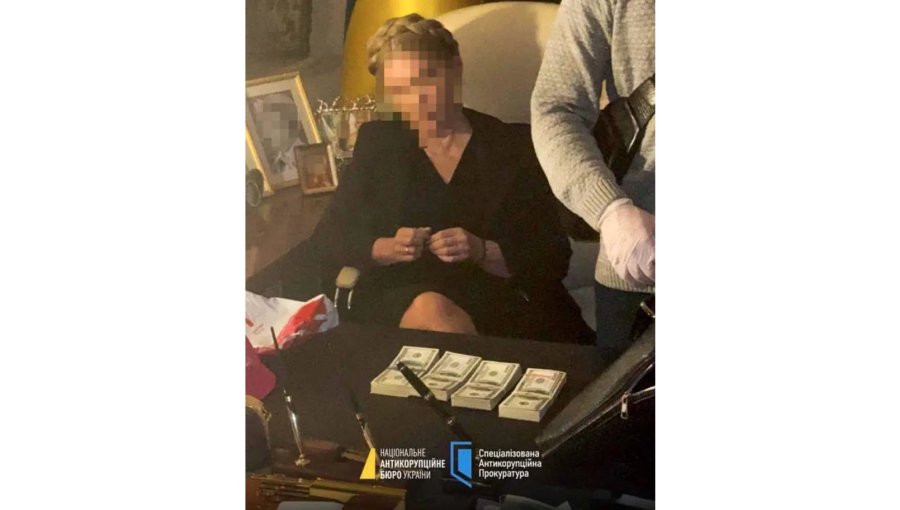
But when she was accused of corruption, accompanied by some very damning video and audio tapes, released by NABU, she hit back by accusing Zelenskiy personally of corruption – a sentiment that will resonate with voters. In the tapes, a voice alleged to be Tymoshenko’s offers deputies $10,000 per month for their votes and speaks of plans to “overthrow the majority.”

The recent charges against Tymoshenko—bribery and attempted vote-buying—come amid what Skorkin described as “a large-scale purge of the elites,” triggered by the publication of the so-called Mindich tapes in late 2025 that are at the centre of the Energoatom corruption scandal. Investigations have already reached members of the ruling party, including Zelensky’s associate Yuriy Kisel.

Her apparent goal, according to Skorkin, was to undermine Zelensky’s single-party control of the Verkhovna Rada, which has been showing signs of fragmentation. “The opposition wants to drive a deeper wedge into this cracked monolith,” Skorkin wrote, pointing to a failed vote on a proposed reshuffle and growing speculation of a “parliamentary coup” that could curtail presidential powers.

In line with the charges, Tymoshenko has been barred from leaving the Kyiv region and from communicating with 66 deputies. Bail has been set at UAH33mn ($760,000). Yet typically for the grandstanding Tymoshenko, even under legal pressure she used the court hearing as a political platform. “Trials and imprisonment have helped Tymoshenko rise to the top of Ukrainian politics on more than one occasion,” Skorkin noted.

Whether that strategy can succeed again is uncertain. “It will be difficult to repeat those past successes given how much time has passed and how much the country has changed since then,” Skorkin concluded. “Still, the Tymoshenko case demonstrates that the anti-corruption earthquake last fall has sent such powerful shock waves through Ukrainian politics that it has brought to the surface those who dwelt in its depths—those who may yet play a role in a battle in which they had already been written off.”