China's space aircraft carrier: superweapon or propaganda?
DW
February 1, 2026
With Luanniao, China is promoting a giant space aircraft carrier as a new superweapon. Is it a vision for war in space — or science fiction?

With Luanniao, China is promoting a giant space aircraft carrier as a new superweapon. Is it a vision for war in space — or science fiction?

China's state television shows a computer simulation of the planned space aircraft carrier "Luanniao," which would surpass all terrestrial carriers in terms of mass
Image: CCTV
The flying aircraft carrier is larger than any warship in use today and heavier than a supertanker: China’s Luanniao is intended to shape future warfare — from space. Yet experts describe the superweapon as high-tech theater with a political message.
China is planning an integrated air- and space-defense system known as Nantianmen ("Heavenly Gate"). Its centerpiece is the flying carrier Luanniao, measuring 242 meters (794 feet) in length, 684 meters in wingspan and reportedly weighing up to 120,000 tons at takeoff — an imposing mass. From its deck, unmanned space fighters, so-called Xuannu, are to launch hypersonic missiles and strike targets in the atmosphere and in orbit.
"China has long been number two in space — behind the United States, but well ahead of Europe," said space security expert Juliana Süß of the German Institute for International and Security Affairs (SWP) in an interview with DW.
Beijing has invested "extremely large sums of money," she said; space plays a clear prestige role for the leadership and is "extremely important for military capabilities."
By weight alone, the planned space carrier would surpass the largest existing aircraft carriers by around 20%. While it would be shorter in length, its wingspan would be significantly broader than that of a conventional maritime aircraft carrier at sea. The largest aircraft carrier currently in service, the USS Gerald R. Ford, measures roughly 337 meters in length and 78 meters in width and weighs about 100,000 tons including fuel, crew and equipment.
A brief report on the military program "Lijian" on China’s state broadcaster CCTV depicts the announced carrier as a photorealistic 3D model hovering above the Earth, releasing space jets and firing weapons in outer space. Excerpts from the show are circulating online, including in a recording on YouTube (with the option to enable English subtitles).
Experts cast doubt on the gigantic space carrier
From a technical standpoint, the plan goes far beyond what today’s rockets could possibly send into orbit. Even if a modular assembly in space were theoretically possible, many problems remain. These include power supply, propulsion, cooling, protection from space debris — and above all, the sheer cost. A 120,000-ton carrier in space would be completely beyond any realistic payload capacity of current launch systems such as SpaceX’s Starship.
German diplomat and space analyst Heinrich Kreft said that, from today’s perspective, the project is "completely unrealistic" — yet still sees it as part of a longer-term trajectory.
"Many things that were science fiction 20 or 30 years ago are real today," Kreft told DW.
This marks China joining a race fueled by figures like Elon Musk or Jeff Bezos with their visions of lunar and Martian colonization.
A superweapon to send a strategic signal
Analyses from the US likewise interpret Luanniao less as a construction blueprint than as a strategic signal. The National Interest ran an article with the headline: "Beijing Wants You to Believe It's Building Flying Aircraft Carriers".
The vision, wrote author Brandon J. Weichert, is part of a "wider propaganda push" that is designed to make the West nervous and waste time and resources.
For space analyst Kreft, the announcement resembles a deliberately placed message in the power games with the United States — cast against the backdrop of the conflict over Taiwan.
"To my ears, this sounds as if China has put something out into the world with Taiwan very much in mind, in order to leave a marker," he said.
He points to a series of spectacular Chinese “superweapon” announcements — ranging from an allegedly ultimate submarine-hunting weapon to space-based systems — that Western experts regularly classify as "unrealistic" but which are seen as part of a narrative designed to form a deterrent.
ADVERTISEMENT
China's next step in the space race with the US
SWP expert Süß places the project in a security-policy context. She views such initiatives "more through a deterrence lens" — the aim, she says, is "to demonstrate strength and project power across multiple domains."
At the same time, she interprets the presentation as China's answer to US missile defense plans in space. The "Golden Dome" proposed by Trump is intended to protect the United States against all types of airborne threats through a multilayered network of ground- and sea-based interceptor missiles, radar systems and possibly space-based interceptors — a project that itself is considered technically extremely ambitious and strategically fraught.
The flying aircraft carrier is larger than any warship in use today and heavier than a supertanker: China’s Luanniao is intended to shape future warfare — from space. Yet experts describe the superweapon as high-tech theater with a political message.
China is planning an integrated air- and space-defense system known as Nantianmen ("Heavenly Gate"). Its centerpiece is the flying carrier Luanniao, measuring 242 meters (794 feet) in length, 684 meters in wingspan and reportedly weighing up to 120,000 tons at takeoff — an imposing mass. From its deck, unmanned space fighters, so-called Xuannu, are to launch hypersonic missiles and strike targets in the atmosphere and in orbit.
"China has long been number two in space — behind the United States, but well ahead of Europe," said space security expert Juliana Süß of the German Institute for International and Security Affairs (SWP) in an interview with DW.
Beijing has invested "extremely large sums of money," she said; space plays a clear prestige role for the leadership and is "extremely important for military capabilities."
By weight alone, the planned space carrier would surpass the largest existing aircraft carriers by around 20%. While it would be shorter in length, its wingspan would be significantly broader than that of a conventional maritime aircraft carrier at sea. The largest aircraft carrier currently in service, the USS Gerald R. Ford, measures roughly 337 meters in length and 78 meters in width and weighs about 100,000 tons including fuel, crew and equipment.
A brief report on the military program "Lijian" on China’s state broadcaster CCTV depicts the announced carrier as a photorealistic 3D model hovering above the Earth, releasing space jets and firing weapons in outer space. Excerpts from the show are circulating online, including in a recording on YouTube (with the option to enable English subtitles).
Experts cast doubt on the gigantic space carrier
From a technical standpoint, the plan goes far beyond what today’s rockets could possibly send into orbit. Even if a modular assembly in space were theoretically possible, many problems remain. These include power supply, propulsion, cooling, protection from space debris — and above all, the sheer cost. A 120,000-ton carrier in space would be completely beyond any realistic payload capacity of current launch systems such as SpaceX’s Starship.
German diplomat and space analyst Heinrich Kreft said that, from today’s perspective, the project is "completely unrealistic" — yet still sees it as part of a longer-term trajectory.
"Many things that were science fiction 20 or 30 years ago are real today," Kreft told DW.
This marks China joining a race fueled by figures like Elon Musk or Jeff Bezos with their visions of lunar and Martian colonization.
A superweapon to send a strategic signal
Analyses from the US likewise interpret Luanniao less as a construction blueprint than as a strategic signal. The National Interest ran an article with the headline: "Beijing Wants You to Believe It's Building Flying Aircraft Carriers".
The vision, wrote author Brandon J. Weichert, is part of a "wider propaganda push" that is designed to make the West nervous and waste time and resources.
For space analyst Kreft, the announcement resembles a deliberately placed message in the power games with the United States — cast against the backdrop of the conflict over Taiwan.
"To my ears, this sounds as if China has put something out into the world with Taiwan very much in mind, in order to leave a marker," he said.
He points to a series of spectacular Chinese “superweapon” announcements — ranging from an allegedly ultimate submarine-hunting weapon to space-based systems — that Western experts regularly classify as "unrealistic" but which are seen as part of a narrative designed to form a deterrent.
ADVERTISEMENT
China's next step in the space race with the US
SWP expert Süß places the project in a security-policy context. She views such initiatives "more through a deterrence lens" — the aim, she says, is "to demonstrate strength and project power across multiple domains."
At the same time, she interprets the presentation as China's answer to US missile defense plans in space. The "Golden Dome" proposed by Trump is intended to protect the United States against all types of airborne threats through a multilayered network of ground- and sea-based interceptor missiles, radar systems and possibly space-based interceptors — a project that itself is considered technically extremely ambitious and strategically fraught.
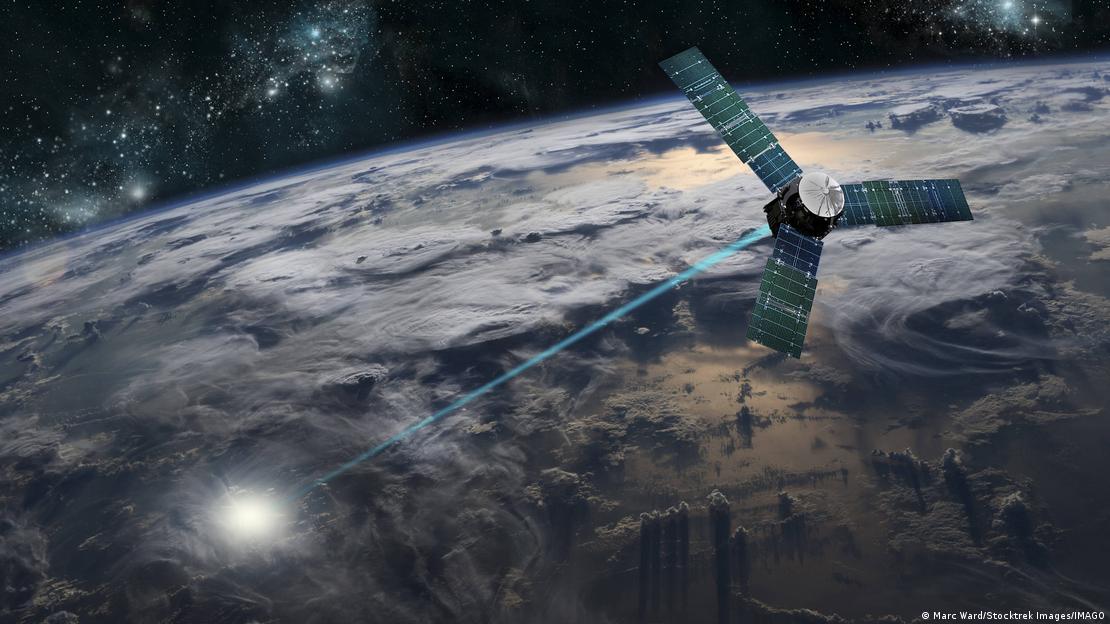
Space weapons could radically change the current power balance: simulation of a satellite firing a space weapon at a target on the Earth's surface
Image: Marc Ward/Stocktrek Images/IMAGO
What is crucial for successful deterrence, Süß said, is above all credibility.
"To what extent such an ambitious and oversized project as this space carrier is actually credible is an entirely different question."
It is precisely in this gray zone that Luanniao aims to strike — an outsized threat that is politically useful long before any metal parts are ever assembled.
Kreft calls the project "humbug, psychological warfare," while at the same time sounding a warning against being deceived by it.
China, he says, is working "on all conceivable future projects and weapons systems," for example in the field of lasers, where Beijing "appears to be further ahead than anyone else."
This article was originally published in German.

Alexander Freund Science editor with a focus on archaeology, history and health@AlexxxFreund
What is crucial for successful deterrence, Süß said, is above all credibility.
"To what extent such an ambitious and oversized project as this space carrier is actually credible is an entirely different question."
It is precisely in this gray zone that Luanniao aims to strike — an outsized threat that is politically useful long before any metal parts are ever assembled.
Kreft calls the project "humbug, psychological warfare," while at the same time sounding a warning against being deceived by it.
China, he says, is working "on all conceivable future projects and weapons systems," for example in the field of lasers, where Beijing "appears to be further ahead than anyone else."
This article was originally published in German.
Alexander Freund Science editor with a focus on archaeology, history and health@AlexxxFreund

No comments:
Post a Comment