Chantal Eco in Tacloban City
DW
February 1, 2026
Journalist Frenchie Mae Cumpio's conviction on terror-financing charges has raised concerns over press freedoms in the Philippines, where activists warn that anti-terror laws are being wielded to clamp down on dissent.

The Committee to Protect Journalists (CPJ) slammed Cumpio's guilty verdict as 'absurd'
'A pattern that undermines due process'
Attorney Josalee Deinla, secretary-general of the National Union of Peoples' Lawyers (NUPL), told DW that such over-reliance on questionable witness testimony is not unique to Cumpio's case.
"What we are seeing is a pattern where terrorism financing cases are not built on financial trails at all, but almost entirely on testimonial evidence," she said.
"This reliance on testimonial evidence, especially from incentivized witnesses, seriously undermines due process," Deinla added.
She explained that these witness testimonies usually come from so-called "rebel returnees" — former members of armed groups who later surrendered to the military under government reintegration programs — who Deinla said function as military assets.
In the same region as Cumpio, development worker Jasmin Jerusalem is facing terrorism-financing charges linked to humanitarian work in Leyte and Samar provinces. Journalist Deo Montesclaros has also faced a terrorism-financing complaint tied to his reporting on armed conflict and community issues.
Journalist Frenchie Mae Cumpio's conviction on terror-financing charges has raised concerns over press freedoms in the Philippines, where activists warn that anti-terror laws are being wielded to clamp down on dissent.

The Committee to Protect Journalists (CPJ) slammed Cumpio's guilty verdict as 'absurd'
Image: Jam Sta Rosa/AFP
The recent conviction of community journalist Frenchie Mae Cumpio has intensified concerns in the Philippines about how counterterrorism laws are being applied, particularly their impact on critical journalism and civic dissent.
After nearly six years in detention awaiting trial, Cumpio was convicted on January 22 of financing terrorism and sentenced to 12 to 18 years in prison. She denies the charges.
Legal experts and activists say the decision illustrates how broadly framed terror laws are being weaponized against journalists, development workers and civil society groups.
"It's a travesty of justice that Frenchie was sentenced. This specific charge, financing terrorism, has been used to target activists and journalists like Frenchie," Aleksandra Bielakowska, advocacy officer at Reporters Without Borders (RSF), told DW.
Bielakowska said the ruling risks setting a worrying precedent for the wider use of terrorism financing charges, noting that other journalists in the Philippines are already facing similar accusations.
The recent conviction of community journalist Frenchie Mae Cumpio has intensified concerns in the Philippines about how counterterrorism laws are being applied, particularly their impact on critical journalism and civic dissent.
After nearly six years in detention awaiting trial, Cumpio was convicted on January 22 of financing terrorism and sentenced to 12 to 18 years in prison. She denies the charges.
Legal experts and activists say the decision illustrates how broadly framed terror laws are being weaponized against journalists, development workers and civil society groups.
"It's a travesty of justice that Frenchie was sentenced. This specific charge, financing terrorism, has been used to target activists and journalists like Frenchie," Aleksandra Bielakowska, advocacy officer at Reporters Without Borders (RSF), told DW.
Bielakowska said the ruling risks setting a worrying precedent for the wider use of terrorism financing charges, noting that other journalists in the Philippines are already facing similar accusations.
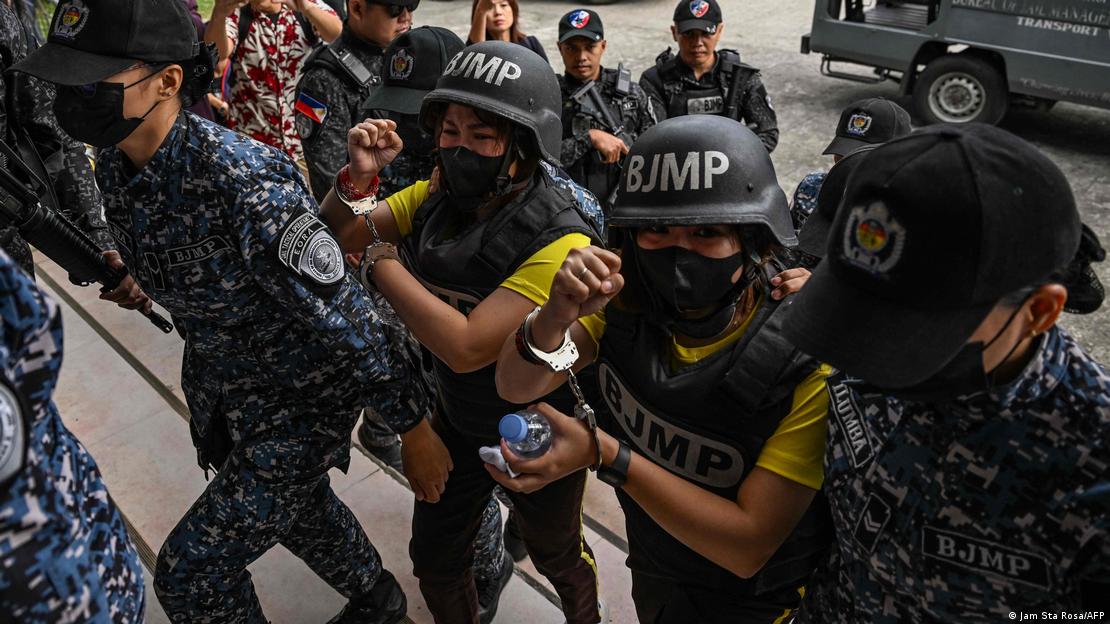
Cumpio and her former roommate Marielle Domequil were held for nearly 6 years without trial
Image: Jam Sta Rosa/AFP
A conviction built on testimony rather than evidence
In its ruling, the regional trial court in Tacloban City said it found Cumpio and her co-accused, lay worker Marielle Domequil, guilty of making funds and logistical support available to members of the New People's Army, the armed wing of the Communist Party of the Philippines, which was designated as a terrorist group by the local Anti-Terrorism Council.
The prosecution's case was built entirely on witness testimony.
"There was no other evidence presented by the prosecution against Frenchie and Marielle except testimonial evidence," said Julianne Agpalo, who is part of Cumpio's defense team.
"There is no documentary or photographic evidence. It's based on these self-serving testimonies of these military assets whose credibility in the first place should be questioned," Agpalo added.
In its ruling, the regional trial court in Tacloban City said it found Cumpio and her co-accused, lay worker Marielle Domequil, guilty of making funds and logistical support available to members of the New People's Army, the armed wing of the Communist Party of the Philippines, which was designated as a terrorist group by the local Anti-Terrorism Council.
The prosecution's case was built entirely on witness testimony.
"There was no other evidence presented by the prosecution against Frenchie and Marielle except testimonial evidence," said Julianne Agpalo, who is part of Cumpio's defense team.
"There is no documentary or photographic evidence. It's based on these self-serving testimonies of these military assets whose credibility in the first place should be questioned," Agpalo added.
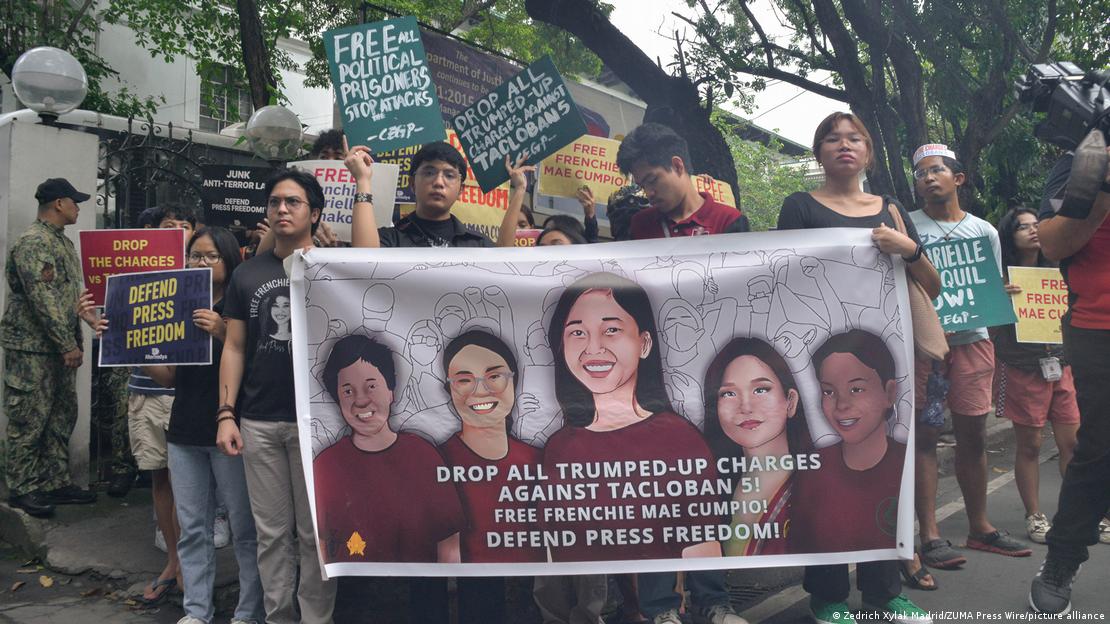
Cumpio and Domequil were arrested along with three others, who became known as 'The 'Tacloban five'
Image: Zedrich Xylak Madrid/ZUMA Press Wire/picture alliance
'A pattern that undermines due process'
Attorney Josalee Deinla, secretary-general of the National Union of Peoples' Lawyers (NUPL), told DW that such over-reliance on questionable witness testimony is not unique to Cumpio's case.
"What we are seeing is a pattern where terrorism financing cases are not built on financial trails at all, but almost entirely on testimonial evidence," she said.
"This reliance on testimonial evidence, especially from incentivized witnesses, seriously undermines due process," Deinla added.
She explained that these witness testimonies usually come from so-called "rebel returnees" — former members of armed groups who later surrendered to the military under government reintegration programs — who Deinla said function as military assets.
In the same region as Cumpio, development worker Jasmin Jerusalem is facing terrorism-financing charges linked to humanitarian work in Leyte and Samar provinces. Journalist Deo Montesclaros has also faced a terrorism-financing complaint tied to his reporting on armed conflict and community issues.
'Politically motivated prosecutions'
The frequency of such cases has spiked significantly in recent years.
Last year, the Department of Justice said it identified a total of 5,557 terrorism financing cases filed between 2020 and 2024, a period that coincided with the Philippines' push to be removed from the Financial Action Task Force (FATF) "grey list" — a goal the country achieved in February 2025.
For years before the grey-listing, there were very few prosecutions and convictions for terror financing offenses, despite the introduction of the Terrorism Financing Prevention and Suppression Act in 2012.
Human Rights Watch (HRW) says many of these cases rely on "flimsy" evidence from potentially compromised witnesses that the police and military in the Philippines have used for years in "politically motivated prosecutions" of journalists, religious workers and leftist defenders of human rights, environmental and indigenous causes.
HRW also alleges that successive national governments have been known to accuse people of being members or of sympathizing with communist insurgents, a tactic known as "red-tagging."
The NUPL, which has represented many alleged victims of red-tagging, accuses the Justice Department of the "weaponization of terror laws to unjustly target activists and civil society organizations" to meet the FATF's quotas.
"There is pressure on the government to show compliance with counter-terrorism financing standards and one way of doing that is by filing more terrorism-financing cases," Deinla told DW.
Deinla said this compliance-driven approach has encouraged the aggressive use of terrorism-financing laws, even in cases where evidence is thin or largely testimonial.
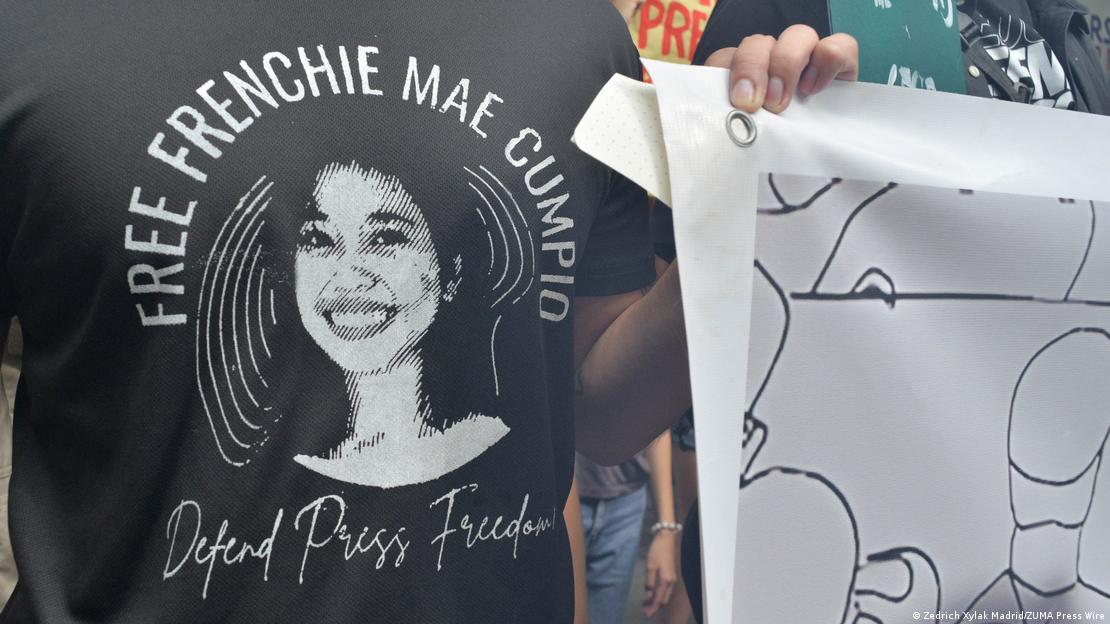
Activists and rights groups have been calling for Cumpio's release for years
Image: Zedrich Xylak Madrid/ZUMA Press Wire
Crackdown initiated under Duterte continues under Marcos Jr.
Cumpio and Domequil were arrested in February 2020, at the height of the administration of Rodrigo Duterte, a period marked by intensified red-tagging, surveillance, and arrests of activists, journalists and human rights defenders as part of the former president's notorious "war on drugs."
The crackdown coincided with the passage of the Anti-Terrorism Act of 2020 and the expanded use of terrorism-financing provisions.
According to Rochelle Porras, spokesperson for the Council for People's Development and Governance, a network of civil society organizations in the Philippines, there has been little indication that this approach has changed under Duterte's successor, Ferdinand Marcos Jr., despite official statements emphasizing press freedom and democratic reform.
"The same counterinsurgency framework is still in place. The institutions, the policies and the mindset that enabled these cases under Duterte remain largely intact," Porras told DW.
Porras added that this continuity helps explain why terrorism-financing cases continue to be filed years after the initial crackdown, even as the government has sought to rebrand its human rights record.
Climate of fear
For journalists and civil society groups, the impact of terrorism-financing cases is felt well beyond the courtroom.
At the University of the Philippines Tacloban College, the student publication UP Vista — where Cumpio once served as editor-in-chief — has operated under a climate of fear since her arrest.
"The fear was there, that they might come after our names because of what we release," current editor MJ Vediola told DW, adding that it stalled the publication of their activist-themed issue for a year.
The editor said recruiting new staffers has become harder due to the risks associated with the publication.
Vediola said that while Cumpio's conviction has forced them to rethink their approach to reporting, the case underscores the importance of continuing to document issues affecting their communities.
"It motivated us to publish beyond what we normally would, because if we don't write about cases like this, then silence wins," said Vediola.
Civil society organizations face similar constraints, according to Porras.
"The freezing of bank accounts is usually the first blow. It immediately paralyzes an organization's ability to function, even before any guilt is established," she said.
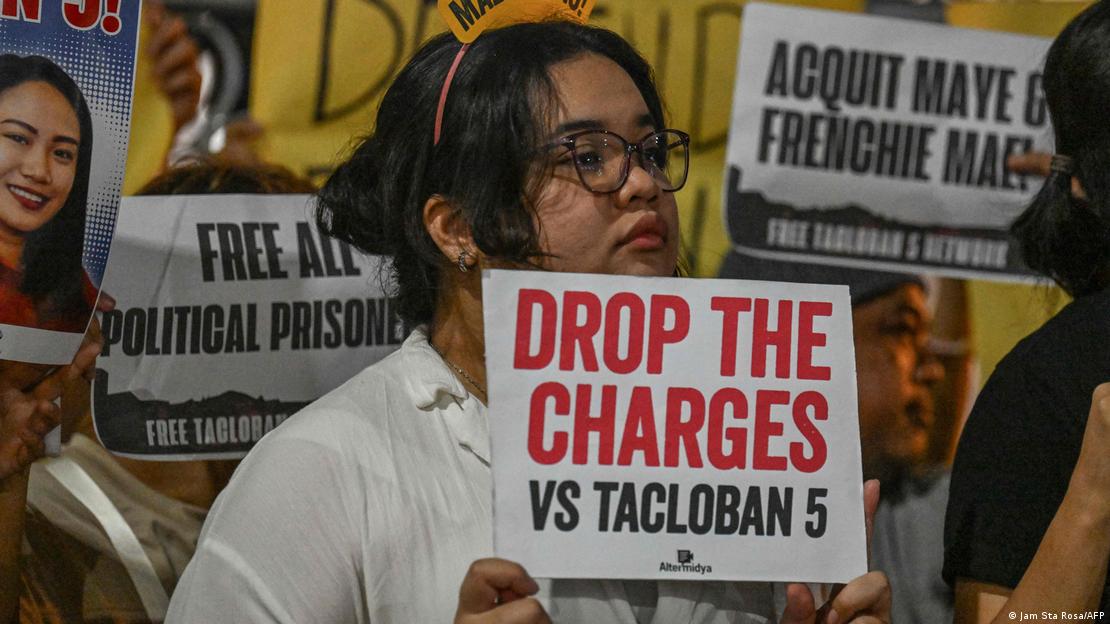
UN special rapporteur Irene Khan said the charges against Mae appeared to be a "retaliation for her work as a journalist"
Image: Jam Sta Rosa/AFP
What does this mean for democracy in the Philippines?
Beyond disrupted operations, Porras warned of broader consequences.
"When civil society groups are silenced, communities lose access to information and services," she added.
Deinla said cases like Cumpio's send a message that critical reporting can be treated as a security issue, affecting not just the accused journalist but the wider media community.
"The effect is not limited to one person. It changes how others assess risk," she said.
According to Deinla, such cases reduce civic space by discouraging scrutiny and participation, weakening accountability and, over time, affecting how democratic institutions function.
Edited by: Karl Sexton

No comments:
Post a Comment