Could Trump’s Iran Fiasco Be America’s Suez Crisis?
Empires rise and fall. They do not last forever. Imperial declines follow a gradual shifting of the economic tides, but are also punctuated and defined by critical tipping points. There are many differences between the Suez Crisis in 1956 and the US war on Iran today, but similarities in the larger context suggest that the United States is facing the same kind of “end of empire” moment that the British Empire faced in that historic crisis.
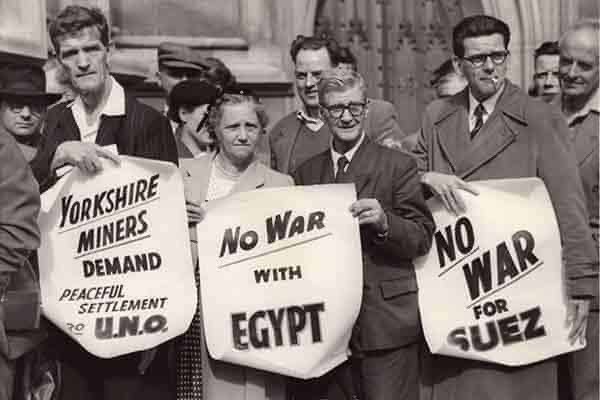
British antiwar protesters during the Suez crisis September 12, 1956. Photo: Socialist Worker archive.
In 1956, the British Empire was still resisting independence movements in many of its colonies. The horrors of British Mau Mau concentration camps in Kenya and Britain’s brutal guerrilla war in Malaya continued throughout the 1950s, and, like the United States today, Britain still had military bases all over the world.
Britain’s imperial domination of Egypt began with its purchase of Egypt’s 44% share in the French-built Suez Canal in 1875. Seven years later, the British invaded Egypt, took over the management of the Canal and controlled access to it for 70 years.
After the Egyptian Revolution overthrew the British-controlled monarchy in 1952, the British agreed to withdraw and close their bases in Egypt by 1956, and to return control of the Suez Canal to Egypt by 1968.
But Egypt was increasingly threatened by Britain, France and Israel. Through the 1955 Baghdad Pact, the British recruited Turkey, Iraq, Iran and Pakistan to form the Central Treaty Organization, an anti-Soviet, anti-Egyptian alliance modeled on NATO in Europe. At the same time, Israel was attacking Egyptian forces in the Gaza Strip, and France was threatening Egypt for supporting Algeria’s war of independence.
Egypt’s President Nasser responded by forging new alliances with Saudi Arabia, Syria and other countries in the region, and, after failing to secure weapons from the US or USSR, Egypt bought large shipments of Soviet weapons from Czechoslovakia.
Upset with Egypt’s new alliances, the United States, Great Britain and the World Bank withdrew their financing from Egypt’s Aswan Dam project on the Nile. In response, Nasser stunned the world by nationalizing the Suez Canal Company and pledging to compensate its British and French shareholders.
British leaders saw the loss of the Suez Canal as unacceptable. Chancellor Harold Macmillan wrote in his diary, “If Nasser ‘gets away with it’, we are done for. The whole Arab world will despise us… and our friends will fall. It may well be the end of British influence and strength forever. So, in the last resort, we must use force and defy opinion, here and overseas”.
British Prime Minister Anthony Eden hatched a secret plan with France and Israel to invade Egypt, seize the Canal and try to overthrow Nasser. The US rejected military action against Egypt, and President Eisenhower told a press conference, on September 5, 1956, “We are committed to a peaceful settlement of this dispute, nothing else.” But the British assumed that the US would ultimately support them once combat began.
Israel invaded the Gaza Strip and the Sinai Peninsula, and then Britain and France landed forces in Port Said at the north end of the Suez Canal, under the pretense of protecting the Canal from both Israel and Egypt.
But before Britain and France could fully seize control of the Canal, the US government intervened to stop them. The US began selling off its British currency reserves and blocked an emergency IMF loan to Britain, triggering a financial crisis. At the same time, the USSR threatened to send forces to defend Egypt and even hinted at the possible use of nuclear weapons against Britain, France and Israel.
The UN Security Council used a procedural vote – which Britain and France could not veto – to convene an Emergency Special Session of the General Assembly under the “Uniting for Peace” process. Resolution 997 called for a ceasefire, a withdrawal to armistice lines and the reopening of the Canal, and was approved by a vote of 64 to 5.
Four days later, Prime Minister Eden declared a ceasefire. British and French forces withdrew six weeks later, and the Canal was cleared and reopened within five months. Egypt subsequently managed the Canal effectively, and did not block British or French ships from using it.
The Suez Crisis was the pivotal moment when the British government finally learned that it could no longer use military force to impose its will on less powerful countries. Like Americans today on Iran, the British public was way ahead of its government: opinion polls found that 44% opposed the use of force against Egypt, while only 37% approved. As Prime Minister Eden dithered over the UN’s ceasefire order, 30,000 people gathered at an anti-war rally in Trafalgar Square.
Eden was forced to resign, and was replaced by Harold Macmillan, who withdrew British forces from bases in Asia, expedited independence for British colonies around the world, and repositioned Britain as a junior partner to the United States. That new role included arming British submarines with U.S. nuclear missiles, which is now a violation of the Nuclear Non-Proliferation Treaty (NPT). But Macmillan’s successor, the Labour Party leader Harold Wilson, would later keep Britain out of Vietnam.
Britain charted a successful transition to a post-imperial future through its relationships with the United States and the British Commonwealth – an association of independent states that preserved British influence in its former colonies. On the domestic front, there was broad political support for a mixed capitalist-socialist economy that included free education and healthcare, publicly owned housing and utilities, nationalized industries, and strong trade unions.
Macmillan was reelected in 1959 with the slogan, “You’ve never had it so good.” When a cartoonist mockingly dubbed him “Supermac,” the nickname stuck.
Britain’s Tories were dyed-in-the-wool imperialists, much like Trump and his motley crew today. But they did not let their imperial world view blind them to the lessons of the Suez Crisis. They could see that the world was changing, and that Britain had to find a new role in a world it could no longer dominate by force.
Most Americans today have learned similar lessons from failed, disastrous US wars in Vietnam, Iraq and Afghanistan. But like the British people who opposed Eden’s invasion of Egypt, Americans have been repeatedly dragged into war by the secret scheming of leaders blinded by anachronistic, racist, imperial assumptions.
Trump is now encountering the same kind of international pressure that forced Britain and France to abandon the Suez invasion. Another Emergency Special Session of the UN General Assembly and a new “Uniting for Peace” resolution might also be helpful.
But ultimately, the resolution of this crisis, and the future of the United States in today’s emerging multipolar world, will depend on whether US politicians are capable of making the kind of historic policy shift that Macmillan and his colleagues made in 1956 and the years that followed.
Macmillan was not an opposition politician, but a senior member of Britain’s Conservative government, up to his neck in the Suez fiasco. The secret plot with the Israelis was his idea. President Eisenhower personally warned him at the White House that the US would not support a British invasion of Egypt. But unlike the British Ambassador who sat in on the same meeting, Macmillan assumed that, when the chips were down, Eisenhower would stand by his old World War II allies.
Maybe it was the shock of getting it all so wrong that persuaded Macmillan and his colleagues to take a fresh look at the world and radically rethink British foreign and colonial policy.
The crisis with Iran is at least as catastrophic for US imperialism as the Suez Crisis was for the British Empire. The question is whether anyone in Washington today is capable of grasping the gravity of the crisis and making the required policy shift.
To follow Britain’s Suez example would mean closing US military bases around the world; renouncing the illegal threat and use of military force as the main tool of US foreign policy; and relying instead on multilateral diplomacy and UN action to resolve international disputes.
But where is the Macmillan in the Trump administration or the Republican Party? Or the Harold Wilson in the Democratic Party, whose leaders have never even tried to formulate a progressive foreign policy since the end of the Cold War? Obama’s belated outreach to Cuba and Iran in his second term were their only flirtation with a new way forward.
The silver lining in the current crisis is that it may mark the final collapse of the neoconservative imperial project that has dominated US foreign policy since the 1990s and now cornered Trump into a “damned if you do, damned if you don’t” choice between an unwinnable war with Iran and a historic diplomatic defeat.
Americans must insist that this crisis spark the radical rethink of US politics, economics and international relations that neocons in both parties have prevented for decades. Trump’s dead end in the Persian Gulf must also be the final end of this ugly, criminal neoconservative era, and the beginning of a transition to a more peaceful future for Americans and all our neighbors.
Medea Benjamin and Nicolas J. S. Davies are the authors of War In Ukraine: Making Sense of a Senseless Conflict, now in a revised, updated 2nd edition.
Medea Benjamin is the cofounder of CODEPINK for Peace, and the author of several books, including Inside Iran: The Real History and Politics of the Islamic Republic of Iran.
Nicolas J. S. Davies is an independent journalist, a researcher for CODEPINK and the author of Blood on Our Hands: The American Invasion and Destruction of Iraq.
The Shipping Shield and Washington’s Strategic Miscalculation
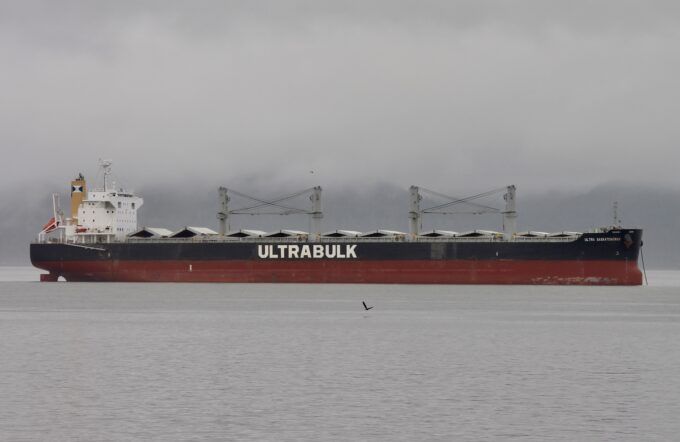
Ultrabulk transoceanic cargo ship, Columbia River. Photo: Jeffrey St. Clair.
The Trump administration is framing its barrage of sanctions announced on April 24, targeting the Hengli Petrochemical refinery in Dalian and 40 associated shipping entities, as a masterstroke of pre-summit leverage. As President Trump prepares to meet President Xi Jinping in the middle of May, the White House seems to believe that by tightening the financial stranglehold on China’s energy supply chains, the United States has secured a dominant position.
However, a cold assessment of the global maritime landscape suggests the opposite. Washington is attempting to use twentieth-century leverage against a twenty-first-century reality. In doing so, it has not created a bargaining chip. Rather, it has signaled a preference for “managed collapse” over a stable global order, inadvertently forcing Beijing to activate its most formidable deterrent: the Shipping Shield.
The administration’s logic rests on the assumption that global trade remains a Western-led system where maritime access is a privilege granted by American naval and financial hegemony. This assumption is increasingly decoupled from reality. For over a decade, Beijing has moved from a directional model of trade to a dimensional one. This is an integrated, redundant, and self-reinforcing global maritime system designed specifically to withstand the type of maximum pressure the Treasury Department is currently exerting. By sanctioning independent refineries and the “shadow fleet” of tankers, Washington is not disrupting a fringe element of Chinese commerce. It is attacking a system that has already built significant immunity to Western jurisdiction.
Consider the industrial foundation of this Shipping Shield. As of the first quarter of 2026, China’s dominance in shipbuilding has reached a point of structural concentration that the world has never seen. Chinese yards now account for over 55 percent of global shipbuilding output. In just the first two months of this year, deliveries surged by 38 percent year-on-year, even as global orders elsewhere fluctuated. This is no longer just about commercial market share. It is about sovereign resilience. China owns the means of production for the global fleet. In a world where 90 percent of trade moves by sea, the nation that builds the ships and controls the containers holds a veto power over global stability that transcends the reach of the U.S. dollar.
Furthermore, this industrial capacity is backed by a global network of port infrastructure that acts as a physical counter-sanction mechanism. From Piraeus in Greece to the logistics hub at Gwadar in Pakistan, Chinese state-owned enterprises manage or own stakes in over 100 ports across 50 countries. This is not the “debt-trap” narrative of years past; it is a sophisticated dual-layer architecture. While Western analysts focus on the Strait of Hormuz—where the United States has recently imposed a physical blockade—Beijing has spent the last decade fast-tracking the China-Pakistan Economic Corridor. The status of the CPEC in 2026 reflects a transition from construction to strategic optimization, providing a vital bypass that renders the “Malacca Dilemma” a relic of the past.
By applying these sanctions just weeks before the May summit, the Trump administration has effectively removed its own bargaining power. In the world of high-stakes diplomacy, the threat of a sanction is far more valuable than its execution. Once the financial stranglehold is applied to an entity like Hengli, which processes 400,000 barrels of crude per day, the target has no choice but to accelerate its integration into alternative, non-Western financial ecosystems. This is playing out in real-time as Beijing operationalizes new regulations. As China’s National Bureau of Statistics recently noted, the industrial sector has continued to post strong growth despite a complex economic environment, driven largely by high-end manufacturing and equipment.
This resilience is codified in recent legal maneuvers. On April 7, the State Council published Order No. 834, which establishes a unified, national security-driven framework for supply chain oversight. This framework provides Beijing with the legal and physical capacity to “blockade the blockaders,” creating a parallel maritime order that is structurally capable of sustaining Chinese commerce even under conditions of Western interdiction. The regulation allows Beijing to investigate any foreign organization that “interrupts normal transactions,” effectively turning the table on those who use commercial ties as a political weapon.
The broader strategic risk for the United States is the alienation of its own allies. European and Asian partners, who rely on the predictability of global shipping, view the “managed collapse” of energy markets with profound alarm. While Washington focuses on punitive measures, Beijing is positioning itself as the guarantor of maritime connectivity. These nations are not looking for a “grand bargain” that preserves American hegemony. They are looking for a system that functions.
When President Trump sits across from President Xi in May, he will likely find that the “sanctioned table” is not the position of strength he imagines. Beijing understands that its control over the nodes of global commerce—from the steel in the shipyards to the cranes in the ports—provides a level of protection that secondary sanctions cannot break. The Shipping Shield is a reminder that in 2026, power is not defined by the ability to stop the flow of goods, but by the capacity to ensure they continue to move.
If the United States continues to treat the global commons as a zero-sum battlefield, it may find that it has not cornered its rival but has instead isolated itself from the very infrastructure of the modern world. Washington’s current course does not lead to a better deal. It leads to a world where the United States is no longer the indispensable mariner.
This first appeared on FPIF.

No comments:
Post a Comment