US Imperialist War in Iran Looks Like an Economic Rescue Mission
May 12, 2026
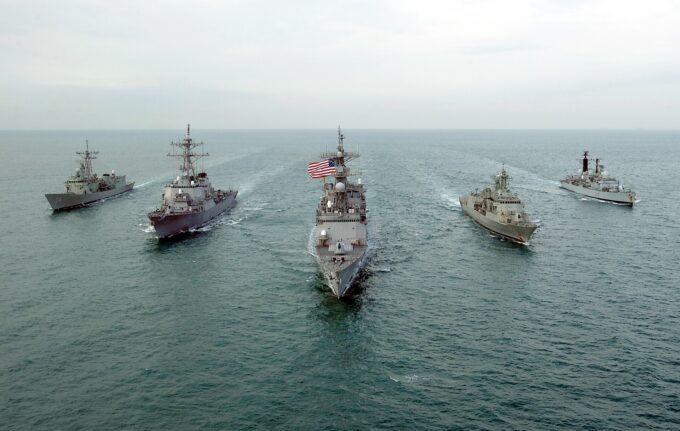
U.S. Navy/PhoM1 Brien Aho – Public Domain
The question of why the U.S. government began a war with Iran is unsettled. The ostensible reasons, blocking Iran from developing nuclear weapons and protecting Iranians’ human rights, are not enough. Iran’s agreement not to build a nuclear arms program was in force from 2016 to 2020, when the U.S. rejected it. The U.S. and Israel attacked Iran’s nuclear facilities in June 2025. Immediately prior to the war, Iran reportedly agreed to “zero stockpiling” of enriched nuclear material.
Additionally, a U.S. government that so easily tolerates human rights abuses within the United States and in certain allied nations would seemingly have little zeal to fight Iran on that account, unless there were other inducements.
Strategic considerations as to U.S. economic sustainability and U.S. economic and political power in the world very likely impelled nervous U.S. decision-makers to start a war. A big issue is the selling and distribution of oil.
Why this war?
Argentinian economist Alejandro Marcó del Pont looks at geographical considerations affecting access to oil. “[T]rue power” he states, “lies in the prerogative to close, to deny, to choke off. And in this equation, keeping the straits of Hormuz and Bab el-Mandeb (the narrow passage at the south end of the Red Sea) open constitutes a structural challenge not only for Tehran or Riyadh, but above all for the major economies of East and South Asia.”
“The impact is of an earthquake of varying intensity: an existential vulnerability in Japan and South Korea, a perfect storm over booming India, and a surgical blow to the foundations of China’s growth … [T]he constant thread running through this second Trump administration has been the geopolitical reconfiguration of the global energy sector. The effective closure of the Strait of Hormuz might not be a strategic “mistake,” but rather a deliberate feature of the conflict….
“And then there is China, the real elephant in the room … For Beijing, the crisis transcends the economic and becomes a strategic vulnerability of the first order, … The argument is that the blockade of the straits is a deliberate move by Washington to choke off China’s energy “lifeline” and, in doing so, halt its geopolitical rise.”
China receives around 90% of Iran’s exported oil; 37.7% of oil produced by the Persian Gulf nations and passing through the Strait of Hormuz goes to China. Marcó de Pont is asserting that the U.S. government started this war to block, or to at least control, the flow of oil and natural gas to nations seen as threats to U.S. interests.
Economist Michael Hudson agrees with Marcó de Pont on these geopolitical realities. Hudson observes that the U.S. seeks “to threaten countries with economic and financial chaos, by closing off the U.S. market to their exports and by blocking their access to oil and gas from Russia, Iran and (until just recently) Venezuela.”
Hudson explores another dimension. He suggests that, “America’s floundering attempts to reverse the loss of its economic power … has left it with few major levers to exert control over other countries …[Indeed,] now that the United States has de-industrialized and become debt-ridden, it has abandoned and indeed reversed these rules that served it eighty years ago. What U.S. officials call national security strategy is how to recover and maintain America’s control over other countries by weaponizing the dollar-centered financial system and its foreign trade.”
He asserts that U.S. warmakers want “Iran’s economy … to be closely intertwined with that of the United States, its export earnings and its monetary reserves held in the form of U.S. Treasury bonds and U.S. corporate securities.” This purpose aligns with the fact that the “entire region has become economically and politically linked to the U.S. economy. It is an investment outlet for Saudi Arabia, the UAE and other Arab sheikdoms (and their wealthy elites) to hold dollarized savings.”
Oil in charge
The U.S. government in the 1970s arranged for the oil-producing Gulf nations and Saudi Arabia to sell their oil exclusively for U.S. dollars. They would purchase U.S. bonds and other financial assets with their accumulated dollars. In return the U.S. would provide military protection, advanced weaponry, and interest income.
That understanding of five decades ago is the basis for why, ever since, the value of the U.S. dollar has depended on the selling price of oil. This arrangement has long served the necessary task of shoring up a U.S. economy sustained through borrowing. The dollar’s value, based on oil, has remained stable and predictable. Managers of U.S. public debt obligations gain assurance not only that instruments of U.S. debt will find buyers but that also interest rates they pay will not unduly fluctuate.
Recent commentary has it that, “Because oil was and is so fundamental to nearly every industry, the ‘petrodollar’ became ubiquitous, and the dollar became the cornerstone of the global economy.” To preserve the petrodollar arrangement and predictability of the dollar’s value becomes a principal objective of this war. Free-floating dollar valuation poses the risk of rising interest rates charged by buyers of U.S. debt. In view of $1.0 trillion in interest already due in FY2026, that’s no small problem.
Further aggravation derives from oil and natural gas now increasingly being sold for the Chinese yuan and other currencies rather than the dollar. Persian Gulf producers supply half of China’s imported oil; Saudi Arabia is the top exporter among them. Venezuela sent more than half of its crude oil exports to China in 2025 in return for yuan.
Capitalism evolves
U.S. imperial ambitions centering now on control of financial and trade mechanisms testify to an evolution. The owning classes, the monopolists in particular, have had to periodically adjust their methods. The particular calculations leading to this current U.S. war represent one more step in a long process.
V.I. Lenin in 1916 mentions that, “Monopolies, oligarchy, the striving for domination and not for freedom, the exploitation of an increasing number of small or weak nations by a handful of the richest or most powerful nations—all these have given birth to those distinctive characteristics of imperialism.”
After World War II, imperialism lost its bloom. Former colonies became independent nations. The political influence of a recovered Soviet Union extended globally. U.S. anticommunist wars in Asia ended inconclusively or disastrously. Stagflation afflicted the U.S. economy. The term signifies inflationary pressures accompanying diminished economic growth.
Neoliberalism took hold. The effect, according to analyst John Bellamy Foster, was “to subordinate the state to the market while also using the state apparatus to enforce market relations.” Foster elsewhere indicates that neoliberalism “involves a systematic shift in the ‘boundary line’ between state economic activities and the private sector. This boundary line has now shifted decisively against the state, leaving little room for the state’s own consumption and investment, outside of the military sector, and with the state increasingly subsidizing the market and capital through its fiscal and monetary operations.”
Money talks
Neoliberalism, he reports, enabled U.S. capitalists to devise a means other than industrial production for accumulating great wealth: “With the growth of excess capacity and stagnant investment, money capital increasingly flowed into the financial sector, which invented new financial instruments with which to absorb it … [Therefore], “neoliberalism is a historical-structural product of an age of mobile monopoly-finance capital that now operates globally through commodity chains, controlled by the financial headquarters of the multinational corporations … All of this has culminated in a globalized process of financialization and value capture.”
Making money via financialization involves the buying and selling of instruments of debt. U.S. high-rollers have long realized that profiteering from the debt of others will not work without the dollar’s value being based on something else with established value, like gold or oil – hence, the petrodollar system.
Dire consequences
The risk to the rest of us is terrible. Says Foster: “[T]he conditions of our time are those of epochal economic, social, and ecological crises, accompanied by intensified imperialism and war.” Foster refers to “a new imperialism that is generating increasing global inequality, instability, and world struggle, made worse in our age by declining U.S. hegemony, which points to the prospect of widening and unlimited war … Science now tells us that the capitalist juggernaut, if present trends continue, will soon undermine industrial civilization and threaten human survival itself—with many of the worst effects occurring during the lifetime of today’s younger generations.”
Michael Hudson sees the Iran War and its ramifications as harbingers of catastrophe ahead. He states that, “We are seeing the economic version of what the 1960s called Mutually Assured Destruction. (1) Today’s world is threatened with a more economic kind of global collapse …[And] this economic and political diplomacy is driving the world toward World War III.”
Disaster on the way represents capitalism in crisis. Changing modes of capitalism have ended up as that skewed form of imperialism that now propels war with Iran. The message of Marxist analyst Samir Amin resonates: “[C]apitalism is incapable of overcoming its fundamental contradictions.” (2) That would be so, especially if working people, the great mass of humanity, rise up, mobilize, and say, No!
For the sake of human survival, under threat currently from wars and environmental collapse, the time is now for capitalism-in-charge to end. The need is great for a future of peace and human decency under socialist auspices. The time is now for socialists and communists, those anti-capitalist specialists, to turn from prioritizing notions of reform and the idealized great majority to putting political power first.
Notes:
1. The term describes the expected outcome of war between nuclear-armed powers.
2. Spectres of Capitalism, Monthly Review Press, 1998

No comments:
Post a Comment