Thoreau the Scientist: How His Environmental Research Informed “Walden” and Later Works
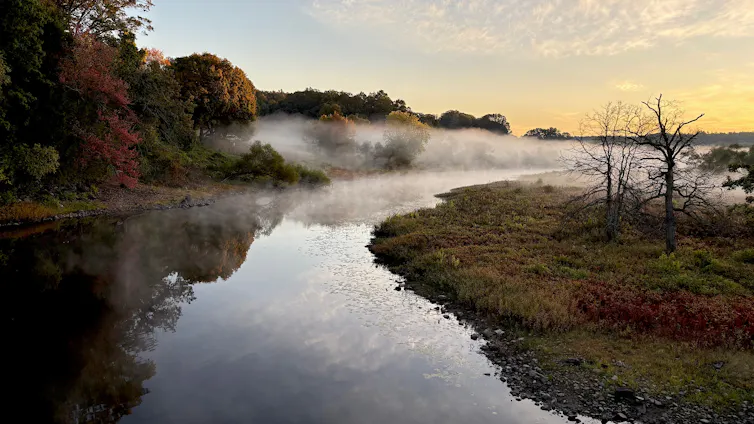
Henry David Thoreau investigated the Sudbury River as America’s first river scientist. Photo: Robert M. Thorson.
The steam locomotive chugged its way toward Cambridge, Massachusetts, on Aug. 15, 1859. On board was an impatient young scientist wanting to understand the math and science governing how river channels should behave. After disembarking at Harvard College and searching the stacks of its library, Henry David Thoreau checked out “Principes D’Hydraulique,” a three-volume tome of hydraulic engineering.
Once he translated and transcribed 17 pages from the original French, he finally discovered what he was looking for: an equation for the equilibrium velocity of a stream, given its shape, slope, volume of flow and bed roughness.
This theoretically minded, quantitative side of Thoreau is nearly invisible in the cultural zeitgeist. There, his other side dominates: the famous 19th-century transcendental nature writer, philosopher, social critic and abolitionist who lived for two years in a small house in the woods above Walden Pond in Concord, Massachusetts.
This literary-minded, qualitative Thoreau is canonized and mythologized for “Walden,” a foundational text for America’s environmental movement, and for “Civil Disobedience,” which describes a model of nonviolent political protest later adopted by Emma Goldman, Mahatma Gandhi, Martin Luther King Jr. and many others.

Removal of this low factory dam across the Concord River in Billerica, Mass., was the center of contention for what may have been America’s first major environmental assessment. Photo: Robert M. Thorson.
The nearly invisible Thoreau – the compulsively quantitative and analytically rigorous physical scientist – emerged from my research as a geologist interested in the history of 19th-century science. With two decades of scholarly books and articles behind me, I’m now featuring this less well-known Thoreau in my upcoming book, “The Walden Experiments: The Science of Henry David Thoreau.”
Footnote to fame
Thoreau rose to fame as an original American thinker. He’s now the star of an award-winning video game. The Thoreau Alliance, an organization dedicated to educating about his life and legacy, is international. A recently released and highly acclaimed Ken Burns-Ewers brothers biopic, “Henry David Thoreau,” focuses on the usual side of Thoreau as a writer and activist, emphasizing his focus on environmental justice, sustainable living and the power of nature to heal our increasingly technological and frenetic lives.

I served as an adviser for and appear in the film, which touches on Thoreau’s science. These touches are limited mainly to his work as a biological naturalist. Examples include his pioneering insights on the dispersal of seeds, his anticipation of Charles Darwin’s theory of natural selection and his study of the seasonal manifestations of natural phenomena, such as plants’ flowering times and bird migrations.
Physical science
“I keep out of doors for the sake of the mineral, vegetable, and animal in me.”
Thoreau wrote this entry in his journal on Nov. 4, 1852, when he was busy researching the lake at Walden Pond. His words remind readers that any search for meaning must ultimately begin with the bedrock roots of their lives on which all plants, animals and cultures depend. My way of saying the same thing is, “No rocks, no ecosystems, no cultures.”
During his research on the lake and nearby streams, Thoreau made an original discovery in fluid mechanics. On June 4, 1854, he wrote the first known technical description of a standing capillary wave: a small water wave that, instead of rippling outward, stays in a fixed position.
This phenomenon, which he later made a technical drawing of, is now known as the Thoreau-Reynolds Ridge. His co-discoverer, Osborne Reynolds, was a pioneering Irish-British hydraulic engineer.
Limnology and geology
Thoreau also pioneered limnology, the science of lakes. He studied how light passed through the water of Lake Walden in liquid, solid and vapor phases, how the lake stored heat in stable layers during the summer and winter, how the water chemistry affected its clarity, and how lakes eventually fill to become dry land.
His 1939 recognition as America’s first limnologist precedes by two years his 1941 canonization as an important American writer.
Thoreau correctly interpreted that his New England landscape had been shaped by a colossal ice sheet that had flowed southward from Canada. At the time, the state geologist of Massachusetts and the American science establishment were incorrectly attributing the same landscape to an iceberg-laden catastrophic flood. He also correctly reasoned that his beloved Walden Pond was born when a buried remnant of that ice sheet melted downward to create a groundwater-filled sinkhole called a kettle.
He kept a growing reference collection of rocks and minerals in his attic garret that was later exhibited for decades at the nearby Fruitlands Museum in Harvard, Massachusetts. His journal entries are peppered with geological insights related to these specimens. His final journal entry is a geological interpretation of rain splash erosion.
Thoreau’s river science
The most analytically rigorous science of Thoreau’s life culminated with his 1859 research trip to the library stacks of Harvard College. At the time, he was investigating how the Concord River watershed had changed in response to the construction of a downstream factory dam a century earlier.
Thoreau’s research was a clandestine part of a protracted legal case involving four acts of the state Legislature between 1859 and 1862. Potentially, this was America’s first major environmental assessment because it examined alternative actions to dam removal and weighed environmental protection against socioeconomic costs.
During a span of 18 months, Thoreau carried out nearly 50 discrete research tasks to create dozens of tables of numerical data and a detailed compilation map of the Concord River Valley that’s over 7 feet long. His river science predates that of the United States’ first recognized river scientist by 18 years.
The boldest claim of my latest book is that Thoreau’s sharp swerve toward science in 1851-52 led to the rescue of “Walden,” his most famous work. Specifically, his field research led to an understanding of its namesake place as a natural system of water, air, land, aquifer and life that included humanity. This more complex and inclusive vision transformed what had been an abandoned draft of social critique into the nature writing that became a foundational text for America’s environmental movement.
The Thoreau who built literary castles in the air put the solid foundations of physical science beneath them.
This article is republished from The Conversation under a Creative Commons license. Read the original article.
The End of Hansel Valley and the Beginning of a Post-Industrial Dark Age
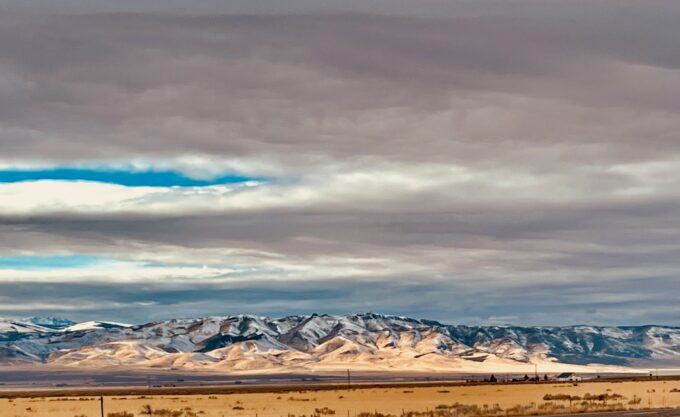
Somewhere in Box Elder County, Utah. Photo: Jeffrey St. Clair.
I first camped out in Hansel Valley at age twelve. That was over sixty years ago. On a fly that I had tied myself, I hooked and lost a huge, perhaps four-pound, Rainbow Trout from one of the many oasis springs collectively known as the Salt Wells complex or Locomotive Springs.[1] I have never forgotten the moment when that powerful creature leaped from the water and its sky-born form, like Moses’ burning bush, flashed a reflection of the fiery desert sunset. Nor how it fell, snapped my line and regained its freedom. That evening, over a Greasewood fire and an ocean of stars, I fell asleep enchanted and completely in love with this magical place. That romance has continued my entire life. I shared my love for the place with friends and took my family camping there often. I shared the valley with scout troops and school groups of children. I delighted in how they felt the same wonder of place that I did.
Decades of degradation; dewatering of the oases from deep-well pivot alfalfa irrigation, ill-advised BLM Sagebrush/Juniper removal, the utter disappearance of the once ubiquitous Blacktail Jackrabbits, the increase of cows and subsequent overgrazing, militia groups who used the open landscape for well-armed, semi-automatic fueled, weekend war play, legions of land eating four wheelers, tight four strand barb wire fences and new, shiny “No Trespass” signs. The open space, the great lake, the stars, wonder and peace and hope the place offered me never left. Despite the increasing scars, the Hansel Valley landscape and what remained of its waters brought forth in me a feeling that I call love.
Now, the final blow for this beloved landscape came with news of a fast-tracked 40,000-acre industrial AI park to be built in the very heart of a place that had become a part of me. The Boxelder County Commission had been given but two weeks by the State of Utah to give final approval. Our good governor assured us that we were no longer safe in our own land and this was good for our military preparedness. It would also bring hundreds of millions of dollars to the state and use twice as much power as the entire state’s current use. We would be in the industrial, Make America Great Again, big leagues. Hurry was necessary. Time is money. No time to lose. A non-elected paramilitary/governmental shell agency called MIDA was brokering the deal. No mention was made of the effort to protect the Great Salt Lake from drying up and perhaps making northern Utah uninhabitable. Pathetic an effort as it might be, it seemed that I owed the land at least the presence of one more body in protest of this very insidious plan.
So last week, I journeyed with several colleagues to the Hansel Valley data center hearing at the Tremonton fairgrounds. We arrived early and the grounds were already packed with people. The news reported six hundred souls, but I would put the number at well over one thousand. An outdoor bandstand was set up and a young man led the throngs in anti-data center chants. Hundreds of signs were held aloft. A full spectrum of ages was represented. A sense of comfort that so many people were of a like mind mingled with the foreboding question, “Will it make any difference to those in charge?” There was hope that it would. That the people, in such numbers, would be heard. The sun was hot. The clouds, heralding an incoming storm, were powerful and beautiful against an azure Utah sky.
Eventually, the doors to the large, sheet metal “art” building were opened and we began to file in. An official announced, “Box Elder County residents only!” We waited. Eventually, the line began to move again and the huge shed filled with people. A bandstand and microphone were set up, and the three Boxelder County Commissioners took their seats. Beneath them was a table where a lawyer and an official from the water district sat. People continued to file in. After a time, when it was obvious that fire codes were being totally ignored, the doors were shut. Many people stood outside. No more room.
The meeting started off badly as the county commissioner’s spokesman assured us that they had received much input, had considered foremost only the input from Boxelder County residents and that many residents were in favor of the project. Their views needed to be considered as well. No breakdown of pro and con views was offered, just the statement of how important it was to consider those in favor. This statement was followed by an announcement that no public comment was allowed at the meeting. The chairman then began to read a PR statement from the developer about how safe, economically lucrative and wonderful the data center would be. It was immediately obvious that it was a done deal. Public input was inconsequential. We had all gathered for nothing. A dark cloud that smelled of anger, betrayal and even incipient violence filled the stadium.
This was how the meeting began. The building rang with loud “boos”. If there was any question of the gathering’s prevailing sentiment, the roar of disapproval left no doubt that folks were there to denounce the project. The county chairman banged his gavel, and as if he were the angry father of misbehaving children, chastised the crowd. The mood grew angrier. The catcalls grew louder. The chair called for police to contain and remove the hecklers. The chair threatened to move the meeting to a private room. The catcalls were so loud and frequent that the meeting could no longer progress. A commissioner shouted angrily at the crowd to”Grow the hell up.” The chair, once again, made clear that there were us, the good, polite and compliant citizens of Box Elder County, and them, the unruly outsiders. Every statement from the podium was met with jeers from the crowd.
The commissioners then adjourned to a private room where the proceedings were Zoomed onto a large screen. In the room were the commissioners, their lawyer and a spokesperson for the developer. No opposition, no scientists, no Devil’s Advocate or mention of far-reaching consequences. Predictably, the project was unanimously approved. A ten-minute press conference was then conducted where the commissioner, developer and lawyer answered some rather softball questions regarding the data center. The Box Elder County Commission made it clear that they no longer had any responsibility or particular oversight, but that everything was now in the hands of MIDA, Mr. Wonderful, the billionaire developer, and the State of Utah. Everything was well seen to, and they had washed their hands of any further responsibility.
To their credit, the law enforcement present seemed in no mood to escalate or create physical confrontation with a sad, angry and completely disenfranchised crowd. The commissioners showed no sympathy that the people were very much against such a rushed process and such a threat to a state and land that they loved. This was not how any of us envisioned democracy but rather a view into an oligarch-led, authoritarian society moving rapidly towards an industrial dark age. I left feeling at once sad and angry but also buoyed by the love that so many of us would disrupt our lives to speak out, not against, but for a landscape that we all loved. The data center will be the end of Hansel Valley, its peaceful quiet, oases, open spaces, wildlife and wonder. The spirits of place will withdraw, as I have seen them withdraw from so many beloved landscapes. They will wait. In geologic time they will return and there will be nothing left of the AI Data center but the rubble of a civilization that worshipped, like the mythical Midas, only gold and whose touch froze everything loving and loveable with that very same, ignorant, horrible touch.
Notes.
[1] Go to Google Earth to view photos of the area by typing in Salt Wells or Locomotive Springs.
The Air-Brushing of Climate Change

Photo by William Bossen on Unsplash
When Stalin wanted to get rid of someone, he didn’t just have them executed with a shot to the back of the head. He attempted to remove the offending person from history as well by excising their name from encyclopedias and airbrushing their image from photographs. In one infamous photo of two dozen Communist leaders from 1920, so many of them were declared “enemies of the people” in subsequent years that the official photo ended up with only Lenin and writer Maxim Gorky standing on the steps of a conspicuously empty porch. In other altered snapshots, Stalin stands alone in the depopulated space.
Donald Trump is no stranger to such visual manipulations, though he tends to add himself rather than subtract others. He has depicted himself as Jesus, as a U.S. Olympic hockey player scoring a goal and beating up Canadian opponents, as a sunbather with other Cabinet members in the Lincoln Memorial reflecting pool. One of his ardent followers in the House, Anna Paulina Luna (R-FL), proposed a bill last year to add Trump to Mt. Rushmore, though Trump beat her to the punch five year earlier with a tweet inserting himself next to the Founding Fathers.
Despite his preference to overpopulate the visual universe with his own image, Trump has also developed his own process of elimination. He has compiled an enemy list—former FBI director James Comey, New York Attorney General Letitia James, Senator Mark Kelly—that he’s been targeting with legal suits and character assassination campaigns. Not content to focus on the present, he has actively been trying to expunge from federal websites, publications, and parks all the non-white, non-male historical figures that previous campaigns saved from obscurity.
But perhaps the most dangerous effort at air-brushing involves climate change. Trump has gone out of his way to turn the United States from a lukewarm advocate of measures to reduce carbon emissions to a stone-cold denier that climate change is even happening. Trump is notoriously upset at not being at the top of every list—best president, smartest guy in the room, most creative hairstyle. Let’s throw in one more list: greatest threat to humanity. Perhaps in order to top that list, too, the president has downgraded the threat of climate change to the point of non-existence. Like Stalin, Trump now stands alone.
The administration’s campaign started with the scrubbing of all references to climate change from federal websites. It has encouraged more widespread self-censorship: anyone who wants to keep their federal job or apply for a federal grant has tactically removed anything Green-related from their descriptions and applications. This animus toward anything climate-related has also shaped many of the administration’s latest budget cuts: the Environmental Protection Agency (EPA) budget halved, $1.6 billion cut from National Oceanic and Atmospheric Administration, the $4 billion Low Income Home Energy Assistance Program eliminated, $449 million in renewable energy funding slashed.
It’s no surprise that the administration has gone after states that have retained strong climate policies. The Justice Department has targeted Vermont and New York for their polluter-pay approaches as well as California for its cap-and-trade system. Despite these attacks, a number of states have actually moved forward with their emissions-reduction and energy-transition strategies. The 24 states in the U.S. Climate Alliance have cut their emissions 24 percent below 2005 levels and promoted the development and adoption of clean-energy technologies.
The administration’s approach can also be seen in the carrot side of the equation. It has approved pipelines like the recent Bridger Pipeline Extension, green-lighted deep-water oil drilling in the Gulf of Mexico, opened up the Arctic National Wildlife Refuge in Alaska to oil companies, and tried to prop up the dying coal industry. The administration has paid out $2 billion to companies to cancel their wind power projects and invest instead in fossil fuels. Deregulation and lack of enforcement—of pollution standards, of safety and health requirements, of environmental permitting—have been huge gifts to companies spewing greenhouse gasses into the atmosphere.
More ominously, the administration has altered the very DNA of regulatory governance by repealing the “endangerment finding.” According to a 2007 Supreme Court ruling, the EPA is required to ascertain if climate change is a danger and, if so, to take steps to address it. Under subsequent administrations, the EPA did just that. But Lee Zeldin, the EPA head determined to destroy his own agency, recently stomped on nearly 20 years of legal precedence by repealing the “endangerment finding.”
At a press conference with Trump at the White House, he said that revoking the finding would save Americans $1.3 trillion, mostly in the form of lower car prices. He neglected to mention the costs of the move, which, by the EPA’s own estimates, could top $1.4 trillion, and this is not even counting the expenses associated with greater warming.
Roughly half the states of the union have joined together to challenge Zeldin and bring the case to the Supreme Court.
In the best of all possible worlds, the Trump assault on climate science, energy transition funding, and regulatory mechanisms is the last hurrah of the fossil fuel cult. After all, the price of renewable energy is dropping, the scientific community remains united in its dour assessments, and most of the rest of the world is committed to doing something about the gathering storm. Even Trump’s all-out bid to save the U.S. coal industry must reckon with the inexorable laws of the market. Because coal-fired power plants are old and just plain uneconomical, Trump has presided over the closure of more of these plants than any other U.S. president.
But this isn’t the best of all possible worlds. Trump’s rearguard actions come at a perilous time when even half-hearted attempts to address climate change are plainly insufficient. Only industrial-strength collective action against fossil fuels can mitigate the worst impacts of climate change. Instead, Trump is playing to the strengths of polluting industries in an attempt to destroy any last hope of restoring a measure of equilibrium to the planet.
The Climate Keeps a Changin’
Although almost every country in the world has pledged to cut its emissions of greenhouse gasses, the overall amount of carbon spewed into the atmosphere continues to grow. In 2025, spurred by a 4.1 percent increase in emissions associated with the oil and gas sector, emissions hit a new record. Methane emissions, considerably more dangerous than those of carbon-dioxide, also increased to a new high after a small decline in 2024.
The total increased in part because of a surge in U.S. emissions. In 2023 and 2024, U.S. greenhouse gas emissions actually declined. Equally important, U.S. policies managed to sever the link between economic growth and emissions, with the former increasing even as the latter declined. In 2025, however, emissions increased by 2.4 percent, once again faster than economic growth.
Just as the impact of Pentagon spending on global military expenditures will not be measured until the figures are released for this year, Trump’s policies on climate won’t begin to register in the statistics until the end of 2026. The increase in emissions last year was more a function of an unusually cold winter and the expansion of both data centers and crypto mining, not Trump’s fossil-fuel-friendly policies.
It’s not all bad news. China, the world’s biggest emitter in total numbers by a long shot, is approaching peak carbon dioxide emissions while also boosting exports of solar panels, batteries, and wind turbines to record levels so that other countries can transition to these renewables. European emissions continue to drop. In 2025, solar became the first renewable energy source to lead the growth in electricity supply. Wind and solar now account for a larger share of electricity generation than coal.
The Iran War, meanwhile, is an unintended inflection point in the trajectory of energy politics. The blockade of the Strait of Hormuz has created a huge energy crisis, with many countries reporting major shortages in oil and gas. As Zoya Teirstein and Jake Bittle write in Grist,
As prices rise and supplies dwindle, countries around the globe are reevaluating their energy futures. While some have fallen back on dirty fuels to fill the gaps caused by the closure of the Strait of Hormuz, others have announced significant investments in clean energy to chart a path away from the sources of energy they have relied on for more than a hundred years.
Trump and company dreamed of accessing Iranian fossil fuels and driving down prices at the pump. So far, they are getting the exact opposite of what they wanted. The same may well hold for their war against renewable energy.
Attempting to Kneecap the International Response
As part of his effort to destroy the “green new scam,” Trump hasn’t been content to dismantle the domestic infrastructure of emission reduction and energy transition. He has taken the United States out of every major international initiative to address climate change, beginning with the Paris Agreement and the UN agency that administers it, the UN Framework Convention on Climate Change (UNFCCC).
So far, however, there hasn’t been a rush to the exits in the wake of U.S. withdrawal. No other countries have exited the Paris Agreement, not Russia, not any of the Gulf Countries, not even Nicaragua and Syria (both of which initially didn’t sign the agreement). Three countries have signed but not ratified the agreement—Iran, Libya, Yemen—but internal turmoil plays a role in their foot-dragging. Meanwhile, all UN members remain part of the UNFCCC.
So, the United States stands alone in its refusal to acknowledge that the world is endangered by climate change.
In general, international responses have been inadequate to the scale of the challenge. Only a trickle of funding is going toward helping countries reduce emissions (mitigation), addressing the ongoing impact of climate change (adaptation), and making the transition away from fossil fuels. But the world minus the United States is at least inching up its commitments to fund these three efforts. Global action continues to address the preservation of biodiversity and the 23 targets identified in the Kunming-Montreal Global Biodiversity Framework.
The Trump administration has turned its back on climate science, slashing funding and even planning to disband the National Center for Atmospheric Research. But the rest of the world has no problem poaching U.S. scientists and surpassing the United States in Green patent filings. In this way, Trump is steering the United States into a high-tech cul-de-sac.
Trump took office with a plan to remake the world with his tariffs, his military interventions, his refocus on fossil fuels, and his preference for authoritarianism. The world has certainly taken note. Given the size of the U.S. economy and the U.S. military, it is impossible to ignore Trump. When it comes to the imperative of climate change, however, the world has shrugged. The international community is not accelerating at the speed necessary to save the world, but it also isn’t slowing down to defer to Donald Trump.
Donald Trump is leading the United States in a great leap backward. The rest of the world, at least when it comes to climate science, is refusing to take that leap with him.
The Amazon Forest at Risk
May 11, 2026
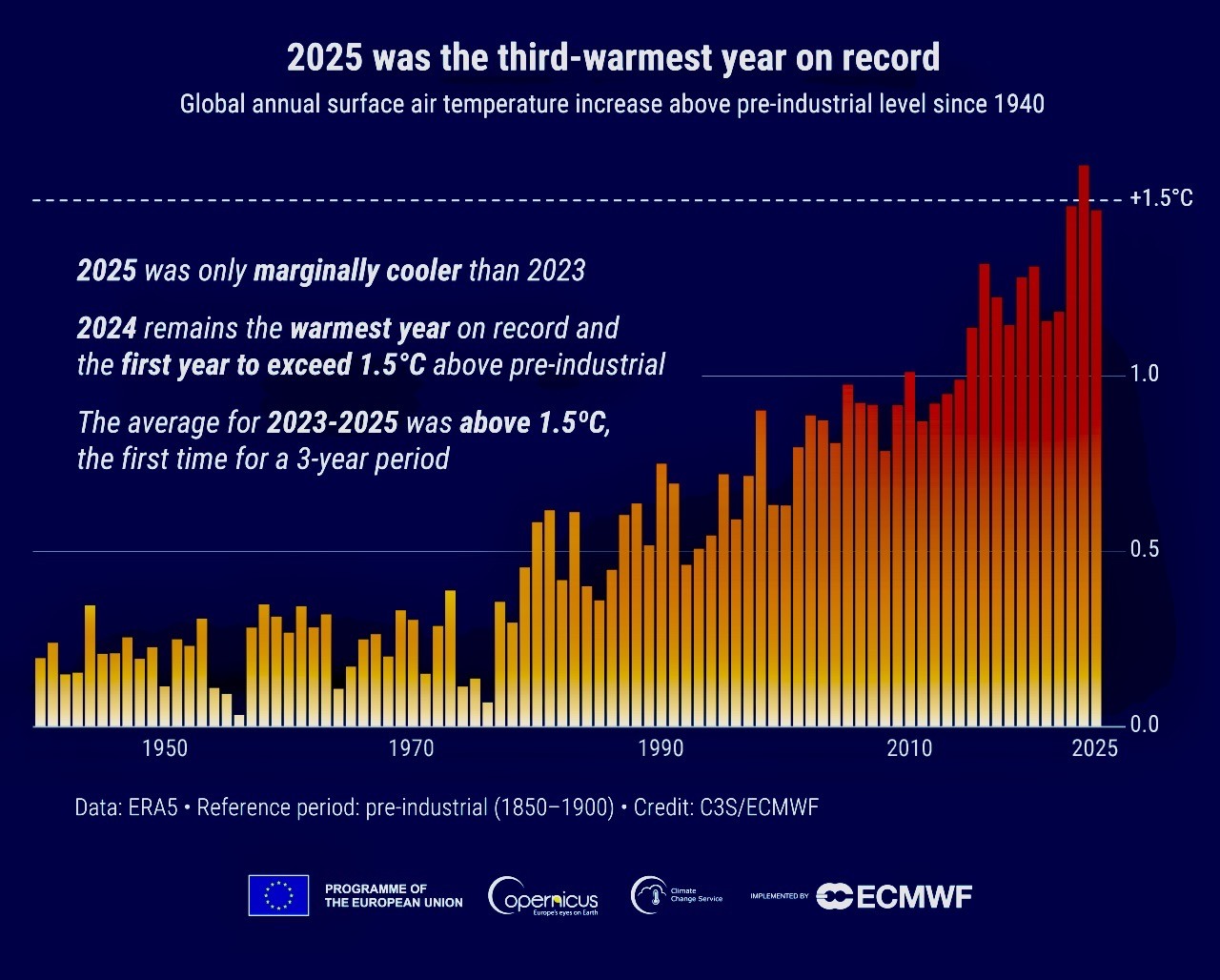
Global temperature, 1950-2025. The temperature of the year 2024, the “warmest year on record,” exceeded the 1.5 degree Celsius. EU Copernicus.
Prologue
Global climate temperature is a key factor in the survival of the Amazon rainforest, indeed the survival of humans, civilization and the Earth. According to Copernicus, the European Union’s Earth Observation Program,
“Europe and the world are in the warmest decade [2020s] on record…. Heat stress is recognized by the WHO [World Health Organization] as the leading cause of global weather-related deaths. In areas with dry and often windy conditions, high temperatures also contributed to the spread and intensification of exceptional wildfires, which produce carbon, toxic air pollutants like particulate matter, and ozone, which impacts human health. This was the case in parts of Europe – which experienced its highest annual total wildfire emissions – and North America… These emissions significantly degraded air quality and had potentially harmful impacts on human health at both the local and larger scales…. The fact that the last eleven years were the warmest on record provides further evidence of the unmistakable trend towards a hotter climate. The world is rapidly approaching the long-term temperature limit set by the Paris agreement [1.5 o Celsius]. We are bound to pass it; the choice we now have is how to best manage the inevitable overshoot and its consequences on societies and natural systems…. Atmospheric data from 2025 paints a clear picture: human activity remains the dominant driver of the exceptional temperatures we are observing. Atmospheric greenhouse gases have steadily increased over the last 10 years.”
Rising global temperature and deforestation threaten the Amazon rainforest
The Amazon forest, the largest tropical rainforest, supports millions of animals and plants while absorbing about a billion tons of anthropogenic carbon dioxide per year. And yet, despite the immense importance of the Amazon forest, business as usual keeps degrading it: “at least 17 percent of the Amazon rainforest has already been cut down, burned or otherwise lost.” A recent study concluded:
“Humanity is putting unprecedented pressures on the Amazon forest system through global warming and land use changes. As the Amazon forest may undergo self-reinforcing transitions, these pressures could lead to system-wide changes across major parts of Amazonian ecosystems.”
Brazilians and foreigners have been burning the Amazon rainforest. Fires kill trees, animals and indigenous plants. In the Amazon, fires are weapons of war. They make dust of millennial life and even human culture that grew in the midst of ancient trees, rivers, creeks and wildlife. Indigenous Brazilians have been paying a genocidal price for growing up and respecting their sacred forest. European Christians grabbed the Amazon and nearly exterminated the local people.
Fires have been ravaging the Amazon since the early sixteenth century when the Portuguese invasion and conquest of the Amazon rainforest.
Memories of fire
In February 1992, I went to Fortaleza, a beautiful city in the state of Seara in northeast Brazil for an academic conference. The purpose of the conference was to prepare the ground for the international climate discussion in Rio de Janeiro, which took place later in 1992.
In the 1990s, the current president of Brazil, Luiz Inacio Lula da Silva, was a leader in trade unions. Then as now, he talked about saving the Amazon. But talk is cheap. Deforestation of the Amazon continues to this day. Indeed, forest grabbers were so determined to convert the forest into mining, agricultural plantations, logging business, animal farms and small farms that those who protected the forest became targets and often victims of assassination.
The idea of agrarian reform, during which the state brings organized violence to an end and then allocates small pieces of land to the needy, never became policy. Strangely enough, my paper at the 1992 conference was about agrarian reform. The conference director, however, did not allow me to deliver my paper. He directed me to a conference room with a dozen or so professors, where I discussed my proposal.
But before returning to the University of New Orleans, I spent a week in Amazonas, the capitol of the Amazon. I joined a few Brazilian zoologists studying frogs. We traveled to a tributary of the giant Amazon River, swam and observed frogs and numerous other wildlife. In general, I was so enthusiastic I did not mind seeing small crocodiles not far from our swimming water hall. Then sleeping under those magnificent trees was heaven. I also climbed a tree and observer the canopy of the forest loaded with beauty: flowers and fruit. That magnificent icon remained with me forever. My mind wondered from Pythagoras, the harmony of the Spheres to Aristotelean zoology and its beautiful and perfect animals and nature: sacred Mother Earth.
The abyss of deforestation
I departed from the Amazon city of Manaus in the darkness of midnight. I kept looking at the forest bellow the aircraft and was struck by the fires consuming it – in late February 1992. No wonder the rainforest is on the borderline of what experts call “tipping point,” namely a state of dreadful biological existence that could be its last.
President Lula keeps saying he is slowing down deforestation. Maybe he is. But that’s not enough. The Climate Summit in Brazil in November 2025 failed to even pass a resolution for phasing out fossil fuels that cause most of climate chaos that is exacerbating deforestation. Climate chaos and deforestation are brothers of nemesis. Each supports the ill-effects of the other. And together, they are shutting down the lungs of the planet, the Amazon rainforest.

Agência Brasil / Bruno Peres. Global March and protest of Indigenous Brazilians during COP30, the Climate Summit, Belem, Brazil, Nov. 2025. UN News, 17, Nov. 2025.
Epilogue
Scientists and politicians have known for decades that the vast tropical Amazon rainforest of Brazil is necessary for a healthy Brazil and healthy planet. Time has come to become serious about phasing out fossil fuels and act to protect the Amazon from deforestation. Affluent countries like the US, China, Russia, the European Union ought to help Brazil to put deforestation out of business. Think of the Amazon as your health bank account. Restoring the Amazon would be a great beginning of seeing nature for what it is: beautiful and perfect: home for millions of animals and plants and indigenous people.
An Amazon without deforestation would recover its former health. It would become a school for the rest of the planet. All forests everywhere deserve protection. Humans must finally realize they are part of nature. Skyscrapers in New York, Moscow, Beijing and London offer no protection from climate chaos. Human health and flourishing depends on healthy and flourishing nature. It’s that simple. Therefore, phasing out fossil fuels would become self-evident truth for rebuilding a more humane, solar and wind-energy future that brings us closer to nature, its beauty and riches. The struggle over the Amazon rainforest is the struggle for a more sustainable world.

No comments:
Post a Comment