Trump Accounts Are a Sick Joke, Not a Threat to Social Security
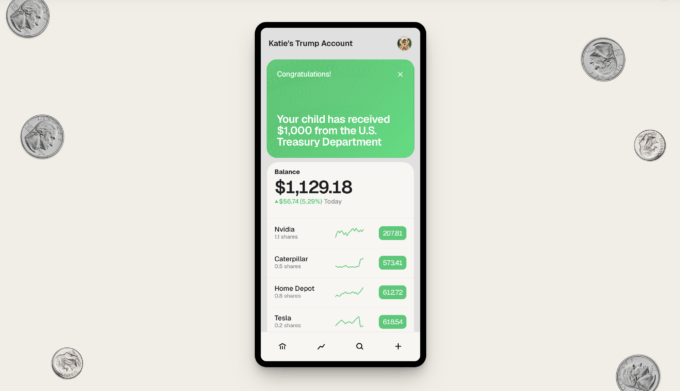
Image Source: https://trumpaccounts.gov
Many of the Trump crew seem to be delusional about Trump accounts. They claim to believe that they will replace Social Security. It shouldn’t be a surprise to us that many supporters of Trump are out of touch with reality, but that is not a reason for the rest of us to take their nonsense seriously.
Let’s keep our eyes on the ball. This is not 3-dimensional chess; it is an account for newborn kids in which the government deposits $1,000. Parents or other relatives can add to it each year, like they can add to an education savings accounts in most states. The amount people contribute to the account is deducted from their taxable income. Also, the money accumulated in the account is not taxed until it is withdrawn.
Some people take advantage of these accounts; most don’t. The reason is that most people don’t have an extra $1,000 or $5,000 or whatever to contribute to these accounts. Furthermore, the tax benefit is not a very big deal to most moderate and even middle-income people.
The overwhelming majority of households are in the 12% bracket or below. More than a fifth are in the zero bracket, meaning they pay no income tax and would get no benefit from tax-advantaged accounts.
Furthermore, even if they wanted to put money in a tax-advantaged account, why would they choose a Trump account rather than an education savings account or an IRA? Money in existing tax-advantaged accounts can be withdrawn, albeit with a penalty. Money in a Trump account can only be accessed by the kid when they turn 18.
This brings us to the sick joke part of the Trump account story. Trump and Congressional Republicans have been gleefully cutting Food Stamps, housing assistance, Medicaid, and the subsidies in the Obamacare exchanges. As a result, tens of millions of people will be denied benefits that they previously depended upon.
Many of these people will end up hungry, homeless, and/or unable to obtain needed medical care. This means two or three years from now, there are likely to be tens, or even hundreds, of thousands of kids with $1,000 in their Trump accounts who are living on the streets, going hungry, or unable to get necessary medical care because Trump has cut the programs their families depend upon.
This will make for great photo ops. Maybe Trump can have some homeless kids over to the White House, or even Mar a Lago, and they can talk about living in the streets of Chicago in winter, or the needed surgery that they can’t afford, but they still have $1,000 in their Trump account. Then Trump and his entourage can all say how great that is!
The other part of the story is the nutty illusion about how rapidly these accounts will grow. The Trump gang likes to say they will grow 10% a year. Amazingly, many who are not on Team Trump are prepared to accept this nonsense.
The 10% rate of return is based on looking at the past, where stocks have yielded somewhere close to a 10% rate of return over the last eight decades. But this is a case of incredibly bad induction, sort of like the person who falls off an 80- story building and says as they pass the 60th floor, the 59th floor, and the 58th floor, “so far so good.”
The simple and obvious point that people who make this inference miss is that the stock market was valued far lower relative to corporate earnings in prior decades than is the case today. Through most of the decade of the 40s, 50s, 60s, and 70s, the price-to-earnings ratio (PE) was generally in the low teens and often considerably lower. When the PE is low and the economy is growing relatively rapidly, it’s possible for the stock market to generate 10% nominal returns, or 7% real (inflation-adjusted). That’s somewhat oversimplifying the inflation story, but it doesn’t affect the argument.
Today, the PE is over 30 and the economy is projected to grow roughly 2.0% a year going forward. In that world, the only way to generate the historic 7% real rate of return is with an ever-rising price to earnings ratio.

The Trumper’s story gives us a PE of almost 92 when today’s newborns turn 18 in 2044. If we want to ask what happens if they hold their money until they hit the Social Security normal retirement age of 67, the PE will be over 2000. A Trump administration economist may be able to make this sort of projection with a straight face, but not many other people could.
Is there a way around this story? Well, the after-tax profit share of GDP could rise further, as it has been doing for the last quarter century. This would be a bleak story for the rest of us, since it would likely mean wages are shrinking. It would also have to almost triple in the next 18 years to keep the PE constant. This is close to unimaginable and a truly horrible story, even if it were. For what it’s worth, the Congressional Budget Office projects the profit share will fall in the next decade.
People could invest their Trump accounts overseas. China is having far more rapid growth than the United States, so perhaps people can get closer to 7.0% real returns there. Maybe this is what the Trump gang has in mind.
If we look at the actual returns that people can expect in their Trump account, it will be close to 3.0% a year in real terms, assuming that they are not ripped off badly on fees by one of Trump’s Wall Street friends. That will give today’s newborn $1,700, adjusted for inflation, when they turn 18.
Somehow, I don’t think this will lead people to discard Social Security. But I could be mistaken.
On the April Jobs Report
May 11, 2026

Photo by Clem Onojeghuo
It doesn’t appear as though the jump in energy prices has yet had much effect on the labor market, as the economy added 115,000 jobs in April. Year-over-year wage growth was 3.6 percent, which is likely to be roughly even with the inflation rate that will be reported next week. The unemployment rate was unchanged at 4.3 percent, with little change for most demographic groups.
Health Care and Social Assistance Again Dominate Job Growth
The job growth was again concentrated in the health care and social assistance category, which added 53,900 jobs in April. Over the last year this category has added 656,500 jobs, accounting for well over 100 percent of all job growth over the period.
Other big gainers were the courier category (think Amazon), which added 37,900 jobs, and retail trade, which added 21,800 jobs. The courier category is always erratic. It reportedly lost 44,000 jobs in February; the April figure put employment just 15,600 above the January level. The rise in retail employment follows an increase of 18,600 in March. If this continues it would be a serious reversal in a sector that had been shedding jobs for most of the last two years.
The restaurant sector added 17,200 jobs, somewhat better than its average of 11,200 jobs over the last year. This seems to indicate that higher gas prices are not yet discouraging people from spending in discretionary areas. On the other hand, jobs in hotels fell by 15,000, but this followed an unusual increase of 12,300 in March, so it could just be random noise.
Goods Sector Shows Weakness
The goods sector looked extraordinarily strong in March, with employment in manufacturing rising by 15,000 after it had been shedding jobs all through 2025, and construction adding 26,000 jobs. The story is less positive in April. Manufacturing lost 2,000 jobs in the month. It now accounts for 7.9 percent of total employment. Construction added 9,000 jobs, but the March gain was revised down to 16,000. Employment in the sector is up just 50,000 YOY, an average of 4,200 a month.
Employment in mining and oil and gas extraction rose by 2,500 in April, but it is still down by 11,700 from its year-ago level. It’s too early to see much of an impact of the war-related jump in oil prices.
Motion Picture Industry Continues to Shed Jobs
The motion picture industry lost another 6,000 jobs in April. Employment is now down 127,300, 27.9 percent, since its peak in November 2022. The federal government also shed jobs in April, losing another 9,000 jobs. State and local government employment was little changed, with state employment up by 1,000 and local employment flat.
Wage Growth at 3.6 Percent
Year-over-year wage growth was 3.6 percent in April. This is likely to be very close to the Consumer Price Index inflation rate that will be reported next week. The growth in the average hourly wage has slowed from slightly over 4.0 percent for most of 2023 and 2024. This series is also consistent with the slowing in the Employment Cost Index and the Indeed wage data, so it is almost certainly real. With inflation accelerating due to tariffs and the war, it means real wage growth has fallen to near zero.

On the plus side, there seems to have been a modest pickup in wage growth at the bottom of the wage ladder. Wages for nonsupervisory workers in restaurants have risen 4.4 percent YOY.
Household Data Are Mostly Healthy
Most of the data in the household survey are consistent with the relatively low 4.3 percent unemployment rate. The employment rate for prime-age workers (ages 25–54) was unchanged at 80.7 percent for the third consecutive month, just 0.2 percentage points below its peak for the recovery. There was an increase of 445,000 in the number of people working part-time involuntarily, but this is still almost 400,000 below the December level.
The one item that is notably out of line is the share of unemployment due to voluntary quits. This fell back to 11.3 percent from 12.4 percent in March. It had averaged over 13 percent in the strong pre-pandemic labor market. This is consistent with the low quit rate reported in the Job Openings and Labor Turnover Survey data. This suggests that workers do not feel confident about their prospects in the current labor market.
On the plus side, all the duration measures of unemployment improved. The average and median duration of unemployment spells both fell, as did the share of long-term unemployed (more than 26 weeks).
Employment Picture for College Grads Improves
Many of us had noted that college grads were seeing near-recession levels of unemployment, with the rate hitting 3.0 percent in January and February, compared to a rate close to 2.0 percent for 2022 and 2023. The rate has fallen slightly to 2.8 percent in March and April. Perhaps more importantly, their employment to population ratio (EPOP) has risen to 69.8 percent, up from 69.3 percent in January. That is still well below the recovery peak of 71.9 percent, but at least it indicates there does not seem to be a downward trend.
On the other side, the unemployment rate for workers without a high school degree rose from 5.9 percent to 6.4 percent, while their EPOP fell from 44.0 percent to 42.1 percent. Both numbers are highly erratic. The unemployment rate had been higher at several points in 2025, but the EPOP is the lowest since June 2022.
Unemployment Rate for Black Workers Rises to 7.3 Percent
The unemployment rate for Black workers rose to 7.3 percent in April from 7.1 percent in March. This is still the replenishment of well below the 8.2 percent rate hit in November, but far above the 4.8 percent low hit in 2023. By contrast, the unemployment rate for whites in April was just 3.7 percent.
The unemployment rate for young workers (ages 20–24) jumped from 6.4 percent to 7.2 percent. That is still down from a peak of 9.2 percent hit last September.
Solid April Report: Rising Energy Prices Have Not Yet Hit Home
The April jobs data is mostly pretty solid. The unemployment rate remains steady at a relatively low level. There remain some reasons for concern. The unusually low share of unemployment due to quits indicates workers are pessimistic about their labor market prospects. The slowing wage growth is also a concern in the context of rising inflation. If real wage growth falls to zero, it is hard to see how demand in the economy can sustain its growth pace. But for now, the solid job growth in April is a good story.
This first appeared on Dean Baker’s Beat the Press blog.

No comments:
Post a Comment