NUCLEAR NEWZ
The AI Boom Is Set to Fast-Track China's Coming Nuclear Energy Dominance
- China added 34 gigawatts of nuclear capacity in a decade while the US built just one new reactor, Plant Vogtle, which came online years late and billions over budget.
- Gavekal analyst Damien Ma says China will have the world's most dynamic nuclear industry through 2035, building new plants in about six years versus more than a decade in the US.
- AI-driven power demand is reviving nuclear interest in both countries, but Beijing's streamlined approvals and funding give it a major head start over Washington.
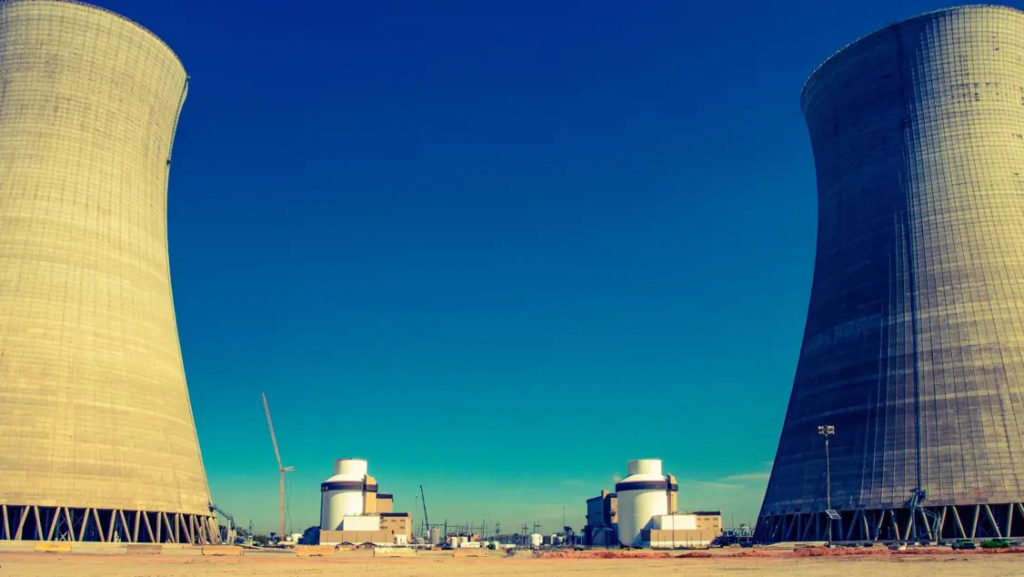
The United States is still the largest producer of nuclear energy in the world – but probably not for long. Decades of political ambivalence have left the domestic nuclear sector in a state of neglect. Far more reactors are aging out than being constructed, and the country’s few attempts at building new nuclear fission reactors have been controversial, expensive, and slow to get off the ground. After Georgia’s Plant Vogtle finally came online years late and billions over budget in 2024, zero new reactors have since come under construction in the United States.
Meanwhile, the circumstances in China are virtually the exact opposite – the nation’s top-down approach leaves no room for political wishy-washiness and funding is no object. In the time that the United States built just one plant – Plant Vogtle – China added a staggering 34 gigawatts of nuclear capacity. Beijing has heavily emphasized the development of new nuclear reactors in its 15th Five Year Plan, and nearly half of all nuclear reactors currently under construction in the world are in China. China is therefore set to overtake the rest of the world in nuclear energy capacity additions in the next five years.
“By a wide margin, China will have the world’s most dynamic and significant nuclear industry through 2035,” Damien Ma, energy lead analyst for Gavekal Technologies, wrote in a recent report, as quoted by the South China Morning Post. “Construction efficiencies mean China can build a new plant in about six years, compared with more than a decade for the latest Vogtle reactors in the US,” Ma went on to say.
Meanwhile, Donald Trump has also made nuclear energy a central part of his energy ambitions and is eager to “produce lasting American dominance in the global nuclear energy market.” But the relative inertia in the United States nuclear sector will make that an extremely difficult goal to achieve. To kickstart the dormant sector, Trump is making a concerted effort to scale back the red tape that slows development in the United States nuclear sector to a snail’s pace when compared to Chinese timelines. But there are, of course, considerable downsides to limiting oversight and regulation in an industry that bears such significant risk to the public if mismanaged.
The United States and China are also in an intense competition when it comes to developing next-gen nuclear technologies like small modular reactors (SMRs), molten salt reactors, and nuclear fusion. These emerging technologies seek to fix some of the biggest issues in the present-day nuclear sector: cost, safety, and the forever-burden of nuclear waste.
SMRs can be produced in factories and assembled on-site, significantly slashing development costs. Molten salt reactors are potential cost-cutters, too, as they are more fuel-efficient than traditional models, and they are much safer. And nuclear fusion represents the holy grail of clean energy – many times more energy efficient than fusion, the process that powers our own sun leaves behind zero radioactive waste, making it a future-facing priority for the world’s two biggest economies. While China and the United States have both made major progress in developing these next-gen technologies, Beijing has a leg up in virtually all of them thanks to the scale of governmental support and streamlined development processes – one of the major upsides of authoritarianism.
The intensification of the competition between China and the United States in nuclear development comes at a time when the artificial intelligence boom is pushing energy demand to new heights and renewing global interest in the nuclear option. Experts predict that energy demand surge driven by hyperscalers is likely to give a major boost to nuclear deployment in the United States, with a potential 60 percent surge. But the same is true in China, and Beijing has streamlined nuclear plant development and approvals within budgets that U.S. developers could only dream of.
By Haley Zaremba for Oilprice.com
DOE launches $17.5B loan program to accelerate nuclear buildout
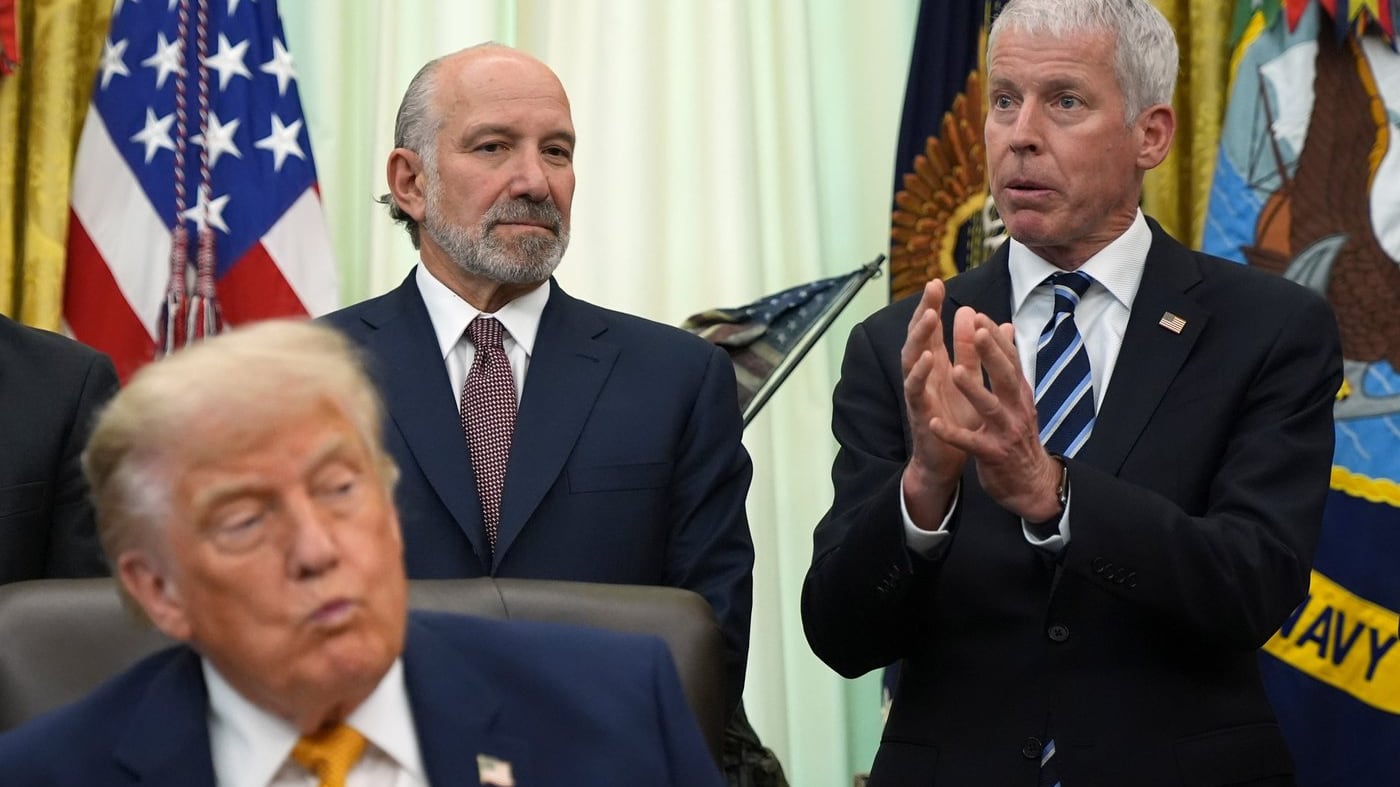
The US Department of Energy (DOE) is planning to provide $17.5 billion in loans to support the nationwide buildout of 10 large-scale commercial nuclear reactors, with the goal of fast-tracking their deployment by up to three years.

The funding — issued by the Office of Energy Dominance Financing (EDF) — is designated to help five eligible projects in their procurement of long-lead-time items needed to build these large nuclear power plants, the DOE said in a statement on Tuesday.
Termed as the American Nuclear Supply Chain Loans, the initiative marks another key step in President Trump’s executive order last year to reinvigorate the US nuclear industrial base.
“Just over one year ago, President Trump directed the Energy Department and its agency partners to unleash the next American nuclear renaissance,” US Energy Secretary Chris Wright said. “To accomplish that mission, these conditional loans will play an important role in reviving the supply chain needed for America to once again build large-scale commercial reactors.”
Procurement for 10 reactors
According to the DOE, the $17.5 billion funding would be allocated towards five energy projects, each supporting two nuclear reactors at its site, for a total of 10 reactors.
Westinghouse, which operates the country’s only licensed large-scale advanced commercial reactors (AP1000), will partner with the selected companies to procure long-lead items at a fixed price and will have joint ownership in each project.
For each project, both Westinghouse and its partner are required to fully commit their project equity of $500 million each ($or 1 billion total per project) upfront prior to accessing DOE loan funds. Purchasing for each project will be staggered based on the timing of equity commitments and other relevant factors.
Westinghouse has signed letters of intent with seven potential partners, each with identified project sites, the Department said.
1.1GW power
According to the Department, each of the AP1000 reactors will generate 1.1 gigawatts of power, with the combined power output from all 10 reactors providing enough electricity to power nearly 10 million American households.
The loan facilities’ bulk equipment purchase order structure creates a strong commitment to restarting the nation’s nuclear industry by providing the necessary financing for rebuilding the American nuclear supply chain, the DOE stated.
In doing so, the loan facilities drive down costs for individual nuclear components, create significant supply chain efficiencies, and shorten timelines for nuclear deployment by up to three years, it added.
Commitment to AP1000
The loan commitment comes eight months after Westinghouse — co-owned by Brookfield Renewable Partners and Canadian uranium producer Cameco — signed an $80 billion deal with the Department of Commerce to build eight AP1000 power plants.
Currently, there are six AP1000 reactors setting operational performance and availability records worldwide with 14 additional reactors under construction and five more under contract, according to the company.
“We are pleased to see the US government make this additional commitment to expanding nuclear power capacity using the proven AP1000 reactor technology,” said Tim Gitzel, CEO of Cameco, in a press release.
“When combined with the May 23, 2025, executive orders and other US government initiatives, we believe the right incentives are being created to advance the rapid deployment of AP1000 reactors in the US.”
Cameco cheers US$17.5-billion conditional loan package for new U.S. reactors
Published:
China Eyes $2 Billion Uzbek Mining Bet as Central Asia Courtship Accelerates
- Kazakhstan has already picked China's National Nuclear Corp. to build two reactors, while Russia's Rosatom builds the country's first, putting Beijing and Moscow to work in the same nuclear sandbox.
- A single Chinese firm wants to sink $2 billion into Uzbekistan's mining sector alone, part of a broader push that also covers energy, infrastructure and tourism.
- Nobel laureate Mo Yan led a Chinese writers' delegation to Kyrgyzstan, a reminder that Beijing's Central Asia strategy runs through culture and soft power, not just minerals and megawatts.
The head of China’s National Energy Administration, Wang Hongzhi, visited Kazakhstan to participate in the inaugural meeting of the Kazakhstan-China Joint Working Group on Cooperation in Civil Nuclear Energy. Participants approved a protocol that defines future cooperation in the nuclear energy sphere, according to a Kazakh government statement, which offered no further details. Kazakhstan has selected China’s National Nuclear Corp. to build two large-scale reactors in the Central Asian nation. Rosatom, Russia’s nuclear agency, has been tapped to build Kazakhstan’s first nuclear plant on the shores of Lake Balkhash.
More from Kazakhstan …
The Chinese electrical appliance manufacturer Midea Group has opened a representative office in Almaty with plans to develop a local operations team and a warehouse complex, as well as build a logistics hub to serve markets throughout Central Asia, reports Forbes.kz. Until recently, Midea operated in Central Asia via a distribution network of third-party local companies.
The China–Kazakhstan Trade and Economic Cooperation Forum took place in Astana. Participating officials announced the opening of the Jiangsu Province Center for Central Asia, which will serve as a unified service hub for Chinese companies, according to Kapital.kz, citing the press service of the Ministry of Trade and Integration. The parties also agreed to diversify Kazakhstani exports, with plans to increase shipments of wheat, meat, and honey to Jiangsu.
Kyrgyzstan
China’s Nerin Engineering Co., Ltd. was selected as the chief contractor to develop production facilities for the Togolok gold deposit, according to the Kumtor Gold Company. The project entails the construction of a gold processing plant, a tailings storage facility, a camp for rotational workers and other essential infrastructure.
The Kyrgyz National Investment Fund and the Chinese company Shenzhen Wuyou Technology Co., Ltd. signed a variety of deals, including one to create a modern electric scooter fleet and another to install a network of charging stations in Kyrgyzstan, according to Open.kg.
China sent a high-profile delegation of writers on a cultural visit to the Kyrgyz capital, Bishkek. Among the Chinese participants were Mo Yan, the only Chinese citizen to be awarded the Nobel Prize in literature, and Zhang Hongsen, the head of the China Writers’ Association (CWA), according to Open.kg. The visit included a meeting with the leadership of Kyrgyzstan’s National Union of Writers (NUW). That meeting yielded a cooperation agreement between the two associations outlining an intent to undertake joint projects, the translation of works and mutual visits by writers.
Tajikistan
Dangara State University, located in Tajikistan’s Khatlon Region, has signed an agreement with the International Foundation for Chinese Language Studies and Shenyang Normal University to establish a Confucius Institute on the Dangara campus, according to a report published by the official Tajik news agency Khovar.
Turkmenistan
The Chinese ambassador to Ashgabat met Turkmen MPs for discussions on organizing Chinese-led seminars for parliamentarians from across Central Asia. The aim of the seminars is to strengthen mutual cooperation on legislative activities.
Uzbekistan
A Chinese company, Zhongjin Guantai Industrial Development Co., Ltd., wants to invest $2 billion in Uzbekistan’s mining sector, $1 billion in cutting-edge energy projects, and $300-500 million in infrastructure and tourism development, reports Dunyo, the Uzbek Foreign Ministry’s official mass media outlet.
Uzbekistan’s state uranium producer, Navoiyuran, and China’s State Nuclear Uranium Resources Development Co., Ltd. agreed to set up a working group to develop joint projects covering geological exploration and mining, including unconventional uranium deposits, reports UZDaily.
Uzbekistan’s Agency for Expansion of Forests and Green Zones and Fighting Desertification signed two agreements with Chinese entities. The first deal involves the PRC’s Ningxia Hui Autonomous Region, experts from which will help their Uzbek counterparts to create protective forest belts and develop sustainable forestry and green industries; the second agreement involves a Chinese company, Yinchuan Wolsenn Modern Irrigation Co., Ltd., which will supply water-saving irrigation technologies to Uzbekistan and organize regular trainings for local specialists.
An MoU to expand production of components of home appliances and to implement joint initiatives for developing "Physical AI" technologies was signed by Uzeltekhsanoat Association and China’s Electronics Enterprises Association.
A roundtable in Tashkent organized by Uzbekistan’s Cabinet of Ministers and Ministry of Agriculture for a visiting delegation comprising representatives of China’s “government entities, financial institutions and leading companies” resulted in signing several agreements focusing on expanding investment in the agricultural sector, reports UZ Daily. Uzbek official did not provide details about the agreements.
Kazakhstan
A market, a state, and a treaty
Inside an interview with the CEO of Kazatomprom, the world’s largest uranium producer.
The first thing you see in the lobby of Kazatomprom’s headquarters in Astana is a price. Not the company’s share price, the number most corporate lobbies display, but the spot price of uranium, glowing on a screen beside the day’s world headlines.
I almost walked past it. It is a subtle detail, yet it tells you the most: a company that hangs its own share price on the wall is keeping score by how the market judges quarterly performance, while Kazatomprom keeps score by the broader market it serves. For the largest uranium producer on Earth, those have quietly become the same number.
That convergence is why the company matters far beyond Central Asia. Kazakhstan mines roughly 40% of the world’s uranium, most of it through Kazatomprom, which makes this state-controlled producer the most important supplier of the fuel behind the nuclear revival that Western utilities and AI data-centre builders are now counting on.
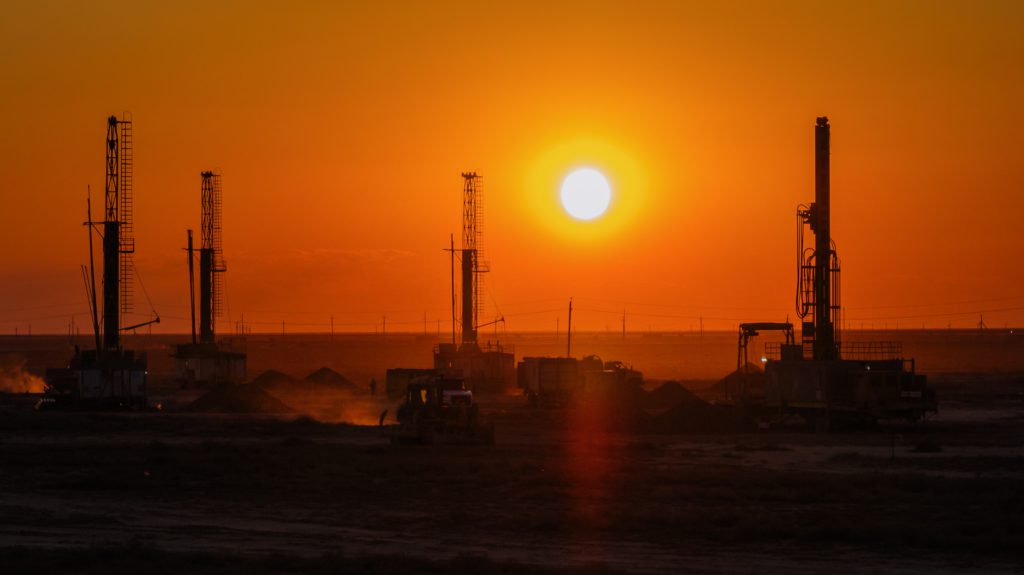
It mines the cheapest way there is, by in-situ recovery, dissolving uranium underground and pumping it to the surface without the cost of a pit or a shaft. When the most important supplier of a suddenly fashionable commodity is also among the lowest-cost, what it chooses not to do matters as much as what it does.
What Kazatomprom chooses, year after year, is restraint. Since its 2018 listing in London and on the Astana International Exchange, it has run what it calls a value-over-volume strategy: it will not flood the market with cheap uranium, even though its costs would let it bury higher-cost rivals if it tried.
It holds supply back and lets the price carry the value. The market has rewarded the discipline, and the London-listed stock has risen roughly sevenfold since the IPO. The restraint is the strategy, and it is posted on the lobby wall.
That discipline is easier to admire than to execute, because Kazatomprom answers to an unusually crowded room. It is three-quarters owned by the Kazakh state, through the sovereign wealth fund Samruk-Kazyna, and roughly one-quarter floated on public exchanges, including London.
So a single company has to satisfy a market, with its disclosure rules and its sometimes impatient shareholders; a state, which owns a controlling interest and uses it as a calling card for the country; and a treaty, the non-proliferation regime that governs every gram of nuclear material it touches.
A market, a state, and a treaty, each pulling in its own direction with its own agenda. That is the pressure the man who runs the company lives under.
The man is Meirzhan Yussupov, who became chief executive in 2023 after rising through the company’s finance side, including a turn as its CFO.
It shows in how he talks. He reaches for payback periods and rates of return the way other executives reach for slogans, and when I asked whether Kazatomprom would build out the parts of the fuel cycle it does not yet control, his first instinct was to explain why a London-listed company cannot make that call regardless of the financial numbers. The conversation was open and easy, which made the one constraint on our meeting all the more telling.
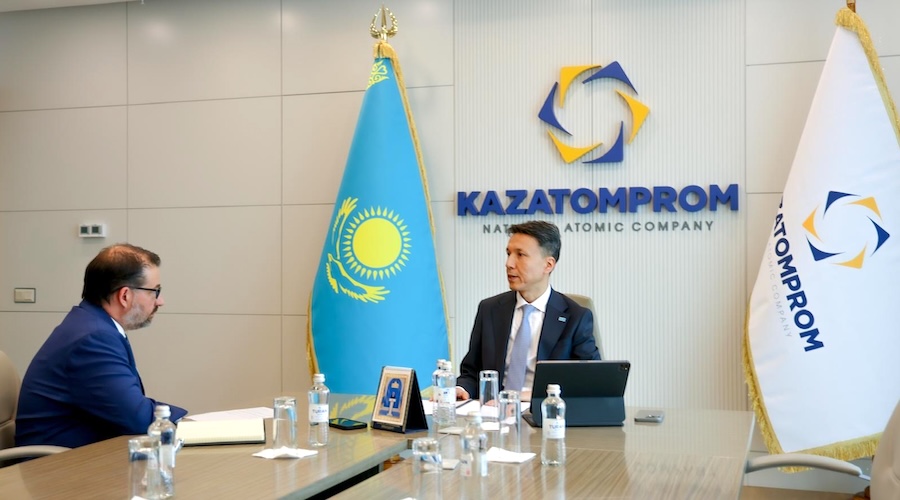
I was met on the ground floor, my credentials checked, and taken to a conference room on the twentieth floor beside Yussupov’s office, where the Kazakh flag and the company flag flank a wall with the company name, which in English translates to “national atomic company.”
Yussupov opened by reminding me that a listed company has to be careful, and 40 minutes later he closed by noting that his investor relations team warns him against saying anything that is not already public. In between, he answered everything I asked.
But first, he turned the tables. Before I could begin, he was the one asking the questions. Was it my first time in Kazakhstan? How did I find it? I told him the truth, that Astana was nothing like I had expected: a clean, fast-rising city of cranes and new light rail that my driver said would have been unrecognizable a decade ago. A big step, he agreed.
The question worth asking across the table from a man whose every sentence has to clear a market, a state, and a treaty, is what he will say plainly, on the record, when you put it to him directly. Here is what he said.
A few exchanges from the conversation appear below, lightly edited and condensed. The full interview runs separately.
MDC: How are you thinking about production discipline versus market share?
Yussupov: We have our “value over volume” strategy, which we adopted many years ago, ever since we went public in 2018. … We don’t want to flood the market with cheap uranium. That’s how we create value for our stakeholders, for future generations, and for our country. … We think there will be enough space for everyone, with this nuclear renaissance and the potential AI demand.
MDC: Does Kazatomprom want to move further downstream in the fuel cycle?
Yussupov: Absolutely. We have this dream of having the whole nuclear fuel cycle within Kazakhstan. … Enrichment is more strategic and more difficult; it’s related to the non-proliferation regime, so only the five permanent Security Council members have access to those technologies. … Because we’re a London-listed company, we can’t enter or invest in a project regardless of the financial numbers. If the payback period, IRR and NPV are good enough, we go. If not, we wait.
MDC: How do you see Kazatomprom’s role in representing Kazakhstan to investors?
Yussupov: We say Kazatomprom can serve as an example of investing in Kazakhstan, in the Kazakh economy, because our share price has increased sevenfold since we went public. It shows we have a stable legislative environment and strong legislation that protects investors’ rights. … We’re not only on the LSE but also on the Astana International Exchange, which is governed by common law, familiar to the Western world. … We see ourselves as an example.
MDC: What does the West most misunderstand about Kazakhstan?
Yussupov: When you’re in the US, Kazakhstan, Pakistan and Afghanistan all sound the same, somewhere in the middle of nowhere. When friends come from the US and other parts of the world, they say, “We didn’t know it’s so big.” It is big. … There aren’t many direct international flights here, because nobody flies over Russia now. We used to fly to Frankfurt in roughly five hours; now it’s eight.
Kazatomprom CEO Meirzhan Yussupov on uranium markets, China and nuclear growth
* This is the complete conversation behind the feature A market, a state, and a treaty.
Meirzhan Yussupov, chief executive of Kazatomprom, the world’s largest uranium producer, sat down with MINING.COM in Astana for a wide-ranging interview on production discipline, AI-driven demand, the nuclear fuel cycle, trade routes, and Kazakhstan’s place in the market. The transcript has been lightly edited and condensed for clarity.
Yussupov: So, is it your first time in Kazakhstan?
MINING.COM: It is.
Yussupov: Oh, really? And how do you find it?
MINING.COM: Completely different than I expected. I’m used to American cities, and this is such a clean city, cranes on every building, new light rail going up. The driver from the airport said ten years ago you wouldn’t recognize any of this.
Yussupov: It’s been a big step.
MINING.COM: How is Kazatomprom thinking about production discipline versus market share in the current price environment?
Yussupov: We have our “value over volume” strategy, which we adopted many years ago, ever since we went public in 2018. We stick to that value over volume strategy, which means we think about market discipline: we don’t want to flood the market with cheap uranium. That’s how we create value for our stakeholders, for the next generations, and for our country. On market share, we are concerned about it, but not that much. We might welcome anyone who wishes to enter the uranium market, but it’s not that easy. We welcome all newcomers, and we think there will be enough space for everyone, with this nuclear renaissance and the potential AI demand, electricity demand, the demand for stable, 24/7 power that is also zero-emission, in large quantities.
MINING.COM: Utilities are re-contracting amid projections of major new demand, including data centers and AI. What is Kazatomprom seeing in customer contracting behavior?
Yussupov: It is changing. A few years ago you’d face a somewhat relaxed attitude from our partners and clients. Now they are more concerned about security of supply. But we have to differentiate by where clients are located. Asia is growing tremendously, China being the largest growing market. India has very ambitious goals, they have this SHANTI Act; they aim to build 100 gigawatts of nuclear power by 2047. In the Middle East, the UAE already has operating reactors at Barakah, built by the Koreans, and Saudi Arabia is also voicing that it will be constructing nuclear. Eastern clients are less price-sensitive, looking decades ahead. Western ones have been in the industry for many years and are a bit more price-sensitive. But overall there’s increasing interest in uranium and a change in contracting behavior.
MINING.COM: Kazakhstan leads the world in uranium production, but most conversion and enrichment capacity is elsewhere. Does Kazatomprom have ambitions to move further downstream in the fuel cycle?
Yussupov: Absolutely. We have this dream of having the whole nuclear fuel cycle within Kazakhstan. We have mining and preliminary processing. We’re missing conversion and enrichment, but we have pellet production, we basically bake pellets like cookies, at our plant in eastern Kazakhstan, and out of pellets we make fuel assemblies that we export to China. Enrichment is more strategic and more difficult, it’s related to the non-proliferation regime, so only the five permanent Security Council members have access to those technologies, because of dual use. For now, of course we want this within our country, but to what extent we’ll be able to get the technology is the question. We still seek options, talking to all our partners, the US, Europe, Russia, China. We strictly stick to the non-proliferation regime and are fully compliant; the question is to what extent others want to share their technology. Conversion is more commercial, less geopolitical. For many years the conversion market wasn’t really there, margins were very thin and payback periods very long, so it didn’t make sense for us. But now we’re exploring it, because we obtained conversion technology from one of our partners, and we’re looking at how we could start a conversion facility here. The decision depends on project fundamentals, metrics and the market, because we’re a London-listed company, we can’t enter or invest in a project regardless of the financial numbers. If the payback period, IRR and NPV are good enough, we go. If not, we wait. And we’ll take the decision in light of our strategy of transforming into a vertically integrated company.
MINING.COM: How is Kazatomprom diversifying its transport and delivery routes, with the Trans-Caspian corridor and the TRIPP corridor in view?
Yussupov: We have a diversified sales portfolio, and like any business that doesn’t want to put all its eggs in one basket, we also have diversified routes. For Eastern clients, China, we deliver to the border; for Russia, we deliver to Russia, no problem. For Western customers, we deliver across Russia to St. Petersburg port, or the other option is the Middle Corridor, the Trans-Caspian route. We’ve been using this route for seven or eight years, and the share of our traffic that goes through the Trans-Caspian depends on customers’ preferences. For example, across 2023, 2024 and 2025, of the production we delivered to Western markets, sometimes it went up to 65%, sometimes 60%, sometimes slightly less than 50% went through the Trans-Caspian. And once TRIPP is operable, we’ll look into those options too.
MINING.COM: Is there a waiver in place for the St. Petersburg route up to 2028, with a window after that where it gets less certain?
Yussupov: I think there’s a misunderstanding. The Russian ban is specifically for Russian uranium produced and enriched in Russia. In our case, we’re just using their territory. I won’t give the name, but some of our Western partners prefer the Middle Corridor over the Russian route, but if needed, they can use the Russian routes; there’s no ban as such.
MINING.COM: So that 2028 deadline is something else?
Yussupov: It’s something else.
MINING.COM: How do you see your customer mix evolving, Eastern versus Western markets, over the next decade?
Yussupov: China, they say every year they bring 8 to 10 reactors into operation. Right now they’re number two globally, with about 62 reactors, and by 2030 they target more than 100. The US has 94 reactors, so China wants to be number one. They’re aiming at 150 by 2035 and potentially 200 by 2040, it’s crazy. So theoretically you’d expect more demand from China. But Kazatomprom has a diversified sales portfolio. Now we try to keep, on average, 50% Asia, 25% Europe, and 25% Americas (North and South, we also sell to Brazil and Argentina, and for the first time in our history, sold to Canada, OPG, Ontario Power Generation; the Canadian market was Cameco’s market, but we sold to them last year). Apart from China, we have Japan restarting, South Korea, India, and Bangladesh, who we expect at some point will come to the market.
MINING.COM: Does production discipline benefit the broader market, not just your shareholders?
Yussupov: Yes, absolutely. We’ve always told our investors, because we are a 25% [publicly] listed company, if there’s big demand, we try to increase production, but we don’t want to flood the market. Compared to last year, we’re growing 10%, and we’ve been growing since 2023, increasing production little by little. But from time to time you see hiccups, Japan, for example; Fukushima was unexpected, like force majeure.
MINING.COM: Nuclear is base-load power, a point that gets lost in the green-energy conversation. If the world is going to decarbonize, is there a way around it?
Yussupov: No, absolutely, we’ve been telling this story since our IPO. If you’re talking about energy transformation, you can’t do it without nuclear. Wind depends on wind; solar depends on the sun. You must have base load for stable operation of the grid, 24/7, readily available, no dependence on weather. And plus, AI growth consumes energy like crazy.
MINING.COM: Officials at the C5+1 spoke about how nimble Kazatomprom was in 2022, adjusting trade and product flows without disruption. Can you talk about that?
Yussupov: In terms of our supply chain, operations is always operations; sometimes unexpected things happen, but we have mitigation measures. They were talking about a shortage of sulfuric acid, but we were able to source it from neighboring countries. That doesn’t mean we’re closing down production. We position Kazatomprom as the reliable supplier of uranium for many years ahead. We tell clients: if you want to be sure to have your pounds of uranium 15 or 20 years from now, come talk to us, don’t talk to traders. A nuclear power facility isn’t something you can just turn off and on; you have to be sure you’re supplied for years ahead. It’s a club, not a closed club, but we know each other.
MINING.COM: Trust is a word I’ve heard a lot.
Yussupov: Trust is very important. We position ourselves as a reliable partner, and we’ve never failed our deliveries. Sometimes hiccups happen, but we’ve overcome those difficulties.
MINING.COM: Kazatomprom says something not just about the company but about the nation; it is the only major publicly traded mining company on an international market out of Central Asia. What is your role in spreading the word about Kazakhstan?
Yussupov: This is actually how we explain it to our government officials. When we talk to investors who buy our shares, we say Kazatomprom can serve as an example of investing in Kazakhstan, in the Kazakh economy, because our share price has increased seven-fold since we went public. It shows we have a stable legislative environment and strong legislation that protects investors’ rights. By the way, we’re not only on the LSE but also on the Astana International Exchange, which is governed by common law, familiar to the Western world. The government is doing a lot to attract investors. We understand our role, we’re also representing our country, so we try to do our best, and to be compliant with all applicable regulations: for listing, for non-proliferation, for the International Atomic Energy Agency. We have a Low Enriched Uranium (LEU) Bank within Kazakhstan, a sign of the international community’s trust toward Kazakhstan, located within our facility at the Ulba Metallurgical Plant. So we see ourselves as an example.
MINING.COM: Is there anything you think the West generally misunderstands about Kazakhstan?
Yussupov: Because of the geographical distance, I think, when you’re in the US, Kazakhstan, Pakistan and Afghanistan all sound the same, somewhere in the middle of nowhere. When friends come from the US and other parts of the world, they say, “We didn’t know it’s so big.” It is big. Our government is heavily investing in tourism, we have beautiful mountains, and the ski season runs from October and November to late March, depending on the weather, a one-hour drive from Almaty to Shymbulak resort. There aren’t many direct international flights here, because nobody flies over Russia now. We used to fly to Frankfurt in roughly five hours; now it’s eight.
* Erik Groves is a contributing analyst for MINING.COM and Corporate Strategy and In-House Counsel at Morgan Companies. He recently attended the 16th International Mining and Metallurgy Congress and Exhibition (AMM) in Astana, Kazakhstan. He will be sharing insights gathered at one of Central Asia’s most important mining events.

No comments:
Post a Comment